Window Replacement ROI by Climate 2026 Tool (Analysis)
Compare window repair, inserts, fullframe replacement, and storm windows using exact NFRC ratings, climate, orientation, air and water leakage, installed scope, modeled energy, comfort, maintenance, incentives, and low/base/high payback.
Direct Answer
Compare window repair, inserts, fullframe replacement, and storm windows using exact NFRC ratings, climate, orientation, air and water leakage, installed scope, modeled energy, comfort, maintenance, incentives, and low/base/high payback.
The Short Answer: The Envelope First Principle
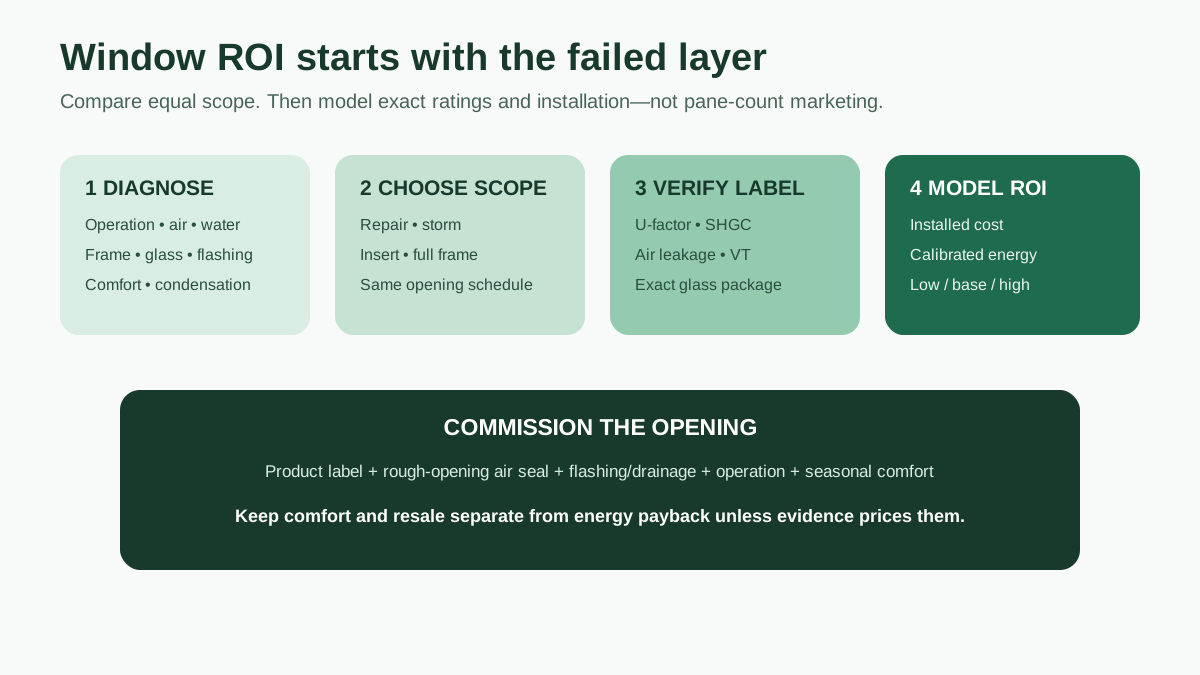
Short answer: Window replacement rarely has one national payback. Compare repair, weatherstripping, interior or exterior storm windows, insert replacement, and full-frame replacement against the same problem. Record each opening's whole-product U-factor, SHGC, air-leakage rating, orientation, size, frame condition, water-management scope, installation price, modeled annual heating and cooling difference, maintenance, and comfort goal. Use low, base, and high cases. Verify any incentive on the decision date; IRS confirms the U.S. section 25C credit ended for property placed in service after December 31, 2025 (IRS).
Before pricing payback, use the high-performance window specification guide to compare the exact whole-product U-factor, SHGC, air leakage, insert/full-frame scope, and rough-opening details. A generic “double pane” quote is not a performance specification.
1. Glazing Physics: Single-Pane vs. Double-Pane vs. Triple-Pane
Windows are often the weakest link in your home's thermal envelope.
A standard insulated wall has an R-value (resistance to heat flow) of R-13 to R-21. A single-pane glass window has an R-value of roughly R-1. It is essentially a thermal hole in your wall.
Upgrading your glazing is about introducing layers of still air or gas to act as insulation.
The Evolution of Glazing:
- Single-Pane: A single sheet of glass. Hot in summer, freezing and drafty in winter, prone to condensation. (R-1)
- Double-Pane: Two sheets of glass separated by a sealed space filled with air or an insulating gas like Argon or Krypton. (R-3 to R-4)
- Triple-Pane: Three sheets of glass with two sealed gas chambers. Highly insulating but heavy and expensive. (R-5 to R-8)
Low-E Coatings (Low-Emissivity)
Low-E is a microscopic, transparent metallic oxide coating applied to the glass. It acts as a selective mirror: in winter, it reflects heat back inside the house; in summer, it reflects solar infrared heat back outside, keeping the home cool. Never buy a window without a Low-E coating in 2026.
To see how these glazing physics and insulation improvements impact your long-term wealth, you can play with the solar panel and investment ROI timelines at CalculatorVillage.
2. Build the Project-Specific ROI Model
Climate affects heating and cooling loads, but it does not determine a universal project cost or savings number. Window area, orientation, shading, existing glass and frame, air leakage, fuel, equipment efficiency, utility prices, installation scope, and occupant settings all change the result. ENERGY STAR's savings estimates are models with stated reference homes and performance baselines, and actual savings vary (methodology).
Use one row per opening or window group
| Input | Existing | Option A | Option B |
|---|---|---|---|
| Opening ID, orientation, area | |||
| Repair, storm, insert, or full-frame | |||
| Whole-product U-factor and SHGC | |||
| Air leakage, VT, condensation resistance | |||
| Installed cost and exclusions | |||
| Modeled annual heating and cooling | |||
| Maintenance and expected repair | |||
| Verified incentive | |||
| Low, base, and high payback |
Track non-energy value separately
Comfort, condensation resistance, easier operation, water management, acoustic performance, and lead-safe replacement can add value. Keep them in separate scored rows rather than turning them into an invented resale percentage.
- HVAC sizing: Do not claim a smaller system until a post-retrofit room-by-room load calculation supports it.
- Resale: Use local comparable sales and appraiser evidence. Do not treat a national project-cost survey as a guaranteed home-value return.
- Sound: Acoustic results depend on glass thickness, laminated layers, air space, frame, seals, vents, wall flanking, and installation—not pane count alone.
3. Double-Pane vs. Triple-Pane: The Payback Wall
In 2026, many window sales representatives are aggressively pushing triple-pane windows as the "green standard" for every home.
But does the math support it?
Compare the exact whole-product U-factor, SHGC, air leakage, size, and installed price. Pane count does not fix the performance value or price premium.
Triple-Pane Payback Formula:
If double-pane windows cost $18,000 and save you $750 a year, and triple-pane windows cost $24,000 and save you $900 a year:
- You are paying an additional $6,000 upfront.
- You are saving an additional $150 a year.
- The payback period for that triple-pane upgrade is 40 years.
That example only shows the arithmetic for those assumed numbers. Triple-pane can be rational for cold-surface comfort, condensation resistance, noise, tight energy targets, or a small verified incremental premium. It can also be poor value. Compare actual quotes and modeled performance.
4. Government Incentives and Tax Credits: The 2026 Stack
An eligible program may lower upfront cost, but eligibility, funding, dates, products, and documentation change. Treat an incentive as zero until the administrator confirms the exact project.
US Federal Credit Status (25C)
- Current status: The old 25C window credit is not a planning incentive for new 2026 placed-in-service projects. IRS guidance limits the credit to qualifying property placed in service before December 31, 2025.
- For 2025 projects: If your eligible windows were installed and ready to use in 2025, review Form 5695 and the IRS instructions with your tax preparer.
- 2026 strategy: Treat state, utility, and whole-home rebate programs as the active incentive layer. For a full explanation, read IRA Energy Tax Credits After 2025.
Canadian Grants and Provincial Rebates
- Provincial utility initiatives provide direct rebates for replacing old windows with Energy Star certified models. Ensure your installer is registered with the provincial program before signing.
5. Window Upgrade Buyer's Guide: Specs to Watch
When evaluating window quotes, do not look at the frame color first. Look at the NFRC (National Fenestration Rating Council) label:
- U-Factor (U-Value): This measures how well the window prevents heat from escaping. The lower the U-factor, the better the window insulates. Look for a U-factor below 0.27 for cold climates.
- Solar Heat Gain Coefficient (SHGC): This measures how much solar heat the window lets inside.
- In cold climates, you want a higher SHGC (around 0.35 to 0.40) on South-facing windows to allow passive solar heating in winter.
- In hot climates, you want a low SHGC (below 0.25) to block the blazing summer sun.
- VT (Visible Transmittance): This measures how much daylight passes through the window. Look for a VT above 0.50 to ensure your rooms remain bright and inviting.
6. Window Staging and Performance Checklist
To ensure your window upgrade project delivers the maximum return, complete this checklist:
- Select double-pane Low-E windows filled with Argon gas (unless you live in an extreme sub-zero zone where triple-pane makes sense).
- Align the Solar Heat Gain Coefficient (SHGC) with your home's orientation (low SHGC for West/East-facing, higher for South-facing in cold zones).
- Hire an installer who uses expanding foam insulation around the window frames during installation to prevent drafts.
- Check local utility, state, and provincial rebates before purchasing.
- If the work was completed in 2025, ask your tax preparer about Form 5695. For new 2026 work, do not assume the old 25C credit applies.
- Verify that your home's air leakage is addressed; otherwise, drafty walls will nullify your new window savings.
Balancing Comfort and Capital
Windows are a significant home investment, but they are also a defining element of your property's comfort and aesthetic appeal. By matching your window specifications to your climate zone and taking advantage of stacked government incentives, you can protect your home's thermal boundaries and enjoy a comfortable, energy-efficient interior for decades to come.
Compare Repair, Storm, Insert, and Full-Frame Scope
The first quote question is not “double or triple pane?” It is “what part of the existing opening is failing?”
| Option | Keeps | Can address | Usually cannot address by itself |
|---|---|---|---|
| Weatherstripping, sash, seal, or hardware repair | most existing window | operation, localized air/water defect | poor whole-product glazing/frame performance |
| Interior or exterior storm window | existing primary window | air layer, surface temperature, some comfort/noise | rotten frame or failed flashing |
| Insert replacement | existing frame/rough-opening integration | sash/frame performance inside retained frame | hidden sill, flashing, or rough-opening defects |
| Full-frame replacement | rough opening only | frame, flashing, air/water transition, size/operation | unrelated wall or roof water source |
Inspect each sill, jamb, head, exterior trim, drainage path, interior staining, operation, glass seal, and rough-opening condition. A full-frame project costs more because it includes more boundary work; an insert can be appropriate when the retained frame and water-management layers are sound.
Do not use a hose spray without a documented procedure. Uncontrolled water testing can drive water into assemblies that normally drain correctly. A window or building-envelope professional can choose a suitable test method.
Read the NFRC Label as a Whole-Product Record
ENERGY STAR explains that NFRC-certified ratings cover the window product, not only center-of-glass performance (label explanation). Record:
- U-factor: heat transfer through the product; lower means less heat transfer under the test basis;
- SHGC: fraction of solar heat transmitted; lower blocks more solar heat;
- air leakage: tested air passage at the stated conditions;
- visible transmittance: daylight transmitted;
- condensation resistance: comparative resistance to condensation where reported.
ENERGY STAR certification currently uses U-factor and SHGC criteria by U.S. climate zone (criteria). It does not certify installation quality, acoustic performance, durability, or freedom from condensation in every indoor/outdoor condition.
Keep the label from every installed unit and match it to the contract opening schedule. Product families can contain different glass packages and ratings.
Model Orientation and Shading
SHGC selection can differ by façade. East and west glass can create morning or late-afternoon cooling peaks; south glass can offer useful winter gain in some cold-climate designs but also needs summer shading; north glass is often dominated by heat loss and diffuse daylight.
Record exterior overhangs, trees, neighboring buildings, screens, interior shades, and planned changes. Do not copy one SHGC to every elevation unless the design supports it. ENERGY STAR notes lower SHGC is important in hot climates and gives orientation-specific context in cold climates (buying guidance).
Calculate Simple Payback Transparently
Use:
Net project cost = installed project cost − verified incentives
Annual net benefit = modeled energy-cost reduction − added annual maintenance or financing cost
Simple payback = net project cost ÷ annual net benefit
If a window needs replacement anyway, compare the incremental cost of the higher-performance option with its incremental benefit. Do not compare a premium upgrade's full price with “do nothing” when a basic replacement is already required.
Run at least three cases:
| Input | Low | Base | High |
|---|---|---|---|
| Installed price | firm quote | firm quote | change-order allowance |
| Annual heating/cooling difference | conservative model | calibrated model | supported upper case |
| Utility escalation | none/current | stated assumption | stress case |
| Maintenance/repair | higher | expected | lower |
| Ownership period | short | likely | long |
Keep comfort and water-management benefits outside the energy payback unless you can price them with defensible evidence.
Commission the Installation
Before removal, photograph labels and existing conditions. During work, document sill pan or drainage detail, flashing integration, rough-opening air seal, insulation, shims/fasteners, and exterior/interior sealant joints. Lead-safe work rules may apply to older painted housing; the contractor must identify the governing requirements.
Before final payment:
- Match each product and glass package to the opening schedule.
- Keep each NFRC and ENERGY STAR label.
- Open, close, lock, and tilt every unit as designed.
- Inspect square, level, reveal, weatherstrip contact, weeps, screens, and sealant.
- Verify drainage and water-control details from photos and approved testing.
- Repeat air-leak, surface-temperature, and condensation observations under suitable weather.
- Update the heating/cooling load calculation before equipment replacement.
- Store warranty, installer, permit, incentive, and maintenance records.
Build a Window-by-Window Scope Before Pricing
Number every opening on the elevation drawing. Do not accept “15 windows” as the full scope because two units of the same rough size can require different glass, operation, access, trim, or water repair.
| Opening | Room/elevation | Existing problem | Proposed scope | NFRC values | Exterior detail | Interior finish | Access/risk |
|---|---|---|---|---|---|---|---|
| W-01 | |||||||
| W-02 | |||||||
| W-03 |
Add tempered or safety-glazing locations, egress requirements, fall protection, accessibility, historic restrictions, security sensors, blinds, screens, and lead-paint controls where they apply. The contract should say who moves furniture and treatments, protects landscaping, repairs plaster or siding, paints, disposes of debris, and handles hidden rot.
A low bid may simply exclude exterior casing, sill repair, permit, lift/scaffold, or interior finish. Normalize those exclusions before comparing energy performance.
Separate Air Leakage from Cold-Glass Downdraft
A person can feel a “draft” beside an airtight window because room air cools against the glass and falls. That is different from outdoor air passing through a failed weatherstrip or rough-opening gap. Use smoke or pressure diagnostics carefully to identify moving air; use surface-temperature measurements to assess cold glazing and frame paths.
This distinction changes the repair:
- failed sash weatherstripping may need adjustment or replacement;
- a rough-opening leak needs interior/exterior boundary work;
- cold glass may improve with a storm window or lower U-factor;
- wall leakage beside the opening will not be fixed by replacing only the sash;
- high indoor humidity can cause condensation even when the window performs as rated.
The window condensation diagnostic helps separate indoor moisture, surface temperature, air leakage, and failed insulated-glass seals.
Price Financing and Timing Honestly
If the project is financed, add fees and interest to the installed cost rather than comparing cash price with annual energy savings. If payment escalates, model the actual schedule. A “same as cash” period still needs a plan for the balance before deferred interest or other contract terms apply.
Coordinate replacement with siding, exterior insulation, air sealing, and HVAC work. Full-frame windows are often easier to flash correctly when cladding is removed. Exterior insulation can change jamb depth, sill projection, and flashing transitions. Finishing windows first without the future wall detail can create expensive rework.
Roof or wall leaks should be repaired before the window order is finalized. Custom units may have limited return rights, and opening dimensions can change after damaged framing is exposed.
Worked Incremental-Premium Example
Suppose the base adequate window package costs $18,400 installed and a lower-U-factor package costs $20,200 with the same scope. The performance premium is $1,800—not $20,200—if replacement is already required.
If a calibrated model estimates $95 per year of additional energy savings from the premium package, simple incremental payback is:
$1,800 ÷ $95/year = 18.9 years
Now stress-test it. At $55 per year, payback is 32.7 years. At $140 per year, it is 12.9 years. Then consider whether the premium also solves a documented cold-surface or condensation goal. These are illustrative inputs, not market averages.
If the existing windows remain serviceable, compare the full replacement cost with repair or storm windows. The “incremental premium” shortcut applies only after establishing that a base replacement is already necessary.
Verify Incentives Without Letting Them Drive the Scope
Save the administrator's current page, eligible-product requirements, application date, funding status, pre-approval rule, invoice requirements, and installation deadline. Match the exact NFRC-rated product, not merely the brand or series.
For U.S. federal planning in 2026, the IRS termination date controls: section 25C does not apply to property placed in service after December 31, 2025 (IRS). State, local, utility, Canadian provincial, and European programs have their own jurisdictions and dates.
Do not upgrade the scope solely to chase a rebate. Compare net installed costs after all required changes and ask whether the higher specification still serves the opening and climate.
Keep a dated decision file with the baseline bills, model inputs, labels, opening schedule, photographs, quotes, and rejected alternatives. If actual use differs after installation, the file shows whether weather, thermostat settings, occupancy, equipment, or the window assumptions changed. Photograph each completed opening before trim conceals the air-sealing and flashing details; the record can support both quality review and later troubleshooting.
Frequently Asked Questions
Do new windows always pay for themselves in energy savings?
No. ENERGY STAR's savings are modeled and actual results vary with climate, existing windows, home, rates, and installation (methodology). Model the exact project and include non-energy goals separately.
Is triple pane always better value?
No. Compare whole-product U-factor, SHGC, air leakage, comfort, condensation, acoustic needs, weight, hardware, installation, and incremental price. Pane count alone is not the decision.
What window ratings should be in the quote?
At minimum, record exact whole-product U-factor and SHGC for each glass package; also capture air leakage, visible transmittance, and condensation resistance where applicable. ENERGY STAR explains these NFRC ratings.
Is the U.S. 25C window credit available for a 2026 installation?
No. IRS says the credit is not allowed for property placed in service after December 31, 2025 (IRS FAQ). Verify state, utility, and local programs separately.
Can storm windows be a lower-cost alternative?
They can be when the primary frame is serviceable and the storm product fits the climate and opening. ENERGY STAR publishes separate storm-window criteria. They do not repair rot or failed flashing.
What to Read Next
Once your windows are updated, make sure your heating system is running at peak efficiency. Read our guide on Cold Climate Heat Pump Performance Data to see how upgrading your home's envelope protects your HVAC from wearing out prematurely.
Also diagnose winter window condensation, compare interior storm windows, and specify the opening with the high-performance window guide.
Sources and Verification
Climate-zone certification, buying guidance, and current criteria use ENERGY STAR windows guidance and key product criteria. Rating definitions use the ENERGY STAR/NFRC label explanation and NFRC. Savings limits use ENERGY STAR's methodology. The U.S. federal-credit date uses the IRS accelerated-termination FAQ. Exact product labels, opening conditions, installation details, climate, utility rates, and current program rules govern.
About the Editorial Team EnergyBS reviews public program rules, product specifications, utility rates, and reader-facing cost assumptions. Treat savings figures as estimates until you verify local prices, permits, rebates, and contractor quotes.
Sources and Verification
- ENERGY STAR: High Performing Windows or Storm Windows
- ENERGY STAR: Windows, Doors, and Skylights Key Product Criteria
- ENERGY STAR: Methodology for Window Savings Estimates
- ENERGY STAR: Independently Tested and Certified Performance
- NFRC: Window Energy Performance Ratings
- IRS: Accelerated Termination of Residential Energy Provisions
Editorial Review
EnergyBS Editorial Team
EnergyBS publishes practical homeowner guides. Important program, product, and cost claims should be checked against the linked source and local project documents before you commit to work.
Related Guides
View All ArticlesHighPerformance Windows (2026 Guide & Data)
Specify replacement windows by wholeproduct NFRC ratings, climate and orientation, comfort, durability, and roughopening installation. Includes a label decoder and quote scorecard.
Winter Window Condensation 2026 Guide & Data
Use condensation location, outdoor temperature, indoor humidity, surface temperature, and room conditions to separate normal coldsnap fogging from failed glass, leaks, and mold risk.
Interior Storm Windows vs. Replacement 2026 Tool
Decide whether an interior storm panel, exterior lowe storm, repair, or full replacement best fits an existing window. Includes fit, condensation, egress, acoustic, and quote checks.