Refrigerator Not Cooling? Protect the Food, Measure the Pattern, and Diagnose Safely
A measurementfirst guide to a warm refrigerator, including food safety, thermometer placement, airflow and door checks, freezerversusfridge patterns, frost evidence, condenser conditions, service documentation, and repair decisions.
Direct Answer
A measurementfirst guide to a warm refrigerator, including food safety, thermometer placement, airflow and door checks, freezerversusfridge patterns, frost evidence, condenser conditions, service documentation, and repair decisions.
Protect the Food Before Troubleshooting the Machine
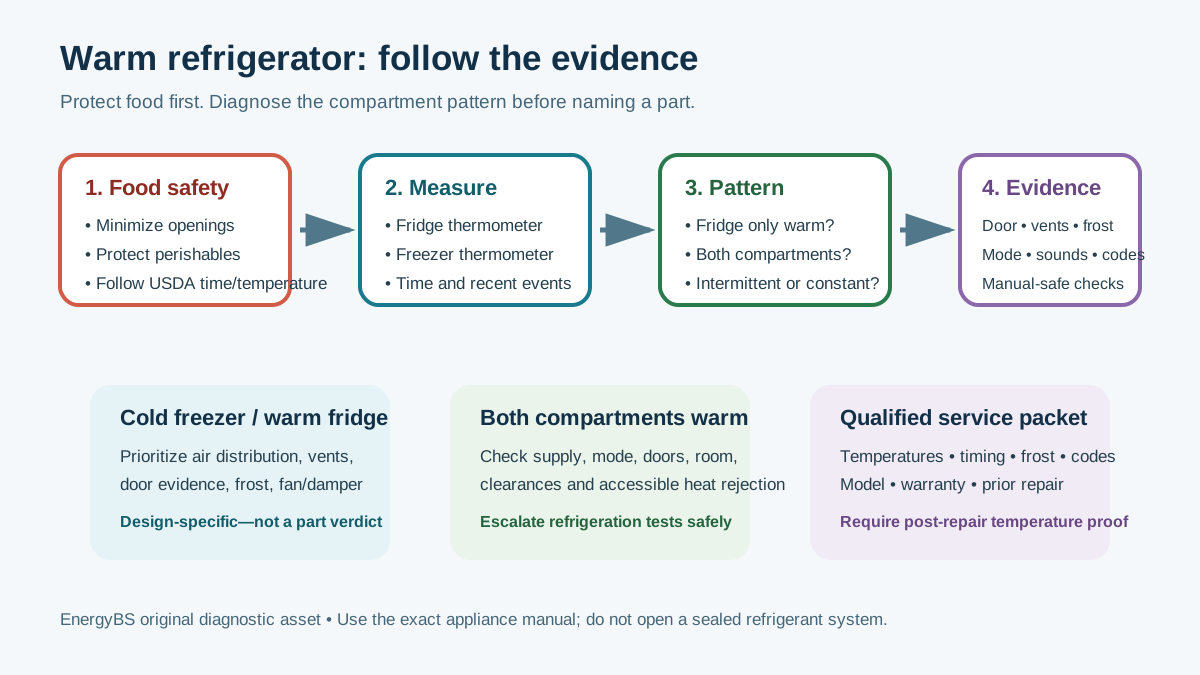
Short answer: Put an appliance thermometer in the refrigerator and another in the freezer, minimize door opening, and protect or discard perishable food according to official food-safety guidance. Then document whether the refrigerator section, freezer, or both are warm. Check power, settings, door closure, blocked internal vents, recent loading, room conditions, and only the maintenance steps allowed by the exact model manual. A cold freezer with a warm fresh-food compartment points to a different path than two warm compartments. Do not dismantle energized equipment or open a sealed refrigerant system; give a qualified technician temperatures, timing, sounds, frost, error codes, and model information.
The U.S. Department of Agriculture says a refrigerator should maintain 40°F (4.4°C) or below and recommends an appliance thermometer rather than judging by touch (USDA refrigeration guidance). The appliance problem and the food-safety decision are related, but they are not the same question. Stabilize the food first.
The First 15 Minutes
1. Stop sampling the temperature with your hand
A shelf can feel cool while food has spent too long above a safe temperature. Place a refrigerator/freezer appliance thermometer where the manual or manufacturer recommends. Record the displayed temperature, thermometer reading, time, and recent events such as an outage, a door left ajar, a large grocery load, a control change, or appliance relocation.
2. Keep doors closed
Repeated checking admits warm humid air and erases useful evidence. USDA emergency guidance says an unopened refrigerator can keep food safely cold for about four hours during a power outage, but that is an emergency planning estimate—not proof that every malfunctioning refrigerator remains safe for four hours. The actual temperature history controls. Review the agency's power-outage food chart when the temperature history is uncertain.
3. Move high-risk food when needed
Use a working refrigerator or an insulated cooler with enough ice or gel packs to hold food at 40°F or below. Label questionable items with the time discovered. Do not taste food to determine safety. Food can be unsafe without looking or smelling spoiled.
4. Capture evidence
Photograph the thermometer, control setting, door position, frost pattern, error code, and model/serial label. Record whether fans or the compressor run, stop, click, or change when a door switch is operated as described in the manual. Do not defeat interlocks or reach into moving parts.
Build the Compartment Pattern
| Measured pattern | What it can suggest | Safe next evidence |
|---|---|---|
| Refrigerator warm, freezer near target | Air distribution, blocked vent, damper/fan, frost restriction, loading, or door issue | Map temperatures, clear product from vents, inspect visible frost and seals |
| Both compartments warm | Power/control, door closure, room/clearance, condenser heat rejection, compressor/sealed-system, or broad airflow problem | Verify supply and settings; inspect accessible conditions under the manual |
| Freezer warm, refrigerator less affected | Recent loading, freezer door/seal, airflow, defrost or refrigeration issue | Measure both compartments over time and inspect visible frost |
| Intermittently warm | Door events, control mode, icing/defrost, unstable power, fan or control fault | Time-stamped temperature log and error history |
| Food freezing in refrigerator | Setting, sensor location, blocked airflow, damper/control, or food position | Map shelf temperatures and compare with manual layout |
This table is a triage map, not a remote diagnosis. Designs differ: top-freezer, bottom-freezer, side-by-side, French-door, single evaporator, dual evaporator, inverter compressor, and convertible compartments do not distribute air the same way.
Verify the Simple Conditions Without Guessing
Power and operating mode
Confirm the interior lights or display do not merely prove full cooling operation. Verify the receptacle and breaker only through normal accessible observation. Check for showroom, demo, vacation, cooling-off, Sabbath, or convertible-zone modes in the exact manual. After a control reset or power restoration, follow the manufacturer's stabilization time rather than repeatedly changing settings.
If the plug, receptacle, cord, or breaker area is hot, scorched, arcing, wet, or damaged, stop and use qualified electrical help. Do not use an extension cord as a refrigerator repair.
Temperature setting
Read the model's control scale. A number may be a temperature on one model and merely a colder/warmer index on another. ENERGY STAR suggests a refrigerator range of 35–38°F for energy-saving operation, while USDA's safety ceiling is 40°F (ENERGY STAR refrigerator tips). Those figures serve different purposes: one is normal operating guidance, the other a food-safety limit.
Door closure and gasket contact
Look for packages, shelves, bins, or a mis-seated drawer preventing closure. Clean the gasket according to the manual. Inspect tears, folds, debris, cabinet alignment, and door sag. Some manufacturer support pages describe a paper-resistance check, but follow the exact model instructions and interpret it as a screening check, not a laboratory leakage test. Samsung's current cooling troubleshooting uses a paper check and separately notes door alignment.
Recent loading and room conditions
A large warm grocery load needs time to cool. Hot food, frequent openings, a very warm garage, direct sun, a nearby range, or insufficient clearances can add load. Conversely, some refrigerators are not designed for very cold garages. Compare ambient limits and installation clearances with the model manual.
Do not pack food tightly against supply or return vents. Whirlpool's model-family guidance lists blocked vents among possible reasons a refrigerator does not cool (Whirlpool not-cooling guide). The exact vent locations vary, so use the cabinet diagram rather than a generic photograph.
Read the Frost and Airflow Evidence
No visible frost is not proof of normal operation
Modern evaporators are often behind panels. A homeowner should not remove a panel unless the manual explicitly makes it a user-service task and the appliance is made safe as instructed. Visible evidence can still help:
- snow or frost on an interior rear wall;
- ice around an air outlet or drawer;
- frost concentrated at a door opening;
- water that later refreezes;
- unusual fan noise that changes with door position;
- a repeating warm/cool cycle.
An even frost pattern on a hidden evaporator, a partial frost pattern, and a solid ice block mean different things to a technician. Do not chip ice with a knife, puncture a liner, or apply a heat gun.
A cold freezer and warm refrigerator often implicate distribution
On many—but not all—designs, cold air is produced in or near the freezer and moved to the fresh-food compartment. Product blocking an inlet or return, ice restriction, a damper issue, or a fan/control problem can therefore produce a cold-freezer/warm-fridge pattern. Dual-evaporator and independent-compartment systems can behave differently.
Use a strip of lightweight tissue near an accessible vent only if the manual allows and it cannot be drawn into a fan. Never insert tools. A technician can check commanded fan operation, sensors, dampers, defrost components, and control outputs with model-specific procedures.
Condenser and Heat-Rejection Checks
A refrigerator moves heat from inside the cabinet to the room. The condenser area must reject that heat. ENERGY STAR recommends allowing circulation behind the unit and keeping accessible condenser coils clean on older models, specifically instructing owners to consult the manual for safe cleaning (ENERGY STAR refrigerators).
Before cleaning anything:
- locate the exact manual;
- determine whether the condenser is owner-accessible;
- follow the required shutdown/unplug procedure;
- protect fragile tubing, wiring, fan blades, and finishes;
- use only allowed tools;
- restore panels and clearances correctly.
Many newer refrigerators use condensers that are not cleaned like an exposed older coil. Do not remove sealed covers or assume a viral cleaning video matches the model.
Warm air at the condenser outlet can be normal evidence that heat is being rejected. A hot cabinet edge can also be normal on designs with anti-condensation loops or heaters. The question is whether temperatures and behavior match the manual—not whether one surface feels warm.
Sounds: Useful Clues, Not Part Numbers
Record sounds with timestamps:
- a single click when operation starts or stops;
- repeated click-hum-stop cycling;
- fan scraping or pulsing;
- gurgling, popping, or flowing sounds;
- long quiet intervals while temperatures rise;
- continuous operation with falling, stable, or rising temperature.
Variable-speed refrigerators may run for long periods at low output. That behavior is not automatically a failing compressor; see the inverter refrigerator compressor guide. Conversely, sound alone does not prove cooling. Pair it with measured temperatures.
What a Technician Should Test
A useful service request is not “the fridge feels warm.” Ask the technician to document findings appropriate to the exact model, such as:
- actual compartment and sensor readings;
- stored fault codes and service-mode data;
- door switches, thermistors, dampers, and fan commands;
- defrost-heater, termination, drain, and control evidence;
- condenser condition and fan operation;
- compressor electrical/command behavior;
- sealed-system pressures or temperature evidence when warranted;
- refrigerant-leak evidence and repair procedure;
- service bulletin, warranty, and parts availability;
- post-repair pull-down and stable-temperature verification.
Sealed refrigeration work requires appropriate tools, handling, and legal compliance. A homeowner should not install piercing valves, release refrigerant, braze tubing, or guess at a refrigerant charge.
Run a Controlled Temperature Map
A single thermometer reading answers “what is the temperature here now,” not “how does the cabinet perform over a cycle.” If food has been protected and the appliance can be monitored safely, build a short map without repeatedly opening the doors.
Use two appliance thermometers or approved logging sensors. Put the refrigerator sensor in the main food zone rather than directly against a cold-air outlet, wall, or door bin. Put the freezer sensor among representative frozen packages without obstructing airflow. Follow the manual if it specifies a test location. Record readings at consistent intervals and note every door opening, grocery load, control change, power interruption, ice-making event, and room-temperature change.
| Time | Refrigerator | Freezer | Compressor/fan observation | Door or load event |
|---|---|---|---|---|
| Start | ||||
| +2 hours | ||||
| +4 hours | ||||
| +8 hours | ||||
| Next morning |
Do not keep unsafe food in place just to complete a test. Do not promise a fixed stabilization period across all models; recent installation, warm loading, defrost, ambient temperature, and product design change pull-down time. The manufacturer manual or support team should state when a post-installation or post-adjustment reading is meaningful.
The shape of the record matters:
- both zones steadily improve: the unit may be recovering from a door/load/power event, but still verify a stable safe result;
- freezer improves while refrigerator stays warm: distribution or fresh-food-zone evidence becomes more important;
- both plateau warm despite long operation: heat rejection, capacity, refrigeration, controls, or measurement conditions require qualified evaluation;
- large repeating swings: match the timing against door events, defrost, control modes, fan behavior, and error history;
- one location freezes while another is warm: sensor location, loading, airflow distribution, damper/control, and cabinet geometry deserve attention.
Compare a built-in display with an independent thermometer
A display may show a setpoint, a rounded sensor value, or a status that is filtered over time. It does not necessarily represent the warmest package or every shelf. Record both without assuming one is “wrong.” A technician can compare service-mode sensor data with calibrated instruments and the model's control logic.
Diagnose the Event That Came Before the Complaint
The prior 24–72 hours can narrow the path more than the current noise. Ask:
- Was the appliance newly delivered, tipped, moved, or unplugged?
- Were doors removed and reinstalled?
- Was a filter, ice maker, fan, control board, or gasket serviced?
- Was the cabinet loaded with warm food?
- Did a breaker trip, lights flicker, or an outage occur?
- Was the control panel cleaned or a mode changed?
- Did a package fall behind a drawer or block a vent?
- Did frost, a water leak, or unusual sound appear first?
- Did room temperature change because of weather or HVAC failure?
Do not infer causation merely because two events are close in time. Instead, give the service provider the sequence. A door removed during flooring work can affect alignment; a power event can reset controls; a water leak can freeze around an air path; a service visit can leave a connector loose. Each is evidence to check, not proof.
Special Cases That Change the Diagnostic Path
Garage or unconditioned-space refrigerator
Verify the model's allowed ambient range. Cold surroundings can interfere with thermostat logic or freezer performance on some designs, while extreme heat raises the load. A “garage ready” label should be confirmed in the exact specification and manual, including its tested temperature range.
Built-in refrigerator
Built-ins depend on specified ventilation paths and can require trained service access. Do not block grilles or pull a heavy built-in cabinet without the installation procedure. Record any recent cabinetry or toe-kick change.
Refrigerator after transport
Follow the manufacturer's orientation, settling, and startup instructions. Do not apply a universal waiting time from an unrelated brand. Delivery damage, pinched connections, door alignment, and incomplete protective-film removal should be documented promptly.
Smart or connected refrigerator
Capture error codes, alerts, firmware/update timing, and network status, but do not assume an app proves mechanical cooling. Preserve screenshots before resetting. A remote temperature notification can be useful evidence; the independent thermometer still protects the food decision.
Second refrigerator on a shared circuit
Verify circuit behavior without using unsafe adapters or extension cords. Intermittent voltage or a tripping protective device needs qualified electrical diagnosis. Do not repeatedly reset a breaker that will not hold.
Commission the Repair Before Reloading Expensive Food
After service, obtain the work order and changed-part numbers. Ask what readings established the diagnosis and what readings now prove the repair. Confirm panels, shelves, drawers, door alignment, water connections, and control settings are restored. Monitor both compartments empty or lightly loaded as the manufacturer directs, then reload gradually while maintaining food safety.
Useful acceptance evidence includes:
- no active or returning error code;
- door seals contact and doors self-close as designed;
- fans operate without rubbing;
- no new frost or water path;
- refrigerator and freezer stabilize within model guidance;
- ice maker/dispenser works without leakage if serviced;
- service documentation states warranty start and coverage.
If a technician says the temperature will improve later, ask for the expected window, measurement location, and escalation threshold in writing. That converts reassurance into a verifiable handoff.
Keep the completed temperature log with the invoice. If the symptom returns, the before-and-after record shows whether the same compartment pattern and operating sequence have actually repeated.
Repair, Replace, or Monitor?
Monitor only when food is protected, the unit returns to verified safe temperature, and a plausible temporary cause has been addressed. Repair is more attractive when the cabinet and doors are sound, diagnosis is specific, parts and warranty are available, and expected remaining life supports the price. Replacement becomes more attractive with repeated sealed-system/control failures, damaged liners or doors, unavailable parts, chronic leakage, very high measured energy use, or a repair quote that does not make economic sense.
Do not replace solely because a generic age chart says so. Use the refrigerator repair-versus-replace worksheet to compare food loss, repair warranty, energy use, delivery, fit, water connection, disposal, and reliability.
Service Call Evidence Sheet
Copy this into a note:
| Field | Record |
|---|---|
| Model and serial | |
| Refrigerator thermometer, time | |
| Freezer thermometer, time | |
| Food-safety action taken | |
| First symptom and recent event | |
| Door/gasket observation | |
| Controls and operating mode | |
| Visible frost or water location | |
| Fan/compressor sound timeline | |
| Error code | |
| Room temperature and clearances | |
| Prior repair and warranty |
This original evidence sheet reduces “no fault found” visits and helps a technician reproduce an intermittent problem.
Frequently Asked Questions
What temperature is unsafe for a refrigerator?
USDA says refrigerators should maintain 40°F or below. Food-specific time and temperature history matters; consult the agency's refrigeration guidance rather than using smell or taste as a safety test.
How long is food safe when the refrigerator stops?
For a power outage, USDA says an unopened refrigerator keeps food safely cold for about four hours and provides item-by-item discard guidance. A mechanical failure may have begun before discovery, so use measured temperature and the official emergency food-safety chart.
Why is the freezer cold but the refrigerator warm?
Blocked vents, loading, door leakage, frost restriction, a damper, fan, sensor, or control issue are possible on systems that share cooling. Designs differ, so compare the pattern with the model manual. Whirlpool includes blocked air vents in its manufacturer troubleshooting.
Should I vacuum the condenser coils?
Only if the exact manual identifies an accessible owner-maintenance procedure. ENERGY STAR recommends clean coils on applicable older models and explicitly directs users to the manual for safe technique (ENERGY STAR guidance).
Does a refrigerator running all the time mean the compressor is failing?
No. Variable-speed operation, recent loading, warm room conditions, door leakage, blocked airflow, dirty accessible heat-rejection surfaces, or a cooling fault can all affect runtime. Measure temperatures and conditions before assigning a part.
Can I melt freezer ice with a heat gun?
Do not use uncontrolled high heat or sharp tools. They can damage plastic, insulation, wiring, and refrigerant tubing. Follow only the defrost procedure in the exact manufacturer manual or request service.
Is 35°F too cold for the refrigerator?
ENERGY STAR lists 35–38°F as normal energy-saving guidance, while USDA requires 40°F or below for safety. Actual shelf temperatures and food freezing matter; verify with an appliance thermometer and the model manual (ENERGY STAR, USDA).
What to Read Next
Learn why long low-speed operation can be normal in the inverter refrigerator compressor guide. If water appears, trace it with the refrigerator leak-source guide. For a priced diagnosis, use the refrigerator repair-versus-replace worksheet, then compare whole-life appliance costs with the high-efficiency appliance guide.
Sources and Verification
Food-safety thresholds and outage actions come from USDA FSIS refrigeration guidance and its emergency chart. Energy and maintenance context comes from ENERGY STAR. The Whirlpool and Samsung pages are manufacturer-specific examples, not universal repair instructions. The exact appliance manual, service literature, warranty, and qualified diagnosis control a particular refrigerator.
Sources and Verification
Editorial Review
EnergyBS Editorial Team
EnergyBS publishes practical homeowner guides. Important program, product, and cost claims should be checked against the linked source and local project documents before you commit to work.
Related Guides
View All ArticlesWhy Your Inverter Refrigerator Runs All The Time (2026 Guide)
If your new refrigerator seems to run constantly, that is often normal invertercompressor behaviour. Here is how to tell efficient operation from a real service problem.
HighEfficiency Appliances: A ModelbyModel LifeCycle Cost Worksheet
Compare appliance purchase, installation, label energy, local utility rates, capacity, service, repair, and residual value with a transparent low/base/high lifecycle worksheet.
Refrigerator Leaking Water? Trace the Source Before Replacing a Part
Trace refrigerator water by location, timing, temperature, and watersupply status to distinguish spills, condensation, defrost drainage, dispenser/filter connections, ice melt, and household plumbing before authorizing repair.