Washer and Dryer Installation Cost 2026: SwapIn Fees, New Hookup Prices, and the Gas vs Electric Decision
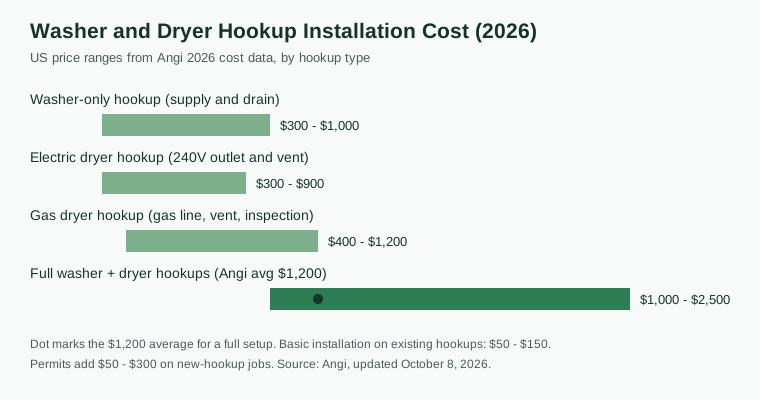
Washer and dryer installation cost in 2026 splits into two completely different jobs. If your home already has hookups, professional installation of a new pair is a small job: Angi puts basic installation with existing hookups at $50 to $150. If you are adding laundry where no hookups exist, professional hookup installation runs $650 to $2,500 with a national average of $1,200 (Angi, 2026): $300 to $900 for an electric dryer hookup, $400 to $1,200 for a gas dryer hookup, and $1,000 to $2,500 for a full washer and dryer setup. Permits add $50 to $300. This guide prices both scopes, compares gas, electric, and heat pump dryers on install and running cost using ENERGY STAR figures, and ends with the checklist that keeps a laundry install from leaking, tripping breakers, or failing inspection.
Quick Checks
- 1Two scopes, two prices: installing a new pair on existing hookups runs $50 to $150 for basic professional installation (Angi). Adding hookups where none exist runs $650 to $2,500, average $1,200 (Angi, 2026). Know which job you are buying before comparing quotes.
- 2Dryer fuel sets the hookup price: an electric dryer hookup runs $300 to $900 (240V outlet plus venting); a gas dryer hookup runs $400 to $1,200 because it adds a gas line and a safety inspection (Angi).
- 3A heat pump dryer skips the vent entirely and uses around 70 percent less energy than a conventional dryer (ENERGY STAR), which makes it the cheapest dryer to run and often the simplest to place in a closet or interior room.
- 4Budget permits on any new-hookup job: $50 to $300, plus $50 to $150 per inspection visit (Angi). Gas and electrical work without a permit is the shortcut that surfaces at resale and at insurance claim time.
- 5The machines are the small part of a new-laundry budget. A full washer and dryer hookup setup at $1,000 to $2,500 (Angi) can rival the price of the pair itself, so get the hookup quote before you fall for a sale on appliances.
Washer and Dryer Installation Cost 2026: Swap-In Fees, New Hookup Prices, and the Gas vs Electric Decision
By EnergyBS Editorial Team | October 21, 2026
The Short Answer
Short Answer: Washer and dryer installation cost in 2026 depends entirely on which of two jobs you are buying. Job one, the swap-in: your laundry spot already has water lines, a drain, power, and a vent, and you are replacing the machines. Basic professional installation on existing hookups runs $50 to $150 (Angi). Job two, new hookups: the room has no laundry connections today. Professional installation of washer and dryer hookups runs $650 to $2,500, with a national average of $1,200 (Angi, updated October 2026). Inside that range, an electric dryer hookup costs $300 to $900 and a gas dryer hookup $400 to $1,200, because the gas job adds a gas line and a safety inspection. Permits add $50 to $300 on top of either scope. Quotes that look wildly different are usually quoting different jobs, so the first step is naming your scope.
The job in six steps:
- Name the scope: swap-in on existing hookups, or new hookups in a room that has none.
- Measure the space, the doorways, and the path in, and leave 6 inches behind the machines for connections.
- Pick the dryer fuel: electric, gas, or a ventless heat pump dryer, because it decides the hookup work.
- Get itemized quotes separating plumbing, electrical or gas, venting, permits, and the machines.
- Install in trade order: plumbing and electrical or gas first, vent second, machines last, then level and test.
- Run a full wash and dry cycle before the installer leaves, and check every connection for leaks and the vent for airflow.
This guide sits in our appliances library alongside the dishwasher installation cost guide, which follows the same two-scope pattern. Here we price both laundry scopes, then compare dryer fuels on the two numbers that matter: what the hookup costs today, and what the dryer costs to run for the next decade.
1. Scope One: Installing on Existing Hookups
If the hookups exist and match the new machines, installation is delivery-grade work: set the machines, connect supply hoses and the drain, connect the dryer cord and vent, level both units, and test. Angi's buying guide puts basic professional installation with existing hookups at $50 to $150. Retailers often bundle this into delivery, sometimes free with the purchase, sometimes as a line item in that same band.
Three things move a swap-in out of the cheap band:
- A cord or fuel mismatch. Dryers ship without cords in many cases, and a home wired for a 3-prong outlet with a 4-prong cord (or the reverse) needs the cord swapped to match. A gas-to-electric or electric-to-gas switch is not a swap-in at all; it is a hookup job from Section 2.
- Old venting. If the existing vent run is crushed, plastic, or far over length, the installer will flag it, and fixing it is vent work, priced in our dryer vent routing guide and typically quoted on the spot.
- Worn supply hoses and valves. Reusing decade-old rubber hoses is the classic false economy of laundry day. New braided hoses and working shut-off valves are small parts; a burst hose on an upper floor is not. Angi prices a water shut-off valve or leak detector add-on at $50 to $400, and a leak detector with automatic shut-off is the version worth having on any floor above the first.
2. Scope Two: Adding Hookups Where None Exist
A new laundry location needs four systems built: hot and cold water supply with shut-offs, a trapped standpipe drain, power (a 240V circuit for a standard electric dryer, or a gas line for a gas dryer), and a dryer vent run to the outside. That is why the range is wide and why two trades are usually involved. Angi's 2026 figures: plumbers charge $45 to $200 per hour, electricians $50 to $130 per hour, and a standard install takes four to eight hours.
| Hookup type (Angi 2026) | Average cost range | What the price covers |
|---|---|---|
| Washer-only hookup | $300 to $1,000 | Supply lines, shut-offs, standpipe drain |
| Electric dryer hookup | $300 to $900 | 240V outlet and circuit, vent run |
| Gas dryer hookup | $400 to $1,200 | Gas line, shut-off, vent run, safety inspection |
| Combo washer-dryer unit | $700 to $1,500 | Plumbing for one all-in-one machine, often ventless |
| Full washer + dryer setup | $1,000 to $2,500 | All plumbing, electrical or gas, and venting |
| Project scenario (Angi 2026) | Average cost range |
|---|---|
| Single washer, plumbing and drain only | $500 to $1,000 |
| Stackable units, compact vertical install | $900 to $2,500 |
| Utility room install, easy utility access | $1,000 to $2,200 |
| Closet install, tight space, custom work | $1,200 to $2,500 |
| Retrofit of an existing finished space | $1,200 to $2,500 |
| New construction, during the build | $650 to $2,000 |
| Multi-unit install, apartments or duplexes | $2,500 to $10,000+ |
Distance is the hidden variable in every row. Hookups placed on the wall behind existing plumbing, near the panel, and under a short vent path land at the bottom of the bands. Every extra foot of water line, drain, circuit, or vent adds labor, and a second-floor or interior location adds the most, which is why closet installs in finished space anchor the top of the table.
When the job is a relocation
Moving laundry from one room to another is the new-hookup job plus a demolition job. Angi's 2026 city cost pages for relocating washer and dryer hookups put the work at two to six hours of labor for the move itself, with the drain line as the single biggest line: installing a new drain line for a relocated washer runs $300 to $1,200 in Angi's Austin and Raleigh data and $300 to $1,800 in its Baltimore data, depending on how far the new spot sits from the existing drain stack. The rest of the relocation bill is the same list as a fresh install (supply lines with cut-off valves at $10 to $50 per line, the dryer circuit or gas line, and the vent run), plus the part homeowners forget to budget: patching the old location. The abandoned drain and supply stubs have to be capped inside the wall, the old vent hole has to be closed and sealed, and the floor and drywall repairs land on the same invoice or on a second one from a handyman. Get the patching named in the quote, because a capped-in-wall stub that was never pressure-tested is tomorrow's slow leak. A relocation that crosses the house, from a basement to a second-floor closet, should be quoted against simply building the Section 2 hookup setup from scratch in the new room and abandoning the old one properly, because that is what the job actually is.
3. The Dryer Decision: Gas, Electric, or Heat Pump
The dryer choice is made once and paid for twice: at hookup, and on every load for the life of the machine.
Electric (resistance) dryer. Hookup $300 to $900 (Angi): a 240V outlet and circuit, plus a vent run. The machines are the cheapest to buy and the simplest to place anywhere power and a vent path exist. Running cost is the highest of the three for the drying itself, partly offset if you choose an ENERGY STAR model, which uses approximately 20 percent less energy than a standard dryer (ENERGY STAR).
Gas dryer. Hookup $400 to $1,200 (Angi): a gas line with its own shut-off, the vent run, and a safety inspection, plus a standard outlet for the drum motor and controls. Gas dryers cost more upfront as appliances too. Whether gas saves money running depends on your local gas and electricity prices; in much of the US gas dries a load for less, but the honest answer is a rate comparison, not a slogan. Have the installer quote the hookup both ways if your laundry wall has gas nearby; the difference is often a few hundred dollars, repaid slowly.
Heat pump dryer. The ventless option. It dries by condensing moisture into a drain or a removable tank instead of blowing hot air outside, so there is no vent run to build, which removes a whole line from the hookup quote and makes interior closets and condos practical. ENERGY STAR puts certified heat pump dryers at around 70 percent less energy than conventional dryers, saving more than $500 in electricity over the product's life. The trade-offs are longer cycle times and a higher machine price. Our heat pump dryer vs vented dryer guide works through that comparison in full.
All-in-one combo units wash and dry in one drum, need only the washer-side plumbing, and skip the vent on heat pump models. Angi prices the combo hookup at $700 to $1,500. ENERGY STAR notes certified combos can save about $130 a year in utility costs against conventional pairs. Capacity is smaller and cycles are longer; for a one or two person household adding laundry to a small space, the math often wins anyway.
4. The Energy Side: What the Pair Costs to Run
Installation is a one-day bill; the pair runs for a decade or more. ENERGY STAR's published figures for certified laundry equipment:
- Certified washers use about 20 percent less energy and about 30 percent less water than standard models, worth about $550 over the washer's lifetime.
- Certified dryers use approximately 20 percent less energy than standard models.
- Certified heat pump dryers use around 70 percent less energy than conventional dryers, worth more than $500 in electricity over the product's life.
Angi estimates the laundry adds $10 to $30 a month in utility bills depending on use and efficiency, which is the range to sanity-check any salesperson's savings claim against. The washer choice also reaches your water heating bill: a washer that uses 30 percent less water heats 30 percent less water, which is part of why the certified pair, not any single machine, is the right unit of comparison.
5. Worked Examples
Example A: the swap-in. Existing hookups, same fuel, vent in good shape. Basic professional installation $50 to $150 (Angi). Add new braided supply hoses and a leak detector from Angi's add-on range of $50 to $400 if the old setup has neither. Realistic total: the low hundreds, and an afternoon.
Example B: the new closet laundry. A hall closet gets a stacked pair. Angi's closet install band is $1,200 to $2,500, permits add $50 to $300, and inspections $50 to $150 a visit. Planning total: $1,200 + $50 = $1,250 at the very bottom, and $2,500 + $300 = $2,800 at the top with one inspection folded in. Choosing a ventless heat pump pair removes the vent run from that scope, which is often the difference between the middle and the top of the band in a tight interior closet, because the vent is the part that has to cross finished rooms.
Example C: repair or replace the hookups. Angi prices hookup repairs at $75 to $900 against full replacement at $650 to $2,500, and its repair-versus-replacement table gives the practical rule: fix leaks and loose connections ($75 to $200) and clean vents ($100 to $200), but replace outdated or code-failing plumbing and electrical rather than patching them, especially past ten years of age.
6. DIY vs Hiring a Pro
Angi puts DIY hookup materials at $300 to $900, plus $50 to $200 for permits and tool rental, against the $650 to $2,500 professional range. The saving is real and so are the limits:
- Water and drain work is within reach of an experienced DIYer, and it is also the work that floods houses when a fitting is wrong. Pressure-test and watch a full cycle before closing any wall.
- The 240V circuit is electrician work in most jurisdictions, and it is permit work almost everywhere.
- The gas line is licensed-fitter work, full stop. A gas dryer hookup includes a safety inspection for a reason (Angi).
- Permits run $50 to $300 with inspections at $50 to $150 per visit (Angi). Unpermitted plumbing and electrical work is the finding that delays closings and complicates insurance claims after a leak or fire.
A sensible split used by many homeowners: hire the trades for the circuit, the gas line, and the permit, and do the demolition, patching, and machine placement yourself.
7. Install Checklist
Confirm each item in writing before work starts:
- Scope named on the quote: swap-in, new hookups, or relocation, with the machines' fuel types stated.
- Measurements confirmed: machine width and depth, doorway and hall clearances, and 6 inches of space behind the machines for connections (Angi).
- Water: new shut-off valves, braided supply hoses, standpipe drain with risk, and a drain pan on any floor above the first.
- Electrical: 240V circuit sized and permitted for an electric dryer, or a standard outlet confirmed for gas or heat pump models.
- Gas: line sized, its own shut-off valve, and the safety inspection scheduled, on gas installs.
- Vent: rigid or semi-rigid metal duct, shortest practical run, exterior termination with a damper, never into an attic or wall cavity. Ventless model confirmed if no vent is being built.
- Permits pulled and inspection visits included in the price, with the permit numbers on the invoice.
- Old machines: haul-away and disposal included or excluded, stated plainly.
- Testing: a full wash cycle and a full dry cycle run before final payment, every connection checked dry afterward.
- Warranty: installer labor warranty in writing, and the manufacturers' paperwork handed over.
Frequently Asked Questions
How much does washer and dryer installation cost with existing hookups?
Basic professional installation runs $50 to $150 when the hookups already exist and match the new machines (Angi). Costs rise if the dryer cord or outlet type mismatches, the vent needs work, or you add a leak detector or new valves.
How much does it cost to add washer and dryer hookups where none exist?
Professional hookup installation runs $650 to $2,500, with a national average of $1,200 (Angi, 2026). A full washer and dryer setup is $1,000 to $2,500; a washer-only hookup is $300 to $1,000. Permits add $50 to $300.
Is a gas or electric dryer cheaper to install?
Electric, on the hookup: $300 to $900 for a 240V outlet and vent run, against $400 to $1,200 for gas, which adds a gas line and a safety inspection (Angi). Running costs reverse in many regions, since gas often dries a load for less than resistance electricity; compare your local rates for the payback.
What about a heat pump dryer?
It skips the vent run entirely, which simplifies the hookup and opens interior locations, and ENERGY STAR puts its energy use at around 70 percent less than a conventional dryer, saving more than $500 in electricity over its life. Cycles run longer and the machine costs more upfront.
Do I need a permit to install washer and dryer hookups?
For new hookups, assume yes: the work is plumbing plus electrical or gas, and Angi puts permits at $50 to $300 with inspections at $50 to $150 per visit. A like-for-like machine swap on existing hookups usually needs no permit. Your building department has the final word.
How long does installation take?
A standard hookup installation takes four to eight hours (Angi), and a swap-in is typically part of the delivery visit. Multi-day jobs are the ones adding long plumbing runs, a new circuit from a distant panel, or wall and floor work in finished space.
Can I install washer and dryer hookups myself?
Parts of it. Angi puts DIY materials at $300 to $900 plus permits and tool rental. Water and drain work suits an experienced DIYer; the 240V circuit and any gas line belong to licensed trades, and the permit and inspection still apply either way.
Does a second-floor laundry cost more?
Usually, yes. Angi notes that second-floor, garage, and other hard-to-reach locations need longer plumbing and electrical runs, which raises the bill, and upper floors add the case for a drain pan and a leak detector with shut-off ($50 to $400 in Angi's add-on table). The protection is cheap next to water damage through a finished ceiling.
How much does it cost to install a stacked washer and dryer?
Angi prices stackable unit hookup installation at $900 to $2,500 in 2026, inside the same band as a closet install, because the two jobs are usually the same job: a compact vertical pair in a tight space. The stacking kit itself is a small manufacturer part, but the quote carries the same plumbing, circuit, and vent work as a side-by-side pair, plus tighter access for every connection. Measure the closet with the door swing included, and confirm the vent path before ordering, because a stacked pair leaves no room to reach connections once the machines are in place. Front-loading machines are required for stacking, and the washer goes on the bottom, always.
How much does it cost to maintain the setup afterward?
Angi budgets annual dryer vent cleaning at $100 to $200, which is also a fire-safety item, and minor hookup repairs at $75 to $350. Checking hoses and connections when you clean the vent keeps the repair bills in that minor band.
The Bottom Line
Name your scope first: $50 to $150 to set a pair on working hookups, $650 to $2,500 (average $1,200) to build the hookups from nothing, permits extra. Then make the dryer decision with both prices in view: electric is cheapest to hook up, gas costs more to connect and often less to run, and a heat pump dryer removes the vent from the project and uses around 70 percent less energy than a conventional dryer. For the vent itself, our dryer vent routing and length guide covers the run limits that decide whether a location works at all; for the machines, the front-load washer odor and cleaning guide covers the maintenance habit that keeps a new washer from becoming a problem; and the high-efficiency appliances guide puts the pair's lifetime costs next to the rest of the appliance fleet.
What to Read Next
Dishwasher Installation Cost 2026: What Installation Really CostsUse this next to compare the cost, incentive, installation, or operating-risk angle before you make a home energy decision.Sources and Verification
- Angi How Much Does It Cost to Install Washer and Dryer Hookups? [2026 Data], updated October 8, 2026 (professional hookup installation $650 to $2,500, national average $1,200; single washer hookup $500 to $1,000; full washer and dryer setup $1,000 to $2,500; stackable units $900 to $2,500; utility room install $1,000 to $2,200; closet install $1,200 to $2,500; multiunit install $2,500 to $10,000 or more; electric dryer hookup $300 to $900 requiring a 240V outlet and venting; gas dryer hookup $400 to $1,200 requiring a gas line, vent, and safety inspection; washeronly hookup $300 to $1,000; combo washerdryer unit $700 to $1,500; retrofit of an existing space $1,200 to $2,500; new construction $650 to $2,000; permits $50 to $300 plus inspections $50 to $150 per visit; plumbers $45 to $200 per hour and electricians $50 to $130 per hour; standard installs take four to eight hours; DIY materials $300 to $900 plus $50 to $200 for permits and tool rental; hookup repairs $75 to $900; addons: utility sink $250 to $600, water shutoff valve or leak detector $50 to $400, cabinetry $150 to $1,000; annual dryer vent cleaning $100 to $200)
- Angi How to Choose a Washer and Dryer: 11 Things to Consider, updated July 10, 2026 (expect to pay $50 to $150 for basic washer and dryer installation with existing hookups, or $500 to $2,000 when new water and venting connections are needed; measure the space and include 6 inches behind each machine for hookups)
- Angi Cost to Move Washer and Dryer Hookups, city cost pages [2026 Data] (relocating hookups typically takes two to six hours of labor; installing a new drain line when relocating a washer runs $300 to $1,200 in the Austin and Raleigh pages and $300 to $1,800 in the Baltimore page; washing machine cutoff valves $10 to $50 per line; the main cost factors in a relocation are drain lines, electrical circuits, dryer vents, and drywall repairs)
- ENERGY STAR (US EPA and US DOE) Laundry (clothes washers that have earned the ENERGY STAR use about 20 percent less energy and about 30 percent less water than standard models; clothes dryers that have earned the ENERGY STAR use approximately 20 percent less energy; about $550 saved over the lifetime of an ENERGY STAR certified clothes washer; ENERGY STAR certified heat pump dryers use around 70 percent less energy than conventional clothes dryers, saving more than $500 in electricity costs over the life of the product; allinone combo units pair a certified washer and heat pump dryer and can save about $130 in annual utility costs)
Editorial Review
EnergyBS Editorial Team
EnergyBS publishes practical homeowner guides. Important program, product, and cost claims should be checked against the linked source and local project documents before you commit to work.
Related Guides
View All ArticlesDishwasher Installation Cost 2026: What Installation Really Costs
Installing a dishwasher costs $1,200 on average in Angi's 2026 data, with a typical range of $1,000 to $1,500 including the appliance. HomeGuide puts a standard replacement at $600 to $1,700 allin, with labor alone at $200 to $500 when the new unit goes into the same opening on existing hookups. The appliance is the largest line on the bill: a new unit runs $400 to $1,200 for most models and up to $3,000 for highend machines. Labor stays in the low hundreds until the job stops being a swap a firsttime install with new plumbing, a new circuit at $250 to $900, or cabinet work is what pushes a fourfigure quote toward $2,500. This guide reconciles the two national datasets line by line, prices each addon separately, works through the energy and water difference a certified model makes, and closes with Canadian pricing from HomeStars.
Dryer Vent Routing and Length 2026 Tool (Guide & Data)
A modelspecific homeowner worksheet for dryer exhaust route length, elbows, materials, transition duct, exterior termination, cleaning access, penetrations, makeup air, contractor scope, and postinstallation verification.
Heat Pump Dryer vs Vented Dryer 2026 Tool (Guide & Data)
A householdspecific comparison of heatpump, vented electric, and gas dryers using model energy data, laundry volume, utility rates, cycle time, drainage, room conditions, vent cost, maintenance, and clothing care.