Dishwasher Installation Cost 2026: What Installation Really Costs
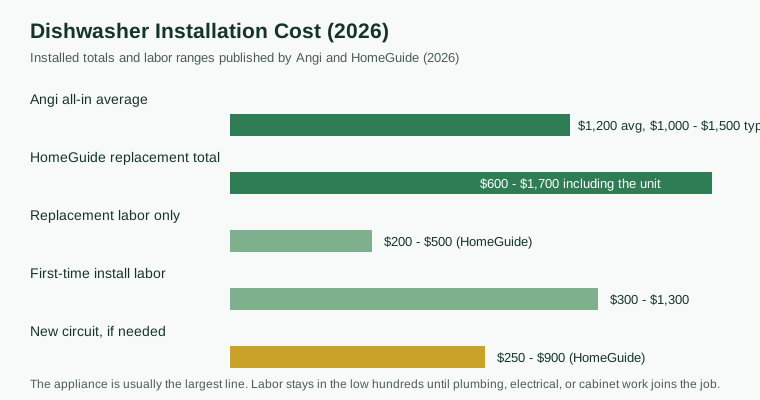
Installing a dishwasher costs $1,200 on average in Angi's 2026 data, with a typical range of $1,000 to $1,500 including the appliance. HomeGuide puts a standard replacement at $600 to $1,700 allin, with labor alone at $200 to $500 when the new unit goes into the same opening on existing hookups. The appliance is the largest line on the bill: a new unit runs $400 to $1,200 for most models and up to $3,000 for highend machines. Labor stays in the low hundreds until the job stops being a swap a firsttime install with new plumbing, a new circuit at $250 to $900, or cabinet work is what pushes a fourfigure quote toward $2,500. This guide reconciles the two national datasets line by line, prices each addon separately, works through the energy and water difference a certified model makes, and closes with Canadian pricing from HomeStars.
Quick Checks
- 1Budget $1,200 all-in for a standard replacement (Angi 2026 average, typical range $1,000 to $1,500). HomeGuide's replacement total runs $600 to $1,700 including the unit, because it spans cheaper units and lower labor markets.
- 2Labor alone is the small line on a swap: $200 to $500 to replace a dishwasher in the same location (HomeGuide), or $150 to $350 in HomeGuide's replacement breakdown. If a swap quote shows $800 of labor, the quote is pricing something else - ask what.
- 3The appliance sets the total. Most units run $400 to $1,200 and high-end models reach $3,000 (HomeGuide), so two quotes $600 apart are usually two different dishwashers, not two different installers.
- 4A first-time install is a different job: $300 to $1,300 for labor before the unit (HomeGuide), plus a new circuit at $250 to $900, cabinet removal at $150 to $400, and rough-in plumbing at $400 to $600 minimum where those lines apply.
- 5On the running-cost side, an ENERGY STAR certified dishwasher uses 12 percent less energy and 30 percent less water on average than a standard model (BC Hydro). Certified models in the ENERGY STAR Product Finder use about 2.9 to 3.2 gallons per cycle against a 5.0-gallon federal standard.
Dishwasher Installation Cost 2026: What Installation Really Costs
By EnergyBS Editorial Team | October 18, 2026
The Short Answer
Short Answer: A professionally installed dishwasher costs $1,200 on average in Angi's 2026 data, with a typical range of $1,000 to $1,500 including the appliance. HomeGuide prices the same standard replacement at $600 to $1,700 all-in, and splits it out: the unit is $400 to $1,200, installation labor is $150 to $350, and removing the old machine is $50 to $150. Labor alone to replace a dishwasher in the same location runs $200 to $500 (HomeGuide). Installing a dishwasher where none existed before is a larger job: $300 to $1,300 for labor before the appliance, and $1,200 to $2,500 as an installed type in Angi's table.
The two datasets do not disagree once you read what each one counts. Angi's $1,200 average describes the whole purchase for a typical household, appliance included, and its second guide puts the purchase itself at a $1,300 average across a $400 to $4,000 span. HomeGuide's band runs lower at the bottom because it includes basic units and installer labor at the low end of its installer table. Both agree on the shape of the job: the dishwasher is most of the money, the swap labor is a few hundred dollars, and the total only climbs past $2,000 when the kitchen itself needs work - new plumbing, a new circuit, or cabinet changes - or when the appliance is a drawer or panel-ready model.
1. Three Jobs Hide Inside One Search
"Dishwasher installation cost" returns one set of numbers for three different jobs, and most quote confusion comes from mixing them up.
The swap. The old dishwasher comes out of a standard 24-inch opening, the new one goes into the same opening, and the water supply, drain, and power connections are reused. This is the job behind HomeGuide's $200 to $500 replacement labor and its $600 to $1,700 total. It takes 1 to 2 hours (HomeGuide). Most replacements are swaps.
The first-time install. The kitchen has never had a dishwasher. A cabinet comes out, a water line and drain connection get created, and power has to arrive at an opening that currently has none. HomeGuide puts the labor at $300 to $1,300 and the install time at up to 6 hours; Angi lists "new installation" at $1,200 to $2,500 as an installed type. Section 4 prices each piece of this job separately, because the pieces, not the dishwasher, decide the total.
The format change. Drawer, panel-ready, oversized, and compact models all install into kitchens built for something else. Angi prices drawer installs at $1,300 to $2,200, panel-ready at $1,000 to $2,000, and oversized at $1,200 to $2,000. The labor premium here is fitting and finishing work: aligning a custom panel, modifying an opening, or plumbing two drawers. A format change quoted at swap prices is a quote that has not looked at the kitchen yet.
Before comparing any two quotes, name which of the three jobs you are buying. A $450 quote and a $1,900 quote can both be fair prices, for different jobs in the same kitchen.
2. Cost by Size and Type
Angi publishes the installed market by size and by type. Read together, the two tables show that width is a weak price driver and type is a strong one.
| Dishwasher size | Installed cost range (Angi) | Notes |
|---|---|---|
| Standard (24-inch) | $600 to $1,000 | Fits most kitchens; the common option |
| Compact (18-inch) | $500 to $900 | For tight spaces; sometimes needs specialty connections |
| Oversized | $1,200 to $2,000 | Commercial or custom units |
| Double drawer | $1,300 to $2,200 | Two drawers, higher complexity |
| Portable / countertop | $400 to $800 | Freestanding, minimal modifications |
| Installation type | Installed cost range (Angi) | What drives it |
|---|---|---|
| Built-in | $600 to $1,000 | Standard under-counter install on existing hookups |
| Portable | $400 to $800 | Connects at the sink faucet; no major modifications |
| Countertop | $350 to $700 | Sits on the counter; smallest capacity |
| Panel-ready | $1,000 to $2,000 | Custom front panel to match cabinetry; cabinet modifications |
| Drawer | $1,300 to $2,200 | Single or double drawers; custom fit |
| New installation | $1,200 to $2,500 | Adding a dishwasher where none existed; plumbing and electrical work |
Two readings. First, the standard 24-inch built-in is the reference job, and its $600 to $1,000 Angi band sits below Angi's own $1,200 all-in average, because that average is pulled up by the pricier types in the second table and by higher-priced units. Second, portable and countertop models are the only types that change the labor story in the homeowner's favor, because they skip the under-counter plumbing work almost entirely. Every other upgrade in type is paid for twice: once in the unit price, once in the fitting labor.
HomeGuide's unit-price tiers explain the unit side of that pattern. A basic entry-level dishwasher runs $400 to $800, a popular mid-range model $800 to $1,200, and a high-end model $1,200 to $3,000, for common 24-inch built-ins. The features that move a unit up a tier are the stainless tub, the third rack, quieter operation, and sanitize and smart functions, not cleaning power in any simple sense. Section 6 covers which of those tiers makes sense on energy and water use.
3. The Cost Stack: Where the Money Goes
For the standard replacement, a 24-inch built-in going into an existing opening on existing connections, HomeGuide publishes the full stack:
| Cost line | Published range | Source |
|---|---|---|
| New dishwasher unit | $400 to $1,200 (high-end to $3,000) | HomeGuide |
| Installation labor (replacement breakdown) | $150 to $350 | HomeGuide |
| Labor to replace in the same location | $200 to $500 | HomeGuide |
| Removing and disposing of the old unit | $50 to $150 | HomeGuide |
| Total cost to replace | $600 to $1,700 | HomeGuide |
| Angi all-in average (typical $1,000 to $1,500) | $1,200 | Angi |
| Angi installation-only band (dishwasher cost guide) | $100 to $450 | Angi |
| Old-unit removal (Angi dishwasher cost guide) | about $150 | Angi |
| Haul-away and disposal (Angi installation guide) | $20 to $100 | Angi |
| Permits | $50 to $250 (Angi); $25 to $100 (HomeGuide) | Both |
The labor figures look inconsistent until you notice they describe different scopes. HomeGuide's $150 to $350 is the installer's labor inside a replacement total that already counts removal separately. Its $200 to $500 is the labor-only price a homeowner pays when hiring the replacement on its own. Angi's $100 to $450 installation band in its dishwasher cost guide covers the same ground from the purchase side. All three bands overlap in the $200 to $350 zone, which is where a straightforward swap in an average-cost market should land.
Removal is the line most often double-counted or quietly dropped. HomeGuide allows $50 to $150, Angi's installation guide puts haul-away at $20 to $100, and its cost guide tells readers to budget about $150 for removal. Some installers include removal in the labor fee; some retailers charge it as a separate delivery-day line. The question to settle before delivery day is which party takes the old machine, and whether that is in the number you were quoted. A dishwasher left on the curb is a disposal problem in many municipalities, and a separate junk-removal call runs $70 to $100 on HomeGuide's figures.
Permits are the smallest line and the most variable. Both sources agree a like-for-like swap often needs none, and that permits enter the picture when new plumbing or electrical work is part of the job. The dollar figures are minor either way. The permit's real value is the inspection that comes with the electrical work in section 4.
One cost neither dataset puts in the headline: delivery. Angi's cost guide flags delivery as an extra on top of the $400 to $4,000 purchase span, and HomeGuide lists delivery fees and stair charges among its cost factors. A second-floor kitchen or a rural delivery address can add a line that no national table predicts. Get it named in the quote.
4. The Add-On Stack: What Turns a Swap Into a Project
Every item below is published pricing for a defined piece of work. A first-time install needs some of them; a swap needs almost none. This is the section to read against any quote that comes in well above the section 3 stack.
| Add-on | Published range | Source |
|---|---|---|
| New electrical circuit | $250 to $900 | HomeGuide |
| New electrical outlet | $150 to $350 | HomeGuide |
| Dishwasher plumbing (supply and drain connection) | $150 to $250 | HomeGuide |
| Rough-in plumbing, new connections and drain | $400 to $600 minimum | HomeGuide |
| Cabinet removal for a first-time opening | $150 to $400 | HomeGuide |
| First-time installation labor (total) | $300 to $1,300 | HomeGuide |
| Garbage disposal installed alongside | $250 to $650 | HomeGuide |
Electrical. A dishwasher needs its own power connection at the opening. A kitchen wired for a dishwasher already has it; a kitchen that never had one may need an outlet at $150 to $350 or a full new circuit at $250 to $900, priced by distance to the panel and access. This is licensed-electrician work, and it is also the line where our panel upgrade cost guide becomes relevant reading: a panel with no spare capacity turns a $250 to $900 circuit into a larger conversation. Most kitchens are not in that position, but the quote should say so explicitly rather than discovering it mid-install.
Plumbing. The supply-and-drain connection itself is $150 to $250 when the sink plumbing is adjacent and sound, which it usually is, because the dishwasher lives next to the sink by design. Rough-in work at $400 to $600 minimum is the version where new connections and a drain have to be created. Old plumbing sometimes needs repair during installation (HomeGuide lists plumbing repairs among its cost factors), and corroded shutoff valves are the common finding. A valve that will not close is a small part and a real delay if it is discovered after the old unit is out.
Cabinet work. A first-time install starts by removing a base cabinet, at $150 to $400, and the opening has to finish at a standard width with the floor and counter supported correctly. Countertop and cabinet modifications on custom work run to hundreds more (Angi). This is the piece DIY quotes most often omit, in section 7.
The disposal question. Dishwashers commonly drain through a garbage disposal, and HomeGuide prices a disposal install at $250 to $650 alongside. Bundling the two jobs shares the under-sink labor. It is worth doing only if the disposal is actually due; a working disposal is not an installation requirement, and a quote that treats it as one should explain why.
Add the pieces a true first-time install can need - $300 to $1,300 labor, a circuit, plumbing, cabinet removal - and Angi's $1,200 to $2,500 new-installation band stops looking padded. It is the arithmetic of four trades visiting one cabinet opening.
5. Who Installs It, and What the Labor Should Look Like
HomeGuide publishes labor by installer type, and the table explains most of the spread in swap quotes:
| Installer | Labor cost (HomeGuide) |
|---|---|
| Handyman | $120 to $250 |
| Home Depot installation | $130 to $220 |
| Plumber | $150 to $350 |
| Lowe's installation | $200 to $230 |
| Best Buy installation | $200 to $215 |
| Basic appliance installation labor, general | $150 to $350 |
Hourly framing, for quotes that bill by time: plumbers run $45 to $150 per hour and handymen $50 to $80 per hour (HomeGuide); Angi puts plumbers and electricians at $75 to $150 per hour, with flat-rate pricing common for standard installs. At 1 to 2 hours for a swap (HomeGuide), hourly billing and flat-rate billing converge on the same few hundred dollars, which matches the section 3 bands.
Who should do which job follows from the work involved, not from the table order. A retailer install crew or an appliance technician is the standard choice for a swap: the job is disconnect, connect, level, secure, and test, and retailer pricing at $130 to $230 reflects that routine. A plumber earns the premium when the supply, drain, or valves need work, or when the old install was improvised. An electrician is a separate visit only when the circuit or outlet work in section 4 is in play. A handyman at the low end of the table is a reasonable swap installer in many places, with two checks: local rules on who may do plumbing and electrical connections vary, and the manufacturer's warranty terms are easier to defend with a licensed installer behind the work.
However the labor is billed, the finished job has a short verification list, and it belongs in the agreement before work starts: water on and a full test cycle run, no leaks at the supply connection, the drain hose secured with its high loop or air gap in place, the unit level and anchored so it does not tip when the door opens with a loaded lower rack, and the old unit's removal settled. Most installation failures are leak failures, and most leaks show up in the first cycles. An installer who runs the machine before leaving has done the cheap half of leak prevention. Our standing-water and drain guide shows the drain path those checks protect, and it is the first read if a new install drains slowly or smells in its first weeks.
6. The Energy and Water Side of the Purchase
This site covers dishwasher installation because the replacement decision is also an energy and water decision, and the numbers here are better than the folklore suggests.
BC Hydro states the certified-model advantage plainly: an ENERGY STAR certified dishwasher uses 12 percent less energy and 30 percent less water on average than a standard model, and units carrying the Most Efficient designation save more. The water figures behind that percentage are visible in the ENERGY STAR Product Finder. The US federal standard for a standard-size dishwasher is 5.0 gallons per cycle; certified models listed in the finder sit at roughly 2.9 to 3.2 gallons per cycle, with the LG example in our citations at 2.9 gallons, 42 percent better than the federal standard on water. ENERGY STAR's own buying guidance (cited above) is the place to check a specific model's certified figures before purchase, because model-level numbers, not category averages, are what your utility bills will follow.
What that gap is worth depends on how much hot water your household runs, and hot water is the point: most of a dishwasher's energy goes to heating water, so gallons saved are also kilowatt-hours saved at the water heater. The worked arithmetic, as a hypothetical example with every assumption stated: take a household running 200 loads a year, and compare a dishwasher at the 5.0-gallon federal ceiling with a certified model at 3.2 gallons. The difference is 1.8 gallons per load, or 360 gallons a year. Price water, sewer, and the energy to heat it at any combined figure you like; at an assumed $0.04 per gallon all-in, that is about $14 a year, and at $0.06 it is about $22. Those assumed prices are illustrations, not published rates.
Read that result the right way. The certified premium, where one exists at the same feature tier, is recovered slowly from water and energy alone, and the gap between an old machine and any current model is usually larger than the gap between a standard and a certified current model, because the federal ceiling itself has pulled the whole market down. Efficiency is a tiebreaker between two models you already like, and a genuine secondary benefit of a replacement you are making anyway. It is rarely a reason to replace a working mid-life dishwasher on its own, which is the same position our dishwasher repair-versus-replace worksheet takes with the full ledger. Two habits matter as much as the label: run full loads, because a dishwasher uses about the same energy and water regardless of how full it is (BC Hydro), and see our high-efficiency appliance guide for how to compare lifetime cost across appliance classes once the install quotes are in.
One related check costs nothing. A dishwasher that stops drying properly or leaves standing water is often a drain, filter, or loading problem before it is a dying appliance. Work through the drying diagnostic guide before pricing a replacement for either symptom; both guides exist so a $0 fix is not mistaken for a $1,200 purchase.
7. Repair or Replace, in Installation Numbers
Because this guide has the replacement totals assembled, the repair comparison can be short. HomeGuide puts dishwasher repair at $100 to $300 on average, and Angi's repair table runs from $100 to $200 for a minor leak or part replacement to $300 to $600 for a major motor or pump failure. Set against the section 3 replacement total of $600 to $1,700, the arithmetic behind Angi's 50 percent rule is easy to see: once a repair quote passes half the cost of the replacement you would actually buy, the money is usually better spent on the new machine and its warranty.
Age is the second input. HomeGuide gives a dishwasher lifespan of 8 to 15 years, and Angi advises that a machine over eight years old that breaks down frequently is a replacement candidate even when individual repairs look cheap. A $250 repair on a twelve-year-old dishwasher buys time on a machine inside its final years, with the next failure unpriced. The same $250 on a five-year-old machine with a diagnosed single fault is a different purchase entirely.
The full decision, including the energy ledger, leak risk, parts availability, and the cases that should stop use immediately, is the repair-versus-replace worksheet. Use this guide for the installed-price side of that comparison, and the worksheet for the decision itself.
8. DIY Versus Hiring a Pro
Angi prices the DIY route at $100 to $300 for tools, materials, and disposal, not counting your time, against the $150 to $350 installer labor in section 5. The saving on a swap is real but narrow, roughly the labor band minus the parts and disposal you now handle yourself, and it shrinks further if the job needs a supply line, a drain fitting, or a cord kit you do not own.
The dividing line both sources draw is the same. HomeGuide: a same-size, same-type replacement on existing connections is a job a capable homeowner can do; new connections or upgraded utilities call for a licensed contractor. Angi makes the same split and adds the warranty point: professional installation protects warranty coverage, and complex jobs are where that protection matters.
What DIY actually involves, in HomeGuide's sequence: shut off water and power, disconnect and remove the old unit, connect the water supply and electric lines on the new unit, slide it into place, turn the water on and check for leaks, then level and secure it. The two steps that punish improvisation are the drain connection, where the high loop or air gap prevents sink water from backflowing into the machine, and the leak check, which needs a full cycle run and a dry inspection under the unit, not a glance at the fittings. A slow leak under a dishwasher damages the floor and the cabinet base for weeks before it shows, which is the failure mode that turns a $250 saving into a flooring bill. If any part of the job touches a new circuit, new plumbing, or the panel, it stops being a DIY question in most jurisdictions; section 4 prices those pieces as the licensed work they are.
9. Canada: HomeStars Pricing
Canadian figures for this job come from HomeStars' appliance replacement cost guide, and they describe the same job at the same shape as the US data. HomeStars puts the total cost to replace a dishwasher at $600 to $1,700, broken into a new unit at $400 to $1,200 (high-end models up to $3,000), installation labour at $150 to $350, and disposal of the old unit at $50 to $150. HomeStars adds the same two qualifiers as the US sources: installation complexity moves the total, and optional warranties add to it.
Read the Canadian band as a planning range in the guide's published dollars, and expect the usual regional spread inside it: higher labour markets price toward the top, and a first-time install or a format change leaves the band entirely, for the same reasons as in sections 1 and 4. The Canadian-specific checks on the quote are the certification and the label: the model should carry the EnerGuide label Canada requires on major appliances, with its annual kilowatt-hour figure printed for comparison, and an ENERGY STAR certified model carries the same finder-verifiable water and energy figures used in section 6. Get removal and disposal named in the quote, as in the US; municipal rules for appliance disposal vary, and the $50 to $150 line is cheaper than arranging it after delivery day.
10. A Worked Example: Two Kitchens, Priced From the Published Lines
These are hypothetical examples assembled only from the ranges above, to show how the budgets build. Change every line to your own quotes before using either total.
Kitchen A: the standard swap. A mid-range 24-inch built-in replaces a worn-out unit in the same opening, on sound existing connections. Unit at $900 (inside HomeGuide's $800 to $1,200 mid-range tier). Installation labor at $250 (inside HomeGuide's $150 to $350 and $200 to $500 bands, and inside Angi's $100 to $450). Removal and disposal at $100 (inside HomeGuide's $50 to $150). Total: $1,250. Cross-check: just above Angi's $1,200 all-in average and well inside HomeGuide's $600 to $1,700 replacement band, which is where a mid-tier unit at mid-band labor should land.
Kitchen B: the first-time install. The same $900 unit goes into a kitchen that has never had a dishwasher. Labor at $700 (inside HomeGuide's $300 to $1,300 first-time band). Cabinet removal at $250 (inside $150 to $400). New circuit at $500 (inside $250 to $900). Rough-in plumbing at $500 (inside the $400 to $600 minimum band). No removal line, because there is no old unit. Total: $2,850, before any permit at $25 to $250 depending on source and jurisdiction. Cross-check: above Angi's $1,200 to $2,500 new-installation band, because this example stacks a circuit and rough-in plumbing at mid-band prices on top of the unit; a kitchen needing only one of those two trades lands inside the band. The example's point is the stack, not the sum: in a first-time install, the kitchen work costs about twice what the installation labor does.
11. The 10-Point Quote Checklist
Compare dishwasher installation quotes line by line. A complete quote names:
- The job type in writing: swap on existing connections, first-time install, or format change. This decides which price bands in this guide apply.
- The unit by make and model, priced separately from labor, so a unit upgrade is not hiding inside an installation figure.
- Labor as its own line, checked against the published bands: $150 to $350 inside a replacement total, $200 to $500 labor-only for a swap, $300 to $1,300 for a first-time install.
- Removal and disposal of the old unit: included, priced ($50 to $150, HomeGuide), or explicitly yours to arrange.
- Delivery, including any stair or distance charges, named before delivery day.
- Electrical scope stated plainly: existing connection reused, new outlet ($150 to $350), or new circuit ($250 to $900), and who does it.
- Plumbing scope stated plainly: connection on existing lines ($150 to $250), or rough-in work ($400 to $600 minimum), plus the condition of the shutoff valves.
- Cabinet and countertop work for first-time or format-change installs, priced separately ($150 to $400 for cabinet removal as the starting line).
- Permits, where the electrical or plumbing scope requires them, and who pulls them.
- The finish conditions: a full test cycle run before the installer leaves, leak check at the supply and drain, unit leveled and anchored, and the installation warranty in writing.
A single lump-sum quote is not automatically a bad quote, but it asks you to skip items 2, 3, and 4, which are the lines where swap quotes quietly become project quotes.
Frequently Asked Questions (FAQ)
How much does dishwasher installation cost in 2026?
Angi's 2026 average is $1,200 installed including the appliance, with a typical range of $1,000 to $1,500. HomeGuide puts a standard replacement at $600 to $1,700 all-in. Smaller, easy installs can start near $350 (Angi), and complex jobs can exceed $3,500.
How much is labor alone to install a dishwasher?
HomeGuide puts replacement labor at $200 to $500 in the same location, and at $150 to $350 inside its replacement cost breakdown. By installer, HomeGuide lists handyman labor at $120 to $250, retailer installation at $130 to $230, and plumber labor at $150 to $350. First-time installation labor runs $300 to $1,300.
What does it cost to install a dishwasher where none existed before?
More, because the kitchen needs the connections a replacement reuses. HomeGuide prices first-time labor at $300 to $1,300, plus the pieces that apply: a new circuit at $250 to $900, a new outlet at $150 to $350, rough-in plumbing at $400 to $600 minimum, and cabinet removal at $150 to $400. Angi lists new installation at $1,200 to $2,500 as an installed type.
How long does dishwasher installation take?
One to two hours for a replacement on existing connections, and up to six hours when there are no existing water or electrical connections (HomeGuide). Cabinet modifications extend a first-time install further.
Can I install a dishwasher myself?
For a same-size replacement on existing hookups, both Angi and HomeGuide treat it as within a capable homeowner's reach; Angi prices DIY at $100 to $300 for tools, materials, and disposal. New plumbing, a new circuit, or upgraded utilities call for a licensed contractor, and professional installation protects warranty coverage (Angi).
Should I repair or replace my dishwasher?
Apply the 50 percent rule: when a repair quote passes half the cost of the replacement you would buy, replacement is usually the better spend (Angi). HomeGuide puts average repair at $100 to $300 and lifespan at 8 to 15 years, so age and failure history decide the close calls. Our repair-versus-replace worksheet works through the full decision.
Does an ENERGY STAR dishwasher save enough to matter?
BC Hydro puts certified models at 12 percent less energy and 30 percent less water than standard models on average, and certified models in the ENERGY STAR Product Finder use about 2.9 to 3.2 gallons per cycle against a 5.0-gallon federal standard. The savings are real but modest per year, so treat efficiency as a tiebreaker between models, not the reason to replace a working machine early.
How much does dishwasher installation cost in Canada?
HomeStars' appliance replacement guide puts the total at $600 to $1,700, with the unit at $400 to $1,200 (high-end to $3,000), installation labour at $150 to $350, and disposal at $50 to $150. First-time installs and format changes price above that band for the same reasons as in the US data.
What should I read next before deciding?
Start with the dishwasher repair-versus-replace worksheet if the old machine still runs at all, because the repair comparison may close the question. If the symptoms are wet dishes or standing water, run the drying diagnostic and the drain guide first; both can end in a free fix. And if the quote includes circuit work, the panel upgrade cost guide prices the panel side of that conversation.
Prices in this guide are planning ranges from the published 2026 sources cited above, not quotes for your kitchen. The unit you choose, the condition of the connections behind the old machine, and local labor decide the final figure. Get the job type, the unit, and the labor named as separate lines, settle removal before delivery day, and have the installer run a full cycle before anyone calls the job done.
What to Read Next
Dishwasher Repair or Replace? A Cost, Energy, andUse this next to compare the cost, incentive, installation, or operating-risk angle before you make a home energy decision.Sources and Verification
- Angi How Much Does Dishwasher Installation Cost? [2026 Data], updated April 6, 2026 (professional installation averages $1,200, typical range $1,000 to $1,500; smaller easy installs from $350, complex jobs can exceed $3,500; by size: standard 24inch $600 to $1,000, compact 18inch $500 to $900, oversized $1,200 to $2,000, double drawer $1,300 to $2,200, portable/countertop $400 to $800; by type: builtin $600 to $1,000, portable $400 to $800, drawer $1,300 to $2,200, countertop $350 to $700, panelready $1,000 to $2,000, new installation where none existed $1,200 to $2,500; plumbers and electricians $75 to $150 per hour; permits $50 to $250; haulaway $20 to $100; DIY installation $100 to $300 for tools, materials and disposal; repair vs replace table: minor leak $100 to $200, frequent breakdowns $250 to $400, motor or pump failure $300 to $600; replacement recommended over repair past eight years or under the 50 percent rule)
- Angi How Much Does a Dishwasher Cost?, updated July 8, 2026 (purchasing a dishwasher averages $1,300, range $400 to $4,000; dishwasher unit $300 to $3,500; installation costs $100 to $450; total cost $400 to $4,000; budget about $150 for old dishwasher removal, plus delivery and any electrical or plumbing upgrades)
- HomeGuide How Much Does Dishwasher Installation Cost? (2026) (installation $600 to $1,700 on average including a new unit; replacement labor $200 to $500 in the same location; firsttime installation labor $300 to $1,300; new unit $400 to $1,200, highend up to $3,000; replacement breakdown: unit $400 to $1,200, removing old dishwasher $50 to $150, installation labor $150 to $350, total $600 to $1,700 on existing connections; installer labor: plumber $150 to $350, handyman $120 to $250, Home Depot $130 to $220, Lowe's $200 to $230, Best Buy $200 to $215; basic appliance installation labor $150 to $350; plumber $45 to $150 per hour, handyman $50 to $80 per hour; new electrical circuit $250 to $900; new outlet $150 to $350; permits $25 to $100; dishwasher plumbing $150 to $250, roughin $400 to $600 minimum; cabinet removal $150 to $400; install takes 1 to 2 hours, up to 6 hours with no existing connections; dishwasher lifespan 8 to 15 years; repair $100 to $300)
- HomeStars Appliance Replacement Cost Guide, Canada (dishwasher replacement typically $600 to $1,700 in total; new dishwasher unit $400 to $1,200, highend models up to $3,000; installation labour $150 to $350; disposal of old unit $50 to $150; installation complexity and optional warranties also affect the total)
- BC Hydro Dishwashers (an ENERGY STAR certified dishwasher uses 12 percent less energy and 30 percent less water on average than a standard model; models with the Most Efficient designation save more; running full loads matters because a dishwasher uses about the same energy and water regardless of load size)
- ENERGY STAR Product Finder certified residential dishwasher detail example, LG model listing (water use 2.9 gallons per cycle against a US federal standard of 5.0 gallons per cycle, 42 percent better than the federal standard on water; certified models in the finder cluster at roughly 2.9 to 3.2 gallons per cycle)
- ENERGY STAR Dishwashers buying guidance (certification criteria, Product Finder, and savings guidance for residential dishwashers)
Editorial Review
EnergyBS Editorial Team
EnergyBS publishes practical homeowner guides. Important program, product, and cost claims should be checked against the linked source and local project documents before you commit to work.
Related Guides
View All ArticlesDishwasher Repair or Replace? A Cost, Energy, and
A diagnosisfirst dishwasher repairversusreplace worksheet covering fixed repair scope, age and condition, model energy and water, installed replacement cost, racks and cycle fit, drying, noise, leak protection, warranty, and disposal.
Dishwasher Not Drying? Diagnose Plastics, Rinse Aid,
A controlledload dishwasher drying diagnostic that separates expected wet plastics and pooled water from cycle, rinseaid, loading, inlettemperature, dooropening, fan, vent, heater, sensor, and installation faults.
Dishwasher Smells or Has Standing Water? Trace the
A safetyfirst odor and standingwater diagnostic that follows the dishwasher filter, sump, drain pump, hose, high loop or air gap, disposal connection, sink drain, door seal, supply, and installation history.