Generator Repair Cost 2026: What Repairs Really Cost, by Part
By EnergyBS Editorial Team | October 29, 2026
The Short Answer
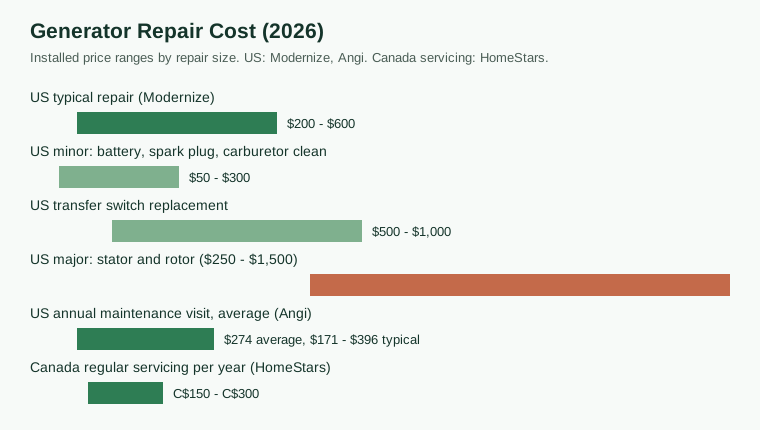
Short Answer: Most generator repairs cost $200 to $600 in the US in 2026, according to Modernize, and the bill starts before the repair does: a service call to diagnose the fault typically runs $45 to $100. Where a quote lands inside that band is decided by the part. A battery replacement runs $60 to $150 and a spark plug $55 to $95 (Modernize). A carburetor cleaning or rebuild runs $50 to $300, a fuel pump $125 to $300, and a transfer switch replacement $500 to $1,000. Angi's by-part table, drawn from 1,488 verified projects on its maintenance guide, puts stator and rotor work at $250 to $1,500 and engine work anywhere from $50 to $2,000. Repairs as a whole can span $50 to $2,000 (Angi), with Modernize putting the wider range for complex work at $80 to $800 before the largest components are counted.
Two structural facts shape every number in this guide. First, a standby generator is not one appliance. It is an engine, an alternator, a control board, a fuel supply, and a transfer switch wired into your panel, and Modernize notes that standby units cost more to diagnose and repair for exactly that reason: the fault can sit in any of those layers. Second, most failures are cheap ones. Modernize reports that a large share of no-start calls come down to stale fuel, a gummed carburetor, or a dead battery, especially after a generator sits through a season without use. The expensive outcome is paying major-part money before those three have been ruled out.
If you are pricing a new system rather than a repair, start with our standby generator cost guide, which puts a professionally installed system at $8,000 to $16,000 all-in. That installed price is the denominator for the repair-or-replace math in Section 8.
1. What a Repair Bill Is Made Of
A generator repair invoice has three layers, and only one of them is the part.
The first layer is the visit itself. Modernize puts a standard service call or diagnostic fee at $45 to $100. That fee buys the troubleshooting: reading fault codes on a standby controller, testing whether the engine cranks, checking fuel delivery, and measuring voltage output. It is charged whether or not you approve the repair, and a storm-night or after-hours visit costs more than a standard weekday appointment. Modernize is explicit that even when the part is inexpensive, the service call and labour can drive the invoice.
The second layer is labour. Generator work sits between two trades. The engine side is small-engine work: carburetors, plugs, fuel pumps, starters. The output side is electrical work: alternators, voltage regulators, control boards, and transfer switches that tie into your home's panel. A repair that crosses from one side to the other, or one that needs a part ordered and a second visit to fit it, costs more in time than the part price suggests. Angi makes the same point on the voltage regulator: the automatic voltage regulator part itself costs no more than $80, so the bulk of that repair bill is the technician's labour.
The third layer is the part, priced in Section 2. Parts for current standby models are brand-specific, above all control boards and controllers, and an older unit can carry a wait while a part is sourced. That wait has a cost of its own if an outage is forecast, which is why Section 6 separates faults you can schedule from faults you cannot leave.
One more line appears on standby invoices and not on portable ones: system testing after the repair. A proper standby repair ends with the unit started, the transfer switch exercised, and output checked under load, because a generator that runs in the driveway but fails to transfer has not been repaired. Angi's description of professional service includes running diagnostic tests and inspecting the electrical systems as part of the visit. If a quote has no test step, ask what confirms the fix.
2. US Prices by Part
The table below combines the two US sources read for this guide. Modernize prices common repair jobs as installed jobs. Angi prices parts and part groups from its project data. Where the two sources price the same job differently, both figures are shown, because the gap itself tells you how much quotes vary by region and by unit.
| Repair | Typical US cost (2026) | Source and note |
|---|---|---|
| Service call / diagnostic visit | $45 - $100 | Modernize; charged before repair, higher after hours |
| Spark plug replacement | $55 - $95 | Modernize; wear, fouling, long storage |
| Battery replacement | $60 - $150 | Modernize; batteries age out, cold and low use shorten life |
| Carburetor cleaning / rebuild | $50 - $300 | Modernize; old fuel, varnish, clogged jets |
| Carburetor repair or replacement | $60 - $500 | Angi; about $50 for a minor fix such as a loose gasket, up to $500 for a full replacement |
| Fuel pump replacement | $125 - $300 | Modernize; fuel delivery failure, contamination |
| Voltage regulator (AVR) | $80 for the part, plus labour | Angi; part is cheap, labour is most of the bill |
| Transfer switch repair | $50 - $150 | Angi |
| Transfer switch replacement | $500 - $1,000 | Modernize, installed job; Angi puts the replacement part alone at $200 - $400 plus several hours of labour |
| Stator and rotor | $250 - $1,500 | Angi; high end is larger standby units where rewinding is labour-heavy |
| Engine repair | $50 - $2,000 | Angi; minor fixes at the low end, major work or engine replacement at the top |
| Typical repair, all-in | $200 - $600 | Modernize; most homeowners |
| Annual maintenance visit | $171 - $396, average $274 | Angi, 1,488 verified projects; see Section 9 |
Read the table by symptom, not by part name, because you will describe a symptom on the phone. A unit that will not start is usually in the first five rows. A unit that starts and runs but produces no power, or power at the wrong voltage, is in the regulator, stator, and transfer switch rows. A unit that starts, transfers, then shuts down under load can be fuel delivery (pump, carburetor) or engine trouble, and that is the symptom where a diagnostic fee earns its money, because guessing wrong means paying for a carburetor rebuild and then paying again for the pump.
Portable and standby units share the cheap rows and split at the expensive ones. A portable has no transfer switch, no automatic controller, and no fixed fuel line, so its repair menu stops earlier. Modernize notes that portable repairs track small-engine pricing, and that a high-end portable costs $800 to $1,500 new, which caps what any portable repair should cost before replacement wins. A standby unit's menu runs longer and higher, because the system around the engine can fail independently of the engine itself.