Generator Transfer Switch Installation Cost 2026: Interlock, Manual and Automatic Prices
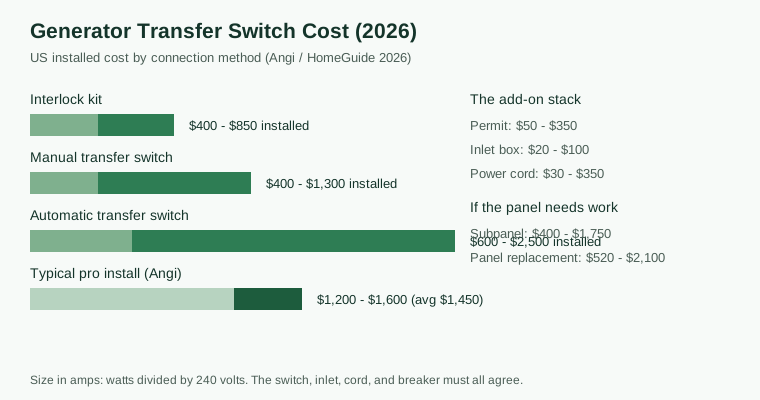
Installing a generator transfer switch costs $400 to $2,500 in total in 2026 (HomeGuide), and Angi puts a professional installation at $1,200 to $1,600, averaging about $1,450. The three connection methods price very differently: an interlock kit runs $400 to $850 installed, a manual transfer switch $400 to $1,300, and an automatic transfer switch $600 to $2,500. This guide prices each method from the published 2026 bands, shows the full cost stack (switch, inlet box, cord, labor, permit), works two complete examples line by line, explains amp sizing with the wattstoamps math, covers the panel and subpanel addons that change quotes, and ends with a 12point quote checklist.
Quick Checks
- 1Budget $400 to $2,500 installed for the connection itself, before the generator (HomeGuide). Angi's professional-installation band is tighter, $1,200 to $1,600 with an average near $1,450, because it reflects complete pro jobs rather than the cheapest interlock installs.
- 2An interlock kit is the low-cost legal connection for a portable generator: $400 to $850 installed (HomeGuide), built from a $50 to $150 kit, $200 to $400 of supplies including the breaker, inlet box and cord, and $150 to $300 of labor.
- 3Never connect a generator to a house panel without transfer equipment or an interlock. Backfeed through a dryer outlet can energize utility lines at transformer voltage and is the injury mechanism NEC Article 702 transfer rules exist to prevent.
- 4Size in amps, not marketing watts: amps = watts divided by 240 volts. A 7,500-watt portable needs a 30-amp inlet and breaker at minimum (7,500 / 240 = 31.25 amps, so most installs use the 30-amp class at reduced load or step to 50-amp), and the switch, inlet and generator breaker must all agree.
- 5The switch is rarely the whole quote. Permits run $50 to $350, and the two add-ons that change a job are a panel replacement at $520 to $2,100 (Angi) and a subpanel at $400 to $1,750. Get both priced as separate lines before work starts.
Generator Transfer Switch Installation Cost 2026: Interlock, Manual and Automatic Prices
By EnergyBS Editorial Team | October 15, 2026
The Short Answer
Short Answer: A generator transfer switch costs $400 to $2,500 installed in 2026, including the switch and labor (HomeGuide). Angi puts a professional installation at $1,200 to $1,600, with most homeowners paying about $1,450, because its band reflects complete pro jobs. The method sets the price: an interlock kit runs $400 to $850 installed, a manual transfer switch runs $400 to $1,300, and an automatic transfer switch runs $600 to $2,500 (Angi and HomeGuide, 2026 guides). Permits add $50 to $350, and a panel that needs replacement or a subpanel adds far more than the switch itself.
This guide covers only the connection between the generator and the house. The generator is a separate purchase, priced in our standby generator cost guide. The connection is the part buyers under-budget, because a generator quote that says "installation included" may bundle a basic switch and exclude the inlet box, the cord, the permit, and the panel work. Each line gets its own price below.
1. What the Switch Actually Does, and Why It Is Not Optional
A transfer switch does one mechanical job: it connects your panel to exactly one power source at a time. Utility power or generator power, never both at once. That exclusivity is the entire safety case. A generator connected to a panel with no transfer equipment can push power backward through the service wires and the pole transformer, which steps the voltage up to distribution level on lines that repair crews believe are dead. That is backfeed, and it is the injury and death mechanism behind the transfer rules.
In the US, a home generator is an optional standby system under NEC Article 702, and transfer equipment suited to the installation is the standard requirement for connecting one to house wiring (EC&M's Article 702 explainers summarize the rule and its narrow temporary-use exception, which needs a lockable disconnect and qualified supervision, conditions a house does not meet). Canada applies the same principle through the Canadian Electrical Code and provincial inspection authorities: the generator supply and the utility supply must be positively separated, and in Ontario the work falls under ESA permit and inspection rules. The practical reading for a homeowner is simple. There are three legal ways to make the connection (interlock, manual switch, automatic switch), a fourth way that is sold in hardware stores as a loose cord with two male ends, and that fourth way is the dangerous one. Do not use it, and do not let an installer suggest it.
The switch also decides how the house behaves in an outage. A manual system waits for you: you start the generator, walk to the panel, and move the load. An automatic system detects the outage, starts a standby generator, and moves the load on its own, then moves it back when utility power returns. That behavioral difference, not the metal box, is most of what the price spread buys.
2. The Three Connection Methods, Priced
| Method | Installed cost (2026) | What you get | Best fit |
|---|---|---|---|
| Interlock kit | $400 to $850 (HomeGuide) | A sliding plate on your existing panel that locks the main breaker and the generator breaker against each other, plus an inlet box and cord | Portable generator, flexible circuit choice, lowest budget |
| Manual transfer switch | $400 to $1,300 (Angi and HomeGuide) | A separate small panel holding a fixed set of chosen circuits, each flipped between line and generator | Portable generator, a defined list of essential circuits, simple operation for anyone in the house |
| Automatic transfer switch | $600 to $2,500 (Angi and HomeGuide) | A switch that senses the outage, starts the standby generator, transfers the load, and transfers back | Permanently installed standby generator, frequent or long outages, nobody home to run a manual sequence |
Interlock kit. The kit itself is a plate and hardware at $50 to $150, listed for a specific panel model. It installs inside your existing panel cover, so there is no new box on the wall. In an outage you turn the main breaker off, slide the plate, and turn the generator breaker on; the plate makes the wrong combination physically impossible. The strength of an interlock is flexibility: any circuit in the panel can run from the generator, as long as the total load stays within what the generator can carry, and you manage that by choosing which breakers are on. The weakness is the same flexibility. Nothing stops an uninformed user from turning on the electric range, the dryer, and the water heater together and stalling a small generator, so an interlock house needs a written load list taped inside the panel door. Panel compatibility is the gate: the kit must be listed for your exact panel and accepted by your inspector, and some panels and some jurisdictions do not have an approved option, which pushes the job to a transfer switch.
Manual transfer switch. A manual switch is a separate enclosure, usually holding 6 to 10 circuit positions, wired between your main panel and the circuits you choose in advance: fridge, furnace or heat pump air handler, well or sump pump, a lighting circuit, a few outlets. In an outage you plug the portable generator into the inlet box, start it, and move each chosen circuit from LINE to GEN. Operation is the simplest of the three for a house sitter or a teenager, because the decisions were made at installation. The constraint is that the list is fixed. A circuit that was not wired into the switch cannot run, and adding one later is electrician work, not a settings change.
Automatic transfer switch. An ATS pairs with a standby generator and does the whole sequence itself. Whole-house models are rated at the service size, commonly 100 or 200 amps, and sit between the meter and the panel; smaller models serve a subpanel of essential circuits. Bought on its own, the hardware is a real line item: HomeGuide prices a 200-amp switch at $680 to $1,500 for the unit, and retailer listings checked for this guide put a Generac 200-amp ATS at $739 for a non-service-rated model and $1,039 for a service-rated model with built-in surge protection. Many standby generator packages bundle a switch, which is why generator quotes and switch quotes overlap; section 7 separates them. An ATS also carries a sizing rule the manual methods do not: because nobody is standing there choosing loads, the generator must be able to carry the full load that can transfer, or the switch must be paired with load management that sheds heavy loads in a set order (NEC 702 as summarized by EC&M; HomeGuide prices a smart load manager accessory at $130 to $250).
A fourth option deserves a sentence: meter-mounted transfer devices that sit behind the utility meter exist in some service areas and are installed with utility involvement. Availability and pricing are utility-specific, and no national published band exists to cite, so this guide does not price them. Ask your utility if the category interests you.
3. Cost by Generator Size, Amps, and Circuits
Three different dials move the hardware price, and quotes mix them freely. Separating them makes quotes comparable.
By generator size (Angi, installed):
| Generator size | Circuits powered | Installed cost range | Typical generator |
|---|---|---|---|
| Up to 5,000 watts | 6 to 10 | $200 to $500 | Small portable |
| 5,000 to 10,000 watts | 10 to 16 | $500 to $1,000 | Mid-size portable |
| 10,000+ watts | 16 to 24 | $1,000 to $2,500 | Whole-house standby |
By switch amperage (HomeGuide, unit price only, installation excluded):
| Switch rating | Generator watts it matches | Unit price |
|---|---|---|
| 30-amp | about 7,500 to 8,000 | $200 to $500 |
| 50-amp | about 8,500 to 12,500 | $260 to $900 |
| 100-amp | about 10,000 to 24,000 | $300 to $950 |
| 200-amp | whole-house service size | $680 to $1,500 |
By circuit count (HomeGuide, unit price only): a 6-circuit manual switch runs $230 to $360, a 10-circuit switch $300 to $670, and 12 circuits and up runs $500 to $1,200 and up. Angi's framing matches: a six-circuit switch can start around $200 in hardware, while a 16-circuit unit often costs $1,000 or more.
The amp math behind the middle table is one division, and it is worth doing yourself before a sales visit. Amps = watts / volts, and a house generator outlet circuit runs at 240 volts. A 5,000-watt portable delivers 5,000 / 240 = about 21 amps, comfortably inside a 30-amp inlet. A 7,500-watt unit delivers about 31 amps, which is why 30-amp inlets on 7,500-watt generators work only with the understanding that the breaker trips before the nameplate peak, and why 50-amp inlets are the common install for portables in the 8,500 to 12,500 watt class. The switch, the inlet box, the cord, and the generator breaker in the panel form one chain, and the chain is rated by its weakest link. A 50-amp switch fed through a 30-amp inlet is a 30-amp system with a more expensive box.
4. The Cost Stack: Where the Money Goes
HomeGuide breaks a transfer switch installation into four lines, and every quote you receive is some arrangement of these lines plus permit and panel work:
| Line | Published range | Notes |
|---|---|---|
| Transfer switch (unit) | $200 to $2,000 | Manual units $200 to $800; automatic units $400 to $2,000+; kits that bundle switch, inlet and cord average $300 to $500 for smaller sizes |
| Installation labor | $200 to $500 | Straightforward jobs; Angi puts complex installations at $500 to $1,500 and electrician time at $50 to $100 per hour for 2 to 4 hours; HomeGuide lists $50 to $130 per hour plus a $75 call-out fee |
| Power inlet box | $20 to $100 | Portable-generator jobs only; the weatherproof socket the cord plugs into |
| Heavy-duty power cord | $30 to $350 | Portable-generator jobs only; price rises with amp rating and length |
| Permit and inspection | $50 to $350 | Both Angi and HomeGuide publish this band; most jurisdictions require a permit for panel work |
Two worked examples show how the stack lands. Both are hypothetical examples built only from the published bands above, labeled as such, and neither is a quote for your house.
Worked example A: interlock kit with a 7,500-watt portable generator. HomeGuide publishes this exact build as a table, and it is the cheapest legal connection in this guide:
| Line | Low | High |
|---|---|---|
| Interlock kit | $50 | $150 |
| Job supplies (breaker, inlet box, cord, misc.) | $200 | $400 |
| Labor | $150 | $300 |
| Total installed | $400 | $850 |
Worked example B: 10-circuit manual transfer switch with a 10,000-watt portable generator.
| Line | Basis | Low | High |
|---|---|---|---|
| 10-circuit switch unit | HomeGuide circuit table | $300 | $670 |
| Power inlet box | HomeGuide stack | $20 | $100 |
| Power cord | HomeGuide stack | $30 | $350 |
| Labor, 2 to 4 hours | HomeGuide / Angi | $200 | $500 |
| Permit | Angi / HomeGuide | $50 | $350 |
| Total | $600 | $1,970 |
Read example B against the published installed band for a manual switch, $400 to $1,300, and the gap teaches the main shopping lesson in this guide. The high column stacks every worst case at once, including the longest cord and the top permit fee, and it buys the switch at full unit price. Most real jobs land lower because the switch is bought as a kit (HomeGuide puts kit prices at $300 to $500 on average, bundling the switch panel, inlet box, and cord), the cord is short, and the labor sits at the 2-hour end. If a quote for a manual switch on a portable generator comes in above the $1,300 published top, the quote should contain a visible reason: panel work, a long or difficult wire run, or a subpanel. If it does not, that is the quote to get competed.
For an automatic switch, the same reading applies in reverse. Angi's $1,200 to $1,600 professional band and $1,450 average describe the common bundled job, where the switch arrives with the standby generator and the electrician is already on site. A standalone ATS replacement or an ATS added to an existing generator prices from the unit table instead: $680 to $1,500 for 200-amp hardware, plus complex-job labor at $500 to $1,500, plus the permit.
5. The Add-Ons That Actually Change the Quote
- Panel replacement. If the existing panel is full, damaged, obsolete, or not approved for an interlock, the switch waits for panel work. Angi prices electrical panel replacement at $520 to $2,100 in this context and HomeGuide at $850 to $2,500. Our panel upgrade cost guide prices the full 100-to-200-amp upgrade job, and the panel capacity guide covers the load calculation that decides whether you need it.
- Subpanel. A full but sound panel can take a subpanel to free space or to hold the backed-up circuits: $400 to $1,750 (Angi), $500 to $1,700 (HomeGuide).
- Breakers. Added or moved breaker switches run $100 to $200 each (Angi). An interlock job needs one double-pole breaker sized to the generator; a manual switch job may need several circuits relocated.
- Wire run distance and access. The switch wants to live beside the panel and the inlet wants to live where the generator will sit, outdoors, with exhaust pointed away from doors and windows. Distance between those points, finished walls, and attic or crawlspace routing are what move a job from Angi's basic labor band to its complex band.
- Service-rated vs non-service-rated ATS. A service-rated switch contains the service disconnect and can sit directly after the meter; a non-service-rated switch needs a separate disconnect ahead of it. The hardware price gap showed in the listings checked for this guide ($739 non-service-rated vs $1,039 service-rated, same brand and amp class), and choosing wrong adds a disconnect and labor instead of saving money.
- Load management modules. $130 to $250 per smart load manager on HomeGuide's accessory pricing. On an automatic system these modules are what let a smaller generator carry a whole-house switch legally, by shedding the air conditioner or range when the load peaks. Price them per managed load, not as a single system line.
- Maintenance. A transfer switch is a mechanical device that sits idle for months and must work on the worst night of the year. HomeGuide prices standby generator maintenance at $200 to $650 per year, and Angi lists annual switch checks (visual and mechanical inspection, voltage and connection checks, a manual transfer test) at electrician rates of $50 to $100 per hour. Testing the transfer under load, on a schedule, is part of owning any of the three methods.
6. Choosing Between the Three: A Decision Sequence
Work these questions in order. The first one that produces a clear answer usually settles the method.
- Is the generator portable or permanently installed? Portable means interlock or manual switch. Permanently installed standby means automatic; pairing a standby generator with a manual switch throws away the automatic start you paid for in the generator.
- Does your panel have a listed, inspector-accepted interlock option? If yes, and the budget is the binding constraint, the interlock at $400 to $850 installed is the value pick, with the written load list as its operating cost. If no approved kit exists for your panel, cross the interlock off rather than accepting a generic plate.
- Who will run the outage sequence? If the answer includes house sitters, renters, teenagers, or nobody, prefer the defined circuit list of a manual switch (or the full automation of an ATS with a standby unit). The interlock's flexibility is only safe in trained hands.
- How fixed is your essential-load list? A stable list (fridge, heat, water, a few lights and outlets) suits a manual switch sized to it, 6 circuits at the small end and 10 for most houses. A list that changes with seasons and projects argues for the interlock's whole-panel access.
- What does the outage pattern look like? Rare, short outages favor the cheapest legal connection. Frequent or multi-day outages, medical equipment in the house, a sump pump protecting a finished basement, or a house that sits empty in winter all push toward the automatic system, because the cost in this guide is small next to the standby generator system it completes, and an outage nobody responds to is the expensive kind.
One alternative belongs in this decision for some houses: a home battery with a critical-loads panel does the automatic, silent, indoor version of this job for short outages, at a higher equipment cost and with no fuel to manage. Our battery storage installation cost guide prices that route, and the critical load sizing guide shows how to build the load list that both a battery system and a manual transfer switch need.
7. Separate the Switch From the Generator Quote
Standby generator quotes routinely present one installed total. The switch hides inside it in one of three ways, and each way has a different failure mode at invoice time.
- Bundled switch, full scope. The quote lists the ATS model, its amp rating, and the electrical work to install it. This is the clean structure; the switch portion should land somewhere near Angi's $1,200 to $1,600 professional band inside the larger total.
- Bundled switch, silent scope. The quote says "transfer switch included" with no model or rating. The risk is a switch sized for essential circuits quoted against your whole-house expectation, or a non-service-rated unit that later needs a disconnect added. Ask for the model number and rating in writing; the unit tables in section 3 tell you what that hardware costs on its own.
- Switch excluded. The quote prices the generator, pad, and fuel work, and the electrical connection appears later as a change order. Price it yourself from this guide before signing: manual $400 to $1,300, automatic $600 to $2,500, plus permit, plus any panel work from section 5.
Portable generator owners face the mirror-image problem: the generator is already in the garage, and the connection is the whole project. For that job, get the quote in the section 4 stack format (unit or kit, inlet, cord, labor, permit as separate lines), because a single lump figure for a manual switch can hide a $300 kit and $900 of unexplained labor.
8. Canada: Same Structure, Different Paperwork
We did not find a published Canadian price band for transfer switch installation from a national cost source to cite for this guide, so no CAD range is printed here rather than a converted US figure dressed up as Canadian data. What can be stated plainly: the three connection methods are the same hardware, Canadian electrical work of this type requires a permit and inspection under provincial rules (in Ontario, through the Electrical Safety Authority, and the work is licensed-electrician work), and the Canadian Electrical Code requires the same positive separation between generator and utility supply that NEC 702 requires in the US. Panel-specific interlock acceptance varies, and meter-mounted transfer devices are offered through some Canadian utilities under their own programs.
Budget practice for a Canadian house: take the US bands in this guide as a floor for planning, expect parts and labor in Canadian dollars to land above a straight currency conversion on this category of electrical work, and get two ESA-permitted quotes with the switch model, inlet, and panel work itemized the same way section 7 describes. If a quote arrives well above the US automatic band, the itemized lines, not the exchange rate, should explain why.
9. The 12-Point Quote Checklist
Compare transfer switch quotes line by line. A complete quote names:
- The method (interlock, manual, automatic) and, for an interlock, the kit make and model and confirmation it is listed for your exact panel.
- The switch make, model, amp rating, and circuit count, priced as its own line against the section 3 tables.
- Service rating on an automatic switch: service-rated, or the separate disconnect it needs, priced.
- The inlet box: amp rating (30 or 50), location, and whether it is inside the kit price or charged separately ($20 to $100, HomeGuide), never both.
- The cord, for portable setups: amp rating, length, and price ($30 to $350), with the rating matching the inlet and the generator outlet.
- The load list: every circuit the generator will carry, by breaker, agreed before installation, with starting loads (well pump, sump pump, furnace, air conditioner) named and summed against the generator's running watts.
- Labor as hours and rate ($50 to $100 per hour on Angi's figures, $50 to $130 on HomeGuide's), with the basic vs complex call stated, not a single unexplained labor lump.
- Permit and inspection: who pulls the permit, the fee ($50 to $350), and whose name the inspection passes under.
- Panel findings priced in advance: the agreed rate for a subpanel ($400 to $1,750) or panel replacement ($520 to $2,100) if the panel cannot take the job as quoted, so a mid-job discovery is a rate, not a negotiation.
- Load management, on automatic systems: which loads are managed, the module count, and the per-module price ($130 to $250).
- The test: a live transfer test under load before final payment, running the actual essential circuits, plus the return-to-utility sequence.
- Warranty split and paperwork: switch manufacturer warranty, installer workmanship warranty, the permit record, and a written outage sequence for the method installed, taped inside the panel door for an interlock or manual system.
A quote missing lines 2, 6, and 8 is not a cheaper version of a complete quote. It is an undefined connection, and undefined electrical work gets defined at change-order prices.
Frequently Asked Questions (FAQ)
How much does it cost to install a generator transfer switch in 2026?
HomeGuide puts the total at $400 to $2,500 installed, including the switch and labor. Angi puts a professional installation at $1,200 to $1,600, averaging about $1,450. By method: an interlock kit installs for $400 to $850, a manual transfer switch for $400 to $1,300, and an automatic transfer switch for $600 to $2,500. Permits add $50 to $350, and panel replacement or a subpanel, when needed, adds $400 to $2,500 on top.
Is an interlock kit as safe as a transfer switch?
An interlock kit listed for your panel and installed under permit does the same core job: it makes it physically impossible for the main breaker and the generator breaker to be on together, which is what prevents backfeed. The difference is operational, not electrical. A transfer switch restricts generator power to a fixed set of circuits chosen in advance, while an interlock lets any circuit in the panel run, so the person operating it has to manage the total load. Interlock kits run $400 to $850 installed (HomeGuide), against $400 to $1,300 for a manual switch.
What size transfer switch do I need for a 7,500-watt generator?
Divide watts by 240 volts: 7,500 / 240 = about 31 amps. HomeGuide's sizing table pairs a 30-amp switch ($200 to $500 for the unit) with generators in the 7,500 to 8,000 watt class, and a 50-amp switch ($260 to $900) with 8,500 to 12,500 watts. Most 7,500-watt installs use a 30-amp inlet and breaker and accept that the breaker limits the peak, or step up to a 50-amp inlet, breaker, and cord set for headroom. The switch, inlet, cord, and panel breaker must all carry the same rating; the lowest-rated part sets the limit.
Can I install a transfer switch myself?
The inlet box and switch involve work inside a live service panel, and both Angi and HomeGuide advise hiring a licensed electrician; HomeGuide notes many cities require one for this work because of the backfeed, fire, and shock risks of a wrong connection. The permit and inspection that most jurisdictions require for panel work also assume a licensed installer in many areas. The homeowner contribution that actually saves money is preparation: clear access to the panel, a written list of the circuits you want backed up, and the generator placed where it will run, so the electrician's 2 to 4 hours go to installation instead of decisions.
Does a portable generator need a transfer switch?
It needs transfer equipment of some kind before it connects to house wiring: a transfer switch or a listed interlock kit. Running a portable generator with extension cords to individual appliances needs neither, and that remains a legal, if inconvenient, way to power a fridge and a few lights. Connecting the generator to the panel without transfer equipment, including through a dryer or range outlet with a double-ended cord, is the backfeed hazard described in section 1 and is prohibited under NEC 702's transfer rules.
How long does installation take?
Two to four hours for a professional installation on the published figures (Angi: 2 to 4 hours; HomeGuide: 2 to 4+ hours), covering the inlet box where one is fitted, the switch or interlock, and wiring the chosen circuits. Jobs that add a subpanel, replace a panel, or run wire a long distance from the panel to the inlet location run longer and price in Angi's complex labor band of $500 to $1,500 rather than the basic $200 to $500.
Why did my quote come in above the ranges in this guide?
Work through the quote against section 5. The usual explanations, in order: a panel replacement at $520 to $2,100 or a subpanel at $400 to $1,750 was folded into the total; the switch is a 200-amp service-rated automatic model, which sits at the top of the $680 to $1,500 unit band before labor; the wire run is long or through finished space, pushing labor into the complex band; or load management modules were added at $130 to $250 each. If none of those lines appears and the total still sits above the band for your method, get a competing quote in the section 9 format.
What should I read next before deciding?
Price the whole system, not just the switch: the standby generator cost guide for the generator, fuel work, pad, and full installed totals; the panel upgrade cost guide if your panel is part of the job; the panel capacity guide for the load calculation behind circuit choices; and, if your outages are short, the battery storage cost guide and critical load sizing guide for the automatic battery alternative and the load list both routes depend on.
Prices in this guide are planning ranges from the published 2026 sources cited above, not quotes for your house. Panel condition, switch rating, circuit count, wire-run distance, and local labor decide the final figure. Get the load list agreed in writing, make sure the permit is pulled, and do not make the final payment until the system has transferred your actual essential circuits under load and transferred back.
What to Read Next
Standby Home Generator Cost 2026: What Installation Really CostsUse this next to compare the cost, incentive, installation, or operating-risk angle before you make a home energy decision.Sources and Verification
- Angi How Much Does It Cost To Install a Generator Transfer Switch? [2026 Data], updated July 10, 2026 (professional installation $1,200 to $1,600, average about $1,450; automatic switch installed $600 to $2,500; manual switch installed $400 to $1,300; cost by generator size: up to 5,000 watts and 6 to 10 circuits $200 to $500, 5,000 to 10,000 watts and 10 to 16 circuits $500 to $1,000, 10,000+ watts and 16 to 24 circuits $1,000 to $2,500; electrician labor $50 to $100 per hour, 2 to 4 hours, basic installation $200 to $500 and complex $500 to $1,500; 6circuit switch hardware from about $200, 16circuit unit $1,000 or more; panel replacement $520 to $2,100, subpanel $400 to $1,750, breaker switch $100 to $200 each; permits $50 to $350)
- HomeGuide 2026 Generator Transfer Switch Installation Cost (total installed $400 to $2,500; breakdown: transfer switch $200 to $2,000, installation labor $200 to $500, power inlet box $20 to $100, heavyduty power cord $30 to $350; transfer switch kits $300 to $500 on average; permits $50 to $350; new electrical panel $850 to $2,500, subpanel $500 to $1,700; electricians $50 to $130 per hour plus a $75 callout fee, installation 2 to 4+ hours; manual switch part alone $200 to $800, installed $400 to $1,300; automatic switch $400 to $2,000+ for the switch alone, $600 to $2,500 installed)
- HomeGuide 2026 Generator Transfer Switch Installation Cost, interlock and sizing tables (interlock kit installed $400 to $850 total: kit $50 to $150, job supplies $200 to $400 including breaker, inlet box and cord, labor $150 to $300; unit prices by amperage, installation excluded: 30amp $200 to $500 for generators up to about 7,500 to 8,000 watts, 50amp $260 to $900, 100amp $300 to $950, 200amp $680 to $1,500; circuit pricing: 6 circuits $230 to $360, 10 circuits $300 to $670, 12+ circuits $500 to $1,200+; installation adds $200 to $500)
- HomeGuide 2026 Whole House Generator Cost guide, transfer and accessory pricing (transfer switch or interlock installation $400 to $2,500 total; interlock $400 to $850 installed; smart load manager accessory $130 to $250; standby generator maintenance $200 to $650 per year)
- Electrical Contractor Magazine (EC&M) NEC Article 702 optional standby systems explainers (residential standby generators are optional standby systems under NEC 702; transfer equipment is required so the generator cannot feed power back into the utility system; with manual transfer equipment the user may select which loads run at one time, and with automatic transfer equipment the generator must carry the full transferred load or be paired with a load management system)
- Retailer listings checked October 15, 2026 for a 200amp automatic transfer switch bought on its own (Generac RXSC200A3 200amp automatic transfer switch listed at $739 at Norwall; Generac 200amp servicerated automatic transfer switch with surge protection, model 9951, listed at $1,039 at Northern Tool). Listings change and stock varies; figures are examples of the standalone hardware band, not quotes.
Editorial Review
EnergyBS Editorial Team
EnergyBS publishes practical homeowner guides. Important program, product, and cost claims should be checked against the linked source and local project documents before you commit to work.
Related Guides
View All ArticlesStandby Home Generator Cost 2026: What Installation Really Costs
A professionally installed standby generator typically costs $8,000$16,000 allin in 2026. This guide breaks down equipment, transfer switches, fuel choices, permits, and running costs plus Canadian pricing.
Electrical Panel Upgrade Cost 2026: What a 100 to 200 Amp Upgrade Runs
Upgrading an electrical panel from 100 to 200 amps costs $1,300$4,200 installed in the US in 2026 depending on market and scope, and C$2,500$4,500 in Ontario. This guide breaks down cost by upgrade path, what a legitimate quote includes, when 200 amps is genuinely needed, and when load management avoids the upgrade entirely.
Electrical Panel Capacity for Home Electrification
A decision guide for homeowners adding heat pumps, EV charging, induction, water heating, solar, or batteries: service ratings, load calculations, demand data, panel space, load management, project sequencing, and quote review.