WholeHouse Surge Protector Cost 2026: Device, Installation, and the Code Rule
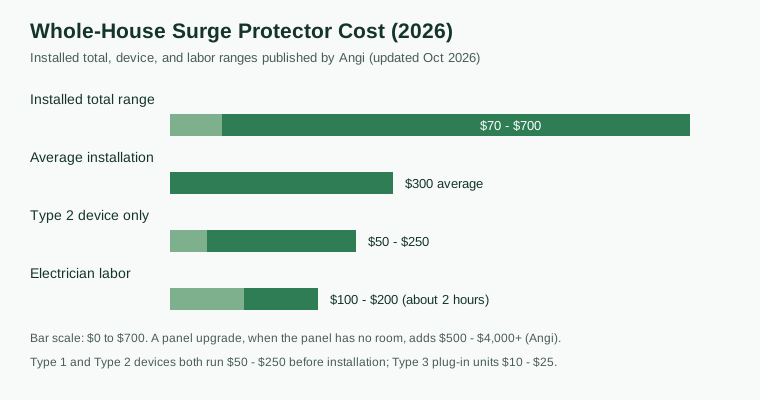
A wholehouse surge protector costs $300 on average installed in Angi's 2026 data, with most homeowners paying $70 to $700. The device is the smaller half of the bill: Type 1 and Type 2 surge protective devices run $50 to $250 before installation, and an electrician charges $100 to $200 for a job that takes about two hours. Since the 2020 National Electrical Code (Article 230.67), a Type 1 or Type 2 device has been required on services supplying dwelling units, including when service equipment is replaced, so the protector now rides along with most panel upgrades whether the homeowner asked for it or not. This guide separates the device decision (type, surge rating in kA, voltage protection rating, enclosure) from the installation decision, prices the cases that push the job past $700 (a full panel, an outdoor NEMA 4 unit, extra electrical work), and closes with Canadian pricing at C$300 to C$700 installed from practitioner sources.
Direct Answer
A wholehouse surge protector costs $300 on average installed in Angi's 2026 data, with most homeowners paying between $70 and $700. The device itself is the smaller decision: a Type 1 or Type 2 surge protective device (SPD) runs $50 to $250 before installation, and Type 2, the...
Quick Checks
- 1Budget $300 installed for the standard job (Angi 2026 average), inside a $70 to $700 range for most homes. The device is $50 to $250 of that for a Type 1 or Type 2 unit, and the electrician is $100 to $200 for about two hours of work.
- 2Type 2 is the default residential choice: it mounts at or inside the main panel and is the type Angi calls the most commonly installed for whole-home protection. Type 1 sits on the line side of the service disconnect, at the meter end. Type 3 is a plug-in strip at $10 to $25, a second layer, not a substitute.
- 3Since the 2020 NEC (Article 230.67), services supplying dwelling units need a Type 1 or Type 2 surge protective device, including when service equipment is replaced, where that code edition is adopted. If you are pricing a panel upgrade, an SPD line on the quote is code, not an upsell.
- 4The job leaves the $300 band for three reasons: the panel has no free two-pole space and needs other work first, the device goes outdoors in a NEMA 4 enclosure ($120 to $225 or more for the device alone, Angi), or extra electrical work rides along, which Angi says can raise the total by 100 percent or more.
- 5Surge protectors wear out. Angi puts replacement at every three to five years, and the indicator light is the only visible difference between a live device and a spent one. Put a glance at that light on the same routine as your furnace filter checks.
Whole-House Surge Protector Cost 2026: Device, Installation, and the Code Rule
By EnergyBS Editorial Team | October 17, 2026
The Short Answer
Short Answer: A whole-house surge protector costs $300 on average installed in Angi's 2026 data, with most homeowners paying between $70 and $700. The device itself is the smaller decision: a Type 1 or Type 2 surge protective device (SPD) runs $50 to $250 before installation, and Type 2, the panel-mounted type, is the one Angi identifies as most commonly installed for whole-home protection. The electrician adds $100 to $200, for a job Angi puts at about two hours, at electrician rates of $50 to $100 per hour. What moves a specific house inside that range is the panel, not the protector: whether the panel has a free two-pole breaker space, whether the device mounts indoors or needs a weather-rated enclosure, and whether other electrical work gets attached to the visit.
There is also a code fact behind the recent rise in quotes naming this device. Article 230.67 of the 2020 National Electrical Code requires services supplying dwelling units to have a Type 1 or Type 2 SPD, and the requirement applies when service equipment is replaced. Where that edition (or the 2023 edition) is the adopted code, a panel upgrade or service replacement now includes surge protection by rule. Section 5 works through what the rule does and does not demand of an existing house.
1. What the Device Actually Does
A surge protective device sits at the service entrance or the main panel and clamps voltage spikes: when line voltage jumps past the device's threshold, the SPD diverts the excess energy to ground instead of letting it travel out along the branch circuits. It works in milliseconds and it works on every circuit downstream of it, including the hardwired loads a plug-in strip can never reach: the furnace control board, the air conditioner, the well pump, the EV charger, the oven's electronics.
The surges it exists for are mostly unspectacular. Utility switching on the grid, power coming back after an outage, a nearby lightning strike inducing a spike on the lines, and large motors inside the house cycling on and off all produce transients. A direct lightning strike on the house is a different energy class, and no panel device in this price range stops one; that is lightning-rod and grounding-system territory, plus insurance. An SPD also does nothing about sustained problems: a minutes-long overvoltage, a brownout, or a lost neutral will pass it by, because the device is built for spikes, not for steady wrong voltage. And it only guards the power lines it is wired to. A surge arriving on a cable TV or data line enters by a different door unless that line has its own protection.
That scope is still wide enough to matter, because the modern house runs on control boards. The appliance repair pattern of the last decade is a board failure after a storm or an outage, on equipment that has no plug a strip could sit on. The panel device is the only layer that covers those loads, which is why this guide treats point-of-use strips as the second layer in section 7, not the plan.
2. Cost by Type: Type 1, Type 2, Type 3
Angi publishes the device market in three types, priced before installation:
| SPD type | Device cost | Where it installs | Role |
|---|---|---|---|
| Type 1 | $50 to $250 | Line side of the service disconnect, at the meter or service entrance | First clamp on surges arriving from the utility side |
| Type 2 | $50 to $250 | At or inside the main panel, on the load side | The standard whole-home layer; most commonly installed (Angi) |
| Type 3 | $10 to $25 | Plugs into an outlet | Point-of-use protection for one device or one strip of devices |
The type number is a location in the system, not a quality grade. A Type 1 device is listed for use ahead of the main disconnect, which is why utilities and meter rules get a say in where it goes. A Type 2 device connects inside or beside the panel, usually through a dedicated two-pole breaker, and it catches both what is left of an external surge and the transients generated inside the house. A house can carry both, and layered installs pair a Type 1 at the service with a Type 2 at the panel so each one takes the surge down a step further. Angi's table prices the two panel-class types identically at $50 to $250, so the choice between them is about mounting position and the panel you own, not about a price tier.
Type 3 is the category error this guide exists to prevent. A $10 to $25 plug-in strip protects what is plugged into it, nothing else, and it does not satisfy the code rule in section 5. Strips belong at the computer and the TV as the last layer, after the panel device has taken the surge down. Buying three strips instead of the panel device leaves every hardwired load, the furnace, the fridge, the charger, unprotected, which is most of the repair-bill risk in the house.
Within the Type 2 shelf, price follows the ratings in section 4 and the enclosure in section 3. A basic panel-brand plug-on unit sits at the low end. A higher surge-current rating, replaceable modules, or an outdoor enclosure moves the same type toward $250.
3. The Cost Stack: Where the Money Goes
For the standard job, a Type 2 device at an accessible indoor panel with a free breaker space, the bill has two lines and a possible third:
| Cost line | Published range | Source |
|---|---|---|
| Type 1 or Type 2 device | $50 to $250 | Angi |
| Type 3 point-of-use device | $10 to $25 | Angi |
| Electrician installation | $100 to $200 | Angi |
| Electrician hourly rate | $50 to $100 per hour, some at a $150 first hour | Angi |
| Typical job length | about 2 hours | Angi |
| NEMA 1 (indoor) enclosure models | $80 to $150 | Angi |
| NEMA 4 (outdoor, dust and moisture resistant) models | $120 to $225 or more | Angi |
| Installed total, typical range | $70 to $700 | Angi |
| Installed total, average | $300 | Angi |
| Electrical panel upgrade, if needed | $500 to $4,000 or more | Angi |
| Effect of extensive additional electrical work | total can rise 100 percent or more | Angi |
Three readings. First, this is one of the cheapest line items in the whole electrical cluster. Our panel upgrade cost guide prices that job in the thousands and the subpanel guide in the high hundreds to low thousands; the surge protector is a $300 average because the work is two hours and the hardware is a few hundred dollars at most.
Second, labor is billed like a service call, because that is what the job is. At $50 to $100 per hour with some electricians charging a $150 first hour, the quote differences between firms on this job are mostly minimum-charge differences. That is also why bundling matters, in section 6: an SPD added to a visit already happening costs the device plus the marginal time, while the same device as a standalone call carries the full first-hour structure.
Third, the enclosure is a real price step with a physical reason. A panel in a finished indoor space takes a NEMA 1 device at $80 to $150. A panel or meter on an outside wall, or a device mounted outdoors, needs the sealed NEMA 4 version at $120 to $225 or more. Ask which enclosure a quote assumes before comparing two quotes $60 apart; they may not be quoting the same box.
4. Reading the Spec Sheet: Four Numbers That Set the Price
SPD listings print a wall of ratings. Four of them explain most of the $50 to $250 spread inside one type, and they are the four to compare when two devices sit $100 apart.
Surge current capacity, in kA. The headline number: how large a surge current the device is built to divert. Bigger is more headroom, and manufacturers print it prominently because it is the easiest number to sell. Read it per the listing, and read it next to the third number below, because the code floor is set there, not by the marketing number.
Voltage protection rating (VPR). From the UL 1449 test: the voltage the device lets through to your equipment during a standardized surge, so lower is tighter protection. Two devices with the same kA figure can carry different VPRs, and the one with the lower VPR is clamping harder. This is the number to compare when kA figures match.
Nominal discharge current (In). The rating the code actually names. NEC 230.67 requires SPDs to carry an In of not less than 10kA (Leviton, quoting the article). Mainstream listed devices clear that floor comfortably; Eaton's SPD series, for example, publishes an In of 20 kA with UL 1449 listing on its product pages. The check on a quote is simple: the device is UL 1449 listed (or CSA listed in Canada) and its In meets the 10kA floor. A device with no listing has no verified ratings at all, whatever the box prints.
Protection modes and the indicator. Count the modes the device protects (line to neutral, line to ground, neutral to ground, line to line). More modes means more surge paths covered. Then find the status indicator: a light or alarm that shows the protection is still alive. SPDs consume themselves a little with every surge they absorb, so the indicator is not a decoration; it is how you know the device in the panel is still a device and not a souvenir. Section 8 returns to this.
One more line on better units: a connected-equipment warranty, a dollar figure the manufacturer promises toward damaged equipment if the device fails to do its job. Read its conditions before counting it as value. Angi notes that many SPD warranties are valid only when a licensed electrician installed the device, which is one more reason the $100 to $200 labor line is not the place to economize.
5. The Code Rule: NEC 230.67, Stated Carefully
Article 230.67 entered the National Electrical Code in the 2020 edition, the first time surge protection became mandatory rather than optional (Hubbell). Its requirements, as Leviton reproduces them:
- All services supplying dwelling units shall be provided with a surge protective device.
- The SPD shall be an integral part of the service equipment or located immediately adjacent to it (with an exception allowing it at each downstream distribution level instead).
- The SPD shall be a Type 1 or Type 2 device.
- Where service equipment is replaced, all of the requirements of this section apply.
- SPDs shall have a nominal discharge current rating (In) of not less than 10kA.
The 2023 edition kept the dwelling-unit rule and expanded the occupancy list to dormitory units, guest rooms and suites of hotels and motels, and patient sleeping room areas of nursing homes and limited-care facilities.
What this means for a homeowner, stated with the limits the sources support. The NEC is a model code: it binds where a state or locality has adopted that edition, and adoption lags by years in some places, so whether 230.67 is enforceable on your street depends on your jurisdiction's adopted edition. The rule is written for services and service equipment, so its clear triggers are new construction and a service or panel replacement, the moments a permit is already open. Nothing in the quoted text orders the owner of an existing, untouched panel to retrofit one tomorrow. The practical consequence is narrower and more useful: if you replace a panel in a 2020-or-later-code jurisdiction, the SPD appears on the job by rule, and a quote that includes it is compliant rather than padded. If your panel is staying, the device is voluntary, and sections 1 and 7 are the case for and against volunteering.
Canada note, kept separate because the code systems differ: the practitioner sources used for section 9 sell the device on protection, not on a Canadian code trigger, and this guide makes no claim of a Canadian equivalent to 230.67. Ontario electrical work runs through a Licensed Electrical Contractor with an ESA permit and inspection as the standing pattern our rewiring guide documents, and devices sold for the Canadian market carry CSA or cUL listing; Eaton's surge line, for instance, lists CSA Type 1 and Type 2 options on its Canadian pages.
6. When the Job Stops Being a $300 Job
The panel has no room. Most external Type 2 devices connect through a dedicated two-pole breaker. A full panel turns a two-hour job into a sequencing problem: the answers are a plug-on SPD that occupies the breaker space itself where the panel brand offers one, a tandem or quad arrangement where the panel is listed for it, or the subpanel or panel upgrade the full panel was already pointing at. Angi prices panel upgrades at $500 to $4,000 or more, which is why a $300 protector can arrive attached to a four-figure conversation. The protector is not the expensive part of that conversation; it is the trigger for having it.
The device goes outdoors. Covered in section 3: NEMA 4 at $120 to $225 or more for the device, against $80 to $150 for NEMA 1. Meter-side Type 1 installs can also involve the utility's rules for work at the meter base, which is scheduling, not hardware.
Other work rides along. Angi states the general rule plainly: extensive additional electrical work can increase this project's total by 100 percent or more. On this job the usual passengers are grounding corrections (an SPD diverts to ground, so a ground system in poor shape is a real finding, not a sales line), a damaged or recalled panel that the electrician will not connect new work to, and the extra circuits the homeowner adds once a call is booked. Each can be legitimate. Each should be a separate named line, priced apart from the device and its two hours, so the $300 job and the attached work can be judged separately.
The bundling discount, in the other direction. The cheapest version of this project is the one added to work already booked: a panel upgrade (where the SPD is required anyway on replacement in 230.67 jurisdictions), a generator transfer switch install, or a subpanel job, all of which already have an electrician standing at an open panel. Quoted as an add-on line in those jobs, the protector should price near device plus marginal labor. Quoted standalone, it carries the service-call structure. Same device, two legitimate prices, and the difference is the truck roll, so get the add-on price in writing while the other job is being quoted.
7. Layered Protection, and the Limits of Each Layer
The working arrangement electricians describe, and the one the type system is built for, is layers:
- At the service or panel (Type 1 and/or Type 2): takes the bulk of an external surge down before it reaches branch circuits, and is the only layer covering hardwired equipment.
- At the outlet (Type 3): a plug-in unit at the computer, the TV, and the network gear, clamping what is left. Cheap at $10 to $25 (Angi), and worth it for the electronics that are both sensitive and plug-connected.
- On the other doors: cable, satellite, and data lines enter the house outside the power system. If those lines matter to you, they need their own protectors, bonded to the same ground; the panel SPD does nothing for a surge that arrives on the coax.
And the limits, repeated because they decide whether this purchase fits your actual risk. No SPD in this class protects against a direct lightning strike on the structure. No SPD corrects sustained overvoltage, undervoltage, or a failing neutral; those are utility and electrician problems with different fixes. And an SPD on a house with a poor grounding system is working with one hand tied, because diverted energy needs somewhere to go. If your worry list is mostly outages rather than spikes, the money may belong in the backup-power direction instead; our smart panel guide covers the monitoring-and-control side of that decision.
8. Lifespan, Indicators, and Replacement
A surge protector is a consumable that happens to last years. Its internal components degrade with each surge they absorb, including the small ones nobody notices, so the device that handled a bad storm season may have little left for the next one. Angi's FAQ gives the planning figure directly: expect to replace a whole-house surge protector every three to five years.
The maintenance burden is one habit: look at the status light when you are at the panel for anything else, and after any major storm or outage event. Light on, protection present. Light out or alarm sounding, the device has spent itself and the house is unprotected until it is swapped, a second visit priced like the first minus any panel surprises. Better units use replaceable modules, which turn the replacement into a part swap instead of a new device; if you are choosing between two units $60 apart and one has replaceable modules, that difference usually earns itself back at the first replacement.
Keep the install invoice and the device paperwork with the panel. The connected-equipment warranty conditions (section 4) and the replacement date both live in that paperwork, and neither can be reconstructed from the device itself five years later.
9. Canada: Practitioner Pricing
Canadian pricing for this job comes from electricians rather than the national cost databases, so treat it as practitioner ranges in Canadian dollars. Mr. Electric of Edmonton, citing Canadian electrical cost guides, puts a professionally installed whole-home surge protector, device and labour included, at roughly C$300 to C$700, with the price driven mostly by panel amperage and by whether a subpanel needs its own unit. The same source adds the older-home caveat that matches the US pattern in section 6: Edmonton homes with a 100-amp panel or aluminum branch wiring sometimes need panel work alongside the install, and that attached work, not the protector, is what grows the bill.
Read against Angi's US figures (US$70 to US$700, US$300 average), the Canadian band describes the same job at the same shape: a few hundred dollars for the standard install, with panel condition as the variable. Two Canada-specific checks belong on the quote. The device should carry a CSA or cUL listing accepted in Canada; a US-only UL mark is not enough. And in Ontario, the work should run through a Licensed Electrical Contractor with the ESA notification and inspection named in the contract, the same paper discipline as any panel work in that province.
10. A Worked Example: Type 2 Protector at an Indoor 200-Amp Panel
This is a hypothetical example built only from the published ranges above, to show how the standard budget assembles. Change every assumption to your own house before using it.
The job. A 200-amp main panel indoors, with a free two-pole breaker space, in a house with a furnace, a central air conditioner, and an EV charger: three hardwired loads no plug-in strip can cover.
The lines. Type 2 device at $150 (inside Angi's $50 to $250). Installation at $175 (inside Angi's $100 to $200; about two hours at the published $50 to $100 per hour rates). No enclosure premium, because the panel is indoors and the device figure already sits inside the NEMA 1 band of $80 to $150 to $250 depending on model.
The total. $150 plus $175 is $325. Cross-check: just above Angi's $300 average and well inside its $70 to $700 typical range, which is where a mid-range device at full standalone labor should land.
The two variants that move it. Price the same protection as an add-on to a panel upgrade already booked, and the labor line shrinks toward the marginal time while the device stays $150; expect a total nearer $200 to $250, assembled from the same published lines, and get that add-on figure quoted as its own line. Move the device outdoors instead, in a NEMA 4 enclosure at $200 (inside Angi's $120 to $225 or more), with labor at the $200 top of its band, and the total is $400 before any other work. Same protection class in all three cases. The visit structure and the box explain the spread.
11. The 8-Point Quote Checklist
Compare surge protector quotes line by line. A complete quote names:
- The device by make and model, its type (1 or 2), and its listing (UL 1449, or CSA/cUL in Canada). No model named, no way to check anything below.
- The ratings that set its price: surge current capacity in kA, voltage protection rating, and nominal discharge current (In) of at least 10kA where NEC 230.67 applies.
- The connection method: dedicated two-pole breaker, plug-on unit, or line-side Type 1, and confirmation that the panel has the space, or the priced fix if it does not.
- The enclosure rating matched to the location: NEMA 1 indoors ($80 to $150 device band, Angi), NEMA 4 outdoors ($120 to $225 or more).
- Labor as its own line, against the published shape of the job: $100 to $200, about two hours (Angi). A labor line far above that should name the extra work inside it.
- Any attached work (grounding corrections, panel repairs, extra circuits) priced separately from the protector, because additional work can double this project's total (Angi).
- If the job is a panel or service replacement: whether the SPD is there to satisfy NEC 230.67 in your jurisdiction, stated as such, not blended into a package price.
- The paperwork: status-indicator location shown to you before the electrician leaves, the device manual and warranty terms in hand, and the install date recorded for the three-to-five-year replacement check.
A quote that is one number for device and labor together is asking you to skip items 1, 2, and 5, which are the lines that separate a listed mid-range protector from the cheapest box on the shelf.
Frequently Asked Questions (FAQ)
How much does a whole-house surge protector cost in 2026?
Angi's 2026 national average is $300 installed, with most homeowners paying $70 to $700. The device runs $50 to $250 for a Type 1 or Type 2 unit before installation, and an electrician typically charges $100 to $200 for a job of about two hours. Extensive additional electrical work can raise the total by 100 percent or more.
Is a whole-house surge protector required by code?
In jurisdictions that have adopted the 2020 or 2023 National Electrical Code, yes, at defined moments. NEC Article 230.67 requires a Type 1 or Type 2 surge protective device on services supplying dwelling units, and the requirement applies when service equipment is replaced. It is not a retrofit order for an existing untouched panel, and adoption varies by state and locality, so your permit office's adopted edition decides.
What is the difference between a Type 1 and a Type 2 surge protector?
Location. A Type 1 device installs on the line side of the service disconnect, at the meter end, and takes the first clamp on surges from the utility side. A Type 2 device installs at or inside the main panel and protects everything downstream, including against transients generated inside the house. Angi prices both types at $50 to $250 for the device and calls Type 2 the most commonly installed for whole-home protection.
Will a whole-house surge protector stop lightning damage?
It reduces damage from nearby strikes and line surges; it does not stop a direct strike on the house, which carries energy beyond any device in this class. Direct-strike protection is a lightning protection system (rods, conductors, grounding) plus insurance. The panel device handles the far more common events: utility switching, restoration spikes after outages, and induced surges from strikes nearby.
How long does a whole-house surge protector last?
Angi's guidance is replacement every three to five years. The device degrades as it absorbs surges, and the status indicator is the check: light on means protection is present, light out means the unit has spent itself. Check it after major storms and on the same routine as other panel visits.
Can I install a whole-house surge protector myself?
Angi recommends a licensed electrician: the work is inside the main panel, improper installation risks shock, fire, and damage, and many manufacturers' connected-equipment warranties are valid only with professional installation. The labor is $100 to $200 of a $300 average job, so the saving from self-installing is small against what it puts at risk.
How much does whole-house surge protection cost in Canada?
Mr. Electric of Edmonton, citing Canadian electrical cost guides, puts a professionally installed whole-home surge protector at roughly C$300 to C$700 including device and labour, driven mostly by panel amperage and whether a subpanel needs its own unit. Confirm the device carries a CSA or cUL listing, and in Ontario expect the work to run through a Licensed Electrical Contractor with an ESA inspection.
What should I read next before deciding?
Start with the panel upgrade cost guide if your panel is full or due for replacement, because the protector then rides that job and may be required on it. Then the subpanel guide for the other answer to a full panel, and the generator transfer switch guide if outages, not spikes, are your main problem. The smart panel guide covers panels that add monitoring and load control on top of protection.
Prices in this guide are planning ranges from the published 2026 sources cited above, not quotes for your house. Device ratings, enclosure, panel space, grounding condition, and local labor decide the final figure. Get the device named by model with its ratings on the quote, get attached work priced as separate lines, and keep the install paperwork for the replacement check three to five years out.
What to Read Next
Electrical Panel Upgrade Cost 2026: What a 100 to 200 Amp Upgrade RunsUse this next to compare the cost, incentive, installation, or operating-risk angle before you make a home energy decision.Sources and Verification
- Angi How Much Does a Whole House Surge Protector Cost? updated October 13, 2026 (national average installed cost $300; most homeowners pay $70 to $700; depending on factors the range can run $50 to $700; device cost before installation: Type 1 $50 to $250, Type 2 $50 to $250, Type 3 $10 to $25; Type 2 is the most commonly installed wholehome option; electrician installation typically $100 to $200 for a job of about two hours, electricians $50 to $100 per hour with some charging a $150 first hour; NEMA 1 enclosure models $80 to $150, NEMA 4 models $120 to $225 or more; additional electrical work can increase the total by 100 percent or more; electrical panel upgrades $500 to $4,000 or more; many device warranties are valid only when a licensed electrician installs the device; Angi FAQ: a wholehouse surge protector needs replacement every three to five years)
- Leviton Surge brochure, NEC updates (Article 230.67 of the 2020 National Electrical Code requires all services supplying dwelling units to be provided with a surge protective device, as an integral part of the equipment or located immediately adjacent; the SPD must be a Type 1 or Type 2 SPD; the requirement applies to residential service equipment being replaced; 2023 NEC text: occupancies expanded to dormitory units, guest rooms and guest suites of hotels and motels, and patient sleeping room areas of nursing homes and limitedcare facilities; SPD shall have a nominal discharge current rating (In) of not less than 10kA)
- Hubbell How to Meet 2023 NEC Surge Protection Requirements (surge protection became mandatory in the 2020 NEC update; Article 230.67: all services supplying dwelling units shall be provided with an SPD, integral to or immediately adjacent to the service equipment, Type 1 or Type 2; the 2023 update expanded the occupancy list and added surge protection for safety circuits for personnel protection)
- Mr. Electric of Edmonton Surge Protector Installation (Canadian electrical cost guides put a professionally installed wholehome surge protector, device and labour included, at roughly $300 to $700; price driven mostly by panel amperage and whether a subpanel needs its own unit; older Edmonton homes with a 100amp panel or aluminum branch wiring sometimes need panel work alongside the install)
- Eaton SPD series surge protection device, model SPD200240S2C product page (UL 1449 Listed; nominal discharge current 20 kA; surge current 200 kA per phase; 120/240 V split singlephase; 15year warranty on this commercial series unit cited here only as a worked example of how manufacturers publish the In rating the code sets a floor for)
Editorial Review
EnergyBS Editorial Team
EnergyBS publishes practical homeowner guides. Important program, product, and cost claims should be checked against the linked source and local project documents before you commit to work.
Related Guides
View All ArticlesElectrical Panel Upgrade Cost 2026: What a 100 to 200 Amp Upgrade Runs
Upgrading an electrical panel from 100 to 200 amps costs $1,300$4,200 installed in the US in 2026 depending on market and scope, and C$2,500$4,500 in Ontario. This guide breaks down cost by upgrade path, what a legitimate quote includes, when 200 amps is genuinely needed, and when load management avoids the upgrade entirely.
Subpanel Installation Cost 2026: By Amps, by Distance, and by Location
Installing a subpanel costs $1,200 on average in Angi's 2026 data, with most projects at $400 to $1,750, and $500 to $1,700 in HomeGuide's breakdown, where the panel itself is only $20 to $150 of the bill and labor is $430 to $1,000. Amperage sets the floor (100amp: $400 to $1,000, Angi; 150amp: $600 to $1,750), and distance from the main panel does the rest: feeder wiring runs $7 to $10 per linear foot (HomeGuide), new wiring averages about $1,400 (Angi), and a detached garage adds trenching at $6.00 to $13.50 per foot plus a grounding rod at $200 to $500. This guide separates the two decisions homeowners mix up: a subpanel adds breaker spaces and shorter circuit runs, but it adds no capacity, and when the main service is the real limit the money belongs in a main panel upgrade instead. Canada pricing from Ontario electricians (C$1,000 to C$2,500 allin, ESA permit and inspection included) closes the guide.
WholeHouse Rewiring Cost 2026: Per Square Foot, by Access and by Room
Rewiring a whole house costs $2 to $4 per square foot in Angi's 2026 calculator ($5,000 to $10,500 for 2,500 sq ft, before permits and wall repair) and $5 to $17 per square foot in HomeGuide's data (a $10,000 to $30,000 average project), and the gap is scope, not error: HomeGuide prices oldhouse work done through finished walls, with access method alone splitting the job into $10,000 to $20,000 fished through an attic or basement versus $20,000 to $30,000 or more with walls opened. This guide reconciles the two sources line by line, prices the panel, outlets, permits, and wall repair separately, covers knob and tube replacement ($12,000 to $35,000, HomeGuide), what Ontario's Electrical Safety Authority actually says about old wiring, and Canada pricing from BC electricians.