Home Battery CriticalLoad Sizing 2026 Tool (Analysis)
Size home battery backup from measured essential loads, duty cycles, surge power, usable energy, reserve, coldweather conditions, solar recharge, and outage priorities.
Direct Answer
Size home battery backup from measured essential loads, duty cycles, surge power, usable energy, reserve, coldweather conditions, solar recharge, and outage priorities.
Quick Checks
- 1Size energy in kWh and instantaneous power in kW; passing one test does not mean the system passes the other.
- 2Measure a winter and summer critical-load day instead of copying generic appliance watts.
- 3Keep medical, fire, pumping, heating, communications, and food-safety priorities explicit in the outage plan.
Start With the Loads That Must Survive
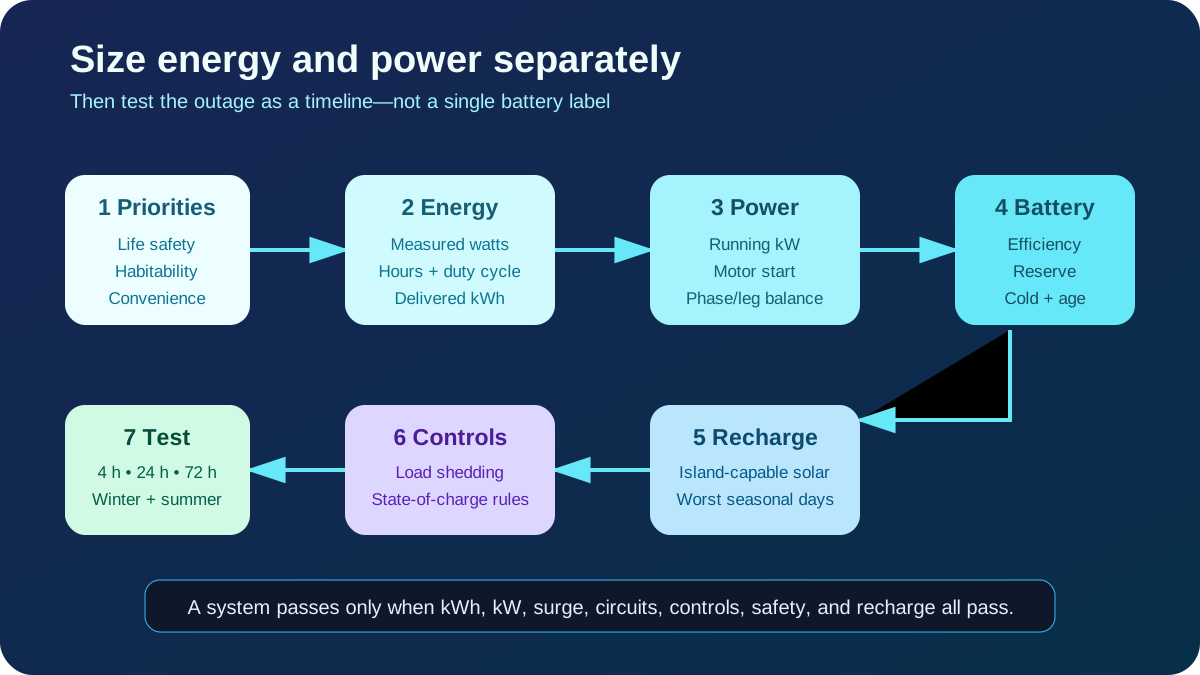
Short answer: Size a home backup battery in two dimensions. Energy capacity in kWh determines how long selected loads can run. Continuous and surge power in kW determine whether those loads can start and operate together. Build a critical-load schedule from measured watts and hours, add conversion losses and a reserve, test the worst seasonal day, then confirm the inverter, transfer equipment, circuits, solar-recharge path, installation location, and code compliance with qualified professionals.
Do not start with “How many batteries does a house need?” Start with “What must remain safe and usable during a 4-hour, 24-hour, and 72-hour outage?” A refrigerator, modem, sump pump, well pump, furnace controls, medical device, and one lighting circuit create a different design from whole-home air conditioning, an electric range, dryer, and EV charger.
Define Critical for Your Household
The U.S. Department of Energy describes critical loads as services considered essential or most important during an outage. At home, that depends on climate, occupants, water and sewer systems, medical needs, building type, and the outage hazard.
Create three tiers:
Tier 1: Life safety and damage prevention
Examples may include:
- prescribed medical equipment with an approved backup plan;
- smoke/CO alarms and required life-safety systems;
- sump or sewage pump;
- well pump where water is essential;
- boiler, furnace, heat-pump controls, or heat tracing in freezing weather;
- refrigeration for medicines or essential food;
- security or accessibility equipment;
- communications needed for alerts and assistance.
Battery planning is not a substitute for a medical contingency plan, safe evacuation, flood plan, or emergency services. Some equipment requires a manufacturer-approved uninterruptible supply or generator rather than a general home battery.
Tier 2: Basic habitability
Examples include a refrigerator/freezer, several LED lights, modem/router, phone charging, selected receptacles, garage access, ventilation, and limited cooking.
Tier 3: Comfort or convenience
Air conditioning, electric resistance heat, water heating, laundry, oven, hot tub, workshop loads, and EV charging can consume far more energy or power. They may be allowed only when the battery state and solar forecast support them.
Write a rule for each load: always on, scheduled, manual approval, or shed automatically.
Separate Energy From Power
These two terms decide whether the design works.
Energy (kWh) is accumulated use. A 100 W device running for 10 hours uses 1 kWh.
Power (kW) is the rate at an instant. A pump may use only 1 kWh in a day but demand several kW for a short start.
A battery can have enough stored energy for 24 hours and still trip when a well pump and refrigerator start together. Or it can have high power output but only a few hours of stored energy.
Check:
- usable battery energy;
- continuous inverter output;
- short-duration surge or motor-start capability;
- output per phase or leg where relevant;
- maximum backed-up breaker and conductor capacity;
- ambient-temperature derating;
- low-state-of-charge behavior;
- islanded neutral, grounding, and transfer design;
- simultaneous-load control.
Manufacturer peak-power numbers use defined durations and conditions. A ten-second rating does not prove that an air conditioner can start reliably at low battery state in cold weather.
Build a Measured Load Inventory
Use measured data when possible:
- circuit-level energy monitor;
- utility interval data;
- battery or smart-panel records;
- plug-in meter for suitable cord-connected devices;
- equipment label and manufacturer documents;
- clamp or power-quality measurements by an electrician;
- controller runtime logs;
- fuel appliance controls and blower specifications.
Do not place a plug meter on hardwired or incompatible equipment. Do not open panels or measure live conductors without qualifications.
Use this worksheet:
| Load | Running W | Start/surge W | Hours/day or duty cycle | Daily kWh | Priority | Season |
|---|---|---|---|---|---|---|
| Refrigerator | 1–2 | All | ||||
| Modem/router | 2 | All | ||||
| Heating controls/blower | 1 | Winter | ||||
| Sump pump | 1 | Storm | ||||
| Well pump | 1 | All | ||||
| Lighting | 2 | All | ||||
| Medical equipment | 1 | All | ||||
| Refrigerator/freezer 2 | 2 | All | ||||
| Selected receptacles | 2 | All |
Measure several ordinary days and at least one demanding seasonal day. A furnace blower in January, sump pump in a rainstorm, and refrigerator in a hot kitchen have different duty cycles from a mild Tuesday.
Calculate Daily Critical-Load Energy
For a steady load:
Daily energy (kWh) = watts × operating hours ÷ 1,000
For a cycling load:
Daily energy = running kW × 24 hours × duty cycle
A 140 W refrigerator compressor operating 35% of the day screens as:
0.14 kW × 24 × 0.35 = 1.18 kWh/day
Real refrigerator energy includes defrost heaters, fans, controls, door opening, room temperature, and start events. A plug meter over several days is better than this simplified screen.
If refrigeration energy rises while cabinet temperatures drift, treat it as an appliance and food-safety problem rather than increasing the battery allowance indefinitely. The warm-refrigerator/cold-freezer diagnostic separates temperature, airflow, door, frost, and service evidence before a backup-load number is trusted.
Add all scheduled loads. Do not add the start watts as if they ran for 24 hours; surge belongs in the power test.
Worked 24-hour critical-load schedule
This is an illustrative home, not a default:
| Load | Operating assumption | Energy |
|---|---|---|
| Refrigerator | measured daily total | 1.25 kWh |
| Freezer | measured daily total | 0.95 kWh |
| Modem/router/ONT | 28 W × 24 h | 0.67 kWh |
| LED lighting | 75 W × 6 h | 0.45 kWh |
| Phones/laptops | measured allowance | 0.60 kWh |
| Gas furnace blower/controls | seasonal measured total | 3.10 kWh |
| Sump pump | 700 W × 0.75 h | 0.53 kWh |
| Cooking small appliances | scheduled allowance | 0.70 kWh |
| Delivered AC energy | 8.25 kWh |
The same house during a mild-season outage might use far less because the furnace and sump pump are idle. Size against the event you are buying protection for.
Convert Load Energy to Required Battery Energy
The battery must supply more than delivered AC load because the system has conversion, standby, control, and wiring losses. It may also reserve some charge and limit usable depth.
A screening equation is:
Required nominal kWh = delivered AC kWh ÷ inverter-path efficiency ÷ usable fraction ÷ temperature/age factor
For the 8.25 kWh example, assume only for screening:
- conversion path efficiency: 92%;
- allowed usable fraction after reserve: 90%;
- cold/age planning factor: 90%.
8.25 ÷ 0.92 ÷ 0.90 ÷ 0.90 = 11.07 kWh nominal
Round only after checking available modular sizes and manufacturer data. Do not hide a 20% “safety factor” on top of conservative duty cycles, low efficiency, deep reserve, and temperature derating without showing the stack. Layered conservatism can become an expensive oversize.
Decide the Reserve Explicitly
Reserve is energy intentionally held back. It can cover unexpected load, a delayed restoration, battery operating limits, or a forecast error. A higher reserve improves protection but reduces usable runtime.
Define:
- normal grid-connected reserve;
- reserve once an outage starts;
- minimum state of charge for Tier 1 loads;
- automatic shedding thresholds;
- manual override rules;
- reserve for a second outage after restoration;
- whether grid charging before a forecast storm is allowed by the system and tariff.
Example rule:
- above 60%: Tier 1 and Tier 2 permitted;
- 30–60%: shed cooking and second freezer;
- 15–30%: Tier 1 plus communications and one light circuit;
- below 15%: medical plan, refrigeration triage, and outage contingency actions.
The exact thresholds depend on the battery and household. Test the automation before an emergency.
Run the Power and Surge Test
List the highest loads that could overlap. Include motor start, defrost, compressor, pump, and heating transitions.
| Event | Running kW after start | Start/surge evidence | Can overlap? | Control |
|---|---|---|---|---|
| Well pump starts | Manufacturer/test | Yes with fridge | Priority relay | |
| Refrigerator starts | Manufacturer/test | Yes | Natural cycling | |
| Sump pump starts | Manufacturer/test | During storms | Never shed | |
| Furnace blower starts | Manufacturer/test | Winter | Priority | |
| Microwave operates | Label/test | User controlled | Lockout if pump active |
Compare three values:
- maximum likely running power;
- worst credible start event while other loads run;
- inverter continuous and surge ratings under the design conditions.
Also check output by phase/leg. A split-phase system can meet total kW while overloading one leg. The electrical designer must balance backed-up circuits and respect breaker, conductor, and equipment limits.
Soft starters or variable-speed equipment can reduce some motor-start demand, but only when listed, compatible, correctly installed, and proven with the exact equipment. They do not reduce the running energy enough to turn large HVAC loads into free backup.
Whole-Home Transfer or Critical-Loads Panel?
A dedicated critical-loads panel physically separates selected circuits. Whole-home transfer can connect the full service while controls shed loads during island operation.
Dedicated panel
Possible benefits:
- clear electrical boundary;
- fewer accidental heavy loads;
- simpler operating expectations;
- potentially smaller inverter and battery;
- easier manual review of backed-up circuits.
Possible limits include panel space, circuit relocation, multiwire branch circuits, shared neutrals, future changes, and a fixed list that may not fit every season.
Whole-home connection with load control
Possible benefits include flexible priorities, circuit monitoring, seasonal rules, and the ability to allow a heavy load briefly.
Risks include control dependency, network/software behavior, poor commissioning, user override, failed contactors, and an assumption that “whole-home backup” means every appliance can operate together. Ask what happens if the controller loses communications.
The electrical-panel capacity guide explains service capacity. Backup output and grid-connected service capacity are separate calculations.
Solar Recharge Changes the Outage Timeline
Solar can extend runtime only if the system is designed to island and charge the battery during an outage. Ordinary grid-tied solar shuts down when the grid fails.
For each outage day:
End-of-day battery energy = start energy + usable solar charge − critical-load energy − system losses
Use seasonal, weather-aware solar ranges from the PVWatts production method. Then account for:
- snow or debris;
- cloud and smoke;
- shorter winter days;
- array/inverter power limit;
- battery maximum charge rate;
- household load while solar operates;
- reserve and full-battery curtailment;
- whether all roof planes operate in backup mode;
- morning restart requirements.
Three-day outage example
Assume 11.1 kWh usable planning energy at the start and 6.5 kWh/day of managed critical load.
| Day | Usable solar into battery | Load | End state |
|---|---|---|---|
| Start | - | - | 11.1 kWh |
| Day 1 cloudy | 2.0 kWh | 6.5 kWh | 6.6 kWh |
| Day 2 mixed | 4.5 kWh | 6.5 kWh | 4.6 kWh |
| Day 3 clear | 7.5 kWh | 6.5 kWh | 5.6 kWh |
This system survives the modeled sequence with disciplined loads. A zero-solar second day would require further shedding or another backup source. Do not promise indefinite operation from an annual-average solar number.
Winter and Summer Are Different Designs
Winter can combine low solar, cold battery conditions, heating load, and freezing risk. Summer can combine higher solar with refrigeration, cooling, sump pumping from storms, wildfire shutoffs, or medical cooling needs.
Build at least four cases:
- four-hour evening outage;
- 24-hour mild-weather outage;
- 72-hour worst winter sequence;
- 72-hour worst summer/storm sequence.
For each, list starting charge, solar availability, load schedule, shed thresholds, minimum indoor conditions, water needs, and contingency action. The “worst” case depends on location. A Toronto winter, Phoenix summer, Florida hurricane, and rural well-dependent home need different plans.
Heating and Cooling Can Dominate the Battery
Do not use a generic HVAC watt number. Measure or model the exact equipment, stage, auxiliary heat, blower, crankcase heater, controls, and climate duty cycle.
Fuel-fired heating still needs electricity for controls, inducer, ignition, pumps, zone valves, and blower. A hydronic system may have several pumps. A cold-climate heat pump can draw much more during cold weather, especially if electric backup heat operates.
Decide whether backup must maintain full comfort or only prevent unsafe temperature and pipe damage. A smaller conditioned safe room, pre-outage temperature adjustment, envelope improvements, and load shedding can reduce required backup energy. Never use unvented combustion appliances indoors as an improvised heat source.
Pumps Need Special Attention
Sump, well, sewage, and condensate pumps combine uncertain runtime with motor-start demand. A storm that causes the outage may also create the highest pumping load.
Record:
- motor label and controller;
- voltage and phase;
- measured running and start behavior;
- cycles per hour during a demanding event;
- storage tank or basin capacity;
- high-water alarm;
- check-valve and mechanical condition;
- alternate drainage or water plan;
- whether the pump shares a circuit.
Battery capacity cannot repair a clogged discharge, failed float, waterlogged pressure tank, or undersized pump. Maintain the mechanical system too.
Medical and Accessibility Loads Need Their Own Plan
Ask the device manufacturer and healthcare provider about approved backup, power quality, alarms, battery duration, maintenance, and emergency procedure. A home battery may be one layer, not the only layer.
Document:
- exact device and power supply;
- continuous versus intermittent need;
- internal battery condition;
- acceptable interruption time;
- heating, cooling, refrigeration, or communications dependencies;
- alternate location and transport;
- utility medical-alert program if available;
- caregiver and emergency contacts.
Do not rely on a marketing runtime estimate for a life-safety decision. Test approved equipment under professional guidance and keep the contingency current.
Installation and Fire Safety Are Design Inputs
Battery capacity is only one part of a safe system. Codes and manufacturer instructions govern listed equipment, location, separation, ventilation, protection from impact, temperature, egress, detection, disconnects, signage, permits, and responder information.
Use qualified installers and the authority having jurisdiction. Do not install or relocate a large battery from an internet diagram. Do not open, transport, dismantle, or attempt to extinguish a damaged battery without emergency guidance.
Ask the installer:
- Which product listing and installation standard apply?
- Is the location within temperature and environmental limits?
- How is vehicle impact prevented in a garage?
- What clearances and fire-resistance rules apply locally?
- Where are disconnects and shutdown instructions?
- What does the household do after flood, fire, impact, odor, smoke, unusual heat, or alarm?
- Has the local fire service or responder pre-plan requirement been addressed?
- How is the battery recycled or returned at end of life?
EPA and NFPA resources emphasize that stored energy and reignition can matter after damage. Leave incident response to trained professionals.
Compare Battery, Generator, and V2H Roles
A battery is quiet, automatic, and useful for daily tariff or solar operation, but finite energy can be costly for long-duration heavy loads. A generator can provide longer duration when fuel is available, but adds combustion, noise, maintenance, siting, transfer, and fuel risks. Vehicle-to-home can offer a large energy reservoir, but the vehicle may be away and compatibility is product specific.
Use the V2H compatibility and runtime guide for the complete vehicle, charger, islanding, export-power, and driving-reserve chain.
Hybrid designs need controls that prevent unsafe backfeed and define which source forms the island. Never connect a portable generator to house wiring without approved transfer equipment installed by qualified professionals. Never run combustion equipment indoors, in a garage, or near openings.
Turn Sizing Into a Contractor Specification
Give bidders the same performance request:
- deliver the named Tier 1 and Tier 2 loads for the defined scenarios;
- show measured or documented load assumptions;
- show required nominal and usable kWh;
- show continuous and surge power by relevant phase/leg;
- state reserve, efficiency, temperature, and degradation assumptions;
- show critical-load panel or load-control architecture;
- show solar behavior during grid outage;
- list automatic and manual shedding rules;
- identify permits, utility approval, and inspection;
- provide commissioning and outage-test procedure;
- state equipment, workmanship, capacity, and labor warranties;
- provide monitoring access, maintenance, incident, and end-of-life plans.
A bidder who cannot show the load table is selling capacity without proving the job.
Commission With a Controlled Outage Test
The installer and owner should plan a safe test under the manufacturer and utility rules. Do not create an outage by unsafe switching.
Verify:
- transfer occurs as designed;
- Tier 1 circuits remain powered;
- non-backed-up circuits are actually off;
- major motors start under a realistic overlap;
- per-leg or phase load stays within limits;
- load shedding triggers at chosen thresholds;
- solar charges the battery in island mode if designed to do so;
- monitoring reports grid, solar, battery, and load correctly;
- manual shutdown and restoration are understood;
- alarms reach the owner;
- the system returns to grid mode cleanly.
Record starting state of charge, load, power, energy, solar, temperature, events, and ending state. Repeat seasonally or after major equipment, firmware, circuit, or household changes.
Operating Card for the Wall
Keep a one-page card near the approved owner controls:
- emergency and installer contacts;
- battery and transfer equipment models;
- approved shutdown procedure;
- Tier 1 loads;
- loads never allowed in outage mode;
- state-of-charge thresholds;
- storm pre-charge instructions if supported;
- medical and water contingencies;
- solar restart expectations;
- signs that require evacuation or emergency response;
- date of last test.
Do not put access credentials or sensitive medical details on a public-facing card. Keep full records securely.
Frequently Asked Questions
How many kWh does a home need for battery backup?
There is no useful single household number. Measure the selected loads and hours, then adjust for efficiency, usable fraction, reserve, temperature, age, and solar. The worked critical-load example in this guide needed about 11.1 nominal kWh under its assumptions; another home may need far less or several times more.
Can one battery run a whole house?
It may connect to a whole house, but stored energy and power still limit which loads can operate. Large HVAC, resistance heat, ranges, dryers, pumps, and EV charging can exceed runtime or surge limits. “Whole-home” describes architecture, not unlimited output.
Should I size from my utility bill?
Use the bill as a reasonableness check, not the only input. Monthly kWh hides timing, surge, circuit priority, seasonal extremes, and the difference between essential and optional loads.
Does solar keep a battery charged during an outage?
Only when the solar, inverter, battery, transfer equipment, and controls are designed and approved for island operation. Standard grid-tied solar commonly shuts down for safety when the grid fails.
What reserve percentage should I use?
Choose it from outage risk, forecast uncertainty, battery instructions, critical-load needs, and alternate plans. Show the reserve explicitly. A larger reserve reduces normal usable energy but protects contingency capacity.
Can a battery start a well pump or central air conditioner?
Sometimes, but total kWh does not answer it. The inverter must meet running and start demand under actual conditions, the electrical architecture must support the load, and other simultaneous loads may need control. Use manufacturer data and qualified measurement.
Is battery backup financially worth it?
Backup value is partly avoided loss and risk tolerance, not just bill savings. Use the home battery value and payback guide for tariff, incentive, and resilience screening, then keep this load design as the technical gate.
What to Read Next
If an EV is already parked at home for long periods, compare stationary storage with the vehicle-to-home compatibility and runtime method before buying capacity twice.
About the Editorial Team EnergyBS uses public resilience and safety guidance plus transparent household-load math. Worked values are illustrative, not equipment specifications. Use current manufacturer documents, local permits, the authority having jurisdiction, and qualified electrical design.
Sources and Verification
- U.S. DOE: Microgrid Overview Fact Sheet
- U.S. DOE: Voices of Experience Microgrids for Resiliency
- U.S. DOE: How Distributed Energy Resources Improve Resilience
- NREL: Best Practices for Operation and Maintenance of Photovoltaic and Energy Storage Systems
- NFPA: Energy Storage Systems Safety Fact Sheet
- U.S. EPA: Battery Energy Storage Systems Safe Installation and Incident Response
Editorial Review
EnergyBS Editorial Team
EnergyBS publishes practical homeowner guides. Important program, product, and cost claims should be checked against the linked source and local project documents before you commit to work.
Related Guides
View All ArticlesIs Home Battery Storage Worth It in 2026? Costs, Backup
Home batteries have evolved from emergency backups to active financial assets. We break down the real costs of Tesla Powerwall 3 and Enphase 5P in 2026, analyze Virtual Power Plant payments, and run the payback math.
VehicletoHome (V2H)
Plan EV backup power from a verified vehiclechargerhome equipment match, criticalload profile, reserve state of charge, islanding design, conversion losses, solar behavior, and utility approvals.
Solar Production Estimate Guide 2026 Tool (Guide & Data)
A homeowner method for independently checking quoted solar kWh using roof planes, tilt, azimuth, shading, DCtoAC ratio, system losses, weather variability, utility load data, and postinstallation verification.