AC Repair Cost 2026: What Repairs Really Cost, by Part
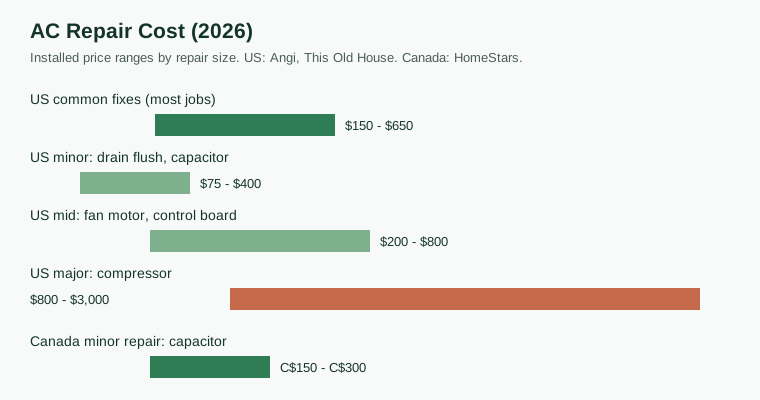
An air conditioner repair costs about $350 on average in the US in 2026, and most common fixes land between $150 and $650 (Angi; This Old House). The failed part decides the bill: a drain line flush runs $75 to $250, a capacitor $100 to $400, a fan motor $200 to $800, a refrigerant leak repair $200 to $1,500, an evaporator coil $700 to $2,500, and a compressor $800 to $3,000 (Angi; This Old House; HomeGuide). In Canada, a seasonal tuneup runs C$100 to C$300, a capacitor C$150 to C$300, and technician labour C$85 to C$150 per hour (HomeStars); one Ontario company's published 2026 list puts a compressor at C$1,500 to C$3,500. This guide prices repairs by part and by symptom for both countries, explains why a refrigerant recharge without a leak repair is money spent twice, and works the repairorreplace math on three labelled examples.
Quick Checks
- 1Budget about $350 as the US average HVAC repair in 2026, with most common AC fixes between $150 and $650 (Angi; This Old House). The spread runs from a $75 drain flush to a $3,000 compressor, so the average alone tells you little about your quote.
- 2The part sets the price: drain line flush $75 to $250 and capacitor $100 to $400 at the low end in the US; fan motor $200 to $800 and control board $100 to $700 in the middle; refrigerant leak repair $200 to $1,500; evaporator coil $700 to $2,500; compressor $800 to $3,000 (Angi; This Old House; HomeGuide).
- 3In Canada, expect a C$100 to C$300 seasonal tune-up, C$150 to C$300 for a capacitor, and C$85 to C$150 per hour for technician labour (HomeStars). One Ontario company's published 2026 list puts a blower motor at C$400 to C$1,500 and a compressor at C$1,500 to C$3,500.
- 4A refrigerant recharge with no leak repair is money spent twice. Refrigerant is not consumed; a system that is low has a leak, and in Ontario the leak has to be found and fixed before a recharge is legal.
- 5Use two tests before a big quote: the 50 percent rule (replace if one repair passes half the cost of a new system, Angi) and the $5,000 rule (age in years times the repair quote; over $5,000 points to replacement, This Old House). Past about 12 years, lower the threshold for compressor and coil quotes.
AC Repair Cost 2026: What Repairs Really Cost, by Part
By EnergyBS Editorial Team | October 26, 2026
The Short Answer
Short Answer: An air conditioner repair costs about $350 on average in the US in 2026, and most common fixes land between $150 and $650 (Angi; This Old House, whose cost data comes from Angi contractor estimates and Home Depot pricing). Where your bill lands depends on the failed part: a condensate drain flush is $75 to $250, a capacitor $100 to $400, a contactor $100 to $450, a fan motor $200 to $800, a control board $100 to $700, a refrigerant leak repair $200 to $1,500, an evaporator coil $700 to $2,500, and a compressor $800 to $3,000 (Angi; This Old House; HomeGuide). In Canada, a seasonal tune-up runs C$100 to C$300, a capacitor C$150 to C$300, and labour C$85 to C$150 per hour (HomeStars); one Ontario company's published 2026 price list puts a blower motor at C$400 to C$1,500 and a compressor at C$1,500 to C$3,500. This guide prices repairs by part and by symptom for both countries, covers the refrigerant rules that change what a recharge quote should include, and works the repair-or-replace math on three labelled examples. Our furnace repair cost guide and heat pump repair cost guide price the other two machines in the same series.
The repair in six steps:
- Rule out the free causes first: a clogged filter, a thermostat set to heat or fan-only, a tripped breaker, a blocked outdoor unit.
- Book a diagnostic visit and confirm the fee, and whether it is credited toward the repair.
- Get the failed part named in writing, with the part price and the labour shown as separate lines.
- Check the quote against the by-part ranges in Section 2 (US) or Section 3 (Canada).
- Run the two tests in Section 7 before approving anything over $500, and factor in the age of the system and its refrigerant.
- Keep the invoice, any refrigerant type and amount added, and the repair warranty terms.
1. What a Repair Bill Is Made Of
Every AC repair quote is three lines wearing one number: the visit, the part, and the labour. The split matters because two of the three are negotiable in ways the total is not, and because the cheapest-looking quote often just hides one of them.
The diagnostic fee. Angi puts an initial HVAC service call at $100 to $250. This Old House puts a diagnostic fee at $75 to $150 and notes that some companies apply it toward the repair bill if you proceed. HomeGuide puts a service call or diagnostic at $75 to $200. In Canada, HomeStars puts a diagnostic at C$75 to C$150 in its capacitor guide and C$99 to C$150 in its Vancouver HVAC guide. Ask when you book whether the fee is credited if you go ahead. A credited fee makes the first quote cheaper to test; an uncredited fee makes a second opinion cost real money, which is worth knowing before the truck rolls.
The part. The capacitor shows the pattern clearly. In Canada the part itself usually costs C$10 to C$50, and labour plus the service call account for 60 to 80 percent of the replacement bill (HomeStars). You are mostly paying for the diagnosis and the visit, not the component. That cuts both ways: a capacitor quote far above the range in Section 2 is a labour or markup problem, and a capacitor quote far below it usually means the diagnosis has not happened yet.
The labour and the clock. Angi puts HVAC labour at $100 to $250 per hour on top of parts, after the initial service call. HomeStars puts Canadian technician labour at C$85 to C$150 per hour. Emergency work is a separate line: Angi puts the after-hours premium at an added $40 to $80 per hour in the US, and HomeStars puts a Canadian emergency or after-hours call at C$200 to C$500 or more, with C$100 to C$200 added over a scheduled capacitor job. A house that is uncomfortable can usually wait for a weekday slot. A house with a breaker that keeps tripping, or water leaking from the indoor unit, cannot, and Section 5 separates those cases.
2. AC Repair Cost by Part (US)
Three US sources publish by-part tables for 2026: Angi (updated August 2026), This Old House (built from Angi contractor estimates and Home Depot pricing), and HomeGuide. Their ranges differ, sometimes by a lot on coils and compressors. All three are shown, because the gap between reputable sources is itself information when you are holding a quote: a price inside all three ranges is ordinary, a price above all three needs an explanation, and a price below all three usually means part of the job is missing.
| Repair | Installed cost (US) | Source |
|---|---|---|
| Condensate drain line flush | $75 to $250 | Angi ($75 to $200 cleaning) and HomeGuide |
| AC tune-up | $70 to $200 | Angi and HomeGuide |
| Capacitor replacement | $100 to $250 | Angi and HomeGuide (This Old House: $150 to $400) |
| Relay or contactor replacement | $100 to $450 | This Old House (HomeGuide contactor: $200 to $450) |
| Thermostat replacement | $100 to $500 | This Old House (Angi: $150 to $350; HomeGuide: $140 to $350) |
| Refrigerant recharge only | $100 to $500 | Angi (HomeGuide: $100 to $600) |
| Control or circuit board replacement | $100 to $700 | Angi ($100 to $600), This Old House ($200 to $800), HomeGuide ($150 to $700) |
| Expansion valve (TXV) replacement | $100 to $500 | Angi (HomeGuide: $300 to $500) |
| Fan or blower motor replacement | $200 to $900 | This Old House fan motor ($300 to $800), Angi ($100 to $700), HomeGuide blower ($300 to $900) |
| Refrigerant leak repair (find, fix, recharge) | $200 to $1,500 | HomeGuide and This Old House (Angi: $250 to $1,500) |
| Evaporator coil replacement | $700 to $2,500 or more | This Old House (Angi coil: $600 to $2,400; HomeGuide: $1,000 to $4,500) |
| Compressor replacement | $800 to $3,000 | Angi (This Old House: $1,000 to $3,000 or more; HomeGuide: $600 to $2,500) |
| Condenser coil replacement | $1,000 to $2,700 or more | This Old House |
| Air handler replacement | $1,500 to $3,400 | HomeGuide |
Read the table by tier, because the tiers drive different decisions:
The $75 to $450 tier is electrical wear items and water management. Capacitors, contactors, thermostats, and drain flushes are the calls that fill a technician's day in July. The parts are cheap; the diagnosis is the product. These repairs are worth doing at almost any system age, because a failed capacitor says little about the health of the sealed refrigerant system behind it. The exception is repetition: a third electrical call in one summer on a 14-year-old system is a pattern, and patterns belong in the Section 7 math.
The $200 to $900 tier is motors, boards, and valves. A fan motor, a blower motor, a control board, or a TXV sits in the middle: real money, but the repair restores the system rather than extending a dying one, provided the compressor and coils are sound. This tier is where an itemized quote matters most, because the same symptom (weak airflow, short cycling) can be priced as a $140 thermostat or a $700 board depending on what the technician actually tested.
The $700-plus tier is a replacement conversation. A compressor at $800 to $3,000, an evaporator coil at $700 to $2,500 or more on This Old House figures (up to $4,500 on HomeGuide), a condenser coil at $1,000 to $2,700 or more. Angi's own repair-versus-replace table puts a typical AC repair at $450 to $1,000 against a replacement at $3,800 to $7,500, so a quote in this tier is already inside replacement territory and should be priced against a new system before parts are ordered. Our compressor repair or replace guide works the compressor case in full, and our central AC replacement cost guide prices the replacement side.
One related cost sits outside the unit itself: ductwork. Angi prices ductwork repair at $500 to $2,000. A cooling problem that lives in crushed, leaking, or disconnected ducts will survive any amount of spending on the outdoor unit, which is why a good diagnostic checks airflow at the vents before it condemns a part.
3. AC Repair Cost in Canada
Canadian pricing is thinner than US pricing in the national guides. HomeStars publishes Canadian servicing and capacitor tables, plus city HVAC guides, and individual Canadian companies publish their own lists. Between them, a Canadian homeowner can bracket most quotes, with the caveat that a single company's list is that company's prices, not a national average.
Servicing and common repairs (Canada, HomeStars, Canadian dollars):
| Service or repair | Typical cost (Canada) |
|---|---|
| Seasonal tune-up (standard) | C$100 to C$300 |
| Annual tune-up and inspection | C$100 to C$200 |
| Diagnostic test or service call | C$75 to C$150 |
| Capacitor replacement | C$150 to C$300 (dual-run: C$200 to C$400) |
| Thermostat recalibration or replacement | C$150 to C$350 |
| Coil cleaning (evaporator or condenser) | C$150 to C$400 |
| Refrigerant recharge | C$50 to C$150 per pound (Vancouver guide: C$200 to C$600 flat) |
| Ductless mini-split service (single zone) | C$100 to C$250 |
| Emergency or after-hours call | C$200 to C$500 or more |
Labour context: Canadian HVAC technicians charge C$85 to C$150 per hour, and a capacitor bill is 60 to 80 percent labour and service call, on a part that costs C$10 to C$50 on its own (HomeStars). HomeStars' Vancouver guide puts HVAC repairs overall at C$100 to C$1,500, with coil replacements at C$500 to C$2,500.
By issue (Ontario, one company's published 2026 list, Canadian dollars): LG Home Comfort, an Ontario HVAC company, publishes repair prices by problem: thermostat C$150 to C$400, capacitor C$200 to C$400, contactor C$200 to C$450, drain clearing C$80 to C$200, coil cleaning C$150 to C$400, blower motor C$400 to C$1,500, minor refrigerant leak repair C$300 to C$800, a major leak repair involving a coil C$800 to C$2,200, an R-410A recharge C$250 to C$800, and a compressor C$1,500 to C$3,500. Read it as a worked example of how one Ontario company prices, and as a cross-check: its capacitor and thermostat figures sit just above the HomeStars ranges, and its compressor figure sits well above the Vancouver guide's range, which is the normal spread between a platform guide and a single company's list.
Replacement context for Section 7: HomeStars puts central air conditioning installation in Vancouver at C$3,000 to C$7,000. A C$3,500 compressor quote against a C$5,000 replacement quote is a different decision from the same quote against a C$7,000 replacement, which is why the replacement quote has to be real and written, not estimated from memory.
A note on refrigerant work in Ontario: a recharge is not a standalone repair. The Ontario list above prices an R-410A recharge at C$250 to C$800 and states the provincial rule directly: a technician must locate and fix the underlying leak before recharging, and handling refrigerants requires 313A or 313D certification. Section 6 covers the same point for US systems.
4. Repair Cost by System Type
This Old House prices common repairs by the kind of air conditioner, using Angi contractor estimates and Home Depot pricing. The ranges cover common issues, not the rare high-cost failures such as a compressor:
| AC unit type | Common issues | Average repair cost (US) |
|---|---|---|
| Central air conditioner | Frozen coils, drain clogs, thermostat issues, capacitor failure, low refrigerant | $150 to $650 |
| Ductless mini-split | Drain clogs, circuit board issues, sensor issues | $250 to $900 |
| Window air conditioner | Thermostat failure, air leaks, fan malfunctions | $100 to $400 |
| Portable air conditioner | Electrical power issues, clogged filters, clogged drain line | $80 to $300 |
| Packaged AC unit | Ignition problems, thermostat malfunction, duct leakage, blower malfunction | $300 to $900 |
| Dual-fuel or hybrid system | Electronic component issues, gas burner malfunction | $300 to $1,200 or more |
| Evaporative cooler | Water pump issues, mineral build-up, motor belt issues | $100 to $500 |
| Geothermal heat pump | Water loop leakage, water pump issues, electronic issues | $400 to $1,500 or more |
Angi's own by-type table puts AC repair higher, at $450 to $2,000, because it averages in the major repairs that the This Old House table sets aside. Both are usable: price a common failure against the This Old House range for your system type, and price a major failure against Section 2.
Two type notes. First, window and portable units sit in an odd spot: a $250 repair on a unit that cost $400 new fails the 50 percent test in Section 7 on arrival, which is why most window AC problems end in replacement rather than repair. Second, mini-split repairs start higher and climb on brand-specific parts: a failed inverter board or a multi-zone compressor is priced from the manufacturer's parts list, not a generic shelf. Our ductless mini-split installation cost guide prices the replacement side for those systems, and our central AC vs mini-split comparison covers how the two system types differ before you own either.
5. Symptoms, Likely Parts, and What Each Costs
A quote makes more sense when you can map the symptom to the short list of parts that cause it, using the US ranges from Section 2.
- Outdoor unit hums, fan does not spin, no cooling. Capacitor first ($100 to $400), then the contactor ($100 to $450) or the fan motor ($200 to $800). This is the most common summer call in these guides, and the cheapest major symptom to fix. Stop restarting it: repeated start attempts against a failed capacitor strain the compressor.
- Runs, but blows warm air. Low refrigerant from a leak ($200 to $1,500 to find, fix, and recharge), a frozen evaporator coil from restricted airflow, or a compressor that is running weakly ($800 to $3,000). Our frozen evaporator coil guide walks the frozen case in order: filter and airflow first, refrigerant second.
- Water pooling around the indoor unit. A clogged condensate drain ($75 to $250 to flush) or a cracked drain pan ($200 to $800, This Old House). Many systems have a float switch that shuts the unit down when the drain backs up, so this symptom often arrives as "the AC stopped" rather than "the AC leaks." Our condensate drain guide covers the clearing and the damage check.
- Short cycling: starts, runs a few minutes, stops, repeats. Thermostat ($100 to $500), control board ($100 to $700), low refrigerant, or airflow restriction tripping a safety limit. The diagnosis is what you are paying for here; the parts span the whole table.
- Breaker trips when the system starts. Capacitor, contactor, a fan motor drawing high current, or a compressor electrical fault. Stop resetting this one and call: the range runs from a $100 capacitor to a $3,000 compressor, and repeated trips are the system reporting an electrical problem.
- Ice on the refrigerant lines or the indoor coil. Airflow first (filter, blower, closed registers), then refrigerant charge. Running a frozen system strains the compressor and can flood it with liquid refrigerant on thaw. Turn cooling off, run the fan to thaw it, and book the visit.
- Electric bill jumps with no change in the weather. A system low on refrigerant, short cycling, or fighting a dirty coil runs far longer hours while still holding temperature, for a while. The bill penalty for waiting is the part nobody quotes you, and it is why a mid-tier repair in June is cheaper than the same repair in August plus two months of long run times.
6. The Refrigerant Note: R-22, R-410A, and R-454B
Refrigerant is where AC repair pricing has a memory. Three generations of equipment are still in service, and which one you own changes what a leak is worth fixing.
R-22 systems (installed before about 2010). R-22 production and import ended in 2020, so service refrigerant is recycled stock only. A recharge on an R-22 system is priced from scarcity, and a major leak repair on one usually fails the Section 7 tests on age alone: the newest R-22 systems are past 15 years old.
R-410A systems (the bulk of systems installed from about 2010 to 2024). Still fully serviceable. Nothing in the current transition bans repairing or recharging one. The change is on the manufacturing side: under the EPA Technology Transitions Program, new residential air conditioning and heat pump systems are limited to refrigerants with a global warming potential of 700 or less, with manufacture and import restrictions beginning January 1, 2025 (Carrier). R-410A has a GWP of 2,088, so it fails that limit for new equipment.
New systems (R-454B and R-32). R-454B has a GWP of 466 and R-32 a GWP of 675. Both are classed A2L, mildly flammable, and the equipment is designed for them. Carrier states the practical point directly: R-454B is not a drop-in replacement for R-410A, and an existing R-410A system should not simply be converted. A quote proposing a cheap refrigerant conversion is proposing something the manufacturer says not to do.
For a repair decision in 2026, three rules follow:
- A recharge is not a repair. Refrigerant circulates in a sealed loop and is not used up. A system that is low has a leak. The priced job is leak repair plus recharge ($200 to $1,500, HomeGuide and This Old House), and a recharge-only quote ($100 to $600) buys you the same failure again on a schedule set by the size of the leak. In Ontario, fixing the leak first is a provincial requirement, not a preference.
- Refrigerant type belongs in the compressor decision. A compressor replacement on an R-410A system is defensible at 8 years and hard to defend at 14, because it locks in years of dependence on a refrigerant no longer used in new equipment, on coils that are ageing alongside it. Example B in Section 7 works the case.
- The leak location decides more than the leak size. A leak at a service valve or a flare fitting is a fitting repair. A leak inside an evaporator coil is a coil replacement ($700 to $2,500 or more), because coils are rarely repairable in place. Ask where the leak is, and what test found it: HomeGuide prices a leak detection test at $100 to $330, inside the leak repair ranges above.
7. Repair or Replace: The Math
Angi gives air conditioners a lifespan of 12 to 20 years; This Old House puts the best residential cooling systems at 12 to 15 years. Replacement runs $3,800 to $7,500 on Angi's repair-versus-replace table, and $2,500 to $15,000 installed on This Old House figures, with size and efficiency driving the spread; our central AC replacement cost guide breaks that range down by tonnage and SEER2 rating, and our SEER2 explainer covers the rating you will be quoted. Two published rules do most of the work:
- The 50 percent rule (Angi): if a single repair costs more than half the price of a new system, replacement is the recommended call.
- The $5,000 rule (This Old House): multiply the age of the system in years by the repair quote. Over $5,000, replacement is likely the better option. A $300 repair at 9 years gives 2,700 (repair); a $1,200 repair at 11 years gives 13,200 (replace). The rule punishes big repairs on old systems, which is the combination that wastes money.
- The age check: under 10 years with no repair history, fixing is usually right. Past 12 to 15 years, or with a compressor or coil failure, or with a second major call in two seasons, price the replacement first even when a quote passes both rules.
Three labelled examples, with hypothetical quotes set inside the published ranges:
Example A: the 5-year-old central AC with a dead capacitor (US, hypothetical). The outdoor unit hums and will not start. Diagnostic quoted at $100, inside Angi's $100 to $250 service call range and This Old House's $75 to $150 diagnostic range, and credited toward the repair. Total quote $275 for a capacitor, inside This Old House's $150 to $400 band. Tests: $275 is 5 percent of a $5,500 replacement quote, inside Angi's $3,800 to $7,500 range, and 5 times $275 is $1,375 on the $5,000 rule. Age: 5 years, first repair. Decision: repair, no second quote needed at this size.
Example B: the 13-year-old R-410A central AC with a failed compressor (US, hypothetical). Compressor quote $2,200, inside Angi's $800 to $3,000 band. Replacement quote $6,800, inside Angi's $3,800 to $7,500 range. The 50 percent test says repair: $2,200 is 32 percent of $6,800. The $5,000 rule says replace: 13 times $2,200 is $28,600. The age check says replace: 13 years is inside This Old House's 12 to 15 year lifespan, the failed part is the compressor, and the system runs R-410A. Decision: replace, and spend the shopping effort on competing installation quotes. This is the case the two rules exist for: on a young system they agree, and on an old system with a major failure they split, and the split itself is the signal. The compressor-only version of this decision is worked in depth in our compressor repair or replace guide.
Example C: the 8-year-old central AC in Ontario with a failed blower motor (Canada, hypothetical). First quote C$1,100, inside the Ontario list's C$400 to C$1,500 blower motor band, including a C$150 diagnostic at the top of HomeStars' C$75 to C$150 range. A second company quotes C$850 for the same motor. Against a C$5,500 replacement quote (inside HomeStars' C$3,000 to C$7,000 Vancouver installation range), C$850 is about 15 percent of replacement. On the $5,000 rule applied in Canadian dollars unadjusted, 8 times C$850 is C$6,800, over the threshold. Age: 8 years, and the failed part moves air rather than refrigerant, so it says nothing about the sealed system. Decision: repair at the second quote, which also saved C$250 against the first. The $5,000 rule is a US rule of thumb from This Old House; on an 8-year-old system with a non-refrigerant repair and a clean history, it loses to the 50 percent test and the age check.
Two cost notes. First, a warranty changes the arithmetic more than any rule: a compressor or board inside its parts warranty leaves you labour and refrigerant handling only, and repair wins cases it would otherwise lose. Angi and This Old House both flag warranty coverage as a first check, and This Old House notes that under warranty you may receive parts at no cost and pay labour only. Second, frequency compounds: two $700 repairs in eighteen months on a 13-year-old system is a $1,400 pattern, even though each repair alone passed the 50 percent test.
8. Before You Call, and What Not to Touch
Four checks cost nothing and close a real share of calls:
- The filter. A clogged filter restricts airflow, forces longer run times, and can freeze the indoor coil. Pull it and replace it if you cannot see light through it. This Old House's repair guide passes on the same advice from its HVAC expert: clear debris from around the outdoor unit and check the vents before booking, because a unit without airflow cannot transfer heat.
- The thermostat. Confirm it is set to cool, the set point is below room temperature, the fan is on auto rather than on (fan-only mode blows uncooled air and reads as a cooling failure), and the batteries are alive.
- The breaker and the outdoor unit. Check the breaker once. Then look at the outdoor unit: debris packed into the fins, a fan blocked by a cover left on from winter, vegetation grown into the coil. Clear what you can reach safely, with the power off.
- The condensate drain. In cooling season a clogged drain triggers a float switch that shuts the system down to prevent water damage. That shutdown looks like a breakdown and is a cleaning job, not a part failure. Our condensate drain guide covers the check.
The boundary after those checks: refrigerant lines, compressors, coils, and internal electrical work belong to a licensed technician. Refrigerant handling is regulated and needs certification, and a capacitor can hold a charge after the power is off, which is why the cheapest part on the truck is still a professional job for most homeowners. Diagnosis is the skilled part; most parts in Section 2 are cheap next to finding the right one.
Prevention prices well against this table. Angi and HomeGuide both put a tune-up at $70 to $200 in the US; HomeStars puts a Canadian seasonal tune-up at C$100 to C$300. A failing capacitor found during a spring tune-up is a scheduled C$150 to C$300 job in Canada (HomeStars); the same failure on the first hot weekend is an emergency call at C$200 to C$500 or more, plus the diagnostic. Angi also prices maintenance contracts at $150 to $500 per year, which only pencils out if the visits actually happen and the contract covers the diagnostic fees you would otherwise pay.
9. Quote Checklist
- The diagnostic fee is stated before the visit, and whether it is credited toward the repair is confirmed.
- The failed part is named, and the test that confirmed it is described (a capacitance reading on a capacitor, a leak test result on a refrigerant quote, amp draw on a motor).
- Part and labour are separate lines, and the part is identified as OEM or aftermarket, with its price.
- The quote is checked against the by-part range for your country.
- Warranty status is checked first: a part inside its warranty should not be quoted at full price.
- Any refrigerant quote names the refrigerant type, the amount, and whether a leak test is included. A recharge with no leak repair is declined.
- Anything over $500 gets a second quote, unless waiting in a heat wave carries its own cost.
- The after-hours premium is a named number, so you can decide whether the repair can wait for a weekday slot.
- On any quote over $1,000, all three repair-or-replace tests are run: the 50 percent rule, the $5,000 rule, and the age check, not just the one that favours the sale being pitched.
- The invoice records the model and serial number, the part number installed, any refrigerant added, and the repair warranty terms.
Frequently Asked Questions
How much does AC repair cost in 2026?
The US average is about $350 for an HVAC repair (Angi), and most common AC fixes land between $150 and $650 (This Old House). In Canada, a seasonal tune-up runs C$100 to C$300, a capacitor C$150 to C$300, and labour C$85 to C$150 per hour (HomeStars). The failed part decides where a specific quote lands: see the by-part tables in Sections 2 and 3.
What is the most expensive AC repair?
The compressor, at $800 to $3,000 on Angi figures and $1,000 to $3,000 or more on This Old House figures, followed by coils (evaporator $700 to $2,500 or more; condenser $1,000 to $2,700 or more, This Old House) and a full air handler at $1,500 to $3,400 (HomeGuide). These are the repairs where the Section 7 tests matter most.
How much is an AC service call?
Angi puts an initial HVAC service call at $100 to $250; This Old House puts a diagnostic fee at $75 to $150, sometimes applied to the repair; HomeGuide puts it at $75 to $200. In Canada, HomeStars puts a diagnostic at C$75 to C$150. Confirm the credit policy when you book.
Why is my AC running but not cooling?
Start with the thermostat (cool mode, set below room temperature, fan on auto), the filter, and the outdoor unit. If the outdoor fan is not spinning, a failed capacitor or contactor is common ($100 to $450). Other causes need a technician: low refrigerant from a leak ($200 to $1,500 to repair), a frozen coil, or a failing compressor. Our frozen evaporator coil guide separates the airflow causes from the refrigerant causes.
Is it worth repairing a 12-year-old air conditioner?
For a wear item, usually yes: a $200 capacitor on a system with no other symptoms is a rational repair at almost any age. For a major part, run the tests. At 12 years the system is at the bottom of Angi's 12 to 20 year lifespan range and inside This Old House's 12 to 15 year range, and a $2,200 compressor quote gives 26,400 on the $5,000 rule. One cheap failure with a clean history is a repair; a major failure or a third call in two seasons is a replacement conversation.
How long does an AC repair take?
Simple electrical repairs (capacitor, contactor, thermostat) typically take one to two hours including diagnosis. A fan or blower motor runs two to four hours. Refrigerant circuit work (leak repair, compressor, coil) takes most of a day once recovery, brazing, evacuation, and recharge are counted, and an ordered part adds a return visit. Ask the company for its own timeline before you approve the work.
Does a warranty cover AC repair?
Often partly. This Old House notes that if the system is still under warranty you may receive replacement parts at no cost and pay only for labour, and Angi notes that manufacturer warranties can cover major components while leaving labour with you. Maintenance plans are separate. Standard home insurance does not cover mechanical breakdown or wear; it covers sudden damage from an insured event.
Why did my AC quote include a recharge but no leak repair?
It should not have, as a complete job. Refrigerant is not consumed; a system that is low has a leak, and recharging without fixing it schedules the same failure again. The complete job is leak repair plus recharge at $200 to $1,500 (HomeGuide; This Old House), against $100 to $600 for a recharge alone. In Ontario, locating and fixing the leak before recharging is a provincial requirement. Ask for the leak test result and the leak location before approving any refrigerant work.
Making the Call
An AC repair is a $350 average job with a long tail, and the tail is where the money goes: a $2,200 compressor approved on a 13-year-old R-410A system without the age tests, a recharge sold without a leak repair, a board replaced at the first quote for a symptom a $140 thermostat also causes. The defences cost nothing: name the part, split the quote into diagnostic, part, and labour, check the range for your country, and run the repair-or-replace tests before anything over $1,000 is approved. Under 10 years, repair it. Between 10 and 15, run the math and count the repair history. On a compressor or coil failure past 12 years, price the replacement first, using the central AC replacement cost guide.
What to Read Next
Central AC Replacement Cost 2026: What Installation Really CostsUse this next to compare the cost, incentive, installation, or operating-risk angle before you make a home energy decision.Sources and Verification
- Angi 2026 HVAC Repairs Cost: A Comprehensive Price Guide, updated August 4, 2026 (HVAC repair costs $350 on average, range $100 to $3,000, normal range $130 to $2,000; AC repair by unit type $450 to $2,000; by part: capacitor $100 to $250, circuit board $100 to $600, fan motor $100 to $700, thermostat $150 to $350, compressor $800 to $3,000, coil replacement $600 to $2,400, drain line cleaning $75 to $200, refrigerant leak $250 to $1,500, refrigerant recharge $100 to $500, TXV $100 to $500, transformer $200 to $600, tuneup $70 to $200; labour $100 to $250 per hour, initial service call $100 to $250, emergency work adds $40 to $80 per hour; ductwork repair $500 to $2,000; repair vs replace table: air conditioning unit repair $450 to $1,000, replacement $3,800 to $7,500; replace when repairs pass 50 percent of a new unit; air conditioners last 12 to 20 years)
- This Old House Air Conditioner Repair Cost (2026 Pricing), cost data from Angi contractor estimates and Home Depot pricing (repairs range $100 to $1,000, most homeowners pay $150 to $650 for common fixes; by unit type: central air conditioner $150 to $650, ductless minisplit $250 to $900, window $100 to $400, portable $80 to $300, packaged $300 to $900, dualfuel or hybrid $300 to $1,200 or more, evaporative cooler $100 to $500, geothermal heat pump $400 to $1,500 or more; by replacement part, parts and labour: capacitor $150 to $400, thermostat $100 to $500, relay or contactor $100 to $450, fan motor $300 to $800, compressor $1,000 to $3,000 or more, evaporator coil $700 to $2,500 or more, condenser coil $1,000 to $2,700 or more, circuit board $200 to $800, refrigerant line set $200 to $700, drain pan $200 to $800; refrigerant leak repair $200 to $1,500 or more; diagnostic fee $75 to $150, sometimes applied to the repair; the $5,000 rule: replace when age in years multiplied by the repair cost passes $5,000; best residential cooling systems last 12 to 15 years; central replacement $2,500 to $15,000 installed)
- HomeGuide How Much Does AC Repair Cost? (2026), prices include parts and labour (service call or diagnostic $75 to $200; tuneup $70 to $200; refrigerant leak repair $200 to $1,500; refrigerant recharge $100 to $600; capacitor replacement $100 to $250; circuit board $150 to $700; blower motor $300 to $900; condenser fan motor $200 to $700; contactor $200 to $450; compressor replacement $600 to $2,500; evaporator coil replacement $1,000 to $4,500; drain line flush $75 to $250; expansion valve $300 to $500; thermostat $140 to $350; hard start kit $100 to $270; air handler replacement $1,500 to $3,400; leak detection test $100 to $330)
- HomeStars Cost to Service an Air Conditioning Unit in Canada in 2026, prices in Canadian dollars (standard seasonal tuneup C$100 to C$300; annual tuneup and inspection C$100 to C$200; refrigerant recharge C$50 to C$150 per pound; evaporator or condenser coil cleaning C$150 to C$400; capacitor replacement C$150 to C$300; thermostat recalibration or replacement C$150 to C$350; ductless minisplit service, single zone, C$100 to C$250; emergency or afterhours service call C$200 to C$500 or more)
- HomeStars HVAC Capacitor Costs in Canada in 2026, prices in Canadian dollars (the capacitor part itself usually costs C$10 to C$50, with most of the bill in the service call and labour; run capacitor replacement C$150 to C$300; start capacitor C$150 to C$280; dualrun capacitor C$200 to C$400; afterhours or emergency service adds C$100 to C$200; HVAC technicians in Canada charge C$85 to C$150 per hour; service call or diagnostic fee C$75 to C$150; labour and the service call account for 60 to 80 percent of a capacitor replacement bill)
- HomeStars Understanding HVAC Cost in Vancouver (HVAC repairs generally C$100 to C$1,500; AC diagnostic tests C$99 to C$150; refrigerant recharge C$200 to C$600; capacitor or motor repairs C$150 to C$400; coil replacements C$500 to C$2,500; central air conditioning installation C$3,000 to C$7,000)
- LG Home Comfort How Much Does AC Repair Cost in Ontario? (2026 Guide), one Ontario HVAC company's published price list, in Canadian dollars (thermostat replacement C$150 to C$400; capacitor replacement C$200 to C$400; refrigerant recharge, R410A recycled, C$250 to C$800; condenser or evaporator coil cleaning C$150 to C$400; condensate drain clearing C$80 to C$200; blower motor replacement C$400 to C$1,500; contactor replacement C$200 to C$450; minor refrigerant leak repair C$300 to C$800; major leak repair involving a coil C$800 to C$2,200; compressor replacement C$1,500 to C$3,500; in Ontario a technician must locate and fix a leak before recharging, and 313A or 313D certification is required to handle refrigerants)
- Carrier What Is R410A Refrigerant? R410A Phase Out Guide (R410A has a global warming potential of 2,088; R454B, sold by Carrier as Puron Advance, has a GWP of 466 and is the lowerGWP refrigerant replacing R410A in newer residential products; R454B is an A2L mildly flammable refrigerant and is not a dropin replacement for R410A, so an existing R410A system should not simply be converted; the EPA Technology Transitions Program set a 700GWP limit for new residential and light commercial air conditioning and heat pump systems, with manufacture and import restrictions beginning January 1, 2025)
Editorial Review
EnergyBS Editorial Team
EnergyBS publishes practical homeowner guides. Important program, product, and cost claims should be checked against the linked source and local project documents before you commit to work.
Related Guides
View All ArticlesCentral AC Replacement Cost 2026: What Installation Really Costs
Replacing a central air conditioner in 2026 typically costs $3,900$8,100 installed in the US (C$4,000C$7,000 in Canada). This guide breaks down equipment vs. labor, tonnage and SEER2 pricing, the refrigerant change, and repairvsreplace math.
Furnace Repair Cost 2026: What Repairs Really Cost, by Part
A furnace repair costs $300 on average in the US in 2026, with most jobs between $125 and $480 (HomeGuide). The failed part decides the bill: a flame sensor runs $80 to $250 installed, an ignitor $100 to $250, a control board $300 to $650, a blower motor $500 to $2,300, and a heat exchanger $1,000 to $3,000. In Canada, a diagnostic visit runs C$80 to C$150, a minor repair C$150 to C$300 all in, and a blower motor or control board C$400 to C$900 (HomeStars). This guide prices repairs by part for both countries, separates the diagnostic fee, part, and labour inside a quote, covers the cracked heat exchanger case where repair stops being the right answer, and works the repairorreplace math on three labelled examples.
Heat Pump Repair Cost 2026: What Repairs Really Cost, by Part
A heat pump repair costs about $410 on average in the US in 2026, with most jobs between $161 and $661 (Angi, from 4,007 verified projects). Fixr puts the average at $400 and most repairs at $150 to $650. The failed part decides the bill: a capacitor or contactor runs $120 to $400 installed, a thermostat $80 to $350, a reversing valve $200 to $650, a fan motor $200 to $700, a refrigerant leak repair $300 to $1,200, a compressor $650 to $2,400, and a coil $550 to $2,500 (Angi; Fixr). In Canada, a diagnostic visit runs C$120 to C$250, a thermostat C$150 to C$300, a blower motor C$450 to C$900, and a compressor C$1,000 to C$2,200 (ProWave Solutions). This guide prices repairs by part and by symptom for both countries, explains the three heat pump parts a furnace does not have (reversing valve, defrost board, auxiliary heat strips), and works the repairorreplace math on three labelled examples.