EnergyBS
    Mini-splits

    Ductless Mini Split Installation Cost 2026: What Installation Really Costs

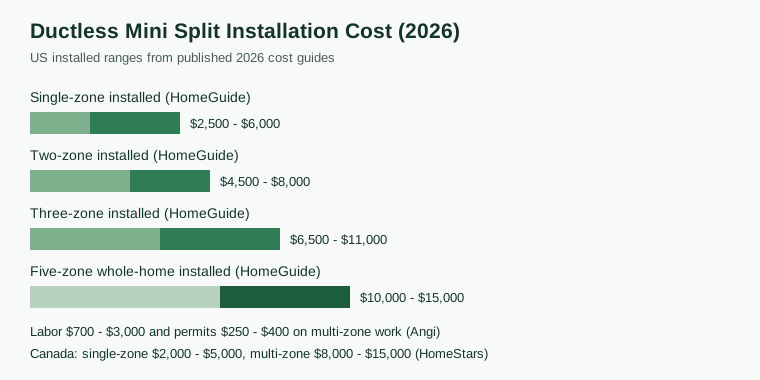
    A ductless mini split installation in the US in 2026 typically costs $2,500 to $15,000 or more in HomeGuide project data: single-zone systems run $2,500 to $6,000, two-zone $4,500 to $8,000, three-zone $6,500 to $11,000, and five-zone whole-home systems $10,000 to $15,000. HVAC labor alone runs $700 to $3,000 on multi-zone work and permits $250 to $400 in Angi data. This guide prices by zone count, BTU capacity and indoor unit style, explains what moves a quote inside each band, runs labeled operating-cost math, and covers Canada pricing.

    EnergyBS Editorial Team4 sources24 min read
    Ductless Mini Split Installation Cost 2026: What Installation Really Costs

    Quick Checks

    • 1Budget $2,500 to $6,000 installed for a single-zone mini split in 2026 in HomeGuide project data. Most homeowners pay near $3,000 for a basic installation in Angi data.
    • 2Each zone adds both equipment and labor. HomeGuide bands two-zone systems at $4,500 to $8,000, three-zone at $6,500 to $11,000, and five-zone whole-home systems at $10,000 to $15,000.
    • 3A standard quote covers about 15 feet of line set. Long runs from the outdoor unit to distant heads, new electrical circuits and condensate routing are the three most common add-ons.
    • 4Sizing is where money gets wasted. Too much capacity costs more upfront and cycles poorly; too little never catches up. Get a room-by-room load calculation before approving a quote.
    • 5In Canada, HomeStars puts single-zone installations at $2,000 to $5,000 and multi-zone systems at $8,000 to $15,000. Cold-climate models rated to -25C sit at the high end of equipment bands.
    On this page(15 sections)Show
    1. The Short Answer
    2. 1. What You Are Actually Buying
    3. 2. Price by Zone Count
    4. 3. Price by Capacity: BTUs and Tons
    5. 4. Price by Indoor Unit Style
    6. 5. What Moves a Quote Inside the Band
    7. 6. Labor, Permits and the DIY Question
    8. 7. Brand Equipment Bands
    9. 8. Sizing: Rules of Thumb and Why They Are Not Enough
    10. 9. Running Costs: SEER2, HSPF2 and the Ductless Math
    11. 10. Mini Split vs Central AC vs the Alternatives
    12. 11. Canada: Pricing, Cold Climate and Rebates
    13. 12. The 10-Point Quote Checklist
    14. 13. Repair, Lifespan and When Replacement Wins
    15. Frequently Asked Questions (FAQ)

    By EnergyBS Editorial Team | October 10, 2026

    The Short Answer

    Short Answer: A ductless mini split installation in the US in 2026 runs $2,500 to $15,000 or more in HomeGuide project data, and the zone count is what sets the band. A single-zone system covering one room costs $2,500 to $6,000 installed. Two zones run $4,500 to $8,000, three zones $6,500 to $11,000, and a five-zone whole-home system runs $10,000 to $15,000. Angi puts the average installation near $3,000, with a typical project range of $2,000 to $5,000. On multi-zone work, Angi breaks out installation labor at $700 to $3,000 and permits at $250 to $400.

    Zone count dominates because every zone is its own installed appliance: an indoor head, its share of the outdoor unit, a line set through the wall, electrical and condensate. The equipment numbers in this guide come from 2026 cost databases and a manufacturer guide current to 2026, and every dollar figure below is an installed price unless it says equipment only.

    This guide prices the whole market the way a quote does: by zone count, by capacity in BTUs, and by the indoor unit style you put on the wall. It also explains what moves a quote inside each band, runs the operating-cost math with the assumptions labeled, and covers Canada separately, because Canadian pricing and cold-climate equipment live in their own world.


    1. What You Are Actually Buying

    A ductless mini split is not one box. It is a small system, and a quote prices each part:

    • The outdoor unit. A compressor/condenser that sits outside the house, usually on a wall bracket or a pad, like a central AC condenser. One outdoor unit can serve up to eight indoor heads in HomeGuide's band table, though most residential quotes top out at four or five.
    • The indoor heads. One per zone. Wall-mounted heads are the common choice; ceiling cassettes, floor-mounted units and concealed-ducted units exist for rooms where a wall box does not fit the design.
    • The line set. Insulated refrigerant lines, a condensate drain line and the control cable, run together through a three-inch hole in the wall from the outdoor unit to each head. HomeGuide notes that a standard quote covers about 15 feet of line set. Longer runs cost more.
    • The electrical connection. A dedicated circuit from the panel to the outdoor unit. Existing capacity makes this a short line item. A full panel means a bigger one. Our electrical panel upgrade cost guide prices that scenario.
    • Controls and commissioning. Thermostat or remote setup, refrigerant charge verification, leak testing and system startup. This is skilled labor, and it is the part DIY attempts cannot legally finish, for reasons section 7 covers.

    Nearly every ductless mini split sold today is also a heat pump: it cools in summer and heats in winter by reversing the refrigeration cycle. That dual function is why the buying decision often competes with furnaces and central heat pumps, and our heat pump vs gas furnace true cost guide runs that comparison with 2026 rates.


    2. Price by Zone Count

    Zone count is the first question on every quote and the biggest lever on the total. HomeGuide's 2026 band table, installed prices:

    Zones Installed cost band, US (HomeGuide) What it covers
    1 $2,500 to $6,000 One room or office
    2 $4,500 to $8,000 Two rooms or a small apartment
    3 $6,500 to $11,000 Multi-room coverage
    5 $10,000 to $15,000 Whole-home system
    8 $18,000 to $20,000+ Large home or commercial space

    Two things matter about this table. First, the per-zone cost falls as zones rise, because one outdoor unit and one day of crew mobilization get spread across more heads. A single-zone quote at $4,000 is a $4,000-per-zone project; a five-zone quote at $12,500 is a $2,500-per-zone project. Second, the bands are wide because zone count is only the headline. The capacity, the indoor unit style and the installation conditions inside the quote move a project up or down the band.

    Angi's 2026 data reads the same market from a lower angle: a typical installation range of $2,000 to $5,000 with an average near $3,000. The gap between the two sources is the gap between a basic single-zone job and the multi-zone jobs that dominate quote databases. Both are useful: Angi tells you what a simple room addition costs, and HomeGuide's zone table tells you what whole-home projects run.

    A zone is a room or area with its own temperature control, not a head count. Two small adjacent rooms can sometimes share one head. Our head placement guide walks through how heads actually get positioned in a house, which is worth reading before a quote locks in the zone count.


    Advertisement

    3. Price by Capacity: BTUs and Tons

    Every system carries a capacity rating in BTUs per hour, often stated in tons (one ton equals 12,000 BTUs). HomeGuide's 2026 installed bands by size:

    Unit size Capacity Installed cost band, US (HomeGuide)
    6,000 BTU 0.5 ton $2,500 to $3,500
    9,000 BTU 0.75 ton $3,000 to $4,200
    12,000 BTU 1 ton $3,500 to $5,000
    18,000 BTU 1.5 ton $4,500 to $6,500
    24,000 BTU 2 ton $6,000 to $8,000
    30,000 BTU 2.5 ton $7,000 to $9,500
    36,000 BTU 3 ton $8,000 to $11,000
    42,000 BTU 3.5 ton $10,000 to $13,000
    48,000 BTU 4 ton $12,000 to $15,000
    60,000 BTU 5 ton $15,000 to $18,000

    Read this table alongside the zone table, because capacity and zone count interact. A 36,000 BTU outdoor unit serving three heads is the classic three-zone whole-floor system, and its $8,000 to $11,000 band sits inside the three-zone band from section 2. A single 12,000 BTU head for a bedroom at $3,500 to $5,000 sits inside the single-zone band. When a quote's bottom line lands far outside both tables for its zone count and size, that is the sign to ask why.

    Capacity mistakes cost money twice. An oversized head costs more on day one and then short-cycles: it blasts cold air, satisfies the thermostat in minutes, shuts off, and never runs long enough to dehumidify. The room feels clammy. An undersized head costs less on day one and then runs flat out on every hot afternoon without ever reaching setpoint. The fix for both is the same and free: a room-by-room load calculation before the quote. A contractor who sizes by square footage alone is guessing. Section 9 gives the rule-of-thumb numbers for a sanity check, then explains why the real calculation still matters.


    4. Price by Indoor Unit Style

    The box on the wall is not the only option, and the alternatives cost more to install. HomeGuide's 2026 installed bands per zone:

    Indoor unit style Installed cost per zone, US (HomeGuide) Why it costs what it does
    Wall-mounted $2,500 to $5,000 The standard: fast to hang, fast to connect, lowest labor
    Floor-mounted $3,000 to $5,000 Low on the wall for rooms with sloped ceilings or tall windows
    Ceiling cassette $3,500 to $6,000 Recessed in the ceiling, 360-degree airflow, more complex rough-in
    Concealed ducted $4,000 to $7,500 Hidden in ceiling or attic with short duct runs to nearby rooms

    Wall-mounted heads own the market for a reason. They hang high, they throw air across the room, and the installer can complete the wall penetration and line set in a day. The premium styles buy aesthetics and airflow geometry, not efficiency: a ceiling cassette in a great room or a concealed unit serving two small bedrooms through short ducts. Each step up the table adds roughly $500 to $1,000 per zone in labor and materials, because the installer is working overhead, in an attic, or building duct transitions.

    One honest note on concealed ducted units. They use short duct runs, which means a little of the duct-loss problem ductless systems avoid comes back. The runs are feet, not the tens of feet of a central system through an attic, so the penalty is small, but it is real, and it is one more reason the style costs more.


    5. What Moves a Quote Inside the Band

    Two quotes for the same zone count can land $2,000 apart and both be fair. The line items below are where the difference hides. A quote that lists them explicitly is a quote you can compare.

    • Line set length. The standard quote covers about 15 feet from the outdoor unit to the head (HomeGuide). Every foot past that is copper, insulation, labor and a condensate run. A head on the far side of the house from the outdoor unit can add several hundred dollars against a head back-to-back with it. Outdoor unit placement is a cost decision, not just an aesthetic one.
    • Electrical work. The outdoor unit needs a dedicated circuit. If the panel has space and the run is short, this is a minor line. If the panel is full or the service needs upgrading, the project inherits panel work. Our electrical panel upgrade cost guide puts 100-to-200-amp upgrades at $2,800 to $4,200 in 2026 electrician pricing.
    • Condensate drainage. Every head produces condensate in cooling mode. A head on an exterior wall drains through the wall with the line set. A head on an interior wall needs a condensate pump or a long gravity run to a drain, each a few hundred dollars.
    • Wall and structural work. Brick, stone and concrete cores take longer than vinyl siding. A head mounted on a wall that needs reinforcement, or a line set routed through finished space that must be opened and patched, adds labor hours.
    • Outdoor unit placement. A ground pad is cheap. A wall bracket on the second story needs a lift or scaffolding time. A roof mount needs structural review. Wind baffles and snow stands in cold climates are small lines that belong on the quote rather than as surprises.
    • Permits and inspections. Angi bands mini split permits at $250 to $400 for multi-zone systems. The installer usually pulls the permit, and the fee lands on the invoice either way.
    • Old equipment removal. Angi lists removing an old AC unit at $80 to $150. Window units the system replaces are often the homeowner's own haul-away.

    The pattern across all seven: the equipment price is the least variable part of the job. The site conditions are what separate a $3,500 single-zone quote from a $6,000 one. This is why three quotes for the same house cluster around a number, and why a quote far below the cluster deserves the question of which of these lines it skipped.


    6. Labor, Permits and the DIY Question

    Angi's 2026 data prices multi-zone installation labor at $700 to $3,000 for the HVAC contractor, and permits at $250 to $400. For a single-zone job, industry guides put technician time at four to eight hours at $75 to $150 per hour, which is $600 to $1,200 in labor before any material is touched. Labor is a real third of a basic job and a smaller share of a multi-zone job, where equipment dominates.

    The DIY question comes up because the equipment is easy to buy online. HomeGuide's answer is direct: DIY installation is not recommended. The reasons are practical, not gatekeeping:

    • Refrigerant handling requires certification. Evacuating the lines, charging the system and verifying no leaks involve regulated refrigerants. In the US, Section 608 of the Clean Air Act requires EPA certification to handle them. An unlicensed charge that leaks is both an environmental release and a system that never performs to its rating.
    • The warranty usually requires professional installation. Most manufacturers tie the parts warranty, often 10 to 12 years on the compressor, to installation by a licensed contractor. A DIY install that saves $1,500 in labor can void $3,000 of warranty coverage on the most expensive part.
    • The vacuum and pressure test are the job. The physical mounting is the easy half. Pulling a proper vacuum, holding it, and verifying the charge is the half that determines whether the system runs at its rated SEER2 or limps along at a fraction of it. This is not visible work, and it is where cheap installs fail.

    What a homeowner can legitimately do: choose the heads, clear access, handle the old window units, and maintain the system afterward. What should stay with the licensed contractor: everything with refrigerant in it.


    7. Brand Equipment Bands

    HomeGuide publishes 2026 equipment-only bands for single-zone systems, installation not included. They are useful for one decision: how much of the quote is the brand name.

    Brand Equipment cost, single-zone (HomeGuide)
    Pioneer $1,000 to $3,400
    GREE $1,000 to $3,800
    Daikin $1,100 to $5,600
    LG $1,100 to $5,000
    Mitsubishi / Trane $1,400 to $4,800
    Fujitsu / Rheem $1,300 to $4,700
    Carrier $2,400 to $6,000

    Two reads of this table. First, the equipment spread between a value brand and a premium brand on a single-zone system is roughly $1,000 to $2,500. On a $4,500 installed quote, that is a quarter of the total at most. The installer, the line set length and the electrical work move the total more than the badge does. Second, the premium brands carry longer standard warranties and deeper cold-climate lineups, which matters in heating-dominated climates and barely matters for a Florida bedroom that only cools.

    The brand conversation to have with a contractor is not which badge is best. It is which of their stocked brands they service, because the company that installs it is usually the company that warranties the labor. A premium unit installed by a contractor who rarely works on that brand is worth less than a mid-tier unit installed by the brand's authorized dealer with ten years of parts and labor coverage on the invoice.


    8. Sizing: Rules of Thumb and Why They Are Not Enough

    Contractors estimate cooling load at roughly 20 to 30 BTUs per square foot for a typical room, and the number shifts with the room:

    Room type Rough BTU need per sq ft 200 sq ft example
    Shaded bedroom, good insulation ~20 4,000 to 6,000 BTU
    Standard living room ~25 5,000 to 9,000 BTU
    Kitchen or sun-exposed room ~30 6,000 to 9,000+ BTU
    Great room, high ceilings 30+ Size by volume, not floor area

    These are planning numbers, labeled as such. The formal calculation is a Manual J load calculation, which accounts for insulation levels, window area and orientation, air leakage, occupancy and the local design temperature. A 200-square-foot bedroom over an unheated garage in Minnesota is a different load than the same bedroom in San Diego, and no per-square-foot rule knows the difference.

    The sizing conversation has a second half that the rule of thumb misses: heating. A mini split sized for cooling in a mixed climate may be undersized for heating in January, and one sized for the coldest night may be oversized for a mild afternoon. Cold-climate models with higher HSPF2 ratings (the heating efficiency metric, covered in section 9) close this gap. In heating-dominated regions, size for the heating load and accept that cooling will be effortless, or plan a backup heat source for the coldest weeks and say so in the quote.


    9. Running Costs: SEER2, HSPF2 and the Ductless Math

    Installed price is half the ownership question. The other half is the electric bill, and mini splits have a genuine structural advantage there. Two mechanisms do the work:

    No ducts, no duct losses. Central systems push conditioned air through ductwork, and leaky or poorly insulated ducts waste a large share of it. Energy agencies put duct losses at more than 30% of heating and cooling energy in bad cases, and 10 to 20% even in decent ones. A ductless head delivers air directly into the room. There is no duct run to leak.

    Zoning means conditioning rooms, not the house. A central system cools every room on the thermostat's call. A five-zone mini split cools the two rooms in use. Turning off or setting back empty zones is not a trick; it is the normal way the system is designed to run.

    Efficiency ratings make the comparison concrete. SEER2 measures cooling efficiency over a season; HSPF2 measures heating efficiency. Higher is better on both. For a sense of the savings mechanism, Natural Resources Canada states that ENERGY STAR certified ductless heat pumps use 60% less energy than standard electric resistance heating and cut cooling costs 30% against conventional room air conditioners.

    A labeled hypothetical shows how the installed price and the bill interact. Take a home heating a 1,500-square-foot main floor with electric baseboards at a hypothetical $1,800 per heating season. Replace the baseboards with a cold-climate mini split and apply the verified 60% reduction: the heating portion falls to about $720, saving roughly $1,080 a year. Against a $9,500 three-zone installation (inside HomeGuide's band), the simple payback lands near nine years, before any rebate and before counting the cooling the old baseboards never provided. The $1,800 figure is the assumption doing the work here: a house with a gas furnace at low gas rates saves far less, because the thing being replaced was already cheap to run. Mini splits pay back fastest against electric resistance heat, oil, and propane. They pay back slowest against cheap natural gas.

    Maintenance is the small annual line. Filters on each head need rinsing every few weeks in heavy use, a five-minute homeowner job. A professional deep clean of the coils and blower wheels every one to two years keeps the efficiency rating honest. Outdoor units need clear airflow, the same as any condenser.


    10. Mini Split vs Central AC vs the Alternatives

    The mini split quote competes with other ways to cool and heat the house. The honest comparison table:

    Option Installed cost band Best fit Weakness
    Ductless mini split $2,500 to $15,000+ (HomeGuide) No existing ducts, additions, zoned comfort, heat plus cool in one system Highest per-room cost at whole-home scale
    Central AC replacement $3,500 to $7,500 (HomeStars, existing ducts) Home already has ductwork and a furnace Duct losses; cools the whole house or nothing
    Central heat pump $4,500 to $10,000 installed (HomeStars, existing ducts) Ducted home wanting heat and cool from one system Same duct losses; bigger single-point project
    Window AC units $150 to $900 per unit (Best Buy Canada) Renters, one hot room, lowest upfront cost Noisy, insecure, inefficient, no heating
    Gas furnace plus central AC Priced separately Cheap natural gas regions Two systems to maintain; no zoning

    Our central AC replacement cost guide prices the ducted path with 2026 SEER2 minimums, and our central AC vs mini split comparison walks the head-to-head decision room by room. The short version: if the house has good existing ducts, a central system usually wins on installed cost per ton. If it does not, running new ductwork through a finished house can cost as much as the equipment, and the mini split wins outright. Our ductwork replacement cost guide prices that side of the ledger.


    11. Canada: Pricing, Cold Climate and Rebates

    Canadian pricing runs in Canadian dollars and sits a little higher than the US bands, with cold-climate equipment as the main reason. HomeStars' 2026 HVAC price guide bands mini split installations as:

    • Single-zone: $2,000 to $5,000 installed for one room.
    • Two-zone: $4,500 to $8,000 with two indoor units and one outdoor unit.
    • Multi-zone: $8,000 to $15,000 depending on zone count and equipment quality.

    Each additional zone adds roughly $1,500 to $3,500, per HomeStars' air conditioning guide, and a three-zone system for a larger home runs $8,000 to $15,000 installed. Standard air-source heat pumps sit at $5,000 to $10,000 installed, while cold-climate models rated to -25C or -30C reach $12,000 to $18,000 for larger homes.

    The cold-climate point deserves emphasis because Canada is a heating market. A standard mini split sized for a Toronto cooling load may need backup heat below about -15C. Cold-climate models hold capacity and efficiency much lower, and they cost more. The right question for a Canadian quote is not the SEER2 cooling number but the HSPF2 heating number and the rated low-temperature capacity: what the unit still delivers at -25C, in BTUs, not in marketing language.

    Rebates change the math but not the method. HomeStars notes that federal and provincial rebates can offset $1,000 to $7,000 or more on qualifying heat pump installations, and provincial programs through utilities like BC Hydro, Hydro-Quebec and Efficiency Nova Scotia have covered ENERGY STAR certified mini splits. Program names, amounts and eligibility change year to year. Verify the current program rules for the province and the specific model before subtracting any rebate from a quote. Applicable federal tax credit rules for home energy equipment changed after 2025, so confirm current IRS or CRA treatment rather than assuming a credit exists.


    Advertisement

    12. The 10-Point Quote Checklist

    Use this list against every quote before signing. A good contractor answers all ten without defensiveness.

    1. Load calculation. Was the system sized by a room-by-room calculation or by square footage? Ask to see it.
    2. Zone map. Which rooms get heads, which share, and which are deliberately left out? Get it in writing with head locations marked.
    3. Line set lengths. How many feet per head, and what does each foot past the included length cost?
    4. Electrical scope. Dedicated circuit from the existing panel, or panel work first? If panel work, is it itemized?
    5. Condensate plan. Gravity drain or pump per head, and where each drain terminates.
    6. Outdoor unit placement. Pad, bracket or roof, with the reasoning. Snow stand or wind baffle if the climate warrants it.
    7. Permit responsibility. Who pulls the permit, and is the $250 to $400 fee on the invoice or absorbed?
    8. Warranty in writing. Equipment warranty years and labor warranty years, separately stated, with the installer's name on the labor line.
    9. Refrigerant and commissioning. Vacuum level held, pressure test passed, charge verified to manufacturer spec. Ask what the startup procedure includes.
    10. Total with the extras. The bottom line including line set overage, electrical, condensate, permit and old equipment removal. Compare bottom lines, not equipment prices.

    Two more behaviors separate good quotes from risky ones. First, the contractor visits the house. A quote written from a phone description of the floor plan is a guess with a signature line. Second, the quote names the exact model numbers, not a brand and a tonnage. Model numbers are what the rebate programs, the warranty registration and the efficiency ratings attach to.


    13. Repair, Lifespan and When Replacement Wins

    A well-installed mini split runs 12 to 15 years on the compressor, with indoor heads sometimes outlasting the outdoor unit. The failures that end systems early are usually installation failures: a bad flare connection that leaks refrigerant slowly for years, an undersized line set, or condensate routed somewhere it grows mold. This is the long tail of section 6's DIY warning. The install quality is the lifespan.

    For existing owners deciding between a repair and a replacement, the framework is the same as any HVAC equipment. A single failed capacitor or contactor on a five-year-old system is a repair. A dead compressor on a 14-year-old system using phased-out refrigerant is a replacement, because the repair approaches the cost of a new outdoor unit and buys back an old efficiency rating. Get the repair quote and the replacement quote on the same visit and compare them against the remaining life, not against each other in isolation.


    Frequently Asked Questions (FAQ)

    How much does it cost to install a mini split in 2026?

    In the US, HomeGuide's 2026 project data bands installations at $2,500 to $15,000 or more: single-zone $2,500 to $6,000, two-zone $4,500 to $8,000, three-zone $6,500 to $11,000, and five-zone whole-home systems $10,000 to $15,000. Angi's 2026 data puts the average near $3,000 with a typical range of $2,000 to $5,000. In Canada, HomeStars bands single-zone at $2,000 to $5,000 and multi-zone systems at $8,000 to $15,000.

    How much does each additional zone add?

    HomeGuide's band table implies roughly $2,000 to $3,000 per added zone on multi-zone systems: moving from one zone ($2,500 to $6,000) to two ($4,500 to $8,000) to three ($6,500 to $11,000). HomeStars' Canadian data puts each additional zone at roughly $1,500 to $3,500. Every zone adds an indoor head, its line set, electrical and condensate work, plus labor.

    What does mini split installation labor cost?

    Angi's 2026 data prices multi-zone installation labor at $700 to $3,000 for the HVAC contractor, with permits at $250 to $400. On a single-zone job, four to eight hours of technician time at $75 to $150 per hour runs $600 to $1,200 in labor alone. Labor is a large share of a basic single-zone job and a smaller share of multi-zone projects where equipment dominates.

    Can I install a mini split myself?

    It is not recommended, and the reasons are practical. Handling refrigerant requires EPA Section 608 certification in the US, the vacuum and pressure test determine whether the system reaches its rated efficiency, and most manufacturers tie the parts warranty to licensed professional installation. A DIY install can void a 10-to-12-year compressor warranty to save a fraction of that in labor.

    Do mini splits need a permit?

    In most US jurisdictions, yes. The work involves electrical and refrigerant connections, and Angi bands the permit at $250 to $400 on multi-zone systems. Installers normally pull the permit themselves. Confirm the fee is on the quote so it does not appear as a surprise.

    How many BTUs do I need per room?

    As a planning estimate only: about 20 BTUs per square foot for a shaded, well-insulated bedroom, about 25 for a standard living room, and 30 or more for kitchens, sun-exposed rooms and great rooms with high ceilings. These rules of thumb do not account for insulation, windows, air leakage or climate. A room-by-room Manual J load calculation is the correct sizing method, and a contractor who sizes by square footage alone is guessing.

    Are mini splits cheaper to run than central AC?

    They can be, for two structural reasons. Ductless systems avoid duct losses, which waste 10 to 30% of heating and cooling energy in ducted systems, and zoning means conditioning occupied rooms instead of the whole house. Natural Resources Canada states that ENERGY STAR certified ductless heat pumps use 60% less energy than standard electric resistance heating and cool for 30% less than conventional room air conditioners. Actual bills depend on local electricity rates, climate and how the zones are used.

    How long do ductless mini splits last?

    Typically 12 to 15 years on the outdoor compressor unit with proper installation and maintenance. Indoor heads can last longer. The most common early failures trace to installation quality: refrigerant leaks from poor connections, incorrect charge, or bad condensate routing. Filter cleaning every few weeks and a professional coil cleaning every one to two years keep the system near its rated efficiency.

    EnergyBS reviews public program rules, product specifications, utility rates, and reader-facing cost assumptions. Treat savings figures as estimates until you verify local prices, permits, rebates, and contractor quotes.

    What to Read Next

    Central AC Replacement Cost 2026: What Installation Really CostsUse this next to compare the cost, incentive, installation, or operating-risk angle before you make a home energy decision.

    Editorial Review

    EnergyBS Editorial Team

    EnergyBS publishes practical homeowner guides. Important program, product, and cost claims should be checked against the linked source and local project documents before you commit to work.

    Read our editorial policy and methodology, or report an error.

    Important: Educational Purposes OnlyThe guides, tools, cost estimates, and ROI calculators provided on EnergyBS.com are for informational and educational purposes only. They do not constitute certified financial, tax, or professional engineering advice. Energy costs, government rebates, and installation fees vary significantly by location and are subject to change. Always consult with certified local professionals before undertaking home energy projects or making financial commitments.