Heat Pump Repair Cost 2026: What Repairs Really Cost, by Part
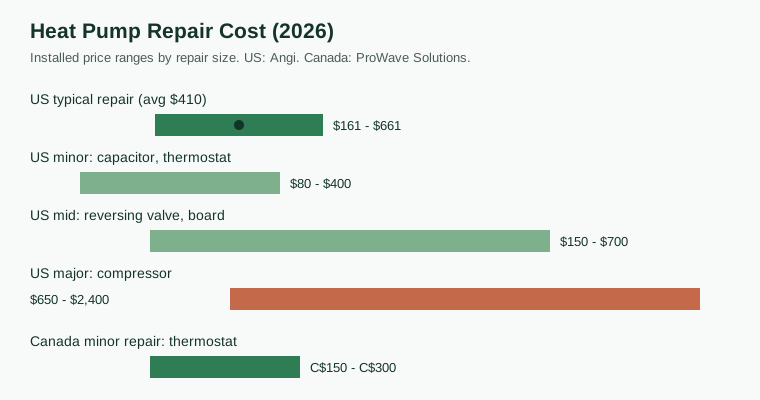
A heat pump repair costs about $410 on average in the US in 2026, with most jobs between $161 and $661 (Angi, from 4,007 verified projects). Fixr puts the average at $400 and most repairs at $150 to $650. The failed part decides the bill: a capacitor or contactor runs $120 to $400 installed, a thermostat $80 to $350, a reversing valve $200 to $650, a fan motor $200 to $700, a refrigerant leak repair $300 to $1,200, a compressor $650 to $2,400, and a coil $550 to $2,500 (Angi; Fixr). In Canada, a diagnostic visit runs C$120 to C$250, a thermostat C$150 to C$300, a blower motor C$450 to C$900, and a compressor C$1,000 to C$2,200 (ProWave Solutions). This guide prices repairs by part and by symptom for both countries, explains the three heat pump parts a furnace does not have (reversing valve, defrost board, auxiliary heat strips), and works the repairorreplace math on three labelled examples.
Direct Answer
A heat pump repair costs about $410 on average in the US in 2026, and most jobs land between $161 and $661 (Angi, from 4,007 verified projects). Fixr puts the average at $400 and most repairs at $150 to $650. The failed part decides where your bill lands: a capacitor or contac...
Quick Checks
- 1Budget about $410 as the US average heat pump repair in 2026, with most jobs between $161 and $661 (Angi, 4,007 verified projects). Fixr puts the average at $400 and most repairs at $150 to $650.
- 2The part sets the price: capacitor or contactor $120 to $400 and thermostat $80 to $350 installed in the US; reversing valve $200 to $650; fan motor $200 to $700; refrigerant leak repair $300 to $1,200; compressor $650 to $2,400 (Angi). A defrost control board runs $200 to $650 (Trane).
- 3In Canada, expect a C$120 to C$250 diagnostic assessment, C$150 to C$300 for a thermostat, C$450 to C$900 for a blower motor, and C$1,000 to C$2,200 for a compressor (ProWave Solutions). Toronto labour runs C$90 to C$150 per hour (HomeStars).
- 4A heat pump has three parts a furnace does not: a reversing valve, a defrost board, and auxiliary heat strips. The strips are the silent bill problem: a system stuck on auxiliary heat can be heating at resistance-heat cost for weeks before anyone notices.
- 5Use two tests before a big quote: the 50 percent rule (replace if one repair passes half the cost of a new system, Angi and Fixr) and the $5,000 rule (age in years times the repair quote; over $5,000 points to replacement, Fixr). Age bands: under 10 years repair, 10 to 15 run both tests, past 15 lower the threshold.
Heat Pump Repair Cost 2026: What Repairs Really Cost, by Part
By EnergyBS Editorial Team | October 22, 2026
The Short Answer
Short Answer: A heat pump repair costs about $410 on average in the US in 2026, and most jobs land between $161 and $661 (Angi, from 4,007 verified projects). Fixr puts the average at $400 and most repairs at $150 to $650. The failed part decides where your bill lands: a capacitor or contactor is $120 to $400 installed, a thermostat $80 to $350, a reversing valve $200 to $650, a fan motor $200 to $700, a refrigerant leak repair $300 to $1,200, a control board $150 to $700, and a compressor $650 to $2,400 (Angi). In Canada, a diagnostic runs C$120 to C$250, a thermostat C$150 to C$300, a blower motor C$450 to C$900, and a compressor C$1,000 to C$2,200 (ProWave Solutions). Heat pump repairs average more than general HVAC repairs ($400 against about $275, per Fixr): a heat pump heats and cools, runs in both seasons, and carries parts a furnace does not have. This guide prices repairs by part for both countries, maps symptoms to likely parts, and works the repair-or-replace math on three labelled examples. Our furnace repair cost guide prices the gas version, and our heat pump maintenance cost guide prices the servicing that keeps these repairs rare.
The repair in six steps:
- Rule out the free causes first: a clogged filter, a thermostat set to the wrong mode, a tripped breaker, ice or debris blocking the outdoor unit.
- Book a diagnostic visit and confirm the fee, and whether it is credited toward the repair.
- Get the failed part named in writing, with the part price and the labour shown as separate lines.
- Check the quote against the by-part ranges in Section 2 (US) or Section 3 (Canada).
- Run the two tests in Section 8 before approving anything over $500, and factor in the age of the system.
- Keep the invoice, any refrigerant type and amount added, and the repair warranty terms.
1. What a Repair Bill Is Made Of
Every heat pump repair quote is three lines wearing one number. The split matters more here than on a furnace, because two common jobs (reversing valve and compressor) require opening the sealed refrigerant circuit, adding recovery, brazing, evacuation, and recharge time to the part swap.
The diagnostic fee. Fixr puts a standard service call at $75 to $250; Trane puts it at $50 to $200, noting some companies apply it toward the repair. In Canada, ProWave prices a diagnostic at C$120 to C$250. Ask when you book whether the fee is credited if you proceed.
The part. Angi's materials data shows why two quotes for the same job can sit hundreds of dollars apart: an OEM part runs $100 to $700 in its data, an aftermarket part $75 to $500, and an upgraded component $200 to $1,000. On a 4-year-old system, the OEM part protects the remaining warranty and service life. On a 13-year-old system, the OEM premium is harder to justify. Check your warranty first: Angi notes that manufacturer warranties can cover major components such as the compressor, reversing valve, and control board, while usually leaving labour with you.
The labour and the clock. Angi and Fixr both put standard HVAC labour at $75 to $150 per hour; Fixr describes the common shape as a flat call-out fee, then $75 to $150 per hour if the job runs past an hour. Emergency and after-hours calls add $100 or more to the rate (Angi). Toronto labour runs C$90 to C$150 per hour (HomeStars). Timing is a real line item: a heat pump running on auxiliary heat is still heating (Section 6 explains the cost), so many failures can wait for a weekday slot. A system blowing no air in a cold snap cannot.
2. Heat Pump Repair Cost by Part (US)
Angi's 2026 US prices are the spine of this table, from its October 2026 update. Fixr and Trane publish their own by-part ranges; where their figures differ from Angi's, both are shown, because the gap between two reputable sources is itself useful when you are holding a quote. All figures are installed prices, part and labour included.
| Repair | Installed cost (US) | Source |
|---|---|---|
| Thermostat replacement | $80 to $350 | Angi (Fixr: $85 to $300; Trane: $90 to $600) |
| Capacitor or contactor replacement | $120 to $400 | Angi (Fixr and Trane: $100 to $400) |
| Electrical or main control board | $150 to $700 | Angi and Fixr (Trane circuit board: $75 to $600) |
| Defrost control board replacement | $200 to $650 | Trane |
| Reversing valve replacement | $200 to $650 | Angi (Fixr: $350 to $700; Trane: $400 to $700) |
| Fan motor replacement | $200 to $700 | Angi, Fixr, and Trane |
| Blower motor replacement | $300 to $1,000 | Fixr |
| Refrigerant leak repair (find, fix, recharge) | $300 to $1,200 | Angi (Fixr: $200 to $1,500) |
| Refrigerant recharge only | $100 to $600 | Fixr |
| Expansion valve (TXV) replacement | $250 to $800 | Fixr |
| Compressor replacement | $650 to $2,400 | Angi (Fixr: $800 to $2,500; Trane: $900 to $2,900) |
| Evaporator coil replacement | $550 to $2,500 | Fixr (Trane: $1,000 to $5,000 or more) |
| Condenser coil replacement | $900 to $2,300 | Fixr (Trane: $1,000 to $4,000 or more) |
| Air handler replacement | $1,500 to $3,500 | Fixr |
Read the table by tier, because the tiers drive different decisions:
The $80 to $400 tier is electrical wear items. Capacitors, contactors, thermostats, and fuses age out on a system that runs twelve months a year. The capacitor is the most common heat pump failure in these guides, and it is mostly a labour bill: the part is small, and you are paying for the diagnosis and the visit. These repairs are worth doing at almost any system age, because they say little about the health of the sealed system behind them. The exception: a third electrical call in one year on an old system is a pattern, and patterns belong in the Section 8 math.
The $200 to $700 tier is where heat pumps diverge from air conditioners. The reversing valve and the defrost board exist only on heat pumps, and both carry a high labour share: a reversing valve is brazed into the refrigerant circuit, so the job includes recovering the charge, swapping the valve, pressure testing, evacuating, and recharging. The three sources put the valve job at $200 to $700 depending on whose data you use. Section 6 covers what these two parts do and how they fail.
The $650-plus tier is a replacement conversation. A compressor at $650 to $2,400 on Angi's figures (up to $2,900 on Trane's), a coil at $550 to $2,500, an air handler at $1,500 to $3,500. Angi's typical range tops out at $661, so any quote in this tier is an outlier against the average job and should be priced against a new system before parts are ordered. Our compressor repair or replace guide works the compressor case in full.
Section 9 prices the prevention side against these repairs.
3. Heat Pump Repair Cost in Canada
Canadian pricing is thinner than US pricing in the national guides. ProWave Solutions, a Canadian HVAC company, publishes a 2026 heat pump repair table in Canadian dollars, and HomeStars publishes Canadian labour and servicing rates. Between them, a Canadian homeowner can bracket most quotes.
Heat pump repairs (Canada, ProWave Solutions, Canadian dollars):
| Repair | Typical cost (Canada) |
|---|---|
| Full diagnostic assessment | C$120 to C$250 |
| Thermostat replacement | C$150 to C$300 |
| Electrical repairs (capacitor, relays, wiring) | C$250 to C$700 |
| Refrigerant leak repair (detection, refill, testing) | C$350 to C$950 |
| Blower motor replacement | C$450 to C$900 |
| Compressor repair or replacement | C$1,000 to C$2,200 |
Labour context: Toronto HVAC labour runs C$90 to C$150 per hour, some companies charge a call-out fee of up to C$195 first, and weekend work runs around C$156 per hour (HomeStars). Toronto and Vancouver labour runs 10 to 25 percent above mid-sized cities such as Calgary or Ottawa.
Servicing context: HomeStars reports that most pros recommend servicing a Canadian heat pump twice a year, at C$150 to C$300 per visit. Our heat pump maintenance cost guide breaks down what those visits should include.
Replacement context for Section 8: HomeStars puts heat pump installation in Canada at C$6,000 to C$15,000, and our heat pump installation cost guide prices what sits inside that range. A C$2,200 compressor job is 15 to 37 percent of a Canadian replacement, which is why system age, not the percentage alone, has to carry the decision.
A note on refrigerant work in Canada: ProWave's C$350 to C$950 leak repair includes detection, the fix, refill, and testing. A refill alone, with no leak test, is not a cheaper version of the same job: refrigerant does not get used up, and a system that is low has a leak.
4. Repair Cost by System Type
Fixr prices average repairs by the kind of heat pump, and the spread changes what a fair quote looks like:
| Heat pump type | Average repair range (US, Fixr) |
|---|---|
| Ductless mini-split | $100 to $1,500 |
| Air-source (ducted or packaged) | $150 to $1,600 |
| Geothermal (ground-source) | $200 to $2,000 |
| Hybrid (dual fuel) | $200 to $2,500 |
Air-source systems are the most common: parts are widely stocked and most technicians work on them daily. Mini-splits start cheaper, but a failed inverter board or compressor on a multi-zone system runs up the range because the parts are brand-specific. Geothermal repairs cost more where the work touches the ground loop or needs excavation (Fixr). Hybrid systems pair a heat pump with a gas furnace, so a no-heat call can sit in either machine or in the control logic between them. Our heat pump vs gas furnace comparison works the running-cost side of that pairing.
5. Symptoms, Likely Parts, and What Each Costs
A quote makes more sense when you can map the symptom to the short list of parts that cause it, using the US ranges from Section 2.
- System will not start, or hums and clicks off. Capacitor or contactor first ($120 to $400, Angi), then the control board ($150 to $700). A humming unit that never starts is the classic failed-capacitor call.
- Runs, but blows lukewarm or cool air in heating mode. Reversing valve not shifting ($200 to $650), low refrigerant from a leak ($300 to $1,200), or the system sitting in defrost or on auxiliary heat (Section 6). Our heat pump blowing cold air guide walks this symptom in order.
- Outdoor unit iced over and staying iced. Defrost failure: defrost board ($200 to $650, Trane), a defrost sensor, or low refrigerant making the coil run colder than it should. Light frost that clears on its own is normal; a coil encased in ice that never clears is a repair call, and running it in that state strains the compressor.
- Weak airflow from the vents. Indoor blower motor ($300 to $1,000, Fixr), a failed blower capacitor, or a clogged filter doing a convincing impression of a motor failure. Check the filter first.
- Short cycling: starts, runs a few minutes, stops, repeats. Thermostat ($80 to $350), control board, low refrigerant, or restricted airflow tripping a protection switch. The diagnosis is what you are paying for here.
- Breaker trips when the system starts. Contactor, capacitor, compressor electrical fault, or the auxiliary heat strips. Stop resetting this one and call: repeated trips are the system reporting an electrical problem, and the range runs from a $120 contactor to a $650 to $2,400 compressor.
- Electric bill jumps with no change in the weather. A heat pump low on refrigerant, short cycling, or leaning on its auxiliary heat strips (Section 6) runs far longer hours while still holding temperature. The bill penalty for waiting is the part nobody quotes you.
6. The Three Parts a Furnace Does Not Have
These three components produce the failures and the bills that have no furnace equivalent.
The reversing valve is the part that makes a heat pump a heat pump. It changes the direction of refrigerant flow, so one machine cools in July and heats in January. When the valve sticks or its solenoid fails, the system locks into one mode, or heats weakly in both. Angi prices the replacement at $200 to $650, Fixr at $350 to $700, and Trane at $400 to $700; the spread reflects the refrigerant work inside the job. A valve diagnosis should come with evidence: the solenoid can be tested and temperatures checked across the valve body. A valve quote offered in the first five minutes, with no test described, deserves a second opinion.
The defrost board runs the winter defrost cycle. In heating mode the outdoor coil grows frost, which blocks airflow and heat transfer. The defrost system periodically reverses the unit for a few minutes to melt it, and the board (with its sensor) decides when. Trane prices a defrost board at $200 to $650. When the board or sensor fails, the coil ices solid, capacity falls, and auxiliary heat picks up the load at resistance-heat prices. A unit steaming briefly on a cold morning is defrost working; thick ice for days is defrost failed.
The auxiliary and emergency heat strips are electric resistance elements in the indoor air handler. They exist for the hours a heat pump cannot carry the house alone. Angi lists the triggers: very cold weather, a frozen outdoor unit in defrost (the backup runs until the cycle completes), a component failure, or a homeowner switching to emergency heat manually at the thermostat. Resistance heat makes heat directly instead of moving it, so it costs far more per unit of heat than the heat pump it backs up. That is why a heat pump can fail financially before it fails mechanically: a stuck contactor or failed defrost board can leave the strips carrying the house for weeks, the vents feel warm, nobody calls, and the only symptom is the power bill. If the thermostat shows Aux Heat on for long stretches outside the coldest days, that is a repair call.
7. The Refrigerant Note: R-410A, R-32, and R-454B
Most heat pumps installed over the past two decades run on R-410A. New ones no longer do. Under the EPA Technology Transitions Program, new residential air conditioning and heat pump systems are limited to refrigerants with a global warming potential of 700 or less, with manufacture and import restrictions beginning January 1, 2025 (Carrier). R-410A has a GWP of 2,088, so it fails that limit. The replacements are R-454B (GWP 466, sold by Carrier as Puron Advance) and R-32 (GWP 675). Both are classed A2L, mildly flammable, and the equipment is built for them.
For a repair decision in 2026:
- Your R-410A system is still serviceable. Nothing in the transition bans repairing or recharging one. Leak repair plus recharge runs inside the Section 2 ranges ($300 to $1,200, Angi; recharge $100 to $600, Fixr).
- R-454B and R-32 are not drop-in replacements. Carrier states this directly: an existing R-410A system should not simply be converted, because the equipment must be designed and listed for the refrigerant. A quote proposing a cheap conversion is proposing something the manufacturer says not to do.
- Refrigerant type belongs in the compressor decision. A compressor replacement on an older R-410A system locks in years of dependence on a refrigerant no longer used in new equipment. That strengthens the replacement side of the ledger past 12 years. Example B in Section 8 works the case.
8. Repair or Replace: The Math
Heat pumps live 10 to 15 years on average (Angi; Fixr extends that to 20 to 25 years with regular maintenance). Fixr puts a replacement at an average of $8,350; Angi prices a new system at $4,000 to $10,000 or more. Two published rules do most of the work:
- The 50 percent rule (Angi and Fixr): if a single repair costs more than half the price of a new system, replacement is the recommended call.
- The $5,000 rule (Fixr): multiply the age of the system in years by the repair quote. Over $5,000, replacement is likely the better option. A $400 repair at 10 years gives 4,000 (repair); a $900 repair at 12 years gives 10,800 (replace). The rule punishes big repairs on old systems, which is the combination that wastes money.
- The age bands (Angi): under 10 years old with infrequent repairs, fixing is usually best. Over 12 years, or with frequent repairs, or with a major component such as the compressor failed, replacement may make more sense even when a quote passes both rules.
Three labelled examples, with hypothetical quotes set inside the published ranges:
Example A: the 6-year-old air-source heat pump with a dead capacitor (US, hypothetical). The outdoor unit hums and will not start. Diagnostic quoted at $125, inside Fixr's $75 to $250 range, and credited toward the repair. Total quote $285 for a capacitor and contactor, inside Angi's $120 to $400 band. Tests: $285 is about 4 percent of a $7,500 replacement quote, and 6 times $285 is $1,710 on the $5,000 rule. Age band: under 10, first repair. Decision: repair, no second quote needed at this size.
Example B: the 13-year-old R-410A heat pump with a failed compressor (US, hypothetical). Compressor quote $2,100, inside Angi's $650 to $2,400 band. Replacement quote $7,900, inside Angi's $4,000 to $10,000 range and close to Fixr's $8,350 average. The 50 percent test says repair: $2,100 is 27 percent of $7,900. The $5,000 rule says replace: 13 times $2,100 is $27,300. The age band says replace: over 12, major component failed. Two of three tests point one way, and the refrigerant note points the same way. Decision: replace, and spend the shopping effort on competing installation quotes using our heat pump installation cost guide. This example is why this guide runs both rules: on mid-life systems they agree, and on old systems with big repairs they split, and the split itself is the signal. The compressor-only version of this decision is worked in depth in our compressor repair or replace guide.
Example C: the 9-year-old heat pump in Ottawa with a failed blower motor (Canada, hypothetical). First quote C$840, inside ProWave's C$450 to C$900 blower motor band, including a C$180 diagnostic inside the C$120 to C$250 band. A second company quotes C$720 for the same motor. Against a C$10,500 replacement quote (inside HomeStars' C$6,000 to C$15,000 range), C$720 is about 7 percent of replacement. On the $5,000 rule, 9 times C$720 is C$6,480, over the threshold if the US rule is applied in Canadian dollars unadjusted. Age band: under 10, and the failed part is a motor, not the compressor or a coil. Decision: repair at the second quote. The $5,000 rule is a US rule of thumb from Fixr; on a 9-year-old system with a non-refrigerant repair, it loses to the age band and the 50 percent test.
Two cost notes. First, a warranty changes the arithmetic more than any rule: a compressor or board inside its parts warranty leaves you labour and refrigerant handling only, and repair wins cases it would otherwise lose (Angi). Second, frequency compounds: two $600 repairs in eighteen months on a 12-year-old system is a $1,200 pattern, even though each repair alone passed the 50 percent test.
9. Before You Call, and What Not to Touch
Four checks cost nothing and close a real share of calls:
- The filter. A clogged filter restricts airflow, forces longer run times, and can ice a coil or trip safety limits. Pull it and replace it if you cannot see light through it.
- The thermostat mode. Confirm the thermostat is set to heat or cool (not fan only, not emergency heat by accident), the set point is past room temperature, and the batteries are alive. A heat pump left on emergency heat after a cold snap heats at resistance prices indefinitely.
- The breaker and the outdoor unit. Check the breaker, then look at the outdoor unit: snow drifted against it, ice encasing the coil, debris packed into the fins. Clear what you can reach safely.
- The condensate drain. In cooling season, a clogged drain line triggers a float switch that shuts the system down to prevent water damage. That shutdown looks like a breakdown and is a cleaning job, not a repair.
The boundary after those checks: refrigerant lines, the reversing valve, compressors, coils, and internal electrical work belong to a licensed technician. Refrigerant handling is regulated, and the sealed system needs gauges and a vacuum pump you do not own. Diagnosis is the skilled part; most parts in Section 2 are cheap next to finding the right one.
Prevention prices well here, with one twist: the system works both seasons, so it needs servicing in both. Angi prices maintenance plans at $150 to $350 per year; HomeStars prices Canadian servicing at C$150 to C$300 per visit, twice a year. A failing capacitor caught during servicing adds C$100 to C$300 in Canada (HomeStars), against the same failure at night in January arriving as an emergency call. Our heat pump maintenance cost guide details what a proper visit covers.
10. Quote Checklist
- The diagnostic fee is stated before the visit, and whether it is credited toward the repair is confirmed.
- The failed part is named, and the test that confirmed it is described (a solenoid test on a valve, a capacitance reading on a capacitor, a leak test on a refrigerant quote).
- Part and labour are separate lines, and the part is identified as OEM or aftermarket, with its price.
- The quote is checked against the by-part range for your country.
- Warranty status is checked first: a part inside its warranty should not be quoted at full price.
- Any refrigerant quote names the refrigerant type, the amount, and whether a leak test is included. A recharge with no leak test is declined.
- Anything over $500 gets a second quote, unless waiting in a cold snap or heat wave carries its own cost.
- The after-hours premium is a named number, so you can decide whether the repair can wait for a weekday slot.
- On any quote over $1,000, all three repair-or-replace tests are run: the 50 percent rule, the $5,000 rule, and the age band, not just the one that favours the sale being pitched.
- The invoice records the model and serial number, the part number installed, any refrigerant added, and the repair warranty terms.
Frequently Asked Questions
How much does heat pump repair cost in 2026?
The US average is about $410, and most repairs land between $161 and $661 (Angi, from 4,007 verified projects). Fixr puts the average at $400 and most repairs at $150 to $650. In Canada, a diagnostic runs C$120 to C$250, a thermostat C$150 to C$300, a blower motor C$450 to C$900, and a compressor C$1,000 to C$2,200 (ProWave Solutions).
What is the most expensive heat pump repair?
The compressor, at $650 to $2,400 on Angi's figures and up to $2,900 on Trane's, followed by coils (evaporator $550 to $2,500, condenser $900 to $2,300, Fixr) and a full air handler at $1,500 to $3,500 (Fixr). These are the repairs where the Section 8 tests matter most.
How much is a heat pump service call?
Fixr puts a standard service call at $75 to $250, and Trane puts the fee at $50 to $200, with some companies applying it toward the repair. In Canada, a diagnostic runs C$120 to C$250 (ProWave). Confirm the credit policy when you book.
Why does my heat pump blow cold air sometimes?
Brief cool air in winter is usually the defrost cycle: the system reverses for a few minutes to melt frost off the outdoor coil, and the auxiliary heat strips switch on to temper the air (Angi). Our heat pump blowing cold air guide separates that normal case from the repair cases: a stuck reversing valve ($200 to $650) or low refrigerant from a leak ($300 to $1,200).
Is it worth repairing a 12-year-old heat pump?
For a wear item, usually yes: a $200 capacitor on a system with no other symptoms is rational at almost any age. For a major part, run the tests. At 12 years the system is past Angi's replacement-consideration line, and a $2,000 compressor quote gives 24,000 on the $5,000 rule. One cheap failure with a clean history is a repair; a third call in two seasons is a replacement conversation.
How long does a heat pump repair take?
Simple electrical repairs (capacitor, contactor, thermostat) typically take one to two hours including diagnosis. A fan or blower motor runs two to four hours. Refrigerant circuit work (reversing valve, compressor, coil) takes most of a day once recovery, brazing, evacuation, and recharge are counted, and an ordered part adds a return visit. Ask the company for its own timeline before you approve the work.
Does a warranty cover heat pump repair?
Often partly. Angi notes that manufacturer and extended warranties can cover major components such as the compressor, reversing valve, and control board, while most warranties do not cover labour, so a service fee usually remains. Maintenance plans are separate, at $150 to $350 per year (Angi). Standard home insurance does not cover mechanical breakdown or wear; it covers sudden damage from an insured event.
Why is my electric bill so high while the heat pump still heats?
The likely cause is auxiliary heat. When a heat pump cannot carry the load (very cold weather, a frozen unit in defrost, or a failed component), the electric resistance strips switch on automatically (Angi). The house stays warm, so nothing feels broken, but resistance heat costs far more per unit of heat. If the thermostat shows Aux Heat running for long stretches outside the coldest weather, book a diagnostic: the fault behind it (a failed defrost board at $200 to $650, low refrigerant, a stuck contactor) is usually a mid tier repair.
Making the Call
A heat pump repair is a $410 average job with a long tail, and the tail is where the money goes: a $2,100 compressor approved on a 13-year-old R-410A system without the age tests, a reversing valve replaced at the first quote with no test described, an auxiliary heat fault left for a month because the house felt warm. The defences cost nothing: name the part, split the quote into diagnostic, part, and labour, check the range for your country, and run the repair-or-replace tests before anything over $1,000 is approved. Under 10 years, repair it. Between 10 and 15, run the math and count the repair history. On a compressor or coil failure past 12 years, price the replacement first, using the heat pump installation cost guide.
What to Read Next
Furnace Repair Cost 2026: What Repairs Really Cost, by PartUse this next to compare the cost, incentive, installation, or operating-risk angle before you make a home energy decision.Sources and Verification
- Angi How Much Does Heat Pump Repair Cost? [2026 Data], updated October 8, 2026 (heat pump repair costs range from $161 to $661, with most homeowners paying around $410, based on 4,007 verified projects; by part: compressor $650 to $2,400, reversing valve $200 to $650, capacitor and contactor $120 to $400, fan motor $200 to $700, thermostat $80 to $350, refrigerant leak repair $300 to $1,200, electrical and control board $150 to $700; thermostat fixes start at $80 and compressor replacements can exceed $2,400; labour $75 to $150 per hour for standard service, emergency or afterhours calls add $100 or more; maintenance plans $150 to $350 per year; the 50 percent rule, with a new system at $4,000 to $10,000 or more; repair if the system is under 10 years old, replacement if over 12 years old, repairs are frequent, or a major component such as the compressor fails; by tonnage: 1.5 to 2 ton $175 to $800, 2.5 to 3 ton $250 to $1,000, 4 to 5 ton $350 to $1,500; OEM parts $100 to $700, aftermarket parts $75 to $500)
- Fixr How Much Does Heat Pump Repair Cost in 2026? (average heat pump repair cost $400, most homeowners pay $150 to $650; standard service call $75 to $250; capacitor replacement $100 to $400; thermostat replacement $85 to $300; refrigerant recharge $100 to $600; refrigerant leak repair $200 to $1,500; circuit board replacement $150 to $700; expansion valve replacement $250 to $800; reversing valve replacement $350 to $700; blower motor replacement $300 to $1,000; evaporator coil replacement $550 to $2,500; condenser coil replacement $900 to $2,300; compressor replacement $800 to $2,500; air handler replacement $1,500 to $3,500; by system type: ductless minisplit $100 to $1,500, airsource $150 to $1,600, geothermal $200 to $2,000, hybrid $200 to $2,500; callout fee $75 to $250, then $75 to $150 per hour if the job takes longer than an hour; heat pump replacement averages $8,350; heat pumps last 10 to 15 years on average, 20 to 25 with regular maintenance; the $5,000 rule: multiply system age by repair cost, and if the result is over $5,000 replacement is likely the better option; general HVAC repair averages around $275 against the heat pump average of $400)
- Trane Average Heat Pump Repair Cost (by part: capacitor $100 to $400, circuit board $75 to $600, compressor $900 to $2,900, defrost mode control board $200 to $650, fan motor $200 to $700, reversing valve $400 to $700, thermostat $90 to $600, condenser coil $1,000 to $4,000 or more, evaporator coil $1,000 to $5,000 or more; citing Forbes: total repair costs range from $100 to $5,000 or more with the average repair costing $550; service call fee $50 to $200, which some companies apply toward the repair)
- ProWave Solutions Fix a Heat Pump: A Complete Homeowner's Guide (Canada 2026), prices in Canadian dollars (thermostat replacement C$150 to C$300; refrigerant leak repair C$350 to C$950, including leak detection, refill, and testing; compressor repair C$1,000 to C$2,200; blower motor replacement C$450 to C$900; electrical repairs covering capacitors, relays, or wiring C$250 to C$700; full diagnostic assessment C$120 to C$250)
- HomeStars Cost to Service an Air Conditioning Unit in Canada in 2026 (heat pumps run yearround for heating and cooling and accumulate wear faster than a coolingonly system; most HVAC pros recommend servicing a heat pump twice a year; a single service visit runs C$150 to C$300, putting annual maintenance at C$300 to C$600 on a twiceyearly schedule; a central AC tuneup runs C$100 to C$200, and a failing capacitor or contactor found during a service adds C$100 to C$300 in parts and labour)
- HomeStars HVAC Costs in Toronto (HVAC professionals in Toronto typically charge $90 to $150 per hour, some companies charge an initial callout fee of $195 before the hourly rate applies; weekend or offhours service runs about $156 per hour) and HomeStars HVAC System Costs in Canada in 2026 (labour in major urban centres such as Toronto and Vancouver runs 10 to 25 percent more than in midsized cities such as Calgary or Ottawa; heat pump installation in Canada runs C$6,000 to C$15,000 per the HomeStars Vancouver HVAC guide)
- Carrier What Is R410A Refrigerant? R410A Phase Out Guide (R410A has a global warming potential of 2,088; R454B, sold by Carrier as Puron Advance, has a GWP of 466 and is the lowerGWP refrigerant replacing R410A in newer residential products; R454B is an A2L mildly flammable refrigerant and is not a dropin replacement for R410A, so an existing R410A system should not simply be converted; the EPA Technology Transitions Program set a 700GWP limit for new residential and light commercial air conditioning and heat pump systems, with manufacture and import restrictions beginning January 1, 2025)
- Angi When Does a Heat Pump Switch to Emergency Heat? (a heat pump may switch to a supplemental heat system when the unit is older and less efficient, when the outdoor unit has frozen and enters a defrost cycle, when a component has failed, or when the homeowner activates emergency heat manually at the thermostat; during defrost the heat pump cannot heat the home, so the emergency or auxiliary system switches on until the cycle completes; heat pumps have an average lifespan of 10 to 15 years, extending to 25 years with proper maintenance)
Editorial Review
EnergyBS Editorial Team
EnergyBS publishes practical homeowner guides. Important program, product, and cost claims should be checked against the linked source and local project documents before you commit to work.
Related Guides
View All ArticlesFurnace Repair Cost 2026: What Repairs Really Cost, by Part
A furnace repair costs $300 on average in the US in 2026, with most jobs between $125 and $480 (HomeGuide). The failed part decides the bill: a flame sensor runs $80 to $250 installed, an ignitor $100 to $250, a control board $300 to $650, a blower motor $500 to $2,300, and a heat exchanger $1,000 to $3,000. In Canada, a diagnostic visit runs C$80 to C$150, a minor repair C$150 to C$300 all in, and a blower motor or control board C$400 to C$900 (HomeStars). This guide prices repairs by part for both countries, separates the diagnostic fee, part, and labour inside a quote, covers the cracked heat exchanger case where repair stops being the right answer, and works the repairorreplace math on three labelled examples.
AC Compressor Repair or Replace the System? An
Confirm the compressor diagnosis, price the complete repair, test the rest of the system, and compare warranty, refrigerant, matchedequipment, downtime, efficiency, and installation risks before replacing an AC or heat pump.
Heat Pump vs Gas Furnace: The True Cost Comparison for 2026
The full 2026 cost comparison of a heat pump vs a gas furnace: verified Ontario installedcost ranges, Home Renovation Savings rebates up to $7,500, operating cost math using published electricity rates, maintenance, lifespan, and the four factors that actually flip the winner.