Bathroom Exhaust Fan Not Working, Noisy, Dripping, or Not Clearing Humidity: A Diagnostic Guide
Diagnose a bathroom fan that will not start, is noisy, moves little air, drips water, or leaves humidity using recall, electrical, airflow, duct, termination, condensation, and measured commissioning evidence.
Direct Answer
Diagnose a bathroom fan that will not start, is noisy, moves little air, drips water, or leaves humidity using recall, electrical, airflow, duct, termination, condensation, and measured commissioning evidence.
Treat Noise, Airflow, and Water as Separate Evidence Streams
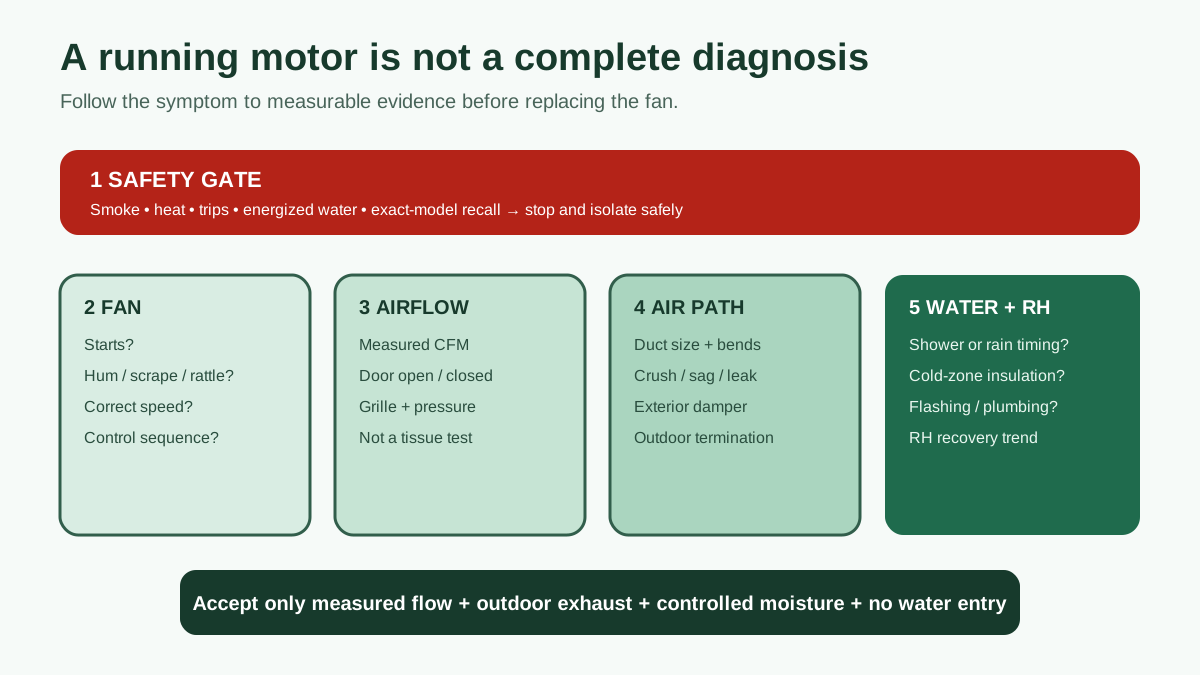
Short answer: Switch the fan off and obtain qualified help for smoke, burning odor, arcing, repeated trips, a hot control or grille, visible melted parts, water at electrical components, or a recalled model. Otherwise, record the exact model, switch/control behavior, measured airflow, door-open/closed difference, duct route, exterior-damper movement, shower temperature/RH trend, and drip timing. A motor that makes noise is not proof that air reaches outdoors. Low flow usually comes from the grille, fan setting, replacement-air path, duct, or termination; dripping can come from duct condensation, rain entry, plumbing, or wet building materials. Test each branch before replacing the fan.
Stop for Electrical, Fire, and Recall Conditions
Turn the switch off. If water is near the switch, fan wiring, light, or heater, do not touch wet surfaces or attempt to remove the grille; isolate power safely and use a qualified professional. Stop for:
- smoke, flame, arcing, or burning odor;
- repeated breaker or ground-fault trips;
- a hot, discolored, melted, or cracked switch/grille/housing;
- grinding followed by a stalled motor;
- a damaged cable or loose electrical box;
- water from the motor/control compartment;
- a heater/fan that overheats or fails to shut down;
- a product covered by a stop-use recall.
Record the full model and date/serial code from a safely accessible label with power isolated. Search CPSC by exact identifiers. For example, a 2012 CPSC notice covered specific Harbor Breeze heater/light bath fans because heater blades could fail to rotate and overheat; consumers were directed to stop use and arrange the stated repair (CPSC notice). That example does not imply other Harbor Breeze models are recalled. The notice’s identifiers control.
Do not bypass a thermal protector, humidity sensor, timer, damper, or interlock. Do not lubricate a sealed motor unless its manual explicitly provides a method. Combination fan/light/heater products can have separate circuits and listings; diagnosis belongs with a qualified electrician or authorized service provider.
Create a Symptom Record Before Cleaning or Replacing
| Evidence | Record | What it separates |
|---|---|---|
| Exact model, speed, duct outlet | manual and certified performance | |
| Which switch/control activates what | wiring versus motor/control issue | |
| Sound: hum, rattle, scrape, flutter | stalled motor, vibration, damper, restriction | |
| Airflow measured at grille | delivered performance, not impression | |
| Door open versus closed CFM | transfer-air restriction | |
| Exterior damper movement | duct connection or blocked cap | |
| Duct diameter, material, bends, length | pressure-loss source | |
| Drip timing: shower/rain/snowmelt | condensation versus exterior water | |
| Temperature/RH before, peak, recovery | moisture-removal performance | |
| Ceiling/attic stains and wet materials | concealed leakage or condensation |
Photograph conditions before disturbing evidence. If a roof or plumbing leak is possible, prevent further water damage and involve the relevant trade; fan replacement is not leak repair.
Branch 1: The Fan Does Not Start
First determine whether the fan, light, and heater (if present) share or use separate controls. Test only user-operable controls. A countdown timer may need programming; a humidity control may not energize below its threshold; a continuous fan may run at a speed too low to hear until boost.
With no wet-area hazard, a qualified person can verify supply, switch output, connections, and motor/control requirements using appropriate electrical procedures. Owner checks should stop at:
- confirming the breaker has not tripped;
- checking an accessible GFCI reset only when dry and safe;
- reading the control and fan manuals;
- confirming a timer is not at zero/off;
- confirming the grille is not mechanically blocking the rotor;
- documenting whether other loads on the circuit work.
Do not repeatedly reset a tripping breaker. A hum without rotation can overheat the motor. Switch it off and arrange service. If supply reaches the fan but the correct motor input does not produce rotation, the motor, capacitor/control, thermal protection, or mechanical assembly needs qualified diagnosis.
Branch 2: The Fan Runs but Moves Little Air
EPA warns that functioning means more than motor noise: the fan must exhaust sufficient air directly outdoors (EPA remodeling guidance). Use a flow hood or documented measurement method. Tissue only shows direction.
Test in this order
- Record selected speed and measured CFM.
- With power isolated, clean the grille/filter and accessible surfaces per manual.
- Retest with the bathroom door open and closed.
- Observe the exterior damper during operation.
- Inspect accessible duct for disconnection, crushing, sag, reduction, or closed damper.
- Inspect the cap for paint, lint, nest, screen blockage, snow, or ice.
- Compare the duct route with the fan performance table.
- Measure static pressure if needed to locate restriction.
If opening the door materially raises airflow, the replacement-air path is restrictive. If the fan is audible in the attic but the exterior damper does not move, suspect disconnected/blocked duct or a stuck cap. If airflow is poor with the duct temporarily isolated during a qualified test, investigate fan setting and condition. Restore exterior ducting immediately after testing.
ENERGY STAR criteria require certified bathroom fans to retain at least 70 percent of their 0.1-inch airflow when tested at 0.25 inches water gauge (criteria). That is a product test, not proof of the field installation. A long reduced flex route can impose more resistance.
Branch 3: The Fan Is Loud, Rattles, or Flutters
Classify the sound:
- buzz/hum: stalled motor, control incompatibility, or vibration;
- scrape/grind: wheel contact, bearing, debris, or mounting shift;
- rattle: loose grille/housing/duct or structural vibration;
- flap/flutter: backdraft damper or exterior cap under wind/pressure;
- air roar/whistle: excessive velocity, small duct, sharp fitting, or restricted grille;
- clicking: loose wheel, control relay, or debris.
With power isolated, verify the grille is seated and fasteners accessible under the manual are secure. Do not bend the wheel, insert weights, or operate without required guards. Check that duct does not pull the housing out of square and that a loose damper is not struck by the wheel.
Sound is often a system symptom. Replacing a motor with a larger fan on the same 3-inch crushed duct can increase pressure noise. Compare certified sones at relevant airflow/pressure, then correct mounting and duct. ENERGY STAR publishes maximum allowable sound levels by certified fan class (criteria); field sound can differ because the room and duct differ from the test.
Branch 4: Water Drips from the Grille
Switch power off if water may contact electrical parts. Catch water without covering the fan or creating an electrical hazard. Map the first wet point and timing.
Shower-related cold-weather drip
Warm shower exhaust can condense inside a cold attic/exterior duct. Look for:
- uninsulated or poorly insulated duct;
- long cold-zone run;
- sag that traps water;
- loose joints leaking humid air into insulation;
- route sloped so water returns to the fan;
- frozen or restricted cap;
- fan shutoff before the duct clears.
Do not drill a drain hole. Correct the full route using approved duct, insulation, air sealing, support/slope, and termination details.
Rain- or snowmelt-related drip
If water appears when the fan has not run but rain/wind/snowmelt occurs, inspect roof/wall flashing, cap, damper, and penetration. A roofer or building-envelope professional may be needed. Replacing the fan motor will not correct failed flashing.
Persistent water independent of weather
Check plumbing above, condensation on cold pipes, wet attic insulation, and other building sources. EPA says moisture control requires fixing the water source and drying wet materials (EPA mold guide). Assess damaged ceiling or insulation rather than sealing stains under paint.
Branch 5: The Fan Runs but Humidity and Fog Persist
Measure instead of using mirror fog alone. Mirror surface temperature, shower temperature/flow, room volume, and door position influence fog.
Place independent temperature/RH sensors away from spray, the grille, exterior wall, and open door. Log:
- 15-minute baseline;
- end-of-shower peak;
- fan speed and door position;
- 15-, 30-, 45-, and 60-minute recovery;
- visible wet surfaces and drying;
- outdoor conditions.
Repeat comparable showers before and after corrections. If measured CFM meets the design target yet one cold exterior corner remains wet, surface temperature/insulation or local air movement may be the limiting factor. If CFM is low, fix air path. If CFM is adequate but occupants turn the fan off immediately, improve controls.
EPA advises an outdoor-vented fan during and after showering and notes that controlling moisture helps limit mold (EPA). There is no one universal post-shower runtime; commission a timer/sensor sequence against the measured room response.
Branch 6: The Fan Blows Air into the Bathroom
Confirm direction with a flow instrument. Reverse flow can come from:
- a shared or misconnected duct;
- wind pressure at the cap;
- missing/stuck backdraft damper;
- another fan pressurizing a common duct;
- whole-building pressure imbalance;
- fan installed/configured incorrectly.
Do not connect bath exhaust to a dryer, range hood, combustion vent, or arbitrary common duct. Trace the route and correct it to the approved exterior termination. Also assess combustion safety where strong exhaust and naturally drafted appliances coexist.
Repair, Duct Correction, or Replacement?
Repair/cleaning is plausible when
- exact model is not recalled;
- electrical and housing condition are sound;
- defect is isolated and parts are available;
- duct and capacity fit the design;
- work has written scope and warranty.
Duct/termination correction dominates when
- measured fan operation is reasonable but delivered CFM is low;
- door-open test shows transfer restriction;
- duct is reduced, crushed, disconnected, or excessively bent;
- cap/damper is blocked;
- drips track cold-duct conditions or failed flashing.
Replacement is stronger when
- motor/control is unsafe or uneconomic;
- recall remedy requires it;
- parts are unavailable;
- fan lacks required pressure capability/capacity;
- noise/efficiency/control needs cannot be met after duct correction;
- housing or combination heater/light assembly is damaged.
Verify a replacement by exact model in the ENERGY STAR product finder. Do not use a marketplace badge as proof.
Locate Restriction with a Pressure-and-Flow Test Plan
When visual inspection does not explain low CFM, ask the contractor for a test plan rather than a larger fan. The useful measurements are grille airflow, pressure near the fan outlet, and—in some cases—pressure along the route. Test ports and instruments must be suitable for low-pressure air systems and sealed after use.
Interpret patterns cautiously:
| Field pattern | Evidence-supported direction | Next inspection |
|---|---|---|
| Low CFM, high outlet pressure | fan works against restriction | small/crushed duct, fittings, damper, cap |
| Low CFM, unusually low pressure | fan speed/condition, disconnection, measurement issue | settings, wheel, open joint, test method |
| CFM rises with door open | room transfer path restricts inlet | undercut/transfer design and requirements |
| CFM rises when cap restriction is removed in controlled test | termination is material | damper, screen, hood geometry, weather debris |
| CFM changes after grille cleaning | inlet loss was material | cleaning schedule and grille suitability |
| Pressure/noise pulses with wind | exterior pressure/damper interaction | cap location and damper condition |
These are directional clues, not universal diagnostic thresholds. Compare with the exact fan curve and account for instrument uncertainty. A flow hood can itself add resistance to a small fan; use its correction method where provided.
Create an as-built route sketch showing actual—not estimated—diameter, each fitting, flex length, sag, transition, and termination. Photograph tape/mastic joints and insulation before closing an attic floor or ceiling. If the contractor cannot inspect the concealed route, label that uncertainty instead of declaring it clear.
Diagnose Humidity Controls and Timers
A sensor-controlled fan can be mechanically healthy but operationally ineffective. Record:
- sensor location relative to shower plume and dry transfer air;
- displayed or configured threshold;
- sensitivity and delay settings;
- manual boost and override behavior;
- fan speed selected during automatic operation;
- power-loss state;
- whether the light switch unintentionally cancels the fan;
- actual start and stop RH measured by a separate sensor.
Humidity sensors respond to relative humidity, which changes with temperature. A cold morning baseline and a warm shower peak may produce different control behavior than a warm summer baseline. Do not calibrate from one shower. Run several comparable tests and compare control response with the model instructions.
For a countdown timer, confirm it supplies the fan’s required motor/control type and that the selected duration persists after a power interruption. Buzzing, flicker, incomplete speed, or heat at the control requires electrical evaluation. Do not assume every electronic timer is compatible with every electronically commutated motor or combination fan/light/heater.
If occupants regularly cancel automatic operation because of noise, the lasting repair may require duct/noise correction plus a better control sequence. A technically functional fan that is not used does not control the shower load.
Inspect Materials After a Ventilation Failure
Once airflow is restored, do not assume stained or wet materials will recover unaided. Inspect the ceiling surface, fan housing perimeter, insulation, roof sheathing, framing, and duct jacket where safely accessible. Use moisture readings appropriate to the material and understand their limitations.
Escalate when there is:
- active wet insulation or ceiling board;
- soft, delaminated, or sagging material;
- recurring visible growth;
- widespread contamination or contaminated water;
- hidden-cavity odor with no accessible source;
- occupant health concern;
- structural or roof-deck deterioration.
EPA emphasizes fixing the moisture source and drying wet materials promptly; ventilation is part of source control, not a substitute for appropriate cleanup (EPA mold guidance). Avoid painting, caulking, or installing an oversized fan over an unresolved wet assembly.
Document pre-correction and dry-state readings at the same marked locations. If a material remains wet despite corrected exhaust and dry weather, reopen the plumbing/roof/enclosure diagnosis.
Compare Contractor Scopes with an Evidence Table
| Required deliverable | Proposal A | Proposal B |
|---|---|---|
| Exact failure and evidence | ||
| Recall check | ||
| Pre-work measured CFM | ||
| Door-open/closed comparison | ||
| Duct route and pressure finding | ||
| Water-source finding | ||
| Exact repair or product model | ||
| Duct/cap/insulation correction | ||
| Electrical/control scope | ||
| Post-work measured CFM | ||
| Moisture-recovery and leak test | ||
| Parts/labor/penetration warranty |
Reject a scope that replaces only the visible grille/motor when evidence points to the duct or cap. Also reject a duct-only promise when the motor overheats, the control is incompatible, or recall status is unresolved. A good scope names the symptom, root cause, correction, and measurable acceptance condition.
Seasonal Verification Matters
A dry-weather same-day test cannot prove a roof cap is watertight, and a warm-day test cannot prove an attic duct will remain condensation-free in winter. Schedule or perform follow-up observation during the condition that produced the complaint:
- wind-driven rain for flashing/cap leakage;
- first sustained cold period for duct condensation/frost;
- long shower sequence for humidity recovery;
- door-closed occupancy for transfer air;
- simultaneous dryer, range hood, fireplace, or combustion operation for pressure interaction, evaluated by a qualified professional where applicable.
Keep the fan available during follow-up but do not leave a previously unsafe or leaking unit energized. Record outdoor temperature/weather, indoor RH, run time, and photographs so the seasonal finding is reproducible.
Repeat the same measurement method at each visit. Changing the grille adapter, instrument position, fan speed, or door state can create an apparent improvement that is only a test-method change. Record instrument model and calibration status, and attach the raw readings to the handoff. If an acceptance limit includes uncertainty, state how pass/fail will be decided before work begins.
Acceptance Test and Handoff
After correction:
- Record exact model, selected speed, and recall result.
- Verify safe switch, timer/sensor, light, and heater operation.
- Measure CFM with door open and closed.
- Verify exterior damper opens and duct leaks are corrected.
- Inspect insulation, air sealing, supports, slope, and flashing.
- Repeat moisture-recovery testing.
- Inspect during rain and cold-weather use when those caused symptoms.
- Record sound/vibration and occupant control instructions.
- Store before/after photos, readings, invoices, and warranties.
Do not accept “it sounds stronger” in place of measured airflow and a verified outdoor termination.
Frequently Asked Questions
Why does my bathroom fan run but not remove steam?
It may have low delivered airflow, inadequate transfer air, an obstructed/disconnected duct, a stuck exterior damper, insufficient runtime, or cold wet surfaces. EPA says motor operation alone is insufficient; air must be exhausted adequately outdoors (EPA).
Is a tissue test enough?
No. It shows direction, not CFM, static pressure, outdoor termination, or humidity recovery. Use a documented airflow measurement.
Why does opening the door make the fan stronger?
The closed-door transfer path is likely restrictive. Design a compliant air path rather than automatically installing a larger fan.
Why does the fan drip only in winter?
Cold-duct condensation is a leading branch, especially with uninsulated, sagging, or leaking attic duct, but roof water and plumbing can mimic it. Use timing and inspection before repair.
Can I vent the fan into a vented attic?
No. EPA directs bathroom exhaust outdoors, not into an attic or enclosed space (EPA remodeling guidance).
Should I replace a noisy fan with a higher-CFM model?
Not until measuring flow and inspecting duct pressure. Restriction can cause noise, and a larger fan on the same bad route may be louder without solving moisture.
How do I know whether a recall applies?
Match the full model and date/serial identifiers to the current CPSC notice and follow its remedy. Similar brand or appearance is not enough; the cited bath-fan recall demonstrates identifier-specific coverage.
What to Read Next
Plan the corrected system with the bathroom fan sizing and duct guide. For whole-home moisture, compare dehumidification and AC. Diagnose a portable unit with the dehumidifier troubleshooting guide, and evaluate cooking exhaust with the range hood venting guide.
Sources and Verification
Outdoor-exhaust, adequate-flow, and moisture-control claims use EPA bathroom-remodeling guidance, the EPA mold guide, and EPA remodeling environmental guidance. Certified airflow-at-pressure and sound claims use ENERGY STAR key criteria, and current certification should be checked in the official product finder. Recall discussion uses the identifier-specific CPSC Harbor Breeze notice. Exact local codes, product listing/manual, electrical system, duct route, weather exposure, and field measurements govern a specific diagnosis.
Sources and Verification
- U.S. EPA: Remodeling Your Home and Indoor Air Quality
- U.S. EPA: A Brief Guide to Mold, Moisture and Your Home
- U.S. EPA: Addressing Indoor Environmental Concerns During Remodeling
- ENERGY STAR: Ventilation Fan Key Product Criteria
- ENERGY STAR: Certified Ventilating Fan Product Finder
- CPSC: Exhaust Fans Sold at Lowe's Recalled Due to Fire Hazard
Editorial Review
EnergyBS Editorial Team
EnergyBS publishes practical homeowner guides. Important program, product, and cost claims should be checked against the linked source and local project documents before you commit to work.
Related Guides
View All ArticlesBathroom Exhaust Fan Sizing and Ducting: Get the Airflow You Paid For
Choose a quiet bath fan, account for duct resistance, route and insulate it to an outdoor cap, select controls, and verify delivered airflow after installation.
WholeHouse Dehumidifier vs. AC: Diagnose, Size, Duct, and Commission It
A measurementfirst wholehouse dehumidification guide covering moisturesource control, portableversusducted selection, pintload sizing, HVAC and ventilation coordination, drainage, energy, and commissioning.
Dehumidifier Not Collecting Water, Icing Up, Leaking, or Running Constantly: A Safe Diagnostic Guide
Diagnose a portable dehumidifier that runs without collecting water, freezes, leaks, cycles incorrectly, or never reaches its setpoint using temperature, humidity, airflow, drainage, recall, and measuredperformance evidence.