Dehumidifier Repair vs. Replacement: A Cost, Safety, Efficiency, and MoistureRisk Decision Guide
Decide whether to repair or replace a portable dehumidifier using recall status, failure evidence, written repair scope, capacity, measured energy, drainage reliability, downtime, warranty, and fiveyear ownership cost.
Direct Answer
Decide whether to repair or replace a portable dehumidifier using recall status, failure evidence, written repair scope, capacity, measured energy, drainage reliability, downtime, warranty, and fiveyear ownership cost.
Replace a Recalled or Unsafe Unit; Otherwise Compare Two Complete Five-Year Paths
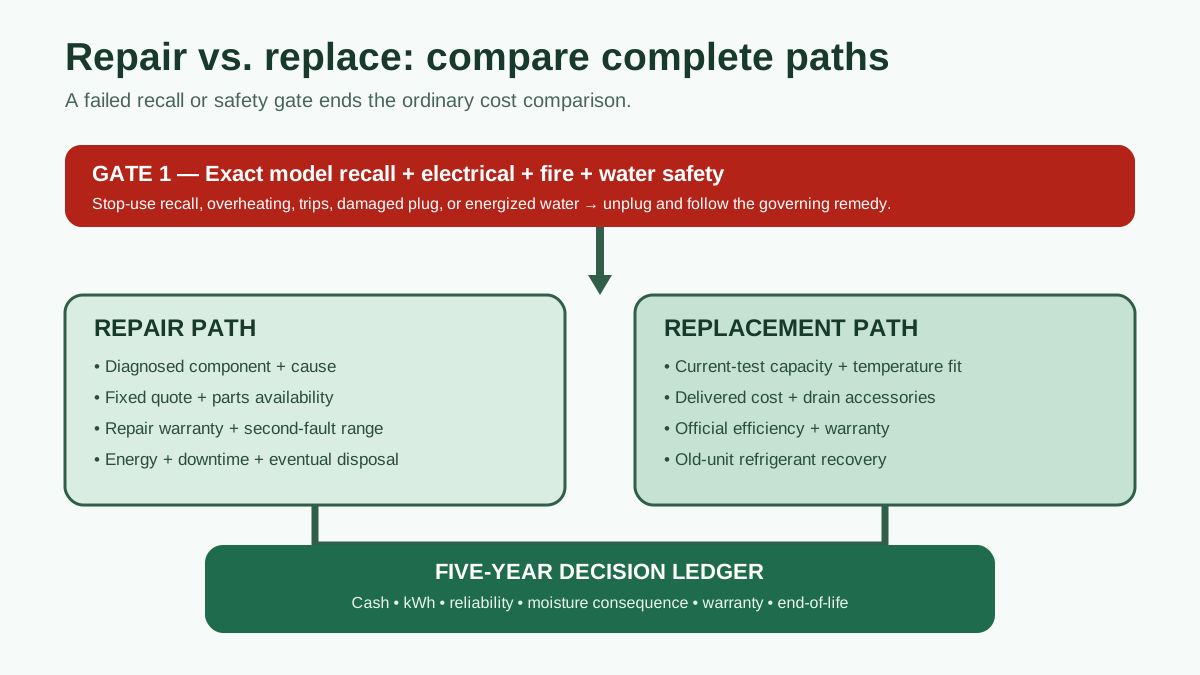
Short answer: Check the exact model and serial/date code for recalls before paying for diagnosis. Retire the unit from use for smoke, overheating, melted electrical parts, repeated trips, cabinet damage, or unsafe leakage. For a non-recalled, safely diagnosable unit, request a written repair scope and compare it with a correctly sized replacement using the same moisture load. Include purchase or repair price, diagnostic charge, electricity, drainage accessories, maintenance, warranty, expected downtime, probability and consequence of another failure, and responsible refrigerant recovery. Repair can be rational for a young unit with a clear, available, warrantied part. Replacement can be rational when safety, sealed-system failure, unavailable parts, wrong capacity, poor drainage, repeated faults, or total ownership cost dominate.
There is no universal “repair if it costs less than half of new” rule. A $90 control repair that restores a suitable unit is different from a $90 guess on an undersized recalled appliance above a finished floor. Build the decision from evidence.
Gate 1: Recall and Safety Override the Financial Calculation
Find the rating label and record the complete brand, model, serial number, and date code. Search the CPSC dehumidifier recall hub and follow the exact notice. A shared brand name or similar cabinet is not enough to include or exclude a unit; identifiers in the notice control.
If a recall says stop use, unplug and follow its remedy. Do not pay someone to “make it safe” outside that process unless the recall administrator explicitly directs it. Recall eligibility, refund, disposal, or proof requirements can be model-specific and time-sensitive.
Stop using a non-recalled unit pending qualified evaluation if it has:
- smoke, scorching, arcing, or burning odor;
- a hot, discolored, cracked, or melted plug or receptacle;
- repeated breaker or ground-fault trips;
- water entering electrical areas;
- a fan that stalls or grinds;
- cabinet or refrigerant-tube damage;
- a defeated, unreliable, or overflowing bucket safety;
- an internal leak above a finished space;
- an undocumented prior overheating event.
Safety problems are not ordinary economic variables. Their potential consequence can outweigh a seemingly cheap repair. The receptacle and branch circuit may also need an electrician; replacing the appliance does not repair a damaged outlet.
Gate 2: Diagnose the Failure Before Pricing the Decision
Do not compare a replacement price with an undefined symptom. First distinguish:
- room already below setpoint;
- low-temperature frost or normal defrost;
- dirty filter or blocked airflow;
- mis-seated bucket or float;
- incorrect gravity hose or pump arrangement;
- continuing bulk-water/moisture source;
- sensor or control failure;
- fan or pump failure;
- sealed refrigeration-system failure;
- wrong capacity or connected-zone assumptions.
Use the portable dehumidifier diagnostic to create a room temperature/RH, runtime, water, kWh, frost, and drain record. A unit that collects little water in a cool, already-dry room may not be broken. A unit that fills its bucket while a hose is attached may have a drainage installation fault rather than a failed compressor.
For paid diagnosis, ask the provider to identify the failed component, evidence, parts source, labor, refrigerant work if any, warranty, and what is excluded. “Needs a recharge” without locating the cause of refrigerant loss is not a complete scope. A sealed system does not consume refrigerant as routine maintenance.
Gate 3: Verify the Existing Unit Still Fits the Job
A successful repair of the wrong unit is not success. Reassess:
- measured floor area and connected air volume;
- uncontrolled dampness category;
- room temperature range;
- bulk water and vapor sources;
- open stairs, crawlspaces, doors, and ventilation;
- target RH and required recovery time;
- bucket, gravity-drain, or pump path;
- noise location and occupied hours;
- electrical supply and required clearances;
- measured removal under representative conditions.
ENERGY STAR sizes portable models using space size and dampness without dehumidification, while advising low-temperature-capable equipment when a space commonly falls below 65°F (ENERGY STAR guidance). The chart is a screening minimum, not a substitute for diagnosing water entry or an open multi-zone load.
Old and current pint ratings may not share the same test basis. ENERGY STAR explains that the newer DOE portable test uses 65°F rather than the older 80°F condition, so a newer unit can show a lower pint number while serving a similar application (testing and capacity). Do not assume “replace 50 pint with 50 pint” until you identify the rating generation.
Build a Written Repair Path
Use this worksheet with an actual quote:
| Repair-path item | Evidence / amount | Confidence | Included in total? |
|---|---|---|---|
| Diagnostic visit | |||
| Failed component and cause | |||
| Part number and availability | |||
| Labor and return visit | |||
| Refrigerant recovery/repair/recharge | |||
| Shipping or shop transport | |||
| New drain hose/pump/accessory | |||
| Repair warranty: parts/labor | |||
| Remaining original warranty | |||
| Expected downtime/moisture control | |||
| Known second fault or corrosion | |||
| Five-year electricity estimate | |||
| End-of-life handling later |
Ask whether the quote is fixed, an estimate, or diagnosis only. Ask what happens if the proposed part does not fix the symptom. A cheap first visit followed by an uncertain board, fan, and sealed-system sequence is not equivalent to a fixed-price repair.
Repair tends to be stronger when
- the exact unit is not recalled;
- it is correctly sized and suitable for the temperature;
- failure is isolated and supported by test evidence;
- parts are available from a traceable source;
- the cabinet, cord, plug, coil, fan, and drain path are sound;
- the repair includes a meaningful parts-and-labor warranty;
- remaining service life is credible;
- it has no history of leaks, overheating, or repeat faults;
- downtime can be covered without moisture damage;
- the five-year ledger beats a properly matched replacement.
Examples might include a bucket, float, accessible drain fitting, or replaceable sensor/control where the manual/service design supports it. The component name alone is not permission for DIY line-voltage work.
Repair tends to be weaker when
- a stop-use recall applies;
- repair safety cannot be documented;
- the sealed system is contaminated, leaking, or uneconomic to restore;
- multiple components or corrosion are involved;
- parts are unavailable or salvage-only;
- the unit is wrong for the load or temperature;
- drainage has already damaged finishes;
- warranty coverage is negligible;
- prior repairs did not last;
- humid-condition downtime threatens materials or health-sensitive spaces.
Build a Like-for-Like Replacement Path
Do not compare the repair with the cheapest product-page price. Create a complete installed alternative:
| Replacement-path item | Evidence / amount | Confidence | Included in total? |
|---|---|---|---|
| Correct current-test capacity | |||
| Verified operating temperature | |||
| Purchase price, tax, delivery | |||
| Drain hose or condensate pump | |||
| Safe platform / receptor work | |||
| Independent hygrometers | |||
| Electrical correction if needed | |||
| Filter cost and availability | |||
| Parts and labor warranty | |||
| Return/restocking terms | |||
| Five-year electricity estimate | |||
| Old-unit refrigerant recovery |
Use the ENERGY STAR certified-product finder to verify current certification rather than relying on an unlinked marketplace badge. Confirm model identifiers in the official listing and manufacturer documentation.
ENERGY STAR says certified dehumidifiers use more efficient coils, compressors, and fans and, as of its current guidance, use 20 percent less energy than similarly sized conventional models (ENERGY STAR). Treat that as a program-level comparison, not a promise that every replacement saves 20 percent against your particular old unit and operating pattern. For a household calculation, compare rated efficiency and measured/estimated kWh under the same load.
Calculate Energy with Transparent Assumptions
Best method: measured old-unit energy
If safe and allowed, use a properly rated plug-in meter for representative humid weeks. Record kWh, water removed, temperature, RH, and runtime. Do not use a smart plug merely as a meter if the dehumidifier load exceeds its listing or the manufacturer prohibits it.
Annual old-unit energy estimate:
Measured kWh per monitored day × comparable operating days per year
This is only as good as “comparable.” A wet July week should not be extrapolated across a dry winter without adjustment.
Replacement estimate from rated or modeled operation
Use the official product listing and manual. If a reliable annual kWh figure is unavailable, estimate:
Input kilowatts × expected compressor/fan runtime hours
Then:
Annual energy cost = annual kWh × your all-in marginal electricity rate
The marginal rate should include energy and per-kWh riders/taxes that actually change with consumption, while fixed monthly charges normally do not disappear when appliance use falls. Keep rate escalation as a separate scenario rather than hiding it in the base case.
Do not compare wattage alone. A lower-watt machine that runs much longer may use more energy. Integrated Energy Factor expresses litres removed per kWh under the applicable test method; higher is more efficient, but field conditions still affect runtime and moisture removed (ENERGY STAR testing explanation).
Price the Moisture Consequence, Not Just the Appliance
A dehumidifier supports moisture control; it does not replace leak repair. EPA says moisture control is central to mold control and recommends drying wet materials and fixing the source (EPA mold guide).
Decision risk increases when the appliance protects:
- paper archives, textiles, instruments, or stored furniture;
- a basement with prior mold or seepage;
- finished flooring or wall assemblies;
- an unattended property;
- a space without a reliable gravity drain;
- a household where overflow cannot be noticed quickly.
Create a contingency during repair downtime: source correction, a safe temporary unit, frequent measurement, bucket checks, or relocation of sensitive contents. Do not leave a questionable appliance running unattended because replacement delivery is delayed.
Avoid assigning an invented dollar value to “mold avoided.” Instead, document the exposure, detection time, and consequence. A reliable gravity drain over an unfinished floor can have a different consequence than an unmonitored pump above finished ceilings.
Compare Five-Year Present Cash Paths Without Fake Precision
Use the same horizon and rate assumptions:
Repair path = diagnosis + repair + accessories + expected follow-up repairs + electricity + eventual disposal − warranty recovery
Replacement path = purchase + delivery + installation/accessories + electricity + maintenance + old-unit disposal − rebates/credits actually verified
Create low, base, and high cases. Vary:
- remaining life after repair;
- annual runtime;
- electricity price;
- probability and cost of a second failure;
- replacement life and warranty recovery;
- drain-pump maintenance/failure;
- moisture-control downtime.
Do not include a rebate until the program administrator confirms the exact model, purchaser, date, location, and documentation. Do not include resale value for an unsafe, recalled, or non-working unit.
Five-year decision ledger
| Decision factor | Repair | Replace | Evidence source |
|---|---|---|---|
| Safety / recall passes? | CPSC + inspection | ||
| Fits load and temperature? | measurements + manual | ||
| Upfront complete cash | written quote / cart | ||
| Five-year electricity | meter + official rating | ||
| Expected follow-up repair | warranty + diagnosis | ||
| Drain/flood resilience | site test | ||
| Downtime consequence | household plan | ||
| End-of-life handling | local provider | ||
| Five-year low / base / high | transparent model |
The lowest base-case number is not automatically the answer. Reject any path that fails the safety gate or cannot reliably control the measured moisture load.
Worked Example: A Decision Without National “Average Cost” Claims
Suppose a six-year-old portable unit in a 900-square-foot basement runs but shows recurring ice. Independent readings show 72°F and 68% RH. The filter is clean, clearances meet the manual, and ice returns after a full thaw. The exact model is not recalled.
A qualified shop quotes a fan repair with a fixed part/labor price and one-year repair warranty. The existing unit is correctly sized under the current-test basis, has a sound gravity drain, and prior metering shows reasonable kWh. A current certified replacement would need a new drain adapter but no electrical work.
The homeowner compares:
- repair quote and warranty;
- replacement delivered price and warranty;
- measured old-unit kWh after repair assumption versus official new-unit efficiency;
- expected second-failure range;
- two days of controlled moisture coverage;
- disposal later versus now.
If repair wins across low/base cases and remains close in the high case, with a well-supported isolated fault, repair can be defensible. If inspection instead finds fan failure plus coil corrosion and an intermittent bucket switch, replacement may win because the repair path is no longer one bounded fault. The method—not a national price threshold—produces the answer.
Commission Either Outcome
Read Warranty Terms as Part of the Price
A headline warranty length is not the same as usable coverage. Download the exact warranty for the model and purchase channel before deciding. Record:
- who is eligible and whether registration is required;
- parts, labor, sealed-system, and replacement-unit periods separately;
- whether the owner pays shipping, diagnosis, removal, or return freight;
- authorized-service requirements and geographic coverage;
- exclusions for commercial use, water damage, dirty filters, improper drainage, voltage, or unauthorized repair;
- proof-of-purchase and model/serial requirements;
- whether a replacement unit receives a new warranty or only the remainder;
- the process and expected time for a claim.
Apply the same discipline to the repair warranty. “One year” may cover only the installed part, not labor, travel, a related fault, or water damage. Ask for those boundaries in writing. If the repairer will not warrant the diagnosis or installed work, put a larger uncertainty range into the repair path.
Warranty is also a downtime question. A no-cost part arriving in six weeks may not protect a humid basement. Keep moisture measurements and a safe contingency plan separate from the reimbursement process.
Compare Drainage Reliability as a System
Many purchase comparisons focus on pint capacity and omit the path taken by every collected pint. Score the full arrangement:
| Drainage factor | Existing/repaired unit | Replacement | Evidence |
|---|---|---|---|
| Bucket capacity and shutoff test | observed test | ||
| Gravity connection and continuous fall | route inspection | ||
| Receptor capacity and backup risk | flow test / local rules | ||
| Pump lift, alarm, and overflow response | manuals + test | ||
| Freeze, kink, or trip exposure | route inspection | ||
| Damage if unattended failure occurs | site assessment | ||
| Routine cleaning access | hands-on check |
A replacement with higher efficiency but a fragile drain adapter or unmonitored pump may be the worse system above finished space. Conversely, a new model that accepts a secure gravity drain and provides a tested shutoff may reduce consequence even when its energy savings alone do not repay the purchase. Use manufacturer-specific features only after confirming them in the exact manual; do not generalize one model’s pump or overflow behavior to the category.
Audit Marketplace and Contractor Claims
Before relying on a listing or quote, save the exact model number and verify claims against official materials. Check:
- current ENERGY STAR listing for that exact model, not a family photo;
- current-test capacity and Integrated Energy Factor;
- permitted temperature range;
- hose, pump, and adapter inclusions;
- clearances and filter access;
- sound claim test basis, if stated;
- warranty issuer and service route;
- return policy after the unit has held water;
- recall search using the delivered serial/date code.
Reject an unlabeled “2026 upgraded” efficiency claim, a crossed-out capacity with no test basis, or an operating-cost promise with no kWh, hours, and rate. Product pages change; store a PDF or screenshot of the official evidence with the decision record.
After repair or replacement, run a documented acceptance test:
- Verify model, recall status, manual, warranty, and receipt.
- Confirm level placement, clearances, grounded supply, and cord condition.
- Test bucket shutoff or documented pump/overflow safety.
- Confirm gravity hose fall and secure receptor.
- Record independent temperature/RH and unit display.
- Measure water and kWh through representative conditions.
- Inspect for ice, leakage, unusual heat, noise, or odor.
- Confirm the difficult zone approaches the chosen RH range.
- Label filter, hose, pump, and recall-check dates.
- Store the evidence where another household member can find it.
Success means controlled moisture and safe water disposal—not merely that the compressor starts.
Frequently Asked Questions
Is a dehumidifier worth repairing?
It can be when the unit is safe, not recalled, correctly sized, and has one evidenced repair with available parts and warranty. Compare the complete five-year paths; do not rely on a percentage-of-purchase-price rule.
How old is too old to repair?
Age alone does not decide. Recall status, failure type, parts, condition, capacity basis, efficiency, drainage, warranty, prior repairs, and moisture consequence matter more. Old and new pint labels may also use different test conditions (ENERGY STAR).
Will an ENERGY STAR replacement cut my energy use by 20 percent?
ENERGY STAR currently states certified models use 20 percent less energy than similarly sized conventional models, but your savings depend on what you replace, sizing, humidity load, setpoint, and runtime (program guidance). Compare official ratings and measured use.
Should I repair a recalled dehumidifier?
Follow the exact CPSC recall notice. If it says stop use, unplug and use the stated remedy rather than arranging an independent repair outside the recall process.
Does a new unit need the same pint rating as the old one?
Not necessarily. DOE test conditions changed, and ENERGY STAR documents how current ratings can be lower than old labels for similar products (capacity explanation). Size from the current basis and actual moisture zone.
Can I put the old dehumidifier in household trash?
Do not assume so. Refrigerant must be recovered before disposal, and local rules may be stricter. Use a provider that explains its refrigerant handling and follow the EPA appliance FAQ.
What proof should I keep?
Keep model/serial photos, CPSC result, diagnosis, written scope, invoices, warranty, room and performance log, drain test, official replacement listing, and disposal receipt. These records support future warranty and safety decisions.
What to Read Next
Determine whether the symptom is real with the dehumidifier diagnostic guide. Recheck load and drainage with the portable sizing and placement guide. Compare a permanent system using the whole-house dehumidifier versus AC guide, and measure operating cost using the summer bill troubleshooting workflow.
Sources and Verification
Sizing, efficiency, current certification, and rating-basis claims use ENERGY STAR dehumidifier guidance, its testing and capacity explanation, and the certified-product finder. Moisture-source claims use the U.S. EPA mold and moisture guide. Recall screening and stop-use actions must follow the exact notice at the CPSC dehumidifier hub. Refrigerant-aware disposal guidance comes from the EPA homeowner appliance FAQ. Prices, programs, warranties, product listings, manuals, electricity rates, and local disposal rules must be verified for the household and decision date.
Sources and Verification
Editorial Review
EnergyBS Editorial Team
EnergyBS publishes practical homeowner guides. Important program, product, and cost claims should be checked against the linked source and local project documents before you commit to work.
Related Guides
View All ArticlesDehumidifier Not Collecting Water, Icing Up, Leaking, or Running Constantly: A Safe Diagnostic Guide
Diagnose a portable dehumidifier that runs without collecting water, freezes, leaks, cycles incorrectly, or never reaches its setpoint using temperature, humidity, airflow, drainage, recall, and measuredperformance evidence.
Portable Dehumidifier Sizing and Placement: Capacity, Drainage, Temperature, and Operating Cost
Size and place a portable dehumidifier using space area, uncontrolled moisture condition, temperature, air connection, drainage, electrical supply, sound, filtration, energy, heat release, commissioning, and sourcecontrol evidence.
WholeHouse Dehumidifier vs. AC: Diagnose, Size, Duct, and Commission It
A measurementfirst wholehouse dehumidification guide covering moisturesource control, portableversusducted selection, pintload sizing, HVAC and ventilation coordination, drainage, energy, and commissioning.