AC Compressor Repair or Replace the System? An
Confirm the compressor diagnosis, price the complete repair, test the rest of the system, and compare warranty, refrigerant, matchedequipment, downtime, efficiency, and installation risks before replacing an AC or heat pump.
Direct Answer
Confirm the compressor diagnosis, price the complete repair, test the rest of the system, and compare warranty, refrigerant, matchedequipment, downtime, efficiency, and installation risks before replacing an AC or heat pump.
Quick Checks
- 1Require a written failure mode and supporting electrical, pressure, temperature, and refrigerant-circuit evidence.
- 2Compare the complete repair - not a compressor part price - with a properly designed, fully installed replacement.
- 3A refrigerant transition does not force retirement of a serviceable existing system; repair components remain available under current EPA rules.
Do Not Decide from Age and a Single Resistance Reading
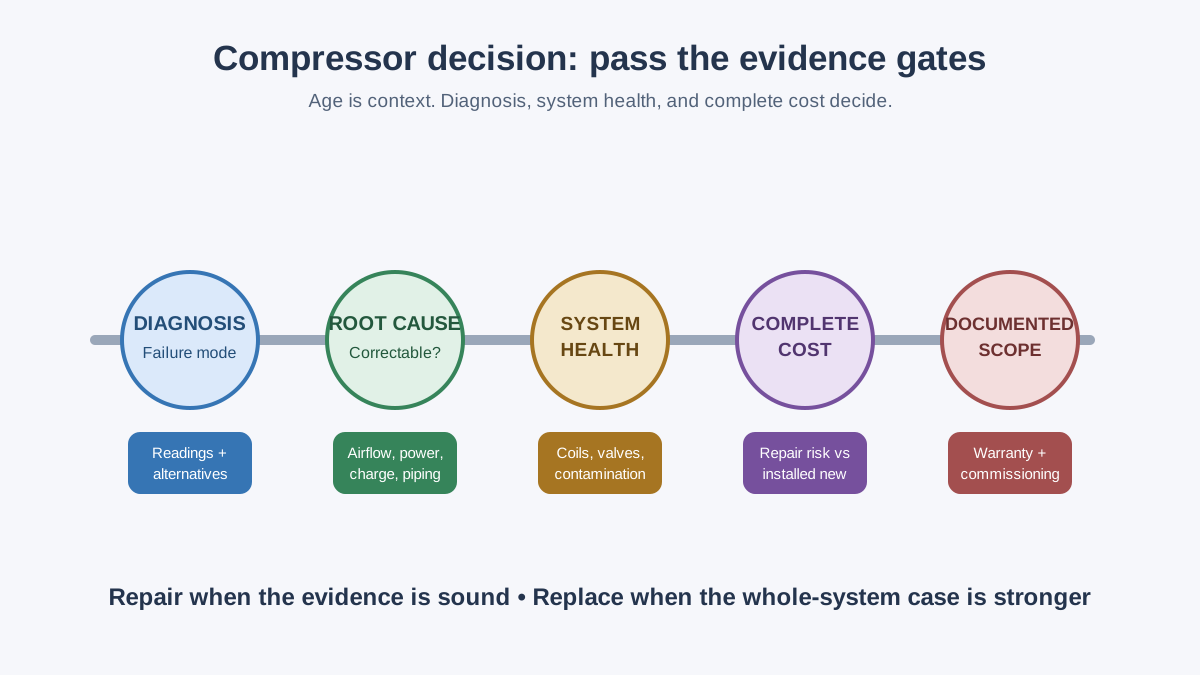
Short answer: Repair can be reasonable when the compressor failure is confirmed, the root cause can be corrected, the indoor and outdoor equipment remain compatible and sound, parts are available, and the complete repair has a useful warranty. Replacement moves higher when the diagnosis shows severe internal contamination, multiple major failures, a leaking or incompatible coil, poor design, recurring problems, or a repair total close to a properly specified new system. Age informs the decision; it does not make it.
“Bad compressor” can mean an open winding, a winding shorted to ground, a mechanical lock, damaged valves, an internal overload, or poor pumping. It can also be a premature verdict on a failed capacitor, contactor, control, power supply, fan, metering device, airflow problem, or refrigerant fault. The first financial decision is whether the diagnosis is proven.
Safety and Refrigerant Boundaries
An outdoor unit contains hazardous voltage, stored capacitor energy, moving parts, hot surfaces, and pressurized refrigerant. Do not remove covers, test live circuits, force a contactor, add a hard-start device, release refrigerant, or attempt compressor replacement as a homeowner.
EPA prohibits intentional venting of many refrigerants, and technicians who maintain or service covered stationary equipment must meet Section 608 requirements. Use a qualified, licensed contractor as required locally. A homeowner's useful role is to document symptoms, collect competing scopes, and ask for the readings and reasoning.
Step 1: Record the Failure Event
Before equipment is disturbed, write down:
- thermostat mode, set point, and room temperature;
- outdoor temperature and weather;
- whether indoor and outdoor fans ran;
- sounds: hum, click, buzz, rattle, silence, or repeated restart;
- breaker, disconnect, thermostat, or equipment alerts;
- frost, oil residue, water, odor, or scorching visible without opening panels;
- recent service, power outage, storm, construction, or filter change;
- whether cooling or heating weakened gradually or stopped suddenly;
- the last date and scope of refrigerant work;
- equipment model/serial numbers and installation date.
Video of a repeatable sound or startup pattern can help, but do not keep cycling a failing unit to record it. Shut it down for smoke, burning odor, arcing, repeated breaker trips, abnormal mechanical noise, or instructions from the technician.
Step 2: Ask What “Failed” Means
A useful diagnosis names the mode and evidence.
| Claimed compressor condition | Evidence a technician may use | What else must be ruled out |
|---|---|---|
| Will not start | Supply voltage, control call, capacitor, contactor, current, winding tests | Power, controls, loose connection, overload, fan, pressure condition |
| Grounded winding | Insulation-resistance or appropriate ground test under safe procedure | Contamination or wet terminals, test method and instrument limits |
| Open winding | Terminal resistance and internal-overload state | Hot compressor still on overload, wiring fault |
| Locked rotor | Start attempt, voltage under load, current, correct start components | Low voltage, wrong capacitor, liquid/refrigerant condition |
| Poor pumping | Pressures, temperatures, current, compression behavior | Metering restriction, charge, reversing valve, airflow, test conditions |
| Mechanical damage | Noise, current, pressure behavior, oil/refrigerant evidence | Fan or piping vibration, loose mount, other rotating components |
The exact test sequence depends on the equipment and manufacturer. Homeowners should not dictate readings; they should ask the technician to show how the conclusion follows from them.
“It draws high amps” is incomplete
Current changes with voltage, load, start conditions, refrigerant pressures, and motor state. Ask whether the reading was startup, locked-rotor, or running current; what the nameplate says; and what voltage was present at the same time.
“It is not cooling” is not a compressor diagnosis
Weak cooling can come from frozen coils, low airflow, dirty heat exchangers, fan faults, controls, refrigerant leaks, restrictions, metering faults, or duct losses. The frozen evaporator-coil guide shows why airflow should be established before refrigerant conclusions.
Step 3: Find the Root Cause Before Installing Another Compressor
Compressors sometimes fail independently, but many are victims of another condition. Replacing one without correcting the cause can sacrifice the new part.
Ask the contractor to evaluate:
- supply voltage, connections, contactor, capacitor, and protective controls;
- condenser fan and coil heat rejection;
- evaporator airflow, filter, blower, and duct static pressure;
- refrigerant charge and leak history;
- metering device and restrictions;
- liquid floodback or migration risk;
- excessive discharge temperature or compression ratio;
- oil return and piping design;
- installation cleanliness, moisture, and noncondensables;
- line-set length, diameter, elevation, and required accessories;
- crankcase heater or low-ambient provisions where specified;
- thermostat staging, short cycling, and rapid power interruptions;
- reversing-valve behavior on a heat pump.
The service report should distinguish a confirmed cause from a plausible contributor. Sometimes physical evidence is destroyed during failure and the cause remains uncertain. That uncertainty belongs in the repair risk assessment.
Step 4: Determine Whether the System Is Clean or Contaminated
An internal motor burnout can contaminate oil and refrigerant circuitry. The contractor may use manufacturer procedures, acid testing where applicable, oil/refrigerant inspection, filter-drier evaluation, and cleanup requirements. Not every compressor failure is a burnout, and dark oil alone should not become a homeowner diagnosis.
Ask:
- Is the failure electrical, mechanical, or uncertain?
- Is acid or debris evidence present?
- Which components and piping may retain contamination?
- What cleanup, filter-drier, evacuation, and follow-up procedure does the manufacturer require?
- Could the indoor coil, line set, reversing valve, or metering device remain at risk?
- Is the proposed warranty valid after this repair path?
Severe contamination can make a compressor-only price misleading because labor, recovery, flushing where permitted, filter-drier changes, oil management, evacuation, charge, and follow-up may be substantial. Product-specific instructions govern; no generic flush is universally safe.
Step 5: Audit the Rest of the System
Create a health sheet rather than judging the compressor alone.
| Component or condition | Evidence | Good / uncertain / poor | Consequence |
|---|---|---|---|
| Indoor coil leak/condition | Leak test, inspection, history | Could turn repair into two major repairs | |
| Outdoor coil and cabinet | Inspection, pressure/temperature behavior | Heat rejection and longevity | |
| Indoor blower and controls | Operation, static, current, fault history | Airflow and repair exposure | |
| Outdoor fan/motor | Operation and condition | Compressor temperature/pressure risk | |
| Metering device | Diagnostic evidence | Must feed repaired system correctly | |
| Reversing valve | Heating/cooling test | Major heat-pump repair risk | |
| Refrigerant line set | Size, length, condition, contamination | Compatibility and cleanup scope | |
| Duct system | Static pressure and defects | Comfort, noise, new-system design | |
| Electrical supply | Voltage, circuit, connections | Reliability and code scope | |
| Drainage and cabinet | Inspection/test | Water damage and indoor-unit health |
If a second major component is leaking or near failure, price that reality. Do not assume it will last because it is not included in today's invoice.
Step 6: Understand Refrigerant Without Transition Panic
The refrigerant name affects parts, service, cleanup, and replacement options, but it does not decide automatically.
R-410A systems can still be repaired
EPA's current HFC frequently asked questions state that owners can continue to use and repair existing air conditioners and heat pumps. The agency specifically says major components such as a compressor or condensing unit can be replaced to service an existing system. Components for legacy R-410A equipment can continue to be made and sold for service under applicable labeling and use rules.
That means “R-410A is illegal, so you must replace everything” is not an accurate summary of current federal rules. Parts availability, price, efficiency, total maintenance cost, and local practice can still make replacement sensible. That is an economic and technical conclusion, not an automatic federal retirement date.
R-22 changes the service economics
EPA's consumer guidance says existing R-22 systems may continue to be serviced, but newly produced or imported R-22 for normal servicing ended; recovered, reclaimed, or previously produced supply serves existing equipment. A substantial compressor job on an R-22 system deserves a careful complete-cost comparison, especially if the coil, controls, or air distribution also need work.
Do not accept an unapproved flammable “drop-in” refrigerant. EPA's stationary-refrigeration homeowner page warns that products called R-22a and similar hydrocarbon blends are not approved for existing residential AC systems.
New refrigerants require their designed equipment
Lower-GWP systems use components, controls, tools, procedures, and safety provisions designed for their refrigerant. A compressor replacement must match the existing approved system; it is not a casual opportunity to change refrigerants. Ask for the exact OEM service part and procedure.
Step 7: Build the Complete Repair Price
A compressor may be under a parts warranty while labor and materials are not. Price the whole event:
| Repair element | Included amount | Warranty | Notes |
|---|---|---|---|
| Diagnostic charge | Credited or separate? | ||
| OEM compressor | Parts coverage/registration | ||
| Labor and access | Crane, attic, roof, tight location | ||
| Refrigerant recovery | Quantity documented | ||
| Cleanup procedure | Burnout/contamination scope | ||
| Filter-drier and related parts | Exact type/location | ||
| Leak repair or test | Confirmed leak? | ||
| Evacuation and standing test | Method documented | ||
| Refrigerant charge | Type, pounds, price | ||
| Electrical/start components | Root cause or preventive scope | ||
| Permit/inspection | If required | ||
| Return commissioning visit | Seasonal conditions? | ||
| Tax and disposal | |||
| Complete repair total |
Ask what happens if the repair reveals an unserviceable coil, blocked line, damaged valve, or unavailable part. A change-order ceiling can make risk more visible.
Step 8: Build a Comparable Replacement Price
Do not compare a compressor repair with a bare replacement-unit advertisement. A valid replacement estimate includes:
- Manual J load calculation and documented equipment selection;
- exact indoor and outdoor matched models and AHRI reference;
- duct and airflow corrections;
- refrigerant piping decision;
- electrical circuit, disconnect, and service changes;
- condensate protection;
- thermostat and control setup;
- permits and inspections;
- removal and refrigerant recovery;
- commissioning and documentation;
- finish work or stated exclusions;
- labor, parts, and registration warranties.
Use the HVAC quote comparison worksheet so the replacement option represents a complete project. A new system can underperform if it inherits the conditions that harmed the old compressor.
A Repair-Versus-Replacement Cash-Flow Worksheet
Use your own quotes, utility rates, and expected operation. Avoid generic percentage rules.
Repair path
- complete repair paid now;
- likely near-term repairs identified in the health audit;
- annual electricity or fuel at current performance;
- maintenance and warranty exclusions;
- value of remaining service life, expressed as a range;
- downtime or temporary-cooling cost.
Replacement path
- gross installed cash price;
- financing cost if used;
- incentives that are confirmed and eligible;
- expected annual operating cost based on local loads and rates;
- planned maintenance;
- warranty value and exclusions;
- duct, electrical, or envelope work that benefits the house beyond the equipment;
- disruption and schedule.
Worked example
Assume a complete compressor repair is $5,200 with a one-year labor warranty and an eight-year-old indoor coil that has no known leak. A properly designed replacement is $15,600 before any confirmed incentive. Estimated annual electricity is $1,450 after repair and $1,100 after replacement.
The simple annual energy difference is $350. Ignoring financing, maintenance, escalation, and time value, energy savings alone would take roughly 30 years to recover the $10,400 incremental upfront cost. That does not prove repair is better: coil condition, warranty, comfort, failure risk, and available cash matter. It does show that “new is more efficient” is not enough without numbers.
Now change the facts: the indoor coil has a confirmed leak adding $3,000 to the repair path, duct changes are needed either way, and the replacement has a valid $2,000 incentive. The incremental replacement cost narrows sharply. Recalculate rather than reusing an age rule.
Risk-Adjusted Decision Matrix
Score evidence, not sales pressure.
| Factor | Leans repair | Leans replacement |
|---|---|---|
| Diagnosis | One confirmed repairable failure | Cause uncertain or multiple major failures |
| Root cause | Identified and corrected | Cannot be corrected economically |
| Coil/refrigerant circuit | Sound, clean, compatible | Leak, corrosion, severe contamination, mismatch |
| Parts | OEM part available | Long delay, obsolete critical components |
| Warranty | Strong part and labor protection | Narrow coverage or no labor protection |
| Design | Existing capacity and ducts proven | Chronic comfort/sizing/duct problems |
| Repair total | Modest against complete replacement | Approaches replacement after contingencies |
| Operating cost | Small realistic savings from replacement | Large modeled savings with credible inputs |
| Reliability need | Temporary outage manageable | Health, work, or climate requires stronger continuity |
| Ownership horizon | Short with disclosed repair | Long enough to value redesign and warranty |
No single row decides. A grounded winding with a healthy matched system can favor repair; a younger compressor with severe contamination and a leaking coil can favor replacement.
When a Second Diagnosis Is Worth Paying For
Seek an independent second opinion when:
- the failure mode is not written down;
- the recommendation changes from a small part to a compressor without new evidence;
- the technician did not evaluate power, airflow, fan, and refrigerant conditions;
- “obsolete refrigerant” is the only replacement reason;
- a large repair has no labor warranty;
- contamination or a leak is asserted without test detail;
- the replacement quote has no load calculation or exact models;
- the decision is being forced during extreme weather with a same-day discount.
Paying for diagnosis can be worthwhile even if the second contractor confirms the first. Request a service call, not a free sales estimate, and disclose what testing has already occurred.
Temporary Cooling and Downtime
Availability can change the rational choice. Record:
- compressor and refrigerant lead time;
- new equipment lead time;
- permit and electrical scheduling;
- expected days without conditioning;
- safe portable cooling or heating options;
- vulnerable occupants, pets, medications, or work equipment;
- hotel or business interruption cost;
- whether a temporary repair compromises warranty or recovery work.
Do not run portable combustion equipment indoors or use improvised electrical circuits. Follow emergency heat and cooling guidance from local authorities during dangerous weather.
What the Repair Invoice Should Contain
Before approving work, ask for a written scope. After completion, retain:
- stated failure mode and root-cause findings;
- compressor part number and serial information;
- refrigerant type, recovered amount when recorded, and final charge method;
- replaced filter-driers and electrical components;
- leak/pressure/evacuation procedure and results;
- airflow and operating measurements;
- final pressures and line temperatures under stated conditions;
- voltage and running current checks as appropriate;
- warranty terms and service contact;
- follow-up or seasonal-test requirement.
Exact readings depend on manufacturer procedure and weather. The point is a traceable repair, not a decorative checklist.
What the Replacement Contract Should Correct
If replacement wins, carry forward every lesson from the failed system:
- oversizing or short cycling;
- restrictive returns or filters;
- bad zoning and minimum-airflow problems;
- low outdoor-unit clearance;
- line-set size, length, elevation, or contamination concerns;
- voltage or connection problems;
- poor condensate protection;
- thermostat configuration;
- lack of surge or phase protection where appropriate and permitted;
- undocumented startup.
The HVAC quote worksheet separates equipment price from the work needed to integrate it correctly, while the line-set reuse guide preserves contamination and piping evidence from the failed system.
Common Decision Mistakes
- Replacing a compressor before ruling out the capacitor, control, fan, or power supply.
- Treating refrigerant as consumed fuel and authorizing repeated top-offs.
- Assuming a parts warranty makes the repair free.
- Ignoring refrigerant recovery, cleanup, access, and recharge cost.
- Using “half the price of new” or another universal percentage rule.
- Comparing repair with an incomplete replacement quote.
- Reusing the old nominal tonnage without a load calculation.
- Believing the R-410A transition bans repairs to existing systems.
- Changing refrigerant without an approved retrofit and component plan.
- Replacing equipment while leaving the root airflow or electrical problem.
- Making a rushed decision without asking about lead time and temporary comfort.
Sources and Verification
This guide uses primary federal and industry sources for factual claims:
- EPA's HFC phasedown FAQ confirms continued repair of existing systems, including replacement of compressors and condensing units, and explains service-component treatment.
- EPA's purchasing and repair guide covers R-22 service, reclaimed or previously produced supply, approved alternatives, and technician certification.
- EPA's homeowner refrigerant resources provide warnings about unapproved flammable substitute refrigerants.
- DOE Building America's diagnostic and replacement measure guide supports measuring installed performance and diagnosing airflow, charge, and equipment condition before replacement decisions.
- ENERGY STAR's maintenance checklist identifies professional checks for refrigerant, electrical connections, condensate, blower, and system controls.
- The AHRI Directory is the primary lookup for certified matched-system performance when replacement equipment is proposed.
Regulations, product availability, and manufacturer procedures change. Verify current EPA pages, exact equipment service literature, and local licensing/code requirements at the time of work.
Frequently Asked Questions
Can a compressor be repaired internally?
Residential hermetic compressors are generally replaced as sealed components rather than opened and rebuilt in the field. External electrical, control, piping, or refrigerant faults may be repairable without replacing the compressor.
Does a breaker trip prove the compressor is grounded?
No. Wiring, motors, controls, shorts, breaker condition, and other faults can trip protection. ENERGY STAR's maintenance checklist includes electrical connections and controls among the items for professional inspection; a qualified technician still needs to isolate the actual fault.
Is a hard-start kit a compressor repair?
No. A start-assist component may be specified for certain applications or diagnoses, but it does not repair damaged windings, mechanical wear, contamination, or an underlying voltage problem.
Must I replace an R-410A system in 2026?
No. EPA's current HFC FAQ says existing systems may continue to be used and repaired, including with major service components. Availability and economics still need to be checked locally.
Should an old R-22 system always be replaced?
Not automatically. EPA's R-22 consumer guidance confirms continued service using recovered, reclaimed, or previously produced supply. Repair scope, efficiency, component condition, and remaining risk still decide the economics.
Can I replace only the outdoor unit?
Sometimes a service component can maintain an existing system; EPA's HFC FAQ specifically discusses replacing faulty R-410A components for service. For a new system, manufacturer compatibility and exact matched performance apply; request OEM and AHRI documentation.
Does a bad compressor contaminate the line set?
It can, especially with an internal electrical burnout, but failure types differ. Testing, system inspection, and manufacturer cleanup instructions determine the scope.
How long should a replacement compressor be warranted?
Terms vary by manufacturer, original equipment registration, service part, and contractor. Compare part, labor, refrigerant, diagnostic, and travel coverage separately in writing.
Will a new system cut my bill enough to justify replacement?
Possibly, but calculate from building loads, climate performance, rates, and operating pattern. Nameplate efficiency alone does not forecast savings.
What to Read Next
For the full price list behind this decision - every common heat pump repair priced by part for the US and Canada, with the repair-or-replace tests worked on labelled examples - see our Heat Pump Repair Cost Guide. If replacement remains plausible, use the HVAC bid comparison worksheet before accepting a proposal. If the failure followed ice or weak airflow, start with the frozen-coil diagnostic sequence.
Sources and Verification
- U.S. EPA: Frequent Questions on the Phasedown of Hydrofluorocarbons
- U.S. EPA: Purchasing and Repairing Home Air Conditioners or Heat Pumps
- U.S. EPA: Stationary Refrigeration Resources for Homeowners
- U.S. DOE Building America: Air Conditioner Diagnostics, Maintenance, and Replacement
- ENERGY STAR: Heating and Cooling Maintenance Checklist
- AHRI Directory of Certified Product Performance
Editorial Review
EnergyBS Editorial Team
EnergyBS publishes practical homeowner guides. Important program, product, and cost claims should be checked against the linked source and local project documents before you commit to work.
Related Guides
View All ArticlesFrozen AC Evaporator Coil (2026 Guide & Data)
Stop compressor operation, manage thaw water, document airflow and ice patterns, and separate filter, blower, duct, coil, thermostat, and refrigerant causes before authorizing repairs.
Heat Pump Quote Comparison Worksheet 2026 Tool
A sidebyside homeowner worksheet for comparing heatpump and HVAC bids by load calculations, exact matched equipment, ducts, electrical work, refrigerant piping, controls, commissioning, warranties, exclusions, and true installed cost.
Reuse or Replace a Refrigerant Line Set? Heat Pump
A productspecific homeowner checklist for deciding whether existing refrigerant piping can remain during an AC or heatpump replacement, including manufacturer permission, geometry, history, contamination, condition, testing, warranty, and fallback scope.