Heat Pump vs Gas Furnace Operating Cost: Calculate Your BreakEven COP
A rateneutral method for comparing heatpump and gasfurnace operating costs using delivered heat, COP, AFUE, full utility charges, weather bins, backup heat, and gasservice fees.
The Short Answer
Short Answer: Compare a heat pump and gas furnace by the cost of delivering the same amount of heat, not by fuel price alone. At an electricity price of E dollars per kWh, a heat pump with seasonal COP C costs E ÷ C per delivered kWh of heat. At a gas price of G dollars per therm and furnace efficiency A, gas costs G ÷ (29.3 × A) per delivered kWh of heat. Include all usage-based charges, backup heat, and any gas fixed fee that disappears if you disconnect service.
The honest result may favor the heat pump, the furnace, or a dual-fuel strategy. Geography is not enough. Two neighbors on different electricity plans or gas-service arrangements can reach different answers.
This guide gives you a calculation you can audit. It does not use a national-average savings claim or assume that a 300% efficient heat pump is automatically cheaper than a 95% furnace. Efficiency and price are different variables.
Start With Delivered Heat
Electricity is billed in kilowatt-hours. U.S. gas bills commonly use therms; Canadian bills often use cubic metres or gigajoules; UK and European bills commonly show kWh of gas. Convert both fuels into the cost of heat that reaches the house.
DOE defines furnace AFUE as useful seasonal heat output divided by fuel input. A furnace with 95% AFUE is modeled as delivering 0.95 units of seasonal heat for each unit of gas energy. AFUE does not include every distribution loss or electricity used by the blower.
A heat pump's coefficient of performance is useful heat output divided by electric input at a stated condition. COP 3 means three units of heat for one unit of electricity. COP changes with outdoor temperature, indoor temperature, airflow, defrost, and equipment operation. A seasonal comparison needs more than the mild-weather headline.
One therm contains approximately 100,000 Btu, equivalent to about 29.3 kWh of heat. Use the billing conversion supplied by your utility when available.
The Two Cost Formulas
Heat pump
Cost per delivered kWh of heat = all-in electricity price per kWh ÷ seasonal COP
If electricity costs $0.18/kWh and the relevant seasonal COP is 2.8:
$0.18 ÷ 2.8 = $0.0643 per delivered kWh of heat
Gas furnace
Cost per delivered kWh of heat = all-in gas price per therm ÷ (29.3 × AFUE)
If gas costs $1.80/therm and furnace AFUE is 0.95:
$1.80 ÷ (29.3 × 0.95) = $0.0646 per delivered kWh of heat
Under those illustrative inputs, operating energy cost is almost tied. A small price or performance change flips the winner. That is why a generic “heat pumps cost half as much” claim is not a household calculation.
Calculate the Break-Even COP
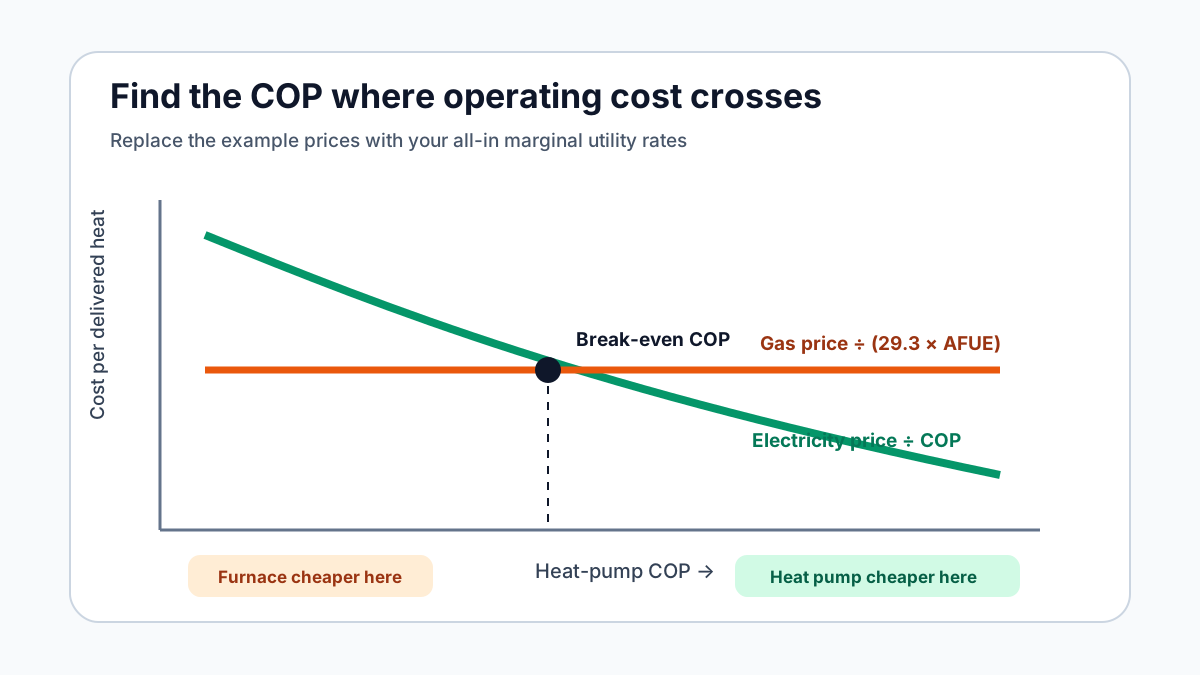
Rearrange the formulas to find the heat-pump COP at which both systems cost the same:
Break-even COP = electricity price × 29.3 × furnace AFUE ÷ gas price per therm
With $0.18/kWh electricity, $1.80/therm gas, and 95% AFUE:
0.18 × 29.3 × 0.95 ÷ 1.80 = COP 2.78
Above COP 2.78, the heat pump is cheaper per unit of delivered heat. Below it, the furnace is cheaper under those variable-rate assumptions.
The break-even COP is more reusable than a national cost table. Update two bill prices and the furnace efficiency, then compare the result with credible heat-pump performance at the temperatures your home experiences.
Use the Marginal Rate, Not the Bill Average Blindly
The right price depends on the decision.
Usage-based electricity charges
Add charges that rise when another kWh is consumed:
- energy or supply charge;
- delivery charge per kWh;
- fuel or power-cost adjustment;
- time-of-use price for the hours the heat pump runs;
- taxes applied to usage;
- tiered-rate effect if heating moves consumption into a higher block.
Do not automatically divide the entire bill by kWh. That includes fixed customer fees that you pay with or without the heat pump. Use the all-in marginal price for added heating consumption. If the rate structure is complicated, calculate a low and high case.
Usage-based gas charges
Add commodity, delivery, riders, and taxes that vary with gas use. Separate the monthly service charge.
If the furnace remains for backup, the fixed gas charge stays. If electrification lets you terminate gas service entirely, annual avoided fixed charges belong in the whole-year comparison. This can be material, but confirm disconnection and reconnection costs, other gas appliances, and local rules.
Demand and time-of-use rates
Most households do not pay a separate demand charge, but some do. A heat pump or resistance backup operating during a billing peak can add a charge not captured by kWh alone. Time-of-use customers need a weighted heating price, not the cheapest overnight rate printed in an advertisement.
The electric-bill breakdown guide helps identify which line items belong in the marginal rate.
Seasonal COP Is Not One Sticker Number
DOE explains COP as heat delivered divided by energy input and describes typical heat-pump COP values as varying by system and condition. Product ratings such as HSPF2 summarize a standardized season, but your weather, sizing, ductwork, setpoints, and backup controls differ from the test procedure.
For a better decision, use temperature-bin analysis:
| Outdoor temperature bin | Estimated house heat needed | Heat-pump COP | Heat-pump share | Backup share |
|---|---|---|---|---|
| Mild | ||||
| Cool | ||||
| Cold | ||||
| Design-cold |
PNNL's cold-climate sizing guidance explains that a home's load increases as weather gets colder while heat-pump output and efficiency change. The annual answer depends on how many heating-load hours fall in each range—not only the coldest recorded night.
Ask the installer for extended performance data showing maximum and minimum capacity and COP at relevant temperatures. Then connect it to the Manual J sizing guide. An oversized or poorly controlled system can perform differently from a properly selected model.
A Three-Bin Worked Example
Suppose a house needs 18,000 kWh of delivered space heat in a representative year. This is a hypothetical model:
| Bin | Share of annual heat | Delivered heat | Heat-pump COP |
|---|---|---|---|
| Mild | 45% | 8,100 kWh | 3.6 |
| Cool | 40% | 7,200 kWh | 2.8 |
| Cold | 15% | 2,700 kWh | 2.0 |
Heat-pump electricity is:
- 8,100 ÷ 3.6 = 2,250 kWh;
- 7,200 ÷ 2.8 = 2,571 kWh;
- 2,700 ÷ 2.0 = 1,350 kWh;
- total = 6,171 kWh.
At an all-in marginal price of $0.18/kWh, modeled heat-pump energy cost is about $1,111.
For a 95% gas furnace, required gas input is 18,000 ÷ 0.95 = 18,947 kWh, or about 647 therms. At $1.80/therm, modeled variable gas cost is about $1,165.
The heat pump saves only about $54 in this scenario before blower electricity, maintenance, fixed fees, or capital cost. Change electricity to $0.22/kWh and heat-pump energy becomes about $1,358. Change gas to $2.40/therm and furnace energy becomes about $1,553. The conclusion is rate-sensitive.
This example's value is the method, not the amounts. Replace every input with your house, tariff, and equipment.
Estimating Annual Heat Demand From Bills
Past fuel use can anchor the comparison when you separate space heating from other uses.
For a gas home:
- Collect at least 12 months of gas bills.
- Estimate non-heating baseload from warm months if gas also serves water heating, cooking, or drying.
- Subtract that baseload from cold-month consumption.
- Convert remaining therms or cubic metres to energy.
- Multiply by the existing furnace's defensible seasonal efficiency.
- Adjust for unusual weather, vacancy, and setpoint changes.
This yields an estimate of delivered annual heat. It can cross-check a contractor model, but it does not produce room-by-room loads or cooling design.
For oil or propane, use delivery records and tank-level uncertainty. For wood, fuel moisture and stove operation make estimates wider. Show a range rather than false precision.
If the old furnace is badly maintained or ducts leak outside, historical delivered heat may be lower than a simple AFUE multiplication suggests. Document assumptions.
Gas, Oil, Propane, and Electric Resistance
The framework works beyond natural gas.
Oil or propane
Convert the local delivered fuel price into cost per kWh or million Btu of input, then multiply by appliance efficiency. Delivery minimums, rental charges, and price volatility may matter. Households replacing expensive propane or oil often find a lower break-even COP than homes with inexpensive pipeline gas.
Electric resistance
Resistance heat has COP approximately 1 at the point of use. A heat pump at COP 2.5 uses about 40% as much electricity to deliver the same heat, before differences in distribution. Persistent auxiliary-strip operation can erase much of that advantage.
Wood
Compare useful heat after appliance efficiency and moisture, not a nominal cord price. Add storage, handling, chimney work, local air-quality rules, and the value of labor.
Fuel-market headlines are context, not a household tariff. For long-term sensitivity testing, vary each fuel price rather than predicting one exact future path.
Dual Fuel and the Economic Changeover Point
A dual-fuel system can run the heat pump when its cost per delivered heat is lower and switch to the furnace when falling COP crosses the break-even value. The economic changeover temperature is where the model's COP curve meets your break-even COP.
Example:
- calculated break-even COP: 2.78;
- manufacturer or field estimate at 35°F: COP 3.4;
- at 20°F: COP 2.8;
- at 5°F: COP 2.2.
Under static prices, an economic changeover near 20°F may follow. But controls must also respect equipment capacity, comfort, defrost, demand charges, minimum furnace runtime, and emissions or resilience priorities.
Do not confuse economic changeover with thermal balance point. The thermal point is where heat-pump capacity no longer meets house load. Gas can be cheaper before that point, or the heat pump can remain cheaper even when supplemental heat is required.
Read the dual-fuel and backup heat guide before accepting a thermostat's default lockout.
Capital Cost: Compare Like-for-Like Replacement Paths
Operating cost is only part of ownership cost. Compare the service each option provides.
A heat pump generally supplies heating and cooling. A gas furnace supplies heating and still needs an air conditioner if cooling is required. Fair pathways might be:
- furnace-only replacement when a sound AC remains;
- furnace plus AC replacement;
- heat pump plus air handler;
- heat pump added to an existing furnace for dual fuel;
- ductless heat pumps plus retained backup;
- heat pump plus required duct or electrical work.
For each path, record:
- installed price before and after verified incentives;
- financing cost;
- expected maintenance;
- remaining life of equipment kept;
- avoided AC replacement;
- gas fixed charges retained or removed;
- expected annual energy range;
- major enabling work with independent value.
Do not turn a low operating-cost estimate into a short payback unless the incremental capital cost is also defined.
Regional Translation
United States
Use the actual utility tariff and recent bills. EIA's Electric Power Monthly supplies state and national context, but household marginal rates can differ through riders, tiers, municipal utilities, and time-of-use plans. Use current state, utility, and program sources for incentives.
Canada
Convert gas priced per cubic metre or gigajoule to a common delivered-heat unit. Add provincial taxes and utility riders that vary with usage. Electricity price structures and gas fixed charges differ by province and utility.
United Kingdom and Europe
Gas and electricity are often billed in kWh, making the core comparison simpler: electricity price ÷ COP versus gas price ÷ boiler seasonal efficiency. Include standing charges only when an option changes whether the account remains open. Air-to-water system temperatures can materially affect seasonal COP.
Across all regions, use the billing period and currency consistently. Do not combine a tax-included gas rate with a tax-excluded electricity rate.
Quote and Calculation Checklist
- Twelve months of heating-fuel and electricity use collected.
- Space-heating demand separated from water heating and baseload.
- Marginal electricity and fuel prices include usage-based riders and taxes.
- Fixed gas fees handled separately.
- Existing furnace AFUE is not confused with current field condition.
- Heat-pump COP varies by temperature rather than using one best-case number.
- Defrost and resistance backup are included.
- Heating demand reflects planned insulation and air sealing.
- Equipment capacity meets the stated heating strategy.
- Furnace-only, furnace-plus-AC, heat-pump, and dual-fuel scopes are comparable.
- Incentives are verified for jurisdiction, date, contractor, and equipment.
- Low, central, and high price scenarios are shown.
Build a Reusable Household Worksheet
Keep the model in a spreadsheet or paper table with one assumption per row. Avoid a calculator that returns a single answer without exposing inputs.
Section A: annual heat demand
Record billed heating fuel, subtract non-heating baseload, convert the remaining fuel to kWh or Btu, and apply the existing system efficiency. Make a low and high demand case for weather and baseload uncertainty. If a professional model provides delivered annual heat, retain the report and compare it with the bill-derived estimate.
Section B: proposed equipment
For each outdoor-temperature bin, enter hours or delivered heat, heat-pump COP, maximum capacity, backup type, and backup share. Use the exact indoor-outdoor equipment match. Flag any COP copied from a marketing page rather than extended performance data.
Section C: current tariffs
Enter electricity by time period or tier, gas or other fuel usage charges, taxes, and variable riders. Put fixed charges on separate lines. Record the tariff name, effective date, and source URL or bill page so the model can be refreshed.
Section D: annual cost bridge
Show these results separately:
- heat-pump compressor electricity;
- indoor fan and pump electricity if material and not already included;
- electric resistance backup;
- furnace fuel;
- furnace blower electricity;
- retained fixed utility fees;
- avoided fixed utility fees;
- annual maintenance assumptions.
Do not hide them inside “annual savings.” A visible bridge shows which input changes the conclusion.
Section E: capital scenarios
Create at least three rows: keep/replace current heating, heat pump, and dual fuel. Add cooling replacement only where the option supplies cooling. Use verified net costs, financing cash flows, and a remaining-life assumption for equipment kept.
Section F: sensitivity
Recalculate with electricity and fuel prices 20% above and below the central case, a colder-weather case, and a lower seasonal COP. This is not a forecast. It shows whether the decision holds across reasonable assumptions or balances on one uncertain input.
If every reasonable case favors the same system, the operating-cost conclusion is strong. If the winner changes repeatedly, comfort, capital cost, resilience, and risk tolerance deserve more weight than a fragile savings estimate.
Reconcile the Model With the First Winter
After installation, compare actual performance with the prediction. Save monthly electricity, fuel, thermostat, and weather data. Record backup-heat runtime where controls expose it.
For each billing period:
- calculate kWh/day and fuel/day;
- compare heating degree days with the model period;
- subtract known non-heating changes such as EV charging;
- note thermostat or occupancy changes;
- check whether backup operated at the intended temperatures;
- compare actual indoor comfort with the design goal.
A higher electric bill does not prove the model failed if a gas or oil bill disappeared. Add all household fuels and compare delivered service. Conversely, a lower total bill in a warm winter does not prove the selected seasonal COP.
Large gaps can indicate incorrect rate inputs, underestimated heat demand, excessive resistance backup, duct loss, control problems, or equipment performance. Bring the documented comparison to the installer while commissioning data and warranty obligations are still accessible.
Operating Cost Is Not Peak Electrical Demand
Annual energy and service capacity answer different questions. A heat pump can have attractive annual cost while its compressor and auxiliary heater create a demanding design-day electrical load. A furnace can use inexpensive fuel while still needing blower and control power.
Coordinate the economic model with the electrical-panel capacity guide. Do not add compressor nameplate current and backup breaker sizes casually; use the electrical design method and exact staged operation. Likewise, do not assume an annual COP proves adequate cold-weather capacity. Cost, capacity, and service design are connected but separate calculations.
Common Calculation Errors
Comparing 18-cent electricity with $1.80 gas directly
The units differ. Convert both into cost per delivered heat.
Calling COP an efficiency percentage and stopping
COP 3 indicates three units of delivered heat per electric unit under the relevant conditions. Cost still depends on electricity price.
Using peak COP for the whole winter
COP falls and changes with temperature and operation. Weight performance by heating demand.
Ignoring auxiliary resistance heat
Resistance backup can have COP near 1. Include staged runtime rather than assuming it never operates.
Counting fixed charges twice
Fixed fees matter only if the decision changes them. They are not part of marginal fuel cost when service remains.
Assuming all gas use is space heating
Subtract water heating, cooking, dryer, fireplace, and other baseloads.
Using current bills without weather context
A warm winter understates long-run demand. Compare degree days or model a representative season.
Frequently Asked Questions
At what COP is a heat pump cheaper than gas?
Use: electricity price × 29.3 × furnace AFUE ÷ gas price per therm. That is the break-even COP for the stated variable prices. If gas is billed in another unit, convert both fuels to the same heat unit first.
Is a heat pump cheaper to run than a 95% furnace?
Sometimes. The result depends on local marginal rates and the heat pump's seasonal performance in that house. A high AFUE does not guarantee cheaper fuel, and a high COP does not guarantee cheap electricity.
Should I include the gas customer charge?
Include avoided annual fixed charges in the whole-project comparison only if all gas use ends and the account can be closed. If the furnace or another gas appliance remains, the charge remains.
Can HSPF2 replace the COP calculation?
HSPF2 helps compare rated seasonal performance but does not directly capture your weather, rates, sizing, ducts, or controls. Use it as a product screen and use temperature-dependent data for the project model.
Why did my heat-pump bill rise even if heating cost fell?
Electrification shifts spending from a gas, oil, or propane bill to electricity. Compare total household energy cost and normalized consumption, not one bill in isolation.
Is dual fuel always cheapest in cold climates?
No. It can be useful where gas is inexpensive, electricity is costly, or the existing furnace has value. Fixed gas fees, maintenance of two systems, control quality, and future prices can reduce the advantage.
Should carbon emissions be part of the decision?
They can be, but this guide calculates household operating cost. Emissions require regional grid intensity, fuel lifecycle boundaries, refrigerant assumptions, and time. Keep the cost and emissions models separate so neither is obscured.
What to Read Next
Use the Manual J heat-pump sizing guide to obtain the capacity and performance inputs this calculation needs. Then compare installation scopes in the heat-pump quote worksheet and test a retained-furnace strategy with the dual-fuel backup guide. If your starting bills look abnormal, begin with the electric-bill breakdown before modeling new equipment.
Sources and Method
The conversion and efficiency framework uses DOE definitions of COP and AFUE, EIA retail-price sources for context, and PNNL guidance on temperature-dependent cold-climate heat-pump sizing. All prices and annual loads in worked examples are illustrative. Recalculate them from current household tariffs, bills, design documents, and exact equipment data.
Sources and Verification
Editorial Review
EnergyBS Editorial Team
EnergyBS publishes practical homeowner guides. Important program, product, and cost claims should be checked against the linked source and local project documents before you commit to work.
Related Guides
View All ArticlesHeat Pump Sizing Guide: How to Read a Manual J and Avoid an Oversized System
A homeownerfocused guide to Manual J loads, Manual S equipment selection, coldweather capacity, balance points, duct constraints, and the documents a defensible heatpump quote should include.
Heat Pump Backup Heat: Dual Fuel, Electric Strips, and Lockout Settings
Size and control heatpump backup from the home's load, lowtemperature equipment capacity, local rates, and outage plan. Compare dual fuel, electric strips, balance points, and lockouts.
How to Read Your Electric Bill: Every Line Item Explained (2026)
Your electric bill is full of confusing charges, fees, and acronyms. Here's a linebyline breakdown of what you're actually paying for—and where to find savings.