Magnetic Refrigeration
Solidstate cooling is here. No refrigerants, no noisy compressors. How magnetocaloric materials are changing HVAC.
The End of Compressors? The Magnetic Refrigeration Revolution
Short Answer: Solid-state cooling is here. No refrigerants, no noisy compressors. How magnetocaloric materials are changing HVAC.
For 100 years, we have cooled our food and homes the same way: Vapor Compression. Squeeze a gas (refrigerant), make it hot, condense it, release it, make it cold. It works, but it's loud, inefficient (electricity hog), and the gases (HFCs) are potent climate pollutants (2,000x worse than CO2).
A silent revolution is coming from the labs of materials science: Magnetocaloric Cooling (Magnetic Refrigeration). No compressors. No gases. Just magnets and metal.
Part 1: How It Works (The Physics)
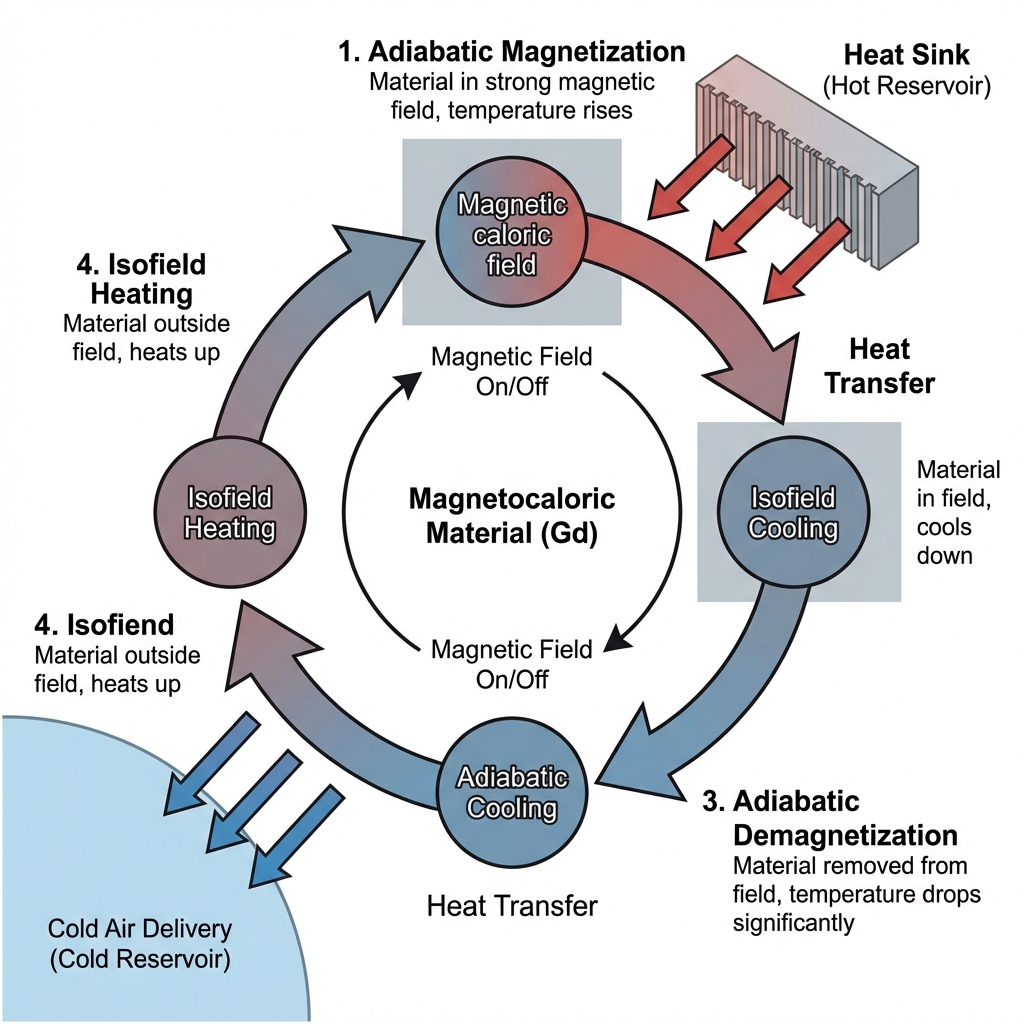
It relies on the Magnetocaloric Effect (MCE). Certain exotic alloys (like Gadolinium) heat up instantly when placed in a magnetic field and cool down instantly when removed.
The Cycle:
- Magnetization: The alloy enters a magnetic field. Its chaotic magnetic dipoles align. This releases entropy as Heat. (The material gets hot).
- Rejection: Water (or a fluid) flows over the hot material, taking the heat away to a radiator (outside).
- Demagnetization: The alloy leaves the magnetic field. The dipoles return to chaos. The material absorbs energy (entropy) from its own lattice. It gets freezing cold.
- Absorption: Air (or fluid) flows over the cold material, cooling down your fridge or room.
It is a solid-state heat pump.
Part 2: The Advantages (Why We Want This)
1. Efficiency (The Holy Grail) Vapor compression is hitting its theoretical limit (Carnot limit). Magnetic cooling is theoretically 20% to 30% more efficient than the best standard compressor. In a world trying to reduce grid load, a 30% drop in cooling energy is widely significant.
2. Silence No compressor rumble. The only moving parts are fluid pumps and a slowly rotating magnet wheel. It runs near-silent.
3. Green (No GWP) Global Warming Potential (GWP) of R-410a refrigerant: 2,088. GWP of Gadolinium Alloy: 0. GWP of Water (coolant): 0. It completely eliminates the risk of refrigerant leaks because there is no refrigerant.
4. Low Pressure Standard AC systems operate at 300-500 PSI. Leaks are inevitable. Magnetic systems operate at water pressure (~20-30 PSI). Safety and durability are vastly superior.
Part 3: The Gadolinium Crisis (The Barrier)
If it stands to change the world, where is it?
The Material Cost: The best magnetocaloric material is Gadolinium (Gd). It is a Rare Earth element.
- Cost: Expensive (~$4,000/kg).
- Supply: Controlled largely by China.
- Scale: You can't urge every fridge in the world to use kilograms of Gadolinium. There isn't enough in the crust.
The Fix: Researchers (GE, Ames Lab) are racing to develop Manganese-Iron-Phosphorus-Silicon alloys. These use cheap, abundant earth materials to mimic the effect of Gadolinium. We are now seeing "High-Entropy Alloys" that are getting close to the performance needed for mass adoption.
Part 4: Commercial Roadmap (2026-2030)
We are in the "Niche Commercialization" phase.
2024-2026: High-End Wine Coolers & Beverage Fridges.
- Haier/GE Appliances demonstrated the prototype "Monogram" magnetic wine cooler.
- Why here? Wine enthusiasts pay a premium for Silence and Vibration-Free cooling (vibration ruins wine sediment). The cost doesn't matter as much.
2027-2028: Commercial Supermarket Refrigeration.
- Grocery stores spend fortunes on electricity and refrigerant leak compliance. A centralized magnetic chiller rack makes economic sense for them before homeowners.
2030+: Residential HVAC / Electric Vehicles.
- EVs are the killer app. Managing cabin temp without draining the battery is crucial. A magnetic heat pump could extend EV range by 10% in winter/summer.
Part 5: The "Caloric" Family (Elastocaloric & Barocaloric)
Magnetic isn't the only contender.
- Elastocaloric: "Heat Pump in a Rubber Band." Stretching a shape-memory metal alloy (Nitinol) releases heat. Retracting it absorbs heat.
- Barocaloric: Squeezing a solid material (pressure) causes heat changes.
Currently, Magnetic is the most mature, but Elastocaloric has a higher theoretical efficiency. The race is on.
Summary Verdict
You cannot buy a Magnetic AC unit at Home Depot in 2026. But you might buy a magnetic wine fridge. This technology represents the first fundamental shift in thermodynamics application since the 1920s. Keep your eye on manufacturers like Camfridge and Magnotherm. The moment they crack the "Iron Alloy" code, the compressor's days are numbered.
About the Editorial Team EnergyBS reviews public program rules, product specifications, utility rates, and reader-facing cost assumptions. Treat savings figures as estimates until you verify local prices, permits, rebates, and contractor quotes.
Common Questions
What should I check first before using this hvac advice?
Start with the numbers that apply to your home: climate, utility rate, equipment age, contractor quote, and local program rules. Solidstate cooling is here. No refrigerants, no noisy compressors. How magnetocaloric materials are changing HVAC.
How should I verify rebates, tax credits, rates, or savings before spending money?
Treat program amounts, utility rates, and tax rules as date-sensitive. Check the named government, utility, or manufacturer source before you sign a contract, and keep screenshots or PDFs of eligibility rules for your records.
What is the next useful step after reading this?
Compare this with Heat Pump Sizing Guide so you can check the cost, rebate, installation, or operating-risk angle before making a decision.
What to Read Next
Heat Pump Sizing GuideUse this next to compare the cost, incentive, installation, or operating-risk angle before you make a home energy decision.Sources and Verification
Editorial Review
EnergyBS Editorial Team
EnergyBS publishes practical homeowner guides. Important program, product, and cost claims should be checked against the linked source and local project documents before you commit to work.
Related Guides
View All ArticlesHeat Pump Sizing Guide
A homeownerfocused guide to Manual J loads, Manual S equipment selection, coldweather capacity, balance points, duct constraints, and the documents a defensible heatpump quote should include.
Ductless MiniSplit Head Placement 2026 Tool
A homeowner planning method for locating ductless indoor units by room load, air throw, doors, sensors, noise, condensate, line routes, service access, and wholehome comfort—not wall convenience alone.
Portable Dehumidifier Sizing and Placement 2026 Analysis
Size and place a portable dehumidifier using space area, uncontrolled moisture condition, temperature, air connection, drainage, electrical supply, sound, filtration, energy, heat release, commissioning, and sourcecontrol evidence.