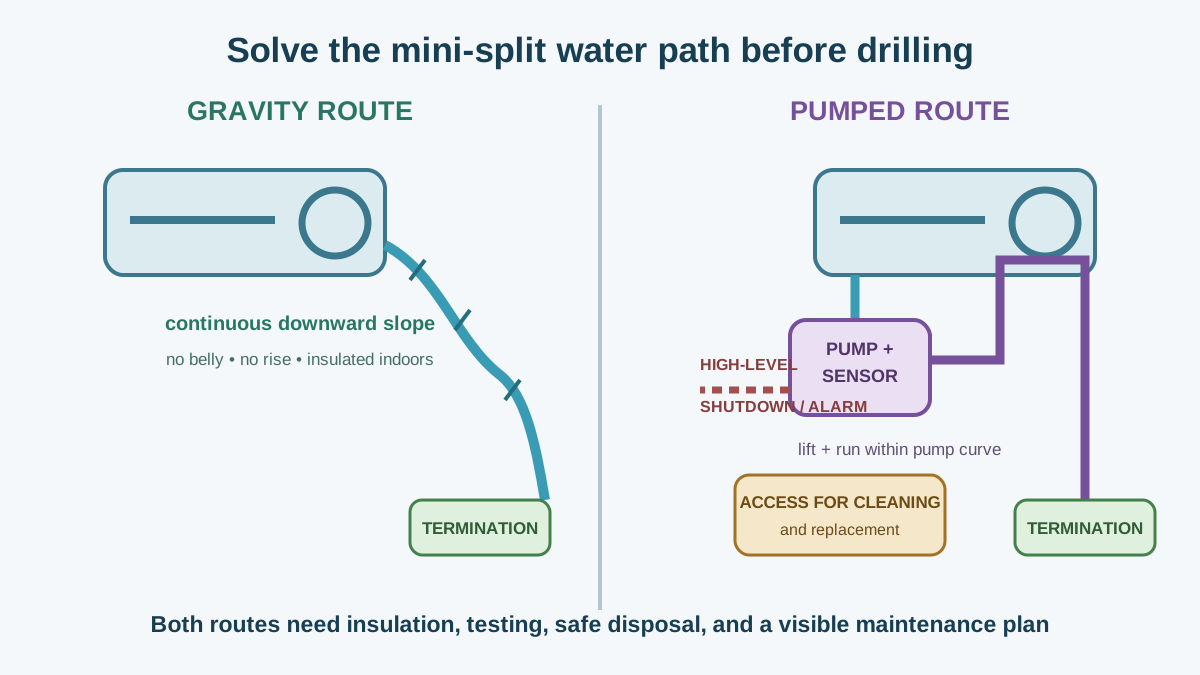
MiniSplit Condensate Drain: Gravity Line or Pump? Plan the Route Before Placement
Choose and commission a ductless minisplit gravity drain or condensate pump by product instructions, continuous slope, lift and run limits, termination, insulation, cleanout access, overflow shutdown, noise, freeze risk, maintenance, and waterdamage consequence.
Direct Answer
Choose and commission a ductless minisplit gravity drain or condensate pump by product instructions, continuous slope, lift and run limits, termination, insulation, cleanout access, overflow shutdown, noise, freeze risk, maintenance, and waterdamage consequence.
The Drain Route Is Part of Indoor-Unit Placement
Short answer: Prefer a continuous gravity drain when the exact mini-split instructions, route, termination, insulation, and local requirements allow it. Use an approved condensate pump when gravity cannot reach a suitable disposal point, but price the pump, reservoir/sensor location, lift and run limits, electrical/control connection, overflow shutdown or alarm, vibration/noise isolation, cleanout access, freeze protection, and replacement path. Test the final route with water before finishes close.
A wall head can look perfectly centered while its drain must rise, cross a doorway, run level inside line-hide, or terminate above a walkway. Moving the indoor unit a few inches early can eliminate years of pump noise and maintenance. Treat condensate as a first-pass routing constraint, not a detail solved after refrigerant holes are drilled.
Why a Mini-Split Makes Water
When the indoor coil operates below the air's dew point, water condenses on it and collects in a pan. The volume changes with humidity, airflow, coil temperature, load, and runtime. The system needs a reliable path from pan to an approved discharge point during every cooling or dehumidification event.
Water at the wall does not automatically mean the drain is clogged. Causes can include:
- indoor unit out of level under its product instructions;
- drain hose rising, sagging, pinched, disconnected, or poorly joined;
- blocked pan or outlet;
- failed or dirty pump;
- cracked pan or hose;
- missing insulation causing exterior condensation;
- cold line or fitting touching finish material;
- frozen coil later thawing;
- wind or termination pressure effects;
- installation debris;
- inadequate overflow response.
The general AC condensate guide provides a water-path diagnosis. This guide focuses on designing a new ductless route.
Product Instructions Override Generic Diagrams
Obtain the exact indoor-unit model and installation manual. Record:
- drain outlet side(s) and conversion steps;
- supplied hose size and connection method;
- required slope and prohibited traps/rises;
- maximum drain lift/run for built-in pumps, if any;
- pipe/hose material and diameter;
- insulation requirements;
- support intervals;
- permitted termination;
- test procedure;
- service access;
- auxiliary pump/control compatibility.
One wall-mounted Daikin FTXR installation manual requires its drain hose to slope downward, prohibits a risk and submerged end, specifies extension details, calls for indoor insulation, and instructs installers to pour water into the pan to verify flow. Another unit may differ. Cite the exact document in the quote.
Gravity Drain: Fewer Moving Parts, More Geometry
A gravity route needs continuous fall from the indoor pan to disposal. The line must not sag between supports, rise over framing, form an unintended risk, or terminate where water backs up.
Gravity-route checklist
- exact unit outlet and level/orientation verified;
- continuous downward slope under manual and code;
- no hidden high point or belly;
- compatible hose/pipe and secure joints;
- enough diameter without reduction;
- supports prevent sag;
- indoor sections insulated against sweating;
- cleanout or service method where appropriate;
- wall penetration sealed without crushing the hose;
- termination visible, legal, and non-damaging;
- exterior section protected from freezing, blockage, pests, and damage;
- test water reaches the outlet freely.
PNNL's ductless code-compliance brief explains that condensate must reach an approved disposal point and gives code-context slope requirements. Current adopted code and the exact equipment instructions control the actual project.
Do not force the indoor unit level by eye
Some products require level installation; others specify a slight relationship to the drain side. Follow the mounting plate and manual. A laser or level is useful only when applied to the correct reference.
Condensate Pump: Solves Elevation, Adds Failure Modes
A pump collects or senses water near the indoor unit and moves it through small tubing to a higher or more distant discharge. Pump types include reservoir, mini-reservoir, peristaltic, and other product-specific designs. Select only equipment approved for the application and condensate characteristics.
The pump decision must state:
- model and rated capacity at actual lift;
- maximum vertical lift and total run;
- reservoir or sensor location;
- inlet gravity section and slope;
- discharge tubing material/size;
- check valve or siphon requirements;
- power source and disconnect/service method;
- high-level switch, shutdown, and alarm behavior;
- sound rating/operating pattern where published;
- mounting/vibration isolation;
- cleaning interval and access;
- replacement route without wall demolition;
- warranty and who services it.
PNNL's HVAC assessment guide says drainage should be checked for proper slope/risk or pump function and that pan, float, alarm, and auxiliary requirements should be assessed. The exact mini-split/pump design determines how those principles are implemented.
Gravity vs Pump Decision Table
| Factor | Gravity | Pump |
|---|---|---|
| Moving parts | None | Motor/mechanism and controls |
| Route requirement | Continuous fall | Lift/run within pump curve |
| Electrical/control | Usually none for drain | Required |
| Routine noise | Usually silent | Cycling or continuous sound possible |
| Maintenance | Inspection/cleaning | Inspection, cleaning, pump/sensor checks |
| Failure behavior | Blockage, sag, freeze, joint leak | All gravity risks plus power/mechanical/control failure |
| Placement flexibility | Lower | Higher |
| Access priority | Cleanout and termination | Reservoir/sensor/pump/tubing replacement |
| Water protection | Product/site dependent | High-level shutdown/alarm should be defined |
| Best use | Suitable downward route | No compliant practical gravity route |
Do not select a pump merely to preserve a cosmetically centered head without comparing a small placement shift.
Map the Route in Three Dimensions
On elevation and plan drawings, mark:
- bottom and outlet of indoor unit;
- initial hose direction;
- every turn and joint;
- framing, header, door, window, beam, cabinet, and chase;
- line-hide size and slope;
- wall penetration elevation;
- pump/sensor and service cover;
- maximum lift and discharge run;
- termination elevation;
- cleanout and test points;
- high-level control wiring;
- areas where a leak damages finishes.
The mini-split head-placement guide maps air throw, sensors, service, piping, and drains together. Do not finish the air-side plan before solving the water path.
Termination Is a Site Decision
Condensate should discharge to an approved location without causing nuisance, foundation moisture, erosion, staining, ice, pests, or damage. Options and rules vary. Possible routes can include an approved receptor, indirect waste arrangement, exterior grade location, or another permitted connection.
Ask:
- Can the termination be observed during a test?
- Will water run toward the foundation?
- Can it freeze on a walk, stair, driveway, or neighbor's property?
- Is the outlet submerged or exposed to wind pressure?
- Can insects or debris enter?
- Does local plumbing/mechanical code restrict the connection?
- Will detergents, sewer gas, or chemical vapors reach the unit?
- Can the outlet be cleaned without a ladder or demolition?
Do not connect directly to a sanitary line by improvisation. Traps, air gaps, receptors, and indirect connections are governed by local rules and the exact equipment design.
Freeze Risk
An exterior gravity hose can freeze if it retains water, lacks fall, runs through a cold cavity, or terminates where ice builds back. A pump discharge can retain water and freeze too.
In freezing climates:
- maintain the prescribed slope;
- minimize exposed sections where practical;
- avoid low spots and upward loops;
- protect the outlet from snow and ice without obstructing it;
- follow product-approved insulation or heat-trace provisions if any;
- do not use an unapproved heater or shared circuit;
- locate termination away from slip areas;
- define winter maintenance.
Some heat pumps do not generate indoor condensate during normal heating, but cooling-season water left in a poor route can still freeze during shoulder-season operation or unusual conditions. Follow local design experience and manuals.
Insulation Prevents False “Drain Leaks”
Cold drain piping, refrigerant tubing, valves, or wall sleeves can condense moisture on their exterior. Insulate indoor drain extensions as required, seal insulation seams, avoid compression, and carry vapor control through joints.
Daikin's wall-unit drain instructions call for a downward route, suitable extension diameter, indoor insulation, and a water-flow test for that model. A wet wall can originate outside the drain tube rather than from its interior.
Avoid Hidden Joints and Inaccessible Pumps
Every joint and pump component is a service point. Prefer accessible, inspectable connections. If a reservoir or sensor sits inside line-hide or behind the head, show how it is removed without disconnecting refrigerant piping or damaging drywall.
Document:
- access-panel dimensions;
- tool clearance;
- tubing slack and strain relief;
- sensor orientation;
- power isolation;
- spill protection during service;
- replacement pump availability;
- whether furniture or cabinetry blocks access.
Do not bury a pump in a sealed wall to hide its appearance.
Noise and Vibration
Pumps can click, buzz, pulse, or transmit vibration through line-hide and framing. Sound depends on pump type, mounting, lift, tubing, water rate, wall construction, and room background.
For bedrooms, offices, studios, and quiet living rooms:
- compare gravity options first;
- locate the pump away from headboards where possible;
- use approved isolation and secure tubing;
- avoid tubing contact that taps inside walls;
- ask for published sound conditions;
- define acceptable operating behavior and callback process.
An app or thermostat may not identify a pump fault. A high-level alarm/shutdown path should be explicit.
Water-Damage Consequence Sets Protection Level
A leak above an unfinished utility sink differs from one above hardwood, artwork, a nursery, or electrical equipment. Assess:
- volume before detection;
- occupied vs unoccupied periods;
- visible vs concealed water path;
- ceiling/floor/wall materials;
- secondary containment possibility;
- high-level shutdown and alarm;
- remote notification reliability;
- repair access and insurance consequences.
PNNL's condensate-pan resource explains how clogged drains and overflowing pans can damage ceilings, floors, and walls and describes pumps with high-water shutdown/alarm concepts. Apply product and code requirements to the actual unit.
Quote Worksheet
| Drain field | Bid A | Bid B | Bid C |
|---|---|---|---|
| Indoor unit model/manual | |||
| Gravity or pump | |||
| Route drawing | |||
| Slope or pump lift/run | |||
| Pipe/hose material and size | |||
| Joints and supports | |||
| Insulation | |||
| Pump model/capacity | |||
| Power/control/shutdown | |||
| Alarm/notification | |||
| Cleanout/service access | |||
| Termination | |||
| Freeze protection | |||
| Water test | |||
| Finish repair | |||
| Drain/pump warranty |
Carry this into the HVAC quote comparison worksheet.
Worked Placement Example
A proposed bedroom wall head sits above a window. Its drain outlet would need to cross a header and rise before reaching the exterior. The contractor proposes a hidden mini pump beside the head.
Candidate A keeps the location and adds the pump, high-level shutdown, accessible line-hide cover, insulated discharge, tested lift, exterior freeze-safe termination, and written pump maintenance. Candidate B shifts the head to an adjacent wall and uses a short continuous gravity line while preserving air throw and service clearance.
Compare noise, aesthetics, line-set length, air distribution, structural penetrations, maintenance, water consequence, and installed price. Candidate B may be simpler, but only if the new wall still satisfies load, sensor, throw, and refrigerant-piping needs.
Installation and Water Test
Before finishes close:
- inspect slope, supports, joints, insulation, and penetrations;
- verify pump model, orientation, power, and control wiring;
- pour the manufacturer-specified test quantity into the pan or test point;
- observe water reaching the termination;
- inspect every accessible joint and wall opening;
- test pump high-level shutdown/alarm under its approved method;
- confirm no siphon, backflow, gurgle, or retained water contrary to instructions;
- restore covers and repeat operational cooling test when conditions allow;
- photograph concealed route and record model/serial;
- show the owner cleaning and service access.
The product instructions decide the test. One successful pour does not eliminate future maintenance.
Maintenance Plan
Record frequency from unit and pump manufacturers. A plan may include:
- inspect pan, outlet, hose, and visible termination;
- clean filters so coil operation remains normal;
- inspect insulation and wall stains;
- clean pump reservoir/sensor with approved method;
- test high-level safety and alarm;
- listen for changed pump cycle or noise;
- clear vegetation, ice, and insects from outlet;
- verify furniture does not block service access;
- document any repeated water event.
Do not pour bleach, acid, high-pressure gas, or an unknown chemical through a mini-split. Use the product-approved maintenance procedure.
Common Failure Patterns
- head installed before gravity route is measured;
- hose runs level inside line-hide;
- framing forces an unseen upward loop;
- small hose extension reduces or leaks at a poor joint;
- indoor piping is uninsulated and sweats;
- exterior outlet ends in soil, snow, or standing water;
- pump lift is quoted without total run or capacity curve;
- pump power is disconnected from unit shutdown logic;
- reservoir is hidden behind drywall;
- discharge tubing taps against framing;
- high-level switch is never tested;
- maintenance requires removing refrigerant connections;
- a water stain is treated as a clog without finding the path.
Size a Pump at the Actual Duty Point
A pump's headline flow at little or no lift is not its flow at the installed height and tubing run. Request the manufacturer's performance curve or table and mark:
- vertical lift from reservoir/sensor to highest discharge point;
- total tubing length;
- tubing inside diameter;
- number and radius of bends;
- check valve and fittings;
- discharge elevation and backpressure condition;
- expected condensate inflow;
- allowed cycle duration and duty;
- ambient temperature limits.
Select with manufacturer guidance and a reasonable design margin. An oversized pump is not automatically quieter or safer; it can cycle differently and still fail from poor routing, contamination, or a blocked outlet.
Prevent siphon and backflow under the exact instructions
Depending on layout, discharge can siphon, drain backward, or retain water. Do not add an arbitrary check valve, risk, vent, or air break. Each device changes resistance and failure behavior. Use only the pump and indoor-unit diagrams for the actual arrangement.
Electrical and Control Scope
The pump needs a listed power and control arrangement. The quote should identify:
- supply voltage and source;
- whether power is continuous or equipment-controlled;
- overcurrent protection under product instructions;
- accessible isolation for service;
- low-voltage high-level contacts and compatible indoor-unit input;
- whether a high level stops cooling, shuts the full unit, or only alarms;
- what happens after power returns;
- wire separation, protection, and concealed connections;
- responsibility of HVAC and electrical trades.
Do not defeat a safety input to stop nuisance shutdowns. A nuisance event means the route, sensor, pump, tubing, or maintenance needs diagnosis.
Shared and Grouped Drains Need Engineering
Do not combine several indoor units merely because their hoses are near each other. A grouped route can create backflow, air interaction, hidden blockages, and disputes about which unit caused water.
Verify:
- every manufacturer permits the arrangement;
- common pipe is sized for simultaneous condensate;
- branches enter under the required geometry;
- slope and supports prevent air pockets/sags;
- one pump is rated and approved for all connected flow, if used;
- high-level protection stops the correct equipment;
- cleaning one branch cannot push debris into another;
- termination handles total flow;
- units and cleanouts are labelled.
Daikin's cited FXAQ installation manual includes model-specific grouped-drain guidance, illustrating why a shared route needs an exact drawing rather than a generic tee.
Finish and Penetration Details
The drain route can fail at the building enclosure even when water flows internally. Specify:
- sleeve or protected wall penetration;
- outward water-management geometry;
- exterior flashing/sealant compatible with cladding;
- interior air sealing without crushing hose;
- fire stopping in rated assemblies;
- pest-resistant termination that does not obstruct flow;
- UV and mechanical protection;
- line-hide joints that shed rain;
- access cover at pump and critical joints;
- finish repair and repainting responsibility.
Photograph the open penetration and route before covers close. Do not use expanding foam in a way that pinches a soft hose or makes pump tubing irreplaceable.
Handoff Record
Leave the owner:
- indoor-unit, pump, and sensor model/serial information;
- route drawing and termination photo;
- slope or lift/run calculation;
- insulation and hidden-joint photos;
- pump curve/duty selection;
- high-level wiring function;
- water-test and shutdown/alarm result;
- approved cleaning materials and interval;
- replacement pump/tubing specifications;
- warranty and service contact;
- symptom log for water, noise, and fault codes.
Label the pump access cover discreetly. Future owners should not discover the device only after a ceiling stain.
After-Installation Symptom Log
| Date/condition | Cooling/dehumidify mode | Pump sound/cycles | Termination flow | Water/fault |
|---|---|---|---|---|
| Humid afternoon | ||||
| Overnight bedroom use | ||||
| After filter cleaning | ||||
| First cold/freeze period |
Changed noise, longer cycles, gurgling, intermittent shutdown, or water at the wall can justify service. The log is evidence, not a diagnosis.
Sources and Verification
- PNNL's ductless code brief provides condensate-disposal and slope code context.
- PNNL's pre-retrofit assessment supports checking drain slope/risk or pump function, pan condition, float, alarm, and auxiliary needs.
- PNNL's condensate-pan guide covers overflow damage and pump high-level protection concepts.
- Daikin's FTXR installation manual and FXAQ manual demonstrate product-specific slope, hose, insulation, and water-test instructions.
- Mitsubishi Electric Trane HVAC US's installation manual provides another manufacturer-specific drain example and reinforces that instructions vary by unit type.
Verify current product manuals and adopted local code for the exact installation.
Frequently Asked Questions
Is a gravity drain always better than a pump?
It has fewer moving parts, but only when a compliant continuous route and approved termination exist. PNNL's ductless code brief provides the disposal/slope context; the product manual controls details.
Can a mini-split drain run uphill?
A plain gravity drain cannot. Some units have an approved built-in lift mechanism or can use a selected auxiliary pump. Follow exact lift/run and routing instructions.
Can the hose end sit in a drain or water?
Not when the product forbids submergence. The cited Daikin FTXR manual specifically says its hose end should not be in water.
Does the indoor drain need insulation?
Often yes where cold surfaces can sweat, but material and extent are product/site-specific. Daikin's drain instructions show an official model-specific insulation requirement.
Should a condensate pump shut the mini-split off if it fails?
High-level protection should be deliberately designed. PNNL's condensate guide describes pumps with a secondary switch that can stop equipment or alarm; confirm compatibility and exact wiring.
How noisy is a mini condensate pump?
It varies with design, lift, mounting, wall, and water rate. Ask for published conditions and service access, and compare a gravity-compatible head location.
Can condensate discharge beside the foundation?
Only if local rules allow and it will not create moisture, erosion, ice, or nuisance. The PNNL code brief states condensate should go to an approved place and not create nuisance.
What should I do if water appears?
Turn cooling off when necessary to prevent damage, protect electrical areas, and identify the full water path. Use the AC condensate diagnostic guide rather than assuming a clog.
What to Read Next
Choose the wall with the mini-split placement guide, price the route with the HVAC quote worksheet, and diagnose existing water with the condensate leak guide.
Sources and Verification
- PNNL Building America: Ductless MiniSplit Heat Pumps Code Compliance Brief
- PNNL Building America: PreRetrofit Assessment of Existing HVAC Systems
- PNNL Building America: CorrosionResistant HVAC Condensate Drain Pan
- Daikin: FTXR Series Installation Manual and Drain Piping
- Daikin: FXAQ Indoor Unit Installation Manual
- Mitsubishi Electric Trane HVAC US: Indoor Unit Installation and Drain Piping
Editorial Review
EnergyBS Editorial Team
EnergyBS publishes practical homeowner guides. Important program, product, and cost claims should be checked against the linked source and local project documents before you commit to work.
Related Guides
View All ArticlesDuctless MiniSplit Head Placement: A RoombyRoom Planning Guide
A homeowner planning method for locating ductless indoor units by room load, air throw, doors, sensors, noise, condensate, line routes, service access, and wholehome comfort—not wall convenience alone.
AC Condensate Drain Clogged or Leaking: Find the Water Path Before Clearing the Line
Separate a clogged primary drain from coil freeze, cracked pans, missing traps, duct sweating, plumbing leaks, and roof water. Includes a panriskswitch commissioning worksheet.
Heat Pump Quote Comparison Worksheet: Normalize Price, Design, and Commissioning
A sidebyside homeowner worksheet for comparing heatpump and HVAC bids by load calculations, exact matched equipment, ducts, electrical work, refrigerant piping, controls, commissioning, warranties, exclusions, and true installed cost.