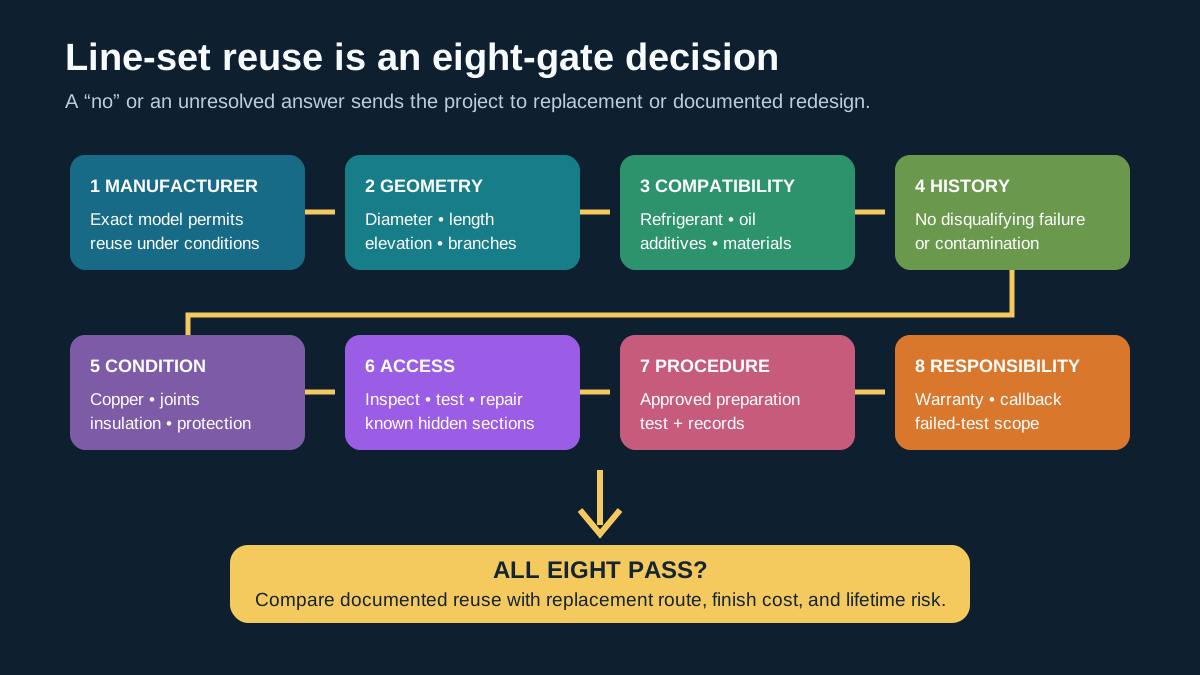
Reuse or Replace a Refrigerant Line Set? Heat Pump
A productspecific homeowner checklist for deciding whether existing refrigerant piping can remain during an AC or heatpump replacement, including manufacturer permission, geometry, history, contamination, condition, testing, warranty, and fallback scope.
Direct Answer
A productspecific homeowner checklist for deciding whether existing refrigerant piping can remain during an AC or heatpump replacement, including manufacturer permission, geometry, history, contamination, condition, testing, warranty, and fallback scope.
Existing Copper Is Not Automatically an Asset or a Defect
Short answer: Reuse an HVAC refrigerant line set only when the exact new equipment manufacturer permits it and a qualified installer verifies tube size, material, length, elevation, refrigerant and oil history, contamination risk, physical condition, joints, insulation, accessibility, pressure/leak testing, evacuation, charge, code, and warranty. Replace or reroute the piping when any required gate fails or when concealed uncertainty creates unacceptable future risk.
The two copper tubes between indoor and outdoor equipment are part of the refrigeration system. Their diameters influence velocity, pressure drop, capacity, and oil return. Length and elevation can require extra charge or accessories. Moisture, acid, debris, old lubricant, damaged insulation, or a hidden leak can undermine new equipment.
Refrigerant Work Is Not a Homeowner Task
Do not cut, open, braze, pressure-test, flush, evacuate, or charge the circuit. It contains pressurized refrigerant; brazing creates fire risk; test cylinders require regulated handling; and the equipment contains hazardous voltage.
EPA's stationary-refrigeration homeowner resources explain technician requirements. EPA also prohibits intentional venting of covered refrigerants during service. Local licences, permits, fire rules, and mechanical/electrical code can add requirements.
The homeowner's useful role is to require a documented decision before the old system is disconnected.
Why There Is No Universal Reuse Rule
Piping requirements vary by brand, series, capacity, refrigerant, component match, and manual revision. One model may permit specific existing piping after inspection and testing. Another may require new tube sizes, prohibit an oil history, limit length, or require accessories.
Daikin's official R-32 long-line application guideline, for example, warns that its instructions are not for R-410A systems and says existing R-410A tubing should not be used for an R-32 retrofit without evaluating velocities across the operating range. A different Daikin R-32 VRV-S installation manual describes conditions for certain existing-pipe applications, including cleaning, size, insulation, and inspection.
These primary documents prove the method is product-specific. They do not authorize reuse for another product.
The Five-Gate Decision
- Manufacturer: the exact matched equipment documentation permits the approach.
- Geometry: both diameters, length, elevation, fittings, charge, and accessories comply.
- History: prior refrigerant, oil, additives, leaks, failures, and exposure are acceptable.
- Condition: tubing, joints, routing, supports, insulation, and accessibility are sound.
- Acceptance tests: the prescribed leak, strength, dehydration, charge, and startup tests pass.
Unknown is not a pass. Put uncertain items into a priced fallback.
Gate 1: Locate the Exact Instructions
Before signing, collect:
- outdoor model number;
- indoor coil or air-handler model number;
- approved matched-system or AHRI reference;
- installation manuals and revision dates;
- piping-size table;
- long-line or vertical-separation guide;
- existing-pipe service bulletin if published;
- written manufacturer technical response for any exception;
- warranty language affected by piping.
Search the documents for tubing size, actual and equivalent length, elevation, vertical separation, additional charge, traps, accessories, existing piping, reuse, flushing, pressure test, evacuation, insulation, joints, and A2L provisions.
Sales literature and a distributor's verbal opinion do not replace the installation manual.
Equipment matching is separate
ENERGY STAR's quality-installation guidebook calls for matched indoor and outdoor equipment documentation. An AHRI certificate supports the component combination; it does not approve a field line set. Check both.
Gate 2: Measure Geometry
Record both copper outside diameters at accessible ends. Do not infer diameter from insulation or old nominal tonnage. Trace the route and establish:
- actual one-way length;
- equivalent length under the manufacturer's fitting method;
- vertical separation and which unit is higher;
- concealed runs and hidden joints;
- number/type of flares, brazes, couplings, reducers, or branches;
- traps, risers, accessories, or abandoned connections;
- bends, supports, vibration points, and abrasion protection;
- wall, slab, chase, attic, roof, crawlspace, underground, and exterior exposure.
Use a source-page column:
| Parameter | Existing | Allowed/required | Pass? | Manual page |
|---|---|---|---|---|
| Liquid tube outside diameter | ||||
| Vapor/gas tube outside diameter | ||||
| Actual length | ||||
| Equivalent length | ||||
| Vertical separation | ||||
| Additional charge | ||||
| Accessories | ||||
| Insulation |
Larger copper is not automatically better. Tube size affects pressure and oil behavior, and the manufacturer's table controls.
Gate 3: Build a Service History
Collect old invoices, labels, and nameplates to document:
- original and subsequent equipment;
- every refrigerant used;
- lubricant history if known;
- leaks and recharge frequency;
- sealants, dyes, or additives;
- compressor burnout or internal damage;
- filter-drier changes;
- pinches, repairs, abandoned branches, or remade joints;
- time open to air;
- flood, fire, construction, or chemical exposure.
Unknown history increases risk. A clean line attached to a functioning system differs from one involved in an electrical burnout or left uncapped during renovation.
The HFC transition does not prove compatibility
EPA's current HFC phasedown FAQ says existing higher-GWP systems can continue to be repaired and treats refrigerant tubing separately from specified major components in the federal transition rule. That regulatory treatment does not make old tubing compatible with a different refrigerant or product. Manufacturer instructions, geometry, material condition, and approved practice decide technical reuse.
Contamination cannot be hand-waved away
Moisture, acid, metal debris, mineral oil, incompatible lubricant, brazing oxide, sealant, and dirty tools can affect a new compressor, valve, or metering device. Ask:
- Is a flushing agent allowed for the exact models?
- Which agent and procedure are approved?
- What contamination is it intended to remove?
- How are residue and dryness verified?
- What finding rejects the line?
Flushing cannot fix wrong diameter, thin copper, crushed bends, poor routing, or inaccessible leaking joints.
Gate 4: Inspect Condition
Material and wall
The installer must verify tubing material and wall suitability for equipment pressure and code. Similar outside diameter does not prove a water tube or unknown older tube is acceptable refrigerant piping.
Corrosion and exposure
Inspect accessible areas for pitting, thinning, green/blue products, blackening, rubbed spots, dissimilar-metal contact, water in sleeves, unprotected burial, pet exposure, coastal exposure, and foam or paint hiding joints.
Discoloration alone does not prove a leak. Clean visible ends do not prove a concealed run is sound. Record evidence and test under the approved process.
Bends and vibration
Kinks reduce flow area and concentrate stress. Unsupported tubing can transmit vibration. Wall penetrations need abrasion and weather protection. Photograph defects and state whether each is repaired, replaced, or accepted under a written criterion.
Joints
List every known flare, braze, reducer, coupling, and mechanical fitting. Confirm which types the new product allows, whether old flares must be remade, and whether concealed joints are acceptable.
Insulation
Verify which tubes require insulation, thickness, temperature and vapor rating, sealed seams, UV/weather protection, support, and indoor condensation risk. “Reuse copper” and “reuse insulation” are separate decisions.
Gate 5: Define Acceptance Tests Before Work
The exact test gas, pressure, duration, temperature correction, evacuation target, decay criteria, and charging method come from the product instructions and applicable code. One brand's numbers should not be copied into another installation.
A written plan can include:
- dimensional and visual inspection;
- remake or removal of unacceptable joints;
- isolation of components not designed for test pressure;
- regulated dry-gas pressure test under the exact procedure;
- leak search and concealed-run assessment;
- recorded pressure, temperature, start/end time, and result;
- approved cleanup or rejection after contamination findings;
- evacuation using clean appropriate tools;
- vacuum and standing/decay result;
- additional charge calculated from measured length;
- startup charge verification under valid conditions;
- final leak check, insulation, and penetration completion;
- report delivered to the homeowner.
Pressure testing is hazardous; the owner requests records rather than standing near the test.
Pressure retention is not dehydration
A line can hold pressure and still contain moisture or noncondensables. It can show a low vacuum near the pump while a restriction or closed valve isolates part of the circuit. Qualified practice and the equipment procedure determine tool setup and interpretation.
Startup is part of acceptance
After charging, verify stable operation. Depending on equipment, records can include pressures, line temperatures, superheat, subcooling, airflow, indoor/outdoor conditions, compressor current, operating mode, and refrigerant weight. If weather prevents a valid test, schedule a documented seasonal return.
Four Practical Options
Full reuse
Reasonable only when every required gate passes and tests are documented.
Partial replacement
Replace damaged ends, bad outdoor routing, obsolete fittings, or degraded insulation while retaining a proven concealed segment. Identify new transition joints and responsibility.
New accessible route
A line-hide, alternate chase, exterior route, or planned interior route can preserve finishes. Check appearance, weather, fire stopping, structural penetrations, drainage, property constraints, and future access.
Full concealed replacement
Opening finishes can eliminate unknown joints and geometry but adds demolition. Price dust containment, hazardous-material assessment where relevant, fire stopping, drywall, paint, flooring, cabinetry, and waterproofing - not just copper.
Compare Cost and Risk
| Factor | Reuse | Partial replacement | New/full route |
|---|---|---|---|
| HVAC labor/material | |||
| Testing/cleanup | |||
| Finish repair | |||
| Schedule | |||
| Known joints | |||
| Concealed uncertainty | |||
| Manufacturer compliance | |||
| Warranty | |||
| Future access | |||
| Failure consequence |
Use the heat-pump quote worksheet so each bidder carries the same contingency.
Worked Example
A 35-foot concealed R-410A line is being evaluated for a new system. Both diameters match the exact product table, equivalent length and elevation are within limits, records show no burnout or additive, accessible copper is sound, and product documentation permits existing piping under specified inspection and test conditions. Reuse can be credible if the contract records leak/pressure testing, evacuation and decay, insulation repairs, new connections, charge, startup, and fallback cost.
Change one fact: the old compressor had a confirmed internal electrical burnout with acid or debris evidence. Contamination risk changes the scope. Change another: the vapor tube is the wrong diameter. A successful pressure test does not correct geometry. Partial or full replacement becomes stronger.
Match Each Defect to the Failure It Can Create
This table prevents a contractor or homeowner from reducing the decision to leak/no leak.
| Evidence gap or defect | Why it matters | Evidence or response |
|---|---|---|
| Vapor tube too small | Pressure drop, capacity, compressor conditions | Exact product piping table and design review |
| Vapor tube too large | Velocity and oil-return concern | Manufacturer application data |
| Liquid tube wrong size | Pressure drop, flashing, charge behavior | Product piping table |
| Excessive equivalent length | Capacity/efficiency loss, accessory and charge needs | Measured route plus fitting method |
| Excessive elevation | Oil and refrigerant management | Vertical-separation rules/accessories |
| Prior burnout | Acid, debris, oil contamination risk | Diagnosis and manufacturer remediation path |
| Tube left open | Moisture and dirt entry | History, capped condition, approved preparation |
| Hidden mechanical joint | Leak/access consequence | Route evidence, approval, warranty decision |
| Kink or crushed bend | Reduced flow area and stress | Visual/dimensional rejection or replacement |
| Pitting or abrasion | Future leak risk | Qualified inspection and test |
| Wet/damaged insulation | Condensation, energy loss, corrosion exposure | Replace and seal appropriate insulation |
| Uncertain length | Charge and application uncertainty | Measure, bound conservatively, or reroute |
A defect does not prove that a particular failure has already occurred. It identifies the technical question the installer must resolve from the exact product literature.
Evaluate Concealed Routes by Consequence
Two unknown lines with the same test result can have different risk. Compare:
- access cost if a leak develops;
- water or finish damage from failed insulation/condensation;
- ability to isolate and repair a joint;
- whether a future product can use the same geometry;
- route proximity to electrical, structural, or fire-rated assemblies;
- disruption to vulnerable occupants or essential cooling/heating;
- contractor responsibility for diagnostic labor and refrigerant;
- expected ownership horizon.
A tested line behind removable basement ceiling tiles differs from one cast into a slab under finished rooms. If failure consequences are high, a new accessible route can be worth more than its immediate material cost.
Create a route map
Draw indoor unit, outdoor unit, vertical rise/drop, every known joint, transitions, wall/slab sleeves, inaccessible segments, and measured endpoints. Add photographs before walls or covers close. Future technicians can then distinguish a concealed straight run from a hidden repair network.
Write an Acceptance Record, Not “Tested Good”
Ask for a form containing:
- project address and date;
- exact indoor/outdoor models and refrigerant;
- tube diameters, actual length, equivalent length, and elevation;
- manual/application-guide title, revision, and cited pages;
- prior equipment, refrigerant, oil, and known failure history;
- inspection notes and joint count;
- preparation or approved cleaning steps;
- pressure-test gas, procedure, start/end pressure, temperature, and duration;
- leak-search method and result;
- evacuation setup, final measurement, isolation/decay observation, and duration;
- additional charge calculation and weighed amount;
- operating conditions and final startup readings;
- insulation, penetration, and support completion;
- technician identity and contractor warranty.
The homeowner does not interpret the technical values as universal pass numbers. The contractor ties them to the cited instructions. The record makes the decision auditable later.
Plan for a Failed Test Before Disconnecting the Old Unit
The best time to negotiate the alternative route is while all bidders can see the building. Ask for:
- the intended new route and line-hide or finish treatment;
- maximum included length and fittings;
- wall, roof, masonry, and fire-stopping work;
- hazardous-material stop-work procedure in older assemblies;
- interior dust and occupant protection;
- exterior waterproofing and pest sealing;
- added labor/material price or capped allowance;
- schedule impact and temporary conditioning;
- ownership of abandoned copper and penetrations;
- photo and inspection requirements before closure.
If no fallback is priced, a failed test can occur after the house is without conditioning and after bargaining use has fallen.
Monitor the Installation After Reuse
Record startup and then watch for symptoms without opening equipment:
- new oil residue or staining at accessible joints;
- damaged or wet insulation;
- condensation at penetrations;
- unusual refrigerant or vibration noise;
- fault codes;
- declining heating/cooling response;
- repeated charge additions;
- ice patterns or water events;
- unexpected electricity changes under similar weather.
These symptoms do not independently diagnose the line set. They justify qualified inspection. Preserve dates, weather, operating mode, thermostat conditions, and photos. Do not authorize recurring refrigerant “top-offs” without documented leak evaluation.
EPA's homeowner refrigerant guidance provides the safety boundary for service. Use the frozen-coil guide when ice or weak airflow appears, because piping is only one of several possible causes.
Contract Fields
Require:
- exact reused segment;
- measured diameters, length, elevation;
- prior refrigerant and known failures;
- manufacturer document, revision, and pages;
- inspections and tests;
- pass/fail criteria;
- approved cleanup method, if any;
- joints and insulation scope;
- charge calculation;
- fallback price and authorization;
- finish/delay responsibility;
- warranty for reused piping, refrigerant, labor, and damage;
- final records.
Questions to Ask
- Do the exact indoor and outdoor models allow this line?
- Which document, revision, section, and page apply?
- What are both diameters, actual/equivalent length, and elevation?
- What refrigerant, oil, additive, leak, and failure history is known?
- Which sections and joints are inaccessible?
- What finding rejects reuse?
- Is flushing permitted, and which exact process?
- Which pressure/leak and evacuation records will I receive?
- How is charge adjusted for length?
- What insulation is replaced?
- Does reuse alter warranty coverage?
- What is the capped fallback price?
Red Flags
- “Copper never wears out.”
- a new refrigerant presented as automatic permission or prohibition;
- universal flushing with no product document;
- diameter guessed from old tonnage;
- length/elevation omitted;
- a burnout ignored;
- hidden joints treated as nonexistent;
- pressure retention used as proof of cleanliness and sizing;
- old insulation accepted without inspection;
- no fallback after equipment removal;
- refrigerant intentionally released;
- warranty promises left verbal.
A2L Equipment Still Requires Product-Specific Answers
Many newer systems use lower-GWP A2L refrigerants such as R-32 or R-454B. Product design and applicable standards can add charge, sensor, airflow, ignition-source, service-tool, labeling, or routing provisions. Requirements depend on the exact product and jurisdiction.
Do not reduce that to “all old copper is forbidden” or “copper is copper.” Ask whether route, connections, occupied-space conditions, and installation comply with the listing, current manual, code, and contractor training.
Records to Keep
- old/new models and serials;
- AHRI certificate where applicable;
- piping manual revision;
- measurement sheet;
- route/joint photos;
- leak/pressure test report;
- evacuation/decay report;
- refrigerant type and added weight;
- startup readings;
- insulation and penetration photos;
- permit/inspection;
- written technical approval;
- equipment, labor, and piping warranties.
Sources and Verification
- EPA's homeowner resources and venting prohibition support the refrigerant-work safety boundary.
- EPA's HFC FAQ confirms continued repair of existing systems and explains federal component treatment.
- ENERGY STAR's quality-installation guidebook supports matched-system and installation records.
- Daikin's R-32 long-line guide and VRV-S manual demonstrate why existing-pipe acceptance is tied to exact products.
Verify the current manual for the equipment actually quoted. Manufacturer examples here demonstrate the method, not instructions for other models.
Frequently Asked Questions
Can an R-410A line be used with R-32 or R-454B equipment?
Only when the exact new product documentation permits it and every criterion passes. Daikin's R-32 guide shows why velocity and application limits require product-specific evaluation.
Does flushing make every old line reusable?
No. It cannot correct diameter, damage, pressure suitability, hidden leaks, or routing. Whether an agent is allowed is manufacturer-specific.
Is a pressure test enough?
No. It does not establish geometry, cleanliness, dehydration, insulation, oil return, or manufacturer permission. ENERGY STAR's guidebook treats matching and field checks as multiple items.
Must concealed copper always be replaced?
No universal rule says that. Apply all five gates and price future access risk.
Can old refrigerant be released before installation?
No intentional shortcut should be used. EPA's venting rule requires proper handling for covered refrigerants.
Does the HFC transition ban repairs to existing R-410A piping?
No. EPA's current FAQ says existing equipment may continue to be repaired. Technical compatibility and local rules remain separate.
Who pays if a reused line later leaks?
The contract and warranties decide. Separate equipment, labor, workmanship, refrigerant, reused-piping, and finish-damage coverage before work.
What to Read Next
Put the decision into the heat-pump quote worksheet, review selection with the Manual J guide, and preserve failure evidence with the frozen-coil guide before removal.
Sources and Verification
Editorial Review
EnergyBS Editorial Team
EnergyBS publishes practical homeowner guides. Important program, product, and cost claims should be checked against the linked source and local project documents before you commit to work.
Related Guides
View All ArticlesHeat Pump Quote Comparison Worksheet 2026 Tool
A sidebyside homeowner worksheet for comparing heatpump and HVAC bids by load calculations, exact matched equipment, ducts, electrical work, refrigerant piping, controls, commissioning, warranties, exclusions, and true installed cost.
Cold Climate Heat Pump Performance Data 2026 Tool
Can heat pumps handle subzero winters? We audit realworld performance data, Coefficient of Performance (COP) curves in extreme cold, and actual utility bill impacts.
Frozen AC Evaporator Coil (2026 Guide & Data)
Stop compressor operation, manage thaw water, document airflow and ice patterns, and separate filter, blower, duct, coil, thermostat, and refrigerant causes before authorizing repairs.