Solar Panel Cost in New York 2026: Installed Prices, NYSun, and the State Tax Credit
New York solar costs about $2.75 per watt installed in October 2026 (EnergySage), or roughly $16,527 for 6 kW before incentives. The federal residential credit no longer applies to 2026 installs, but New York still offers a NYSun incentive through participating contractors and a 25 percent state tax credit capped at $5,000.
Quick Checks
- 1Budget about $2.75 per watt installed in New York in late 2026: roughly $16,527 for 6 kW, $22,037 for 8 kW, and $27,546 for 10 kW before incentives (EnergySage, October 2026).
- 2Do not subtract a 30 percent federal credit from a 2026 owned-system quote. The IRS states the residential credit is not available for property placed in service after December 31, 2025.
- 3New York still helps twice: a NY-Sun incentive through a participating contractor, and a state tax credit of 25 percent of qualified cost capped at $5,000 (Form IT-255). Confirm your NY-Sun block rate in the signed contract.
- 4Ask which export tariff you get. Smaller residential systems generally stay on Phase One net metering, while community and large projects are paid through the VDER Value Stack. The contract should name yours.
- 5New York production per kilowatt is lower than in the Southwest. Size the system from your actual annual usage and a checked production estimate, not from roof area alone.
Solar Panel Cost in New York 2026: Installed Prices, NY-Sun, and the State Tax Credit
By EnergyBS Editorial Team | October 2, 2026
The Short Answer: What Solar Costs in New York
Short Answer: In October 2026, a residential solar system in New York costs about $2.75 per watt installed, based on EnergySage marketplace quote data. That puts a typical 11.99 kW system at about $33,033 before incentives, with a typical market range of $28,078 to $37,988. At the same per-watt rate, 6 kW costs about $16,527, 8 kW about $22,037, and 10 kW about $27,546.
The single biggest New York-specific factor is that the state incentive stack survived even though the federal one did not. The IRS states the federal residential clean energy credit is not available for property placed in service after December 31, 2025. New York, however, still offers a NY-Sun incentive paid through participating contractors and a state solar tax credit of 25 percent of qualified expenditures, capped at $5,000. Those two items are worth thousands on a typical system, but only if the paperwork is right. In New York the contract details matter as much as the hardware.
A second factor sits quietly behind the first: production. New York roofs make fewer kilowatt-hours per kilowatt than roofs in Arizona or Texas. That does not kill the economics, because New York electricity prices and incentives do real work, but it means system size, shade, and orientation deserve more scrutiny here than in a high-sun state. Section 5 runs the payback with every assumption labeled, so you can see exactly where your home lands.
1. The Installed Cost Stack: 6, 8, and 10 kW
New York pricing reflects Northeast labor, permitting, and interconnection costs. EnergySage's October 2026 New York data reports $2.75 per watt installed and an average system size of 11.99 kW, larger than many homeowners expect, in part because electric heating, EV charging, and full-offset designs are common in the region. The table applies the verified rate to three standard sizes.
| System size (DC) | Gross installed cost at $2.75/W | What this size usually fits |
|---|---|---|
| 6 kW | $16,527 | Smaller homes, partial offset, tight or shaded roofs |
| 8 kW | $22,037 | Mid-size homes offsetting most annual electric use |
| 10 kW | $27,546 | Larger homes, heat pumps, EV charging, full-offset designs |
Source for all three prices: EnergySage New York Solar Panel Cost page, October 2026 data, opened for this guide. The same page lists 6 kW at $16,527, 8 kW at $22,037, and 10 kW at $27,546, matching the $2.75 per watt average after rounding.
Why is New York above the Texas figure in our companion guide and above the national conversation? Soft costs. Design, permitting across many local jurisdictions, utility interconnection review, and higher labor rates all price in. That is also why quote dispersion is wide. Two installers can differ by thousands on the same roof while both calling their price competitive. The cure is not haggling over slogans. It is scope control: same system size, same equipment tier, same battery decision, same electrical scope, compared line by line. Our solar quote comparison worksheet is built for exactly that comparison.
Watch two line items in particular. First, main panel and service work. Older New York homes often need electrical upgrades before a larger array or battery interconnects, and that work should be priced separately from the solar. Second, roofing. Mounting a 25-year asset on a roof covering with eight years left creates a future removal cost that belongs in today's decision. Our replace roof before solar guide helps sequence the two projects. For national context, compare these figures with the solar panel cost by state 2026 data guide.
2. The Federal Credit Is Gone for 2026 Installs. The State Credit Is Not.
The most expensive misunderstanding in a 2026 New York quote is a familiar one: a net price that subtracts 30 percent as a federal tax credit for a system you buy. The IRS rule is unambiguous. The residential clean energy credit covers qualified property installed from 2022 through December 31, 2025, and is not available for any property placed in service after December 31, 2025.
Send any 2026 proposal with that subtraction back for correction. The gross price is the starting price for an owned system.
New York's own credit is a different program with a different form, and it is alive. The New York State Department of Taxation and Finance states that the Solar Energy System Equipment Credit equals 25 percent of qualified solar energy system equipment expenditures, limited to $5,000, for a system installed and used at your principal residence in New York State. The credit is not refundable, but an amount above your tax due can be carried over for up to five years. It is claimed on Form IT-255.
Work the cap honestly. Twenty-five percent reaches $5,000 at $20,000 of qualified expenditures. On an 8 kW system at $22,037 gross, the state credit is the full $5,000 cap, not $5,509. On a smaller system below $20,000 of qualified cost, the credit is a true 25 percent. Qualified expenditures exclude amounts paid with certain nontaxable grants and exclude interest and finance charges, and the expense definitions matter. This guide explains the structure; your tax preparer applies it to your return. Keep the contract, the final invoice, proof of payment, and permission-to-operate documentation with the return records.
Leases and power purchase agreements again sit apart. A third-party owner may use commercial federal incentives and price value into the contract, while New York's homeowner credit rules depend on the structure, including lease and long-term power purchase provisions described in the IT-255 instructions. Do not assume you claim the same credit on a leased system. Get the tax treatment of your exact structure in writing from the provider and confirm it with your own tax advisor.
3. The NY-Sun Incentive: Real Money, Contract-First
NY-Sun is NYSERDA's solar incentive program, and for homeowners its defining feature is plumbing: the incentive flows through your installer, not through a rebate check you chase afterward. NYSERDA's Paying for Solar guidance states that NY-Sun gives you an incentive through your contractor to lower the project price, that in most cases the contractor takes the amount off the contract price, and that the incentive amount must be disclosed in the customer contract. The exact amount depends on project size and location, and incentives phase down over time as adoption grows.
That phase-down has a structure you should understand before signing. NY-Sun pays residential incentives in megawatt blocks that differ by region, including Con Edison, Upstate, and Long Island structures administered with the utilities. As each block fills, the dollars per watt step down. The NY-Sun Operating Plan tables show how far that staircase has descended: early residential blocks paid around a dollar per watt, while the late blocks listed in the plan sit at $0.20 per watt. NYSERDA's Con Edison dashboard confirms the current program architecture and notes a separate Affordable Solar Residential Incentive that brings the total to $0.80 per watt for eligible households in the Con Edison region.
Because block status moves, this guide will not pin your 2026 project to one statewide cents-per-watt figure. That number belongs in your signed contract, quoted for your region and your application date by a NY-Sun participating contractor. What you should demand:
- The NY-Sun incentive stated in dollars and in dollars per watt in the contract, as NYSERDA requires disclosure.
- Confirmation that the contractor is a NY-Sun participating contractor and that the incentive is reserved or will be reserved at application, not merely estimated.
- The price with and without the NY-Sun incentive, so you can see the underlying installation price.
- Any adder you are told you qualify for, especially income-eligible Affordable Solar, identified by name with its eligibility proof.
To see the size of the item at stake without inventing a current rate: at the $0.20 per watt late-block level documented in the NY-Sun plan, an 8 kW system carries a $1,600 incentive. At the $0.80 per watt Affordable Solar total documented for eligible Con Edison households, the same system carries $6,400. The spread explains why eligibility verification is worth your time. Only count the figure your contractor confirms for your block in writing.
Low-interest state-supported financing also runs through NYSERDA's lending partner, including on-bill recovery and smart energy loan options described in the same guidance. Financing does not change the system price, but it changes what you pay in total. Compare any loan on rate, term, fees, and total of payments against home equity or personal loan alternatives.
4. Getting Paid for Power: Phase One Net Metering and the Value Stack
New York runs two compensation systems side by side, and confusing them is a reliable way to misjudge savings.
Phase One net energy metering is the arrangement most single-home rooftop projects still recognize. Your excess generation earns credits that offset later consumption, broadly on a kilowatt-hour basis within the billing framework, so exported solar retains much of its retail value. New York Department of Public Service materials in the Value of Distributed Energy Resources proceeding state that residential and smaller onsite projects, defined there as nameplate ratings under 750 kilowatts AC, can remain on a modified form of net metering called Phase One NEM. A home system measured in kilowatts DC sits far under that threshold. Your utility tariff and interconnection agreement still control the details, including any customer benefit contribution or related charges adopted in recent years, so ask your installer to name the exact tariff on your account and model savings on it.
The VDER Value Stack is the newer compensation method built for community solar, remote net metering, and larger onsite projects. Instead of kilowatt-hour credits, the Value Stack pays a monetary credit built from components: the wholesale energy value (locational-based marginal pricing), capacity value, environmental value, and demand reduction and locational relief values where they apply. It rewards when and where power is delivered, not just how much. If you are offered a community solar subscription rather than rooftop panels, Value Stack economics sit behind the discount on that offer, and the guaranteed savings percentage in the subscription contract matters more than the tariff formula.
The practical questions for a rooftop buyer are simple. Which tariff am I on? Is there a monthly charge tied to that choice? How long is the arrangement locked, and what happens if I add a battery or expand the system? Get the answers from the utility tariff and your interconnection paperwork, not from a brochure. If a savings model assumes retail-value credits, confirm your project actually receives them. Our community solar guide for renters and condo owners explains the subscription alternative for homes where rooftop does not fit.
5. A Worked Payback Example With Every Input Labeled
New York payback claims often blend the state credit, NY-Sun, and optimistic production into one confident number. The example below separates the verified market price from every hypothetical input, then applies the verified state credit rule. Financing, maintenance, degradation, and rate changes are excluded and noted.
System (verified market input): 8 kW system at $2.75 per watt = $22,037 gross.
Incentive inputs: NY-Sun at $0.20 per watt (input basis: late residential block level documented in the NY-Sun Operating Plan; your contract rate may differ and must be confirmed). Incentive equals 8,000 W x $0.20 = $1,600. State tax credit at 25 percent of qualified cost capped at $5,000 (verified Tax Department rule): the cap applies, so $5,000, subject to your tax liability and the five-year carryover. Net cost used here: $22,037 - $1,600 - $5,000 = $15,437. No federal credit in 2026.
Hypothetical inputs (illustration only, not a forecast):
- Annual production: 9,600 kWh (labeled hypothetical; equals 1,200 kWh per kW per year)
- Value of solar energy: $0.24 per kWh blended (labeled hypothetical; stands in for avoided imports and credits on the residential tariff assumed here)
- Annual operations cost: $0 assumed (labeled simplification)
Year-one bill savings math: 9,600 kWh x $0.24 = $2,304.
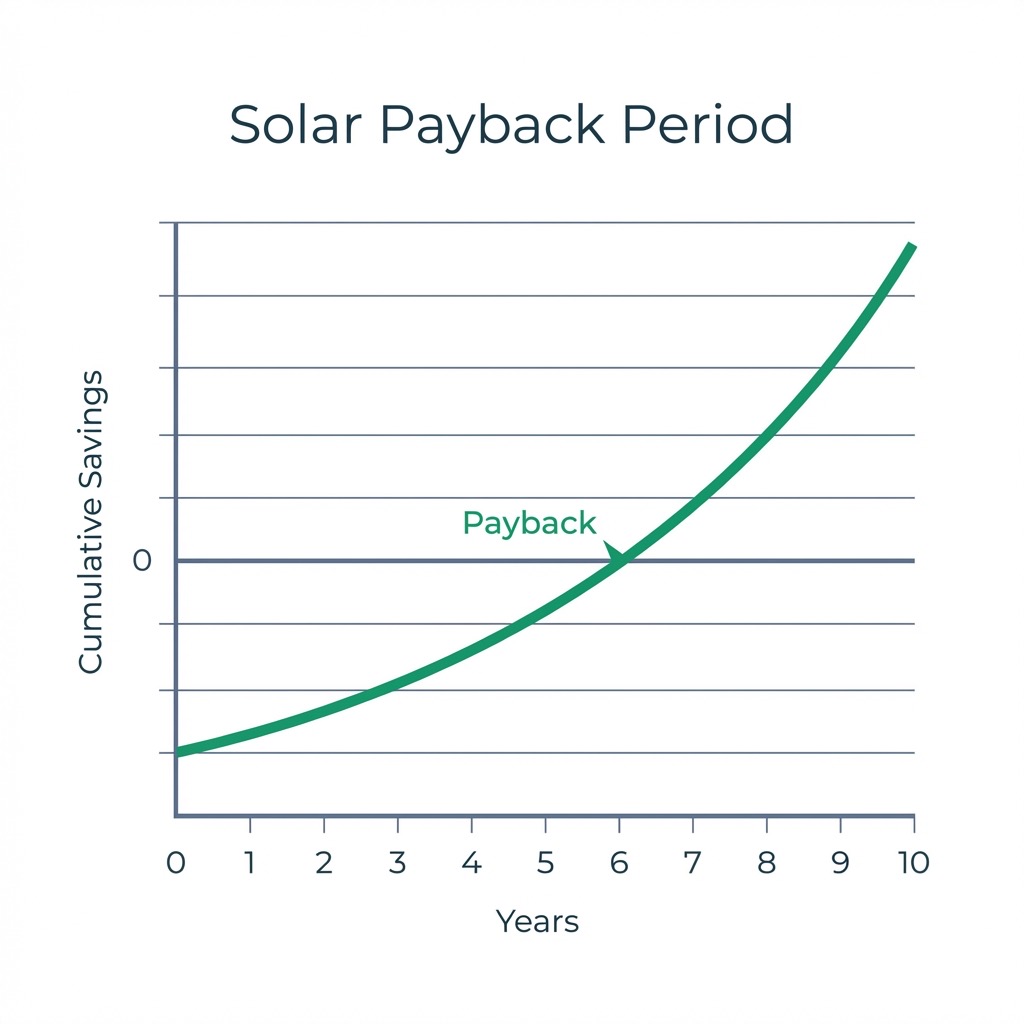
Simple payback: $15,437 / $2,304 = about 6.7 years, before rate escalation, degradation, and any financing or maintenance cost.
Now stress the two assumptions homeowners control least and must verify most. If production comes in at 8,800 kWh (labeled hypothetical, reflecting shade or orientation), savings fall to $2,112 and payback stretches to about 7.3 years. If the blended value is $0.20 per kWh instead of $0.24 (labeled hypothetical), savings at the original production fall to $1,920 and payback stretches to about 8.0 years. If your NY-Sun block pays less than the illustration, or your tax situation spreads the $5,000 credit over several carryover years, the cash payback lengthens further even though the total benefit is similar. None of these outcomes makes the project unsound. They show why the contract incentive, the production estimate, and the tariff name have to be pinned down before the payback sentence means anything.
Check production independently with the method in our solar production estimate PVWatts guide, then rerun the table with your utility tariff. Extend it over time with our solar panel ROI timeline for 2026.
6. The Battery Question in New York
New York batteries sell on three promises: backup power, time shifting, and grid programs. Weigh them separately.
For backup, winter storms and summer outages make a clear case for some households, especially outside the city where outages last longer and well pumps, heating controls, and medical devices matter. Size the battery to a critical-load panel and expected outage hours, not to the solar array size. Our home battery storage guide and home battery critical load sizing guide work through that sizing.
For bill shifting, the case depends on your tariff. On Phase One net metering, exported solar already offsets later use at strong value, which weakens the pure arbitrage case for storage compared with a low-export-rate state. A battery adds more bill value where time-varying prices, demand-related charges, or a move to a successor tariff reward stored evening energy. Ask the installer to model the battery on your actual tariff with and without storage, showing the incremental savings the battery alone produces. If that increment is small, you are buying resilience, which may be worth it, but price it as resilience.
For programs, New York utilities and aggregators have recruited home batteries into demand response and virtual power plant arrangements that pay for grid support during peak events. Availability and payment terms are program-specific and change over time. Treat any program revenue as a bonus confirmed in an enrollment agreement, never as a guaranteed line in the base payback. Our virtual power plant and demand response guide explains how these arrangements usually work.
As always, get storage priced as its own line with usable kilowatt-hours, continuous and surge power, warranty term, and warranted end-of-warranty capacity. Compare that line across installers before debating chemistry or brand.
7. Local Realities: Permits, Property Tax, and Older Homes
New York's local layer decides schedules as often as equipment does:
- Permitting and interconnection vary by town and utility. New York has worked to standardize solar permitting, but local building and electrical review, historic district rules in some areas, and utility interconnection studies still set the calendar. Your contract should state who files what and what counts as completion.
- Property tax treatment needs a local check. New York has a long-standing property tax exemption framework for solar energy systems, and many homeowners will hear it described as automatic. Municipal opt-outs and local assessor practice mean the safe move is to confirm with your assessor and on DSIRE how the exemption is recorded for your town after installation. Do not let a salesperson convert a conditional local benefit into a guaranteed statewide promise.
- Sales tax and fees belong on the invoice. Ask how state and local taxes apply to equipment and installation on your contract and keep the itemized final invoice for the IT-255 file. Surprise tax lines after signing are a scope failure.
- Snow, shade, and roof geometry set production. A low-slope or partly shaded New York roof can produce well below a clean south-facing estimate. Tilt, azimuth, and shade analysis should be printed in the proposal, and the savings model should use those derated figures.
None of these items should scare a prepared buyer. All of them should be papered before the installation crew is booked.
8. Quote Checklist for New York Homeowners
Get at least three quotes from NY-Sun participating contractors on the same scope:
- System size in kW DC, panel and inverter models, gross cash price, and dollars per watt, with any battery and electrical upgrade priced as separate lines.
- Production estimate naming the tool, tilt, azimuth, and shade assumptions, plus annual kilowatt-hours by month if available.
- NY-Sun incentive in dollars and dollars per watt, disclosed in the contract as NYSERDA requires, with reservation timing stated.
- Your export tariff named explicitly (Phase One net metering or another arrangement), with any monthly charges included in the savings model.
- State tax credit handling: the qualified cost the installer expects, the $5,000 cap applied correctly, and the documents you will receive for Form IT-255. Confirm tax questions with your own tax advisor.
- Written confirmation that no section 25D federal credit is subtracted for a 2026 owned system, or complete lease or PPA terms if a third party owns the system.
- Roof condition assessment and any roofing scope, with removal and reinstallation terms if roof work is expected during the panel life.
- Warranties separated into panels, inverter, battery, workmanship, and roof penetrations, with the party responsible for each claim.
- Payment milestones tied to contract, permit, installation, and permission to operate. Avoid large payments ahead of work performed.
Red flags: a federal 30 percent credit subtracted in 2026, a NY-Sun amount promised without a block or contract line, production figures with no shade or orientation basis, savings modeled at a tariff you will not receive, or a state credit calculated above the $5,000 cap.
Frequently Asked Questions (FAQ)
How much do solar panels cost in New York in 2026?
EnergySage marketplace data for October 2026 puts the New York average at $2.75 per watt installed. That is about $16,527 for 6 kW, $22,037 for 8 kW, and $27,546 for 10 kW before incentives. The average New York system in the same data is 11.99 kW at about $33,033. Electrical upgrades, roofing, and batteries move real quotes off the average.
What incentives does New York offer for solar in 2026?
Two state items lead: the NY-Sun incentive, paid through a participating contractor and disclosed in your contract, and the state Solar Energy System Equipment Credit of 25 percent of qualified expenditures capped at $5,000, claimed on Form IT-255. Income-eligible households may qualify for higher Affordable Solar incentive levels. There is no federal residential credit for an owned system placed in service in 2026.
How much is the NY-Sun incentive for a home system?
It depends on your region and the megawatt block open when your contractor applies. NY-Sun residential rates have stepped down over the program's life, with late blocks documented at $0.20 per watt and an Affordable Solar total of $0.80 per watt for eligible households in the Con Edison region. Your signed contract must state your incentive. Confirm the amount in dollars before signing.
How does the New York state solar tax credit work?
The Tax Department states the credit equals 25 percent of qualified solar energy system equipment expenditures, limited to $5,000, for a system installed and used at your principal residence in New York State. It is nonrefundable, with unused amounts carried forward up to five years. File Form IT-255 and keep your contract, invoice, and proof of payment.
Does New York still have net metering for homes?
Residential and smaller onsite projects can remain on Phase One net energy metering under the Department of Public Service framework described in the VDER proceeding, while community solar and large projects are compensated through the VDER Value Stack. Confirm the tariff named in your interconnection agreement, including any associated monthly charges.
Is a battery worth adding in New York?
For backup power, often yes for outage-exposed homes sized to critical loads. For bill savings alone on Phase One net metering, the added value is usually smaller than in low-export-rate states, because net metering already credits exports well. Model the battery separately on your tariff, and count virtual power plant or demand response payments only when enrolled in a specific program.
How long is the payback for solar in New York?
This guide's worked example, an $22,037 8 kW system reduced by a documented late-block NY-Sun illustration and the $5,000 state credit cap, pays back in about seven years at clearly labeled hypothetical production and energy value. Lower production, a lower energy value, or a smaller incentive stretches the result toward eight years and beyond. Your contract incentive, tariff, and checked production estimate decide the real figure.
What to Read Next
- Solar Panel Cost by State 2026 Data Guide - how New York pricing and incentives compare nationally
- Solar Panel ROI Timeline 2026 - payback math over the system life
- Solar Quote Comparison Worksheet - compare NY-Sun quotes line by line
- Solar Production Estimate PVWatts Guide - check a New York production estimate for free
- Community Solar Guide for Renters and Condo Owners - the no-roof alternative in New York
- Run your own system-size and savings scenarios with the solar calculators at CalculatorVillage.com once you have real quotes in hand.
Sources and Verification
- IRS Residential Clean Energy Credit: 30% credit for property installed 2022 through December 31, 2025; credit is not available for any property placed in service after December 31, 2025
- EnergySage New York Solar Panel Cost (October 2026 marketplace data): average $2.75/W installed; 11.99 kW average system $33,033, range $28,078$37,988; 6 kW $16,527, 8 kW $22,037, 10 kW $27,546
- NYSERDA Paying for Solar (NYSun): NYSun incentive is provided through the contractor, typically taken off the contract price; exact amount depends on project size and location and phases down over time; incentive amount must be disclosed in the customer contract
- NYSERDA Con Edison Dashboard and NYSun Operating Plan: MW Block incentive rates step down by block (late residential blocks listed at $0.20/W in Con Edison and Upstate tables); Affordable Solar Residential Incentive provides a total of $0.80/W in the Con Edison region
- New York State Department of Taxation and Finance Solar Energy System Equipment Credit: credit equals 25% of qualified expenditures, limited to $5,000, for a system installed and used at the taxpayer's principal residence in New York State; nonrefundable with carryover up to five years; claimed on Form IT255
- New York DPS (Case 21E0629 background, citing the March 9, 2017 VDER Transition Order): residential and smaller onsite projects under 750 kW AC can remain on Phase One net energy metering; Value Stack compensation applies to community distributed generation, remote net metered, and large onsite projects
- DSIRE Database of State Incentives for Renewables and Efficiency: crosscheck for current NYSun blocks, utility programs, and local property tax treatment
Editorial Review
EnergyBS Editorial Team
EnergyBS publishes practical homeowner guides. Important program, product, and cost claims should be checked against the linked source and local project documents before you commit to work.
Related Guides
View All ArticlesSolar Quote Comparison Worksheet 2026 Tool (Guide & Data)
A sidebyside homeowner worksheet for normalizing solar cash prices, financed cost, equipment, production assumptions, roof scope, utility rules, warranties, and contract obligations.
Should You Replace the Roof Before Solar? A 2026 Analysis
A roofandsolar sequencing guide covering condition evidence, remaining life, removeandreinstall scope, warranties, structural and electrical coordination, and sidebyside lifecycle scenarios.
Solar Production Estimate Guide 2026 Tool (Guide & Data)
A homeowner method for independently checking quoted solar kWh using roof planes, tilt, azimuth, shading, DCtoAC ratio, system losses, weather variability, utility load data, and postinstallation verification.