Solar Quote Comparison Worksheet: Price, Production, Financing, and Contract Checks
A sidebyside homeowner worksheet for normalizing solar cash prices, financed cost, equipment, production assumptions, roof scope, utility rules, warranties, and contract obligations.
The Short Answer
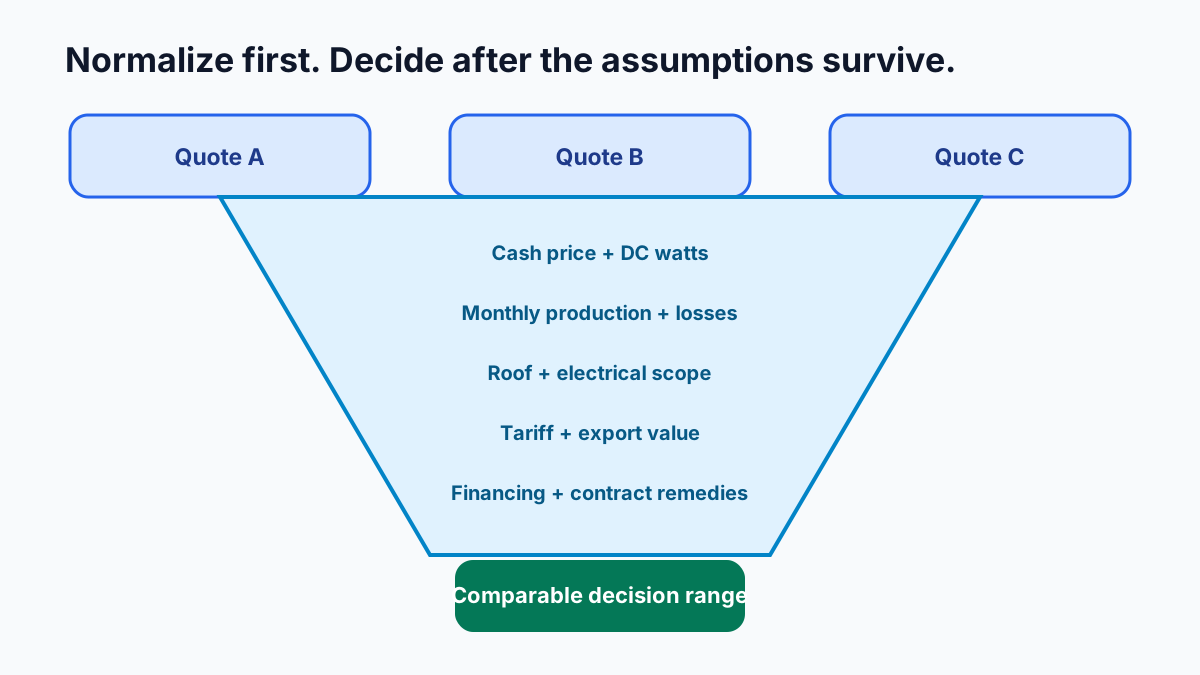
Short Answer: Compare solar quotes only after every installer provides the cash price, exact system size, equipment model numbers, first-year monthly production, degradation and shading assumptions, utility export rules, roof and electrical scope, financing disclosures, warranties, and cancellation terms. Normalize cash price per DC watt before incentives, then evaluate financed total paid, not the monthly payment. Rebuild production independently and remove any incentive you have not verified for your jurisdiction and tax situation.
The lowest monthly payment is not necessarily the lowest price. The largest panel count is not necessarily the highest production. A 100% annual offset estimate is not necessarily a low bill. This worksheet makes unlike proposals comparable without pretending that one national price benchmark decides every project.
The FTC advises consumers to obtain detailed bids from several companies and examine system size, expected delivery, full installation cost, production commitments, warranties, roof repair obligations, financing, and contract terms. Use that as the minimum disclosure standard.
Page One: Normalize the Three Quotes
Create one row per proposal:
| Field | Quote A | Quote B | Quote C |
|---|---|---|---|
| DC system size (kW) | |||
| AC inverter capacity (kW) | |||
| Panel count and exact model | |||
| Inverter(s) and exact model | |||
| Battery model and usable energy, if any | |||
| Cash price before incentives | |||
| Cash price per DC watt | |||
| Financed amount | |||
| APR and term | |||
| Total scheduled payments | |||
| First-year production (kWh) | |||
| First-year utility-bill value | |||
| Roof, electrical, permit, and interconnection scope | |||
| Incentives assumed | |||
| Ownership: cash, loan, lease, or PPA |
If an installer will not provide exact model numbers and a cash price, the quote is not ready for comparison.
Calculate Cash Price Per Watt Correctly
Gross cash price per watt = cash contract price before incentives ÷ DC system watts
Example:
- quoted cash contract: $24,000;
- system: 8.0 kW DC, or 8,000 W;
- gross cash price: $24,000 ÷ 8,000 = $3.00/W.
Use the same inclusion rules across quotes. Separate optional battery, reroof, service upgrade, trenching, tree work, EV charger, and premium monitoring where possible. A quote that embeds a $12,000 battery cannot be compared with a solar-only price per watt.
Do not subtract a tax credit, rebate, or projected certificate value before calculating gross price. Incentives depend on ownership, eligibility, timing, tax facts, and local program rules. A salesperson's “net price” is a scenario, not the signed obligation.
Price per watt is a screening metric. It does not capture roof complexity, equipment, production, workmanship, financing, or service. Use it to expose differences, then investigate them.
Cash Price and Financed Price Are Two Products
Ask each installer for both even if you intend to finance. A low advertised APR can be paired with a higher principal or other financing cost. Compare:
- cash contract price;
- financed amount at signing;
- APR;
- term;
- payment schedule;
- total of payments if held to maturity;
- fees and liens;
- prepayment treatment;
- whether a payment assumes a tax-credit lump sum;
- deadline and consequence if that lump sum is not made;
- dealer or origination costs disclosed in the documents;
- transfer or payoff terms when selling the home.
Keep those exit terms with the property records. A future buyer can use the four-file solar-home audit to reconcile the financing contract with title/UCC records, roof condition, production, utility tariff, warranties, and closing transfer instead of relying on a listing's “owned solar” label.
Worked example:
| Option | Cash price | Financed principal | Term | Total scheduled payments |
|---|---|---|---|---|
| Cash | $24,000 | — | — | $24,000 |
| Loan A | $24,000 | $31,000 | 20 years | Read disclosure |
| Loan B | $24,000 | $24,000 | 10 years | Read disclosure |
The table deliberately leaves APR and total payments blank. Fill them from the lender disclosure, not a salesperson's app screen. Monthly payment alone hides term and principal.
FTC consumer guidance says to take time, compare financing, read warranties and cancellation policies, and avoid pressure to sign immediately or only on an electronic tablet without the full agreement.
Rebuild the Production Estimate
Every proposal should show at least:
- annual AC production in kWh;
- monthly production profile;
- roof-plane tilt and azimuth;
- system losses;
- shading method and result;
- DC-to-AC ratio;
- weather dataset;
- degradation assumption;
- module and inverter model;
- clipping treatment;
- availability or downtime assumption.
Use NREL's PVWatts as an independent screening model with the same system size, roof planes, and defensible losses. PVWatts uses long-term weather data and permits adjustments for losses such as soiling and shading. It is not a site survey and cannot see a chimney, tree growth, snow drift, or complex horizon unless the inputs reflect them.
If a quote is materially above the independent range, ask the installer to reconcile every difference. Do not average incompatible models.
The solar production estimate guide provides a step-by-step reconstruction.
Keep the same monthly forecast after commissioning. If production later appears low, the solar underperformance diagnostic guide shows how to compare it with complete monitoring and weather evidence instead of judging one peak-power screenshot.
Annual Offset Is Not Bill Offset
Annual energy offset = projected annual solar kWh ÷ annual household kWh
That metric ignores timing and tariff value. A home can export midday power at one rate and buy evening power at another. Fixed customer charges, minimum bills, non-bypassable charges, demand charges, true-ups, and tier rules can remain.
Ask each quote to separate:
- solar kWh consumed directly in the home;
- solar kWh exported;
- export compensation by time or period;
- grid imports after solar;
- fixed and unavoidable charges;
- battery losses and cycling, if applicable;
- utility-rate escalation used in long-term savings.
A claim that “the panels cover 100% of usage” does not mean the utility bill becomes zero.
Read the net-metering policy comparison and verify the actual utility tariff before signing.
Compare Equipment Without Brand Rankings
Record exact model numbers and datasheets.
Modules
- rated watts and efficiency;
- physical dimensions and roof fit;
- product warranty;
- performance warranty schedule;
- temperature coefficient;
- mechanical loading and applicable certifications;
- manufacturer and warranty claimant;
- expected replacement compatibility.
Inverters
- string, optimizer, or microinverter architecture;
- exact AC rating;
- DC-to-AC ratio;
- number and location;
- shade and mismatch behavior;
- monitoring access;
- rapid-shutdown design where required;
- product warranty and labor coverage;
- replacement process and likely service interruption.
Batteries
- usable energy, not only nominal energy;
- continuous and peak power;
- backup circuits or whole-home topology;
- grid-charging and export permissions;
- warranted throughput or cycles;
- operating temperature and location;
- islanding equipment;
- black-start capability;
- subscription or cloud dependencies;
- fire, permit, and utility requirements.
The microinverter versus string-inverter guide explains architecture. A more expensive component is worthwhile only when it solves a real site or service need.
Also ask each bidder to describe the eventual replacement path. The inverter replacement cost and decision worksheet separates hardware, labor, permits, utility treatment, monitoring migration, downtime, compatibility, and recycling so a future box price does not become a surprise installed scope.
Roof and Mounting Scope
Solar and roof life must be coordinated. Ask for:
- roof age, material, condition, and remaining-life assessment;
- installer responsibility for confirming suitability;
- mounting and flashing system;
- attachment spacing and structural assumptions;
- underlayment and deck conditions that can stop work;
- workmanship/leak warranty and exclusions;
- responsibility for pre-existing leaks;
- snow, wind, fire-access, and setback requirements;
- plan for future roof repair or replacement;
- removal/reinstallation price or method, if offered;
- who stores and insures removed equipment.
Do not rely on “roof included” without a separate roofing scope. The roof replacement before solar guide provides the sequencing worksheet.
For Canadian buyers comparing a solar-equipped resale property, BubbleWatch's roof inspection guide shows which records and concealed limitations matter during due diligence.
Electrical, Permit, and Utility Scope
The quote should name who handles and pays for:
- electrical design and single-line diagram;
- panel or service changes;
- meter or service equipment;
- trenching and conduit;
- structural review;
- building and electrical permits;
- inspections;
- utility interconnection application;
- required studies or upgrades;
- permission to operate;
- homeowner association or heritage approval;
- monitoring setup and owner access;
- final labels and as-built documents.
An “all-inclusive” line needs written exclusions. Utility delays do not necessarily excuse indefinite contractor performance; read milestone and cancellation language.
Production Guarantee Versus Forecast
A forecast estimates output. A production guarantee creates a contractual remedy under defined conditions.
If a guarantee is offered, read:
- guaranteed kWh by year;
- degradation schedule;
- measurement source;
- exclusions for weather, shade growth, snow, outage, curtailment, grid events, soiling, and homeowner actions;
- claim window;
- required maintenance;
- remedy calculation;
- whether payment replaces repair;
- provider responsible if installer closes;
- transfer to a new owner.
A small reimbursement can coexist with a chronically weak system. Evaluate the system design first.
Warranties: Identify the Party and the Remedy
“25-year warranty” can refer to several documents:
| Warranty | Typical subject | Questions |
|---|---|---|
| Module product | Manufacturing defects | Who files and pays labor/shipping? |
| Module performance | Output decline schedule | How is underperformance proven? |
| Inverter | Electronics | Is replacement labor included? |
| Battery | Capacity/throughput | Which operating conditions apply? |
| Workmanship | Installation | Does it include penetrations and leaks? |
| Roof | Roofing assembly | Does solar work affect coverage? |
| Production | System kWh | What is the remedy and exclusions? |
Write down manufacturer, installer, lender, lessor, PPA provider, roofer, and monitoring vendor. Each may own a different obligation.
Keep the warranty packet with the commissioning baseline. If a defect or shortfall appears, the solar warranty claim workflow separates product, performance, inverter, battery, workmanship, roof, production-guarantee, and insurance routes before evidence is lost.
Contract Audit Before Signature
Confirm the signed agreement matches the proposal:
- exact equipment or a narrow substitution process;
- total price and payment milestones;
- financing documents and security interest;
- start and completion conditions;
- permit and interconnection responsibilities;
- change-order approval;
- roof and electrical exclusions;
- incentive ownership and uncertainty;
- cancellation rights;
- dispute process;
- access to the property;
- insurance and damage responsibility;
- sale or transfer requirements;
- removal at end of lease or PPA;
- data, monitoring, and privacy terms;
- warranty documents attached or incorporated.
FTC guidance warns against “free solar,” government-affiliation claims, high-pressure signatures, and large advance fees without legitimate work. Verify licenses and complaint history with the relevant local authority.
This is a substantial home and financial contract. Obtain independent legal, tax, lending, roofing, or electrical advice where the risk warrants it.
Scoring the Quotes Without Fake Precision
Use red/yellow/green evidence rather than a weighted score designed to make one seller win.
Green
- exact equipment and full cash price;
- assumptions and production model supplied;
- tariff verified;
- roof and electrical scope documented;
- financing total cost disclosed;
- warranties and remedies attached;
- reasonable review time;
- references, licenses, permits, and insurance verifiable.
Yellow
- site survey pending;
- shading or structural input provisional;
- utility upgrade unknown;
- substitute equipment allowed broadly;
- savings depend on aggressive rate escalation;
- roof responsibility divided between contractors.
Red
- “free” or government-installed claim;
- immediate-signature pressure;
- cash price withheld;
- monthly payment shown without principal and term;
- incentive treated as guaranteed cash;
- utility bill promised to disappear;
- blank contract sections;
- verbal warranty not in documents;
- request for unsafe payment method or excessive advance fee;
- identity or credit information requested before company verification.
One red item may justify stopping rather than negotiating.
Worked Comparison
Suppose three 8 kW proposals report:
| A | B | C | |
|---|---|---|---|
| Cash price | $24,000 | $22,800 | $31,000 |
| Price/W | $3.00 | $2.85 | $3.88 |
| First-year production | 10,200 kWh | 11,600 kWh | 10,400 kWh |
| Financing | cash | cash | low-payment loan |
Quote B appears best until its model is checked. If it omits tree shade and assumes a roof plane not available, its production advantage disappears. Quote C may be a $24,000 cash system with financing cost embedded in the principal. Quote A may exclude a required panel change.
The decision cannot be made from the first four rows. Normalize scope, rebuild production, read financing, and add unresolved allowances. Then calculate a range using the verified utility tariff.
For an independent scenario, use Calculator Village's solar ROI and payback calculator with your corrected inputs, not the sales proposal's headline savings.
Stress-Test the Shortlist Before Choosing
A quote comparison is incomplete until the leading proposal survives conditions that are less favorable than the sales illustration. Create three rows under each finalist: the installer case, a cautious case, and a downside case. This is not an attempt to predict the future precisely. It reveals which assumptions control the decision.
For production, keep the installer's first-year estimate in the first row. In the cautious row, use the lower of your independent model or the installer's value. In the downside row, reduce the cautious output to reflect a combination of weather variability, unresolved shade, downtime, or snow that is credible for the property. Do not blindly subtract the same percentage everywhere. The purpose is to expose sensitivity to known uncertainties.
For electricity value, separate three quantities:
- energy used immediately in the home;
- exported energy credited under the current tariff;
- fixed charges, minimum bills, demand charges, and other items solar does not avoid.
Then repeat the comparison with no assumed future utility-price escalation. A proposal that works only when electricity prices compound aggressively is more fragile than one that works on today's tariff. If an installer assumes a specific escalation rate, ask for the source and run a zero-escalation case beside it.
For incentives, show a verified case and a no-incentive case. The no-incentive row does not mean the incentive will disappear. It shows the contractual exposure if eligibility, timing, tax capacity, assignment, or paperwork differs from the proposal. Never let a contingent credit disguise the amount you owe the installer or lender.
For financing, compare at least these exit dates:
| Exit event | Question to answer |
|---|---|
| Pay off after one year | What exact principal and fee would be due? |
| Sell after five years | Must the obligation be paid, transferred, or assumed? |
| Miss an expected lump-sum payment | Does the monthly payment change? |
| Refinance the home | Does any lien or filing need attention? |
| Replace the roof | Who can remove and reinstall the array, and at what price basis? |
Obtain answers from the actual contract and lender documents. A salesperson's description is useful only when it matches the binding language.
For a future sale or purchase, the solar-homebuyer four-file audit checks ownership, finance, title, roof, production, utility, insurance, warranties, and closing transfer as separate deliverables.
Compare the Installers, Not Just the Hardware
The system will need interconnection, commissioning, monitoring, and perhaps service years after the sale. Add an installer-due-diligence page to the worksheet. Record the legal contracting entity, license where required, years operating under that entity, insurance evidence, who employs or supervises the installation crew, and who receives a service request after commissioning.
Ask each finalist for recent local references with a similar roof type, electrical scope, and utility. A simple installation on a new asphalt roof is not a useful reference for a tile roof, a main-panel relocation, or a service with a line-side connection. When speaking with a reference, ask about change orders, inspection corrections, interconnection time, communication after payment, and service response—not merely whether the panels look good.
Check whether subcontracting is disclosed. Subcontracting is not automatically a defect, but responsibility must be clear. The contract should identify who pulls permits, performs roof penetrations, completes electrical work, corrects inspection failures, registers equipment warranties, submits interconnection documents, and repairs damage. If three companies can point at one another, the homeowner owns the coordination problem.
Request a sample plan set, closeout package, and monitoring handoff. A strong closeout package normally includes approved plans, permits and inspection records, interconnection approval, equipment serial numbers, array map, shutdown instructions, warranty registrations, monitoring credentials, and emergency contacts. Score this deliverable before signing, not after the final payment.
Hold a Clarification Meeting With a Written Agenda
Send the same unanswered questions to every finalist and require written responses. Use one meeting to resolve discrepancies, then attach material clarifications to the contract. A useful agenda covers system design, production inputs, exclusions, roof responsibility, electrical upgrades, utility delays, equipment substitutions, schedule, payment milestones, cancellation, warranties, service, and closeout documents.
Do not allow the meeting to turn into a new monthly-payment pitch. Work down the worksheet field by field. Mark each response as confirmed in contract, confirmed in an attachment, informational only, or unresolved. Any promise important enough to change the decision is important enough to document.
After the meeting, recalculate the comparison from the revised documents. A quote that changes size, equipment, scope, or price is a new quote. Preserve the earlier version so you can see what changed. If the installer will not give you time to review a revision, pause the purchase.
Final Checklist
- Three detailed written bids collected.
- Cash price and gross price/W calculated consistently.
- Financed principal and total scheduled payments recorded.
- Exact models and datasheets supplied.
- Monthly production and all modeling assumptions supplied.
- Independent production range completed.
- Utility tariff and export value confirmed directly.
- Roof suitability and future removal scope documented.
- Electrical, permit, and interconnection responsibilities named.
- Incentives verified independently and treated as uncertain until approved.
- Warranties identify party, term, labor, exclusions, and remedy.
- Contract reviewed without sales pressure.
- Sale, transfer, payoff, and removal obligations understood.
- Low, expected, and high ROI cases calculated.
Frequently Asked Questions
How many solar quotes should I get?
Get several detailed bids; three is a practical minimum for comparison. More is not useful if they are lead-generator copies or lack site-specific assumptions. Include qualified local providers and verify licensing and insurance.
Should I compare solar by price per watt?
Yes as one normalized cash-price screen before incentives. Then compare production, roof complexity, equipment, electrical work, service, warranties, and financing. It is not a standalone quality score.
Why is the financed solar price higher than cash?
Financing can include interest, origination, dealer, or other costs reflected in principal or payments. Read lender disclosures and compare total cost with independent financing. Do not infer cost from APR alone.
Is a 100% offset system best?
Not automatically. Tariff, export value, roof planes, future loads, fixed charges, and size limits matter. A smaller system with high self-consumption can outperform a larger export-heavy system financially.
Can an installer guarantee no utility bill?
Treat that as a warning. Fixed charges, imports, weather variation, load changes, outages, and tariff rules remain. Require a written production model and bill calculation.
Should I include incentives in price per watt?
Use gross cash price before incentives for quote comparison. Calculate a separate verified net cost based on ownership, jurisdiction, date, and eligibility.
What if the quote allows “equivalent” panels?
Require a narrow substitution standard covering watts, dimensions, certifications, warranties, electrical compatibility, appearance, and price adjustment, plus your written approval before installation.
What to Read Next
Rebuild the most important sales assumption with the solar production estimate guide, then coordinate roof life using the reroof-before-solar guide. Compare ownership structures in solar buy versus lease and verify export assumptions with the net-metering comparison.
Sources and Method
This worksheet uses FTC consumer-protection requirements for detailed bids and contracts, DOE homeowner guidance on site and financial variables, and NREL PVWatts as an independent production-screening method. Worked prices are illustrative. Verify current incentives, tax treatment, rates, product specifications, permits, and contract law for the actual address.
Sources and Verification
Editorial Review
EnergyBS Editorial Team
EnergyBS publishes practical homeowner guides. Important program, product, and cost claims should be checked against the linked source and local project documents before you commit to work.
Related Guides
View All ArticlesBuying vs. Leasing Solar in 2026: The OBBBA Tax Credit Reality
Residential solar credit rules changed after 2025. Here is the raw math on whether you should buy your panels for cash or sign a lease in 2026.
The 2026 Solar PPA risk: UCC Liens, Escalators, and homesale complications
Doortodoor solar reps are pushing 25year PPAs aggressively in 2026. Here is exactly how these contracts work, the overlooked fees to watch out for, and how to avoid hurting your home's resale process.
Solar Panel ROI Timeline: Payback Periods by State and Province in 2026
How long does it take for solar panels to pay for themselves? We analyze the 2026 solar landscape, including California's NEM 3.0 battery mandates, Canadian Greener Homes interestfree loans, and local payback grids.