Sewer Line Replacement Cost 2026: PerFoot Prices for Trenchless, Lining, and DigandReplace
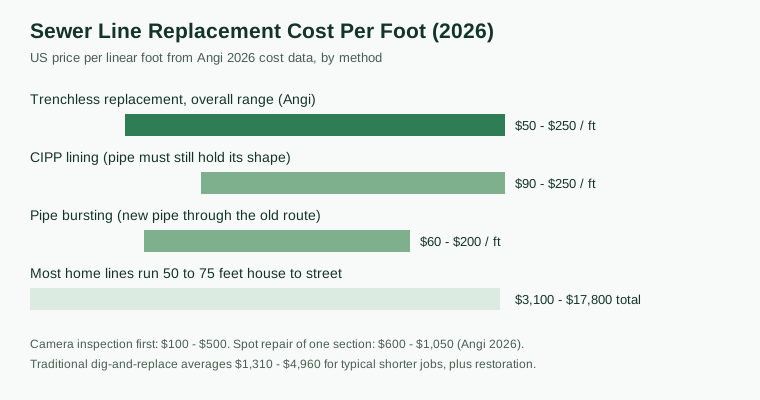
Sewer line replacement in 2026 is priced by the foot and by the method. Trenchless replacement runs $50 to $250 per linear foot (Angi), with curedinplace lining at $90 to $250 per foot and pipe bursting at $60 to $200 per foot. A traditional digandreplace averages $1,310 to $4,960 for typical jobs in Angi's data, while Angi's overall replacement average is $3,319 across a mix of partial and full projects. Most home sewer lines run 50 to 75 feet, which puts a full trenchless replacement of a typical line in the $3,100 to $17,800 band in Angi's city data. The decision that protects the budget comes first: a camera inspection at $100 to $500 that shows whether you need a $600 spot repair, a lining, or a full replacement at all. This guide prices every method, works a 60foot example end to end, and lists what to get in writing before anyone digs.
Quick Checks
- 1Sewer work is priced per linear foot: trenchless replacement runs $50 to $250 per foot (Angi). Most home lines are 50 to 75 feet, so a full trenchless replacement typically lands between $3,100 and $17,800 (Angi city data).
- 2Never approve a replacement without a camera inspection. At $100 to $500 it is the cheapest money in the whole project, and it is what separates a $600 to $1,050 spot repair from a five-figure replacement.
- 3Method follows pipe condition: lining (CIPP, $90 to $250 per foot) renews a pipe that still holds its shape; pipe bursting ($60 to $200 per foot) replaces a pipe too damaged to line; a collapsed or badly sloped line still needs digging, whatever the trenchless quote says.
- 4Angi's $3,319 average for sewer line replacement mixes partial and short jobs. Do not budget a full house-to-street replacement from it; budget from your measured length times the per-foot rate for your method.
- 5The dig is not the whole bill on a traditional replacement: driveway, sidewalk, and landscaping restoration is where trenchless earns its premium back, up to 75 percent saved over digging on the wrong yard (Angi).
Sewer Line Replacement Cost 2026: Per-Foot Prices for Trenchless, Lining, and Dig-and-Replace
By EnergyBS Editorial Team | October 21, 2026
The Short Answer
Short Answer: Sewer line replacement cost in 2026 is a per-foot price times your line's length, and the method decides the rate. Trenchless replacement runs $50 to $250 per linear foot (Angi): cured-in-place lining at $90 to $250 per foot, pipe bursting at $60 to $200 per foot. A traditional dig-and-replace averages $1,310 to $4,960 for typical jobs in Angi's data, which reflects shorter and partial runs; full-length traditional replacements price out by the foot as well once excavation and restoration are counted. Most home sewer lines run 50 to 75 feet from house to street main, and Angi's city data puts a full trenchless replacement of a line that long at $3,100 to $17,800. Angi's overall replacement average of $3,319 is real but misleading for planning, because it mixes spot jobs and short laterals with full replacements. Measure your length, pick the method your pipe's condition allows, and multiply.
The job in six steps:
- Confirm the problem is the line, not a clog: recurring backups in the lowest fixtures, multiple drains slow at once.
- Get a camera inspection ($100 to $500) and keep the video; it decides everything downstream.
- Read the diagnosis into a method: spot repair, lining, bursting, or dig-and-replace.
- Measure the run: length, depth, and what sits on top of it (lawn, driveway, trees, street).
- Get per-foot quotes with the method, restoration, and permit itemized, and the responsibility boundary confirmed with your city.
- After the work, get the post-job camera video and the inspection sign-off before final payment.
This guide belongs to our water and drainage library, alongside the septic system installation cost guide for homes off the municipal system. A failing sewer line is also a water problem: a cracked lateral leaks sewage out and lets groundwater in, and both directions cost the homeowner and the city money. The fix is priced below, method by method.
1. Camera First: the $100 to $500 Step That Decides the Other $10,000
Every sewer quote that starts with a replacement price and no camera video is a guess with an invoice attached. A camera inspection, $100 to $500 in 2026 cost data, sends a camera through the line and answers the four questions that pick the method:
- Where is the damage? One cracked joint at 22 feet is a different job from deterioration along the whole run.
- What kind of damage? Roots, cracks, offset joints, scale, a belly (a sagging section that holds water), or a collapse each point to a different fix.
- What is the pipe made of and what shape is it in? Clay, cast iron, Orangeburg, and PVC age differently, and lining needs a host pipe that still holds its round shape.
- How long and how deep is the run? The two numbers that turn a per-foot rate into your price.
The same video sorts the cheap outcomes from the expensive ones. Roots in an otherwise sound pipe are a clearing job at $100 to $600. One cracked section with sound pipe around it is a spot repair at $600 to $1,050. Only when the video shows widespread cracking, collapse, a badly sloped run, or a pipe too deformed to line does replacement enter the conversation. Get the video file, not just a verbal summary: it is your evidence for the second and third quotes, and a contractor who will not share it is telling you something.
2. The Four Methods and What Each Costs
| Method (2026) | Cost | When it is the right job |
|---|---|---|
| Spot repair (dig at the damage) | $600 to $1,050 | One damaged section, sound pipe around it |
| CIPP lining (trenchless) | $90 to $250 per linear foot | Pipe is cracked or root-damaged but still holds its shape |
| Pipe bursting (trenchless) | $60 to $200 per linear foot | Pipe too damaged to line, but the route and slope are good |
| Dig-and-replace (traditional) | $1,310 to $4,960 average for typical jobs (Angi); full runs priced per foot plus restoration | Collapsed pipe, bad slope or bellies, or a route change |
CIPP lining (cured-in-place pipe) pulls a resin-coated liner through the old pipe and cures it into a new pipe inside the old one. No trench, two small access points, and the yard survives. The limits are structural: the liner follows the host pipe, so it cannot fix a belly or a wrong slope, it slightly reduces the inside diameter, and a collapsed section blocks the pull entirely. Angi's caution on trenchless work is the right summary: it works best when the pipes are otherwise healthy and it will not fix corrosion or severe damage that requires full replacement.
Pipe bursting pulls a bursting head through the old pipe, fracturing it outward while towing a new pipe into the same route. It replaces rather than renews, so it handles pipes too far gone to line, and it can even upsize the pipe. It still follows the existing route and slope, so a bellied or mis-sloped line keeps its problem with a new pipe around it.
Dig-and-replace is the excavator job: trench the route, remove the old pipe, lay new pipe (PVC is the standard material; Angi's Minneapolis data prices pipe materials from $50 per linear foot for basic PVC up to $250 for copper, materials and labor) at the correct slope, backfill, and restore the surface. It is the only method that fixes slope, and the only one that can reroute a line. Its headline price is also the most deceptive, because the restoration (driveway sections, sidewalk, sod, plantings, occasionally street patching) rides on top and varies more than the plumbing does.
3. Price by Length: Turning Feet Into a Budget
Angi's city cost pages publish replacement totals by line length for trenchless work. The St. Louis table (trenchless at $55 to $240 per foot):
| Sewer line length | Replacement cost (Angi 2026) |
|---|---|
| 25 to 35 ft | $1,400 to $8,300 |
| 35 to 45 ft | $2,000 to $10,700 |
| 45 to 55 ft | $2,600 to $13,100 |
| 55 to 75 ft | $3,100 to $17,800 |
| 75 to 100 ft | $4,300 to $23,800 |
Charlotte's page, at $60 to $240 per foot, lands in the same place (55 to 75 ft: $3,200 to $18,200). Two lessons from the table. First, length dominates: Angi notes that even 10 extra feet can add thousands of dollars, which is why measuring the run, from the camera's distance counter, beats guessing from the property line. Second, the bands are wide because depth, access, and local labor sit inside them; your job prices to a point in the band once a contractor has the video and the depth.
4. Worked Example: a 60-Foot Line, Three Ways
A 60-foot clay lateral, root damage at several joints, one offset joint, no collapse, slope good on camera.
- CIPP lining: 60 ft at $90 to $250 per foot = $5,400 to $15,000. The yard, driveway, and the tree over the line are untouched.
- Pipe bursting: 60 ft at $60 to $200 per foot = $3,600 to $12,000. Same route, new pipe, two pits dug at the ends.
- Dig-and-replace: the pipe work prices in the same general territory per foot once excavated, but this line runs under a driveway and a mature tree. The restoration (driveway section replacement, tree work or root damage risk, sod and replanting) is the swing cost, and it is the reason Angi credits trenchless with saving up to 75 percent over traditional digging on the wrong property.
All three totals sit inside Angi's published 55 to 75 ft trenchless band of $3,100 to $17,800, which is the check that the arithmetic is sane. The decision between them is not price first; it is the camera's verdict on shape and slope, then price among the methods that verdict allows.
5. What Else Changes the Price
- Depth. A line at 4 feet is a morning of digging; a line at 10 to 12 feet needs shoring, more spoil handling, and more time, by any method. Cold climates bury lines deeper (Angi's Minneapolis page flags the deep frost line as a direct cost driver).
- What is on top. Lawn is cheap to cross and cheap to restore. Driveways, patios, retaining walls, pools, and mature trees are where traditional digging gets expensive and trenchless earns its rate.
- Access points. Bursting and lining need pits or cleanout access at one or both ends. A home with no exterior cleanout may need one installed, a small job that should appear on the quote rather than inside it.
- Permits and inspection. Sewer work is permit work almost everywhere. As a scale reference, Minneapolis charges a $160 base utility permit fee for sewer and water upgrades up to 75 feet (Angi). Your city's fee will differ; the inspection sign-off should not be optional at any price.
- The responsibility boundary. In most cities the homeowner owns the lateral from the house to the street main, and the city owns the main; some cities split the lateral at the property line or the curb. Confirm the boundary with your city before paying to replace a section that is not yours.
- Emergency timing. A line that has failed completely, with sewage backing into the house, compresses your shopping into a day. The camera discipline in Section 1 matters most exactly here: it is the difference between an emergency spot repair and an emergency full replacement.
6. Why the Old Line Failed: Materials Matter for the Diagnosis
The camera video makes more sense when you know what your line is likely made of, because each era's material fails in its own way:
- Clay (vitrified clay pipe), common into the 1970s. Durable pipe, weak joints. The short sections are joined every few feet, and tree roots find the joints, enter as hair roots, and grow into mats that catch everything else. Root damage at the joints of an otherwise round, well-sloped clay line is the classic lining candidate: the pipe's shape is sound, so a liner seals the joints the roots were using.
- Cast iron, common from the 1940s through the 1970s. Fails from the inside out: corrosion roughens and scales the wall, scale catches solids, and the bottom channel can rot through entirely (channel rot), leaving a pipe that looks intact from above and is open to the soil below. Heavy scale and channel rot are why cast iron lines are often bursting or dig candidates rather than lining candidates; a liner needs a host wall that is still there.
- Orangeburg (bituminous fiber pipe), roughly 1940s to early 1970s. A pressed wood-fiber and pitch pipe with a known habit of blistering, deforming, and going oval with age. An oval pipe cannot be lined reliably, and Orangeburg found on camera is close to an automatic replacement conversation.
- PVC and ABS, 1970s onward. The modern materials rarely fail from age; when they do fail it is usually installation (poor slope, badly glued joints), ground movement, or damage from digging. A young PVC line with one problem area is a spot repair, not a replacement, and a quote that says otherwise needs the video to prove it.
This is also why two neighbors with the same symptoms get different quotes: the method is chosen off the material and its condition, not off the symptom list.
7. Buying or Selling a Home: Get the Line Scoped
A sewer line is the largest hidden system in a house purchase, and it has its own inspection for a reason. A camera scope during the inspection period costs the same $100 to $500 as the diagnostic in Section 1, and it is the only way to price the risk on a home old enough to have clay, cast iron, or Orangeburg in the ground. Sellers increasingly scope pre-listing for the same reason: a documented sound line, or a documented repair with a warranty, removes a five-figure unknown from the negotiation. If a scope on a home you are buying shows a failing line, the worked example in Section 4 is your negotiating arithmetic: length times method rate, with the camera video attached to the request. Guessing a credit without the video invites the other side to guess lower.
8. Quote Checklist
- Camera video from your line, shared with you as a file, with the distance counter visible.
- Diagnosis in writing: damage type, locations by distance, pipe material, and remaining condition of the rest of the run.
- Method named and justified against the video: why lining, why bursting, or why digging, in one or two sentences each.
- Length and depth measured and stated on the quote; price shown per linear foot and as a total.
- Restoration itemized separately: driveway, sidewalk, sod, plantings, street patch, or explicitly excluded.
- Permit and city inspection included, with the permit number on the final invoice.
- Cleanout: existing access confirmed, or installation of a new cleanout priced as its own line.
- Warranty on the new or lined pipe in writing, years and coverage (materials, labor, root intrusion).
- Post-job camera video of the finished line before final payment.
- Responsibility boundary confirmed: the quote covers only the section that is yours to repair.
Frequently Asked Questions
How much does sewer line replacement cost in 2026?
Priced per foot by method: trenchless replacement $50 to $250 per linear foot, with CIPP lining at $90 to $250 and pipe bursting at $60 to $200 (Angi). A typical 50 to 75 ft line replaced trenchless runs $3,100 to $17,800 in Angi's city data. Angi's $3,319 overall average mixes partial and short jobs and understates a full replacement.
Do I need a full replacement, or will a repair do?
The camera decides. Roots in a sound pipe are a $100 to $600 clearing; one cracked section is a $600 to $1,050 spot repair. Replacement is for widespread cracking, collapse, a pipe too deformed to line, or a run whose slope is wrong. Any replacement quote without a camera inspection behind it is premature.
Is trenchless replacement worth it?
When the pipe's route and slope are good, usually yes: the per-foot rate is competitive and the yard survives, which is where Angi's up to 75 percent saving over digging comes from. Trenchless cannot fix a belly or a bad slope, because lining and bursting both follow the existing path. A mis-sloped line has to be dug, whatever the brochure says.
How long does sewer line replacement take?
Trenchless methods are typically one to two days of work once access pits are dug, because there is no long trench to open and close. Dig-and-replace stretches with length, depth, and restoration, and the surface work often takes longer than the pipe work. Your contractor should put a schedule on the quote; these are planning norms, not guarantees.
Who is responsible for the sewer line, me or the city?
In most cities, you own the lateral from your house to the street main, and the city owns the main. Some cities split responsibility at the property line or sidewalk. Call the city before you pay: replacing a section that turns out to be the city's is an expensive misunderstanding, and a failed city main causing your backup is the city's repair.
Does homeowners insurance cover sewer line replacement?
Generally, no for wear and tear, age, roots, and gradual deterioration, which are the causes behind most replacements. Some policies and service-line endorsements cover sudden damage to the line, and coverage for the backup damage inside the house is a separate question from the pipe itself. Read your policy's service line wording or ask your insurer before assuming either way.
What are the signs a sewer line is failing?
Recurring backups that return after snaking, several drains slow at the same time, gurgling in the lowest fixtures, sewage odor in the yard, and patches of unusually lush grass over the line's route. Each one alone has cheaper explanations; together they justify the $100 to $500 camera inspection that settles it.
What pipe materials are used for replacement?
PVC is the standard for new residential laterals: smooth, root-resistant at glued joints, and the low end of Angi's material range at about $50 per linear foot installed for basic PVC in its Minneapolis data, with materials overall running to $250 per foot for copper. Lined pipe (CIPP) is a resin pipe formed inside your existing one, warranted as its own product.
How deep is a sewer line, and does depth change the price?
Depth varies with climate and the street main's depth; frost lines push northern lines deeper, and Angi flags depth as a direct cost driver because deeper work needs shoring and more excavation. Depth also tilts the method choice: excavation cost climbs steeply with every added foot of trench, while lining and bursting costs barely notice depth at all, so a deep line under a shallow quote deserves a second look. Depth is one of the numbers the camera inspection and a locate should put on your quote before you compare prices.
The Bottom Line
A sewer line replacement is a measured length times a method rate: $90 to $250 per foot to line a pipe that still holds its shape, $60 to $200 to burst a new pipe through the old route, and a dig when the slope or a collapse leaves no choice. Spend the first $100 to $500 on a camera, keep the video, and make every quote answer to it. For the rest of the below-grade water picture, see our sump pump installation cost guide and basement waterproofing cost guide, and if your home is on a private system instead of a city main, the septic system installation cost guide prices that side of the fence.
What to Read Next
Septic System Installation Cost 2026: What Installation Really CostsUse this next to compare the cost, incentive, installation, or operating-risk angle before you make a home energy decision.Sources and Verification
- Angi Why Sewer Line Replacement Is Expensive: Save With a Trenchless Repair, updated July 9, 2026 (traditional sewer line replacement costs $1,310 to $4,960 on average; trenchless sewer line replacement runs $50 to $250 per linear foot and can save up to 75 percent over traditional digging methods once restoration is counted; trenchless repair works best when pipes are otherwise healthy and will not fix corrosion or severe damage that requires full replacement)
- Angi How Much Does Trenchless Sewer Line Replacement Cost in St. Louis, MO?, updated April 24, 2026 (trenchless replacement $55 to $240 per linear foot; average sewer line length between 50 and 75 feet; replacement cost by length: 25 to 35 ft $1,400 to $8,300, 35 to 45 ft $2,000 to $10,700, 45 to 55 ft $2,600 to $13,100, 55 to 75 ft $3,100 to $17,800, 75 to 100 ft $4,300 to $23,800; sewer line replacement in general averages about $2,800 for traditional piping methods in the page's comparison)
- Angi How Much Does Trenchless Sewer Line Replacement Cost in Charlotte, NC?, updated April 27, 2026 (trenchless replacement $60 to $240 per linear foot; by length: 45 to 55 ft $2,700 to $13,300, 55 to 75 ft $3,200 to $18,200, 75 to 100 ft $4,400 to $24,300; even 10 extra feet of line can add thousands of dollars to the total)
- Angi project data as compiled in 2026 sewer cost guides (sewer line replacement averages $3,319 across reported projects, with many projects between $1,388 and $5,323 reflecting a mix of partial and shorter jobs; camera inspection $100 to $500; root removal or clearing $100 to $600; cracked pipe spot repair $600 to $1,050; pipe bursting $60 to $200 per linear foot; CIPP lining $90 to $250 per linear foot; full replacement priced by length and method rather than by the mixedproject average)
- Angi How Much Does Sewer Line Replacement Cost in Minneapolis, MN?, updated April 6, 2026 (trenchless replacement $60 to $250 per linear foot; pipe materials from $50 per linear foot for basic PVC to $250 for highend copper including materials and labor; the base Minneapolis utility permit fee is $160 for sewer and water upgrades up to 75 feet; deeper frost lines require deeper burial and raise cost)
Editorial Review
EnergyBS Editorial Team
EnergyBS publishes practical homeowner guides. Important program, product, and cost claims should be checked against the linked source and local project documents before you commit to work.
Related Guides
View All ArticlesSeptic System Installation Cost 2026: What Installation Really Costs
A new conventional septic system in the US in 2026 typically costs $3,500 to $8,500 installed in HomeGuide project data, with tank and drain field replacement at $5,000 to $12,000 in Angi data. Soil and system type set the spread: chamber systems run $4,000 to $11,000, aerobic treatment units $20,000 to $40,000 or more, and mound systems $25,000 to $50,000 or more. This guide prices each system type, tank size and material, site work, running costs with labeled math, Canada pricing, and a quote checklist.
Sump Pump Installation Cost 2026: What Installation Really Costs
Installing a sump pump in 2026 typically costs $600 to $2,500 in the US, with replacement in an existing pit at $400 to $700 and concrete floor work pushing a new pit to $2,500 to $5,000. This guide prices pedestal, submersible, battery backup and waterpowered options, works through sizing in gallons per hour, running cost, Canada pricing, and a quote checklist.
Basement Waterproofing Cost 2026: What Installation Really Costs
Waterproofing a basement in 2026 averages $5,239 in the US (Angi, updated July 2026), with most homeowners paying $2,461 to $8,201. This guide prices every method: crack injection at $250 to $800+ per crack, interior drains at $4,000 to $17,000, exterior membranes at $100 to $300 per linear foot in Canada, and the fullsystem math that moves quotes past $15,000. Includes interiorvsexterior decision logic, Canada pricing, rebates, and a 13point quote checklist.