Sump Pump Installation Cost 2026: What Installation Really Costs
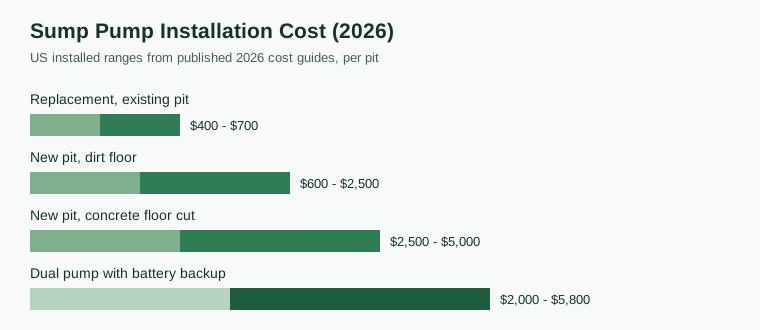
Installing a sump pump in 2026 typically costs $600 to $2,500 in the US, with replacement in an existing pit at $400 to $700 and concrete floor work pushing a new pit to $2,500 to $5,000. This guide prices pedestal, submersible, battery backup and waterpowered options, works through sizing in gallons per hour, running cost, Canada pricing, and a quote checklist.
Quick Checks
- 1Budget $600 to $2,500 installed for a new sump pump in the US in 2026. HomeGuide puts the national average near $1,600. Angi puts professional installation in a tighter $800 to $1,500 band with an average near $1,100. The gap between the two is scope: HomeGuide includes more concrete-cut and drainage work at the top.
- 2Replacement in an existing pit is the cheap job at $400 to $700, because there is no digging and no new discharge line. A first-time pit cut into a concrete floor runs $2,500 to $5,000 installed in HomeGuide data.
- 3The pump is the small line. Units run $100 to $800. Labor runs $500 to $1,700 and makes up 65 to 80 percent of the total, so pit location and floor type move the price more than the pump brand does.
- 4A battery backup is a separate purchase. HomeGuide prices battery units at $150 to $800, Angi prices an installed battery backup add-on at $1,000 to $2,500, and the battery itself needs replacement every 3 to 5 years.
- 5In Canada, HomeStars prices basic installation at C$700 to C$2,000 and complex work at C$2,500 to C$5,500, with the pit at C$500 to C$1,000, piping at C$200 to C$600, electrical at C$150 to C$800 and labour at C$60 to C$110 an hour.
Sump Pump Installation Cost 2026: What Installation Really Costs
By EnergyBS Editorial Team | October 8, 2026
The Short Answer
Short Answer: A new sump pump installation costs $600 to $2,500 in the US in 2026, with a national average near $1,600 in HomeGuide's member-reported cost guide. Angi's 2026 data describes the standard professional job in a tighter band, $800 to $1,500 with an average near $1,100, and puts the low end at $675 for a do-it-yourself pedestal installation. Replacing a pump in an existing pit costs $400 to $700, because the digging, discharge line and electrical work already exist. A first-time pit cut through a concrete floor runs $2,500 to $5,000 in HomeGuide data, and dual-pump systems with battery backup run $2,000 to $5,800 in Angi's city pricing tables. The spread is not noise. It is scope, priced in this order: pit, floor, discharge, backup.
A sump pump earns a place on an energy site for three reasons. It runs on the house electrical system, so it has a running cost and a backup-power question. It protects the insulation, air sealing and finished-floor work below grade, which is where a large share of retrofit money now sits. And it fails at the worst moment by design, during the storm that also cuts power, so the backup decision is part of the purchase rather than an accessory. This guide prices the job from the published 2026 tables, separates the pump price from the pit price, works through sizing in gallons per hour, and covers the discharge and maintenance details that decide whether the system works on the one night it has to.
1. Test, Repair, or Replace: The Order That Saves Money
A sump pit that misbehaves has four common causes, and three of them are cheap.
Power and float come first. A pump that does not start is a switch or power problem until proven otherwise. HomeGuide prices a float switch at $35 to $70 for the part and a check valve at $15 to $30, and either one can imitate a dead pump. A stuck float, a float hung up on the pit wall and a tripped breaker on the dedicated outlet are all no-parts checks. Pour water into the pit and watch the cycle before anyone quotes a pump.
Short cycling comes second. A pump that starts every few minutes in wet weather and stops just as fast is usually moving the same water twice: the check valve has failed, so the discharge column falls back into the pit after every cycle. The fix is the valve priced above, plus the labor to fit it. Continuous running in dry weather points the other way, to a float that never drops or a switch that has welded shut.
Noise and vibration come third. Grinding, rattling and a pit that hums through the floor point to bearings, a damaged impeller, or debris in the volute. HomeGuide puts repair and maintenance work at $200 to $870 depending on the fault, with emergency after-hours calls adding $50 to $150. A pump that needs a motor at seven years old is a replacement argument, covered in section 9. A pump that needs a switch at three years old is a repair.
Age decides the rest. HomeGuide's lifespan figures put pedestal pumps at 10 to 30 years and submersible pumps at 5 to 20 years, and HomeStars tells Canadian owners to plan on replacement at 7 to 10 years. Read together, the working rule is this: a submersible pump past seven years that needs anything beyond a switch or a valve is a replacement, because the next failure is already scheduled. A pedestal pump of the same age has its motor above the water, and that motor is the part that ages slowest in the system.
Replace the pump when the motor has failed, the housing is cracked or corroded through, the unit runs continuously after the switch and valve check out, or the repair quote approaches half the $400 to $700 replacement band on a pump in the back half of its life. Repair when the pump is young and the fault is in the switch, the valve, or the discharge line. Test before either one, because the test is free and it separates the two lists.
2. What the Installed Price Covers
A standard professional installation, as US and Canadian installers describe the scope, normally includes setting or resetting the pit liner, fitting the pump and float, piping the discharge through a check valve to the exterior, sealing the pit cover, and testing the cycle with water. On a replacement, the same scope is shorter: out with the old pump, in with the new one, valve replaced as a matter of course, cycle tested.
Five items sit outside the base scope often enough that each one needs a written answer before work starts:
- The pit itself. Where no pit exists, the excavation is the job. HomeGuide prices the dirt-floor case inside the standard $600 to $2,500 band and the concrete case at $2,500 to $5,000 once jackhammer or saw work enters. HomeStars prices pit creation on its own at C$500 to C$1,000.
- Interior drain tile. A pump without a collection system only empties its own pit. Tying the pit into a new interior drainage channel is a separate project at $4,000 to $12,000 in HomeGuide data, and it is the line that turns a pump quote into a waterproofing quote. Our crawl space encapsulation cost guide covers the crawl space version of the same decision.
- Electrical work. A first-time pit needs a receptacle within cord reach, and many installers put it on a dedicated circuit. HomeStars prices electrical connections at C$150 to C$800. An alarm, a high-water sensor and Wi-Fi monitoring sit on the same line at C$50 to C$150 for the alarm in HomeStars pricing.
- Battery backup. Priced separately in every dataset in this guide. Section 5 prices the three backup types.
- Permits and inspection. HomeStars puts permits and inspections at C$50 to C$500 where they apply. Plumbing and electrical rules for sump discharge vary by municipality, and section 6 covers the part that gets systems failed: where the water is allowed to go.
One bundling note. A backup pump fitted on the same visit as the primary pump shares the pit work, the discharge work and the trip. A backup added two years later pays for all three again. The pairing question belongs in the first quote, even when the answer is to stage the backup for a second phase.
3. Price by Scope: Replacement, Dirt Floor, Concrete, and Dual Systems
Scope moves this price more than equipment does. Four standard scopes cover most quotes:
| Scope | Installed range, US | What the price buys |
|---|---|---|
| Replacement in existing pit | $400 to $700 | New pump, new check valve, cycle test, no digging |
| New pit, dirt or gravel floor | $600 to $2,500 | Pit, pump, discharge line, basic electrical |
| New pit, concrete floor cut | $2,500 to $5,000 | Saw or jackhammer work, pit, pump, discharge, floor patch |
| Dual pump with battery backup | $2,000 to $5,800 | Primary plus backup pump, battery, shared or split discharge |
HomeGuide supplies the first three rows: replacement at $400 to $700, standard installation at $600 to $2,500 with a $1,600 average, and the concrete case at $2,500 to $5,000. Angi supplies the fourth: dual pumps or multiple pits at $2,000 to $4,000 and up in its Minneapolis table and $2,000 to $5,800 in its Detroit table. Angi's standard professional band of $800 to $1,500 with an $1,100 average describes the middle two rows where a pit exists or the floor is dirt, which is why it sits inside HomeGuide's wider range.
Two scope traps show up in quotes. The first is the pit that is too small for the job. A narrow liner cycles the pump hard, and two pumps in one pit need room for both floats to swing without fouling each other or the wall. A quote that pairs a primary and a backup in an existing small liner should name the liner size, and a liner upgrade belongs on the quote when the answer is tight. The second is access. HomeGuide flags crawl space and hard-to-reach installations as costing more than open-basement work, and Angi prices crawl space and exterior installations as their own band at $1,500 to $4,600. A pump under a low crawl space is a different job from the same pump in a walkout basement, and the quote should say which one it is pricing.
Time follows scope. HomeGuide puts a simple installation at 8 to 10 hours, with concrete work, added plumbing, or electrical work extending it. Replacement in an existing pit is the short visit in this family, usually a single call with a cycle test at the end.
4. Price by Pump Type and Horsepower
Two decisions set the equipment price: where the motor sits, and how much water the pump moves at the height it has to lift it.
| Pump type | Unit price, US | Installed band, US | Working life in published guidance |
|---|---|---|---|
| Pedestal | $100 to $400 | $500 to $1,500 | 10 to 30 years |
| Submersible | $100 to $800 | $600 to $2,500 | 5 to 20 years |
| Water-powered | $100 to $700 | $1,200 to $2,500 | Backup role, annual inspection |
| Battery backup (add-on) | $150 to $800 | $1,000 to $2,500 | Battery swap every 3 to 5 years |
Unit prices are HomeGuide's. Installed bands are Angi's, with HomeGuide's repair guide as the cross-check on the battery row. The pedestal design puts the motor above the pit on a column, which keeps it dry, easy to service and long-lived at the cost of noise and floor space. The submersible design puts the whole unit in the pit, runs quietly, handles higher flows and fits under a sealed cover, which matters where the pit doubles as a radon entry point. Our radon mitigation cost guide covers the sealed-lid half of that pairing: a gas-tight cover over the pit is part of the radon scope, and a submersible pump under that cover is the standard arrangement.
Horsepower is the flow decision. Angi's city tables price installed work by size:
| Size | Rated flow | Installed range across Angi city tables |
|---|---|---|
| 1/3 HP | About 2,000 gallons per hour | $650 to $1,600 |
| 1/2 HP | About 3,000 gallons per hour | $800 to $1,600 |
| 3/4 HP and up | 3,000+ gallons per hour | $1,000 to $3,600 |
HomeGuide frames the same choice from the house side: drier sites can run a 0.25 horsepower pump, while homes with frequent water need 0.33 to 0.5 horsepower. The flow figure needs one caution that belongs in every quote comparison. Gallons per hour are rated at a stated lift height, and the flow falls as the lift rises. A pump rated at 3,000 gallons per hour at five feet of lift moves less at ten feet, before pipe friction takes its share. Compare pumps at the lift your discharge actually imposes, not at the headline number on the box. Section 7 works through that math.
Material is the smaller dial. HomeGuide notes that metal-bodied pumps run about double the price of plastic-bodied equivalents, against longer service in the pit environment. In a $100 to $800 unit band, that is a real choice rather than a rounding error, and it interacts with the replacement clock in section 10.
5. Backup Power: Battery, Water, or Generator
A sump pump has one design weakness that no motor upgrade fixes: the storm that fills the pit is the storm that cuts power. Every dataset in this guide prices backup as a separate line, and the three backup types solve the problem three different ways.
Battery backup is the standard answer. A second, smaller pump in the same pit runs from a deep-cycle battery charged off the house supply. HomeGuide prices battery units at $150 to $800 and its repair guide prices the installed backup addition at $150 to $500 for the backup system in simple form; Angi prices an installed battery backup add-on at $1,000 to $2,500 in Detroit and $1,000 to $2,900 in Chicago, where the figure includes the pump, battery, charger and labor. The battery is a consumable in this design. HomeGuide puts battery replacement at every 3 to 5 years, and a backup system tested never is a pump with a dead battery at the end of that interval. HomeStars prices the Canadian addition at C$200 to C$600 for the backup component.
Water-powered backup uses municipal water pressure to drive a venturi pump. HomeGuide prices the units at $100 to $700 and Angi prices the installed result at $1,200 to $2,500. It needs no battery and never runs flat, and it has three hard limits: it only works on a municipal supply with adequate pressure, it spends treated water to move pit water, and many jurisdictions require a backflow preventer on the supply line, which is plumbing scope on the same visit. Homes on a well have no pressure when the power is out, which removes this option entirely.
A standby generator backs up the primary pump along with the rest of the house. It is the expensive answer and the complete one, and it only belongs in this guide as a pointer: our standby home generator cost guide prices that scope at $8,000 to $16,000 installed, which is a whole-home resilience purchase, not a sump accessory. The battery backup is the right-sized tool for the pit on its own.
Worked example, with the assumptions stated. A battery backup pump rated at 300 watts, running from a 75 amp-hour battery discharged to half its capacity, holds roughly 37 amp-hours of usable charge, or about 450 watt-hours at 12 volts. At a full 300-watt draw, that is about an hour and a half of continuous pumping. At a 20 percent duty cycle, four minutes of pumping in every twenty, it stretches to roughly seven hours of wall-clock protection. Those are illustration figures, not a product rating: read the backup pump draw and the battery capacity off the units you are quoted, and rerun the same two divisions. The example makes the sizing point plainly. Runtime is bought with amp-hours, and the second battery some systems accept doubles it at the battery price, not the system price.
The alarm belongs in this section. A high-water alarm at C$50 to C$150 in HomeStars pricing, or a monitoring controller bundled into the Angi add-on band, is what converts a silent failure into a phone notification. In a two-pump pit, the alarm float sits above the backup float: primary failure wakes the backup, backup operation wakes the owner. That sequence is the whole value of the dual system, and the quote should describe it in those terms.
6. Where the Water Goes: Discharge, Freeze, and the Sewer Rule
The pump is half the system. The discharge line decides whether the water leaves, and it fails in two predictable places.
Distance and slope at the outlet. Water pumped to a point beside the foundation returns to the pit through the soil, and the pump runs again to move the same water. The discharge should end well away from the foundation wall, on ground that slopes away from the house. This is grading and pipe length, not pump capacity, and a quote that ends the discharge at the wall has priced a loop rather than a system.
Freeze at the exit point. In cold climates, the section of pipe where the discharge leaves the heated space is the freeze point, and a frozen discharge leaves the pump running against a blocked line. The standard fixes are a discharge that slopes so the exterior run drains dry after each cycle, an oversized exterior section that tolerates an ice rim, and an air gap or freeze relief fitting where the line exits. Specify which one the quote includes. Our whole house dehumidifier cost guide covers the humidity side of the same basement; the sump discharge is the bulk-water side, and the two systems solve different problems in sequence: pump first, dehumidify second.
The sewer rule. Many municipalities prohibit discharging sump water into the sanitary sewer, and some prohibit connection to the floor drain or the laundry tub for the same reason: storm inflow overloads the treatment system during the events that fill pits. Others route sump discharge to a storm connection or a dry well by rule. There is no national answer, and the installer should name the legal outlet for your address on the quote. A discharge that has run to a floor drain for years is not evidence that it may; it is evidence that no one has checked. The permit line in HomeStars pricing, C$50 to C$500, exists for this verification.
The cover. A sealed, gasketed pit cover does three jobs: it keeps objects and children out of the pit, it holds back pit odors and soil gas, and it quietens a pedestal motor. Where radon is in scope, the sealed cover is not optional, and the cover type belongs on the quote beside the pump type.
7. Running Cost: What a Sump Pump Adds to the Bill
A sump pump is an intermittent load, and its annual electricity cost is small next to the water damage it prevents. It is still worth pricing, because the figure answers the most common objection to a larger pump or a dual system.
The math is nameplate arithmetic. A pump drawing 6 amps at 120 volts uses 720 watts while it runs, which is 0.72 kilowatts. Energy is that figure multiplied by running hours.
Worked example, with the assumptions stated. Take the 0.72-kilowatt pump above. In a wet season pattern of 15 running minutes a day averaged across the year, annual use is 0.72 x 0.25 x 365, which is about 66 kilowatt-hours. At a labeled example rate of 17 cents per kilowatt-hour, that is roughly $11 a year. In a heavy pattern, two running hours a day across 60 wet days, annual use is about 86 kilowatt-hours, or roughly $15 at the same rate. Those are planning illustrations, not measurements for your pit: read the amp draw off the pump you are quoted, time a cycle in wet weather, and rerun the multiplication with your rate from your bill. The pattern holds at any input. A sump pump is a tens-of-dollars annual load, and a pump that shows up as hundreds of dollars on the bill is a pump running continuously, which is a fault from section 1 rather than a cost of ownership.
The pedestal and submersible comparison carries one energy footnote. HomeGuide's type table notes that submersible units use more electricity per hour and pedestal units less, against higher flow from the submersible side. Over the annual figures above, that difference is a few dollars. It should never decide the pump type; flow at your lift height and cover sealing should.
Standby draw rounds out the picture. A battery backup charger holds its battery on a float charge year-round, and a monitoring controller draws a small continuous load. Both belong in the vampire-load category this site tracks: small, real, and worth a smart plug measurement if you are auditing the basement circuit. Our guide to home battery storage worth covers the larger version of the same standby question for whole-home systems.
8. Sizing the Pump: Flow at Height, Cycle Time, and the Pit
Three numbers size a sump installation, and only one of them is on the box in large type.
Flow at your lift height. The pump has to lift pit water from the pit to the discharge exit, usually 8 to 12 feet in a basement once the horizontal run and its friction are counted. A pump rated at 3,000 gallons per hour at five feet delivers less at ten. Angi's tables put a 1/3-horsepower pump at about 2,000 gallons per hour and a 1/2-horsepower pump at about 3,000 gallons per hour, and HomeGuide's guidance matches the house side of that ladder: 0.25 horsepower for drier sites, 0.33 to 0.5 horsepower where water is frequent. The sizing error in this trade is buying the headline flow without the height it was measured at. Ask for the flow at your lift, in writing, and compare quotes at the same height.
Inflow rate. The pit has to outrun the water arriving in the worst hour, not the average day. A practical field measure: in wet weather, time how fast the pit fills with the pump off, over a measured rise in the liner, and give that figure to every installer quoting the job. Homes that have flooded with a working pump have an undersized pump or a blocked discharge, and the fill test separates the two before money is spent.
Cycle behaviour. Each start is wear on the motor and the switch. A pump slightly large for the pit, on a short float swing, starts often and runs briefly, which is the hardest pattern in this equipment. The float tether or the vertical float travel sets the gallons moved per cycle. A quote that names the switch type, tethered float, vertical float, or electronic sensor, and the pit diameter it assumes, is describing cycle behaviour. A quote that names only horsepower is not.
Where the numbers land for most houses: a 1/3-horsepower submersible at a typical basement lift covers the standard case, a 1/2-horsepower unit covers high water tables and long discharge runs, and 3/4-horsepower and dual systems cover large footprints, multiple pits, and sites with a flooding history. Dual pumps earn their $2,000-plus band where the inflow in a storm hour exceeds one pump at height, or where a finished basement puts the cost of one failure above the cost of the second pump.
9. Repair vs Replace: The Ledger
Replacement is one way to spend money in a pit. The repair ledger, from the HomeGuide guides used throughout this article, prices the other way:
| Work | Published range, US |
|---|---|
| Float switch, part | $35 to $70 |
| Check valve, part | $15 to $30 |
| Repair and maintenance visit | $200 to $870 |
| Emergency call premium | $50 to $150 |
| Maintenance plan, per year | $100 to $250 |
| Pump replacement in existing pit | $400 to $700 |
| Battery backup addition | $150 to $500 and up by scope |
The pattern across the table is the same one that governs the furnace and door guides on this site: parts are cheap, access and labor carry the bill, and the decision turns on age. A float switch on a three-year-old submersible is a repair at any price on the table. A motor failure on an eight-year-old submersible is a replacement, because the $400 to $700 installed band buys a new warranty clock against a repair figure that starts at $200 with the old clock still running.
Two exceptions cut the other way. A pump that has run dry for an extended period after a float failure may have heat damage that no switch replacement undoes; the test in section 1 has to include a loaded cycle, not a dry spin. And a pit that floods with a pump testing well has a discharge or inflow problem, covered in sections 6 and 8, and replacing the pump leaves that fault exactly where it was.
10. Canada Pricing
Canadian pricing separates into the same scopes with different labor arithmetic. HomeStars' sump pump cost guide prices the components:
| Component | Cost, Canada |
|---|---|
| Pedestal pump unit | C$100 to C$300 |
| Submersible pump unit | C$300 to C$600 |
| Battery backup unit | C$200 to C$500 |
| Combination primary plus backup | C$500 to C$1,200 |
| Pit creation | C$500 to C$1,000 |
| Piping and fittings | C$200 to C$600 |
| Electrical connections | C$150 to C$800 |
| Labour | C$60 to C$110 per hour |
The assembled figures follow from the parts. HomeStars puts basic installation at C$700 to C$2,000 and complex projects at C$2,500 to C$5,500, with replacement at C$300 to C$1,200 including the unit and installation. Its waterproofing guide prices sump installation inside a broader scope at C$1,200 to C$3,000, depending on whether a pit exists and a battery backup is included, and its Toronto guide widens that to C$650 to C$4,000. Battery backups add C$200 to C$600 as components, alarms C$50 to C$150, and permits or inspections C$50 to C$500.
The Canadian buying pattern follows the water table and the freeze line. Submersible units under sealed covers are the standard pick where radon and winter discharge freezing are both in scope, and combination systems at C$500 to C$1,200 for the paired units price below two separate purchases. Municipal flood programs in several Canadian cities have historically covered part of backwater valve and sump work; the valve itself runs C$1,600 to C$3,500 installed in HomeStars' waterproofing guide, and the current program status for your address is worth one check before the quote is signed, since a subsidy changes which scope is the right buy.
11. Lifespan, Maintenance, and Ownership Cost
A sump installation is a 5-to-30-year purchase depending on type, with a maintenance schedule that is short and not optional:
- The pump. Pedestal units run 10 to 30 years and submersibles 5 to 20 years in HomeGuide guidance, with HomeStars advising Canadian owners to plan replacement at 7 to 10 years. The switch usually fails before the motor, and an annual test cycle catches it in the cheap years.
- The battery. Backup batteries are replaced every 3 to 5 years in HomeGuide guidance. A battery on its second five-year interval is the most common reason a backup system fails its only real test.
- The valve and switch. Check valves and float switches are the wear parts priced in section 9, at $15 to $30 and $35 to $70 for parts. Replacing the valve with the pump costs nothing in added labor and resets the short-cycling fault.
- The pit. Debris, iron bacteria slime and construction sediment reduce the pit volume and foul floats. An annual pit check and a water test of both pumps, primary and backup, is the maintenance plan HomeGuide prices at $100 to $250 a year when a contractor carries it, and it is a bucket and ten minutes when the owner does.
Ownership cost over ten years is therefore the installed price, one battery in most backup systems, one switch or valve event, and the electricity from section 7 at tens of dollars a year. Priced against one flooded finished basement, where the EPA guidance in this guide's citations starts at drying wet materials within 24 to 48 hours to limit mold, the ledger is not close. The purchase argument for the backup and the alarm is the same arithmetic: each one removes a single-point failure from a system whose failure cost is measured in rooms.
The test routine belongs in writing on the fridge, not in memory. Fill the pit until the primary starts. Confirm discharge at the outlet. Cut power at the breaker and repeat the fill to watch the backup carry the cycle, on systems that have one. Check the battery charger indicator while you are there. Twice a year, spring melt and fall rain, covers both failure seasons in most of the country.
12. How to Compare Quotes: A Checklist
Quotes for the same pit can sit far apart while describing different systems. These lines force the comparison onto the same scope:
- Scope named in one line: replacement, new pit in dirt, new pit in concrete, or dual system, with the floor type stated.
- Pump type and model: pedestal or submersible, horsepower, and the flow at your discharge lift height, not the headline flow.
- Switch type: tethered float, vertical float, or electronic sensor, and the pit diameter it will swing in.
- Pit liner: reused or new, and sized for a second pump where a backup is planned.
- Discharge route: pipe size, exit point, distance from the foundation, freeze protection method, and the legal outlet for your municipality.
- Check valve: new valve included, and its position above the pit for service.
- Cover: sealed and gasketed, or open, with the radon requirement answered where it applies.
- Electrical: receptacle position, dedicated circuit or shared, and who does the work.
- Backup: battery, water-powered, or none, with battery size, charger, and alarm priced as separate lines.
- Battery clock: the replacement interval and the part price for the next battery, in writing.
- Permit and inspection: required or not at your address, and who pulls it.
- Warranty split: pump, switch, battery, and labor, each with its term.
- Cycle test at completion: primary and backup both run under water, discharge confirmed at the outlet, before final payment.
A quote missing lines 2, 5 and 9 is not yet comparable to one that has them. The cheapest complete quote, describing the same pump at the same lift with the same discharge, is the one to buy.
Frequently Asked Questions (FAQ)
How much does it cost to install a sump pump in 2026?
A new installation costs $600 to $2,500 in the US, with a national average near $1,600 in HomeGuide data. Angi puts the standard professional job at $800 to $1,500 with an average near $1,100. Cutting a first pit into a concrete floor runs $2,500 to $5,000, and dual systems with battery backup run $2,000 to $5,800. In Canada, HomeStars puts basic installation at C$700 to C$2,000 and complex work at C$2,500 to C$5,500.
How much does it cost to replace a sump pump?
Replacement in an existing pit costs $400 to $700 in the US, because the pit, discharge line and electrical work already exist. HomeGuide breaks the job into a $100 to $800 unit plus labor inside that band, and HomeStars puts Canadian replacement at C$300 to C$1,200 including the unit and installation. Replacing the check valve at the same visit adds a $15 to $30 part and no meaningful labor.
Is a battery backup sump pump worth the extra cost?
Where the basement is finished, the water table is high, or outages and heavy rain arrive together, yes. Angi prices an installed battery backup add-on at $1,000 to $2,500, and HomeGuide prices battery units at $150 to $800 before installation scope. The backup removes the outage failure, which is the most common failure there is. Budget the battery itself as a consumable: HomeGuide puts replacement at every 3 to 5 years.
What size sump pump do I need?
Most houses land on 1/3 or 1/2 horsepower. Angi's tables rate a 1/3-horsepower pump at about 2,000 gallons per hour and a 1/2-horsepower pump at about 3,000, and HomeGuide advises 0.25 horsepower for drier sites against 0.33 to 0.5 where water is frequent. Compare flow at your discharge lift height, usually 8 to 12 feet in a basement, because flow falls as lift rises. High water tables, long discharge runs and a flooding history push toward 1/2 horsepower or a dual system.
How long does a sump pump last?
HomeGuide puts pedestal pumps at 10 to 30 years and submersible pumps at 5 to 20 years. HomeStars advises planning replacement at 7 to 10 years. The float switch and check valve usually fail before the motor does, at $35 to $70 and $15 to $30 for parts. An annual water test of the pit catches both in the cheap years.
How much electricity does a sump pump use?
Tens of dollars a year in most houses. A pump drawing 6 amps at 120 volts uses 0.72 kilowatts while running. At a labeled example pattern of 15 running minutes a day, that is about 66 kilowatt-hours a year, roughly $11 at a 17-cent example rate. A pump that adds hundreds of dollars to a bill is running continuously, which is a switch, valve, or discharge fault rather than a cost of ownership.
Can a sump pump discharge into a floor drain or sewer?
Often no. Many municipalities prohibit sump discharge to the sanitary sewer, because storm inflow overloads treatment during the events that fill pits. Rules vary by address, and the installer should name the legal outlet, usually grade away from the foundation, a storm connection, or a dry well, on the quote. A permit or inspection line at C$50 to C$500 in HomeStars pricing covers this verification in Canada.
What should I read next before deciding?
If the pit sits in a crawl space, read our crawl space encapsulation cost guide for the groundcover and sealing scope that pairs with the pump. For the power side, compare the battery decision here with standby generator costs, and for a pit that doubles as a radon entry point, see radon mitigation system costs for the sealed-cover half of that job.
Prices in this guide are planning ranges from the published 2026 sources cited above, not quotes for your pit. Pit scope, floor type, pump size at your lift height, discharge route, backup type, permits and local labor decide the final figure. Get itemized written quotes on the same scope, confirm the flow at your lift height and the battery replacement clock in writing, and test both pumps under water before final payment.
What to Read Next
Crawl Space Encapsulation Cost 2026: What Installation Really CostsUse this next to compare the cost, incentive, installation, or operating-risk angle before you make a home energy decision.Sources and Verification
- HomeGuide How Much Does Sump Pump Installation Cost? (2026 Guide) (installed range $600 to $2,500, national average $1,600, unit and labor split, replacement, floor and drainage factors, from memberreported project costs)
- HomeGuide How Much Does Sump Pump Maintenance and Repair Cost? (2026) (repair and maintenance range, battery backup addon, replacement by pump type, switch and valve parts pricing)
- Angi How Much Does It Cost to Install a Sump Pump? [2026 Data], updated May 3, 2026 (professional installation normal range $800 to $1,500, average $1,100, installed pricing by horsepower and pump type)
- HomeStars Understanding Sump Pump Costs (Canada unit pricing, pit, piping, electrical and labour task costs, basic and complex installation bands, replacement range)
- HomeStars Basement Waterproofing Cost in Canada: 2026 Guide (sump pump installation $1,200 to $3,000 inside waterproofing scope, Toronto range, backwater valve and window well context)
- U.S. EPA A Brief Guide to Mold, Moisture and Your Home (keep indoor humidity below 60 percent, dry wet materials within 24 to 48 hours, fix leaks and drainage at the source)
Editorial Review
EnergyBS Editorial Team
EnergyBS publishes practical homeowner guides. Important program, product, and cost claims should be checked against the linked source and local project documents before you commit to work.
Related Guides
View All ArticlesCrawl Space Encapsulation Cost 2026: What Installation Really Costs
Encapsulating a crawl space in 2026 typically costs $3 to $10 per square foot, or $3,000 to $15,000 total for most homes. This guide breaks down cost by crawl size and barrier thickness, what the vapor barrier, insulation, and dehumidifier lines actually cover, the prep work that moves a quote, and how to compare bids without paying twice for the same scope.
Radon Mitigation System Cost 2026: What Installation Really Costs
A radon mitigation system installed in 2026 typically costs $1,200 to $2,000 in the US, with active soil depressurization doing most of the work. This guide prices each system type, the testing that comes before it, the fan electricity that runs for decades, and the quote lines that separate a complete job from a cheap one.
Standby Home Generator Cost 2026: What Installation Really Costs
A professionally installed standby generator typically costs $8,000$16,000 allin in 2026. This guide breaks down equipment, transfer switches, fuel choices, permits, and running costs plus Canadian pricing.