Septic System Installation Cost 2026: What Installation Really Costs
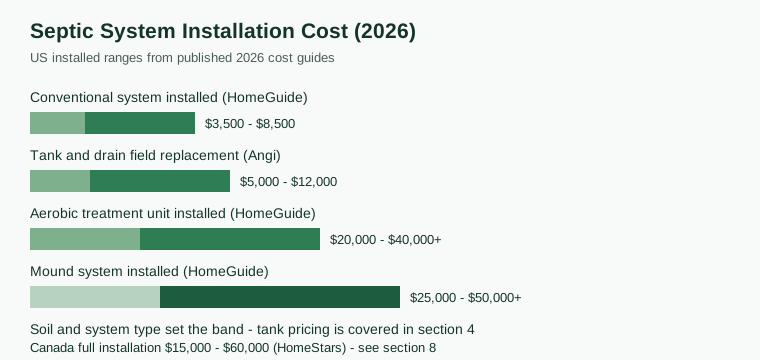
A new conventional septic system in the US in 2026 typically costs $3,500 to $8,500 installed in HomeGuide project data, with tank and drain field replacement at $5,000 to $12,000 in Angi data. Soil and system type set the spread: chamber systems run $4,000 to $11,000, aerobic treatment units $20,000 to $40,000 or more, and mound systems $25,000 to $50,000 or more. This guide prices each system type, tank size and material, site work, running costs with labeled math, Canada pricing, and a quote checklist.
Quick Checks
- 1Budget $3,500 to $8,500 for a conventional US septic system installed in 2026 in HomeGuide project data. Soil that cannot take a conventional field moves the project into alternative or engineered bands.
- 2Tank and drain field replacement together runs $5,000 to $12,000 in Angi data. A failed tank with a working field, or the reverse, is a partial project at a partial price.
- 3The tank is a small line in the invoice. A 1,000-gallon tank runs $1,000 to $1,500 before labor, while site prep and installation labor runs $1,000 to $4,500 on a conventional job in HomeGuide pricing.
- 4Permits, inspections and soil testing add $1,000 to $2,000 on a typical job in HomeGuide pricing. Angi puts perc testing alone at about $1,300 on replacement work.
- 5In Canada, HomeStars puts a full septic installation at $15,000 to $60,000, with pumping at $400 to $800 every 2 to 5 years.
Septic System Installation Cost 2026: What Installation Really Costs
By EnergyBS Editorial Team | October 10, 2026
The Short Answer
Short Answer: A new conventional septic system costs $3,500 to $8,500 installed for most US homeowners in 2026 in HomeGuide project data. Replacing a tank and drain field together runs $5,000 to $12,000 in Angi data, with an average near $6,000. The tank itself is a small part of either figure. HomeGuide prices a 1,000-gallon tank at $1,000 to $1,500 before labor, a distribution box at $500 to $1,000, site preparation and installation labor at $1,000 to $4,500, and engineering, permits and inspections at $1,000 to $1,500 on a conventional job. Soil decides which band a project lands in. Systems that treat or lift effluent because the native soil cannot do the work run higher: chamber systems at $4,000 to $11,000, aerobic treatment units at $20,000 to $40,000 or more, and mound systems at $25,000 to $50,000 or more, all installed in HomeGuide pricing. In Canada, HomeStars puts a full installation at $15,000 to $60,000.
A house on a private septic system runs its own wastewater plant. Every gallon that leaves a tap, a washer or a shower has to be settled, separated and returned to the soil on the same lot. The water arriving at that plant comes from the supply side of the same property, which our well pump replacement cost guide prices, and the quality of that water is set by the treatment train in our whole house water filtration cost guide. This guide prices the plant at the other end of the pipes.
1. Diagnose First: Tank, Field, or Both
A failing system announces itself the same way whether the fault sits in the tank or in the field: slow drains through the house, gurgling at fixtures, odors near the tank or field, wet ground over the field, or a backup at the lowest fixture. HomeGuide lists that same symptom set as the trigger for repair or replacement work. The symptom does not name the failed part, and the price difference between the parts is the whole budgeting question.
Three scopes cover nearly every quote:
- Tank work only. Angi puts a new septic tank installed at $3,000 to $10,000 when the drain field still passes. Inside that scope, small parts stay small: Angi prices baffle replacement at $300 to $900, and HomeGuide puts general septic repairs at $600 to $3,000.
- Field work only. Angi puts drain field replacement at about $7,000 as a standalone figure, and HomeGuide puts leach field repair at $1,000 to $5,000 against full field replacement at $3,000 to $15,000. A clogged field that can be treated rather than rebuilt sits at the repair end of that spread.
- Tank and field together. Angi bands the combined replacement at $5,000 to $12,000. This is the full-system case, and it is the figure to use when both halves test as failed or when a replacement permit requires current standards for the whole system.
The test that separates the scopes is inspection plus a soil check. Angi prices septic inspections at $200 to $900 and notes that replacement work requires perc testing, a measure of how fast the soil absorbs water, at about $1,300 on average. HomeGuide prices a soil test at $250 to $700, with a deeper percolation test by an engineer running up to $2,000. A field that has served for decades can fail the current test even while it still drains, which moves the project from a like-for-like rebuild to a relocated or redesigned system at a higher band. Paying for that answer before excavation is the cheapest decision in the project. A quote written without a tank condition, a field condition and a perc result is a guess with a signature line.
One boundary belongs in this section. A house that can connect to a municipal sewer should price that connection against any septic rebuild before signing either one. The comparison is local, set by the utility and the distance to the main, and no national band in this guide covers it. The septic figures below assume the lot stays on a private system.
2. What the Installed Price Covers
A conventional installation, as installers scope the job, normally includes the tank set and leveled, the distribution box, the drain field pipe runs in prepared trenches or beds, the connecting lines from house to tank and tank to field, backfill and rough grading, and the inspections the permit requires during construction. Angi notes that new systems need at least two professional inspections during construction to confirm the work meets standards.
Six items sit outside that base scope often enough to need a written answer before work starts:
- Engineering and design. Angi puts engineering consultant time at $125 to $200 an hour. Mound and other engineered systems need that design work as a condition of the permit, not as an upgrade.
- Permits as separate lines. HomeGuide puts permits, inspections and testing at $1,000 to $2,000 together on a typical job, split across a building permit at $250 to $450, a drain field permit at $250 to $650, and abandonment permits at $100 to $250 for each old field taken out of service. Angi bands drainage field permits wider, at $450 to $2,000 by jurisdiction.
- Excavation beyond the field. Angi prices excavation at $1 to $5 per square foot, and HomeGuide prices an excavator with operator at $100 to $300 an hour. Rock, a high water table or a tight lot moves hours, and hours move the invoice.
- Tree and root removal. Angi puts removal at $200 to $2,000 where trees stand in the tank or field footprint. Roots in an existing field are also a failure cause, so the same line can appear as diagnosis and as site work.
- New connecting lines. Angi prices new septic lines at $100 to $240 per linear foot installed, and HomeGuide prices repair of the house-to-tank line at $50 to $250 per linear foot. A long run from house to a relocated field reprices quickly at those rates.
- Surface restoration. Sod runs $0.35 to $0.85 per square foot for material in Angi pricing, or $1 to $2 per square foot installed, and yard regrading runs $1,000 to $3,300. HomeGuide puts land leveling at $500 to $5,000 by yard size. None of this treats wastewater. All of it shows up in the yard the owner looks at afterward.
The bundling note for a septic project runs through the lot, not the house. The system shares ground with the well, the water lines and any future structure, and the field needs reserved area that stays clear of vehicles and deep roots. Our sump pump installation cost guide covers the other buried water decision on the same lot, moving groundwater away from the foundation. Both projects are excavation priced by access and soil, and doing them in separate years pays the mobilization twice.
3. Price by System Type: Conventional, Chamber, Aerobic, Mound
Soil picks the system before the budget does. A lot with deep, permeable soil and room for a field takes the conventional design. A lot without those conditions takes treatment, lift or imported sand, and each step up that ladder has its own band:
| System type | Installed cost band, US (HomeGuide) | Where it fits |
|---|---|---|
| Conventional anaerobic system | $3,500 to $8,500 | Gravity flow, suitable native soil, room for a field |
| Chamber system | $4,000 to $11,000 | Buried chambers in place of gravel trenches, limited space or high groundwater |
| Drip distribution system | $6,500 to $15,000 | Effluent spread by emitters for even distribution |
| Constructed wetland system | $7,000 to $14,000 | Tank effluent polished through a planted bed |
| Evapotranspiration system | $10,000 to $15,000 | Lined bed, effluent evaporates rather than reaching groundwater, arid sites |
| Recirculating sand filter system | $15,000 to $25,000 or more | Effluent filtered through a sand bed, thin native soil |
| Aerobic treatment unit (ATU) | $20,000 to $40,000 or more | Air added to speed breakdown, small lots or sensitive areas, disinfection and yearly inspection |
| Mound system | $25,000 to $50,000 or more | Field raised in imported sand, 1 to 2 feet of native soil |
Read the table with the scope each source attaches. HomeGuide bands the full installed system. Angi, pricing tank and field replacement, puts the field portion by type at $5,000 for an anaerobic field, $7,000 for an aerobic field, $8,000 for an evapotranspiration field and $12,000 for a mound field. The two sets describe the same ladder from different ends: the field and its treatment step carry the cost, and the tank at the head of the system is the smaller line in section 4.
Three distinctions keep quotes comparable:
Conventional is a soil finding, not a default. The $3,500 to $8,500 band holds where the perc result, the depth to groundwater and the available area all suit a gravity field. An installer quoting that band before testing has priced the hope, not the lot. The test fees in section 2 are what confirm the band applies.
Aerobic buys treatment with electricity and service. HomeGuide notes that an ATU adds oxygen to break down solids faster, can require disinfection by chlorine or ultraviolet treatment before the field, and needs inspection at least once a year. That is a machine in the yard, with a power draw and a service rhythm a conventional system does not have. Section 6 prices both. The smaller field an ATU can serve is the gain. The running costs are the price of that gain, paid every year rather than once.
Mound buys soil the lot does not have. A mound system builds the treatment bed above the natural surface in specified sand fill, which HomeGuide describes for sites with only 1 to 2 feet of native soil. The sand, the lift pump to reach the raised bed and the larger footprint explain the top band. A sand filter sits one step below, at $15,000 to $25,000 or more, for sites with about 1.5 feet of native soil under the field. In both cases the quote should state the fill quantity and the pump as separate lines, because those two lines are where mound quotes spread apart.
Mobile homes price as small houses in this market. HomeGuide puts a mobile home septic system at $3,000 to $5,000 installed, with placement kept clear of any surface the home or vehicles will sit or drive on, since weight over the tank or field damages both.
4. Tank Size and Material: The Small Line Priced Right
Tank size follows bedrooms, on the reasoning HomeGuide states: bedrooms proxy occupancy, and occupancy sets wastewater flow. The tank-only bands, before installation labor, run as follows:
| Home size | Tank size | Tank cost, US (HomeGuide) |
|---|---|---|
| 1 to 2 bedroom | 750 gal | $700 to $1,200 |
| 3 bedroom | 1,000 gal | $1,000 to $1,500 |
| 4 bedroom | 1,250 gal | $1,200 to $1,800 |
| 5 bedroom | 1,500 gal | $1,500 to $2,500 |
| 6 or more bedrooms | 1,750 gal | $2,000 to $3,000 |
Material moves the same tank within and past those bands:
| Material | Tank cost, US (HomeGuide) | Trade-off in the source |
|---|---|---|
| Plastic (polyethylene) | $700 to $2,500 | Lowest cost, light and easy to set, can float in a high water table and can deform under weight above it |
| Fiberglass | $1,400 to $2,000 | Strong and watertight, still light enough to float or shift where groundwater is high |
| Concrete | $1,000 to $3,000 | Heaviest, will not float, lasts for decades, needs heavy equipment to set and can crack |
Two sizing points decide whether the tank choice lasts. The first is that the tank is sized for the house as permitted, not for the family in it today. A tank set to current occupancy with bedrooms uncounted becomes the bottleneck the next owner inherits, and the field behind it takes the overload first. The second is that bigger is cheap here. Moving from a 1,000-gallon to a 1,250-gallon tank adds a few hundred dollars at the tank line, against field replacement at $3,000 to $15,000 if solids carry over from an undersized tank. Effluent filters, priced in section 6, guard the same path for less.
Garbage disposal use belongs in the sizing conversation rather than as an afterthought, since ground food waste raises the solids load the tank must settle. A quote should state the bedroom count, the tank volume and the material as three separate facts. A quote that names only a diameter or a brand has skipped the arithmetic.
5. Site Costs: Soil, Depth, Access and Distance
Two houses buying the same tank and the same field design can pay different totals because the ground differs. Five site facts set that difference, and a comparable quote states each one:
- Perc rate and soil profile. The test in section 1 sets field size. Slow soil needs a larger field or a treatment step, and clay or shallow bedrock removes the conventional option entirely. HomeGuide advises a larger tank for yards with sandy or clay soils, and the field consequence is larger still.
- Depth to groundwater and bedrock. Shallow limits push the design toward chamber, sand filter or mound systems, in that cost order in section 3. This is a measurement from the test pits, and it belongs on the quote as a number, not as a verbal summary.
- Excavation conditions. At $1 to $5 per square foot in Angi pricing and $100 to $300 an hour for machine and operator in HomeGuide pricing, rock, groundwater in the cut and hand work around existing lines all bill by time. A fixed quote on untested ground carries that risk somewhere, usually in a change-order clause. Ask where it sits.
- Access for equipment. A tank arrives by truck and is set by machine. A lot that cannot take that equipment to the field area pays for smaller machines, more hours or hand work. Angi flags hard-to-reach locations as a direct cost driver on replacement work for the same reason.
- Distance and elevation. Lines at $100 to $240 per linear foot mean a field moved 50 feet from the original footprint adds $5,000 to $12,000 in line work alone at those rates, before the field itself. A field downhill of the tank flows by gravity. A field uphill needs a lift pump, its chamber and its power run, each as its own line.
The labeled example below assembles those lines for one house so the totals can be checked against the bands. It is a worked illustration with its assumptions stated, not a quote and not an average:
| Line, labeled hypothetical: 3-bedroom house, 1,000-gallon tank | Assumed value |
|---|---|
| Tank, concrete, from section 4 band | $1,500 |
| Distribution box | $750 |
| Field pipe, beds and site labor (conventional) | $3,000 |
| Permits, inspections and soil test combined | $1,500 |
| Excavation and backfill beyond base scope | $1,000 |
| Surface restoration, rough grade only | $500 |
| Illustrative conventional total | $8,250 |
The same house on thin soil with a mound field reuses the tank and permit lines and replaces the field line with the mound band from section 3, which is why the total moves from the single-thousands into the $25,000 to $50,000 or more range without any line being padded. The lesson of the example is the shape, not the $8,250: on a conventional lot the labor and fees together outweigh the tank, and on a difficult lot the field design outweighs everything else combined. Quotes that invert that shape, a costly tank on a cheap field, deserve a line-by-line question.
6. Running Costs: Pumping, Inspections and Power
The installed price is the first of two costs. The second is a service rhythm, small each year and expensive only when skipped:
| Service, US (HomeGuide) | Published cost | Rhythm in the source |
|---|---|---|
| Inspection | $150 to $450 | Routine check of tank and pipes, sets the pumping date |
| Pumping | $300 to $700 | Every 3 to 5 years by tank size, occupants and water use |
| Effluent filter cleaning | $100 to $400 | Often included with a pumping visit |
| Repairs | $600 to $3,000 | By fault, baffles at $300 to $900 in Angi pricing |
HomeGuide puts yearly maintenance at $150 to $1,000 across inspection and services as needed. Annualized, a pumped-on-schedule conventional system costs a few hundred dollars a year. The comparison that matters is against the failure it prevents: solids that escape an unpumped tank reach the field, and field replacement runs $3,000 to $15,000 in HomeGuide pricing. Pumping is the cheapest field insurance in this guide, and the pumping record is also the document a buyer, an inspector or a permit office will ask for later. Keep it with the house.
Power. A gravity conventional system uses no electricity to treat wastewater. The moment the design adds a lift pump or an aerator, the system becomes a load on the house meter, and that load belongs in the replacement conversation for two reasons. The first is the bill. No source cited here publishes a single yearly figure, because draw and duty cycle vary by unit, so the example below is labeled math with its assumptions stated, not a statistic:
| Input, labeled example | Assumed value |
|---|---|
| Aerator draw while running | 100 watts |
| Running time | Continuous, 24 hours a day |
| Electricity per year | 876 kWh (0.1 kW x 8,760 hours) |
| Cost at an assumed $0.15 per kWh | About $131 per year |
Your unit nameplate, its duty cycle and your rate decide your figure. A lift pump that runs in bursts after each draw uses a fraction of the continuous case. The second reason is backup. A pumped system that loses power loses wastewater movement, where a gravity system keeps working through an outage. Houses that already size a generator or a battery for a well pump should add the septic pump to the same load list, since both move water and both fail the house when they stop. Our standby home generator cost guide prices that generator side, and the well pump guide linked in section 1 works through starting loads for the supply side.
Water use. Flow is the load the system was sized against, and fixtures set it. A leaking toilet or a softener regenerating more often than its settings require sends water the tank must settle and the field must absorb, every day, without adding a single occupant. Where hardness drives extra regeneration, our water softener installation cost guide covers the sizing that keeps that flow in check. Spreading laundry across the week rather than through one day keeps peak flow inside the design the permit was written for. None of this needs new equipment. It keeps the installed system working at the size it was bought at.
7. Lifespan and Repair-or-Replace
A septic system ages in two parts, on two different clocks:
- The tank. HomeGuide puts a concrete tank at 20 to 30 years with proper maintenance, with life set by tank quality, soil conditions and household load. Plastic and fiberglass carry their own limits from section 4, buoyancy and deformation where groundwater or loads press on them. A tank that still settles and separates, with sound baffles and no root intrusion, is a service asset even late in that range.
- The field. Angi puts a properly installed and maintained drain field at up to 50 years, with an average near 20 years, and notes that poor soil, heavy use or weak maintenance can pull that down to 15 to 20 years. The field fails by clogging and by soil that no longer absorbs, which is why the perc result on an old field can end its service before the hardware does.
The repair-or-replace rule follows the bands. A fault priced in the repair range, baffles at $300 to $900, a line repair at $50 to $250 per foot, or a field treatment inside the $1,000 to $5,000 repair band, on a system with documented pumping and a passing inspection, is a repair. A tank at the end of its material life with structural damage, or a field that fails perc and inspection together, is a replacement, priced in the combined $5,000 to $12,000 band or the engineered bands above it where soil requires them. Age alone decides neither direction. A young system overloaded past its bedroom rating fails early with a cause to fix, starting with flow. An old system passing inspection with records is a dated budget plan, not an emergency.
What not to do sits on the record in both US sources. HomeGuide and Angi both advise against owner installation or major owner repair: the work involves excavation, raw sewage exposure and permit standards, and errors surface as leaks, backups and legal exposure with neighbors and regulators. The owner jobs are the rhythm in section 6, records, water discipline and keeping vehicles and deep-rooted planting off the field. The licensed installer jobs are everything underground.
8. Buying in Canada
HomeStars publishes the Canadian figures as a full-installation range with replacement scenarios, and they sit above the US conventional band:
| Item, Canada (HomeStars) | Published cost |
|---|---|
| Full septic installation, excavation, pipes, tank and inspections | $15,000 to $60,000 |
| Basic system replacement scenario | About $3,500 |
| Replacement with minor repairs scenario | About $5,000 |
| Replacement with major excavation scenario | About $8,500 |
| Pumping, every 2 to 5 years | $400 to $800 |
| Annual inspection | $100 to $300 |
| Filter cleaning | $100 to $400 |
Read the replacement scenarios as scope illustrations next to the full-installation band, not as a second set of project totals: a full Canadian installation with excavation, pipe runs, tank set and inspections is the $15,000 to $60,000 figure, while the lower scenarios describe narrower replacement scopes. A Canadian quote should therefore be compared installed-to-installed: tank, field, excavation, permits and inspections each named, with the scenario it matches stated. HomeStars counts system type, property layout, soil condition and local rules as the drivers, the same four that set US pricing, and adds permit and inspection fees, soil testing, landscaping restoration and winter ground conditions as the extras to confirm. Provincial and municipal rules govern design standards, installer certification and setback distances, and they differ by province, so the quote should name the permit and the standard the design follows rather than citing a generic code.
The stage logic north of the border is unchanged: test before designing, size to bedrooms, and keep the service rhythm documented. Pumping at $400 to $800 on a 2 to 5 year cycle and inspections at $100 to $300 guard the same field-replacement exposure as in the US figures, against a larger installed total.
9. How to Compare Quotes: A Checklist
Quotes for the same failing system can sit tens of thousands of dollars apart while describing different scopes. These lines force the comparison onto the same lot and the same design:
- Diagnosis stated: tank condition, field condition and perc result, each with its test, before a system type is quoted.
- System type named with its fit: conventional, chamber, aerobic, sand filter or mound, matched to the measured soil depth and perc rate.
- Bedroom count and tank volume stated: gallons, material, and the occupancy the sizing assumes.
- Field design on paper: field type, size, location on the lot, and the reserve area kept clear for a future field.
- Fill and pump lines separated where fitted: sand quantity for a mound, lift pump and chamber, aerator and disinfection for an ATU.
- Equipment separated from labor: tank, box, pipe and fill as material lines; excavation, set and installation as labor at stated rates or hours.
- Permits and fees itemized: building and field permits, inspections during construction, soil testing, and any abandonment permit for the old system.
- Line runs priced by length: house-to-tank and tank-to-field distances at a per-foot rate, with any relocation measured.
- Power scope named where fitted: aerator or pump circuit, alarm, and who supplies the electrical work.
- Surface restoration defined: rough grade only, or sod and regrading included, at a stated area.
- Warranty split: tank, field, pumps and controls, and labor, each with its term, plus the service contract an ATU requires.
- Records promised: permit set, as-built field location, tank size and material, and the first pumping date left with the house.
A quote missing lines 1, 2 and 4 is not yet comparable to one that has them. The cheapest complete quote, treating the same wastewater at the same soil standard with the same site work, is the one to buy.
Frequently Asked Questions (FAQ)
How much does a septic system cost in 2026?
A conventional system runs $3,500 to $8,500 installed in US HomeGuide project data. Tank and drain field replacement together runs $5,000 to $12,000 in Angi data, with an average near $6,000. Systems that must treat or lift effluent cost more: aerobic treatment units run $20,000 to $40,000 or more and mound systems $25,000 to $50,000 or more installed in HomeGuide pricing. In Canada, HomeStars puts a full installation at $15,000 to $60,000.
How much does it cost to replace just the septic tank?
Angi puts a new tank installed at $3,000 to $10,000 where the drain field still passes. The tank alone, before labor, runs $1,000 to $1,500 for a 1,000-gallon unit in HomeGuide pricing, inside material bands of $700 to $2,500 for plastic, $1,400 to $2,000 for fiberglass and $1,000 to $3,000 for concrete. Small tank faults stay small: baffles run $300 to $900 in Angi pricing and general repairs $600 to $3,000 in HomeGuide pricing.
What size septic tank do I need?
Size follows bedrooms. HomeGuide bands tanks at 750 gallons for 1 to 2 bedrooms, 1,000 gallons for 3 bedrooms, 1,250 gallons for 4 bedrooms, 1,500 gallons for 5 bedrooms and 1,750 gallons for 6 or more bedrooms, before installation labor. Size for the house as permitted rather than for current occupancy, and state the bedroom count, volume and material on the quote.
Why does an aerobic or mound system cost so much more?
Both replace soil work the lot cannot do. An aerobic unit adds powered treatment, possible disinfection and at least yearly inspection, and a mound builds the field in imported sand with a pump to lift effluent to it. HomeGuide prices aerobic units at $20,000 to $40,000 or more and mounds at $25,000 to $50,000 or more installed, against $3,500 to $8,500 for a conventional system where native soil suits a gravity field.
How long does a septic system last?
HomeGuide puts a concrete tank at 20 to 30 years with proper maintenance. Angi puts a drain field at up to 50 years, with an average near 20 years, falling to 15 to 20 years under poor soil, heavy use or weak maintenance. Pumping every 3 to 5 years in US guidance is the service that keeps both clocks running long.
How much does septic pumping and upkeep cost?
HomeGuide prices pumping at $300 to $700 every 3 to 5 years, inspections at $150 to $450 and filter cleaning at $100 to $400, inside yearly maintenance of $150 to $1,000. In Canada, HomeStars prices pumping at $400 to $800 every 2 to 5 years and inspections at $100 to $300. Skipped pumping sends solids to the field, where replacement runs $3,000 to $15,000.
Does a septic system use electricity?
A gravity conventional system uses none. A lift pump or an aerobic aerator adds a metered load. The labeled example in section 6, a 100-watt aerator running continuously at an assumed $0.15 per kWh, works out to 876 kWh and about $131 a year. Your nameplate draw, duty cycle and rate decide your figure. A pumped system also stops moving wastewater in an outage, which belongs in any generator or battery sizing for the house.
What should I read next before deciding?
Start on the supply side of the same lot, with our well pump replacement cost guide, then the treatment train the pump feeds in our whole house water filtration cost guide and water softener installation cost guide. For the heater that draws on the same water, read our tank water heater replacement cost guide, and for groundwater at the foundation, our sump pump installation cost guide.
Prices in this guide are planning ranges from the published 2026 sources cited above, not quotes for your lot. Your soil test, system design, tank size, site access and local labor decide the final figure. Test before designing, get itemized written quotes at the same system type and scope, and keep the permit set and pumping record with the house.
What to Read Next
Well Pump Replacement Cost 2026: What Replacement Really CostsUse this next to compare the cost, incentive, installation, or operating-risk angle before you make a home energy decision.Sources and Verification
- HomeGuide How Much Does a Septic Tank System Cost? (2026) (conventional system $3,500 to $8,500 installed, alternative systems $4,000 to $15,000, engineered systems $15,000 to $50,000, 1,000gallon tank $1,000 to $1,500, tank size and material bands, labor, permits, testing and maintenance bands)
- Angi Cost to Replace Septic Tank and Drain Field [2026 Data], updated Jul 8, 2026 (tank and drain field replacement $5,000 to $12,000, average near $6,000, drain field type averages, perc testing, labor, permits and inspection bands)
- HomeStars Septic Tank Costs in Canada (full installation $15,000 to $60,000, replacement scenarios, pumping every 2 to 5 years at $400 to $800, inspections $100 to $300)
Editorial Review
EnergyBS Editorial Team
EnergyBS publishes practical homeowner guides. Important program, product, and cost claims should be checked against the linked source and local project documents before you commit to work.
Related Guides
View All ArticlesWell Pump Replacement Cost 2026: What Replacement Really Costs
Replacing a well pump in the US in 2026 typically costs $974 to $2,821, with a national average near $1,897 in Angi project data from 1,339 projects. Pump type and well depth set the spread: shallow jet equipment runs $450 to $1,500 before installation lines, submersible equipment $1,000 to $2,500 or more, and wells over 150 feet land at $2,000 to $10,000 or more as projects. This guide prices each pump type, works through flow and pressuretank sizing, covers electricity running costs with labeled math, Canada pricing, and a quote checklist.
Whole House Water Filtration System Cost 2026: What Installation Really Costs
Installing a wholehouse water filtration system in the US in 2026 typically costs $1,129 to $3,541, with a national average near $2,275 in Angi project data. HomeGuide puts the firstyear total at $1,000 to $5,650 once equipment, labor and first filters are counted, and wholehouse reverse osmosis at $4,800 to $8,000. This guide prices carbon, multistage and UV systems, works through flowrate sizing, covers filter and lamp running costs, Canada pricing, and a quote checklist.
Water Softener Installation Cost 2026: What Installation Really Costs
Installing a wholehouse water softener in 2026 typically costs $1,200 to $3,800 in the US for a saltbased ion exchange system, with most homeowners paying near $1,500. This guide prices singletank, dualtank and saltfree systems, works through graincapacity sizing, covers salt and regeneration running costs, Canada pricing, and a quote checklist.