Refrigerator Repair Cost 2026: What Repairs Really Cost, by Part
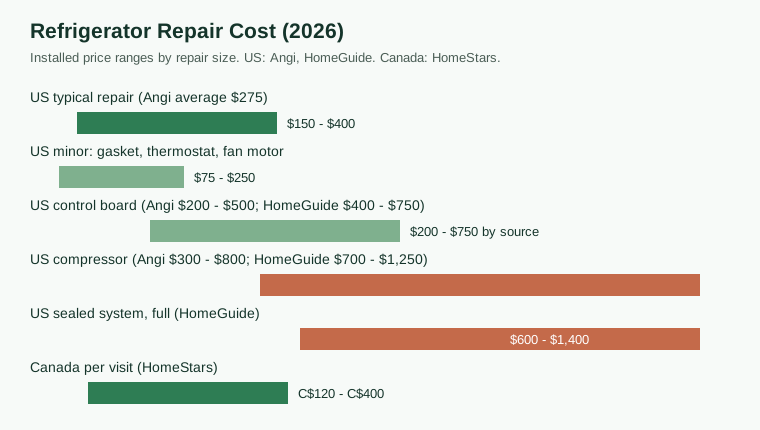
Most refrigerator repairs cost $150 to $400 in the US in 2026, with a $275 national average (Angi, updated October 15, 2026). HomeGuide puts the average range at $125 to $500 with a $300 national average. The failed part decides where a quote lands: a door gasket runs $75 to $200 (Angi), a thermostat or fan motor $100 to $250, a control board $200 to $500, and a compressor $300 to $800 on Angi's table against $700 to $1,250 on HomeGuide's, a gap this guide explains rather than averages away. In Canada, fridge repairs run C$120 to C$400 per visit (HomeStars). This guide prices repairs by part and by symptom, explains the sealed system that drives the top prices, and works the repair-or-replace decision on three labelled examples.
Quick Checks
- 1Budget $150 to $400 for a typical US refrigerator repair in 2026, with a $275 national average (Angi). HomeGuide's average range is $125 to $500 with a $300 average. Both averages sit far below the sealed-system jobs at the top of the table.
- 2The part sets the price: door gasket $75 to $200 and water dispenser $75 to $200 at the low end (Angi); thermostat, defrost heater, and fan motor at $100 to $250 in the middle; control board $200 to $500 and compressor $300 to $800 at the top on Angi's table.
- 3Compressor and control board quotes vary more between sources than any other row: HomeGuide prices a compressor at $700 to $1,250 installed (part alone $200 to $400) and a control board at $400 to $750, well above Angi's bands. On those two jobs, get the part-versus-labour split in writing and take a second quote.
- 4In Canada, fridge repair runs C$120 to C$400 per visit, or C$80 to C$150 per hour, with minor repairs at C$120 to C$200 and major part replacement at C$200 to C$350 (HomeStars). Diagnostic visits run C$80 to C$150.
- 5A fridge that will not get cold enough is the single most reported fault, at nearly 34 percent of Angi customer reports, and its causes span the whole price table, from a $60 to $120 coil cleaning (Angi) to a sealed-system repair at $600 to $1,400 (HomeGuide). Diagnosis comes before any part is approved.
- 6Use the age and percentage tests together: both Angi and HomeGuide point to repair when the fridge is under 10 years old and the repair costs less than half the price of a comparable new unit. Angi prices new refrigerators at $1,000 to $3,000; HomeGuide prices replacement at $675 to $2,500.
Refrigerator Repair Cost 2026: What Repairs Really Cost, by Part
By EnergyBS Editorial Team | October 29, 2026
The Short Answer
Short Answer: Most refrigerator repairs cost $150 to $400 in the US in 2026, with a national average of $275 (Angi, updated October 15, 2026). HomeGuide, working from its own member project costs, puts the average range at $125 to $500 with a $300 national average. The two sources agree on the middle of the market and disagree at the top, and this guide keeps both figures visible instead of blending them into a number neither source published. Where a quote lands is decided by the part. A door gasket runs $75 to $200 and a thermostat $100 to $250 (Angi). A control board runs $200 to $500. A compressor runs $300 to $800 on Angi's table and $700 to $1,250 on HomeGuide's, with HomeGuide pricing the compressor part alone at $200 to $400, so most of its higher band is sealed-system labour. In Canada, fridge repair runs C$120 to C$400 per visit (HomeStars).
A refrigerator is the one appliance that cannot wait a week for a cheaper slot. It runs all day, it holds food that spoils, and the FDA food-safety line is plain: keep the refrigerator at 40 degrees F (4 degrees C) or below. That time pressure is part of the price structure in this guide. Emergency and after-hours work adds $50 to $100 on Angi's figures and starts at $140 to $400 minimum on HomeGuide's, so the same repair costs more on a Sunday night than on a Tuesday morning, before any part is touched.
This guide prices repairs by part first, then maps the symptom you will describe on the phone to the parts that usually cause it, then works the repair-or-replace decision. Our companion worksheet prices the other side of that decision in full, including running costs and fit: refrigerator repair vs replace.
The repair in six steps:
- Measure before you call. Put an appliance thermometer in the fridge and the freezer and write down both readings. The target is 40 degrees F or below in the fridge and 0 degrees F in the freezer (FDA). A fridge at 44 degrees with a freezer at 0 is a different fault from both compartments warm, and the distinction saves a diagnostic hour.
- Do the free checks: condenser coils dusty or clear, door gaskets sealing on all sides, vents inside the freezer not blocked by food, and the temperature setting unchanged. Coil cleaning is a $60 to $120 add-on (Angi) when a technician does it, and it is owner work with a brush and a vacuum.
- Move food on a clock, not on hope. If the fridge cannot hold 40 degrees F, perishables go to a cooler with ice, a neighbour's fridge, or the freezer if it still holds 0 degrees. Food cost is part of the repair bill whether it appears on the invoice or not.
- Call with the model number, the age, and both thermometer readings ready. Ask what the diagnostic fee is, whether any of it is credited toward the repair, and whether the technician is EPA-certified if a refrigerant fault is suspected. HomeGuide is explicit that sealed-system work requires an EPA-certified technician.
- Approve a diagnosis before you approve a part. The quote should name the failed part, separate part price from labour, and state the warranty on each. Section 10 lists the full set of items to get in writing.
- Run the age and percentage tests in Section 8 before approving any job over $400. On a fridge under 10 years old with a quote under half the replacement price, repair is the default both sources support. Outside those lines, price the replacement in the same week, while the old unit still limps.
1. What a Repair Bill Is Made Of
A refrigerator repair invoice has three layers, and the part is often the smallest of them.
The first layer is the visit. HomeGuide puts minimum call-out fees at $70 to $130, including up to an hour of labour and diagnostic tests. Angi puts minimum service fees at $75 to $125. That fee buys the diagnosis: thermometer readings, coil and fan inspection, electrical tests on the compressor start components and control board, and, where a refrigerant fault is suspected, pressure checks on the sealed system. Some companies credit the fee toward the repair if you approve the work and some do not. That single policy detail can move the real price of the same job by $100, so it belongs in the first phone call, not on the invoice.
The second layer is labour, at $50 to $125 per hour (HomeGuide) or $50 to $150 per hour (Angi). Refrigerator labour has a built-in multiplier that furnace or water heater labour does not: access. The evaporator fan, defrost heater, and thermostat sit behind the freezer's rear panel, inside a compartment full of frozen food that has to come out first. The compressor and condenser sit underneath or behind the cabinet, which has to be pulled out from the wall. A built-in unit framed into cabinetry costs more time on every step, which is one reason Angi prices built-in repairs at $300 to $700 against $100 to $350 for a top-freezer model.
The third layer is the part, priced in Section 2. HomeGuide publishes part-alone prices for the three expensive rows, and they explain the whole table. A compressor part costs $200 to $400 but installs at $700 to $1,250. A control board part costs $100 to $300 but installs at $400 to $750. An evaporator fan motor part costs $30 to $150 but installs at $250 to $400. On sealed-system and board work, you are mostly buying skilled hours, refrigerant handling, and the risk the technician carries if the diagnosis is wrong.
Two add-on lines appear often enough to budget for. Angi prices a refrigerant recharge at $150 to $300, a water line repair at $75 to $150, a filter replacement at $20 to $60, coil cleaning at $60 to $120, and disposal of old parts at $20 to $50, with additional services adding $20 to $300 to a bill in total. A recharge quoted without a leak repair is a red flag, and Section 7 explains why: refrigerant does not get used up, so a low charge means a leak, and topping up a leaking system buys weeks, not a fix.
2. US Prices by Part
The table below keeps the two US sources in separate columns on purpose. Angi and HomeGuide price the common, cheap rows almost identically and the sealed-system rows very differently. Showing both tells you which quotes are stable across the market and which ones justify a second opinion.
| Repair | Angi (2026) | HomeGuide (2026) | Note |
|---|---|---|---|
| Typical repair, all-in | $150 - $400, average $275 | $125 - $500, average $300 | The two averages are $25 apart |
| Service call / diagnostic | $75 - $125 minimum fee | $70 - $130 call-out | Ask whether the fee is credited toward the repair |
| Door seal / gasket | $75 - $200 | $100 - $300 | Cheap part, energy cost while it leaks |
| Water dispenser | $75 - $200 | Tubing $140 - $200; valve $100 - $250 | Valve is the usual ice and water fault |
| Thermostat | $100 - $250 | $100 - $400 | Too warm, too cold, or swinging temperatures |
| Defrost heater | $100 - $250 | $120 - $400 | Frost buildup, freezer cold and fridge warm |
| Fan motor | $100 - $250 | Evaporator $250 - $400; condenser $200 - $350 | HomeGuide splits the two fans; Angi prices fan motor as one row |
| Ice maker | $100 - $300 | Repair $100 - $225; replacement $250 - $600 | Replacement is often the quoted route |
| Control board | $200 - $500 | $400 - $750 | Part alone $100 - $300 (HomeGuide) |
| Compressor | $300 - $800 | $700 - $1,250 | Part alone $200 - $400 (HomeGuide); see below |
| Coil cleaning | $60 - $120 | $70 - $130 | Add-on service, also owner-level work |
| Refrigerant recharge | $150 - $300 | Leak repair $400 - $1,100 | A recharge without a leak fix is not a repair |
| Condenser coil replacement | Not broken out | $650 - $1,400 | Part alone $70 - $225 (HomeGuide) |
| Entire sealed system | Not broken out | $600 - $1,400 | EPA-certified technician required |
| Door dent / door replacement | Not broken out | Dent $125 - $250; door $220 - $530 | Cosmetic, never urgent |
The compressor gap deserves a direct explanation, because it is the largest disagreement between two reputable sources in this guide. Angi's $300 to $800 band and HomeGuide's $700 to $1,250 band overlap only at the top of Angi's range. HomeGuide's own detail supplies the mechanism: the part is $200 to $400, and the rest is the sealed-system procedure around it, cutting out the failed compressor, welding the new one in, evacuating and recharging the refrigerant, and leak-testing the result. A quote near Angi's low end for a compressor job should prompt one question: does this price include the full sealed-system procedure, or is the recharge billed separately? A quote near HomeGuide's high end on a standard-brand fridge should prompt the second-quote step in Section 10. Both sources agree on the decision that follows from either band, which is that a compressor quote belongs in the Section 8 percentage test before it is approved on any fridge past mid-life.
Read the table by symptom if you do not yet have a diagnosis. Noise plus uneven cooling points at the fan rows. Frost on the freezer back wall plus a warm fridge points at the defrost row. A fridge that runs constantly and still will not hold temperature points first at the gasket and coils, the two cheapest rows, and only after those are cleared at the sealed system. Section 5 runs the full mapping.
Brand moves every row. Both sources make the same point in different words: luxury and built-in brands use proprietary parts and specialist technicians, while high-volume brands benefit from widely available parts. HomeGuide adds that special-order parts can carry shipping fees, and a part on order has a second cost on a refrigerator that no other appliance has, which is days of cooler-and-ice food storage while the food clock runs.
3. Price by Refrigerator Type and Size
The same failed part costs different money in different cabinets. Angi publishes both splits, and they are worth checking before you decide a quote is high.
| Refrigerator type | Average repair cost (Angi, 2026) |
|---|---|
| Compact | $100 - $250 |
| Top-freezer | $100 - $350 |
| Bottom-freezer | $150 - $400 |
| Side-by-side | $200 - $500 |
| French door | $250 - $600 |
| Built-in | $300 - $700 |
| Size | Average repair cost (Angi, 2026) |
|---|---|
| Under 10 cu ft | $100 - $200 |
| 10 - 18 cu ft | $150 - $300 |
| 19 - 25 cu ft | $200 - $450 |
| 26 cu ft and over | $300 - $700 |
The pattern is complexity, not size alone. A French door unit has two door gaskets, often two evaporators or a twin-cooling arrangement, an ice system in the door, and more board-controlled functions than a top-freezer unit with one gasket and one evaporator. A built-in adds cabinetry labour to every job. A side-by-side puts the freezer's defrost and fan components behind a narrower compartment. None of this changes the part price much. It changes the hours, and Section 1 showed that hours are most of the bill on the larger jobs.
There is a decision consequence at the compact end. Angi prices compact repairs at $100 to $250, and HomeGuide prices wine and mini fridge repairs at $200 to $450, noting that the cost to fix a mini fridge is typically the same as buying a new one. The percentage test in Section 8 reaches its limit here: on a small, inexpensive unit, almost any professional visit fails the test, and replacement is the default unless the fault is a gasket, a thermostat setting, or dirty coils you can address yourself.
4. Canada Prices
Canadian pricing for refrigerator repair is published as visit and category bands, not as a by-part table, and this guide does not convert US part prices into invented Canadian ones.
HomeStars, the Canadian source read for this guide, puts fridge and freezer repair at C$120 to C$400 per visit, or C$80 to C$150 per hour where the job is billed hourly. Inside that range, HomeStars separates three tiers. Minor repairs, naming a thermostat, a fan, or a temperature issue, run C$120 to C$200. Compressor, motor, or major part replacement runs C$200 to C$350. Complex repairs involving both the fridge and freezer units run C$300 to C$400. A routine maintenance or diagnostic visit runs C$80 to C$150.
Read the Canadian compressor tier against the US tables with care. HomeStars' C$200 to C$350 major-part band sits well below HomeGuide's US$700 to $1,250 installed compressor band. The two figures come from different data: HomeStars describes what its marketplace quotes for major part work as a category, while HomeGuide prices the full sealed-system compressor procedure as a specific job. A Canadian quote for a true sealed-system compressor replacement that lands far above the HomeStars category band is not automatically wrong, and a quote inside the band for what turns out to be a start relay or a fan motor is not automatically a bargain. The protection is the same in both countries: the quote names the part, separates part from labour, and states whether refrigerant work is included.
HomeStars adds the modifiers that move a Canadian quote inside its bands: appliance type, repair complexity, parts required, and service fees, with older or high-end models costing more. For the replacement side of a Canadian repair-or-replace decision, use a priced replacement for the style you would actually buy, measured for your opening, rather than any US replacement band converted at an exchange rate. Cabinet fit is a real constraint in Canadian kitchens as much as anywhere, and our repair vs replace worksheet carries the fit and five-year cost checks in full.
5. Symptom to Part: What You Describe, What It Usually Is
You will not order a control board by name. You will say the fridge is warm, or noisy, or leaking, and the technician will map that symptom to a part. This table runs the mapping in the open, with the US price attached, so you can place a quote when you hear it. Angi's customer data says the starting point for most calls is the same: nearly 34 percent of reported refrigerator issues are the appliance not getting cold enough, with ice maker failure, a refrigerator not running at all, and a malfunctioning water dispenser as the next most cited problems.
| What you describe | First checks (cheap) | Likely part if the checks pass | US cost |
|---|---|---|---|
| Fridge warm, freezer cold | Freezer vents blocked by food; frost on the freezer back wall | Evaporator fan motor, then defrost heater or defrost thermostat | Fan $100 - $250 (Angi) / $250 - $400 (HomeGuide); defrost heater $100 - $250 / $120 - $400 |
| Both compartments warm, unit running | Coils dusty; gasket leaking cold air; room too hot around the unit | Condenser fan motor, then sealed system | Condenser fan $200 - $350 (HomeGuide); sealed system $600 - $1,400 (HomeGuide) |
| Both compartments warm, unit silent | Breaker; outlet; start relay click test by the technician | Start components, control board, then compressor | Board $200 - $500 / $400 - $750; compressor $300 - $800 / $700 - $1,250 |
| Runs constantly, never reaches temperature | Gasket seal on all sides; coil condition; door left ajar overnight | Door gasket, then refrigerant leak | Gasket $75 - $200 / $100 - $300; leak repair $400 - $1,100 (HomeGuide) |
| Frost and ice building up in the freezer | Door sealing; defrost drain clear | Defrost heater or defrost thermostat | $100 - $250 (Angi) / $120 - $400 (HomeGuide) |
| Loud noise, buzzing, or clicking | Unit level; fan blades obstructed by ice | Evaporator or condenser fan motor; compressor at the serious end | Fans as above; compressor as above |
| Water on the floor or under the crisper | Defrost drain blocked; water line connection at the back | Water valve, dispenser tubing, drip pan | Valve $100 - $250; tubing $140 - $200; drip pan $125 - $225 (HomeGuide) |
| Ice maker stopped, water dispenser weak | Filter age; water supply valve fully open | Water inlet valve, then the ice maker itself | Valve $100 - $250; ice maker repair $100 - $300 (Angi), replacement $250 - $600 (HomeGuide) |
| Temperatures swing or food freezes in the fridge | Thermostat setting disturbed; vents blocked by tall items | Thermostat or temperature sensor, then control board | Thermostat $100 - $250 / $100 - $400; board as above |
Two rows in this table carry most of the diagnostic value in the whole guide. The first is fridge warm and freezer cold. That pattern means the refrigeration system is working and the cold air is not moving or the frost is choking it, which keeps the fault in the fan and defrost rows, the middle of the price table. Our warm fridge, cold freezer diagnostic guide works that pattern step by step. The second is both compartments warm with the unit running constantly. That pattern is where the cheap checks matter most, because a failed gasket and dust-choked coils produce exactly the same symptom as a refrigerant leak, at $75 to $300 against $400 to $1,100. Our refrigerator not cooling guide sequences those checks before anyone is booked.
A leak has its own fork. Water from a blocked defrost drain or a split dispenser line is a plumbing-priced repair in the low rows. Water plus poor cooling plus an oily residue near the compressor is a refrigerant question, and it moves the call into Section 7 territory. Our refrigerator leaking water guide separates the water sources one by one, and our freezer frost guide covers the frost pattern that precedes a defrost failure.
6. The Safety Cases: When Repair Stops Being a Price Question
Most refrigerator faults are scheduling and money problems. A short list is not, because the risk runs while you wait.
Food temperature. The FDA line is 40 degrees F (4 degrees C) or below for the refrigerator and 0 degrees F (-18 degrees C) for the freezer. A fridge drifting in the mid-40s is not a fridge that is mostly working. It is a food-safety problem with a repair attached. Move perishables to verified cold storage first and price the repair second. If you do not own an appliance thermometer, that measurement gap is the first thing to close, because every decision in this guide, including whether the repair worked, depends on a number instead of a hand on the milk carton.
Refrigerant. Sealed-system work is certified work. HomeGuide states that an EPA-certified technician trained to handle refrigerants must perform it, covering leak repair, compressor and condenser replacement, and recharging. A quote for refrigerant work from anyone who cannot name their certification is a quote to decline, whatever its price. The related scam pattern is named by HomeGuide directly: an offer to refill refrigerant without finding the leak. Refrigerant is not consumed in normal operation. A system that needs gas has a leak, and the repair is the leak fix at $400 to $1,100 (HomeGuide), with the recharge at $150 to $300 (Angi) as the final step of that repair, not a substitute for it.
Electrical faults. Burning smells, a breaker that trips repeatedly, a control board with visible scorching, or a compressor that clicks and hums without starting and gets hot are stop-and-unplug conditions, not run-it-and-see conditions. Angi's repair-versus-replace guidance and its DIY section make the matching point on scope: compressor and control board work attempted without training can void warranties and create hazards, and those two rows are professional jobs at any price.
Water near electrics. A dispenser or inlet-valve leak at the back of the unit runs toward the compressor compartment and its wiring. A small, clean-water leak from a drain you can see is owner-paced. A leak you cannot source, near a unit that is also tripping or humming, is a shut-the-water-off and book-the-visit case. The water supply valve behind the fridge is the first control to close.
7. The Sealed System: Why the Top of the Table Costs What It Costs
Every expensive row in Section 2 belongs to one assembly: the sealed system. It is the loop of compressor, condenser coil, evaporator coil, and refrigerant-filled tubing that actually moves heat out of the cabinet. It is sealed at the factory, it has no service parts in the ordinary sense, and opening it is a procedure, not a swap.
HomeGuide prices the assembly as a group, and the group prices explain the shape of the whole market. The entire sealed system runs $600 to $1,400. A refrigerant leak repair runs $400 to $1,100, covering detection, replacing the leaking part, and recharging. A condenser coil replacement runs $650 to $1,400, with the part alone at $70 to $225, and HomeGuide notes that on a major leak, replacing the condenser and evaporator in the same visit is typically necessary. A compressor installs at $700 to $1,250 on a part that costs $200 to $400, because the job is cutting out the failed unit, welding in the new one, evacuating the system, recharging it to the specified charge, and proving it holds.
Three practical consequences follow. First, sealed-system quotes should be itemized as procedure steps, not presented as a single part price, and a quote that cannot be itemized cannot be compared. Second, sealed-system work concentrates the warranty question: a compressor replaced on a system with a slow leak elsewhere in the loop will be back, so the quote should state what leak testing was done and what the sealed-system warranty covers. Third, the sealed system is where the repair-or-replace test bites hardest, because its prices overlap the bottom of the replacement range. HomeGuide prices a replacement refrigerator at $675 to $2,500. A $1,100 leak repair plus a $900 compressor on the same aging unit is not two repairs. It is a replacement bought in instalments, without the new unit's warranty or efficiency. Section 8 formalizes that judgement.
None of this makes a sealed-system repair wrong. On a four-year-old French door unit that cost $2,400, a $750 control board or a $900 compressor procedure, inside warranty-adjacent age and well under half the replacement price, is the correct spend, and both sources' decision rules say so. The sealed system punishes one specific pattern: repeated major work on an old, inexpensive cabinet, where each individual quote looked defensible and the total never got added up.
8. Repair or Replace: Age, Percentage, and the Stacking Test
The two US sources state the same decision rule in nearly the same words. Angi: if the fridge is less than ten years old and the repair cost is less than 50 percent of a new model, repair is the best choice, and for older units or repairs approaching half the replacement price, replacement is usually smarter. HomeGuide: a refrigerator is worth repairing if it is less than 10 years old, has warranty coverage, and the repair costs less than half of a new unit. HomeGuide adds the lifespan behind the age line: a refrigerator lasts 10 to 20 years on average.
The denominator needs fixing before the percentage means anything. Angi prices new refrigerators at $1,000 to $3,000. HomeGuide prices replacement at $675 to $2,500. Neither band is your denominator. Your denominator is the delivered, installed price of the specific unit that fits your opening, including any cabinet or flooring adjustment, delivery, and haul-away of the old unit. Our repair vs replace worksheet builds that full replacement figure and the five-year running-cost comparison beside it, because a new unit's energy use is part of the comparison, not a footnote.
Hypothetical example 1 (labelled as such): evaporator fan on a 5-year-old top-freezer fridge, US. The freezer is cold, the fridge sits at 48 degrees, and the diagnosis is the evaporator fan motor. Quote: $290, inside HomeGuide's $250 to $400 band and just above Angi's $100 to $250 fan row, plus the $95 diagnostic visit inside both sources' call-out bands, for $385 all-in before any fee credit. Against a $1,100 replacement for a comparable top-freezer unit, that is 35 percent, on a fridge with most of its 10-to-20-year lifespan ahead of it. Both tests say repair, and this is the most common shape of a correct refrigerator repair: a mid-table part on a young unit.
Hypothetical example 2 (labelled as such): control board on an 8-year-old French door fridge, US. The display is dead, temperatures swing, and the board is condemned. Quote: $560, inside HomeGuide's $400 to $750 band and above Angi's $200 to $500 band, which is exactly the source gap Section 2 flagged, so a second quote is part of the procedure here, not a delay. Against a $2,200 replacement for a comparable French door unit, even the higher quote is about 25 percent. The percentage test says repair. The note to file is the stacking one: a board at year eight is system-level repair number one, and the record of it belongs with the fridge's papers, because the next major quote gets judged against a unit that has already had one.
Hypothetical example 3 (labelled as such): compressor on a 13-year-old side-by-side, US. The unit runs, cools poorly, and the compressor is confirmed failed after the fan, gasket, and coil checks pass. Quote: $980, inside HomeGuide's $700 to $1,250 band. Against a $1,400 replacement for a comparable side-by-side, that is 70 percent, past the 50 percent line both sources draw, on a fridge already inside the back half of its expected lifespan, with its gaskets, fans, and board all the same age as the compressor that failed. Replace it. The same $980 quote on the 5-year-old unit in a different example would be a repair, which is why the quote alone never decides this question. Age and denominator decide it, and the quote is just the numerator.
One more test catches what the percentage test misses, and it is the stacking test from our other repair guides applied to a fridge. Add the last three years of repair invoices. A unit that took a defrost heater, then a fan motor, then a water valve in successive years is aging in sequence, and each visit also carried a diagnostic fee of $70 to $130. A stacked total climbing toward a third of replacement, with the intervals shortening, is a replacement signal even when the next single quote is small. The exception is the warranty case both sources name: a major part covered under a manufacturer or extended warranty changes the out-of-pocket numerator, not the age, so a covered compressor on a 9-year-old unit can be the right call where the same job at full price would not be. Check coverage before the diagnostic visit, not after the quote, because Angi notes that many new refrigerators carry a one-year parts and labour warranty with longer coverage on major components such as compressors.
9. The Maintenance That Prevents the Middle of the Table
A refrigerator has no annual service ritual on the scale of a furnace or a generator, and neither source sells it as one. Angi prices maintenance plans at $100 to $300 per year for readers who want inspections and minor repairs bundled, and is plain that pay-as-you-go can be cheaper upfront. The owner-level work is short, specific, and aimed at the rows of the table that maintenance can actually prevent.
Coils. Dust-choked condenser coils force the compressor to run longer to move the same heat, and they present as the both-compartments-warm symptom that can be misread as a sealed-system fault. Angi prices professional coil cleaning at $60 to $120 and HomeGuide at $70 to $130, and both treat cleaning as the first check before a compressor is condemned. As owner work with the unit unplugged, a coil brush and a vacuum, twice a year in a house with pets and once a year without, it is the cheapest diagnostic step in this guide: a fridge that recovers after a coil clean never needed a part.
Gaskets. A door seal that leaks cold air produces the runs-constantly symptom and frost patterns that imitate defrost failures. Angi prices gasket replacement at $75 to $200 and lists condensation, frost, and felt cold air at the door as the wear signs. The owner check is a closed-door test on each side of each door: a gasket that grips a slipped-in sheet of paper firmly at every point is sealing, and one that lets it slide free at a corner is leaking at that corner. Cleaning the gasket faces and the cabinet faces they meet closes some of those leaks for free, because the seal fails on grime as often as on torn rubber.
Filters and temperatures. A water filter runs $20 to $60 (Angi) and HomeGuide puts the replacement interval at every 6 months for fridges with an ice maker and dispenser. A clogged filter presents as a weak dispenser and a slowing ice maker, two symptoms that otherwise point at the $100 to $250 water valve row. The thermometer habit from Section 6 belongs in this section too: a $10 appliance thermometer read monthly catches a drifting thermostat or a failing fan while the fault is still in the cheap rows, weeks before the food does the reporting.
Levelling and airflow. A unit that rocks or sits with its front low can hold a door a fraction open on its seal, and food packed against the interior vents starves the fridge compartment of the cold air the freezer is making. Both present as temperature faults and both are free to correct. They are also the two checks a good technician runs before quoting, so running them yourself first either fixes the call or shortens the diagnostic hour you are paying for.
The accounting is modest and should be stated that way. None of this prevents a compressor or a board from failing on schedule. It prevents the misdiagnosis pattern, where a maintenance symptom gets priced as a major part, and it keeps the middle rows of the table, the fans, defrost parts, and valves, from being replaced into a fridge whose real problem was dust and a dirty seal.
10. Quote Checklist: How to Compare Refrigerator Repair Quotes
Refrigerator quotes are hard to compare because the first quote often bundles the diagnosis and the second does not, and because the two national sources in this guide disagree by hundreds of dollars on the two biggest jobs. Get these items in writing before you compare totals.
- Both thermometer readings recorded on the quote: fridge compartment and freezer, against the 40 degrees F and 0 degrees F targets
- The free checks confirmed before a major part was condemned: coil condition, gasket seal, vent blockage, filter age
- The failed part named, with its part number, and whether the price quoted is the part alone or the installed job
- Part price and labour stated separately, with labour in hours or as a stated flat job price ($50 to $125 per hour is HomeGuide's band; $50 to $150 is Angi's)
- The diagnostic or call-out fee stated separately ($70 to $130, HomeGuide; $75 to $125 minimum, Angi), and whether any of it is credited if you approve the repair
- For a compressor, board, or any sealed-system quote: the procedure steps itemized (recovery, replacement, evacuation, recharge, leak test), not a single lump figure
- For any refrigerant work: the technician's EPA certification for refrigerant handling, named before the work is approved
- A recharge never quoted on its own: the leak it answers must be located and priced in the same quote
- Parts warranty and labour warranty stated separately, with durations, and what the sealed-system warranty covers if sealed work was done
- The fridge's age, warranty status, and repair history noted on the quote, so the Section 8 tests run on the full record
- For any quote over $400: a priced replacement for a comparable, fitting unit from the same week, so the percentage test uses a real denominator
- The old part returned or shown to you, on any repair over $300
Red flags: a compressor condemned with no coil, fan, or gasket check recorded; a refrigerant top-up offered as a fix; a board quote with no part-versus-labour split on the one job where the sources disagree most; emergency pricing applied to a cosmetic job such as a door dent, which HomeGuide prices at $125 to $250 and which can always wait for a standard slot; and any pressure to decide a sealed-system job on the doorstep before a second quote can be taken on a fridge that is still holding safe temperatures on cooler ice for a day.
Frequently Asked Questions
How much does it cost to repair a refrigerator in 2026? Most US repairs cost $150 to $400, with a $275 national average (Angi, updated October 15, 2026). HomeGuide puts the average range at $125 to $500 with a $300 average. Common jobs sit inside those bands: gasket $75 to $200, thermostat and fan motor $100 to $250, ice maker $100 to $300 (Angi). Sealed-system work runs higher, to $600 to $1,400 for the full system (HomeGuide). In Canada, repairs run C$120 to C$400 per visit (HomeStars).
How much does it cost to replace a refrigerator compressor? The sources disagree, and the gap is the story. Angi prices compressor work at $300 to $800. HomeGuide prices it at $700 to $1,250 installed, with the part alone at $200 to $400, the rest being the sealed-system procedure of welding, evacuation, recharge, and leak testing. Get the procedure itemized and take a second quote on this job. In Canada, HomeStars places compressor or major part replacement in its C$200 to C$350 tier, as a marketplace category rather than a priced sealed-system procedure.
Why is my fridge warm but my freezer cold? That pattern usually means the cooling system works and the cold air is not moving: a failed evaporator fan motor, or frost from a failed defrost heater or thermostat choking the airflow. Fan work runs $100 to $250 (Angi) or $250 to $400 for the evaporator fan (HomeGuide), and defrost work $100 to $250 or $120 to $400 on the same two sources. It is a middle-table fault, not a compressor fault, in most cases.
How much does a refrigerator control board replacement cost? $200 to $500 (Angi) or $400 to $750 (HomeGuide), with the board part alone at $100 to $300 (HomeGuide). The board manages the unit's electronic functions, and its failure presents as erratic temperatures or a full shutdown. The source gap on this row is wide enough that a second quote is standard practice, not a sign of distrust.
How much does refrigerator repair cost in Canada? C$120 to C$400 per visit, or C$80 to C$150 per hour (HomeStars). Minor repairs such as a thermostat or fan run C$120 to C$200, compressor or major part replacement C$200 to C$350, and complex fridge-and-freezer repairs C$300 to C$400. A diagnostic or maintenance visit runs C$80 to C$150. HomeStars publishes no by-part Canadian table, so Canadian part-level quotes should be itemized by the technician rather than checked against a published band.
Is it worth repairing a 12-year-old refrigerator? Run both tests. Angi and HomeGuide both use an age line near 10 years and a cost line at 50 percent of replacement, and HomeGuide puts the average refrigerator lifespan at 10 to 20 years. A cheap part, a gasket at $75 to $200 or a thermostat at $100 to $250, can still be the right spend at 12 years. A compressor at $700 to $1,250 (HomeGuide) on a 12-year-old unit fails both tests in most cases, because the remaining parts are the same age as the one that failed.
Can I repair a refrigerator myself? Owner work is the check and maintenance layer: cleaning coils ($60 to $120 as a paid add-on, Angi), replacing a water filter ($20 to $60), testing gaskets, levelling the unit, and clearing blocked vents and drains you can reach. Angi puts simple DIY parts at $20 to $60 and thermostat or gasket parts at $50 to $200 for readers with mechanical skill. Compressor, control board, and any refrigerant work are professional jobs: HomeGuide requires an EPA-certified technician for sealed-system work, and Angi warns that DIY attempts on compressors and boards can void warranties and create hazards.
What does a refrigerator service call cost before any repair? HomeGuide puts minimum call-out fees at $70 to $130, including up to an hour of labour and diagnostic tests, and Angi puts minimum service fees at $75 to $125. Emergency and after-hours calls cost more: Angi adds $50 to $100, and HomeGuide puts emergency call-out minimums at $140 to $400. Ask in the first call whether the fee is credited toward the repair if you approve it, because that policy alone can separate two otherwise identical quotes by about $100.
Related Reading
Common Questions
What should I check first before using this appliances advice?
Start with the numbers that apply to your home: climate, utility rate, equipment age, contractor quote, and local program rules. Most refrigerator repairs cost $150 to $400 in the US in 2026, with a national average of $275 (Angi, updated October 15, 2026). HomeGuide, working from its own member project costs, puts the average range at $125 to $500 with a $300 national average. The two sources agree on...
How should I verify rebates, tax credits, rates, or savings before spending money?
Treat program amounts, utility rates, and tax rules as date-sensitive. Check the named government, utility, or manufacturer source before you sign a contract, and keep screenshots or PDFs of eligibility rules for your records.
When should I involve a licensed professional instead of doing this myself?
Bring in a licensed electrician, HVAC technician, or other qualified professional for panel work, refrigerant handling, combustion equipment, structural changes, or anything that needs a permit or inspection. A guide can help you prepare questions and compare options, but it does not replace licensed work where codes or safety are involved.
How should I compare contractor quotes for this kind of work?
Ask each contractor to separate equipment, labor, electrical work, permits, and rebate assumptions on the quote, and to name the exact model numbers being priced. Comparing itemized quotes on the same scope is more useful than comparing headline prices, and it shows which savings claims depend on incentives you have not yet confirmed.
What is the next useful step after reading this?
Compare this with Refrigerator Repair vs. Replace 2026 Tool (Guide & Data) so you can check the cost, rebate, installation, or operating-risk angle before making a decision.
What to Read Next
Refrigerator Repair vs. Replace 2026 Tool (Guide & Data)Use this next to compare the cost, incentive, installation, or operating-risk angle before you make a home energy decision.Sources and Verification
- Angi How Much Does Refrigerator Repair Cost? [2026 Data], updated October 15, 2026 (national average $275; most homeowners pay $150 to $400; repair prices by type range $75 to $800: compressor $300 to $800, thermostat $100 to $250, door seal or gasket $75 to $200, ice maker $100 to $300, defrost heater $100 to $250, control board $200 to $500, fan motor $100 to $250, water dispenser $75 to $200; by refrigerator type: top-freezer $100 to $350, bottom-freezer $150 to $400, side-by-side $200 to $500, French door $250 to $600, built-in $300 to $700, compact $100 to $250; by size: under 10 cu ft $100 to $200, 10 to 18 cu ft $150 to $300, 19 to 25 cu ft $200 to $450, 26+ cu ft $300 to $700; labour $50 to $150 per hour, minimum service fees $75 to $125, emergency or after-hours adds $50 to $100; add-on services: water line repair $75 to $150, filter replacement $20 to $60, refrigerant recharge $150 to $300, coil cleaning $60 to $120, disposal of old parts $20 to $50; maintenance plans $100 to $300 per year; repair-versus-replace guidance: repair if the fridge is less than ten years old and the repair costs less than 50 percent of a new model; new refrigerators cost $1,000 to $3,000; the most frequently cited refrigerator issue in Angi customer data is the appliance not getting cold enough, reported by nearly 34 percent of customers, followed by ice maker not working, refrigerator not running, and a malfunctioning water dispenser)
- HomeGuide Refrigerator Repair Cost (2026) (average range $125 to $500, national average $300, minimum $70, maximum $1,400, from research and project costs reported by HomeGuide members; labour $50 to $125 per hour, minimum call-out fees $70 to $130; by part, installed: compressor $700 to $1,250 with the part alone $200 to $400, evaporator fan motor $250 to $400 with the part alone $30 to $150, control board $400 to $750 with the part alone $100 to $300, thermostat $100 to $400, defrost heater $120 to $400, water valve $100 to $250, water dispenser tubing $140 to $200, water supply line $275 to $550, condenser fan motor $200 to $350, coil cleaning $70 to $130, door seal $100 to $300, drip pan $125 to $225, entire sealed system $600 to $1,400, refrigerant leak repair $400 to $1,100, condenser coil replacement $650 to $1,400 with the part alone $70 to $225, ice maker repair $100 to $225 and ice maker replacement $250 to $600, freezer repairs $100 to $400, wine or mini fridge $200 to $450; emergency call-out fees $140 to $400 minimum; replacing a refrigerator costs $675 to $2,500; a refrigerator lasts 10 to 20 years on average; a refrigerator is worth repairing if the unit is less than 10 years old, has warranty coverage, and repairing it costs less than half of a new unit; sealed-system work must be performed by an EPA-certified technician trained to handle refrigerants)
- HomeStars (Canada) Fridge and freezer repair services (fridge repair services are generally charged on a flat-fee or hourly basis and range from around C$80 to C$150 per hour or C$120 to C$400 per visit; minor repairs such as a thermostat, fan, or temperature issue C$120 to C$200; compressor, motor, or major part replacement C$200 to C$350; complex repairs involving both fridge and freezer units C$300 to C$400; routine maintenance or diagnostic visits C$80 to C$150; costs depend on appliance type, repair complexity, parts required, and service fees, and older or high-end models may cost more; HomeStars publishes no by-part refrigerator repair table for Canada, so no Canadian by-part band is claimed in this guide)
- US Food and Drug Administration Refrigerator Thermometers: Cold Facts About Food Safety (keep the refrigerator at 40 degrees F / 4 degrees C or below and the freezer at 0 degrees F / -18 degrees C; check temperatures with an appliance thermometer)
Editorial Review
EnergyBS Editorial Team
EnergyBS publishes practical homeowner guides. Important program, product, and cost claims should be checked against the linked source and local project documents before you commit to work.
Related Guides
View All ArticlesRefrigerator Repair vs. Replace 2026 Tool (Guide & Data)
A diagnosis-first refrigerator repair-versus-replace worksheet that compares the full installed decision, EnergyGuide operating cost, food-loss risk, warranties, fit, serviceability, and responsible disposal.
Refrigerator Not Cooling? Protect the Food, Measure the
A measurement-first guide to a warm refrigerator, including food safety, thermometer placement, airflow and door checks, freezer-versus-fridge patterns, frost evidence, condenser conditions, service documentation, and repair decisions.
Refrigerator Warm but Freezer Cold? A Food-Safe
A thermometer-led guide to a warm refrigerator and cold freezer that protects food first, then separates setting, loading, airflow, door-seal, frost, fan, damper, and sealed-system evidence.