Washing Machine Repair or Replace? A FiveYear Cost, Water, and Reliability Worksheet
Compare a diagnosed washer repair with a fully installed replacement using repair certainty, warranty, downtime, leak risk, model energy and water data, dryer effects, fit, hookups, delivery, and responsible haulaway.
Direct Answer
Compare a diagnosed washer repair with a fully installed replacement using repair certainty, warranty, downtime, leak risk, model energy and water data, dryer effects, fit, hookups, delivery, and responsible haulaway.
Start With a Diagnosis, Then Compare the Same Five Years
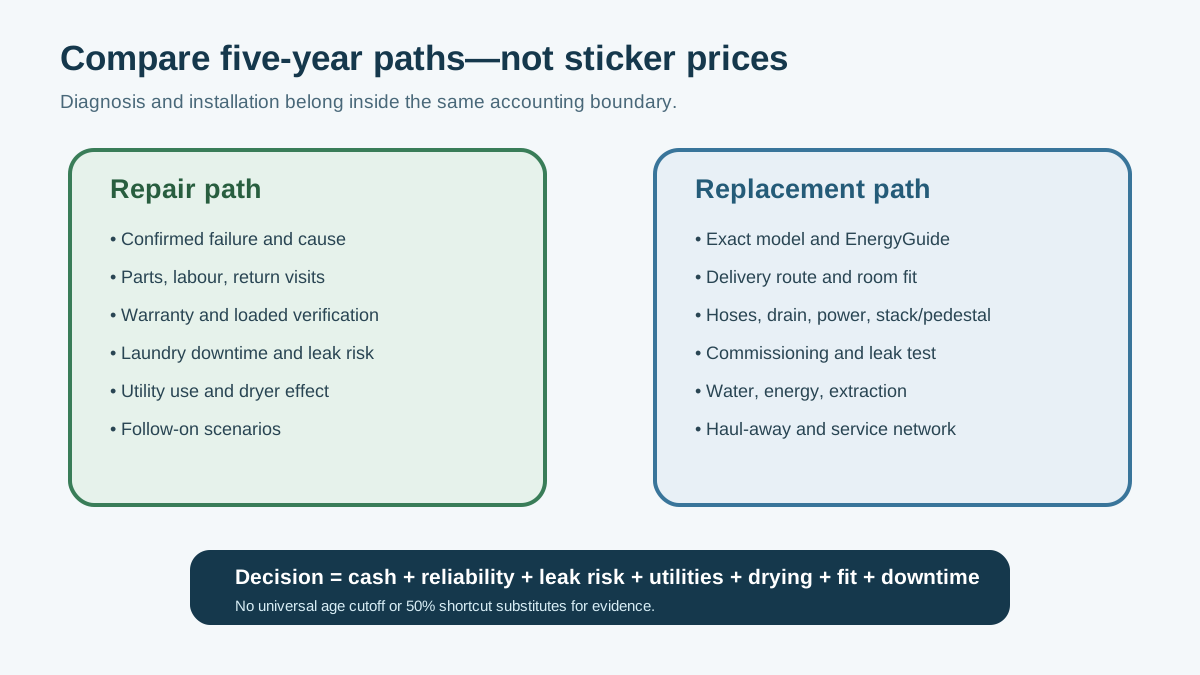
Short answer: Repair when the failed condition is confirmed, the tub/cabinet/door and hookups are sound, parts and qualified service are available, the written warranty transfers meaningful risk, and five-year repair-path value beats the fully installed replacement path. Replace when failure is repeated or broad, a tub/bearing/cabinet or control system creates high uncertainty, parts are unavailable, active leak or downtime risk is unacceptable, or a suitable exact new model produces enough water, energy, extraction, fit, and reliability value to justify the installed premium. Do not use appliance age or a “50% rule” alone.
A $450 repair and $900 washer are not separated by $450. Replacement can add delivery, stairs, door removal, stacking kit, pedestal, hoses, drain correction, electrical work, dryer compatibility, floor leveling, haul-away, tax, and downtime. Repair can add diagnosis, parts delay, second visit, laundry service, water damage, and repeat failure. Put both on one boundary.
Gate 1: Stop the Damage and Preserve Evidence
Do not make an economic decision while water is still escaping or the machine is electrically/mechanically unsafe. Close washer supplies when a pressurized leak is suspected and the valves can be operated safely. Stop use for smoke, burning odor, repeated trips, wet electrical parts, violent movement, or an official stop-use recall.
Photograph the error, leak path, drum, load, hoses, floor, model/serial, and installation. Save the error before resetting. If standing water remains, use the drain-and-spin diagnostic. If the floor is wet, use the leak-source cycle map.
Check warranty, retailer protection, credit-card benefit, service campaign, and recalls before paying. Search the exact model and serial in the manufacturer's official system and CPSC washing-machine recalls. A recall remedy can supersede ordinary repair economics.
Gate 2: Turn the Service Call Into a Scope
Ask the technician to state:
- observed failed condition and reproduction;
- tests that identify the part/system;
- root cause and connected components checked;
- part number, availability, and lead time;
- new, remanufactured, or substituted part status;
- full labor, materials, tax, travel, and return-visit price;
- possible additional cost and authorization boundary;
- parts and labor warranty;
- loaded cycle/leak/spin verification;
- other defects excluded from the quote.
“Needs a pump” is incomplete without evidence that settings, hose, standpipe, filter, level sensing, command, and wiring support that conclusion. “Needs bearings” should distinguish bearing noise/play from an unbalanced load, shipping bolt, suspension, foreign object, or loose installation.
Bounded versus system-level repair
A door strike, accessible hose, known valve, pump, sensor, or control can be a bounded repair when diagnosis and parts are clear. A cracked outer tub, failed tub bearing integrated into a large assembly, inaccessible wiring damage, corrosion, repeated control failures, or leak affecting multiple components may create broader uncertainty. Models differ; do not generalize a part price from a video.
Build the Repair Ledger
| Repair path item | Low | Expected | High |
|---|---|---|---|
| Diagnostic charge | |||
| Confirmed parts and labor | |||
| Second visit/shipping | |||
| Plumbing/electrical correction | |||
| Laundry service/time | |||
| Water/property drying | |||
| Plausible follow-on scenario | |||
| Total |
Avoid assigning invented probabilities. Use three transparent scenarios:
- Bounded success: quoted repair works through the horizon.
- Documented uncertainty: a connected component or delayed part adds the stated cost.
- Adverse but plausible: another major fault occurs; show consequence, not false precision.
Ask what the warranty covers if the original complaint returns. A part-only warranty may still leave diagnosis, labor, travel, and laundry costs with the owner.
Build the Fully Installed Replacement Ledger
| Replacement path item | Model A | Model B | Model C |
|---|---|---|---|
| Exact washer price | |||
| Tax and delivery | |||
| Access/stairs/door removal | |||
| Approved hoses/valves/drain work | |||
| Electrical correction | |||
| Pedestal/stacking/trim | |||
| Dryer compatibility or relocation | |||
| Old unit haul-away/recycling | |||
| Confirmed rebate | |||
| Installed total |
Confirm who connects supplies, inspects shutoffs, sets drain hose height/insertion, removes shipping bolts, levels feet, installs stacking hardware, runs calibration, tests for leaks, and completes a wash/drain/spin cycle. “Delivery included” may mean curbside only.
Treat rebates as zero until the official administrator confirms exact model, retailer, date, household/address, documents, and funding. Do not let a temporary sale force purchase before measuring fit.
Measure the Room and Route
Record:
- exterior door, hallway, stair, elevator, landing, and turn dimensions;
- washer body versus removable packaging/door projections;
- alcove width, depth, height, and service clearances;
- door swing and ability to remove laundry;
- supply valve, standpipe, drain, and receptacle locations;
- floor condition, slope, stiffness, and drain pan;
- pedestal or approved stacking kit compatibility;
- dryer door/vent/cord/gas or heat-pump clearance interactions;
- closet ventilation requirements;
- service access to pump filter or rear connections.
Do not reuse a stacking kit because bolt holes look close. Use the exact approved model combination. A deeper new washer can push a vented dryer hose into a restrictive bend or block a closet door. A high pedestal can place controls out of reach.
Compare Energy and Water With Standardized Data
The FTC explains that EnergyGuide annual cost is an estimate based on typical use and a national average energy price (FTC EnergyGuide). Use model kWh/year and water data where available, then apply local marginal rates and household cycle count.
ENERGY STAR clothes-washer criteria use Integrated Modified Energy Factor (IMEF) and Integrated Water Factor (IWF). Higher IMEF represents better combined energy performance; lower IWF represents lower water use per capacity under the test framework (ENERGY STAR criteria). Product Finder gives model-level comparison; it does not predict every custom cycle.
Address-specific annual comparison
Electricity difference = (old kWh/cycle − new kWh/cycle) × annual cycles × local $/kWh
Water/sewer difference = (old gallons/cycle − new gallons/cycle) × annual cycles × combined local $/gallon
Use credible old-model data or a safe representative measurement. Do not measure a washer through an underrated plug monitor, adapter, or extension cord. Utility water/sewer bills may use tiered units and fixed charges; marginal savings are not the total bill divided simplistically.
Worked example—not a savings promise
Assume:
- repair installed: $520;
- replacement installed: $1,350;
- replacement saves $35 electricity and $25 water/sewer per year;
- five-year horizon.
Five-year undiscounted utility advantage is ($35 + $25) × 5 = $300. Replacement still costs $530 more within the horizon before reliability, laundry downtime, repair scenarios, or residual value: $1,350 − $520 − $300 = $530. That gap may be justified by a failing tub, repeat leaks, inaccessible parts, better fit, or lower wet-clothes drying load—but not by claiming utility savings alone “pay for” the machine.
Include Dryer Energy and Time
Washer spin extraction changes how much water the dryer must remove. ENERGY STAR's IMEF framework accounts for remaining moisture in its energy metric, but household impact still depends on cycle/spin selection, textiles, load balance, and dryer type. Compare actual or standardized remaining-moisture performance where available.
If clothes leave the washer unusually wet, diagnose drainage/spin before blaming the dryer. Replacing a washer with stronger extraction may reduce dryer time, but quantify it from representative loads rather than a sales claim. The dryer slow-cycle diagnostic helps separate washer moisture from vent and dryer conditions.
Reliability, Service, and Downtime
Ask for service-network facts, not brand folklore:
- Who services the exact model at the address?
- What is the current appointment and part lead time?
- Which components have longer limited coverage?
- Does coverage include labor, travel, diagnosis, shipping, and removal from a stack?
- Is in-home service available?
- Are firmware/app requirements material to basic operation?
- Can common filters and service points be accessed in the installation?
New equipment can fail early; old equipment can run after repair. Use written warranty and local service availability to transfer uncertainty. Reviews may reveal questions to ask but do not establish failure rates without a representative dataset.
Households with cloth diapers, medical laundry, uniforms, large families, mobility needs, or no nearby laundromat may value downtime more. State that value rather than hiding it in a universal replacement threshold.
Create a Warranty Coverage Map
Marketing may highlight a long motor or tub warranty while leaving labour, travel, diagnosis, controls, seals, bearings, pumps, and removal from a stack uncovered. Put the terms side by side:
| Coverage | Current repair | Candidate factory warranty | Optional plan |
|---|---|---|---|
| Complete appliance parts | |||
| Labour and diagnosis | |||
| Motor/drive named parts | |||
| Tub/drum/bearing/seal | |||
| Control/electronics | |||
| Water damage/laundry benefit | |||
| Travel/stack removal | |||
| Deductible/claim cap | |||
| Local authorized servicer |
Read exclusions for corrosion, foreign objects, oversudsing, installation, commercial use, flood, moving damage, unauthorized repair, and consequential loss. Verify registration and proof-of-purchase requirements. Do not assign full replacement value to a parts-only promise.
Compare the Laundry Workflow, Not Just Capacity
Nominal cubic feet does not show usable household throughput. Build a one-week load inventory:
| Load | Weekly count | Typical dry mass | Required cycle/spin | Current wash time | Dryer impact |
|---|---|---|---|---|---|
| Everyday mixed | |||||
| Towels | |||||
| Bedding | |||||
| Delicates | |||||
| Bulky approved items | |||||
| High-soil/special care |
Ask whether a candidate can accept the actual load while leaving room for cleaning and balancing. Compare wash capacity with dryer capacity; an oversized washer that forces every load to be split for drying may reduce convenience and alter energy. Check cycle duration, final-spin options, delayed start, noise, and whether basic cycles work without an app.
For accessibility, test reach to the back of a top-load tub, front-load door height, control visibility, dispenser force, door swing, and transfer to the dryer. Price a compatible pedestal or side-by-side arrangement rather than assuming the old pedestal fits.
Worked Case A: Bounded Drain-Pump Repair
An eight-year-old washer has a confirmed failed pump. The standpipe, hoses, tub, bearings, drive, suspension, control, and wiring show no other fault. Repair is $410 installed with one-year parts/labour coverage. A comparable replacement is $1,180 fully installed and offers $45/year screened utility savings.
| Five-year item | Repair | Replace |
|---|---|---|
| Immediate/installed | $410 | $1,180 |
| Utility difference | $225 more | Baseline |
| Follow-on allowance | $200–$600 | $100–$350 |
| Downtime/leak allowance | $75–$250 | $50–$150 |
| Planning range | $910–$1,485 | $1,330–$1,680 |
Repair has the stronger base case; the ranges overlap. If bearing noise, corrosion, or a recurring leak is also documented, rebuild the range rather than hiding the new evidence.
Worked Case B: Structural Failure in a Stack
A twelve-year-old stacked front loader has a loud bearing, tub-seal leakage, drum play, and a $1,250–$1,750 repair range after unstacking. A compatible new washer, approved stacking kit, delivery, unstack/restack, hoses, tax, and haul-away total $1,620. It screens at $260 less utilities over five years and has local service.
Replacement is stronger because installed costs overlap while the structural repair remains uncertain. But if the new washer is not compatible with a healthy dryer, include the cost of changing the dryer or choose a compatible alternative. Never reuse a stack kit based only on appearance.
Price the Delivery and Utility Corrections Before Ordering
Request a written scope for stairs, elevator, long carry, door removal, floor protection, old-unit drainage, shutoffs, hoses, drain height/insertion, receptacle, circuit, pan, leak shutoff, pedestal/stack, calibration, test cycle, and haul-away.
Photograph the route and measure the narrowest door, turn, closet, and installed depth including hoses. Confirm who pays if a shutoff leaks when operated, the standpipe fails the test, the machine cannot level on the floor, or the unit is damaged during delivery. A low online price is not comparable with a complete installed repair until these lines are included.
Front Load, Top Load, and Combo Are Not One Decision
Front-load washer
Often offers strong extraction and stackability, but requires door swing, gasket care, low access, floor stability, and correct detergent/drying habits. Check pump-filter access.
Top-load washer
Requires overhead clearance and reach into the tub. Agitator/impeller designs, load geometry, deep-fill options, and spin behavior differ. Do not compare nominal capacity alone.
All-in-one washer-dryer
Combines space functions but can change cycle time, load transfer, drying technology, electrical/vent/drain needs, and service concentration. A failure can remove both washing and drying. Compare exact wash and dry capacity and performance separately.
Compact washer
May need a matching dryer, nonstandard stacking kit, different supply, or specialized service. Verify voltage, receptacle, drainage, and route.
Keep, Repair, Replace, or Retire?
Four legitimate outcomes exist:
- Keep/monitor: no confirmed fault, safe operation, and verified performance.
- Repair: bounded warranted scope creates good remaining value.
- Replace: installed new value and risk reduction justify the premium.
- Retire without replacement: a second/unused washer or changed household no longer needs capacity.
Do not sell a known unsafe, recalled, leaking, or misrepresented appliance. Use a responsible local reuse/recycling channel and secure the machine during storage/transport. Ask the retailer or municipality what actually happens to the unit rather than assuming “haul-away” means recycling.
Commission the Replacement
Before final acceptance:
- verify exact model/serial and visible damage;
- confirm shipping restraints removed and retained/disposed per instructions;
- inspect hot/cold valve operation and approved hoses;
- verify drain height, insertion, restraint, and no airtight improvised seal;
- verify dedicated power requirements without adapters;
- level and lock feet on the final floor;
- confirm approved stack/pedestal hardware;
- run calibration/installation cycle if specified;
- observe fill connections, dispenser, door/lid, drain, standpipe, and spin;
- check for leaks again after pushing into position;
- register warranty and save EnergyGuide/manual/receipt.
Run a representative load before disposing of all packaging or signing away damage claims if retailer terms allow. Document vibration, sound, leaks, cycle completion, and moisture extraction.
Original Five-Year Decision Scorecard
| Factor | Repair | Replace | Evidence |
|---|---|---|---|
| Diagnostic certainty | |||
| Written parts/labor coverage | |||
| Leak/property risk | |||
| Service/parts lead time | |||
| Five-year cash | |||
| Electricity/water | |||
| Dryer impact | |||
| Fit/accessibility | |||
| Household downtime | |||
| Responsible end-of-life |
Score 0–3 but explain each score. Do not mechanically select the total; it reveals the tradeoff and missing evidence.
Write a Replacement Performance Specification
Do not shop by brand and capacity alone. Define minimum needs:
- permitted largest/most difficult loads;
- annual cycle estimate;
- front/top/compact/combo format;
- opening and route dimensions;
- door/lid reach and accessibility;
- stack/pedestal compatibility;
- hot/cold supply and drain arrangement;
- voltage/receptacle and connected load;
- maximum depth with hoses and door closed/open;
- pump-filter/service access;
- cycle temperature, allergen/sanitize claims and required certifications if relevant;
- spin/extraction choices;
- EnergyGuide kWh and model water data;
- local service and parts;
- noise/vibration sensitivity;
- warranty terms that name labor and major components.
Then compare only models that satisfy the specification. A large tub is not useful if the household's bedding is prohibited or the machine cannot be delivered through the stair. A low-water test rating does not prove one specialty cycle meets every preference.
Used, Open-Box, and Refurbished Washers
The purchase discount must cover added uncertainty. Request:
- complete model/serial and manufacture history if available;
- recall check;
- reason for return/refurbishment;
- repair and parts record;
- leak, drain, lock, balance, and loaded-spin test;
- shipping-bolt/transport history;
- visible tub, gasket, dispenser, hose, cabinet, and corrosion condition;
- warranty, return, delivery, and installation terms;
- EnergyGuide/model data;
- confirmation that stacking hardware and manuals are exact.
Never transport a front loader without the required shipping restraints. Do not buy a machine that cannot be safely tested or returned merely because it powers on. Lights and tumbling do not prove fill, heat, drain, balance, and leak performance.
Financing and Extended Coverage
Compare cash price with total financed cost, including interest, fees, deferred-interest conditions, and add-ons. A monthly payment can hide a poor replacement decision. Do not count a rebate before approval.
For extended coverage, read:
- start date and overlap with manufacturer warranty;
- covered parts/labor/travel/removal from stack;
- service fee and claim limit;
- exclusions for hoses, valves, drain, installation, rust, mold, cosmetic damage, misuse, and consequential water loss;
- replacement/depreciation terms;
- food/laundry or rental benefit;
- cancellation and provider solvency/service network.
Coverage is risk transfer, not proof the product is reliable. Compare premium with the household's ability to self-insure and the quality of local service.
Water-Heating Energy Can Dominate Some Wash Habits
The washer label and test method incorporate defined cycles, but household temperature selection changes energy. A family using frequent hot/sanitize cycles may have different water-heating cost than one using cold cycles. Calculate:
Water heating energy ≈ gallons of hot water × temperature rise × conversion factor / heater efficiency or COP
Do not estimate without knowing cycle hot-water volume and incoming/setpoint temperatures. A heat-pump water heater, gas heater, electric resistance tank, or district system changes cost. Compare models and behavior, not a generic “cold wash saves X dollars” claim.
Fabric care and hygiene may require particular temperatures or cycles. Follow textile labels and public-health/medical guidance; do not reduce temperature solely for an energy target when it conflicts with required cleaning.
The Washer Can Trigger Other Project Costs
Replacement may expose:
- seized or leaking shutoff valves;
- corroded supply box;
- noncompliant drain/standpipe;
- ungrounded/damaged receptacle;
- weak or sloped floor;
- dryer vent crushed by new depth;
- unavailable stacking kit;
- cabinet/door conflict;
- pan/drain that blocks leveling;
- inaccessible filter after installation.
Price these before delivery. A qualified plumber/electrician/carpenter may be needed. Do not let a delivery crew improvise building changes outside their scope.
Compare Environmental Claims Carefully
A more efficient washer can reduce operating water and energy, while keeping a repairable machine avoids near-term manufacturing and disposal. The better environmental result depends on the actual repair, remaining life, old/new operation, household use, and end-of-life path. Do not claim replacement is automatically greener from the ENERGY STAR logo alone.
Ask the recycler or retailer whether the old washer is reused, refurbished, dismantled for metal/plastic/electronics, or disposed. Remove personal connected-app data and accounts before transfer. Secure doors/lids and prevent unsafe child access during temporary storage.
Thirty-Day Acceptance Log
| Check | Delivery | Week 1 | Week 4 |
|---|---|---|---|
| Fill connections dry | |||
| Door/lid and dispenser dry | |||
| Standpipe handles discharge | |||
| Normal load balances/spins | |||
| Bulky permitted load completes | |||
| Laundry moisture acceptable | |||
| Error/alert history | |||
| Controls/accessibility workable |
Use the retailer and manufacturer reporting windows. Preserve video and timestamps for intermittent vibration or leakage. Do not normalize a defect until the return period expires.
Decision Memo: Record Why the Choice Won
Write one paragraph before authorizing work:
We chose repair/replacement because the confirmed failure was ___; five-year expected cash was ___ versus ___; the written warranty covers ___; the largest unresolved risk is ___; and we will verify success by ___.
Attach the two quotes, model data, measurements, recall search, and scorecard. This small memo prevents a sales deadline or sunk diagnostic fee from replacing the evidence. It also gives another household member a clear basis for reviewing the decision.
If neither path is acceptable—parts unavailable, replacement will not fit, or the laundry area needs building work—use a temporary laundromat or approved portable arrangement rather than installing unsafe adapters, drain extensions, or unrestrained hoses. Expand the project scope explicitly and obtain the appropriate trade quote.
Set a review date for any deferred decision. Recheck for leakage, error codes, cycle completion, vibration, hose condition, and changing repair availability. Monitoring is a valid outcome only when the washer remains safe and the household has defined evidence that would trigger service or replacement.
Frequently Asked Questions
Is a 10-year-old washer automatically worth replacing?
No. Age helps frame remaining uncertainty but does not replace diagnosis, condition, installed replacement cost, energy/water data, service access, and household risk.
Should I replace when repair exceeds half the new price?
Not automatically. That shortcut ignores delivery, hookups, fit, water damage, warranty, energy/water, dryer impact, and the quality of the diagnosis. Compare full five-year paths.
Does ENERGY STAR guarantee lower bills?
Certification confirms program efficiency criteria, not a household dollar amount. Use model data, local marginal rates, cycle count, and comparable capacity/features. See ENERGY STAR washer criteria.
Is the EnergyGuide annual cost what I will pay?
It is a standardized estimate using assumed use and a national average energy price. The FTC explains why actual cost differs (FTC EnergyGuide).
Should I replace a washer with a leaking tub?
Obtain model-specific evidence, assembly/part price, collateral condition, warranty, and post-repair leak test. A bounded tub component under coverage can differ from a costly integrated assembly with corrosion or repeated leakage.
Should dryer savings count?
Yes, when supported by extraction/moisture evidence for representative loads. Do not claim a fixed dryer saving solely from washer type.
Where do I check recalls?
Search the exact model and serial with the manufacturer and CPSC washing-machine recall category, then follow the official remedy.
What to Read Next
Diagnose standing water and wet loads with the washer drain-and-spin guide. Trace water using the washer leak-source map. Resolve residue before condemning the appliance with the front-load washer odor guide. Check the downstream moisture path with the dryer two-cycle guide.
Sources and Verification
Efficiency and model claims use ENERGY STAR clothes-washer guidance, key criteria, and the Product Finder. EnergyGuide interpretation comes from the FTC. Recall status must be checked through CPSC and the manufacturer. Exact diagnosis, quotes, local water/energy rates, warranty, installation instructions, and recycling rules control the household decision.
Sources and Verification
Editorial Review
EnergyBS Editorial Team
EnergyBS publishes practical homeowner guides. Important program, product, and cost claims should be checked against the linked source and local project documents before you commit to work.
Related Guides
View All ArticlesWashing Machine Won't Drain or Spin? Separate the Water Path From the Spin Problem
A safe, modelspecific diagnostic for standing water, soaked clothes, drain errors, and nospin complaints that separates cycle, load, suds, hose, standpipe, filter, pump, door/lid, balance, and drive evidence.
Washing Machine Leaking Water? Map Fill, Wash, Drain, and Idle Timing
Trace a washer leak by first wet point and cycle timing to separate household valves and drains, inlet hoses, dispensers and suds, door/gasket paths, pump filters, drain hoses, internal components, and overspray or spills.
FrontLoad Washer Smells Musty? Remove Residue and Moisture Without Mixing Cleaners
A modelspecific frontload washer odor plan covering retained laundry and moisture, detergent dosing, gasket and dispenser cleaning, pumpfilter and drain checks, tubclean cycles, chemical safety, ventilation, recurrence tracking, and service escalation.