Insulation Payback by Climate: A Homeowner's Savings and Quote Worksheet
A climateaware method for estimating attic and envelope insulation payback without applying a generic savings percentage to the entire utility bill.
The Short Answer
Short Answer: Insulation payback equals net project cost divided by annual heating-and-cooling savings, but the savings rate should apply only to the energy affected by the project—not the entire utility bill. Estimate the current envelope loss, climate exposure, heating and cooling share, equipment efficiency, air leakage, and diminishing return from added R-value. Model a low, expected, and high case. Air-seal before insulating, and treat comfort or moisture repairs separately from energy payback.
ENERGY STAR estimates that a package of air sealing plus insulation in attics, floors over crawlspaces, and accessible basement rim joists can save an average of 15% on heating and cooling costs, or about 11% of total household energy costs, for modeled typical U.S. homes. That is a useful benchmark for a package, not a promise that every attic top-up saves 15% of every bill.
This worksheet turns a quote into a range you can inspect.
Define the Project Before Calculating Payback
“Add insulation” is not a complete scope. Record:
- assembly: attic floor, roof deck, wall, basement wall, rim joist, crawlspace, or floor;
- existing material, depth, condition, and effective R-value;
- target R-value and insulation type;
- air-sealing details;
- ventilation changes;
- moisture, pest, electrical, and combustion corrections;
- square footage actually treated;
- inaccessible or excluded areas;
- gross cost, verified incentive, and net homeowner cost.
Attic insulation over a nearly bare ceiling is a different investment from adding R-11 over a well-installed R-49 assembly. The attic top-up versus removal guide shows how to preserve clean material while still exposing air leaks. Dense-packing an empty wall differs from exterior continuous insulation installed during an already-planned siding replacement. Payback belongs to the incremental energy scope.
Use the R-value heat-flow worksheet to calculate the marginal conductive reduction before applying local climate, equipment efficiency, and energy prices.
The Payback Formula
Simple payback = net project cost ÷ expected annual savings
If a $4,800 project receives a verified $800 rebate and is expected to save $400 per year:
($4,800 − $800) ÷ $400 = 10 years
Simple payback ignores financing, energy-price changes, maintenance, resale, and the time value of money. It is still useful when the assumptions are visible.
For a range:
| Case | Net cost | Annual savings | Simple payback |
|---|---|---|---|
| Low savings | $4,000 | $240 | 16.7 years |
| Expected | $4,000 | $400 | 10.0 years |
| High savings | $4,000 | $600 | 6.7 years |
Do not choose the high case because it produces an attractive answer. Tie each case to a stated leakage, insulation, climate, and energy-cost assumption.
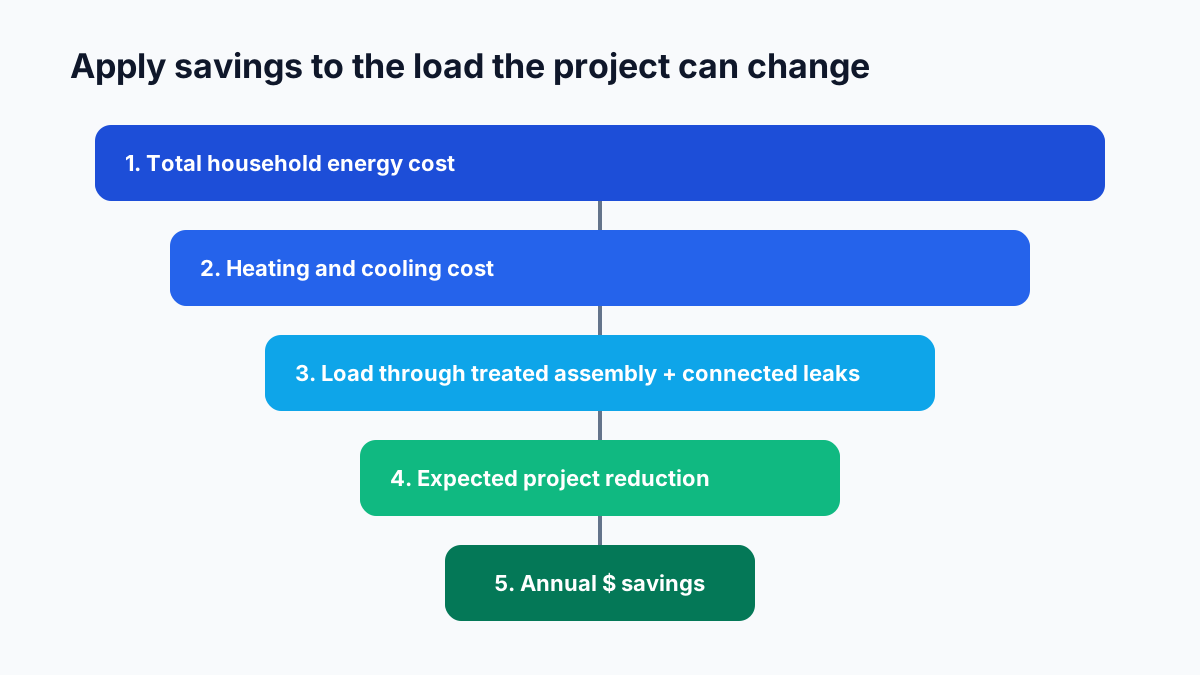
The Savings Waterfall
The calculation should move through five filters:
- Total household energy cost across electricity and fuels.
- Heating and cooling portion affected by the enclosure.
- Share of that load through the treated assembly and connected air leaks.
- Reduction the project can plausibly achieve.
- Delivered energy and dollar value after equipment efficiency and rates.
Applying 15% directly to a $4,000 total energy bill gives $600. But if only $2,000 is space conditioning and the project is a limited attic top-up in an already reasonable attic, $600 may be implausible. Conversely, an uninsulated, leaky attic in a severe climate may justify a larger estimate.
A Calculation Framework That Avoids False Precision
Use this screening equation:
Annual savings ≈ annual heating-and-cooling cost × affected-load share × project-reduction share
Example:
- annual heating and cooling cost: $2,400;
- estimated share associated with attic conduction and attic-connected leakage: 30%;
- modeled reduction in that share after sealing and insulation: 35%.
$2,400 × 0.30 × 0.35 = $252 per year
This is not a building simulation. It forces the estimate to name the two uncertain shares. Use an audit or energy model to improve them.
Create ranges:
| Input | Low | Expected | High |
|---|---|---|---|
| Heating and cooling cost | $2,100 | $2,400 | $2,700 |
| Attic-related share | 20% | 30% | 40% |
| Reduction after work | 20% | 35% | 45% |
| Annual savings | $84 | $252 | $486 |
The spread reveals whether the project is an obvious financial win or depends on optimistic assumptions.
Climate Changes Both Load and Priority
ENERGY STAR publishes recommended insulation levels by climate because cost-effective targets differ. Climate also changes whether heating, cooling, humidity, ice dams, or solar gain dominates.
Hot-humid climates
Attic heat gain and cooling runtime matter, but moisture control is inseparable from the assembly. Air leakage can carry humid outdoor air into cavities. Ducts in a vented attic can increase the value of attic and duct improvements. Vapor control must follow the local assembly, not cold-climate intuition.
Hot-dry climates
Large daily temperature swings and solar-loaded roofs can create strong attic gains. Air sealing, attic insulation, cool-roof strategy, shading, and night ventilation may compete for budget. Savings depend on cooling equipment and rate structure.
Mixed climates
Both heating and cooling contribute. Air sealing often improves comfort across seasons. Assemblies must manage inward and outward vapor drives at different times.
Cold and very cold climates
Heating dominates. Attic bypasses can move warm, moist air into cold roof assemblies, contributing to condensation and ice dams. High insulation targets may be cost-effective, but adding depth without sealing bypasses can preserve the main failure.
Marine climates
Moderate temperatures can lengthen simple payback even when comfort improves. Moisture durability, air sealing, and targeted weak assemblies may matter more than maximum R-value everywhere.
Climate zone is a starting point. Elevation, wind, shade, orientation, local design temperatures, fuel prices, and occupant schedules refine it.
Why R-Value Has Diminishing Returns
For a simple one-dimensional assembly, heat flow is inversely related to total thermal resistance. Moving from R-5 to R-10 cuts the modeled conductive heat flow through that layer in half. Moving from R-40 to R-45 produces a much smaller reduction.
Illustrative relative conduction:
| Starting R | Ending R | Relative heat-flow reduction through that layer |
|---|---|---|
| R-5 | R-10 | 50% |
| R-10 | R-20 | 50% |
| R-20 | R-40 | 50% |
| R-40 | R-50 | 20% |
This simplified table does not include framing, air leakage, thermal bridges, installation defects, surface films, or moisture. It demonstrates why “add R-10” has no fixed savings value.
The R-value diminishing-returns guide explains the physics in more detail.
Effective R-Value Versus Bag Count
Insulation performs as installed. Common losses include:
- batts cut poorly around wiring and plumbing;
- gaps at framing transitions;
- blown insulation displaced by wind washing;
- compressed fiberglass;
- settled or uneven material;
- missing insulation above exterior top plates;
- thermal bridging through studs and joists;
- wet material;
- open attic bypasses;
- recessed lights or heat-producing equipment lacking safe clearances.
A quote based only on bags or nominal inches can miss these details. Ask for target settled depth, coverage, material data, density where relevant, baffles, dams, rulers, and photo documentation.
ENERGY STAR's R-value recommendations are assembly targets, not permission to ignore installation quality.
Air Sealing Comes First
Insulation slows conduction. Air sealing limits uncontrolled air movement. Fibrous insulation generally does not stop air by itself.
Attic air-sealing targets can include:
- plumbing and wiring penetrations;
- top plates and partition transitions;
- attic hatches and pull-down stairs;
- dropped soffits and chases;
- duct boots and registers;
- flue and chimney transitions using code-appropriate materials;
- recessed fixtures according to their rating;
- balloon-framed wall openings.
Safety and durability govern. Combustion venting, electrical heat, fire blocking, and ventilation paths require qualified treatment. Do not bury a hazard beneath new insulation.
ENERGY STAR identifies attic sealing and insulation as a combined home-upgrade measure. The air-sealing physics guide helps identify why a high-R attic can still perform badly.
Worked Example 1: Underinsulated Cold-Climate Attic
Hypothetical house:
- 1,600 square feet of attic floor;
- patchy R-12 equivalent;
- visible bypasses at chases and top plates;
- annual space-heating and cooling cost: $2,800;
- mostly heating-dominated;
- scope: hazard review, air sealing, ventilation baffles, and added cellulose to the locally appropriate target;
- gross cost: $5,800;
- verified rebate: $1,000;
- net cost: $4,800.
An audit estimates the attic package can reduce space-conditioning cost by 12% to 22%. That is $336 to $616 per year.
- low-case payback: $4,800 ÷ $336 = 14.3 years;
- central case at $476: 10.1 years;
- high-case payback: $4,800 ÷ $616 = 7.8 years.
Comfort, ice-dam risk, and equipment downsizing may add value but should not be converted into invented dollar savings. If a heat-pump replacement is planned, complete the envelope work before final sizing.
Worked Example 2: Topping Up an Already Good Attic
Hypothetical house:
- 1,600 square feet;
- uniform R-45 with good air sealing;
- annual space-conditioning cost: $1,600;
- proposal: add material to R-60 for $3,200 net.
If the modeled whole heating-and-cooling reduction is only 2% to 4%, annual savings are $32 to $64. Simple payback is 50 to 100 years.
The project may still be chosen for a code requirement, a disturbed area, or a specific comfort issue. But a sales claim based on the average package savings would be misleading. The next dollar may be better spent on ducts, shading, controls, or another weak assembly.
Worked Example 3: Exterior Insulation During Re-Siding
Suppose exterior continuous insulation would cost $18,000 as a standalone project, but the siding already needs replacement. The incremental efficiency cost for insulation, detailing, window transitions, and added labor is $7,500.
Use $7,500—not the entire siding contract—as the energy-payback numerator, provided the base siding scope is genuinely required. Then model:
- reduction in wall conduction and thermal bridging;
- air-control improvements from the new layer;
- climate and heating/cooling costs;
- moisture design and drying potential;
- window, door, roof, and foundation transitions.
Incremental-cost analysis often makes bundled retrofits more rational than stand-alone demolition.
Heating-System Efficiency Changes Dollar Savings
Insulation reduces delivered heat required by the house. The fuel savings needed to provide that heat depend on equipment.
If a project saves 3,000 kWh of delivered heat:
- resistance heat at COP 1 avoids about 3,000 kWh of electricity;
- a heat pump at seasonal COP 3 avoids about 1,000 kWh;
- a 95% furnace avoids about 3,158 kWh of gas input, roughly 108 therms.
The efficient heat pump already supplies heat with less purchased energy, so the dollar payback from insulation can be longer at the same delivered-load reduction. That does not make insulation useless. It can reduce peak capacity, backup heat, drafts, noise, and resilience needs.
Coordinate the envelope model with the heat-pump sizing guide rather than calculating them as independent projects.
Cooling Savings Need Sensible and Latent Context
Insulation primarily limits conductive heat flow. Air sealing can reduce sensible and moisture loads, but tighter homes may need intentional ventilation and humidity control.
In hot-humid climates, an attic project can reduce cooling runtime while poor duct leakage in the same attic continues to waste energy. In dry climates, shading and nighttime ventilation may offer better marginal savings. In mild climates, comfort improvement can exceed bill impact.
Ask whether the audit separates:
- roof and ceiling conduction;
- solar gain;
- infiltration;
- duct loss;
- window gain;
- internal loads;
- latent moisture load.
The cause determines the remedy.
Compare Quotes on Scope, Not R-Value Alone
| Quote item | Why it matters |
|---|---|
| Existing condition and measured depths | Establishes the baseline |
| Treated square footage | Prevents ambiguous allowances |
| Air-sealing locations and materials | Identifies the control layer |
| Target settled R-value/depth | Makes result verifiable |
| Ventilation baffles and wind control | Protects roof and material performance |
| Attic hatch treatment | Closes a common weak point |
| Recessed light, flue, and wiring plan | Addresses fire/electrical safety |
| Moisture or roof-leak exclusions | Prevents burying damage |
| Bath and kitchen exhaust routing | Keeps moisture out of attic |
| Combustion-safety process | Protects atmospherically vented appliances |
| Pre/post photos and depth markers | Documents completion |
| Rebate responsibilities | Avoids eligibility assumptions |
The lowest price may omit the diagnostic and detailing work that creates the savings.
Incentives and Net Cost
Programs vary by country, state, province, municipality, utility, income, property type, audit result, and installation date. Verify before work begins:
- whether a pre-audit or pre-approval is required;
- eligible materials and contractors;
- minimum existing and target levels;
- income or modeled-savings tiers;
- required invoices, photos, and certificates;
- whether rebates can be stacked;
- whether funding is reserved or subject to availability.
Do not reduce the payback numerator until eligibility is documented. A marketing estimate is not an awarded rebate.
Comfort, Durability, and Resale Without Double Counting
Insulation projects can reduce surface-temperature differences, drafts, noise, ice dams, frozen-pipe exposure, and room-to-room imbalance. They may improve a future buyer's confidence when documentation is strong. These benefits are real but hard to monetize generically.
Keep a project record with:
- audit report;
- before and after photos;
- material and safety data;
- invoices and proof of payment;
- permits if required;
- rebate approval;
- insulation depth and coverage;
- blower-door results if used;
- ventilation changes;
- energy use before and after, normalized for weather.
For property-market context, use BubbleWatch's documented home-value analysis only after confirming the upgrade, not as a guaranteed appraisal premium.
Post-Project Measurement
Compare energy units, not only dollars. Rates change.
- Save 12 to 24 months of pre-work electricity and fuel use.
- Record work completion date and thermostat changes.
- Compare heating and cooling seasons using degree days when possible.
- Separate other changes such as a new EV, hot tub, occupancy, or HVAC system.
- Use a blower-door retest when air sealing was a defined objective.
- Investigate moisture or ventilation effects after tightening.
One mild winter cannot prove the annual estimate. Treat the payback as a model that improves with measured data.
Decision Scorecard
- The assembly is clearly weak, damaged, or below a locally appropriate target.
- Air leakage and moisture paths were assessed.
- The net cost uses only verified incentives.
- Savings apply to heating and cooling, not blindly to the whole bill.
- Low, central, and high cases are shown.
- Existing and target effective R-values are documented.
- Installation defects, thermal bridges, and access are considered.
- Safety, ventilation, and combustion issues are in scope.
- The project is coordinated with planned HVAC or roofing/siding work.
- Non-energy benefits are described without inventing dollar values.
- Post-work verification is included.
Rank Assemblies Before Spending
A whole-house audit often finds several plausible projects. Compare them with a constraint-first matrix rather than sorting only by advertised R-value.
| Evidence | Likely priority question |
|---|---|
| Bare or patchy attic plus visible bypasses | Can safe attic sealing and insulation address the largest accessible loss? |
| Adequate attic but cold floors over crawlspace | Is the floor, crawlspace wall, rim joist, or moisture condition the real boundary problem? |
| One cold room beside an exterior wall | Is insulation missing, or is airflow, duct delivery, window exposure, or wind washing responsible? |
| High bills with even comfort | Are rates, equipment efficiency, controls, or duct losses stronger opportunities? |
| Ice dams | Are attic heat leaks, roof geometry, ventilation, snow, and weather being diagnosed together? |
| Basement odor or humidity | Must drainage and moisture sources be corrected before insulation? |
| Siding or roofing already due | Can insulation be added at lower incremental cost while layers are open? |
Prioritize work that fixes a measured weak point, can be detailed safely, and coordinates with an already-needed project. A long payback does not automatically reject a durability repair; it means energy savings should not be the sole sales argument.
Account for Project Life and Financing
Simple payback can mislead when two scopes have different service lives or financing.
For a fuller comparison, record:
- expected useful life of the installed assembly and finishes;
- loan interest, fees, and term;
- whether interest applies to the whole renovation or only efficiency increment;
- replacement or maintenance expectations;
- energy-price sensitivity rather than one escalation forecast;
- planned ownership period;
- residual value without assuming a guaranteed resale premium.
An insulation layer may last decades if it remains dry and undisturbed, while air-sealing joints, mechanical penetrations, roof work, or pest damage may require future attention. Ask what the installer warrants: material, settled depth, workmanship, air-leakage result, or only product defects.
If financing a $4,000 net project at a real borrowing cost, the economic cost exceeds $4,000. A zero-interest program can improve cash flow but does not change weak technical scope. Compare monthly payment with conservative monthly savings, and do not claim “cash-flow positive” from the most optimistic case.
A Measurement Plan for Comfort
Energy is not the only reason to insulate, but comfort should still be measured. Before work, record indoor air temperature, relative humidity, and representative surface temperatures in problem rooms during relevant weather. Note drafts, floor temperature, snow melt or ice patterns, and HVAC runtime.
After work, repeat observations under comparable conditions. Improvement in ceiling or wall surface temperature can reduce radiant discomfort even when thermostat air temperature is unchanged. A smaller upstairs-downstairs difference can be valuable without creating a precise dollar value.
If comfort does not improve, investigate whether the project treated the wrong assembly, left gaps, altered pressure, or exposed a duct or airflow problem. Documentation turns a vague complaint into a warranty conversation.
Special Cases That Need Wider Scope
Finished attics and cathedral roofs
These assemblies have limited depth and complex air, vapor, ventilation, and roof-deck conditions. Adding insulation from inside or outside can change drying potential. Use a design appropriate to the climate and existing roof.
Knob-and-tube wiring or heat-producing fixtures
Older wiring, recessed lights, chimneys, flues, and exhausts can constrain insulation placement. Obtain qualified electrical or fire-safety review rather than covering unknown conditions.
Wet, moldy, or pest-damaged material
Correct the source and define safe remediation before adding insulation. New material over a leak does not create durability.
Masonry and historic walls
Insulating old solid masonry can alter freeze-thaw and drying behavior. Heritage details and rain exposure matter. Generic cavity-fill advice can cause damage.
Multifamily and attached homes
Ownership boundaries, fire separations, shared ventilation, party walls, and access require coordination. Model the actual unit and common systems rather than applying a detached-house percentage.
Frequently Asked Questions
How long does attic insulation take to pay back?
It can range from a few years to several decades. The fastest cases usually start with little insulation, substantial leakage, high heating or cooling costs, and a well-priced combined scope. A top-up over a good attic can have a very long energy payback.
Can I use ENERGY STAR's 15% estimate for my quote?
Use it as a benchmark for a modeled package of air sealing and insulation in typical U.S. homes, not a guaranteed attic-only result. Compare your assembly, climate, and audit estimate with the published methodology.
Is more R-value always worth it?
No. Heat-flow reduction has diminishing returns. Reach the locally appropriate assembly target and correct gaps, air leakage, thermal bridges, and moisture before buying extreme depth.
Should I air-seal before adding attic insulation?
Usually yes. New insulation can hide leakage locations and does not automatically stop air movement. Fire, combustion, ventilation, and electrical details require proper materials and expertise.
Do new windows beat insulation on payback?
Not usually when the comparison is energy savings alone, especially if the attic is poorly insulated. Windows may be chosen for comfort, water damage, operation, noise, or appearance. Diagnose the weakest assembly first.
Does insulation increase home value?
It can improve marketability and documented operating performance, but no universal appraisal premium applies. Keep records and avoid counting both full energy payback and an assumed resale premium without evidence.
How should renters evaluate insulation?
Renters should report defects and discuss improvements with the owner. Do not alter assemblies without permission. Portable shading, safe weatherstripping, thermostat practices, and utility programs may be more accessible.
What to Read Next
Compare materials with the insulation types and R-value guide, then understand R-value diminishing returns. Use the air-sealing physics guide before covering attic bypasses, and document the baseline with the home energy audit guide.
Sources and Method
The savings benchmark and climate targets come from current ENERGY STAR seal-and-insulate methodology and recommended R-value guidance. DOE material supports the role of insulation and air sealing in reducing heating and cooling waste. Worked examples are scenarios, not quotes; update them with current local rates, climate, measured conditions, and professional project modeling.
Sources and Verification
Editorial Review
EnergyBS Editorial Team
EnergyBS publishes practical homeowner guides. Important program, product, and cost claims should be checked against the linked source and local project documents before you commit to work.
Related Guides
View All ArticlesInsulation Types Compared: RValue, Air and Moisture Control, Installation, and Retrofit Fit
Compare fiberglass, cellulose, mineral wool, spray foam, and rigid insulation by tested Rvalue, installed quality, air and moisture role, fire and health constraints, assembly location, serviceability, and verified project cost.
How Much Insulation Is Enough? RValue, Heat Loss, and Diminishing Returns
Choose an insulation target from climate guidance, existing wholeassembly performance, air leakage, moisture risk, installation access, and the marginal cost of each added Rvalue.
The Physics of Air Sealing: Why Your RValue Doesn't Matter (If You Don't Seal)
Insulation is just a sweater. Air sealing is the windbreaker. We explain the physics of the Stack Effect, why Rvalues lie, and how to stop your home from leaking energy like a sieve.