Radiant Barrier Installation Cost 2026: Attic Prices and Payback
Professional radiant barrier installation costs $710 to $2,840 in Angi's 2026 data, and HomeGuide puts the national average at $1,600, at $0.30 to $2.00 per square foot installed. Foil is the cheap material in the attic: onesided foil runs $0.10 to $0.50 per square foot and twosided foil $0.50 to $0.90 (Angi, materials only), while labor at $0.60 to $1.00 per square foot is roughly half the finished price. What the barrier buys is narrower than the sales pitch: the U.S. Department of Energy credits radiant barriers with 5% to 10% lower cooling costs in warm, sunny climates, and says plainly that in cool climates more thermal insulation is usually the better buy. This guide prices the job by attic size and by material, explains where the foil has to go to work at all, and does the payback math honestly, including the cases where it does not pay.
Quick Checks
- 1Budget $710 to $2,840 for professional installation (Angi 2026). HomeGuide's national average is $1,600, at $0.30 to $2.00 per square foot installed.
- 2The foil itself is cheap: one-sided foil is $0.10 to $0.50 per square foot and two-sided foil $0.50 to $0.90, materials only (Angi). Labor at $0.60 to $1.00 per square foot is about half the finished price.
- 3The U.S. Department of Energy credits radiant barriers with 5% to 10% lower cooling costs in warm, sunny climates, and the biggest gains when air ducts sit in the attic.
- 4Placement decides whether it works: the reflective face needs an air space (DOE), stapled under the rafters with at least a 1-inch droop. DOE strongly recommends against laying it on top of attic floor insulation, where dust and trapped moisture undo it.
- 5In cool climates, including most of Canada, DOE says more thermal insulation is usually the better buy. A radiant barrier has no R-value and is not a substitute for insulation (HomeGuide).
Radiant Barrier Installation Cost 2026: Attic Prices and Payback
By EnergyBS Editorial Team | October 21, 2026
The Short Answer
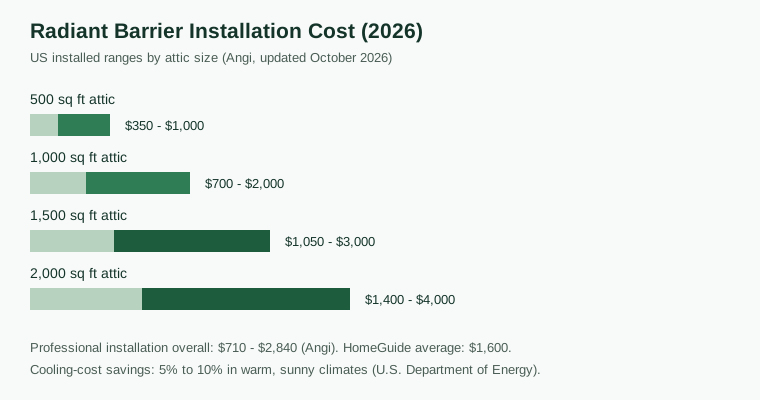
Short Answer: Professional radiant barrier installation costs $710 to $2,840 in the US in 2026 (Angi, updated October 2026), and HomeGuide puts the national average at $1,600, within an average range of $350 to $2,700 at $0.30 to $2.00 per square foot installed. By attic size, Angi's table runs from $350 to $1,000 for 500 square feet to $1,400 to $4,000 for 2,000 square feet. The material is the minor cost: one-sided foil is $0.10 to $0.50 per square foot and two-sided foil $0.50 to $0.90 (Angi, materials only), while installer labor at $0.60 to $1.00 per square foot accounts for roughly half the finished price. What the money buys is specific and limited. The U.S. Department of Energy (DOE) credits radiant barriers with 5% to 10% lower cooling costs in warm, sunny climates, with the strongest case when cooling ducts run through the attic, and states that in cool climates it is usually more cost-effective to add thermal insulation instead.
The job in six steps:
- Measure the attic and decide the placement: stapled under the rafters is the standard retrofit; foil-faced roof sheathing belongs to a reroof or new build.
- Check the existing insulation first. If the attic floor is under-insulated, that job comes before this one, because a radiant barrier has no R-value.
- Pick the material: one-sided foil, two-sided foil, or a spray coating, knowing the spray is the weaker product (section 3).
- Confirm ventilation at the eaves and ridge stays open; the barrier must not block soffit airflow.
- Install with the reflective face toward an air space, draped to leave at least 1 inch of clearance under the roof deck (DOE), clear of any bare electrical wiring.
- Walk the attic afterward and check coverage, the ventilation gaps, and that no foil sits flat on top of the floor insulation.
A radiant barrier is the most climate-dependent product in the insulation aisle. The same $1,600 job that trims a Florida or Texas cooling bill every sunny month does very little for a house whose energy problem is a January heating bill. This guide prices the work, then spends as much time on when not to buy it as on how it is installed, because the honest answer in this category depends on your climate, your ducts, and what is already in your attic.
1. Price by Attic Size: Two Published Tables, One Wide Range
Angi and HomeGuide both price this job by attic area, and their tables agree on the shape of the market while differing at the edges.
| Attic size | Angi (2026) | HomeGuide (2026) |
|---|---|---|
| 500 sq ft | $350 to $1,000 | $150 to $1,000 |
| 1,000 sq ft | $700 to $2,000 | $300 to $2,000 |
| 1,500 sq ft | $1,050 to $3,000 | $450 to $3,000 |
| 2,000 sq ft | $1,400 to $4,000 | $600 to $4,000 |
Both tables are built from a per-square-foot rate: HomeGuide states $0.30 to $2.00 per square foot for labor and materials together, and Angi's size table works out to $0.70 to $2.00 per square foot. Angi's headline range for a professional job, $710 to $2,840, is the middle of that market: a typical attic, a standard foil, no complications. HomeGuide's wider bookkeeping (minimum $200, maximum $5,000 across reported projects) captures the tails: the small DIY-adjacent job at one end and the large, steep, hard-to-work attic at the other.
Three things move a quote inside these bands. The first is placement. Stapling foil under the rafters of an open, walkable attic is the priced case. Working over a low, duct-crossed attic where the installer moves on planks between joists is slower and prices at the top. The second is roof geometry: every hip, valley, and dormer adds cutting and fitting, and the foil area on a steep or complex roof is larger than the attic floor area below it. The third is what else the attic needs. A barrier stapled into an attic with blocked soffits, a bathroom fan venting into the roof space, or insulation that has slid off the hatch is a quote that should name those fixes separately, the way section 8's checklist requires.
Before comparing quotes, get every bidder pricing the same area definition. One quote measured on the attic floor and another measured on the roof surface above it are pricing different quantities of the same job, and the roof-surface number is legitimately 10% to 30% larger on a pitched roof. Neither is padding; they are different measurements, and the quote should say which one it used.
2. How a Radiant Barrier Works, and Why Placement Is Everything
The DOE's explanation is the one to work from, because it separates the three ways heat moves. Heat travels by conduction through materials, by convection in moving air, and by radiation in a straight line from a warm surface to anything that absorbs it. Ordinary insulation slows conduction and, to a lesser extent, convection. It does almost nothing about radiation, which is most of what a sun-baked roof sends into an attic: the hot underside of the roof deck radiates heat onto the attic floor, the insulation on it, and any air ducts crossing the space.
A radiant barrier is a highly reflective material, usually aluminum foil, that reflects that radiant heat instead of absorbing it. HomeGuide quantifies the reflection at 90% or more of radiant heat for foil products, with attic temperatures reduced by up to 30 degrees F. Two conditions decide whether the product delivers that in a real attic, and both come from the DOE:
The reflective surface must face an air space. Radiation only travels across a gap. Foil pressed flat against the roof deck or buried under insulation has nothing to reflect across and behaves as a conductor instead. The standard retrofit, stapling the foil to the underside of the rafters, works because the foil faces the open attic. The DOE adds a detail most quotes skip: the material should be allowed to droop between attachment points to leave at least a 1.0 inch (2.5 cm) air space between the foil and the bottom of the roof.
Dust is the slow failure mode. Dust settling on an upward-facing reflective surface reduces its reflectivity, which is why the DOE says installation should minimize dust accumulation, why new-build foil is draped foil-face down between the rafters, and why it strongly recommends against applying a radiant barrier directly on top of attic floor insulation: laid flat on the floor, the foil collects dust and can risk moisture in the fiber insulation below it. HomeGuide's guidance points the same way for the rafter method, calling stapled rafter installation the better option and the ideal for hot climates and attics with ductwork. If a quote proposes laying foil over your floor insulation, that disagreement with the DOE is the quote's problem to explain, not yours to accept.
One more DOE point belongs in every buyer's head: a radiant barrier works best when the temperature difference across it is large, which is the physics behind the climate story. A roof deck at summer-afternoon temperature over a cooled house is a large difference. A cold-climate attic in winter is a smaller one, and the barrier reflects in the wrong season's direction to matter much. Section 7 takes up what that means for Canada and the northern US.
3. The Three Forms: Foil, Spray, and Foil-Faced Sheathing
Sheet foil is the standard product: aluminum foil applied to one or both sides of a backing such as kraft paper, plastic film, cardboard, or air infiltration barrier material (DOE), with some products fiber-reinforced for durability and handling. Angi prices the material alone at $0.10 to $0.25 per square foot for one-sided foil, up to $0.50 for high-quality material, and $0.50 to $0.90 for two-sided foil. HomeGuide's material table is close: $0.10 to $0.30 one-sided, $0.15 to $1.10 two-sided, within a general materials band of $0.10 to $0.60 per square foot. The one-sided product goes under the rafters with its reflective face toward the attic air space. The two-sided product costs more and earns it in one specific case: HomeGuide notes two-sided foil can be up to 50% more effective than single-sided when installed with air space on both sides, and that over floor insulation (not recommended by the DOE in any case) the downward face keeps working if the upward face collects dust.
Spray coatings are the second form, sold as reflective paint applied to the underside of the roof deck. Angi prices spray material at $0.65 to $1.00 per square foot, and HomeGuide prices a 5-gallon bucket at $250 to $400, covering 500 to 2,000 square feet. Both sources then undercut the product in the same way, and a buyer should hear it plainly: HomeGuide states that barrier sprays block 75% to 85% of radiant heat against foil's 90% or more, and that sprays are not considered true radiant barriers. Angi adds that sprays are slightly less effective than foil and harder to apply because of the volatile organic compounds in the coating. The spray's real advantage is access: it reaches deck areas a stapled sheet cannot, in attics too tight or obstructed for sheet work. Price it as a compromise for a difficult attic, not as an equal product at a similar per-foot price.
Foil-faced sheathing is the third form and the only one that is not a retrofit. Foil-faced plywood or oriented strand board (OSB) goes on as the roof deck itself, with the foil face toward the attic, during new construction or a full reroof (DOE). There is no separate attic labor, which is why adding the barrier during a reroof is the cheapest version of this project that exists. If a reroof is already in your two-year plan, get the sheathing upgrade priced as a line on that quote before paying retrofit prices to staple foil under a deck you are about to replace. Our roof replacement cost guide prices the reroof the sheathing would ride on.
Reflective insulation is a different product and the terms are often mixed in quotes. A radiant barrier has no R-value (HomeGuide): it reflects radiation and does nothing else. Reflective insulation is a barrier bonded to a thin thermal layer, costs $0.50 to $2.20 per square foot installed, and provides R-3 to R-21 depending on the assembly and its air spaces. If a quote uses the words interchangeably, ask which product is actually being installed and which number, reflectivity or R-value, the price is buying.
4. Labor, DIY, and the Safety Notes That Are Not Fine Print
Angi puts installer labor at $0.60 to $1.00 per square foot for both foil and spray work, roughly $30 to $80 per hour, and notes that about half the project cost is labor. HomeGuide's labor band is wider, $0.20 to $1.40 per square foot at the same $30 to $80 hourly range, with materials and labor together at $0.30 to $2.00. That labor share is why the DIY version of this project looks tempting on paper: the material for a 1,500 square foot attic in one-sided foil can cost under $400 at Angi's rates.
The honest DIY accounting has three more lines. First, time: Angi's FAQ puts a professional crew at a day or two for a typical job and two to three days for larger homes, against several days for DIY. Attic work is done in the heat the barrier is meant to fight, on planks over joists, in a space where a misstep goes through a ceiling. Second, supplies: for the spray route, HomeGuide lists $200 to $950 of additional DIY gear beyond the coating itself, including an airless sprayer at $100 to $600 and a respirator at $15 to $50, which erases much of the labor saving on a small attic. Third, the two safety points the sources state outright. The DOE warns that reflective foil conducts electricity, so anyone working with it must avoid contact with bare electrical wiring, a real condition in older attics with knob-and-tube or damaged cable. Angi notes spray coatings are harder and more hazardous to apply because of their volatile organic compounds, which is respirator and ventilation territory, not a weekend afterthought.
DIY makes its best case on a simple, open, rafter-staple foil job in a house with modern wiring and a walkable attic, done in mild weather. Every deviation from that description moves value toward the professional quote, and the professional's $0.60 to $1.00 per square foot is also buying the placement judgment in section 2: air space, droop, dust orientation, and open soffits.
5. What It Saves: 5% to 10% of Cooling, and Nothing Else
The savings claim for this product is unusually well bounded, because the DOE states it as a range with conditions attached: some studies show cooling cost reductions of 5% to 10% in a warm, sunny climate, the reduced heat gain may allow a smaller air conditioning system in new construction, and barriers are more effective when cooling air ducts are located in the attic, because the ducts stop picking up attic heat on their way to the rooms.
Angi converts the DOE range into dollars using the EIA's U.S. average electric bill of $137 per month: 5% to 10% of cooling comes to $6.85 to $13.70 per month, or $82.20 to $164.40 per year, for an average-bill household. At the Florida average bill of $272 per month (EnergySage, via Angi), the same percentages are $13.60 to $27.20 per month, or $163.20 to $326.40 per year. HomeGuide's independent savings figures are more conservative: $45 to $90 per year in hot climates and $12 to $24 per year in cooler regions, or 10 to 20 kWh per month. The two sources are describing different households (a full-year average bill against cooling-season-only savings, at different assumed prices), and the gap between them is itself the lesson: the saving is a percentage of your cooling spend, so a household with a $90 summer cooling bill and a household with a $400 one are buying different products at the same install price.
What a barrier does not save matters as much. It does not reduce heating costs in any material way, because it addresses radiant gain from a hot roof, not heat loss through a cold ceiling. It does not substitute for missing insulation: conduction through an under-insulated ceiling continues untouched, which is why the DOE pairs the product with adequate thermal insulation in every description. And the comfort effect, a measurably cooler attic (up to 30 degrees F, HomeGuide) and less heat radiating through the ceiling on the worst afternoons, is real but does not appear on a bill. Price the purchase on the bill math in section 6 and treat comfort as the tiebreaker, not the justification.
6. Payback Math, Done Honestly
Simple payback is the install price divided by the annual saving. Using HomeGuide's $1,600 national average install and the cited savings figures, with every scenario labeled by whose numbers it uses:
| Scenario (labeled) | Install | Annual saving used | Simple payback |
|---|---|---|---|
| Hot climate, high bill (Angi/Florida figures) | $1,600 | $326.40 (10% end) | About 4.9 years |
| Hot climate, high bill, low end | $1,600 | $163.20 (5% end) | About 9.8 years |
| Hot climate (HomeGuide savings) | $1,600 | $45 to $90 | About 18 to 36 years |
| Average US bill (Angi derivation) | $1,600 | $82.20 to $164.40 | About 10 to 19 years |
| Cooler region (HomeGuide savings) | $1,600 | $12 to $24 | Over 65 years |
Read that table as the product's real market shape. At the top, in a hot state with a high cooling bill and ducts in the attic, a barrier at the average price pays back in roughly five to ten years and then keeps paying for the life of the roof assembly, which is a reasonable purchase. In the middle rows the payback stretches past a decade, where the purchase has to be justified by comfort, by a cheap install during other attic or roof work, or by material-only DIY pricing rather than by the bill. At the bottom, in a cooler region, there is no bill-based case at all, which is exactly what the DOE's cool-climate guidance in section 7 says in words.
Two levers move a household up the table, and both are worth checking before signing anything. The first is install price: the same attic quoted at Angi's $710 floor instead of the $1,600 average cuts every payback above by more than half, and a barrier added during a reroof or during an insulation top-up (one crew, one attic trip) is the usual way that floor price happens. The second is the duct question. If your cooling ducts run through the attic, the DOE's condition for the barrier's best performance is met, and your effective saving sits at the top of the 5% to 10% range rather than the bottom. If your ducts are inside the conditioned space, expect the bottom of the range and price accordingly.
7. Canada and Cold Climates: Insulation First, Barrier Maybe
There is no published national Canadian price band for radiant barrier installation in the sources behind this guide, and the US tables above should not be read across the border as CAD quotes. Canadian attic work is quoted per job, and the comparison discipline is the same one this site uses for other trades: get the area definition, material, and placement as separate lines on every quote, and compare complete quotes against each other rather than against a US average.
The substantive Canadian point is the DOE's, and it is not a pricing point: in cool climates, it is usually more cost-effective to install more thermal insulation than to add a radiant barrier. Most Canadian homes are heating-dominated, their attics lose heat upward all winter (the problem our ice dam guide and attic frost guide work on), and a product whose documented effect is a 5% to 10% cut in cooling costs addresses the smaller of the two bills. The sequence that follows from the DOE guidance, for a Canadian attic and for the northern US alike, is air sealing first, insulation to the recommended depth second, and a radiant barrier only after both, if summer overheating is still a measured problem and ducts sit in the attic. Our air sealing guide for old homes and the blown-in insulation cost guide price the first two steps. A barrier sold to a cold-climate homeowner as a heating upgrade is being sold against the DOE's own description of the product.
8. Two Labeled Worked Examples
These are hypothetical examples assembled only from the ranges cited above. Change every line to your own quotes before using either total.
Property A: a 1,500 square foot attic, rafter-stapled two-sided foil, hot climate. Material at $0.70 per square foot (inside Angi's $0.50 to $0.90 two-sided band) is $1,050. Labor at $0.80 per square foot (inside Angi's $0.60 to $1.00) is $1,200. Total: $2,250. Cross-check: inside Angi's $1,050 to $3,000 band for 1,500 square feet and inside HomeGuide's $450 to $3,000. Payback check, labeled: at the Angi Florida high-bill saving of $326.40 per year this total returns in about 6.9 years; at HomeGuide's $90 hot-climate top end it takes 25 years. The same physical job is a good buy or a poor one depending entirely on which savings household it lands in, which is why section 6 comes before any quote signing.
Property B: a 1,000 square foot attic, spray coating, difficult access. Coating at $0.85 per square foot (inside Angi's $0.65 to $1.00 spray band) is $850. Labor at $0.80 per square foot is $800. Total: $1,650. Cross-check: inside Angi's $700 to $2,000 band for 1,000 square feet. The honest footnote: this total buys the weaker product. At HomeGuide's stated 75% to 85% radiant block against foil's 90% or more, the same money in one-sided foil (material $0.10 to $0.50 per square foot) would have bought more reflection wherever sheet access allowed it, and the spray only wins where the attic genuinely cannot take sheet work.
The pattern across both examples is the category's pattern: material is a minority of the money, access and labor set the total, and the payback is decided by the household's cooling bill rather than by anything the installer does.
9. Radiant Barrier vs. More Insulation: the Add-On Prices
Because the DOE's guidance makes insulation the first buy in most attics, the comparison prices belong in this guide. From Angi's radiant barrier cost data, the add-on insulation market around this job: attic insulation averages $2,500 as a project, with blown-in insulation at $0.50 to $2.30 per square foot, fiberglass at $0.30 to $1.50 per square foot, and spray foam at $0.44 to $3.00 per board foot. HomeGuide puts attic insulation at $1 to $4 per square foot installed. Our blown-in cellulose vs fiberglass cost guide and spray foam cost guide price those options in full, and the insulation payback by climate guide works the climate-by-climate comparison the DOE points at.
Ventilation is the other common add-on, and both sources price it: an attic fan averages $625 on Angi's data and $300 to $900 on HomeGuide's. A barrier and a fan solve different problems (radiant gain against air exchange), and a quote bundling them should still price them as separate lines. If the attic also needs old insulation out before new work goes in, that is its own priced job, covered in our attic insulation removal cost guide, and if the plan is to top up what is already there, the order-of-work questions are in our attic insulation top-up guide.
10. The 10-Point Quote Checklist
- Area defined in writing: attic floor square feet or roof surface square feet, and which one the price is built on.
- Placement named: under-rafter staple-up, foil-faced sheathing (reroof only), or spray, with the air space on the reflective face confirmed.
- Product specified: one-sided or two-sided foil, or spray coating, with the reflectivity basis stated (foil 90% or more; spray 75% to 85%, per HomeGuide).
- Droop and clearance: the foil will hang with at least 1 inch of air space below the deck (DOE), not pulled tight against it.
- No foil flat on the attic floor insulation, per the DOE's dust and moisture warning. If the installer proposes it, the reason is in writing.
- Ventilation protected: soffit vents left open and unbaffled areas named, ridge or gable exhaust unobstructed.
- Electrical safety: the crew's method for keeping conductive foil clear of bare or damaged wiring, stated before work starts.
- Material and labor priced separately, per square foot, so the quote can be checked against the published bands in this guide.
- Add-ons unbundled: insulation, attic fan, and any removal work as their own lines with their own prices.
- Climate case stated: the installer's own savings estimate for your house, in percent of cooling cost, checked against the DOE's 5% to 10% warm-climate range. An estimate far above it needs evidence, not confidence.
A quote that cannot state lines 2, 5, and 10 is selling a shiny material rather than a measured result. In this category the complete, climate-honest quote is the benchmark, for the same reason as in every attic job: the missing lines reappear later, as dust on foil that was laid the easy way.
Frequently Asked Questions (FAQ)
How much does it cost to install a radiant barrier in 2026?
Professional installation costs $710 to $2,840 (Angi 2026), and HomeGuide's national average is $1,600 within an average range of $350 to $2,700. Installed pricing runs $0.30 to $2.00 per square foot (HomeGuide). By attic size, Angi prices 500 square feet at $350 to $1,000 and 2,000 square feet at $1,400 to $4,000. Material is the smaller half: foil runs $0.10 to $0.90 per square foot depending on type, and labor at $0.60 to $1.00 per square foot is about half the finished price (Angi).
Is a radiant barrier worth it?
It depends on climate and on where your ducts are, and the U.S. Department of Energy frames both conditions: radiant barriers can reduce cooling costs 5% to 10% in warm, sunny climates, work best when cooling ducts are in the attic, and in cool climates more thermal insulation is usually the better buy. At HomeGuide's $1,600 average install, the hot-climate, high-bill case pays back in about 5 to 10 years on the cited savings figures; the cooler-region case, at $12 to $24 per year (HomeGuide), effectively never does. Run your own cooling bill through section 6 before deciding.
Does a radiant barrier work in Canada or cold climates?
Poorly, relative to insulation. The product reduces summer cooling costs (5% to 10%, DOE); it does not address winter heat loss, and the DOE states that in cool climates installing more thermal insulation is usually more cost-effective than adding a radiant barrier. For a heating-dominated house, air sealing and insulation depth come first. A barrier is a later, optional step for a measured summer overheating problem, ideally with ducts in the attic.
Can a radiant barrier go on top of attic insulation?
The DOE strongly recommends against it. Foil laid on top of attic floor insulation collects dust, which reduces its reflectivity, and can risk moisture in the fiber insulation below. The recommended retrofit placement is stapled to the underside of the rafters, reflective face toward the attic air space, draped to keep at least 1 inch of air space below the roof deck.
What is the difference between a radiant barrier and reflective insulation?
A radiant barrier is a reflective surface only, usually aluminum foil on a backing, and it has no R-value (HomeGuide). Reflective insulation bonds that barrier to a thin thermal layer, provides R-3 to R-21 depending on the assembly, and costs $0.50 to $2.20 per square foot installed (HomeGuide). The barrier fights radiation; the insulation product fights radiation plus some conduction. Neither replaces a full depth of attic insulation.
Is foil or spray better?
Foil, where the attic allows it. Foil blocks 90% or more of radiant heat, while sprays block 75% to 85% and are not considered true radiant barriers (HomeGuide). Spray material also costs more per square foot than one-sided foil ($0.65 to $1.00 against $0.10 to $0.50, Angi) and involves volatile organic compounds during application. The spray's case is access: it reaches deck areas in tight or obstructed attics that stapled sheet cannot.
How long does installation take?
A professional crew typically installs a radiant barrier in a day or two, and two to three days for larger homes (Angi). DIY installation takes several days on Angi's account, in attic heat, working over joists. The material is light; the time goes into access, cutting around roof geometry, and keeping the air space and ventilation details right.
What should I read next before deciding?
If your attic is under-insulated, price the first buy first with our blown-in insulation cost guide and the insulation payback by climate guide. If old material has to come out first, the attic insulation removal cost guide prices that step, and if you are topping up instead, the attic insulation top-up guide covers the order-of-work questions. If a reroof is coming anyway, the foil-faced sheathing route in section 3 is the cheapest version of this product you will ever be offered.
Prices in this guide are planning ranges from the published 2026 sources cited above, not quotes for your house. Attic size and access, roof geometry, material type, placement, ventilation condition, and local labor decide the final figure. Get the area definition, placement, and material as separate lines on every quote, and check any savings claim against the Department of Energy range for your climate before signing.
What to Read Next
Attic Insulation Removal Cost 2026: What Removal and Replacement Really CostUse this next to compare the cost, incentive, installation, or operating-risk angle before you make a home energy decision.Sources and Verification
- Angi How Much Does a Radiant Barrier Cost to Install? [2026 Data], updated October 14, 2026 (professional installation $710 to $2,840; cost by attic size: 500 sq ft $350 to $1,000, 1,000 sq ft $700 to $2,000, 1,500 sq ft $1,050 to $3,000, 2,000 sq ft $1,400 to $4,000; materials only: onesided foil $0.10 to $0.25 per sq ft, up to $0.50 for highquality material, twosided foil $0.50 to $0.90, spray coatings $0.65 to $1.00; installer labor $0.60 to $1.00 per sq ft, roughly $30 to $80 per hour, about half the project cost; addons: attic insulation averages $2,500, blownin $0.50 to $2.30 per sq ft, spray foam $0.44 to $3.00 per board foot, fiberglass $0.30 to $1.50 per sq ft, attic fan $625 average; savings derivation: DOE 5% to 10% cooling reduction applied to the EIA U.S. average $137 monthly electric bill gives $6.85 to $13.70 per month or $82.20 to $164.40 per year, and $13.60 to $27.20 per month or $163.20 to $326.40 per year at Florida's $272 average bill per EnergySage; pros install in a day or two, larger homes two to three days, DIY several days; spray coatings carry volatile organic compounds)
- HomeGuide 2026 Radiant Barrier Cost, Attic Installation Prices (installation $0.30 to $2.00 per sq ft for labor and materials; attic projects $350 to $2,700 on average, national average $1,600, minimum $200, maximum $5,000; cost by size at $0.30 to $2.00 per sq ft: 500 sq ft $150 to $1,000, 1,000 sq ft $300 to $2,000, 1,500 sq ft $450 to $3,000, 2,000 sq ft $600 to $4,000; materials $0.10 to $0.60 per sq ft and labor $0.20 to $1.40 per sq ft, contractors $30 to $80 per hour; foil material alone: onesided $0.10 to $0.30, twosided $0.15 to $1.10; radiant barrier spray $250 to $400 per 5gallon bucket covering 500 to 2,000 sq ft, plus $200 to $950 of DIY supplies; sprays block 75% to 85% of radiant heat and are not true radiant barriers, foil blocks 90% or more; barriers reflect 90%+ of radiant heat and can reduce attic temperatures by up to 30 degrees F; a radiant barrier has no Rvalue; reflective insulation costs $0.50 to $2.20 per sq ft installed and provides R3 to R21; savings $45 to $90 per year in hot climates and $12 to $24 per year in cooler regions, 10 to 20 kWh per month; attic fan installation $300 to $900; attic insulation $1 to $4 per sq ft installed; twosided foil up to 50% more effective than singlesided when installed with air space on both sides)
- U.S. Department of Energy, Energy Saver Radiant Barriers (barriers are installed in attics primarily to reduce summer heat gain and cooling costs; the reflective surface must face an air space; dust accumulation reduces reflective capability and installation should minimize it; some studies show cooling cost reductions of 5% to 10% in warm, sunny climates; barriers are more effective in hot climates, especially when cooling air ducts are in the attic; in cool climates it is usually more costeffective to install more thermal insulation than to add a radiant barrier; barrier material is usually aluminum foil applied to kraft paper, plastic films, cardboard, oriented strand board, or air infiltration barrier material, some fiberreinforced; in new homes foil is draped foilface down between rafters to minimize dust, and in existing homes it is stapled to the bottom of the rafters; foil should droop between attachment points to leave at least a 1.0 inch (2.5 cm) air space; reflective foil conducts electricity, so contact with bare wiring must be avoided; it is strongly recommended NOT to apply radiant barriers directly on top of attic floor insulation because of dust accumulation and trapped moisture; foilfaced plywood or OSB sheathing is also available; effectiveness depends on proper installation and a certified installer is recommended)
Editorial Review
EnergyBS Editorial Team
EnergyBS publishes practical homeowner guides. Important program, product, and cost claims should be checked against the linked source and local project documents before you commit to work.
Related Guides
View All ArticlesAttic Insulation Removal Cost 2026: What Removal and Replacement Really Cost
Removing old attic insulation in 2026 typically costs $1$2 per square foot, or $1,600$3,600 total on average, and removing plus replacing runs $2$6 per square foot. This guide breaks down cost by attic size and material, contamination and asbestos surcharges, why the empty attic is the cheapest airsealing window you will ever get, and how to compare quotes.
Should You Remove Old Attic Insulation or Add More on
Keep dry, clean insulation when it can remain part of a safe assembly; remove only what blocks air sealing or is wet, contaminated, damaged, or incompatible. Includes a quote and depthgrid worksheet.
Insulation Payback by Climate: A Homeowner's Savings and Quote Worksheet
A climateaware method for estimating attic and envelope insulation payback without applying a generic savings percentage to the entire utility bill.