Buying a House With Solar Panels: The Contract, Roof, and Production Audit
A homebuyer audit for owned, financed, leased, PPA, and PACE solar covering title, lender approval, transfer terms, roof condition, production, warranties, insurance, and closing documents.
Direct Answer
A homebuyer audit for owned, financed, leased, PPA, and PACE solar covering title, lender approval, transfer terms, roof condition, production, warranties, insurance, and closing documents.
Quick Checks
- 1Do not treat the panels as owned until the contract, payoff, title, lender, and third-party records agree.
- 2Obtain 24 months of production and utility data plus monitoring access before removing the solar condition.
- 3Make transfer, payoff, roof, warranty, and monitoring deliverables explicit closing items.
Identify Who Owns the Equipment Before Valuing It
Short answer: Before buying a house with solar, verify whether the system is owned outright, collateral for a separate loan, leased, governed by a power purchase agreement, or financed through a property assessment. Give the purchase contract, solar documents, title record, credit obligations, roof condition, production history, utility tariff, warranties, insurance, and transfer approval to the right professionals before closing. Do not assume panels convey debt-free because they are bolted to the roof.
Solar can be a useful home asset. It can also be someone else’s equipment, a monthly obligation, collateral, or a system that needs roof work. The label in the listing is not enough.
This guide is a U.S.-forward screening method. Mortgage, title, property, tax, consumer, disclosure, and electricity rules vary by state and transaction. Canadian buyers should use provincial counsel, lender, insurer, utility, and land-title advice; the Canadian home inspection checklist is a useful companion for the rest of the property. Australian buyers should check state title and consumer rules plus the national Solar Consumer Guide. None of those regional paths can be replaced by a generic contract summary.
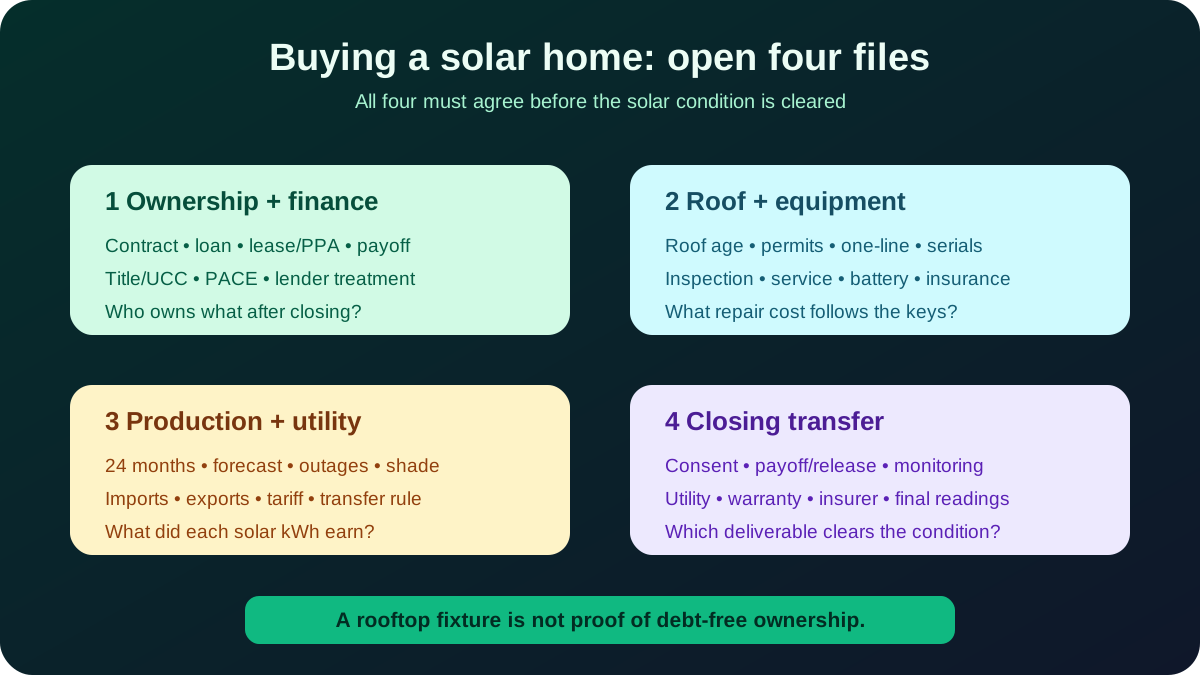
Open Four Files for the Property
Keep the evidence in separate folders so the attractive electricity story does not hide a financing or roof problem.
| File | Core question | Minimum evidence |
|---|---|---|
| Ownership and finance | Who owns the system, who is owed money, and what survives closing? | Contract, note, lease/PPA, payoff, UCC/title search, tax assessment, transfer terms |
| Roof and equipment | Is the roof-system assembly safe, permitted, serviceable, and insurable? | Roof age, permits, one-line, layout, inspection, equipment list, service records |
| Production and utility | What did it actually produce and what was each kWh worth? | 24 months of monitoring, bills, interval data, tariff, export agreement, outages |
| Closing transfer | What must happen before money and possession change hands? | Lender/title approval, third-party consent, warranties, monitoring, utility, insurer, final readings |
If one file is missing, value the solar conservatively until it is resolved. An owned, productive system with complete records differs from a claimed “paid-off” array when the seller cannot produce a contract, permit, or monitoring account.
Classify the Ownership Structure
Owned outright
The seller says the system was paid in cash or its financing was fully repaid. Verify with the purchase contract, final invoice, proof of payment, lien releases, title/UCC searches where relevant, and confirmation that no lease or PPA provider claims ownership.
Owned equipment may transfer with the real estate under local law and the purchase agreement. Your lawyer or title professional must decide that. Ask the purchase contract to identify the modules, inverters, battery, gateways, meters, and other included equipment rather than relying on “solar panels included.”
Separately financed ownership
The homeowner owns the system but still owes a solar lender. The loan may be unsecured, secured by the equipment, reflected in a UCC filing, or tied to another structure.
CFPB’s 2024 solar financing report says a U.S. seller with an unpaid solar loan typically either obtains a permitted assumption by the buyer or pays the balance before sale. “Typically” is not your contract. Obtain the lender’s current written payoff and transfer rules.
Lease
A third party owns the equipment and the resident pays a fixed or scheduled lease amount. Payments may rise under an escalator. The provider controls removal, service, insurance responsibilities, and end-of-term choices under the agreement.
Power purchase agreement
A third party owns the equipment and the resident buys generated electricity under a rate formula. Review the starting rate, escalator, term, minimum payments or production rules, service obligations, buyout schedule, transfer, default, roof work, insurance, and end-of-term provisions.
Property-assessed financing
In U.S. jurisdictions with residential PACE, the obligation may be collected through a property-tax assessment. CFPB notes that PACE financing increases the property-tax payment and can carry serious consequences if unpaid. Fannie Mae’s current Selling Guide says properties with PACE-financed solar or other energy items are not eligible for delivery to Fannie Mae unless the PACE loan is paid in full before or at closing.
Do not generalize that rule to every mortgage. Ask your lender exactly which program and current guide govern your loan.
Ask the Seller for the Complete Solar Packet
Request these documents early, not three days before closing:
- signed cash contract, loan note, lease, PPA, amendments, and change orders;
- final invoice and payment record;
- current payoff and transfer quote with expiration date;
- lender, lessor, PPA provider, installer, and equipment manufacturer contacts;
- UCC statements, fixture filings, liens, releases, and property-assessment records where applicable;
- module, inverter, optimizer, racking, battery, gateway, and meter model/serial numbers;
- array layout and electrical one-line;
- building and electrical permits, inspection approvals, and permission to operate;
- utility interconnection and export/tariff agreement;
- module product and performance warranties;
- inverter, battery, racking, roof-penetration, and workmanship warranties;
- commissioning report and production estimate;
- monitoring history and account-transfer instructions;
- service, warranty, storm, roof, outage, and repair records;
- insurer notification and current coverage information;
- renewable-energy certificate or environmental-attribute agreements if relevant.
NREL’s photovoltaic work specifications identify owner documentation such as manuals, warranty details, serial numbers, installer contacts, diagrams, inspection approval, monitoring access, and performance benchmarks. Missing records do not prove the system is defective. They increase the cost of proving what exists.
Read the Contract as a Future Cash-Flow Schedule
Do not compare only today’s payment with today’s utility bill. Build a year-by-year table through the remaining term.
| Year | Lease payment or PPA rate | Expected solar kWh | Solar payment | Utility imports and fixed charges | Service/roof cost | Total |
|---|---|---|---|---|---|---|
| Closing year | ||||||
| Year 2 | ||||||
| Year 5 | ||||||
| Year 10 | ||||||
| Final contract year |
For a lease, apply the exact payment schedule. For a PPA, apply the exact rate formula to a conservative production range. Keep utility fixed charges, non-bypassable charges, imported energy, demand charges, and export treatment separate.
Worked PPA screen
Suppose a fictional home has:
- 9,000 expected solar kWh in the first full year;
- 85% bought under a PPA because of the agreement’s billing boundary;
- starting PPA rate of $0.17/kWh;
- 2.9% annual rate escalator;
- current utility import rate of $0.22/kWh;
- no assumption that the utility rate rises.
First-year PPA payment screens as:
9,000 × 85% × $0.17 = $1,300.50
After ten escalator applications, the PPA rate is about:
$0.17 × 1.029^10 = $0.226/kWh
This example does not predict utility rates or savings. It shows why the escalator deserves its own row. Run low, central, and high production plus several utility-rate scenarios.
Involve the Mortgage Lender Early
Solar ownership and payments can affect underwriting. Fannie Mae’s current guide separates borrower-owned, separately financed, leased, and PPA systems. It tells lenders to review ownership and financing, title records, and relevant contracts. Treatment of debt, appraised value, LTV, and UCC records depends on the structure.
Give the lender complete documents before the financing condition expires. Ask in writing:
- How will the solar payment or debt affect qualification?
- Which documents must the lender review?
- Is an assumption allowed?
- Must a lien, PACE assessment, or UCC fixture filing be paid, released, or subordinated?
- May the appraiser attribute value to the system?
- Does third-party ownership change appraisal treatment?
- Does the transaction need a specific title-insurance endorsement or exception review?
- What must be complete before closing?
Fannie Mae rules apply only when that channel governs the mortgage. FHA, VA, Freddie Mac, portfolio lenders, credit unions, Canadian lenders, and other jurisdictions can differ.
Let Title Professionals Resolve the Filing, Not the Salesperson
A UCC filing can describe equipment, fixtures, or other collateral under state law. Fannie Mae distinguishes certain precautionary filings for leased or PPA equipment from fixture filings tied to financed ownership. The distinction affects lender treatment, but a buyer should not classify a filing from a search-result title alone.
Ask the title company and counsel to identify:
- exact debtor and secured party;
- filing jurisdiction and number;
- collateral description;
- whether it appears in land or personal-property records;
- whether it is active, continued, assigned, terminated, or released;
- what the mortgage lender requires;
- what closing instruction clears or accepts it;
- which party pays fees and obtains proof.
“The panels are paid” is not a termination statement. “The UCC is just standard” is not legal review.
Inspect the Roof and Solar as One Assembly
Solar does not erase the roof’s age. Get a roof inspection appropriate to the property and a solar inspection by a qualified provider who is independent of the seller’s sales transaction when practical.
Review:
- roof covering, deck, flashing, penetrations, underlayment, drainage, and attic evidence;
- array attachment, racking, clamps, corrosion, wire management, conduit, enclosures, and labels;
- signs of leaks, repairs, animal activity, storm damage, loose equipment, or overheating;
- safe access, fire setbacks, shutoffs, rapid-shutdown equipment, and disconnects;
- inverter condition, alerts, ventilation, and remaining support;
- battery location, alarms, damage, permits, and age;
- whether roof work requires provider-approved removal and reinstallation;
- who holds roof, workmanship, and equipment responsibility.
Use the roof-before-solar lifecycle guide to price near-term reroofing. If a roof is likely to need replacement in four years, add remove-and-reinstall, storage, permit, inspection, utility, contract approval, and downtime—not just shingles.
Do not climb the roof or open energized equipment. A daylight array may remain energized after a switch is opened.
Reconstruct Actual Production
DOE advises buyers to obtain production data and monitoring access. Request at least 24 complete months when available, plus the original monthly forecast.
Compare:
- portal production kWh;
- inverter lifetime energy;
- utility import/export;
- household load changes;
- outages and offline periods;
- weather and snow;
- new shade or tree growth;
- repairs and component replacements;
- monthly model expectations.
Use the solar underperformance evidence method when the history shows a gap. Do not reject a property because one cloudy year missed a brochure total. Do not accept “working great” when the portal has been offline for 18 months.
Production value is tariff specific
Separate solar used in the home from exports. Self-consumed kWh may avoid an import rate. Exported kWh receives the applicable credit or settlement. A battery shifts timing but adds conversion losses and operating rules.
Ask the utility whether the current tariff, net-metering status, export agreement, renewable credits, or grandfathered terms transfer to a new account or owner. Get the answer for the exact meter and closing date.
Check Warranties One by One
The house may have several warranties, each with a different provider and trigger:
- module product warranty;
- module performance warranty;
- inverter or microinverter product warranty;
- battery product, capacity, cycle, or throughput warranty;
- racking warranty;
- installer workmanship warranty;
- roof-penetration warranty;
- separate production guarantee;
- service plan.
Confirm transferability, deadline, registration, original purchaser requirement, labor, shipping, diagnostic cost, roof access, exclusions, remedy, and remaining term. If the installer closed, manufacturer coverage may still exist while installer workmanship coverage becomes harder to pursue.
The solar warranty claim guide provides the evidence and routing method. Do not count a 25-year performance promise as a 25-year free labor plan.
Review Insurance Before Removing the Condition
Send the insurer the system details, ownership structure, battery, roof, and third-party contract. Ask whether:
- the array is included in the dwelling limit or needs an endorsement;
- the insured value should change;
- leased/PPA equipment needs special treatment;
- roof and solar losses share or separate deductibles;
- wind, hail, flood, wildfire, theft, electrical, and equipment breakdown are handled differently;
- removal and reinstallation for covered roof work is addressed;
- loss-of-generation or contract payments continue after damage;
- a battery changes eligibility, location, or inspection requirements.
Coverage is policy and jurisdiction specific. The Australian Government’s Solar Consumer Guide likewise tells owners to speak with their insurer and notes that weather damage may be outside equipment warranties.
Battery Due Diligence Adds Another Layer
A battery needs its own model, serial, commissioning date, usable energy, power rating, reserve settings, cycling history, warranty, permits, alarms, and incident plan.
Test what the marketing phrase “whole-home backup” means. Which circuits operate? Can large motors start? Does solar recharge during an outage? Is grid charging allowed? What happens without internet? How old is the battery, and what measured usable capacity remains?
Use the critical-load battery sizing guide to compare energy and power. A battery may be a useful asset, but it can also be an aging product with a future replacement cost.
Write the Solar Condition Around Deliverables
Your agent and lawyer should draft terms for the jurisdiction and transaction. A useful issue list may require, by stated deadlines:
- all solar and finance documents;
- buyer’s satisfactory review;
- lender and title acceptance;
- third-party transfer approval;
- seller payoff, release, termination, or other agreed treatment;
- independent roof/solar inspection and negotiated remedy;
- utility and tariff confirmation;
- insurer acceptance;
- warranty and monitoring transfer;
- specified closing documents;
- consequences if any item fails.
Do not copy legal wording from an article. The clause must fit local law, the purchase agreement, financing, deadlines, and available remedies.
Closing-Day Solar Checklist
Before funds release, confirm:
- agreed payoff or assumption completed;
- required lien/UCC/title action documented;
- lessor or PPA transfer effective;
- lender condition cleared;
- equipment included or third-party-owned status stated correctly;
- utility account and export/tariff path confirmed;
- monitoring owner/admin access transferred;
- warranties registered or transfer notices submitted;
- installer, service, manufacturer, lender, and provider contacts received;
- final inverter and battery readings recorded;
- keys, shutdown instructions, manuals, one-line, permits, and serials delivered;
- insurer coverage effective at the required time.
After possession, compare the first full billing and production period with the transferred data. Fix account ownership while the seller and closing professionals can still help.
Red Flags That Need Resolution
- listing says “owned,” but seller produces only a monthly payment;
- no one can name the lender, lessor, or PPA provider;
- title and solar documents describe different parties;
- payoff quote excludes a buyout or early-termination amount;
- provider approval will arrive after the financing condition;
- roof is near replacement, but removal rights and price are unknown;
- production data stop before a major storm or repair;
- monitoring belongs to a closed installer;
- system size or serials do not match permits;
- seller promises tariff transfer without utility confirmation;
- warranty is described by term only, with no transfer or labor terms;
- appraised solar value assumes buyer ownership when equipment is third-party owned;
- battery has alerts, damage, missing permit, or no shutdown instructions.
A red flag is a request for evidence, not automatic proof of fraud or defect.
Compare Three Closing Scenarios
Put each negotiable path on one page. This stops the solar obligation from disappearing inside the home price.
Suppose a buyer is considering a $640,000 house with a third-party solar agreement. The provider offers transfer, a seller buyout, or an early equipment purchase. Do not compare the provider’s headline amounts alone.
| Item | Buyer assumes | Seller buys out | Buyer purchases at closing |
|---|---|---|---|
| Home purchase price | $640,000 | $640,000 | $640,000 |
| Price adjustment negotiated | |||
| Solar cash due at closing | |||
| Remaining scheduled solar payments | |||
| Escalator exposure | |||
| Financing effect | |||
| Equipment ownership after closing | |||
| Service and repair responsibility | |||
| Roof removal/reinstall obligation | |||
| End-of-term cost | |||
| Transfer or transaction fees |
Add present value only after the cash-flow timing is correct. Keep mortgage interest separate from the home price. A $15,000 seller buyout funded through a higher purchase price may cost more than $15,000 after financing, while an assumed escalating PPA can cost more than its first-year payment suggests.
Also test failure. What happens if the provider rejects the transfer, the buyer’s lender will not accept the agreement, the payoff expires, or the title release misses closing? The purchase contract should allocate deadlines, notice, extensions, termination rights, and deposit treatment through local counsel. A spreadsheet identifies the exposure; it does not create the remedy.
Finally, compare the no-solar counterfactual. Estimate what the same house would cost and consume without the array, using local comparable sales and defensible utility data. This prevents a buyer from assigning the system both a full home-price premium and all projected future savings.
Frequently Asked Questions
Is it good to buy a house with solar panels?
It can be. The system should have clear ownership, acceptable contract terms, a sound roof, safe installation, useful production, transferable service access, and economics that work under the actual tariff. Evaluate the specific asset, not solar as a slogan.
Do solar panels automatically transfer with the house?
Do not assume that. Owned equipment, financed equipment, leases, PPAs, property assessments, security filings, and purchase-contract language can lead to different outcomes. Use the title company, lender, counsel, and third-party provider.
Can a solar lease stop a mortgage approval?
It can affect underwriting or documents, depending on the lender and agreement. Fannie Mae’s current guide has specific treatment for leased and PPA systems, including contract review and payment rules. Your lender must apply the rules governing your loan.
Should the seller pay off the solar loan?
That is a negotiation informed by lender requirements, payoff terms, property price, system value, and buyer risk. CFPB describes payoff or permitted assumption as common U.S. paths. Get the exact lender process and closing treatment in writing.
How much value should I assign to solar?
Do not multiply a national premium by the sale price. Ownership, debt, tariff, production, roof, age, condition, local market evidence, and appraisal rules matter. Third-party-owned equipment may not be treated as the buyer’s asset.
What if the original installer is out of business?
Identify equipment manufacturers, warranty administrators, monitoring provider, permits, and independent qualified service options. Manufacturer warranties may survive while installer workmanship or service obligations become difficult. Price the support gap.
How much production history should I request?
Ask for at least 24 complete months when available, plus the original monthly forecast and event log. Use more history for degradation, seasonal, storm, or intermittent questions.
What to Read Next
If the ownership file shows a lease or PPA, use the buy-versus-lease economics guide to rebuild every remaining payment and rate escalator before you agree to the transfer.
About the Editorial Team EnergyBS organizes public solar, consumer-finance, lender, and technical guidance into homeowner decision tools. This article is general education, not legal, lending, title, insurance, tax, appraisal, or electrical advice. Use the professionals and current rules that govern the property and transaction.
Sources and Verification
- U.S. DOE: A Consumer's Guide to Buying a House With Solar Panels
- CFPB: Issue Spotlight on Solar Financing
- Fannie Mae: Special Property Eligibility Considerations—Properties With Solar Panels
- FTC: Solar Power for Your Home
- NREL: Photovoltaics Standard Work Specifications
- Australian Government: Solar Warranties and Insurance
Editorial Review
EnergyBS Editorial Team
EnergyBS publishes practical homeowner guides. Important program, product, and cost claims should be checked against the linked source and local project documents before you commit to work.
Related Guides
View All ArticlesBuying vs. Leasing Solar: Why You Should Avoid PPAs (2026)
Doortodoor sales reps love to pitch 'Free Solar'. It's called a PPA, and it can lower your home's value and scare away buyers. Always Buy if you can.
Solar Quote Comparison Worksheet: Price, Production, Financing, and Contract Checks
A sidebyside homeowner worksheet for normalizing solar cash prices, financed cost, equipment, production assumptions, roof scope, utility rules, warranties, and contract obligations.
Solar Panels Underperforming? Prove the Loss Before Paying for Repairs
A weatheraware method to separate low sunlight, monitoring gaps, clipping, shade, soiling, inverter faults, string failures, curtailment, and billing confusion.