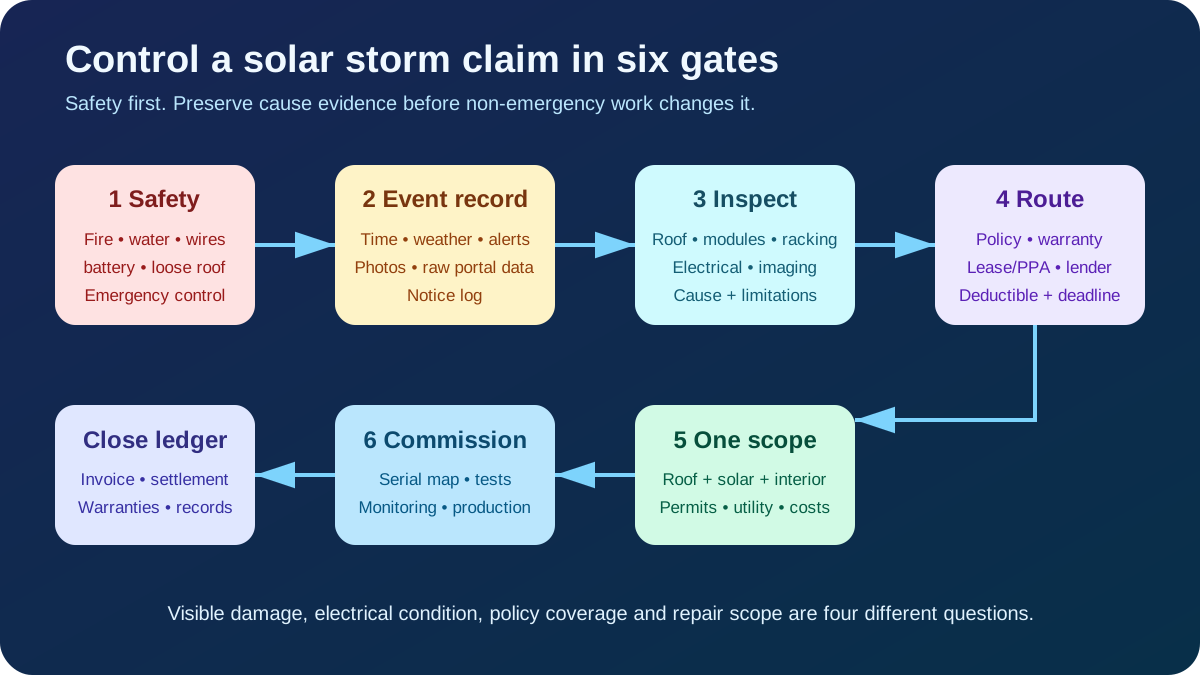
Solar Panel Storm Damage: Inspection, Insurance Claim, and Roof Repair Scope
A poststorm workflow for solar safety, evidence, hail and wind inspection, insurer notice, warranty routing, roof coordination, repair scope, deductibles, downtime, and commissioning.
Direct Answer
A poststorm workflow for solar safety, evidence, hail and wind inspection, insurer notice, warranty routing, roof coordination, repair scope, deductibles, downtime, and commissioning.
Quick Checks
- 1Treat fallen conductors, wet electrical equipment, damaged batteries, smoke, arcing, and loose rooftop equipment as safety hazards.
- 2Document the event and condition before non-emergency work changes the evidence.
- 3Build one coordinated scope for roof, solar, electrical, permits, utility, interior damage, monitoring, and commissioning.
Safety and Evidence Come Before the Estimate
Short answer: After hail, wind, lightning, flood, fire, or tree impact, stay away from fallen conductors, wet electrical equipment, damaged batteries, arcing, smoke, and loose rooftop components. Call emergency services, the utility, insurer, and qualified solar/roof professionals as the condition requires. Photograph safely, preserve monitoring and weather records, give timely notice, and obtain a coordinated roof-plus-solar scope before approving removal or repair.
Solar modules can look intact while cells are cracked. They can also look dramatic after a storm yet remain electrically serviceable. A production drop can come from a utility outage or monitoring gap rather than module damage. The claim needs cause, condition, scope, and policy evidence—not a guess from the driveway.
This is general education, not an assurance of coverage. Insurance, deductibles, proof, notice, matching, building code, appraisal, consumer rights, and dispute rules vary by policy and jurisdiction.
Treat These as Immediate Hazards
Do not approach, touch, move, tarp, wash, or reset equipment when you see:
- downed utility or solar conductors;
- arcing, sparks, smoke, burning odor, melting, or scorching;
- broken modules with exposed wiring;
- wet inverter, combiner, disconnect, meter, battery, or service equipment;
- flooded electrical rooms or basements;
- a swollen, punctured, smoking, hissing, unusually hot, or impact-damaged battery;
- roof collapse, structural movement, loose array sections, or hanging components;
- fire damage;
- a tree or debris resting on electrical equipment;
- an active ground-fault, arc-fault, isolation, battery, or rapid-shutdown alarm.
Keep people and animals away. Follow emergency, fire, utility, and manufacturer instructions. Do not assume opening an AC breaker makes rooftop DC conductors safe in daylight. Do not enter a damaged building until authorities say it is safe.
If emergency work is needed to prevent further injury or property damage, safety comes first. Ask responders and contractors to photograph the condition when practical and preserve removed parts that may matter to the insurer or manufacturer.
Name the Event and Time Window
Create an event record while details are fresh:
- date and local start/end time;
- address and affected roof planes;
- hail, wind, lightning, fire, flood, snow/ice, tree, debris, or combined event;
- official warning or report source;
- observed hail size only if safely documented;
- wind direction and visible debris path;
- outage and utility restoration times;
- first inverter, battery, or monitoring alert;
- first interior leak or electrical symptom;
- emergency contacts and actions;
- neighboring damage where relevant;
- photos/video from safe locations.
Download portal data before it rolls off. Save raw interval exports, event logs, state of charge, fault codes, and screenshots. Note the monitoring timezone.
Official weather data can support timing but does not prove damage at one roof. Site evidence still matters.
Preserve the Pre-Storm Baseline
The strongest claim comparison often existed before the storm. Save the last 12 to 24 months of monthly energy, several recent clear-day curves, array map, module and device serials, lifetime inverter energy, roof photos, prior inspection, service history, and the original commissioning benchmark.
Build a before-and-after table:
| Evidence | Before event | After event | Difference needing explanation |
|---|---|---|---|
| Active modules/devices | |||
| Active strings/inputs | |||
| Clear-day curve shape | |||
| Daily weather-adjusted energy | |||
| Inverter/battery alerts | |||
| Roof leak/moisture evidence | |||
| Visible racking/module condition |
Use the same monitoring interval and timezone. Note any portal, firmware, meter, tariff, tree, or equipment change between periods. A storm can coincide with an unrelated communications outage, so support physical and production conclusions independently.
If you do not have a baseline, request records from the installer, manufacturer portal, utility, previous owner, battery gateway, or service provider. Missing history does not defeat every claim, but it changes which conclusions can be proved. Keep that limitation explicit in the inspection scope.
For future resilience, export records quarterly and after major service. Photograph the roof and equipment annually from safe locations. Store contracts, one-line diagrams, permits, serials, warranties, and insurer correspondence outside the monitoring vendor’s cloud account.
Notify the Right Parties Without Assigning Cause Too Early
Potential parties include:
- homeowners or property insurer;
- flood insurer where separate;
- solar installer or service provider;
- module, inverter, battery, optimizer, or racking manufacturer;
- lease or PPA owner;
- solar lender when the agreement requires notice;
- roofer and roof-warranty provider;
- utility and authority having jurisdiction;
- mortgage lender for material damage when required;
- emergency services.
Tell them what happened and what you observed. Avoid stating that “hail destroyed every panel” or “the installer caused the leak” before inspection.
Ask each party:
- What notice deadline and channel apply?
- What emergency mitigation is authorized?
- May equipment be moved or removed before inspection?
- Which photos, tests, estimates, and inventories are required?
- Who selects or approves contractors?
- Must damaged parts be retained?
- Is there a separate adjuster, engineer, or solar specialist?
- What deductible and coverage section may apply?
- How are roof and solar scopes coordinated?
Record names, case numbers, dates, instructions, and documents sent.
Read the Insurance Policy Before Assuming Coverage
NAIC explains that homeowners policies have defined covered perils, limits, exclusions, and deductibles. Wind and hail may be covered under some forms, but named-storm, windstorm, hurricane, flood, equipment-breakdown, and other treatment can differ.
Review:
- declarations and dwelling limit;
- endorsements for solar or other structures;
- ownership and third-party equipment;
- covered causes of loss;
- wind/hail/named-storm/hurricane deductibles;
- flood and surface-water exclusions or separate policy;
- replacement-cost or actual-cash-value treatment;
- ordinance or law coverage;
- matching and cosmetic damage language;
- debris removal;
- reasonable emergency mitigation;
- interior water and resulting damage;
- loss of use;
- business use;
- equipment breakdown;
- solar removal and reinstallation;
- loss of generation, lease, or PPA payment obligations;
- claim notice, proof, appraisal, and suit deadlines.
Ask the insurer to point to the controlling language. A neighbor’s settlement does not define your policy.
Deductible math
A percentage deductible may apply to the dwelling limit, not the repair invoice. If a policy has a 2% wind deductible on a $600,000 insured dwelling, the screen is:
$600,000 × 2% = $12,000
That example is not a policy interpretation. Confirm the trigger and base. A flat deductible, separate solar deductible, or another term may apply.
Warranty and Insurance Solve Different Problems
The Australian Government’s Solar Consumer Guide notes that warranties commonly exclude weather damage such as hail and advises owners to review insurance. A manufacturer warranty generally addresses a defined product or performance promise. Insurance addresses covered external events under the policy.
Possible routes:
| Finding | Likely route to investigate | Why |
|---|---|---|
| Impact-cracked glass after documented hail | Insurance first; warranty notice if cause disputed | External event may be excluded by product warranty |
| Module delamination with no storm evidence | Product warranty | Possible covered defect |
| Loose rail due to installation error exposed by ordinary wind | Workmanship, liability, warranty, insurance review | Cause and resulting loss need allocation |
| Lightning-related inverter damage | Insurance/equipment coverage and product diagnosis | External surge versus covered internal defect |
| Array energy low after storm, no visible damage | Technical inspection, then route | Hidden cell/string/electrical or unrelated data issue |
| Roof leaks after wind displaced shingles | Property policy and roof scope | Not automatically solar workmanship |
Use the solar warranty claim routing guide when a covered defect may coexist with storm damage. Notify relevant parties before a deadline even when cause remains open.
Do a Ground-Level Condition Survey
Only from safe locations. Use zoom rather than climbing.
Photograph:
- every roof plane and array edge;
- broken or shifted modules;
- lifted, twisted, or displaced array sections;
- visible racking, clamps, flashings, conduit, and enclosures;
- tree and debris impacts;
- roof covering, ridge, vents, gutters, siding, windows, and exterior damage;
- inverter and battery exterior/status from a safe distance;
- interior ceilings, walls, attic area, floors, and contents affected by water;
- temporary mitigation before and after;
- equipment labels if accessible without hazard.
Use wide, medium, and detail views. Include a scale only when safe. Keep original files with date/time metadata and a written photo index.
Do not mark glass, move debris, walk under a loose array, or wash dirt away before inspection.
Hidden Damage Needs Qualified Testing
NREL reports that severe weather inspections can require electrical or imaging methods because damage is not always visible. Cell cracks can affect power without shattering the front glass.
A qualified solar assessment may include:
- array and roof visual inspection;
- module and attachment mapping;
- inverter and module-level monitoring review;
- string voltage/current and comparison;
- insulation and ground-fault tests;
- I-V curve tracing;
- infrared imaging under suitable conditions;
- electroluminescence or photoluminescence where warranted;
- racking/fastener/attachment investigation;
- conductor, connector, enclosure, and wire-management checks;
- inverter, optimizer, shutdown, meter, and battery diagnostics;
- production comparison before and after the event.
Ask the inspector to state method, conditions, instruments, limitations, photos, affected serials, severity, safety status, repair recommendation, and whether destructive testing or removal is needed.
One low module in a portal is not a complete hail assessment. One visual drive-by is not a full electrical clearance.
Roof and Solar Scopes Must Fit Together
A roofing estimate that says “solar by others” and a solar estimate that says “roof by others” can leave a large gap.
Build a responsibility matrix:
| Scope item | Roofer | Solar contractor | Electrician | Insurer/owner approval |
|---|---|---|---|---|
| Emergency dry-in | ||||
| Electrical shutdown/isolation | ||||
| Array mapping and labeling | ||||
| Removal and protected storage | ||||
| Roof deck/covering/flashing repair | ||||
| Attachment layout and engineering | ||||
| Reinstallation | ||||
| Wiring, connectors, labels | ||||
| Permit and inspection | ||||
| Utility/interconnection work | ||||
| Monitoring/commissioning | ||||
| Interior restoration | ||||
| Recycling/disposal |
Use the roof and solar sequencing guide to compare partial repair, full reroof, removal/reinstallation, resize, and retirement. An insurer may approve one scope while building code, manufacturer instructions, or field findings change it. Follow the policy change-order process.
Decide Repair, Selective Replacement, or Full Array Replacement
Do not accept “all panels must match” or “only cracked glass counts” without technical and policy support.
Consider:
- affected module count and mapped evidence;
- electrical and mechanical safety;
- hidden damage testing;
- availability of the same model;
- compatible voltage, current, dimensions, connectors, clamps, fire rating, optimizer/microinverter, and warranty;
- string mismatch and design limits;
- appearance and policy matching language;
- racking and roof damage;
- remaining system age and condition;
- permit and utility treatment;
- repair versus replacement cost;
- salvage and recycling;
- expected production after work.
If a replacement model differs, require the designer to document compatibility. Similar wattage alone is not enough.
Full replacement can be reasonable after widespread damage, unsafe racking, incompatible unavailable modules, or a roof rebuild. It should not be the automatic sales answer when two modules are repairable.
Leased and PPA Systems Add a Contract Owner
The resident may insure the house while another company owns the solar equipment. The contract may allocate equipment insurance, roof repair, notice, access, removal, payment during downtime, buyout, and insurer proceeds.
Ask:
- Who files the equipment claim?
- Who authorizes removal and selects the contractor?
- Does the resident still owe lease or PPA payments during outage?
- Who pays the roof remove/reinstall scope?
- Is the third-party owner a loss payee or otherwise involved?
- Who receives claim funds?
- What happens if the owner delays roof access?
- Does repair change production guarantees or monitoring?
Send the agreement to the insurer and counsel. Do not let a roofing crew remove third-party equipment without authorization except as emergency authorities direct.
The solar-homebuyer ownership audit explains why these responsibilities should be identified before purchase.
Batteries Change the Emergency Plan
Storm, flood, fire, and impact damage to energy storage needs trained response. Do not touch, open, move, charge, transport, or re-energize a damaged unit.
Preserve from a safe state:
- model, serial, location, installation date;
- state-of-charge and last logs if remotely available;
- alarm and shutdown messages;
- event timing;
- visible water, impact, heat, smoke, swelling, or enclosure damage;
- responder and manufacturer instructions;
- permit and installation records.
The battery may retain dangerous energy after the building is disconnected. Follow fire, emergency, manufacturer, insurer, and qualified installer direction.
Calculate the Complete Loss
Separate claimed, covered, and owner-paid amounts. Do not inflate all missing solar kWh at the highest retail rate.
Potential cost lines:
- emergency mitigation;
- inspection and testing;
- array removal and storage;
- roof repair or replacement;
- modules, inverters, racking, wiring, battery, meters, and controls;
- labor, lift, scaffolding, travel, freight, and tax;
- permits, engineering, inspection, and utility work;
- interior drying and repair;
- debris handling and recycling;
- monitoring and commissioning;
- code upgrades;
- temporary accommodation where covered;
- lost generation or continuing contract payments if covered;
- deductible and depreciation;
- betterment or elective upgrade.
Lost-generation screen
Suppose the array is offline for 60 days and a weather-aware forecast is 1,800 kWh. You estimate 55% would have served the home at $0.25/kWh and 45% exported at $0.07/kWh:
- self-consumed value: 990 × $0.25 = $247.50;
- export value: 810 × $0.07 = $56.70;
- total screen: $304.20.
Coverage may exclude it. The calculation still helps compare repair schedules and document the economic effect accurately.
Separate Restoration From an Upgrade
A storm claim can create an opportunity to add capacity, a battery, a new roof type, or premium modules. Keep the base restoration scope separate from owner-elected improvement.
| Line | Like-kind restoration | Code-required change | Owner upgrade |
|---|---|---|---|
| Modules | |||
| Inverter/controls | |||
| Racking/attachments | |||
| Roof covering | |||
| Battery | |||
| Service/panel |
Ask the insurer to identify its approved amount and the owner to sign upgrade change orders separately. Do not represent elective capacity as storm loss.
If the inverter also needs replacement, compare compatibility and lifecycle with the inverter replacement decision worksheet.
Create a Claim Control Log
| Date | Event/action | Party | Evidence or amount | Approval/status | Next deadline |
|---|---|---|---|---|---|
| Loss reported | Insurer | ||||
| Emergency mitigation | |||||
| Solar inspection | |||||
| Roof inspection | |||||
| Scope submitted | |||||
| Change order | |||||
| Repair complete | |||||
| Commissioning |
Keep estimates, adjuster reports, engineering, invoices, receipts, permits, messages, and photos. Confirm phone instructions by email.
If scope is disputed, ask which quantities, prices, cause findings, coverage terms, depreciation, or exclusions differ. A line-item disagreement is easier to address than “the estimate is too low.”
Reconcile the Settlement Before Signing Completion
Create a three-column ledger: contractor invoice, insurer estimate, and final paid amount. Match quantities, tax, labor, access, overhead, depreciation, deductible, prior payments, and owner upgrades.
| Reconciliation item | Contractor | Insurer | Difference/action |
|---|---|---|---|
| Module removal and mapping | |||
| Roof work | |||
| Solar replacement/reinstall | |||
| Electrical and commissioning | |||
| Permit/engineering/utility | |||
| Interior mitigation/repair | |||
| Tax and approved fees | |||
| Depreciation withheld | |||
| Deductible | |||
| Owner upgrade |
Ask what documentation releases recoverable depreciation or a final holdback. Submit invoices, completion certificates, photos, permits, and cancelled-payment evidence only through the insurer’s approved process. Do not sign an assignment, release, proof of loss, direction to pay, or contractor completion statement you do not understand.
Check the solar financing or third-party contract before directing proceeds. A lender, lessor, PPA owner, mortgage company, or other party may have defined rights in claim payments or repair approval. The check may name multiple parties.
If repair cost exceeds an approved amount, identify whether the difference is a missing covered item, price disagreement, code change, concealed condition, depreciation, deductible, policy limit, excluded cause, or elective upgrade. Each category has a different response. Get local insurance or legal help when the amount is material or a deadline approaches.
Keep the final ledger with the home records. The next insurer, buyer, roofer, and solar technician will need to know which components were replaced, what the storm affected, and which warranties started or continued.
Avoid Post-Storm Scams
Be cautious with unsolicited contractors who:
- claim every panel must be replaced without testing;
- promise the insurer will pay before policy review;
- ask you to assign all claim rights immediately;
- demand a large cash deposit after a disaster;
- tell you to inflate damage;
- pressure you to sign before an adjuster or lender review;
- lack required license, insurance, address, or written scope;
- offer to hide owner upgrades inside the claim;
- want monitoring credentials rather than proper delegated access.
Verify licensing, insurance, business identity, manufacturer authorization, and references through independent channels. Get several detailed scopes when time and safety allow.
Commission the Restored System
Do not measure completion by “panels are back on the roof.” Collect:
- final module and device serial map;
- updated one-line and layout;
- roof and attachment documentation;
- electrical test results;
- inverter, shutdown, export, battery, and transfer settings;
- permits and inspection signoff;
- utility approval if required;
- monitoring ownership and correct array mapping;
- warranty registrations;
- replaced-part disposition;
- clear-day production verification;
- interior moisture/repair closeout;
- insurer payment and depreciation recovery documents where applicable.
Compare the first complete months with the weather-aware underperformance method. A portal can show green while one string is missing.
Frequently Asked Questions
Does homeowners insurance cover hail damage to solar panels?
Some policies may cover solar equipment and hail, while ownership, endorsements, exclusions, limits, and deductibles differ. Read the exact policy and ask the insurer. Do not rely on a national yes/no answer.
Can hail damage a panel without breaking the glass?
Yes, cell or internal damage can exist without obvious glass breakage. NREL discusses imaging and electrical assessment after severe weather. Use qualified testing rather than assuming every intact module passed.
Should I shut solar off after a storm?
Follow emergency, utility, manufacturer, and qualified professional instructions. Do not approach damaged equipment or assume a switch removes all PV voltage. If there is arcing, smoke, water, loose equipment, or exposed wiring, keep away and call for help.
Who removes panels for a roof insurance claim?
Use a qualified solar provider approved as required by the policy, contract, equipment owner, permits, and warranties. Coordinate mapping, safe shutdown, storage, roof work, reinstall, and commissioning in writing.
Will the insurer replace every panel if one model is unavailable?
That depends on damage, safe technical compatibility, policy language, matching rules, repair feasibility, and jurisdiction. Get engineering and policy analysis; do not accept a universal claim from either contractor or adjuster.
Is storm damage a manufacturer warranty claim?
Often an external weather event is excluded from product warranties, but exact terms and cause control. A latent defect and storm damage can also coexist. Notify relevant parties and preserve evidence.
Can I upgrade the system during the claim?
Often you can choose owner-paid upgrades if the insurer, lender, utility, permits, equipment owner, and contractors agree. Separate restoration, code-required changes, and elective improvements in the scope and invoice.
What to Read Next
If the insurer or manufacturer questions whether the storm caused the production loss, use the solar underperformance evidence ladder to compare pre-event and post-event data without confusing weather, monitoring gaps, or curtailment with damage.
About the Editorial Team EnergyBS combines public solar reliability, insurance, and consumer guidance into decision worksheets. This is general education, not emergency, insurance, legal, engineering, roofing, or electrical advice. The current policy, contracts, authorities, and qualified local professionals control the response.
Sources and Verification
- NREL: How Extreme Weather and System Aging Affect the U.S. Photovoltaic Fleet
- NREL: A Faster Way to Assess Solar Panels After Severe Weather
- NREL: Best Practices for Operation and Maintenance of Photovoltaic and Energy Storage Systems
- NAIC: Homeowners Insurance
- NAIC: PostDisaster Claims Guide
- Australian Government: Solar Warranties and Insurance
Editorial Review
EnergyBS Editorial Team
EnergyBS publishes practical homeowner guides. Important program, product, and cost claims should be checked against the linked source and local project documents before you commit to work.
Related Guides
View All ArticlesSolar Panel Warranty Claim: Prove the Defect and Route It to the Right Provider
A claim workflow for solar product, performance, inverter, battery, racking, workmanship, roof, and production guarantees, including evidence, testing, labor gaps, and installer closure.
Solar Panels Underperforming? Prove the Loss Before Paying for Repairs
A weatheraware method to separate low sunlight, monitoring gaps, clipping, shade, soiling, inverter faults, string failures, curtailment, and billing confusion.
Should You Replace the Roof Before Solar? A RemovalandReinstallation Decision Guide
A roofandsolar sequencing guide covering condition evidence, remaining life, removeandreinstall scope, warranties, structural and electrical coordination, and sidebyside lifecycle scenarios.