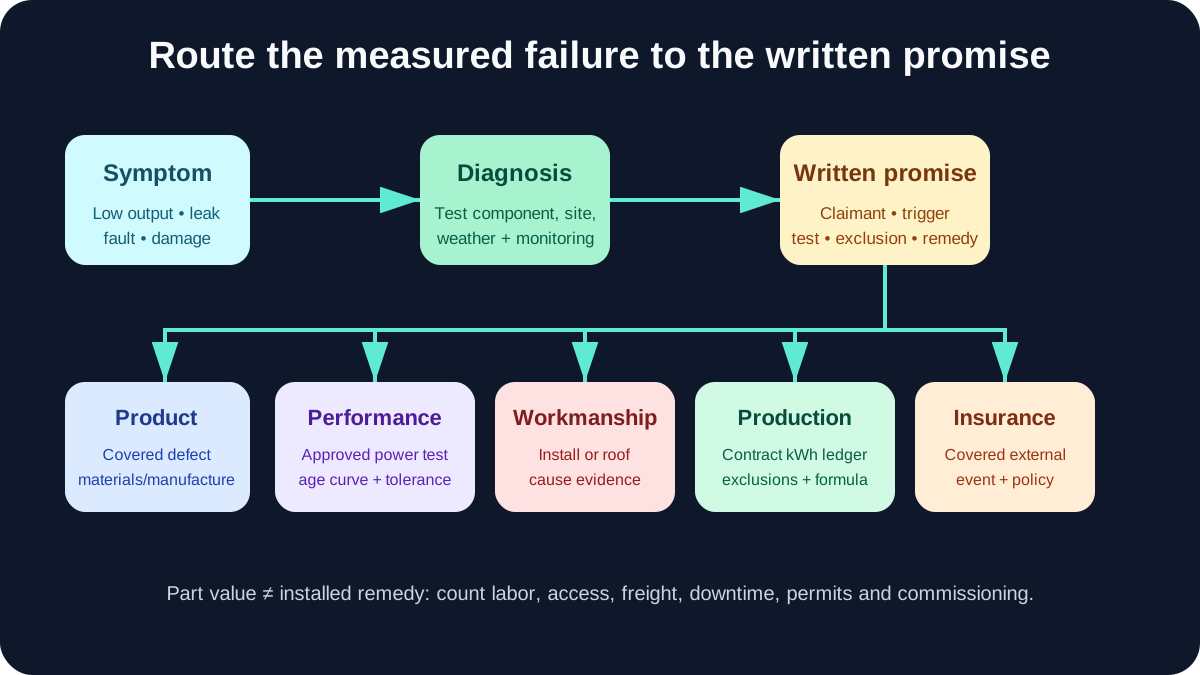
Solar Panel Warranty Claim: Prove the Defect and Route It to the Right Provider
A claim workflow for solar product, performance, inverter, battery, racking, workmanship, roof, and production guarantees, including evidence, testing, labor gaps, and installer closure.
Direct Answer
A claim workflow for solar product, performance, inverter, battery, racking, workmanship, roof, and production guarantees, including evidence, testing, labor gaps, and installer closure.
Quick Checks
- 1Match the symptom to the written promise before demanding a remedy.
- 2Preserve serial numbers, monitoring exports, alerts, photos, invoices, commissioning data, and test results.
- 3Price labor, access, shipping, downtime, permits, and monitoring—not just the replacement part.
A Warranty Term Does Not Identify the Claim
Short answer: Start a solar warranty claim by naming the failed promise: product defect, measured module performance, inverter or battery coverage, installer workmanship, roof penetration, or a separate production guarantee. Preserve the contract and warranty version, identify the claimant and provider, document serial numbers and commissioning, prove the failure under the required test method, and price excluded labor, access, shipping, permits, downtime, and re-commissioning before accepting the remedy.
“My solar is underperforming” is not yet a warranty category. One string may be disconnected. The monitoring gateway may be offline. A roof leak may come from flashing. Hail may be an insurance event. A module can be physically defective without breaching its performance curve, or can test below a performance promise without visible damage.
This guide is general education. Warranty, contract, consumer, limitation, insurance, evidence, and dispute rules vary by country and state/province. Use current written terms and local professional advice.
Build the Warranty Map Before Calling
A home solar system can contain promises from different entities.
| Promise | Common provider | Typical subject | Evidence that matters |
|---|---|---|---|
| Module product warranty | Module manufacturer | Defect in materials or manufacture | Serial, photos, electrical/physical tests, installation compliance |
| Module performance warranty | Module manufacturer | Minimum output or degradation curve | Approved power test, age, rating, tolerance, exclusions |
| Inverter warranty | Inverter manufacturer | Covered inverter failure | Fault logs, serial, commissioning, manufacturer case, technician tests |
| Optimizer/microinverter warranty | Device manufacturer | Covered module-level device | Portal/map, serial, input/output tests, roof access |
| Battery warranty | Battery manufacturer | Product, capacity, cycles, throughput, or retention | Logs, settings, energy/throughput, temperature, test protocol |
| Racking warranty | Racking manufacturer | Covered component or finish issue | Layout, attachment, torque/installation records, photos |
| Workmanship warranty | Installer | Installation quality | Permit/as-built, independent diagnosis, leak/electrical evidence |
| Roof-penetration promise | Installer/roofer/contract | Defined leak or penetration responsibility | Roof history, location, moisture evidence, installation records |
| Production guarantee | Installer/owner/provider | Contractual energy level | Complete monitoring, weather method, exclusions, remedy formula |
| Insurance | Insurer | Covered external event or property loss | Policy, event, cause, damage, scope, deductible, timely notice |
Read every document. A brochure, sales email, manufacturer warranty, installer contract, financing agreement, service plan, and insurance policy can use the same word differently.
Preserve the Exact Warranty Version
Manufacturers update warranty terms. Download the version tied to the model, purchase or installation date, market, and claimant. Save it with the original proposal and invoice.
Record:
- warrantor legal name and contact;
- covered model and serial range;
- claimant eligibility and transfer rules;
- start date and duration;
- product versus performance promise;
- required registration;
- installation and operating conditions;
- maintenance and monitoring duties;
- notice and claim deadline;
- required test method and who pays;
- exclusions;
- remedy options;
- labor, removal, shipping, customs, travel, and reinstall treatment;
- replacement product and remaining-term rules;
- dispute process, governing law, and venue where applicable.
FTC consumer guidance tells U.S. buyers to keep the written warranty and receipt and to get spoken promises in writing. That simple record habit matters years later when the original salesperson is gone.
Identify the Claimant
Some warranties cover the original purchaser. Others transfer to later owners automatically, require notice or registration, or follow the installed product. Third-party-owned systems may make the lessor or PPA provider—not the resident—the equipment warranty claimant.
Ask:
- Who bought the equipment from the manufacturer or distributor?
- Who owns it today?
- Did the home sale transfer the warranty?
- Does the contract require the installer or distributor to submit claims?
- Did an assignment transfer service rights?
- Is the lender only a secured party, or also involved in service?
- Who owns monitoring and has installer-level data?
If you bought the home later, use the solar-home due-diligence guide to reconstruct ownership, serials, permits, and transfers.
Separate Diagnosis From Warranty Approval
The component that reports an error is not always the failed component. An inverter may stop because of grid voltage, a ground fault in array wiring, a missing string, an external shutdown device, or a configuration problem.
Create a diagnosis question:
Which measured condition violates which written promise, and what evidence does that provider require?
Use the solar underperformance diagnostic method to rule out missing portal data, weather, shade, snow, soiling, clipping, curtailment, load/billing confusion, and site changes. Do not open energized equipment or disconnect rooftop components yourself.
Qualified testing may include:
- visual inspection and thermal evidence;
- inverter and gateway logs;
- DC voltage/current by string or module-level device;
- insulation or ground-fault testing;
- I-V curve or approved module power testing;
- electroluminescence or other imaging when appropriate;
- battery capacity or energy test under the warranty protocol;
- roof moisture and penetration investigation;
- torque, attachment, flashing, or wiring review;
- weather-normalized production analysis.
The warranty may specify acceptable labs, instruments, calibration, irradiance, temperature correction, tolerances, or installer authorization. Confirm the method before paying for a test the provider may reject.
Ask for pre-authorization in writing when the warranty makes reimbursement conditional. The request should name the proposed technician, test, standard or manufacturer procedure, estimated price, travel, module removal, shipping, and what happens if the test confirms or rejects the claim. State whether the system will be offline and for how long.
If the provider insists on its own inspection, ask for the date, safety instructions, access requirements, data it will collect, and a copy of the findings. Do not let a claim sit indefinitely while production is lost. Preserve the right to mitigate safely under local advice, but avoid irreversible work that destroys the evidence before the provider has a fair inspection opportunity.
For a dispute about measurement, compare raw readings, correction inputs, instrument calibration, uncertainty, module tolerance, and threshold calculation line by line. “Our technician says it passed” is not a reproducible result; neither is a homeowner app screenshot a certified module power test.
Product and Performance Claims Are Different
Product defect
A product warranty may address manufacturing or material defects: glass, frame, junction box, connector, backsheet, cell, laminate, or another covered component. Visual appearance alone may not meet the definition. External impact, installation damage, environment, incompatible equipment, misuse, or unauthorized alteration may be excluded.
Document the physical symptom, affected serials, first observed date, progression, neighboring module comparison, electrical behavior, and installation context.
Performance shortfall
A performance warranty commonly describes a minimum nameplate-power path over time. It is not usually a guarantee of the home’s annual kWh. Annual system energy also depends on sunlight, temperature, orientation, shade, soiling, snow, inverter, wiring, availability, and grid conditions.
The claim calculation may resemble:
Allowed minimum power = original rated power × warranty factor for module age
Suppose only as an example that a 400 W module has an applicable minimum factor of 90% at the claim age. The threshold before any stated tolerance would be:
400 W × 0.90 = 360 W
If an approved corrected test reports 354 W, the next step is not automatically a new panel. Apply the warranty’s measurement tolerance, test uncertainty, exclusions, and remedy wording. If the corrected result is 372 W, low annual system kWh may come from another cause.
Read the Remedy, Not Just the Threshold
Possible warranty remedies include repair, replacement, extra modules, refund based on current or depreciated value, or another provider-selected action. The provider may reserve the choice.
Ask for a written remedy scope:
- new, refurbished, or equivalent model;
- wattage, size, color, connector, current, voltage, and mechanical compatibility;
- shipping origin and lead time;
- removal and roof access;
- labor allowance;
- disposal or return freight;
- permits and inspection;
- inverter/optimizer compatibility;
- array map and monitoring changes;
- commissioning and production verification;
- warranty term after replacement;
- treatment of lost energy.
A “free panel” can still create a large labor bill. A physically larger replacement may not fit the racking or electrical string. The inverter replacement decision guide applies the same installed-scope discipline when the inverter is involved.
Workmanship and Roof Claims Need Cause Evidence
A leak near an array does not prove the penetration caused it. Water can enter upslope, at flashing, a vent, ridge, wall, or damaged roof covering, then travel before appearing indoors.
Preserve:
- weather date and direction;
- attic and interior moisture location;
- safe ground and interior photos;
- roof age and prior leaks;
- array layout and attachment points;
- installer detail and manufacturer instructions;
- permit and inspection;
- independent roofer or building-envelope findings;
- moisture mapping where appropriate;
- temporary mitigation and receipts.
Coordinate the solar installer and roofer. One trade should not remove equipment in a way that erases evidence or voids another warranty. Emergency water control comes first, but photograph and notify providers as soon as safely practical.
The workmanship promise may cover repair of the installation defect but not interior finishes, mold, business interruption, or roof age. Insurance may address a covered resulting loss while pursuing responsibility elsewhere. Let the actual contracts and professionals allocate it.
Production Guarantees Need Their Own Ledger
A production guarantee is a contract formula. It may exclude weather, grid outages, shade changes, snow, cleaning, internet gaps, force majeure, utility curtailment, owner actions, equipment-access delays, or other conditions.
Build a claim table:
| Period | Guaranteed kWh | Recorded kWh | Valid missing data adjustment | Contract exclusions | Eligible shortfall | Remedy rate |
|---|---|---|---|---|---|---|
| Year 1 | ||||||
| Year 2 | ||||||
| Claim total |
Do not fill a portal gap with zero unless the contract says zero production. Use inverter counters, revenue meters, utility data, or the contract’s estimation method.
Also check whether notice must be filed within a number of days after the annual statement. A multi-year shortfall may not remain claimable forever.
Battery Claims Require Operating History
Battery warranties often use time plus capacity, cycles, throughput, operating temperature, reserve, firmware, installation, and approved-use conditions. Preserve data before a reset or account transfer.
Record:
- model, serial, installation and commissioning dates;
- rated and usable energy definitions;
- state-of-charge limits and reserve;
- charge/discharge energy and cycles;
- operating temperature history;
- error events and firmware;
- grid, solar, generator, and backup modes;
- capacity-test method;
- communications gaps;
- installer and manufacturer cases.
Do not perform a deep-discharge test contrary to the instructions. A capacity test can interrupt backup readiness and may need controlled conditions.
Storm Damage Usually Starts With Insurance Review
The Australian Government’s Solar Consumer Guide notes that many equipment warranties exclude weather damage such as hail and tells owners to speak with their insurer. The exact allocation in your jurisdiction comes from the written warranty, policy, lease/PPA, and cause evidence.
After hail, wind, lightning, flood, fire, tree impact, or another external event, use the solar storm damage and insurance guide before treating cracked or low-output modules as ordinary warranty defects.
Notify both the insurer and relevant solar provider when the cause is uncertain and deadlines may run. Do not double-recover the same loss. Let the parties decide coverage and recovery rights.
Build a Claim Packet That Can Be Reviewed
Use one index and stable filenames:
- cover letter with requested outcome;
- claimant and ownership evidence;
- invoice, receipt, and contract;
- exact warranty version;
- model and serial inventory;
- permit, inspection, one-line, layout, and commissioning;
- monitoring exports and event logs;
- weather, utility, and outage context;
- dated photos and videos;
- qualified diagnosis and test data;
- prior service history;
- cost estimates for labor, access, shipping, and downtime;
- communication log;
- requested remedy tied to the written term.
Keep original files. Do not edit image metadata or overwrite raw exports. Make annotated copies for explanation.
A concise claim statement
Module serials A123 and A124 were commissioned on May 14, 2019. On June 2, 2026, panel-level monitoring showed a persistent 28% gap against adjacent modules on the same roof plane. A qualified provider ruled out shading, mapping, connector, optimizer, and inverter-input causes. The attached approved test, corrected under the warranty method, reports values below the applicable threshold. Please open a product/performance claim and state required next steps, remedy, labor, shipping, return, and replacement-warranty treatment.
Change every fact to match the case. Do not call a hypothesis a completed test.
Track the Claim Like a Project
Use a log:
| Date | Party | Channel/case | Evidence sent | Response | Deadline/next action |
|---|---|---|---|---|---|
| Installer | |||||
| Manufacturer | |||||
| Distributor | |||||
| Insurer | |||||
| Lessor/PPA |
Confirm phone promises by email. Record case numbers and the legal name of the responding company. Save delivery receipts and portal submissions.
Set reminders before notice, inspection, return, appeal, limitation, or offer-expiration dates. Local counsel or a consumer agency can advise on rights and deadlines.
If the Installer Closed
An installer closure does not automatically erase manufacturer warranties, but it can remove the party that diagnoses, submits, or pays labor.
Work through this order:
- verify the installer’s legal status and any successor/service notice;
- contact equipment manufacturers with serials and proof;
- ask whether a distributor or authorized service provider can submit the claim;
- recover monitoring owner access and exports;
- obtain permits and inspection records from the authority;
- check contractor licensing, bond, insolvency, receivership, or consumer-protection channels with local professionals;
- get independent qualified diagnosis and installed-scope quotes;
- review insurance and financing/service contracts;
- preserve deadlines while responsibility is sorted out.
Do not pay an unknown caller for a “mandatory warranty transfer” without verifying the company through independent manufacturer and public contact information.
Decide Whether the Claim Is Economically Worth Pursuing
Safety defects must be addressed regardless of short-term energy value. For a non-safety performance dispute, compare realistic recovery with claim cost.
Expected net claim value = likely covered remedy + recovered energy value − testing − access/labor − shipping − owner time/fees not recoverable
Suppose the expected provider remedy is a replacement component worth $620, but the owner expects $420 of diagnosis, $680 of roof labor, and $110 of shipping not covered. The claim may still matter if the failed component blocks substantial production, but “free replacement” does not mean the claim is cash-positive by itself.
Request labor coverage or a cash alternative where the contract permits. Compare a supported repair or compatible replacement. Do not abandon a valid claim solely because the first representative states an exclusion without pointing to the written term.
Escalate With Evidence, Not Volume
If the first response fails to address the claim:
- ask for the specific warranty clause and factual basis;
- correct missing or misunderstood evidence;
- use the provider’s written review or appeal path;
- send a dated written notice to the contract address;
- contact the state/provincial consumer agency, contractor regulator, licensing board, insurer regulator, or ombudsman that fits the issue;
- obtain legal advice for material loss, safety, insolvency, or approaching deadlines.
In the U.S., FTC guidance describes written and implied warranties generally and provides complaint channels. It does not decide an individual solar claim. Australian Consumer Law rights can sit alongside written warranties, as the Australian Government guide explains. Other countries have their own regimes.
Verify the Repair Before Closing the Case
After work, collect:
- replaced and retained serial numbers;
- work order and fault found;
- new warranty and remaining-term explanation;
- permits/inspection where needed;
- updated one-line and array map;
- monitoring restoration;
- commissioning readings;
- roof/flashing documentation;
- recycling or return record;
- clear-day and monthly production follow-up;
- insurer or provider payment statement;
- case closure in writing.
Do not close a production claim the minute a portal icon turns green. Compare the repaired subsystem with its peers and a weather-aware range.
Three Symptoms, Three Different Routes
One module shows a dark cell pattern after no known storm
Preserve panel-level history, layout mapping, photos, and serials. A qualified provider checks the module, connector, optimizer or microinverter, and neighboring devices. If physical and electrical evidence supports a covered manufacturing defect, route it to the module product warranty. Do not call it a performance claim merely because output is lower.
The whole array misses its annual forecast by 14%
First test monitoring completeness, actual weather, shade, snow, inverter availability, clipping, export control, and household/utility meter boundaries. If modules pass and the system still breaches a written installer production guarantee after its defined adjustments, route the claim to that guarantee. A manufacturer performance warranty may be irrelevant.
Water appears below the array after wind-driven rain
Mitigate interior damage safely and notify the relevant installer, roofer, and insurer under their deadlines. Preserve location, weather, attic path, penetration layout, and prior roof condition. The cause could be array flashing, displaced roof material, an unrelated upslope detail, or storm damage. Keep workmanship, roof, and insurance routes open until competent inspection resolves cause.
These examples show why the claim subject should not be chosen from the most visible symptom. The evidence tree protects both sides: it prevents a provider from dismissing a documented defect as weather, and it prevents a homeowner from spending months on the wrong warranty.
When two promises may apply, send notice to both without asserting double payment. State that cause and allocation remain under review. Ask each party to preserve evidence, coordinate access, and identify any inspection it needs before repairs change the scene.
Frequently Asked Questions
Does a 25-year solar warranty cover everything?
No. The term may describe a module performance curve, not labor, inverter, roof, storm, monitoring, or annual system energy. Read provider, trigger, exclusions, test, and remedy.
Who pays labor on a solar warranty claim?
The written warranty and any installer/service agreement decide. Some cover a labor allowance; others provide only a part. Ask about removal, roof access, shipping, permits, reinstall, and commissioning.
How do I prove solar panels degraded too much?
Use the warranty’s approved power-test method, age curve, correction, tolerance, and claimant process. Household annual kWh alone cannot isolate module power from weather, shade, inverter, and downtime.
Can I claim a roof leak under the panel warranty?
A module product warranty usually is not a roof workmanship promise. Review installer and roof-penetration terms, insurance, and cause evidence. Coordinate roof and solar experts.
What happens if replacement panels do not match?
Electrical, mechanical, size, connector, appearance, racking, inverter, optimizer, permit, and warranty compatibility need review. The provider’s right to supply an “equivalent” product does not remove design requirements.
Can I claim lost electricity revenue?
Only if the applicable contract, law, policy, or settlement supports it. Many product warranties limit remedies. Calculate lost value accurately and ask the provider to identify the governing term.
Should I reset the inverter before filing?
Preserve the error code, log, screenshots, and timestamps first. Follow the manufacturer’s owner instructions. Do not repeat resets or bypass protection to force operation.
What to Read Next
If the loss appeared after hail, wind, lightning, flood, fire, or a falling tree, use the solar storm-damage insurance workflow before routing it as an ordinary product defect.
About the Editorial Team EnergyBS turns public warranty, technical, and consumer guidance into evidence checklists. This is general education, not legal, insurance, contract, engineering, or electrical advice. Current written terms and qualified local professionals govern each claim.
Sources and Verification
- FTC: Warranties
- FTC: Solar Power for Your Home
- Australian Government: Solar Warranties and Insurance
- NREL: Photovoltaics Standard Work Specifications
- NREL: Best Practices for Operation and Maintenance of Photovoltaic and Energy Storage Systems
- U.S. DOE: Optimizing Solar Photovoltaic Performance for Longevity
Editorial Review
EnergyBS Editorial Team
EnergyBS publishes practical homeowner guides. Important program, product, and cost claims should be checked against the linked source and local project documents before you commit to work.
Related Guides
View All ArticlesSolar Panels Underperforming? Prove the Loss Before Paying for Repairs
A weatheraware method to separate low sunlight, monitoring gaps, clipping, shade, soiling, inverter faults, string failures, curtailment, and billing confusion.
Solar Inverter Replacement Cost: Repair, Replace, or Repower the Array?
Compare inverter repair, warranty swap, likeforlike replacement, repowering, and fullsystem replacement using compatibility, permit, downtime, and 15year cashflow evidence.
Solar Panel Degradation: How Long Do Panels Last? (2026)
Warranties say 25 years. Reality says 40. Here is the actual data on how panels age, fail, and keep producing power long after you've paid them off.