Solar Inverter Replacement Cost 2026 Tool (Guide & Data)
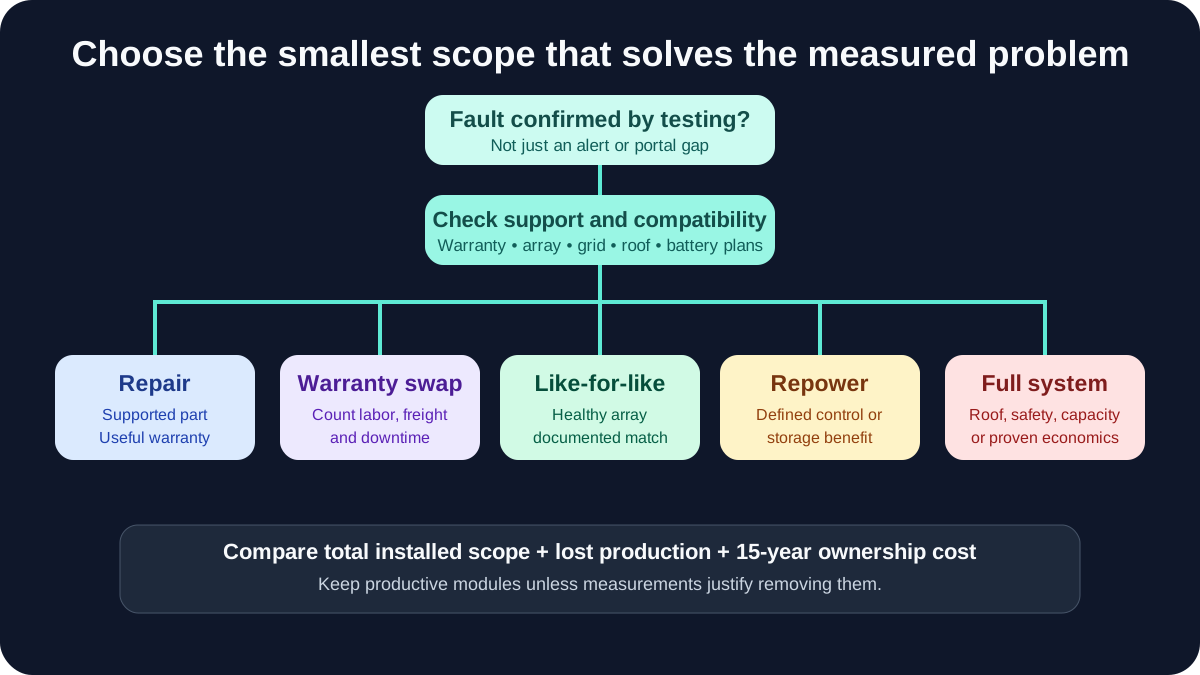
Compare inverter repair, warranty swap, likeforlike replacement, repowering, and fullsystem replacement using compatibility, permit, downtime, and 15year cashflow evidence.
Direct Answer
Compare inverter repair, warranty swap, likeforlike replacement, repowering, and fullsystem replacement using compatibility, permit, downtime, and 15year cashflow evidence.
Quick Checks
- 1Require test evidence that the inverter failed before approving replacement.
- 2Compare total installed scope, compatibility, permit, monitoring, warranty, downtime, and future battery plans - not hardware price alone.
- 3Keep old modules when they are safe, compatible, productive, and more valuable in service than removed for a sales upgrade.
Price the Decision, Not Just the Box
Short answer: Replace a failed solar inverter only after a qualified technician confirms the fault and checks module-string voltage, current, insulation, grid conditions, wiring, configuration, and monitoring. Compare four paths: repair, warranty replacement, a compatible like-for-like inverter, or repowering. A full new array makes sense only when roof work, unsafe or incompatible equipment, repeated failures, capacity goals, or strong lifetime economics justify removing working modules.
An inverter quote is not the same as an online hardware price. The installed decision can include diagnosis, access, electrical changes, rapid-shutdown equipment, permits, utility paperwork, monitoring migration, commissioning, taxes, shipping, warranty labor, and lost production.
First Confirm the Inverter Is the Problem
An inverter alert can be caused by the inverter, but it can also report a condition elsewhere. Examples include grid voltage, a ground or insulation fault, a missing DC string, a failed rooftop device, a loose connection, a rapid-shutdown issue, or incorrect settings.
Before paying for replacement, preserve:
- exact fault code and timestamp;
- monitoring export and event history;
- inverter model, serial number, firmware, and commissioning date;
- array module count, string layout, and DC size;
- AC rating, service voltage, breaker, and export limit;
- one-line diagram and interconnection approval;
- warranty certificate, installer contract, and ownership record;
- safe photos of labels and external condition;
- prior service records and any storm, roof, utility, or network event.
Use the solar underperformance diagnostic guide if the unit still operates but output looks low. A communications failure does not justify an inverter replacement when energy production continues.
What the technician should test
The exact procedure comes from the manufacturer and local rules. A useful written diagnosis may include:
| Test area | Evidence to request | What it can separate |
|---|---|---|
| DC array | open-circuit voltage, operating voltage/current by input, polarity | Missing string, array fault, wiring, input problem |
| Insulation/ground | manufacturer-approved isolation or ground-fault tests | Array or conductor fault versus internal inverter fault |
| AC side | voltage by leg/phase, connections, breaker, conductor drop | Utility/grid condition or AC wiring issue |
| Thermal | temperature, ventilation, fan, derating log | Heat/airflow issue versus component failure |
| Control | firmware, country/grid profile, export settings | Configuration or update issue |
| Monitoring | local energy counter versus portal/upload | Communications failure versus generation loss |
| Internal diagnostics | error history and manufacturer case | Repairable internal assembly or replacement decision |
Do not perform these tests as a homeowner. PV DC can remain energized in sunlight, and inverter capacitors may hold hazardous energy.
Use Five Replacement Paths
1. Repair the existing inverter
Repair can make sense when the manufacturer supports field replacement of a fan, display, communications board, relay assembly, or other approved part; the main power stage and enclosure remain sound; and labor plus downtime are reasonable.
Ask whether the repair receives a new warranty and whether parts are supported for the expected remaining system life. A cheap repair with no parts path can create a second service call soon after.
2. Use the product warranty
A warranty may provide a replacement unit but exclude diagnosis, removal, shipping, roof access, electrical changes, and installation labor. Read the terms rather than treating “12-year warranty” as “free repair.”
Confirm:
- original or remaining term;
- transfer rules after a home sale;
- registration requirement;
- replacement with new, refurbished, or equivalent equipment;
- freight and advance replacement;
- labor allowance;
- installer participation;
- monitoring-account access;
- whether the replacement inherits the old term or starts a new one.
Get the manufacturer case number. If the original installer has closed, ask the manufacturer for an authorized service path before choosing an unrelated replacement that could end a valid claim.
Use the solar warranty claim process to preserve the exact warranty version, claimant status, serials, diagnostics, labor exclusions, shipping, monitoring, and replacement-term treatment before authorizing a paid substitute.
3. Install a compatible like-for-like replacement
This is often the lowest-complexity paid path for a healthy array and stable interconnection. “Like-for-like” still needs proof. A current model may use different input voltage, current, connectors, communications, grounding, rapid-shutdown support, mounting, grid profile, or monitoring.
Compatibility checks include:
- maximum DC voltage in the coldest design condition;
- MPPT operating range;
- input current and short-circuit current limits;
- number and length of strings;
- module and optimizer approval;
- grounding and transformer topology;
- rapid-shutdown system;
- AC voltage, phase, breaker, and conductor capacity;
- export or zero-export controls;
- utility-approved equipment list;
- battery or generator interaction;
- outdoor rating and environmental limits.
Do not accept “same kilowatts” as a complete compatibility statement.
4. Repower the array
Repowering keeps some of the existing solar asset but changes the conversion architecture or other balance-of-system equipment. Examples include replacing a legacy central inverter with a modern string inverter, changing module-level electronics, adding approved rapid shutdown, adding storage controls, or restructuring strings.
Repowering can solve obsolescence, restore monitoring, support a battery, or improve serviceability. It can also add rooftop labor and new failure points. Ask for a marked-up one-line diagram showing exactly what stays and what changes.
5. Replace the complete solar system
A full replacement is the most material option. It may be reasonable when:
- the roof must be replaced and removal/reinstallation is already required;
- modules, racking, wiring, or enclosures are damaged or unsafe;
- old modules cannot be configured safely with supported inverters;
- repeated component failures make support impractical;
- the existing array is very small relative to a documented new load;
- a utility, code, or insurance condition cannot be resolved with a scoped repair;
- a larger new system has stronger incremental economics after removal, roof, interconnection, tax, and tariff effects are included.
It is not justified merely because newer panels have higher wattage. The Australian Government's Solar Consumer Guide notes that inverters often need replacement during panel life and that replacing an entire system at once is uncommon. Working modules still produce energy.
What Does an Inverter Replacement Cost?
There is no trustworthy universal installed price. Labor rates, system architecture, access, jurisdiction, electrical scope, warranty, and product availability create wide variation. Use local written quotes dated for the same scope.
Break every quote into these rows:
| Cost line | Quote A | Quote B | Quote C |
|---|---|---|---|
| Diagnostic visit and report | |||
| Inverter or replacement units | |||
| Optimizers/microinverters/rapid shutdown | |||
| Mounting, wiring, breaker, disconnect, labels | |||
| Roof access or lift | |||
| Removal and disposal/recycling | |||
| Permit and inspection | |||
| Utility/interconnection paperwork | |||
| Monitoring gateway and data migration | |||
| Commissioning and production verification | |||
| Taxes, shipping, travel | |||
| Warranty credit or labor allowance | |||
| Total installed |
Ask whether the price is fixed after diagnosis. A low bid with “electrical work extra” may be impossible to compare.
Illustrative quote, not a market price
Suppose a fictional quote contains:
- compatible string inverter: $1,850;
- diagnosis and design review: $280;
- removal and installation labor: $720;
- permit/inspection: $240;
- monitoring setup and commissioning: $180;
- recycling and travel: $130;
- tax: $260;
- total: $3,660.
That example shows the method only. It is not a current price claim for your city or system. Replace every line with local quotes and document currency, tax, and date.
Add the Cost of Downtime
An expensive fast repair can beat a cheaper unit with a long delivery delay during a high-production season.
Estimate lost value with separate self-consumption and export rates:
Daily lost value = missing self-consumed kWh × import rate + missing exported kWh × export rate
Assume the disabled system would produce 32 kWh/day. Sixty percent would be used at home at $0.28/kWh, and 40% exported at $0.09/kWh:
- home value: 19.2 × $0.28 = $5.38/day;
- export value: 12.8 × $0.09 = $1.15/day;
- total: $6.53/day;
- 45-day delay: about $294.
Use a weather-aware seasonal forecast, not the array’s annual average during peak summer or winter.
Compare 15-Year Ownership Cost
The cheapest day-one option may have poor warranty labor, obsolete monitoring, or another likely replacement before the panels retire.
For each path, estimate:
15-year ownership cost = installed price − warranty credits + expected maintenance + future replacement + lost-production value − incremental energy value
Discount future cash flows if you are making a formal investment comparison. Keep uncertain entries as ranges.
| Decision factor | Repair | Like-for-like | Repower | Full replacement |
|---|---|---|---|---|
| Upfront scope | Lowest when supported | Focused | Medium to high | Highest |
| Existing modules | Keep | Keep | Usually keep | Remove |
| Permit risk | Often low, varies | Low to medium | Medium | High |
| Monitoring | Existing | May migrate | Usually new | New |
| Battery readiness | Usually unchanged | Product dependent | Can be designed in | Can be designed in |
| Tariff/interconnection risk | Often lowest | Verify | Verify carefully | Highest chance of new review |
| Roof waste | Low | Low | Low to medium | High if working equipment removed |
| Warranty reset | Repair terms | New-unit terms vary | New equipment only | New system terms |
Do not count a new system’s gross production as a benefit. Count only production above what a repaired existing system would deliver.
Check the Roof Before Replacing Electronics
If roof replacement is likely within the next few years, coordinate the plans. Paying for an inverter now and a full remove/reinstall soon after can be wasteful. But leaving a dead system for years also loses energy.
Use the roof-before-solar decision guide to compare roof age, leak evidence, remaining life, removal/reinstallation, insurance, and timing. Ask the roofer and solar contractor to define separate warranties around penetrations and equipment handling.
A wall-mounted inverter replacement does not always require module removal. Do not let roof uncertainty become an automatic full-array sale.
Decide Whether to Add a Battery
An inverter failure creates a tempting moment to add storage. Treat that as a second decision. Battery economics, outage goals, critical-load design, tax treatment, tariff, product compatibility, and fire/electrical rules must stand on their own.
Ask:
- Is the proposed architecture AC-coupled or DC-coupled?
- Can the existing array charge the battery during a grid outage?
- Which equipment establishes the island and neutral/ground behavior?
- What continuous and surge power can it supply?
- Which loads are backed up?
- Does battery addition change the inverter choice or interconnection?
- What happens if the battery manufacturer exits or changes support?
- Can the home operate solar normally if the battery is unavailable?
Use the critical-load battery sizing guide to size energy and power. A “battery-ready” label without named compatible equipment, wiring, controls, and approvals is only a marketing phrase.
Old Modules and New Inverters
Module age alone does not decide compatibility. The designer needs exact electrical specifications and field condition.
Review:
- module model and label data;
- string open-circuit voltage at design cold temperature;
- current relative to new input limits;
- insulation and connector condition;
- grounding method;
- degradation and mismatch;
- available string lengths;
- listed or manufacturer-approved pairings with module-level devices;
- remaining product and performance warranties.
Mixing connector brands or incompatible mating parts can create serious risk even when connectors look similar. Use listed, approved methods and qualified installers.
If modules are productive but cannot fit a supported design, document the engineering constraint. “Too old” is not a measurement.
Microinverter Replacement Is a Different Job
One failed microinverter may reduce only one module’s output, but access can require roof work and module removal. A central inverter failure can stop the whole array but may be accessible at ground level.
For microinverters, ask:
- Is one unit failed or is the gateway mapping wrong?
- Is the exact replacement or a supported compatible model available?
- Will mixed generations operate on the same branch and gateway?
- Does the warranty cover roof labor?
- Can several aging units be replaced economically in one mobilization?
- Is the module, connector, trunk cable, or microinverter the measured cause?
Do not replace every microinverter solely because one failed. Do compare repeated roof mobilization cost when failures cluster and the manufacturer documents a supported upgrade path.
Permits, Utility Approval, and Tariff Risk
Requirements vary by country, state/province, utility, and authority having jurisdiction. Ask in writing whether the scope is treated as maintenance, equipment replacement, capacity change, or new interconnection.
Verify:
- electrical permit and inspection;
- building or fire review where applicable;
- utility notification or approval;
- approved inverter and grid-support settings;
- export capacity and control;
- meter or protection changes;
- whether tariff or legacy export credits are affected;
- insurance notice;
- equipment labeling and shutdown documentation.
Do not accept “no permit needed” without jurisdiction-specific support. Do not assume a full replacement preserves an old net-metering arrangement.
Monitoring and Data Ownership
A new inverter may strand old history. Before migration:
- export lifetime, annual, monthly, daily, and alert data;
- save array maps and serial numbers;
- confirm system owner and installer permissions;
- document old lifetime energy reading;
- define who creates the new account;
- test homeowner access before final payment;
- verify timezone, array size, tariff, and panel mapping;
- record the new commissioning baseline.
Ask whether monitoring requires a subscription, proprietary gateway, cellular plan, or installer account. A functioning inverter with inaccessible data is harder to maintain and sell with the home.
Commission the Replacement Properly
Final payment should follow documented commissioning, not simply a green light.
Request:
- model and serial numbers;
- updated one-line and labels;
- permit/inspection and utility records;
- DC and AC commissioning readings;
- firmware and grid profile;
- export-control test;
- rapid-shutdown test where required;
- monitoring access and array map;
- warranty registration;
- clear-day production verification;
- disposal/recycling receipt where available;
- owner shutdown and emergency instructions.
Compare actual output with the independent PVWatts estimate. One short test cannot prove annual energy, but it can catch missing inputs, configuration errors, or data problems.
Build a Quote Scorecard
Score each proposal from 0 to 2: zero means missing, one means partial, two means documented.
| Criterion | Weight | A | B | C |
|---|---|---|---|---|
| Failure evidence | 3 | |||
| Electrical compatibility | 3 | |||
| Complete installed scope | 3 | |||
| Permit/utility treatment | 2 | |||
| Warranty parts and labor | 2 | |||
| Monitoring/data migration | 2 | |||
| Commissioning plan | 2 | |||
| Downtime and availability | 1 | |||
| Recycling/end-of-life | 1 | |||
| Future battery/expansion fit | 1 |
Multiply score by weight. The score does not replace judgment, but it exposes a cheap proposal that omits the hardest work.
Questions for the Installer
- Which measured test proves the inverter, not the array or grid, failed?
- Is a manufacturer warranty case open?
- What exact equipment remains and what is removed?
- Show the cold-voltage, current, MPPT, AC, rapid-shutdown, and export compatibility checks.
- Is the total fixed, and what conditions can change it?
- Who obtains permits and utility approval?
- Could this work change my export tariff or system capacity record?
- What labor is excluded from the warranty?
- How many days of production are likely to be lost?
- Will historical monitoring data remain available?
- What readings prove the new unit is commissioned correctly?
- Who recycles the failed inverter?
Get material answers in the contract. Verbal promises are difficult to use when the crew or salesperson changes.
Use a Written Decision Rule
Choose the smallest scope that restores safe, supported production and still fits the home's documented plans. A repair wins when its expected service life, warranty, and downtime justify the cost. A compatible replacement wins when the array is healthy and the old platform is no longer practical. Repowering wins when a defined control, storage, serviceability, or compatibility benefit is worth the extra electrical work. Full replacement wins only when the incremental lifetime value exceeds keeping the existing asset after roof, removal, interconnection, tariff, and disposal effects are counted.
Write the rule before the sales meeting. For example:
Keep the existing modules unless testing finds unsafe insulation, widespread physical damage, incompatible electrical limits, or a full replacement has at least $6,000 more present value than a supported inverter-only option under the same conservative tariff and production assumptions.
Your threshold will differ. The point is to name it. Otherwise a salesperson can move the decision from “restore 7,800 annual kWh” to “buy the newest 12 kW package” without proving that the added capacity has enough roof space, household use, export value, or retained tariff.
Record the rejected options too. If a warranty unit was unavailable for 16 weeks, a repair lacked parts support, or a repower required a new utility study, that context will help the next owner or technician understand why the installed path was chosen.
Frequently Asked Questions
How long does a solar inverter last?
It depends on architecture, product, environment, loading, installation, maintenance, and failure definition. The Australian Government gives an average range of 10–15 years for string inverters and 20–25 years for microinverters. Treat ranges as planning inputs, not scheduled failure dates.
Should I replace a 12-year-old inverter before it fails?
Age alone is weak evidence. Consider alerts, parts availability, warranty, service access, downtime risk, roof plans, battery plans, and measured performance. Preventive replacement may suit a remote or mission-critical site; many homes can plan a reserve and wait for evidence.
Can I install a larger inverter?
Only after design, equipment, conductor, breaker, interconnection, export, and permit review. A larger AC rating may recover little annual clipping energy and can trigger utility changes. Model the incremental kWh and value.
Do I need new panels with a new inverter?
Usually not when existing modules are safe, productive, electrically compatible, and supported in the new design. Replace modules when condition, compatibility, roof, capacity, or economics proves the need - not as a default bundle.
Is inverter replacement a DIY job?
No. PV conductors can remain energized in daylight, equipment may store hazardous energy, and grid interconnection requires qualified work, testing, permits, and commissioning under local rules.
Can a replacement affect my solar warranty?
Yes. Review inverter, module, optimizer, installer, workmanship, and production-guarantee terms. Get manufacturer confirmation for substitute equipment and record the service case.
What to Read Next
Before approving replacement, run the exact production evidence through the solar underperformance diagnostic method; it can keep a monitoring, grid, or string problem from becoming an unnecessary inverter purchase.
About the Editorial Team EnergyBS compares public technical guidance, system records, and homeowner cash-flow assumptions. Prices in worked examples are illustrative. Obtain current local quotes, permits, utility approval, and qualified electrical design before proceeding.
Sources and Verification
- Australian Government: Replace and Recycle Your Solar System
- NREL: Photovoltaic Inverter Reliability Assessment
- NREL: Best Practices for Operation and Maintenance of Photovoltaic and Energy Storage Systems
- PNNL: Solar Photovoltaic Operations and Maintenance Best Practices
- U.S. DOE: Homeowner's Guide to Solar
- U.S. EPA: Certified Electronics Recyclers
Editorial Review
EnergyBS Editorial Team
EnergyBS publishes practical homeowner guides. Important program, product, and cost claims should be checked against the linked source and local project documents before you commit to work.
Related Guides
View All ArticlesSolar Panels Underperforming? Prove the Loss Before
A weatheraware method to separate low sunlight, monitoring gaps, clipping, shade, soiling, inverter faults, string failures, curtailment, and billing confusion.
Microinverters vs. String Inverters 2026 Tool
A roofspecific inverter comparison using shade and mismatch, DC/AC ratio, modulelevel electronics, monitoring ownership, service access, battery coupling, grid requirements, and a 25year replacement ledger.
Solar Panel Degradation: How Long Do Panels Last? (2026)
Warranties say 25 years. Reality says 40. Here is the actual data on how panels age, fail, and keep producing power long after you've paid them off.