Water Heater Repair Cost 2026: What Repairs Really Cost, by Part
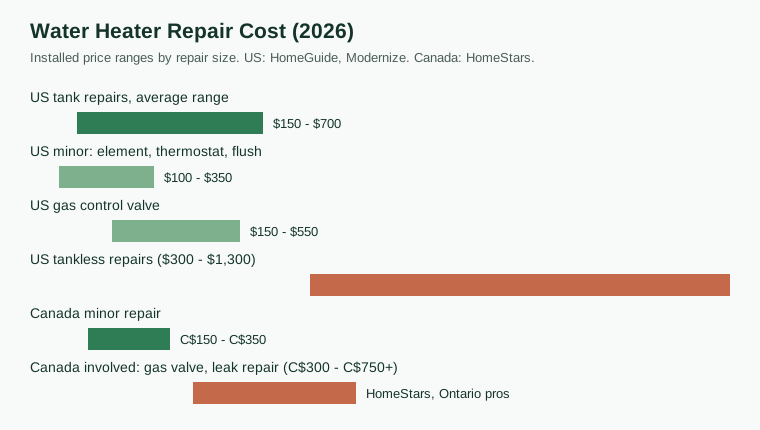
Most tank water heater repairs cost $150 to $700 in the US in 2026, with a $455 national average (HomeGuide, 349 reported projects). The failed part decides where a quote lands: a heating element or thermostat runs $100 to $350 installed, a thermocouple $100 to $325, a gas control valve $150 to $550, and a tankless heat exchanger $600 to $1,300. Tankless repairs as a group run $300 to $1,300. In Canada, minor repairs such as a thermostat or element run C$150 to C$350 and larger jobs such as a gas valve or leak repair C$300 to C$750 or more (HomeStars). This guide prices repairs by part and by symptom for tank, tankless, gas, and electric units in both countries, and works the repair-or-replace math on three labelled examples.
Quick Checks
- 1Budget $150 to $700 for a typical US tank water heater repair in 2026, with a $455 national average (HomeGuide). A tankless repair runs higher as a group, at $300 to $1,300.
- 2The part sets the price: heating element and thermostat at $100 to $350 installed at the low end (HomeGuide); thermocouple $100 to $325 and gas control valve $150 to $550 in the middle; a tankless heat exchanger at $600 to $1,300 at the top.
- 3The part itself is often cheap. Angi prices an element at under $20 and a thermostat at $10 to $250 before labour, while plumbers charge $45 to $150 per hour (HomeGuide). Most of a repair bill is the visit, the drain-down, and the labour.
- 4In Canada, minor repairs such as a thermostat or element run C$150 to C$350, and larger jobs such as a gas valve or leak repair run C$300 to C$750 or more (HomeStars). Emergency call-out fees add C$50 to C$200.
- 5A leak from the tank itself is not a repair. Both HomeGuide and Modernize treat a leaking tank as a replacement: no part swap fixes a corroded tank wall.
- 6Use the 50 percent test before a large quote: HomeGuide advises considering replacement when a water heater is over 10 years old or the repair costs more than 50 percent of the replacement cost.
Water Heater Repair Cost 2026: What Repairs Really Cost, by Part
By EnergyBS Editorial Team | October 28, 2026
The Short Answer
Short Answer: Most tank water heater repairs cost $150 to $700 in the US in 2026, with a national average of $455 across 349 reported projects (HomeGuide). The failed part decides where inside that range a quote lands. A heating element or a thermostat runs $100 to $350 installed, a thermocouple $100 to $325, a gas control valve $150 to $550, and a flush $75 to $250. Tankless units repair higher as a group, at $300 to $1,300, and a tankless heat exchanger alone runs $600 to $1,300 (HomeGuide). Modernize sorts the same market into tiers: minor repairs $100 to $350, medium repairs $200 to $750, and severe problems $750 to $1,775 or more. In Canada, minor fixes such as a thermostat or heating element generally run C$150 to C$350, while a gas valve replacement or leak repair can run C$300 to C$750 or more (HomeStars, Ontario). One finding overrides every table below: a leak that comes from the tank itself is not a repair at any price. The tank gets replaced.
Water heater quotes confuse people for a structural reason. The symptom is one sentence (no hot water, lukewarm water, a puddle, a rumbling tank) and the causes sit in very different price bands. No hot water from an electric tank can be a tripped breaker that costs nothing, an element at $100 to $350, or a thermostat at $100 to $350. No hot water from a gas tank can be a pilot light at $50 to $200, a thermocouple at $100 to $325, or a gas control valve at $150 to $550. This guide prices the parts first, then maps symptoms to the parts that usually cause them, then works the repair-or-replace decision. Our companion guide prices the other side of that decision: tank water heater replacement cost.
The repair in six steps:
- Name the symptom precisely before you call: no hot water at all, hot water that runs out fast, lukewarm only, water too hot, noise, rusty water, or water on the floor. Note whether the leak, if there is one, comes from a valve or fitting at the top or from the tank body near the bottom.
- Check the free items first: the breaker on an electric unit, the thermostat setting, and on a gas unit whether the pilot is lit. HomeGuide prices a blown fuse at $10 to $20 and a reset breaker can cost nothing at all.
- Find the age. The rating plate carries the model and serial number, and the manufacture date is usually coded in the serial. Age decides how much repair money the tank can justify (Section 8).
- Book the diagnostic visit and confirm the fee, and whether it is credited toward the repair, before the truck rolls. Published diagnostic and call-out fees run $50 to $200 (HomeGuide) and $75 to $200 (Modernize).
- Get the failed part named in writing, with part and labour as separate lines, and check it against Section 2 (US tank), Section 3 (tankless), or Section 4 (Canada).
- If the quote passes $500, run the percentage test in Section 8 before approving: repair cost against replacement cost, at your unit's age.
1. What a Repair Bill Is Made Of
A water heater repair bill looks odd until you split it into its three lines, because the parts on this appliance are cheap and the labour is not.
The diagnostic fee. HomeGuide puts minimum service call-out fees at $50 to $200, and Modernize puts a diagnostic or service call at $75 to $200. Plumbers charge $45 to $150 per hour for water heater work (HomeGuide). Ask whether the fee is credited toward the repair if the same company does the work. Two quotes $150 apart are often the same repair with different fee handling.
The part. Angi publishes part prices with labour excluded, and they explain the shape of every bill in this guide: a heating element costs under $20 as a part, a thermostat $10 to $250, an anode rod $15 to $35, a dip tube $10 to $60, a pressure relief valve $15 to $150, and a gas control valve $120 to $280. Almost nobody pays part price alone, because almost every repair includes draining some or all of the tank, swapping the part, refilling, purging air, and checking for leaks. That is why an element that retails for under $20 lands at $100 to $350 installed (HomeGuide) and $200 to $300 in Angi's by-service table.
The clock and the calendar. Timing is the line you control. HomeStars puts Canadian emergency or after-hours call-out fees at C$50 to C$200 on top of standard repair rates. A heater that has failed safely (no active leak, no gas smell, no scalding water) on a Friday night usually costs less repaired on Monday. A heater that is leaking onto the floor, discharging from its relief valve, or showing any sign in Section 7 is not a wait-until-Monday case.
Access. A tank in an open basement corner and the same tank in a tight closet or attic do not take the same labour time. Anode rod replacement is the clearest case: the rod comes out of the top of the tank, and a unit installed under a low ceiling can turn a $150 to $350 job (HomeGuide) into a partial drain, tilt, or disconnect job. Ask whether the quote assumes normal access.
2. US Prices by Part: Tank Units
HomeGuide's 2026 table is the spine here; it reports average costs to repair, parts and labour included, from member project data. Modernize's 2026 table, updated August 12, 2026, sits close to it on most parts and is noted where the two differ.
| Repair or part | Typical US cost (2026) | Source |
|---|---|---|
| Blown fuse / tripped breaker | $10 - $20 | HomeGuide |
| Flush and clean tank | $75 - $250 | HomeGuide; Modernize $100 - $250 |
| Pilot light replacement | $50 - $200 | HomeGuide |
| Pressure relief (T&P) valve | $50 - $300 | HomeGuide; Modernize $150 - $350 |
| Heating element | $100 - $350 | HomeGuide; Modernize $150 - $350; Angi $200 - $300 |
| Thermostat | $100 - $350 | HomeGuide; Modernize $100 - $300; Angi $150 - $200 electric |
| Dip tube | $100 - $300 | HomeGuide; Modernize $150 - $400 |
| Thermocouple | $100 - $325 | HomeGuide; Modernize $150 - $350; Angi $100 - $150 |
| Flue pipe | $100 - $350 | HomeGuide |
| Igniter repair | $75 - $350 | HomeGuide; Modernize pilot/ignition $150 - $450 |
| Tune-up | $100 - $500 | HomeGuide |
| Anode rod | $150 - $350 | HomeGuide; Modernize $200 - $500; Angi $85 - $180 |
| Gas control valve | $150 - $550 | HomeGuide; Modernize $250 - $750; Angi $400 |
| Leak repair (fittings, valves, lines) | $100 - $1,000 | HomeGuide; Modernize $150 - $600; Angi $370 - $570 |
| Expansion tank | $300 - $800 | HomeGuide; Modernize $150 - $400; Angi $220 - $480 |
| Circulator / recirculation pump | $150 - $680 | HomeGuide |
| Timer | $100 - $350 | HomeGuide |
Read the table in three bands:
The $100 to $350 band is where most repairs live. Elements, thermostats, thermocouples, dip tubes, and flushes are wear items with a known swap procedure. HomeGuide's $455 national average sits just above this band because the average mixes in the larger jobs below. If your unit is under 10 years old and the quote is in this band for one named part, the repair is normally the straightforward choice (the full test is in Section 8).
The gas control valve is the mid-price risk. At $150 to $550 (HomeGuide), $250 to $750 (Modernize), and $400 as a single Angi figure, it is the most expensive common repair on a gas tank, and the spread between sources is wide because the valve is brand-specific on many models: the part alone runs $120 to $280 (Angi, labour excluded). A valve quote deserves the same question as a boiler control board quote: what test condemned it? A thermocouple at $100 to $325 produces the same headline symptom (pilot will not stay lit), and a competent diagnostic tests the thermocouple before condemning the valve it reports to.
Leak repairs split in two, and only one half is a repair. HomeGuide's $100 to $1,000 leak range covers leaks from fittings, valves, and lines. A leak from the tank body is a different event entirely: the steel has corroded through, there is no patch, and both HomeGuide and Modernize treat it as replacement. Section 7 covers how to tell the two apart. Our water heater leak guide walks the source-by-source diagnosis in detail.
3. Tankless Prices: A Separate, Higher Band
Tankless repairs price differently because the failure list is different: no tank to corrode, but a heat exchanger that scales, flow and temperature sensors, and an ignition system that works on every draw.
| Tankless service | Typical US cost (2026) | Source |
|---|---|---|
| Flush and descale (maintenance) | $75 - $300 | HomeGuide; service-specific flush $150 - $350 |
| Descaling, Modernize table | $150 - $400 | Modernize |
| Sensor replacement | $150 - $500 | Modernize |
| Heat exchanger | $600 - $1,300 | HomeGuide ($600 - $700 labour alone; $1,200 - $1,300 with the part) |
| Heat exchanger issues, Modernize | $500 - $1,500+ | Modernize |
| Tankless repairs, all types | $300 - $1,300 | HomeGuide |
| Tankless maintenance overall | $75 - $350 | HomeGuide |
Two points decide most tankless repair decisions. First, maintenance is the cheapest repair there is: HomeGuide puts a tankless flush at $150 to $350 on its service-specific line, recommends flushing at least once a year, and states plainly that failure to flush is the leading cause of tankless breakdowns in its data. Our tankless descaling guide covers the procedure and the error codes scale produces. Second, the heat exchanger is to a tankless unit what the tank is to a storage unit: the core part. At $600 to $1,300 (HomeGuide) or $500 to $1,500 or more (Modernize), an exchanger quote on an older unit belongs in Section 8's percentage test against a new tankless replacement at $800 to $3,500 (HomeGuide repair guide figure; our tankless installation cost guide prices full installs, including conversions, higher). HomeGuide adds one warranty note that changes the math on younger units: manufacturer warranties typically cover labour for 1 year and parts for 5 to 12 years, so an exchanger failure inside the parts window may cost labour only.
4. Canada Prices
Canadian published pricing for water heater repair is thinner than US pricing, and the clearest current source is HomeStars' pro pricing for Ontario cities, in Canadian dollars.
| Repair scope | Typical Canada cost (2026) | Source |
|---|---|---|
| Minor fix: thermostat or heating element | C$150 - C$350 | HomeStars (Brampton, ON) |
| Involved work: gas valve replacement or leak repair | C$300 - C$750 or more | HomeStars (Brampton, ON) |
| Emergency / after-hours call-out fee | C$50 - C$200 on top of standard rates | HomeStars (Brampton, ON) |
| Full replacement, for comparison | C$1,000 - C$3,500 | HomeStars (Brampton, ON) |
| Replacement labour alone, standard tank | C$450 - C$600 | HomeStars (Brampton, ON) |
The structure matches the US market: the same two bands (a minor band and an involved band) with Canadian labour priced inside them. Two Canada-specific notes apply. First, a large share of Ontario homes rent their water heater rather than owning it. If your tank is a rental, most repairs are the rental company's cost, not yours: check the tank's rating plate and your gas or hydro bill for a rental line before paying for any repair in the table above. Calling the rental company's service line first is the cheapest step in Canadian water heater repair. Second, gas water heater work is gas fitting work. In Ontario that means a certified gas technician, and the certificate belongs on the invoice for the same reason it does on a furnace or boiler repair: an uncertified gas repair can void the appliance warranty and complicate an insurance claim if something fails later.
5. Cost by Fuel and Type
The same symptom prices differently by fuel, because the parts that produce it differ.
| Unit type | Typical repair range (US) | Failures that set the price |
|---|---|---|
| Electric tank | $100 - $350 on average | Heating element, thermostat, tripped breaker |
| Gas tank | $50 - $600 | Pilot, thermocouple, gas control valve, flue |
| Tankless (gas or electric) | $300 - $1,300 | Scale in the exchanger, sensors, ignition, exchanger itself |
| Storage tank overall | $150 - $700 average range; $455 average | Mix of the rows above |
Electric tank repairs sit in the narrowest band because the failure list is short: two elements, two thermostats, a breaker, and wiring. HomeGuide notes the diagnostic value of which element failed: lukewarm water throughout points at the upper element, while hot water that runs out quickly points at the lower element, because the lower element does the recovery work after a draw. Gas tank repairs start cheaper (a pilot relight can be a $50 to $200 visit, and a thermocouple $100 to $325) and end higher, because the gas control valve and any flue work carry gas-safety labour. HomeGuide prices flue pipe replacement at $100 to $350 and warns that a damaged flue or poor venting can release exhaust gas into the house, which puts flue work in the do-not-defer category in Section 7.
Heat pump water heaters sit between the tank and tankless bands for a different reason: the water-side parts (elements, thermostats, anode, valves) price like a tank unit, while the refrigeration-side parts price like a heat pump and need a different technician. If a quote on a hybrid unit looks like a tank quote for a compressor-side fault, get a second quote from a company that services the refrigeration side. Our heat pump water heater cost guide covers the replacement side of that comparison.
6. Symptom to Part: What You Describe, What It Usually Is
Callers describe symptoms; invoices charge for parts. This map connects the two, using HomeGuide's published problem-and-cause table and Modernize's signs table, priced from Sections 2 to 4. It is a starting point for the conversation with the plumber, not a diagnosis of your unit.
| What you notice | Parts usually tested first | Typical US cost |
|---|---|---|
| No hot water, electric | Breaker, upper element, upper thermostat | $10 - $350 |
| No hot water, gas | Pilot, thermocouple, gas control valve | $50 - $550 |
| Hot water runs out fast | Lower element, sediment load, dip tube | $100 - $350 |
| Lukewarm water only | Upper element, thermostat, cracked dip tube | $100 - $400 |
| Water too hot | Thermostat, T&P valve check | $100 - $350 |
| Rumbling or popping noises | Sediment buildup; flush first | $75 - $250 |
| Rusty or discoloured hot water only | Anode rod spent, tank corrosion starting | $150 - $350 for the rod; corrosion means replacement |
| Rotten-egg smell in hot water | Anode rod reaction, sediment | $150 - $350 |
| Puddle at the base | Drain valve, element gasket, T&P discharge, or the tank body | $100 - $1,000 if a fitting; replacement if the tank body |
| T&P valve drips | Excess pressure, failed expansion tank, failing valve | $50 - $800 depending on which of the three |
| Tankless: error codes, flow drops | Scale in the exchanger, sensors | Descale $150 - $400; sensors $150 - $500 |
Three rows deserve a warning each:
Rumbling is sediment until proven otherwise. The popping and rumbling come from steam forming under a sediment layer at the bottom of the tank, the same mechanism HomeGuide and Modernize both tie to a flush: $75 to $250 (HomeGuide) or $100 to $250 (Modernize). A flush quote is the first move. An element or tank quote for a noise complaint, without a flush being tried or sediment being shown to you, skips the cheap step. Heavy sediment also shortens the lower element's life, so a unit that has never been flushed can legitimately need both.
Rusty hot water has a clock on it. If only the hot water runs rusty, the anode rod has usually finished its service life and the tank steel has started to corrode in its place. A new rod at $150 to $350 (HomeGuide) slows that process; it does not reverse corrosion that has already started. Our anode rod maintenance guide covers rod types, the 3-to-5-year replacement interval HomeGuide recommends, and the clearance problem that makes some rods a professional job. Budget-wise, rusty water on a tank over 10 years old is a reason to price a replacement alongside the rod, not after it.
Where the puddle starts decides everything. Water that tracks down from a top fitting, the T&P valve, or the drain valve is a fitting repair inside the $100 to $1,000 leak band (HomeGuide). Water that seeps from the tank body itself, or rust streaks running down the jacket from a seam, is the tank failing. Shut off the cold supply and the fuel or power, drain what you safely can, and move straight to replacement quotes. Paying a diagnostic fee to confirm a body leak is reasonable; paying for a repair attempt on one is not.
7. The Safety Cases: When Repair Stops Being a Price Question
Most water heater faults are money. Three are not, and they override every table in this guide.
A malfunctioning gas control valve is a gas hazard. HomeGuide's warning is direct: if the gas control valve malfunctions, shut off the gas supply and contact a plumber for emergency repairs, because a faulty valve can cause a gas leak, fire, or explosion. If you smell gas, leave the house and call the gas utility or 911 from outside. Relighting a pilot by hand on a unit with electronic ignition is also out: HomeGuide advises following the manual and never hand-lighting an electronic-ignition unit.
Never cap or plug a discharging T&P valve. The temperature and pressure relief valve is the device that keeps an overheating tank from becoming a pressure rupture. HomeGuide puts its replacement at $50 to $300 and directs homeowners to repair a faulty valve immediately. A discharge means the tank reached the valve's temperature or pressure setting, or the valve itself has failed. Replacing the valve, the expansion tank, or both is the fix. Plugging the discharge pipe converts a $50 to $800 repair into a hazard.
A leaking tank is a flood on a timer. A tank body leak does not stabilise; corrosion that has opened one pinhole has thinned the surrounding steel. Until the replacement lands: cold supply off, power or gas off, and a drain hose on the drain valve if the valve still works. Water damage from a tank that lets go in full is the expensive outcome every other decision in this guide is priced against.
A fourth case is quieter: water that has become scalding hot without any setting change points at a failed thermostat or a failing T&P valve, the two parts that stand between normal operation and an overheat. Treat it as urgent, turn the thermostat down, and book the visit the same day.
8. Repair or Replace: The 50 Percent Test, Worked
HomeGuide gives the industry framing in one line: consider replacing a water heater over 10 years old, or when the repair costs more than 50 percent of the replacement cost. The lifespans behind the age line are 8 to 15 years for a tank unit and 10 to 20 years for tankless (HomeGuide). The denominator matters, so fix it first: HomeGuide prices a new tank replacement at $600 to $1,800 and a new tankless replacement at $800 to $3,500 in its repair guide, while our tank replacement guide puts a standard 40- to 50-gallon tank swap at $600 to $3,100 installed in the US once size, fuel, and code upgrades are counted, and C$1,100 to C$3,000 or more in Canada. Use the replacement quote for the unit you would actually buy, not the cheapest line in any table.
Hypothetical example 1 (labelled as such): heating element on a 5-year-old electric tank, US. Quote: $275, inside HomeGuide's $100 to $350 element range and Angi's $200 to $300 by-service range. The same plumber's replacement quote for a like-for-like tank is $1,300, inside the $600 to $3,100 installed range in our replacement guide. The repair is 21 percent of replacement ($275 divided by $1,300), on a tank with most of its 8-to-15-year life left. Repair it.
Hypothetical example 2 (labelled as such): gas control valve plus a flush on a 12-year-old gas tank, US. Quotes: $650 for the valve, inside Modernize's $250 to $750 range, plus $180 for the flush the sediment load needs, inside Angi's $180 to $220 flush range, for $830 total. Replacement quote for a like-for-like gas tank: $1,450, inside the same installed range. The combined repair is 57 percent of replacement ($830 divided by $1,450), past the 50 percent line, on a tank that is 12 years into an 8-to-15-year life and has never had its anode rod changed. Replace it, and put the $830 toward the new tank's warranty years instead.
Hypothetical example 3 (labelled as such): thermostat and element on a 7-year-old tank, Ontario. Quote: C$320 for both, inside HomeStars' C$150 to C$350 minor-repair band. Replacement quote: C$1,900, inside HomeStars' C$1,000 to C$3,500 replacement range. The repair is 17 percent of replacement (C$320 divided by C$1,900). Repair it, and add an anode rod inspection to the same visit: the rod is the part that decides whether this tank reaches the top of its lifespan range, and the tank is already open on the bench, so to speak, with a technician standing in front of it.
The pattern across all three: percentage first, age second, part third. A cheap part on a young tank is almost always the right spend. An expensive part on an old tank is usually the wrong one, even when the part itself would fix the symptom, because the tank wall, the anode, and the other wear parts are the same age as the part that failed. If the decision lands on replacement and you are weighing a fuel or type switch at the same time, our water heater fuel type cost comparison works the operating-cost side of tank, tankless, and heat pump options.
9. The Maintenance That Prevents the Big Bills
Two scheduled items carry almost all of the prevention value on a tank unit, and both are priced in the same sources as the repairs they prevent:
- Annual flush. A professional flush runs $75 to $200 (HomeGuide's flush-specific line; its by-service table says $75 to $250). Sediment is the root cause behind the rumbling row, much of the lower-element wear, and part of the anode and tank corrosion story in Section 6. On a tankless unit the equivalent is descaling: $150 to $350 (HomeGuide), recommended at least once a year, and more often in hard water.
- Anode rod every 3 to 5 years. HomeGuide recommends replacement on that interval and prices the rod at $150 to $350 installed, or $20 to $50 for the part alone; Angi prices the rod itself at $15 to $35. The rod corrodes so the tank does not. A rod that is never changed is the single most common reason a tank dies at year 8 instead of year 14.
- A tune-up when symptoms start, not after they stack. HomeGuide prices a water heater tune-up at $100 to $500, covering leak and corrosion checks, a flush, burner cleaning on gas units, and tests of the T&P valve, gas control valve, and elements. One visit that tests all three safety and wear items is cheaper than three separate diagnostic fees across a winter.
None of this extends a tank past the lifespan ranges in Section 8. It moves failures from the emergency band (after-hours fees, water on the floor, a forced same-day replacement at the first quote offered) to scheduled work at standard rates, which over a 12-year tank life is worth more than any single repair in this guide. If the symptom you already have is hot water that runs out too fast, our hot water diagnostic guide works that problem step by step before you book anyone.
10. Quote Checklist: How to Compare Water Heater Repair Quotes
Quotes vary more by scope than by company. Before approving a repair over $300, get these in writing:
- The failed part named specifically (not "heating issue" or "control problem"), with the test or reading that condemned it
- Part price and labour shown as separate lines, especially on a gas control valve, where the part alone runs $120 to $280 (Angi)
- Whether the diagnostic or call-out fee ($50 to $200 in the published ranges) is included, credited, or charged on top
- Drain-down, refill, and leak check included in the labour line, or billed separately
- On a gas unit: whether the thermocouple was tested before the gas control valve was condemned
- Parts warranty and labour warranty stated separately, with durations
- Whether the tank itself is still under manufacturer warranty, and the manufacture year read from the rating plate during the visit
- For any quote over $500: a replacement quote for the whole unit from the same visit, so Section 8's percentage test runs on real numbers
- On a rental tank in Canada: confirmation of who owns the unit and who pays, checked before the work starts
- The old part returned or shown to you, on any repair over $300
Red flags: a gas control valve condemned without a thermocouple test, a tank-body leak described as repairable, a quote that is only a total with no part named, any suggestion to plug a T&P discharge or disable a safety control, and pressure to decide during the visit on a unit that is heating and not leaking. Each of those converts a priced repair into an unpriced risk.
Frequently Asked Questions
How much does it cost to repair a water heater in 2026? Most US tank repairs cost $150 to $700, with a $455 national average across 349 reported projects (HomeGuide). Common parts sit inside that range: element or thermostat $100 to $350, thermocouple $100 to $325, gas control valve $150 to $550. Tankless repairs run $300 to $1,300. In Canada, minor repairs run C$150 to C$350 and involved work C$300 to C$750 or more (HomeStars).
What is the most common water heater repair? On electric tanks, a heating element: $100 to $350 installed (HomeGuide), with the part itself under $20 (Angi) and the rest labour and drain-down. On gas tanks, the thermocouple is the most common repair in HomeGuide's account, at $100 to $325, because it is the part that keeps the pilot lit.
How much does it cost to replace a heating element? $100 to $350 installed in the US (HomeGuide; Modernize $150 to $350; Angi $200 to $300 by service). Lukewarm water throughout usually means the upper element; hot water that runs out fast usually means the lower element (HomeGuide). In Canada an element replacement sits in HomeStars' minor-repair band at C$150 to C$350.
How much does a gas control valve replacement cost? $150 to $550 (HomeGuide) or $250 to $750 (Modernize); Angi's by-service figure is $400, and the part alone runs $120 to $280 (Angi). It is the most expensive common repair on a gas tank, and it deserves a thermocouple test first, because a failed thermocouple at $100 to $325 produces the same pilot symptom.
Can a leaking water heater be repaired? Only if the leak comes from a fitting, valve, or line: those repairs run $100 to $1,000 (HomeGuide). A leak from the tank body means the steel has corroded through. Both HomeGuide and Modernize treat that as replacement, not repair.
Is it worth repairing a 12-year-old water heater? Usually only for a cheap part. HomeGuide advises considering replacement past 10 years, or when a repair passes 50 percent of replacement cost, and tank lifespans run 8 to 15 years. A $200 element at year 12 can be reasonable; an $800 valve-and-flush combination at year 12, as in Section 8's second example, is 57 percent of a $1,450 replacement and is not.
How much does it cost to flush a water heater? A professional tank flush runs $75 to $250 (HomeGuide) or $100 to $250 (Modernize); Angi's by-service figure is $180 to $220. Tankless descaling runs $150 to $350 (HomeGuide). Both are recommended at least once a year, and more often with hard water.
How long do water heater repairs take? Most single-part repairs in this guide are one-visit jobs: the published labour rates ($45 to $150 per hour, HomeGuide) and the part prices assume a standard swap with drain-down and refill. Jobs that stretch are the ones waiting on a brand-specific part, most often a gas control valve or a tankless heat exchanger, or where access forces a partial disconnect before the part can be reached.
Common Questions
What should I check first before using this water advice?
Start with the numbers that apply to your home: climate, utility rate, equipment age, contractor quote, and local program rules. Most tank water heater repairs cost $150 to $700 in the US in 2026, with a national average of $455 across 349 reported projects (HomeGuide). The failed part decides where inside that range a quote lands. A heating element or a thermostat runs $100 to $350 installed, a thermoc...
How should I verify rebates, tax credits, rates, or savings before spending money?
Treat program amounts, utility rates, and tax rules as date-sensitive. Check the named government, utility, or manufacturer source before you sign a contract, and keep screenshots or PDFs of eligibility rules for your records.
When should I involve a licensed professional instead of doing this myself?
Bring in a licensed electrician, HVAC technician, or other qualified professional for panel work, refrigerant handling, combustion equipment, structural changes, or anything that needs a permit or inspection. A guide can help you prepare questions and compare options, but it does not replace licensed work where codes or safety are involved.
How should I compare contractor quotes for this kind of work?
Ask each contractor to separate equipment, labor, electrical work, permits, and rebate assumptions on the quote, and to name the exact model numbers being priced. Comparing itemized quotes on the same scope is more useful than comparing headline prices, and it shows which savings claims depend on incentives you have not yet confirmed.
What is the next useful step after reading this?
Compare this with Tank Water Heater Replacement Cost 2026: What Installation Really Costs so you can check the cost, rebate, installation, or operating-risk angle before making a decision.
What to Read Next
Tank Water Heater Replacement Cost 2026: What Installation Really CostsUse this next to compare the cost, incentive, installation, or operating-risk angle before you make a home energy decision.Sources and Verification
- HomeGuide Water Heater Repair Cost (2026) (tank repairs $150 to $700 on average, national average $455, minimum $50, maximum $1,500, based on 349 project costs reported by HomeGuide members; by service, parts and labour: anode rod $150 to $350, dip tube $100 to $300, expansion tank $300 to $800, flue pipe $100 to $350, flush and clean tank $75 to $250, flush and descale tankless $75 to $300, gas control valve $150 to $550, heat exchanger $600 to $1,300, heating element $100 to $350, igniter $75 to $350, leak repairs $100 to $1,000, pilot light $50 to $200, pressure relief valve $50 to $300, thermocouple $100 to $325, thermostat $100 to $350, timer $100 to $350, tune-up $100 to $500, circulator pump $150 to $680; minimum service call-out fees $50 to $200; plumbers charge $45 to $150 per hour; gas water heater repairs $50 to $600; electric water heater repairs $100 to $350 on average; tankless maintenance $75 to $350 and tankless repairs $300 to $1,300; tankless flush $150 to $350; tankless heat exchanger $600 to $700 labour alone or $1,200 to $1,300 parts and labour; anode rod part alone $20 to $50, replace every 3 to 5 years; dip tube part alone $10 to $20; professional flush $75 to $200; tank water heaters last 8 to 15 years, tankless 10 to 20 years; consider replacing a water heater over 10 years old or when the repair costs more than 50 percent of the replacement cost; new tank replacement $600 to $1,800, new tankless replacement $800 to $3,500)
- Modernize Water Heater Repair Cost 2026, updated August 12, 2026 (repair tiers: minor $100 to $350, medium $200 to $750, severe $750 to $1,775 or more; diagnostic or service call $75 to $200; thermostat $100 to $300; heating element $150 to $350; tank flushing $100 to $250; anode rod $200 to $500; dip tube $150 to $400; T&P relief valve $150 to $350; gas thermocouple or flame sensor $150 to $350; pilot or ignition repair $150 to $450; gas control valve $250 to $750; leak repair for valves, fittings and lines $150 to $600; expansion tank $150 to $400; tankless descaling $150 to $400; tankless sensor $150 to $500; tankless heat exchanger $500 to $1,500 or more; a leaking tank itself typically means replacement, not a repair)
- Angi How Much Does Water Heater Repair Cost? updated August 4, 2026 (part prices alone, labour extra: thermostat $10 to $250, heating element under $20, pressure relief valve $15 to $150, anode rod $15 to $35, dip tube $10 to $60, gas control valve $120 to $280, gas burner $30 to $60 for the main burner and $120 to $180 for the full assembly, flue pipe $30 to $100, igniter $30 to $60 and $100 to $250 for the full assembly, circulator pump $50 to $400, water tank $400 to $1,800; by service, parts and labour: flush $180 to $220, repairing a leaking water heater $370 to $570, pressure relief valve replacement $180 to $220, dip tube replacement $180, anode rod replacement $85 to $180, expansion tank replacement $220 to $480; gas services: pilot light replacement $100 to $150, thermocouple replacement $100 to $150, thermostat $250, gas control valve replacement $400; electric services: heating element replacement $200 to $300, thermostat replacement $150 to $200)
- HomeStars Water Heater Repair Pros, Brampton, Ontario, Canada (minor fixes such as a thermostat or heating element replacement generally range from C$150 to C$350; more involved work such as a gas valve replacement or leak repair can run C$300 to C$750 or more; emergency or after-hours call-out fees generally range from C$50 to C$200 on top of standard rates; water heater replacement costs C$1,000 to C$3,500, with labour alone typically C$450 to C$600 for a standard tank)
Editorial Review
EnergyBS Editorial Team
EnergyBS publishes practical homeowner guides. Important program, product, and cost claims should be checked against the linked source and local project documents before you commit to work.
Related Guides
View All ArticlesTank Water Heater Replacement Cost 2026: What Installation Really Costs
Replacing a standard tank water heater in 2026 typically costs $600-$3,100 installed in the US for a 40- to 50-gallon unit, and $1,100-$3,000+ in Canada. This guide breaks down size, fuel, labor, code upgrades, repair-vs-replace math, and running costs.
Tankless Water Heater Installation Cost 2026: Prices, Add-Ons and Payback
A tankless water heater costs $1,400-$5,600 installed in the US in 2026, and C$2,800-$6,500 for a typical Canadian gas install. This guide breaks down unit, labor, venting, gas-line and panel add-ons, sizes the unit, and runs 20-year payback math with stated assumptions against a new tank.
Water Heater Anode Rod and Maintenance 2026 Tool
A model-specific water-heater maintenance plan covering anode type and depletion, water chemistry, access, flushing, relief and leak checks, heat-pump filters/condensate, tankless scale service, records, and replacement contingencies.