Dishwasher Repair Cost 2026: What Repairs Really Cost, by Part
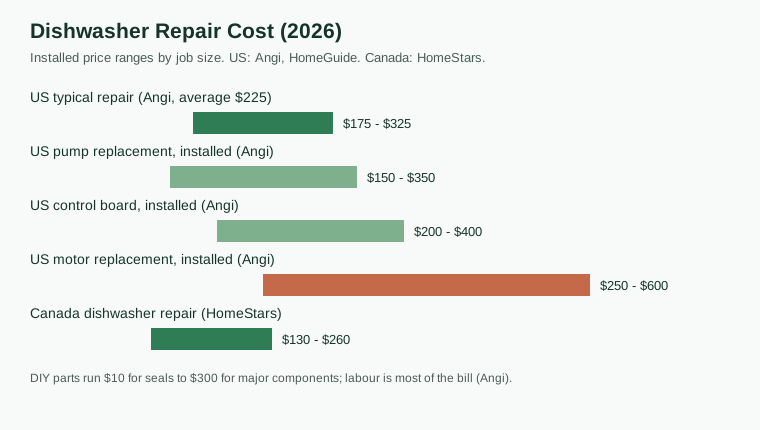
Most dishwasher repairs cost $175 to $325 in the US in 2026, with a national average of $225 (Angi, updated October 21, 2026). HomeGuide puts dishwasher repair at $100 to $300 on average, naming the pump, heating element and motor as the most commonly replaced parts. Angi prices the work by repair type: a door latch runs $75 to $175, a spray arm $75 to $150, a pump $150 to $350, a heating element $150 to $300, a control board $200 to $400, and a motor $250 to $600. Smart and drawer models cost more to fix than a standard built-in, and a leak repair sits at $100 to $250 before any water damage is counted. In Canada, the HomeStars cost guide puts dishwasher repair at approximately $130 to $260. This guide prices repairs by symptom and by part, separates the two pumps so a quote names the right one, explains why a leak is a different kind of repair from a broken latch, and works the repair-or-replace decision on three labelled examples.
Quick Checks
- 1Budget $175 to $325 for a typical US dishwasher repair in 2026, with a national average of $225 (Angi, updated October 21, 2026). HomeGuide puts dishwasher repair at $100 to $300 on average.
- 2Angi prices the work by repair type, installed: a door latch runs $75 to $175, a spray arm $75 to $150, a pump $150 to $350, a heating element $150 to $300, a control board $200 to $400, and a motor $250 to $600.
- 3Price by symptom first. A machine that will not drain and a machine that will not start are different jobs at different prices, and the free checks in Section 5 separate a clogged filter from a failed pump before anyone is booked.
- 4A leak is not a parts row. Angi prices leak repair at $100 to $250, but that figure covers the failed seal or hose, not water damage to the floor or the cabinet, and a leak near power is a stop-use case, not a quote-shopping case.
- 5In Canada, dishwasher repair runs approximately $130 to $260 in the HomeStars cost guide, inside a general appliance repair average of $220. HomeStars publishes no Canadian by-part dishwasher table, so a Canadian quote should be judged against that band and itemized the same way.
- 6Angi's repair rule is plain: repair when the dishwasher is under eight years old and the repair costs under half the price of a new unit installed ($500 to $1,300). HomeGuide draws the age line at 5 to 8 years.
Dishwasher Repair Cost 2026: What Repairs Really Cost, by Part
By EnergyBS Editorial Team | November 7, 2026
The Short Answer
Short Answer: Most dishwasher repairs cost $175 to $325 in the US in 2026, with a national average of $225 (Angi, updated October 21, 2026). HomeGuide puts dishwasher repair at $100 to $300 on average, naming the pump, heating element and motor as the most commonly replaced parts. Angi prices the work by repair type, installed: a door latch runs $75 to $175, a spray arm $75 to $150, a pump $150 to $350, a heating element $150 to $300, a control board $200 to $400, and a motor $250 to $600. In Canada, dishwasher repair runs approximately $130 to $260 in the HomeStars cost guide.
A dishwasher is a small machine with an expensive failure mode. It is the only appliance in the kitchen that combines a water supply, a drain, a heater and a control board in one cabinet, and the only one whose cheapest failure can quietly damage the floor it stands on. That combination shapes every price in this guide. The parts themselves are mostly modest: Angi puts DIY parts at $10 for seals up to $300 for major components. The bill is the visit, the diagnosis, and the part that the diagnosis names, in that order. A latch is a $75 to $175 job because it is a small part reached in minutes. A motor is a $250 to $600 job because it is a large part reached by taking the machine apart.
This guide prices repairs by symptom first, then by part, then by machine type, because a built-in and a drawer dishwasher are different repair jobs at different prices. It also keeps the leak rows separate from the parts rows, because a leak has a second bill hiding behind it: the water damage. Our companion guides cover the diagnosis side of the machine in full: why a dishwasher leaves dishes wet works the drying sequence step by step, and the dishwasher smell and drain guide covers the drain path that sits behind most will-not-drain calls.
The repair in six steps:
- Name the symptom in plain words before you call: will not start, will not fill, will not drain, leaks, does not clean, does not dry, makes a grinding noise, or shows an error code. Each symptom maps to a short part list in Section 5, and Angi publishes a price band for the repair type itself, so you can place any quote against it.
- Do the free checks first: filter lifted out and rinsed, spray arms spun by hand and checked for clogged holes, door closing and latching with a firm click, water supply valve under the sink fully open, and the float inside the tub moving freely. A clogged filter is behind more dishwasher symptoms than any single failed part.
- Stop on the safety cases in Section 6 before pricing anything: an active leak near the electrical connection, a burning smell, repeated breaker trips, or water standing in the tub that will not drain. Those are not quote-shopping situations.
- Call with the model number, the machine type (built-in, drawer, portable, countertop or smart), the age, and the symptom ready. Ask the service call fee and whether it is credited toward the repair. Angi puts the diagnostic fee at $50 to $80, HomeGuide at $70 to $130 including the first hour.
- Approve a diagnosis before you approve a part. On an appliance where a seal costs $10 and the visit costs $100 or more, the sentence you are paying for is the one that names the failed part and the test that proved it.
- Run the age and percentage tests in Section 8 before approving any job over $300. Dishwasher repairs are cheap enough that repair usually wins, and Section 8 marks the narrow band where it stops winning: board and motor work on an old machine.
1. What a Repair Bill Is Made Of
A dishwasher repair invoice has three layers, and the proportions are the useful part.
The first layer is the visit. Angi puts a dishwasher diagnostic fee at $50 to $80, on top of hourly charges, and notes that some technicians charge a separate diagnostic fee in addition to labour. HomeGuide puts an appliance service call at $70 to $130, including travel in the standard service area, diagnostics, and the first hour of labour. Ask how the visit is priced before anyone is booked: flat rate, hourly, or minimum charge changes what a latch-sized job should cost, and whether the fee is credited if you approve the repair changes the comparison between two quotes by the full fee.
The second layer is labour. Angi puts dishwasher repair labour at $75 to $125 per hour, depending on whether the work needs an appliance technician, a plumber or an electrician. HomeGuide puts appliance repair labour at $50 to $125 per hour, excluding the minimum service fee. Emergency or after-hours service adds $50 to $150 on Angi's figures, and HomeGuide puts an emergency call-out at $140 to $400 against a standard $70 to $130. A dishwasher that can wait for a standard slot should wait. Nothing about a dishwasher fault gets cheaper after hours except the water damage, and that is a different problem with its own section.
The third layer is the part, and this is where the dishwasher differs from the dryer in the same series. Angi publishes dryer parts alone in their own table. For dishwashers it publishes installed prices by repair type, and the only parts-alone figure on the page is the DIY range: parts from $10 for seals to $300 for major components. That is a real constraint on this guide, and it is stated here rather than worked around: there is no published parts-alone table for dishwasher components to reproduce, so the tables in Section 2 use Angi's installed bands and label them as installed. A quote should say which unit it is using. A $150 pump line on a quote is a different claim from a $150 pump part, and the difference is the visit and the labour you are also paying for.
Two more charges can appear on a dishwasher invoice that rarely appear on other appliances. The first is the add-on stack Angi publishes for this appliance: water line replacement $100 to $200, electrical upgrades $150 to $300, mold remediation $200 to $600, haul-away of old parts $20 to $50, and a permit or inspection at $50 to $200 where plumbing or electrical work requires one. The second is the second visit. A part that has to be ordered, most often a control board or a model-specific pump, means the technician diagnoses on visit one and installs on visit two, and some shops charge the visit fee twice. Ask, before approving the diagnosis, whether the quote covers both visits.
HomeGuide adds the portfolio view: annual appliance maintenance plans run $200 to $500 depending on how many devices are covered, including cleaning, inspections and tune-ups, with repair discounts in some plans. Against a dishwasher whose average repair is $225 (Angi), a plan's dishwasher share only pencils out when the same plan covers several larger appliances. Price it as a portfolio, never for the dishwasher alone.
2. US Prices by Problem and by Part
Angi publishes dishwasher pricing in one unit: the installed repair, parts and labour together, by repair type. Read the table in that unit. It answers the question "what should this job cost", and it does not answer "what does this part cost alone". The DIY parts range sits underneath it as the only parts-alone figure available: $10 for seals to $300 for major components.
| Repair type | What it is | Installed cost, 2026 (Angi) |
|---|---|---|
| Door latch repair | Fixes or replaces the latch that secures the door | $75 - $175 |
| Spray arm repair | Cleans, fixes or replaces spray arms | $75 - $150 |
| Hose replacement | Swaps out inlet or drain hoses | $75 - $130 |
| Leak repair | Addresses leaks from seals, hoses or tub cracks | $100 - $250 |
| Drainage issue repair | Fixes clogs or faulty drain pumps | $100 - $250 |
| Sensor repair | Repairs or replaces cycle or water sensors | $100 - $200 |
| Pump replacement | Replaces the water pump that circulates water | $150 - $350 |
| Heating element replacement | Installs a new element for washing and drying | $150 - $300 |
| Control board replacement | Swaps out the electronic control panel | $200 - $400 |
| Motor replacement | Replaces the main motor powering the unit | $250 - $600 |
HomeGuide cross-checks the whole picture from its member project costs: dishwasher repair at $100 to $300 on average, with the pump, heating element and motor named as the most commonly replaced parts. That trio is the same trio that tops Angi's table. Two independent sources, built from different data, put the same three components at the expensive end of the same appliance.
Read the table from the bottom up and the diagnostic stakes become concrete. A machine that will not drain, priced at $100 to $250 as a drainage issue, can be a clogged filter that costs nothing, a drain hose at $75 to $130, or a drain pump inside the $150 to $350 pump band. The spread between the cheapest and most expensive cause of the same symptom is the entire typical repair budget. That is why Section 5 maps symptoms in price order, cheapest cause first, and why a will-not-drain quote that names a pump without a filter, hose and drain-path check recorded deserves a question.
The control board row deserves its own sentence, because it is the row where the price and the diagnosis most often come apart. A board at $200 to $400 installed is the second most expensive single repair on the table, and it is also the part most often blamed for faults that live elsewhere: a door latch that does not report closed, a float switch stuck by debris, a sensor reading a level that is not there. A board quote should name the tests that cleared the cheaper parts first. If it does not, the board is a guess with a $400 price tag, and guesses on this appliance are paid for in full.
One more comparison before leaving this table. The full range Angi publishes for dishwasher repair is $75 to $600, and the typical band is $175 to $325, against an average of $225. A quote inside the typical band for a named repair type is ordinary. A quote above $400 for anything other than a motor, a board, or a smart or drawer machine needs the part named and the second visit explained. A quote under $75 for a named repair is not a bargain until the visit fee and the part are both on the same page.
3. What the Machine Type Does to the Price
A dishwasher is not one appliance for pricing purposes. Angi publishes separate bands by machine type, by size, and by tub material, and the bands are wide enough to change a repair decision.
| Dishwasher type | Cost range, 2026 (Angi) |
|---|---|
| Built-in (standard under-counter) | $125 - $400 |
| Portable (freestanding, movable) | $100 - $300 |
| Drawer (single or double pull-out) | $150 - $500 |
| Countertop (compact, sits on counter) | $75 - $200 |
| Smart (Wi-Fi enabled, advanced features) | $200 - $600 |
The built-in row is the default. Most homes have one, most parts fit it, and most technicians have worked on it. The other rows cost more for reasons that are easy to state. Drawer machines have two independent wash systems in the space of one, with their own pumps, lids and seals per drawer, so a fault can mean opening a drawer mechanism rather than a cabinet. Smart machines add a control board, sensors and a connectivity module to the parts list, and their boards are model-specific where a built-in board is often shared across a range. Countertop machines are cheaper to repair because there is less machine to open, not because their parts are cheaper.
Size moves the price in the same direction. A standard 24-inch unit runs $125 to $400; a compact 18-inch unit runs $100 to $300; an oversized or custom unit runs $150 to $500, because the parts are less common and the cabinet work takes longer. A panel-ready built-in, the kind that takes a cabinet front to match the kitchen, adds its own wrinkle: the panel has to come off and go back on without damage, and that labour is on the invoice even when the fault is a $75 latch.
Materials move the price too, and Angi publishes the split. A stainless steel tub repair runs $150 to $400 against $100 to $300 for a plastic tub, because stainless resists staining and cracking and so fails less often, but costs more when it does. Metal racks run $125 to $400 against $100 to $250 for plastic racks, which warp and break over time. Braided hoses run $75 to $150 against $75 to $130 for rubber hoses, which are cheaper and need replacing more often. None of these rows is a reason to buy a machine. They are a reason to read a quote against the right row: a $400 repair on a stainless-tub smart dishwasher is inside its band, and the same $400 on a plastic-tub built-in is at the top of it.
The practical consequence is a two-line check before you approve anything over $200. First, is the machine type on the quote, and does the price sit inside that type's band? Second, is the part model-specific? A board or pump that only fits one model can take a week to arrive and a second visit to fit, and both of those belong on the quote before the diagnosis is approved, not after.
4. Canada Prices
HomeStars, the Canadian source read for this guide, puts dishwasher repair at approximately $130 to $260. That sits inside its general appliance figures: based on homeowner reports, the average cost for appliance repair is $220, with most spending between $135 and $300, and hourly rates for an appliance repair professional fall between $130 and $260 per hour.
Read those numbers carefully, because they are not built the same way as the US figures. HomeStars publishes dishwasher pricing as a single band in its small-appliance section, not as a by-part or by-symptom table. There is no Canadian pump row, no Canadian board row, and no Canadian leak row in the guide. This guide does not invent them by converting the US table. A Canadian quote should be judged against the $130 to $260 band and itemized the same way a US quote is: part, labour, and the visit fee stated separately, so the comparison is against the band and not against a converted US price that no Canadian shop charges.
Two Canadian details are worth carrying into the quote. First, the hourly rate. HomeStars publishes general appliance hourly rates of $130 to $260 per hour, which is roughly double the US appliance labour bands in HomeGuide ($50 to $125) and well above Angi's dishwasher band ($75 to $125). A Canadian quote should state which rate structure it uses, because the same two-hour motor job prices very differently at $130 an hour than at $260. Second, the bundling point. HomeStars advises grouping appliance repairs into one visit where possible, and the advice is worth more in Canada than in the US precisely because the hourly rate is higher: two small jobs on one visit cost one call-out, and a second visit for a part that could have been ordered with the first doubles the most expensive line on the invoice.
For the replacement side of a Canadian repair-or-replace decision, price the machine you would actually buy, delivered and installed, in Canadian dollars, from a Canadian retailer in the same week. Our dishwasher installation cost guide prices the install itself, including the drain, electrical, supply, anchoring and testing lines that an installed-price comparison has to carry.
5. Symptom to Part: What You Describe, What It Usually Is
You will not order a drain pump by name. You will say the dishwasher leaves an inch of water in the bottom, or it hums and does nothing, or the dishes come out gritty. This table runs the mapping in the open, cheapest cause first, with the published prices attached.
| What you describe | Free checks first | Likely part if the checks pass | Published cost |
|---|---|---|---|
| Will not start at all | Breaker on; door fully closed with a firm click; delay start not set | Door latch, then door switch, then control board | Latch $75 - $175; board $200 - $400 (Angi); HomeGuide names the same range of causes for a dead appliance |
| Will not fill with water | Supply valve under the sink fully open; inlet hose not kinked; float inside the tub moving freely | Inlet valve or float switch | No dedicated Angi row for a fill fault; the nearest published bands are sensor repair $100 - $200 and hose replacement $75 - $130 |
| Will not drain, water standing in the tub | Filter lifted out and rinsed; drain hose not kinked where it leaves the machine; garbage disposal knockout checked on a new install | Drain pump, then drain hose | Drainage issue $100 - $250; pump $150 - $350 (Angi); the drain path is worked in full in our dishwasher smell and drain guide |
| Leaks during the cycle | Door seal wiped and checked for tears; racks not blocking the door; detergent type and amount per the manual | Door gasket, inlet or drain hose, then tub seal | Leak repair $100 - $250 (Angi), before any water damage; Section 6 covers the cases where the leak is the emergency, not the repair |
| Dishes come out dirty or gritty | Spray arms spun by hand; holes checked for clogging; filter rinsed; loading checked against the manual | Spray arm, then circulation pump | Spray arm $75 - $150; pump $150 - $350 (Angi); our dishwasher loading guide covers the loading half of this symptom |
| Dishes come out wet | Rinse aid filled; cycle and drying setting per the manual; plastics expected to stay wetter than glass | Heating element, then thermostat or sensor | Heating element $150 - $300; sensor $100 - $200 (Angi); the full drying sequence is in our dishwasher not drying guide |
| Grinding or humming noise | Filter and spray arms checked for a trapped item; racks seated | Circulation pump, then motor | Pump $150 - $350; motor $250 - $600 (Angi) |
| Error code, or cycles that stop halfway | Power cycled once at the breaker; code noted exactly as shown; door latch confirmed | Control board, then the sensor the code names | Board $200 - $400; sensor $100 - $200 (Angi) |
Two rows carry most of the value in this table. The first is will not drain. A dishwasher that leaves standing water is describing a drain-path problem in most cases, not a dead pump: the filter, the hose and the disposal connection are all cheaper than the pump, and all three are checked before the pump is condemned. Our drain guide works that sequence in order, and the fix prices in this guide's drainage rows ($100 to $250 for the issue, $150 to $350 for a pump) all sit above the free checks that a rushed diagnosis skips. The second is will not fill, where the fact is that Angi publishes no fill-specific row. The inlet valve and the float switch are real parts with real prices, but this guide will not assign them a band the source does not publish. A fill quote should name the part and price it as its own line, and the sensor and hose bands beside it are the nearest published anchors, not a substitute for the quote itself.
The noise row works in the opposite direction. A grinding noise that follows the wash cycle is a pump or motor row, and those are the two most expensive parts on the table. A hum with no water movement can be a pump jammed by a piece of glass or a bone fragment, which is a cleaning job, not a parts job. The distinction is testable before anyone is booked: filter out, spray arms off, and a look into the sump with a torch. A quote that condemns a $250 to $600 motor without that check has skipped the free evidence.
6. The Safety Cases: Water, Power, and the Leak You Cannot See
Most dishwasher faults are money and scheduling problems. Four are not, and they share one mechanism: water where it should not be, near power.
An active leak. Angi prices leak repair at $100 to $250, and that figure covers the failed seal or hose. It does not cover the floor. A dishwasher leak runs under the machine, into the subfloor and the cabinet base, and the damage is usually found after the repair, when the floor is already swollen. If the leak is active, shut the water supply valve under the sink and the breaker, mop what you can see, and do not run the machine to check whether it still leaks. A leak near the electrical connection is a stop-use case. Angi prices mold remediation as an add-on at $200 to $600 where a leak has stood long enough for mold, and that line belongs in the conversation before the seal is priced, not after the floor comes up.
Burning smell or smoke. A burning smell from a dishwasher is usually the heating element or the motor, and it is a stop rule, not a price. Turn the machine off at the breaker, do not open the door to look for the source while it is powered, and do not run it again to confirm the smell. The element row in Angi's table is $150 to $300 and the motor row is $250 to $600, but neither figure applies until the machine is inspected dead, with the power off, by someone qualified to open it.
Repeated breaker trips. A dishwasher that trips its breaker once can be a nuisance. A dishwasher that trips it twice has a fault in the heater circuit, the motor, or the wiring, and resetting the breaker to see if it clears is how a $150 element job becomes a board job or a fire call. Note the pattern, leave the breaker off, and call with the pattern described.
Standing water that will not drain. Standing water in the tub is a hygiene problem as well as a repair problem: it goes stagnant, it smells, and on a machine with a leak it is the water that finds the floor. Do not bail it into the sink and run the machine again. The drain path is worked in our dishwasher smell and drain guide, and the pump row in Angi's table is $150 to $350. The safety point is narrower: if the standing water is accompanied by a leak under the machine, the leak is the problem and the drain is the second problem.
One more boundary, stated plainly. Angi names the professional-only work on this appliance directly: repairs involving electricity, water lines or electronic control boards should be left to professionals. A latch swap and a spray arm cleaning are owner work. A board swap on a machine wired to a dedicated circuit, with a water supply attached, is not a place to save the visit fee.
7. The Pump and the Motor: Why Drainage Costs What It Costs
The expensive end of the dishwasher table is two components that do similar-sounding jobs and are priced very differently: the pump at $150 to $350 and the motor at $250 to $600 (Angi).
Most built-in dishwashers move water with two pumps. A circulation pump pushes water through the spray arms during the wash, and a drain pump pushes it out at the end of the cycle. Angi prices "pump replacement" as a single row at $150 to $350, without separating the two. That matters for the quote, because the two pumps fail differently and cost different amounts of labour to reach. A drain pump sits low in the machine and is usually reached from below or from the front; a circulation pump is buried deeper, and on many models the motor and the circulation pump come out as one assembly. A quote that says "pump" without naming which one has not finished the diagnosis.
The motor row sits above the pump row for a structural reason. The motor drives the circulation pump, and on machines where the two are one assembly, a motor failure is a pump-and-motor failure priced as a motor job. Angi's $250 to $600 band is the widest on the table, and the width is the assembly: a motor alone at the bottom of the band, a motor and pump assembly with the labour of a full strip-down at the top. HomeGuide names the same trio at the top of its own list: the pump, the heating element and the motor are the most commonly replaced dishwasher parts, and the motor is the one of the three that most often tips a repair toward replacement.
Three practical consequences follow. First, a drainage fault should be diagnosed as a drain-path fault first and a pump fault second, because the drain pump is the cheaper of the two pumps to reach and the drain path is free to check. Second, a circulation fault should be diagnosed against the spray arms and the filter before the pump, because a clogged arm and a failed pump describe the same dirty dishes and only one of them costs $150 to $350. Third, a motor quote on a machine over eight years old should be read beside the replacement price in the same week, because the motor band tops out at $600 against new dishwashers at $500 to $1,300 installed (Angi) and $400 to $1,200 for the unit alone (HomeGuide). A $600 motor on a $600 replacement is not a repair. It is a new machine with the old machine's racks, tub and board still attached to it.
None of this makes a pump job wrong. On a four-year-old built-in, a drain pump at the middle of its band, installed inside the drainage issue's $100 to $250 range where the diagnosis allows it, is a sound repair on a machine with years of tub, rack and board life left around it. The pump and motor rows punish the same pattern they punish across this repair series: major work approved one visit at a time on an old machine, with the totals never added up.
8. Repair or Replace: Age, Percentage, and the Two Rules
Dishwasher repair economics start from a friendly position: the average repair ($225, Angi) is small against any replacement, so repair wins by default and replacement has to argue its case. The sources give that argument in two forms, and they agree on the shape.
Angi states the rule in full: consider repairing if the dishwasher is less than eight years old and the repair costs less than 50 percent of the price of a new unit, which it puts at $500 to $1,300 including installation. Consider replacing if the dishwasher is over eight years old, breaks down frequently, or needs major repairs. HomeGuide states the age line differently: consider replacing if the dishwasher is more than 5 to 8 years old or if repairs are more expensive, and its general appliance rule adds the same 50 percent test, with appliances more than 10 years old typically not worth repairing. HomeStars adds the Canadian lifespan context: modern appliances last approximately 6 to 9 years, against 8 to 12 years three decades ago.
The two age lines disagree, and the disagreement is printed here rather than averaged away. Angi draws the line at eight years. HomeGuide draws it at five to eight. Your machine's service history is a better guide than either: a dishwasher on its first fault at nine years is a younger machine, in every way that costs money, than a dishwasher on its fourth fault at six. Use the published spans as brackets, the fault count as the tiebreak, and the percentage test with a real denominator: the delivered, installed price of the specific dishwasher that fits your opening, your supply and your drain, including the hookup. Our dishwasher installation cost guide prices that install, and our dishwasher repair-versus-replace worksheet runs the full comparison, including the disposal, the cabinet corrections and the energy and water math that this section does not repeat.
Hypothetical example 1 (labelled as such): drain pump on a 4-year-old built-in, US. The dishwasher leaves standing water. The filter is clean, the hose is clear, and the drain pump tests dead. Quote: $275 all-in, inside Angi's $150 to $350 pump band. Against a $900 delivered and installed replacement for a comparable machine, that is about 31 percent, on a dishwasher inside every source's repair age. Repair it, and file the real lesson: the pump was the failure, the filter check was the diagnosis, and the drain path is now part of the machine's record.
Hypothetical example 2 (labelled as such): control board on a 7-year-old built-in, US. The machine stops halfway through the cycle and shows an error code. The latch tests good, the float moves freely, and the board has a failed relay. Quote: $340, inside Angi's $200 to $400 board band. Against an $850 replacement, that is 40 percent. The percentage test says repair by a clear margin. The age test is the one to pause on: at seven years the machine is inside Angi's eight-year line and at the edge of HomeGuide's 5- to 8-year line, so the answer turns on history. First major fault: repair. Third visit in two years: price the replacement in the same week and put the two totals side by side, because the stacking pattern, not this quote, is the problem.
Hypothetical example 3 (labelled as such): motor and leak on an 11-year-old dishwasher, US. The motor has failed and the tub seal leaks at the door. Quote: $520, built from the motor inside Angi's $250 to $600 band plus leak work inside the $100 to $250 band. Against an $800 delivered replacement for a comparable machine, that is 65 percent, on a dishwasher past Angi's eight-year line and past HomeGuide's 5- to 8-year line, with its pump, element and board all the same age as the parts that failed, and a leak that has already had time to reach the floor. Replace it. The same $520 split across two visits in the same year is how this total usually arrives, which is why the stacking test below exists.
The stacking test: add the last three years of dishwasher invoices, visits included. Because dishwasher parts are modest and the visit is not, the stack is mostly call-outs, and a machine collecting two paid visits a year is spending a replacement's carrying cost without acquiring a replacement. One exception applies, as it does across this repair series: warranty coverage changes the numerator. A board or motor covered under a manufacturer or extended warranty, on a machine whose uncovered age would otherwise fail the test, can be the right call. Check coverage before the diagnostic visit, while it can still change which quote you ask for.
9. The Maintenance That Prevents the Middle of the Table
Dishwasher maintenance is short, and most of it is the filter. Everything else in this section is the filter taken seriously, plus the parts that clog when the filter is ignored.
The filter. The filter is a cylinder or a flat screen at the bottom of the tub, and it catches the food the spray arms wash off. Rinse it under running water every week or two, more often in a household that runs the machine daily. A filter left in place for months does two things: it starves the circulation pump, which then works harder and fails earlier, and it sends dirty water back over the dishes, which reads as a cleaning fault and gets diagnosed as a pump fault. A filter that is torn or will not seat gets replaced. It is a $10-class part in Angi's DIY range, and it is the cheapest insurance on the machine.
The spray arms. Spin both arms by hand once a month and look at the holes. A hole clogged with a seed or a grain of rice throws the spray pattern off for a whole rack, and the fix is a toothpick, not a part. An arm that does not spin freely has a bearing or a mount problem, and that is the moment to call, while it is still a spray arm job at $75 to $150 rather than a pump job at $150 to $350.
The door seal. Wipe the door gasket with a damp cloth when you wipe the kitchen down. Food and detergent residue harden on the seal, the seal stops sealing, and the leak that follows is priced at $100 to $250 before the floor is counted. A seal with a tear or a flat spot that will not spring back gets replaced, and it is the other $10-class part in Angi's DIY range.
The water. Two habits that cost nothing: run the hot water at the sink until it runs hot before starting the machine, so the first fill is hot water rather than cold water the element has to heat, and use the detergent amount the manual specifies rather than the amount that feels right. Overdosing detergent leaves residue on the dishes and in the machine, and the residue is what clogs the filter and the spray arms that this section is about.
The drain path. The drain hose leaves the machine and rises to an air gap or a high loop before it meets the disposal or the drain. A hose that sags, kinks or sits low lets dirty water flow back into the tub, and the symptom is standing water that looks like a pump failure. The path is worked in our dishwasher smell and drain guide. Check it when the machine is new to you, and again whenever the machine is pulled out for any other reason.
The accounting, stated plainly: maintenance on this appliance prevents the filter rows (poor cleaning, slow draining, pump strain) and catches the wear rows early (spray arms, seals). It does not prevent a control board from failing, and no habit in this section should be sold to yourself as board insurance.
10. Quote Checklist: How to Compare Dishwasher Repair Quotes
Dishwasher quotes are hard to compare because the part is modest and everything else is structure: one quote bundles the visit, the next prices it separately, a third adds a water line the first two never mentioned, and a fourth prices a pump without saying which pump. Get these items in writing before you compare totals.
- The symptom recorded on the quote in the words you reported it, with the machine type (built-in, drawer, portable, countertop or smart), the size, and the model number
- The free checks confirmed before a part was condemned: filter rinsed, spray arms spun and checked, door latching, supply valve open, float moving freely
- For a will-not-drain quote: the filter, hose and drain path checked, with the failed part named as drain pump or circulation pump, not just "pump"
- For a leak quote: the failed seal or hose named, the water damage checked and stated separately from the repair, and the electrical connection checked before the machine is run again
- For a control board quote: the latch, float switch and sensors tested and cleared first, with the failed relay or circuit named
- The failed part named, with its part number, and whether the price is the part alone or the installed job (Angi's dishwasher table is installed prices; a quote should say which unit it is using)
- Part price and labour stated separately, with labour in hours or as a stated flat job price ($75 to $125 per hour is Angi's dishwasher band; $50 to $125 is HomeGuide's appliance band)
- The service call or diagnostic fee stated separately ($50 to $80, Angi; $70 to $130 including the first hour, HomeGuide), and whether any of it is credited if you approve the repair
- Whether a second visit is included if the part has to be ordered, and whether the visit fee is charged twice
- Any add-on work quoted as its own line (water line $100 to $200; electrical $150 to $300; mold remediation $200 to $600; haul-away $20 to $50; permit $50 to $200, Angi), separate from the appliance repair
- Parts warranty and labour warranty stated separately, with durations
- The dishwasher's age, warranty status and repair history noted on the quote, so the Section 8 tests run on the full record
- For any quote over $300: a priced replacement for a comparable, fitting dishwasher from the same week, so the percentage test uses a real denominator
- The old part returned or shown to you, on any repair over $250
Red flags: a pump quoted for a will-not-drain symptom with no filter or hose check recorded; a control board quoted with no latch, float or sensor test; a leak repaired with no water-damage check on the invoice; a motor condemned with no spray arm or filter check; emergency pricing on a machine with no safety fault, when the dishes can wait for a standard slot; and a board quote on a dishwasher over eight years old with no percentage test shown.
Frequently Asked Questions
How much does it cost to repair a dishwasher in 2026? Most US repairs cost $175 to $325, with a national average of $225 (Angi, updated October 21, 2026). HomeGuide puts dishwasher repair at $100 to $300 on average, naming the pump, heating element and motor as the most commonly replaced parts. By repair type, Angi prices a door latch at $75 to $175, a spray arm at $75 to $150, a pump at $150 to $350, a heating element at $150 to $300, a control board at $200 to $400, and a motor at $250 to $600. In Canada, dishwasher repair runs approximately $130 to $260 in the HomeStars cost guide.
How much does dishwasher pump replacement cost? $150 to $350 installed (Angi). That row covers the water pump, and a quote should name which pump: the circulation pump that pushes water through the spray arms or the drain pump that pushes it out. A will-not-drain fault should be checked as a drain-path fault first, because a clogged filter, a kinked hose or a blocked disposal connection all cost less than the pump and cause the same standing water.
How much does it cost to replace a dishwasher control board? $200 to $400 installed (Angi). The board is the second most expensive single repair on the table, and it is also the part most often blamed for faults that live elsewhere. A board quote should name the tests that cleared the door latch, the float switch and the sensors first. If it does not, the board is a guess with a $400 price tag.
How much does dishwasher heating element replacement cost? $150 to $300 installed (Angi). The element heats the wash water and dries the dishes, so a failed element shows up twice: dishes that come out dirty and dishes that come out wet. Before approving an element, the spray arms and the filter should be checked, because a clogged arm describes the same dirty dishes for far less money. The full drying sequence is in our dishwasher not drying guide.
Why is my dishwasher not draining? In most cases the drain path is blocked, not the pump. Lift the filter out and rinse it, check the drain hose where it leaves the machine for a kink, and on a new installation check that the garbage disposal knockout plug was removed. If those pass, the drain pump is the suspect, priced at $150 to $350 inside Angi's pump band, with the drainage issue itself at $100 to $250. The full sequence is in our dishwasher smell and drain guide.
How much does dishwasher repair cost in Canada? Approximately $130 to $260 for a dishwasher repair in the HomeStars Canada cost guide, inside a general appliance repair average of $220, with most homeowners spending $135 to $300 on appliance repair overall. Hourly rates for a Canadian appliance repair professional fall between $130 and $260 per hour. HomeStars publishes no Canadian by-part dishwasher table, so a Canadian quote should be judged against the $130 to $260 band and itemized the same way: part, labour and the visit fee stated separately.
Is it worth repairing a 10-year-old dishwasher? Run both tests. Angi advises repair under eight years of age with the repair under 50 percent of a new dishwasher ($500 to $1,300 installed in its guidance), and replacement over eight years. HomeGuide draws the age line at 5 to 8 years and prices a new dishwasher at $400 to $1,200 for the unit alone, plus $200 to $500 for installation. A cheap wear part (a latch job at $75 to $175) can still be the right spend at 10 years. Board or motor work reaching $400 to $600 on a 10-year-old machine fails both tests in most cases.
Can I repair a dishwasher myself? The owner layer is real on this appliance because the parts are cheap and the access is simple: Angi names cleaning filters, unclogging spray arms and replacing racks as DIY-friendly, with DIY parts from $10 for seals to $300 for major components, saving $75 to $125 per hour in labour. Two boundaries are firm. Repairs involving electricity, water lines or electronic control boards should be left to professionals, and any repair on a machine with an active leak near the electrical connection is professional work, not a DIY project at any skill level. A pump swap without the drain-path check is also not a completed DIY repair, whatever your skill level.
Related Reading
Common Questions
What should I check first before using this appliances advice?
Start with the numbers that apply to your home: climate, utility rate, equipment age, contractor quote, and local program rules. Most dishwasher repairs cost $175 to $325 in the US in 2026, with a national average of $225 (Angi, updated October 21, 2026). HomeGuide puts dishwasher repair at $100 to $300 on average, naming the pump, heating element and motor as the most commonly replaced parts. Angi pric...
How should I verify rebates, tax credits, rates, or savings before spending money?
Treat program amounts, utility rates, and tax rules as date-sensitive. Check the named government, utility, or manufacturer source before you sign a contract, and keep screenshots or PDFs of eligibility rules for your records.
When should I involve a licensed professional instead of doing this myself?
Bring in a licensed electrician, HVAC technician, or other qualified professional for panel work, refrigerant handling, combustion equipment, structural changes, or anything that needs a permit or inspection. A guide can help you prepare questions and compare options, but it does not replace licensed work where codes or safety are involved.
How should I compare contractor quotes for this kind of work?
Ask each contractor to separate equipment, labor, electrical work, permits, and rebate assumptions on the quote, and to name the exact model numbers being priced. Comparing itemized quotes on the same scope is more useful than comparing headline prices, and it shows which savings claims depend on incentives you have not yet confirmed.
What is the next useful step after reading this?
Compare this with Dishwasher Repair or Replace? A Cost, Energy, and so you can check the cost, rebate, installation, or operating-risk angle before making a decision.
What to Read Next
Dishwasher Repair or Replace? A Cost, Energy, andUse this next to compare the cost, incentive, installation, or operating-risk angle before you make a home energy decision.Sources and Verification
- Angi How Much Does Dishwasher Repair Cost? [2026 Data], updated October 21, 2026 (dishwasher repair costs range from $75 to $600, with most homeowners paying around $225 for standard repairs; in 2026 typical costs range from $175 to $325; by repair type: pump replacement $150 to $350, door latch repair $75 to $175, control board replacement $200 to $400, leak repair $100 to $250, drainage issue repair $100 to $250, heating element replacement $150 to $300, spray arm repair $75 to $150, motor replacement $250 to $600, hose replacement $75 to $130, sensor repair $100 to $200; by dishwasher type: built-in $125 to $400, portable $100 to $300, drawer $150 to $500, countertop $75 to $200, smart $200 to $600; by size: standard 24-inch $125 to $400, compact 18-inch $100 to $300, oversized $150 to $500; by material: stainless steel tub $150 to $400, plastic tub $100 to $300, metal racks $125 to $400, plastic racks $100 to $250, braided hoses $75 to $150, rubber hoses $75 to $130; labour $75 to $125 per hour with diagnostic and minimum service fees of $50 to $80; add-ons: water line replacement $100 to $200, electrical upgrades $150 to $300, mold remediation $200 to $600, haul-away old parts $20 to $50, emergency service $50 to $150 extra, permit or inspection $50 to $200; repair versus replace: repair if the dishwasher is less than eight years old and the repair costs under 50 percent of a new unit, with new dishwashers including installation at $500 to $1,300; DIY parts range from $10 for seals to $300 for major components, and DIY saves $75 to $125 per hour in labour; parts most prone to failure are pumps, heating elements, hoses and electronic controls; simple fixes such as cleaning filters, unclogging spray arms or replacing racks are DIY-friendly, while repairs involving electricity, water lines or electronic control boards should be left to professionals)
- HomeGuide How Much Does Appliance Repair Cost? (2026), updated July 14, 2025 (dishwasher repair costs $100 to $300; commonly replaced parts include the dishwasher pump, heating element and the motor; consider replacing the dishwasher if it is more than 5 to 8 years old or if repairs are more expensive; a new dishwasher costs $400 to $1,200 for the unit alone and dishwasher installation costs $200 to $500 for replacement labour; appliance repair service call costs $70 to $130 including travel, diagnostics and the first hour of labour; appliance repair labour costs $50 to $125 per hour; emergency call-out fee $140 to $400; national average appliance repair cost $200 with an average range of $100 to $400; appliances more than 10 years old or with repairs costing more than 50 percent of a replacement typically are not worth repairing; annual appliance maintenance plans cost $200 to $500)
- HomeStars (Canada) Guide to Appliance Repair Costs and Estimates in Canada, published June 30, 2026, updated August 21, 2026 (based on homeowner reports, the average cost for appliance repair is $220, with most spending between $135 and $300; hourly rates for an appliance repair professional fall between $130 and $260 per hour; for slightly larger appliances such as dishwashers, expect to pay approximately $130 to $260; no Canadian by-part dishwasher table is published in the guide; modern appliances last approximately 6 to 9 years, compared with 8 to 12 years three decades ago; the guide advises grouping appliance repairs into one visit where possible)
Editorial Review
EnergyBS Editorial Team
EnergyBS publishes practical homeowner guides. Important program, product, and cost claims should be checked against the linked source and local project documents before you commit to work.
Related Guides
View All ArticlesDishwasher Repair or Replace? A Cost, Energy, and
A diagnosis-first dishwasher repair-versus-replace worksheet covering fixed repair scope, age and condition, model energy and water, installed replacement cost, racks and cycle fit, drying, noise, leak protection, warranty, and disposal.
Dishwasher Not Drying? Diagnose Plastics, Rinse Aid,
A controlled-load dishwasher drying diagnostic that separates expected wet plastics and pooled water from cycle, rinse-aid, loading, inlet-temperature, door-opening, fan, vent, heater, sensor, and installation faults.
Dishwasher Smells or Has Standing Water? Trace the
A safety-first odor and standing-water diagnostic that follows the dishwasher filter, sump, drain pump, hose, high loop or air gap, disposal connection, sink drain, door seal, supply, and installation history.