Dryer Repair Cost 2026: What Repairs Really Cost, by Part
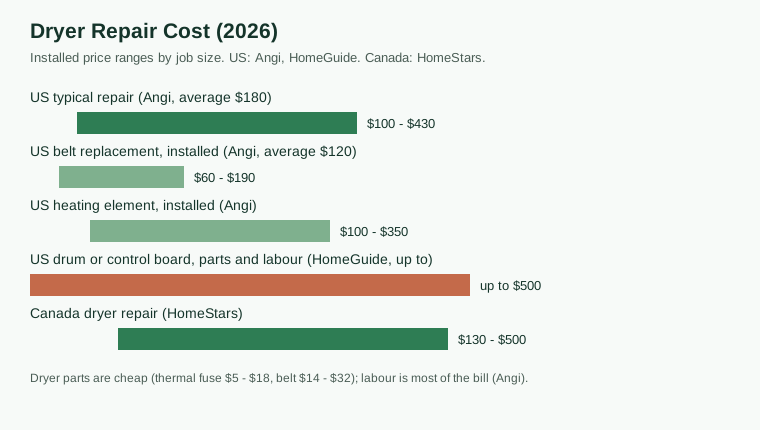
Most dryer repairs cost $100 to $430 in the US in 2026, with a national average of $180 (Angi, updated September 18, 2026). HomeGuide puts dryer repair at $100 to $300 on average, with a drum or control board job reaching $500 for parts and labour. The symptom sets the band: not heating runs $80 to $420, not spinning $30 to $250, and loud noises $10 to $450 (Angi, by problem). Two jobs have their own published installed prices: a heating element replacement runs $100 to $350, and a professional belt replacement runs $60 to $190 with a $120 average. The parts alone are cheap on this appliance (thermal fuse $5 to $18, drive belt $14 to $32, control board $90 to $280), so labour and diagnosis are most of a dryer bill. In Canada, the HomeStars cost guide puts dryer repair at $130 to $500, with a belt replacement averaging $260. This guide prices repairs by problem and by part, separates electric from gas heating repairs, explains why a blown thermal fuse is a warning rather than a repair, and works the repair-or-replace decision on three labelled examples.
Quick Checks
- 1Budget $100 to $430 for a typical US dryer repair in 2026, with a national average of $180 (Angi). HomeGuide puts the average job at $100 to $300, with a drum or control board job reaching $500 for parts and labour.
- 2Dryer parts are cheap and labour is the bill: a thermal fuse costs $5 to $18 and a drive belt $14 to $32 as parts (Angi), while a professional belt replacement runs $60 to $190 installed and a heating element replacement $100 to $350.
- 3Price by symptom first: not heating $80 to $420, not spinning $30 to $250, will not turn on $15 to $300, loud noises $10 to $450 (Angi, by problem). One symptom can hide a $15 part or a $350 job, and diagnosis is what separates them.
- 4A blown thermal fuse is a warning, not a repair. The fuse opens because the dryer overheated, usually on restricted airflow. Replacing the fuse without clearing the vent and checking the cycling thermostat buys a repeat failure.
- 5In Canada, dryer repair runs $130 to $500 in the HomeStars cost guide, with a belt replacement averaging $260, a no-heat repair at $100 to $260, and drum issues at $60 to $260.
- 6Gas and electric dryers fail differently at the heating end: electric heating parts run $90 to $250 to replace, gas heating parts $100 to $350 (Angi), because a gas burner assembly is several parts (igniter, flame sensor, valve coils) rather than one element.
Dryer Repair Cost 2026: What Repairs Really Cost, by Part
By EnergyBS Editorial Team | October 30, 2026
The Short Answer
Short Answer: Most dryer repairs cost $100 to $430 in the US in 2026, with a national average of $180 (Angi, updated September 18, 2026). HomeGuide puts dryer repair at $100 to $300 on average, with a drum or control board job reaching $500 for parts and labour. Angi prices the work by problem: not heating runs $80 to $420, not spinning $30 to $250, will not turn on $15 to $300, and loud noises $10 to $450. Two common jobs carry their own installed prices in Angi's companion guides: a heating element replacement runs $100 to $350, and a professional belt replacement runs $60 to $190, averaging $120. In Canada, dryer repair runs $130 to $500 in the HomeStars cost guide.
A dryer is the cheapest major appliance in the house to repair, and the reason sits in the parts table. A thermal fuse costs $5 to $18 as a part. A drive belt costs $14 to $32. Even a motor, at $60 to $150 for the part, costs less than the visit that installs it. Angi states the shape of the bill directly: labour can account for 90 percent or more of a dryer repair total. That single fact drives most of the advice in this guide. On a dryer, you are mostly paying for diagnosis and an hour of work, so the quality of the diagnosis matters more than the price of the part, and a wrong first guess costs almost as much as the repair itself.
This guide prices repairs by problem first, then by part, then separates the electric and gas heating systems, because they fail in different places. It also covers the one dryer fault that is a safety signal rather than a price line: the thermal fuse. Our companion guides cover the airflow side of the machine in full: why a dryer takes two cycles works the slow-drying diagnosis step by step, and dryer vent routing and length prices and specifies the vent run itself.
The repair in six steps:
- Name the symptom in plain words before you call: no heat, no spin, will not start, shuts off early, overheats, or loud noise. Each symptom maps to a short part list in Section 5, and Angi publishes a price band for the symptom itself, so you can place any quote against it.
- Do the free checks first: lint filter seated and clean, vent hood outside opening and not blocked, breaker fully on (an electric dryer on one tripped leg of its two-pole breaker can tumble without heat), and the door closing and latching. A blocked vent is behind more dryer symptoms than any single failed part.
- Stop on the safety cases in Section 6 before pricing anything: sparks, a burning smell, or a dryer that has blown its thermal fuse more than once. Those are not quote-shopping situations.
- Call with the model number, the fuel (gas or electric), the age, and the symptom ready. Ask the service call fee and whether it is credited toward the repair. Angi puts the service call at $50 to $80 plus labour, HomeGuide at $70 to $130 including the first hour.
- Approve a diagnosis before you approve a part. On an appliance where the part costs $15 and the visit costs $150, the sentence you are paying for is the one that names the failed part and the test that proved it.
- Run the age and percentage tests in Section 8 before approving any job over $300. Dryer repairs are cheap enough that repair usually wins, and Section 8 marks the narrow band where it stops winning: board and drum work on an old machine.
1. What a Repair Bill Is Made Of
A dryer repair invoice has the same three layers as any appliance bill, but the proportions are unusual, and the proportions are the useful part.
The first layer is the visit. Angi puts a dryer service call fee at $50 to $80 just to come to the home, plus an hourly rate of $50 to $100, and notes that some technicians charge a separate diagnostic fee on top. HomeGuide puts an appliance service call at $70 to $130, including travel in the standard service area, diagnostics, and the first hour of labour. For heating work specifically, Angi's heating element guide puts professional labour at $60 to $150 per hour, and notes that some companies price by flat rate or apply a minimum charge that a small job can fall under. Ask how the visit is priced before anyone is booked: flat rate, hourly, or minimum charge changes what a fuse-sized job should cost.
The second layer is labour, and on a dryer it dominates. Most dryer parts swap in under an hour once the cabinet is open, and the cabinet on a dryer is one of the simpler ones in the house to open. Angi's figure bears repeating because it reframes every quote in this guide: labour can easily account for 90 percent or more of the total repair bill. A $120 belt job at Angi's average is an $8 to $25 belt and lubricant at $3 to $15, carried by a visit and an hour. That is not a rip-off pattern. It is the arithmetic of sending a trained person to a house. It does mean that bundling work into one visit is the main lever a homeowner actually controls, a point Section 7 returns to, because the belt, rollers and idler pulley on a dryer are normally replaced together for exactly this reason.
The third layer is the part, priced in Section 2. Dryer parts sit at the bottom of the appliance price range: switches and fuses in single digits to $40, wear parts under $60, and only the control board, at $90 to $280 for the part alone, reaching into real money. HomeGuide adds the ceiling for the assembled jobs: replacing the drum or the control board can cost up to $500 for parts and labour.
Emergency pricing exists here too, at $140 to $400 for an emergency call-out on HomeGuide's figures, against $70 to $130 standard. A dryer almost never justifies it. Wet laundry is an inconvenience with a laundromat at the end of it, not a loss in progress the way a dead refrigerator is. The exception is again a safety case, and a safety case is a stop-using-it instruction, not an emergency booking.
2. US Prices by Problem and by Part
Angi publishes dryer pricing in two different units, and mixing them is the most common way dryer quotes get misread. The by-problem table is an average repair cost: an installed, all-in figure for fixing that symptom. The by-part table is a parts cost: what the component itself sells for, before the visit and the labour are added. Both tables are reproduced here in their own units, labelled, because each one answers a different question. The by-problem table tells you what the job should cost. The by-part table tells you where the money goes.
| Problem | Average repair cost, installed (Angi, 2026) | Usual causes named by Angi |
|---|---|---|
| Not heating | $80 - $420 | Heating element, thermostat, blown thermal fuse |
| Not spinning | $30 - $250 | Broken drive belt, motor, worn drum rollers |
| Will not turn on | $15 - $300 | Door switch, start switch, control board |
| Shuts off quickly | $25 - $300 | Overheating from a clogged vent, bad thermostat |
| Overheating | $90 - $320 | Clogged vent, malfunctioning thermostat |
| Loud noises | $10 - $450 | Drum bearing, loose belt, broken motor, loose screws |
| Sparks or smells | $400 - $600 | Malfunctioning electrics; requires total replacement |
| Part | Part cost alone (Angi, 2026) |
|---|---|
| Thermal fuse | $5 - $18 |
| Start switch | $5 - $40 |
| Door switch | $8 - $30 |
| Lint filter | $10 - $35 |
| Drive belt | $14 - $32 |
| Thermostat / cycling thermostat | $15 - $60 |
| Drum rollers | $20 - $55 |
| Drum bearings | $20 - $60 |
| Motor | $60 - $150 |
| Control board | $90 - $280 |
Two installed jobs are priced individually in Angi's companion guides, and they anchor the middle of the market. A heating element replacement runs $100 to $350 installed. A professional belt replacement runs $60 to $190, with a national average of $120; the same guide splits the job by scope, from a belt alone at $8 to $25 in materials to an entire belt assembly at $130 to $210. HomeGuide cross-checks the whole picture from its member project costs: dryer repair at $100 to $300 on average, the most commonly replaced parts named as the heating element, thermal fuse, belt and start switch, and the drum or control board ceiling at up to $500 for parts and labour.
Read the two tables together and the diagnostic stakes become concrete. A no-heat symptom at $80 to $420 can be a $5 to $18 thermal fuse, a thermostat at $15 to $60 for the part, or a heating element job at $100 to $350 installed. The spread between the cheapest and most expensive cause of the same symptom is the entire typical repair budget. That is why Section 5 maps symptoms in price order, cheapest cause first, and why a no-heat quote that names an element without a fuse and thermostat test recorded deserves a question.
How common is each failure? Angi's customer base gives a rough shape: based on responses from 20,600 customers, over 20 percent of homeowners requesting washer or dryer service have an appliance that does not run at all, and 8 percent say their dryer does not get hot enough. The dead machine and the cold machine are the two front doors into this market, and both open onto the cheap end of the parts table more often than the expensive end.
3. Gas vs Electric: Two Different Heating Systems
A dryer is a motor, a drum and a heat source, and the heat source is where gas and electric machines stop being the same appliance.
An electric dryer makes heat in one component: a resistive heating element, replaced as a single part when it fails. Angi puts electric dryer heating parts at $90 to $250 to replace, inside the $100 to $350 installed band for the element job itself. The failure chain around it is electrical: the thermal fuse, the cycling thermostat and the high-limit thermostat guard and govern the element, and each of those parts costs $5 to $60 alone.
A gas dryer makes heat in a burner assembly of several parts: an igniter, a flame sensor and gas valve coils, any one of which can fail while the others still work. Angi puts gas dryer heating parts at $100 to $350 to replace, and prices the add-on components at materials cost in the same guide: igniter $30, flame sensor $20, valve coils $10, thermal fuse $15, sensors $20, timer $100. HomeStars makes the same structural point from the Canadian side: gas dryers have ignition coils that will need to be replaced throughout the dryer's lifetime, alongside igniters, flame sensors, gas valves and thermal fuses. Because the assembly is several parts, a gas no-heat diagnosis can legitimately land on a $10 set of valve coils, and a technician rarely needs to replace the whole assembly at once.
The general price relationship between the fuels is published twice, in two forms. HomeGuide states that gas appliances typically cost 10 to 20 percent more to repair than electric ones, because of higher part prices, higher safety risks and the more experienced technicians the work needs. HomeStars states the direction without the percentage: gas appliances are generally more expensive to repair than electric, because there is more risk involved in the repair. Both sources also agree that the purchase and running sides run the other way: HomeStars notes gas dryers cost more to buy and less to power. None of that changes the repair decision on a machine you already own. It explains why a gas no-heat quote can sit modestly above an electric one for the same symptom without anything being wrong with the quote, and why gas heating work is professional work in a way a belt swap is not: the burner assembly connects to a gas line, and that connection is the line between owner scope and technician scope in Section 6.
One shared component deserves its own sentence, because it appears in both systems and in both countries' tables: the thermal fuse. It costs $5 to $18 as a part in the US (Angi) and $15 at materials cost in Angi's add-on table. It is also the subject of Section 6, because what it means matters more than what it costs.
4. Canada Prices
HomeStars, the Canadian source read for this guide, puts dryer repair at $130 to $500 depending on the type of repair. That sits inside its general appliance figures: based on homeowner reports, the average cost for appliance repair is $220, with most spending between $135 and $300.
HomeStars publishes dryer pricing by issue rather than by part, and the rows are worth reading beside Angi's by-problem table, because the two sources were built independently and land in the same shape:
| Issue (HomeStars, Canada) | Cost |
|---|---|
| Dryer belt replacement (average) | $260 |
| No heat (thermostat, timer, fuses, temperature switches, heating coils) | $100 - $260 |
| Drum issues (belt, roller, motor or idler pulley) | $60 - $260 |
| Overheated dryer (clogged vent, thermostat, heating coils) | $60 - $160 |
| Faulty dryer (power, timer, thermostat, terminal block, start switch) | $60 - over $1,000 |
HomeStars adds two part and labour figures for Canada: heating elements can cost anywhere from $40 to $260 for the part, and labour in its dryer section runs $40 to $130 per hour. The same guide publishes general appliance hourly rates of $130 to $260 per hour elsewhere on the page, so a Canadian quote should state which rate structure it uses rather than leave the hourly figure to be discovered on the invoice. HomeStars also advises grouping repairs into one visit where possible, the same bundling point Section 1 makes on US figures.
The belt row is the one Canadian figure that sits visibly above its US counterpart: a $260 average in Canada against $60 to $190 installed, averaging $120, in the US (Angi). This guide does not convert or average the two. They come from different markets, different labour rates and different survey bases, and a Canadian belt quote should be judged against the Canadian band and itemized the same way: part, labour, and whether the rollers and idler pulley are included, since HomeStars notes those parts are often replaced at the same time as the belt.
For the replacement side of a Canadian repair-or-replace decision, price the machine you would actually buy, delivered and installed. Our washer and dryer installation cost guide prices the install itself, including the gas and electric hookup difference that matters on a dryer swap.
5. Symptom to Part: What You Describe, What It Usually Is
You will not order a valve coil by name. You will say the dryer runs but the clothes come out cold, or it thumps, or it stops after ten minutes. This table runs the mapping in the open, cheapest cause first, with the published prices attached.
| What you describe | Free checks first | Likely part if the checks pass | Published cost |
|---|---|---|---|
| Runs, tumbles, no heat (electric) | Breaker fully on, both legs; lint filter and vent clear | Thermal fuse, then thermostat, then heating element | Fuse part $5 - $18; element job $100 - $350 installed (Angi); symptom band $80 - $420 |
| Runs, tumbles, no heat (gas) | Vent clear; watch through the inspection plug for igniter glow where your model allows it | Igniter, flame sensor or valve coils, then thermal fuse | Heating parts $100 - $350 (Angi); add-on parts $10 - $30 each at materials cost |
| Drum will not tumble, motor hums or runs | Load not overfilled; door latching | Drive belt, then idler pulley, then motor | Belt job $60 - $190 installed, average $120 (Angi); symptom band $30 - $250 |
| Thumping, rumbling or squealing that follows drum speed | Spin the empty drum by hand and listen; check for a loose item in the drum | Drum rollers, bearings, belt, idler pulley | Rollers $20 - $55 and bearings $20 - $60, parts alone (Angi); symptom band $10 - $450 |
| Will not start at all | Outlet and breaker; door fully closed | Door switch, start switch, thermal fuse, then control board | Switches $5 - $40 parts alone; board $90 - $280 part alone (Angi); symptom band $15 - $300 |
| Shuts off after a few minutes, or runs very hot | Lint filter, vent run and outside hood, first and always | Cycling thermostat, then the airflow itself | Symptom bands $25 - $300 (shuts off) and $90 - $320 (overheating) (Angi) |
| Takes two cycles to dry a normal load | Filter, vent and hood; load size and fabric mix | Usually airflow, not a part; then moisture sensor or a weakening element | Vent cleaning $100 - $185, vent repair $75 - $150 (Angi) before any part |
| Sparks, burning smell, scorch marks | Stop. Unplug it. Do not run it to check | Electrical fault; Angi prices this row as replacement | $400 - $600, requires total replacement (Angi) |
Two rows carry most of the value in this table. The first is slow drying. A dryer that takes two cycles is describing an airflow problem in most cases, not a dying element: the machine makes heat it cannot move. Our dryer takes two cycles diagnostic guide works that sequence in order, and the fix prices in this guide's vent rows (cleaning at $100 to $185, vent repair at $75 to $150, vent replacement at $100 to $300) all sit below the heating element row that a rushed diagnosis reaches for. The second is no heat on an electric machine, where the price order runs fuse, thermostat, element, and the three causes differ by hundreds of dollars. A quote that starts at the element has skipped the two cheapest tests on the appliance.
The noise row works in the opposite direction. Noise that follows drum speed is a wear row (rollers, bearings, belt, idler), and those parts are normally replaced as a set while the drum is out, because the labour of opening the machine is paid once. HomeStars makes the same point for the belt job in Canada: rollers and idler pulleys can be replaced at the same time as the belt. A quote for rollers alone, on a machine with its original belt still fitted, is a quote that plans to open the same cabinet twice.
6. The Safety Cases: The Thermal Fuse, Sparks, and the Vent
Most dryer faults are money and scheduling problems. Three are not, and they share one mechanism: heat that cannot leave the machine.
The thermal fuse. The thermal fuse is a one-time safety device in the exhaust path. When the dryer overheats, the fuse opens and cuts the circuit, and on many electric models the machine then tumbles without heat or will not run at all. The fuse does not reset and it is not meant to. It opens because the temperature went somewhere it should not go, and the usual reason is restricted airflow: a clogged vent run, a crushed transition duct, a blocked outside hood, or a lint filter so coated that air cannot pass it. Angi lists the blown thermal fuse among the causes of a no-heat dryer, HomeGuide names it among the most commonly replaced dryer parts, and HomeStars lists fuses among the no-heat causes in Canada. All three treat it as a part. The mechanical point sits underneath the part: replacing a $5 to $18 fuse without finding and clearing the restriction installs a new fuse in front of the same overheating, and the second opening can come with worse company than the first. A fuse replacement quote should name the airflow check it includes. If it does not, ask for one, in writing.
Sparks and smells. Angi's by-problem table gives this row its own line and its own instruction: sparks or smells run $400 to $600 and require total replacement, with malfunctioning electrics as the cause. Read that as a stop rule rather than a price. A dryer showing sparks, a burning smell, or scorch marks comes off and stays off. The repair-or-replace tests in Section 8 do not apply, because there is no repair branch on that row in the source that prices the rest of the table.
The vent. The vent is a repair surface in its own right in Angi's figures: budget an additional $150 to $300 if your dryer vent needs attention, vent repair runs $75 to $150, a vent that cannot be salvaged is replaced at $100 to $300, and vent cleaning as an add-on to a heating job runs $100 to $185. Angi's maintenance guidance is plain about the owner-level share: cleaning the lint filter after every load and periodically clearing the exhaust vent are the two most important maintenance tasks on the machine. Our dryer vent routing and length guide covers what a correct vent run looks like, including the length and elbow limits that decide whether a vent can move the air the dryer makes. A long, sagging or foil-duct vent run is not a cleaning problem. It is an installation problem that will keep presenting as appliance symptoms, at appliance prices, until the run itself is fixed.
Gas connections. Any repair that opens a gas dryer's burner assembly or disturbs its gas connection is professional work, full stop. The parts are cheap ($10 valve coils, a $30 igniter) and the connection is not a place to save the visit fee. The same applies to the electrical supply on an electric dryer: the element circuit is a high-current 240-volt circuit, and element work with the machine plugged in is how a $15 diagnosis becomes an injury.
7. The Drum Assembly: Why Noises Cost What They Cost
The expensive end of the dryer table is one assembly: the drum, the belt that drives it, the rollers and bearings it rides on, the idler pulley that tensions the belt, and the motor underneath all of it.
The parts ladder is short and cheap. Belt $14 to $32, rollers $20 to $55, bearings $20 to $60, motor $60 to $150, all as parts alone (Angi). The installed ladder is where the labour shape shows. A belt job runs $60 to $190 installed (Angi), because reaching the belt means opening the cabinet and lifting the drum. A full belt assembly runs $130 to $210. HomeGuide puts the ceiling for the assembly's biggest job, a drum or control board replacement, at up to $500 for parts and labour.
Three practical consequences follow, and they mirror the drum logic in our washing machine repair cost guide with one difference: on a dryer the parts are cheaper, so the bundling argument is stronger, not weaker. First, wear parts in this assembly are replaced as a set. Belt, rollers and idler come out together in most services, because each one is under $55 as a part and the cabinet opening is paid once. Second, a noise diagnosis is testable before anyone is booked: an empty drum turned slowly by hand reproduces roller and bearing noise without heat or power, and a quote that condemns a motor ($60 to $150 part, inside a $30 to $250 no-spin band or a $10 to $450 noise band) without that check has skipped the free evidence. Third, the drum itself is the replace-the-machine line on this appliance. A drum replacement reaching HomeGuide's $500 ceiling, on a machine whose replacement prices start in the same few hundred dollars, fails the percentage test in Section 8 on almost any dryer old enough to need one.
None of this makes a motor job wrong. On a five-year-old dryer, a motor at the top of its parts band, installed inside the no-spin symptom band, is a sound repair on a machine with years of drum, element and cabinet life left around it. The assembly punishes the same pattern it punishes on a washer: major work approved one visit at a time on an old machine, with the totals never added up.
8. Repair or Replace: Age, Percentage, and the Two Lifespans
Dryer repair economics start from a friendly position: the average repair ($180, Angi) is small against any replacement, so repair wins by default and replacement has to argue its case. The sources give that argument three forms.
Angi's heating element guide states the rule in full: consider repairing if the dryer is less than 7 to 10 years old and the repair costs less than 50 percent of the price of a new dryer, which it puts at an average of $400 to $1,000. Consider replacing if the dryer is more than 10 years old, needs frequent repairs, or the repair exceeds 50 percent. HomeGuide states the general appliance version: appliances more than 10 years old, or with repairs costing more than 50 percent of a replacement, typically are not worth repairing, and it prices a new dryer at $800 to $1,200 for the unit alone.
The lifespan figures disagree, and the disagreement is printed here rather than averaged away. Angi puts the average dryer lifespan at 10 to 13 years. HomeGuide puts most dryers at 6 to 10 years. The two sources survey different populations and publish different numbers, and your machine's service history is a better guide than either: a dryer on its first fault at nine years is a younger machine, in every way that costs money, than a dryer on its fourth fault at seven. Use the published spans as brackets, the fault count as the tiebreak, and the percentage test with a real denominator: the delivered, installed price of the specific dryer that fits your space, your fuel and your vent run, including the hookup. Our washer and dryer installation cost guide prices that install, and our heat pump dryer vs vented dryer guide covers the replacement technology choice itself, including the ventless option that removes the vent run from the house entirely.
Hypothetical example 1 (labelled as such): thermal fuse and vent cleaning on a 5-year-old electric dryer, US. The dryer tumbles with no heat. The fuse tests open, the vent run is found packed at the outside hood, and the element tests good. Quote: $275 all-in, built from the fuse inside Angi's $80 to $420 no-heat symptom band plus vent cleaning inside Angi's $100 to $185 add-on band. Against a $750 delivered replacement for a comparable machine, that is about 37 percent, on a dryer inside every source's repair age. Repair it, and file the real lesson: the fuse was the symptom, the vent was the repair, and the cleaning interval is now part of the machine's record.
Hypothetical example 2 (labelled as such): heating element on an 8-year-old electric dryer, US. The element tests open, the fuse and thermostats test good, and the vent is clear. Quote: $240, inside Angi's $100 to $350 installed element band. Against an $850 replacement, that is about 28 percent. The percentage test says repair by a wide margin. The age test is the one to pause on: at eight years the machine is inside Angi's 10- to 13-year span and at the edge of HomeGuide's 6- to 10-year span, so the answer turns on history. First major fault: repair. Third visit in two years: price the replacement in the same week and put the two totals side by side, because the stacking pattern, not this quote, is the problem.
Hypothetical example 3 (labelled as such): control board and drum work on a 12-year-old dryer, US. The board has failed and the drum bearing is worn. Quote: $520, at HomeGuide's up-to-$500 drum and board ceiling and inside Angi's $10 to $550 full range. Against a $700 delivered replacement for a comparable machine, that is about 74 percent, on a dryer past Angi's 10-year replace line and past both published lifespans' working ends, with its motor, element and belt all the same age as the parts that failed. Replace it. The same $520 split across two visits in the same year is how this total usually arrives, which is why the stacking test below exists.
The stacking test: add the last three years of dryer invoices, visits included. Because dryer parts are cheap, the stack is mostly call-outs, and a machine collecting two paid visits a year is spending a replacement's carrying cost without acquiring a replacement. One exception applies, as it does across this repair series: warranty coverage changes the numerator. A board or motor covered under a manufacturer or extended warranty, on a machine whose uncovered age would otherwise fail the test, can be the right call. Check coverage before the diagnostic visit, while it can still change which quote you ask for.
9. The Maintenance That Prevents the Middle of the Table
Dryer maintenance is short, and Angi names its two items directly: clean the lint filter after every load, and clear the exhaust vent periodically. Everything else in this section is those two habits taken seriously, plus the prices of paying someone else to do the second one.
The filter. The lint filter is a $10 to $35 part (Angi) and the first restriction in the airflow path. A filter coated in fabric-softener residue can look clean and still block air; washing it with soap and water and letting it dry fully is owner work with no tools beyond a brush. A torn or warped filter gets replaced, because lint that passes the filter collects in the vent run and around the element, where it does the damage Section 6 describes.
The vent. Professional vent cleaning runs $100 to $185 as an add-on in Angi's heating guide, vent repair $75 to $150, and vent replacement $100 to $300. Budget an additional $150 to $300 if the vent needs attention alongside a repair (Angi). The interval depends on the run: a short, straight, rigid-metal run in a house doing average laundry can go longer between cleanings than a long run with elbows serving a large household. The symptom-based test is free and reliable: when drying times lengthen on loads that used to finish in one cycle, the vent is the first suspect, before any part in Section 2. Our slow-drying diagnostic guide runs that test in order.
The drum set. Rollers, bearings and the belt wear on a schedule set by load size and frequency, and they announce themselves as noise long before they stop the drum. The announcement is the cheap moment: a wear set replaced during a planned visit costs the parts (under $60 each, Angi) plus one opening of the cabinet, while the same parts replaced after a belt snaps and takes a load of laundry hostage costs the same parts plus an urgent visit on top.
Plans, priced plainly. HomeGuide prices annual appliance maintenance plans at $200 to $500 depending on how many devices are covered, including cleaning, inspections and tune-ups, with repair discounts in some plans. Against a dryer whose average repair is $180 (Angi) and whose owner-level maintenance is a filter and a vent, a plan's dryer share only pencils out when the same plan covers several larger appliances. Price it as a portfolio, never for the dryer alone.
The accounting, stated plainly: maintenance on this appliance prevents the airflow rows (fuse, overheating, slow drying, early shut-off) and catches the wear rows early. It does not prevent a control board from failing, and no plan or habit in this section should be sold to yourself as board insurance.
10. Quote Checklist: How to Compare Dryer Repair Quotes
Dryer quotes are hard to compare because the part is cheap and everything else is structure: one quote bundles the visit, the next prices it separately, and a third adds a vent line the first two never mentioned. Get these items in writing before you compare totals.
- The symptom recorded on the quote in the words you reported it, with the fuel (gas or electric) and the model number
- The free checks confirmed before a part was condemned: lint filter and vent run checked, breaker confirmed on both legs (electric), door switch tested
- For a no-heat quote: the fuse, thermostat and element (electric) or igniter, flame sensor and coils (gas) each tested, with the failed one named
- For a thermal fuse replacement: the airflow cause found and cleared, named on the quote, not just the fuse swapped
- The failed part named, with its part number, and whether the price is the part alone or the installed job (Angi's parts table and installed tables differ by design; a quote should say which one it is using)
- Part price and labour stated separately, with labour in hours or as a stated flat job price ($50 to $100 per hour is Angi's dryer band; $50 to $125 is HomeGuide's appliance band; $60 to $150 is Angi's band for heating work)
- The service call or diagnostic fee stated separately ($50 to $80, Angi; $70 to $130 including the first hour, HomeGuide), and whether any of it is credited if you approve the repair
- For a belt, roller or bearing quote: whether the full wear set (belt, rollers, idler pulley) is included, or only the single failed part
- Any vent work quoted as its own line (cleaning $100 to $185; repair $75 to $150; replacement $100 to $300, Angi), separate from the appliance repair
- Parts warranty and labour warranty stated separately, with durations
- The dryer's age, warranty status and repair history noted on the quote, so the Section 8 tests run on the full record
- For any quote over $300: a priced replacement for a comparable, fitting dryer from the same week, so the percentage test uses a real denominator
- The old part returned or shown to you, on any repair over $250
Red flags: a heating element quoted for a no-heat symptom with no fuse or thermostat test recorded; a thermal fuse replaced with no vent or airflow check on the invoice; a motor condemned with no belt or roller check; emergency pricing on a machine with no safety fault, when the laundry can wait for a standard slot; and a board quote on a dryer over 10 years old with no percentage test shown.
Frequently Asked Questions
How much does it cost to repair a dryer in 2026? Most US repairs cost $100 to $430, with a national average of $180 (Angi, updated September 18, 2026). HomeGuide puts dryer repair at $100 to $300 on average, with a drum or control board job reaching $500 for parts and labour. By problem, Angi prices not heating at $80 to $420, not spinning at $30 to $250, and loud noises at $10 to $450. In Canada, dryer repair runs $130 to $500 in the HomeStars cost guide.
How much does it cost to replace a dryer heating element? $100 to $350 installed (Angi). Electric dryer heating parts run $90 to $250 to replace and gas dryer heating parts $100 to $350, because a gas burner assembly is several components (igniter, flame sensor, valve coils) rather than one element. Before approving an element, the thermal fuse ($5 to $18 as a part) and the thermostat ($15 to $60) should be tested and cleared: both cause the same no-heat symptom for far less money.
How much does dryer belt replacement cost? A professional belt replacement runs $60 to $190, with a national average of $120 (Angi). The belt itself costs $8 to $25 in materials, and an entire belt assembly runs $130 to $210. Labour is most of the installed price, which is why rollers and the idler pulley are often replaced in the same visit. In Canada, HomeStars puts a belt replacement at a $260 average.
Why does my dryer run but not heat? On an electric dryer, the causes run in price order: a blown thermal fuse first, then a thermostat, then the heating element itself, with Angi pricing the symptom at $80 to $420. A tripped breaker leg can also leave an electric dryer tumbling without heat. On a gas dryer, the burner assembly is the suspect set: igniter, flame sensor and valve coils, with heating parts at $100 to $350 (Angi). A blocked vent sits behind several of these causes, because the overheating it creates is what blows the fuse.
What does a blown thermal fuse mean? It means the dryer overheated and a one-time safety device opened the circuit to stop it. The fuse itself costs $5 to $18 as a part (Angi), but the fuse is the messenger, not the fault. The cause is usually restricted airflow from a clogged vent, a blocked outside hood or a coated lint filter. Replacing the fuse without clearing the cause installs a new fuse in front of the same overheating, and the repair is not complete until the airflow check is on the invoice.
How much does dryer repair cost in Canada? $130 to $500 for a dryer repair in the HomeStars Canada cost guide, inside a general appliance repair average of $220, with most homeowners spending $135 to $300 on appliance repair overall. By issue, HomeStars prices a belt replacement at a $260 average, no heat at $100 to $260, drum issues at $60 to $260, and an overheated dryer at $60 to $160. Heating element parts run $40 to $260, and labour in the guide's dryer section runs $40 to $130 per hour.
Is it worth repairing a 10-year-old dryer? Run both tests. Angi advises repair under 7 to 10 years of age with the repair under 50 percent of a new dryer ($400 to $1,000 average in its guidance), and replacement over 10 years. HomeGuide flags appliances over 10 years old and prices a new dryer at $800 to $1,200 for the unit alone. The published lifespans bracket the question rather than settle it: 10 to 13 years (Angi) against 6 to 10 years (HomeGuide). A cheap wear part (a belt job at $60 to $190) can still be the right spend at 10 years. Board or drum work reaching $500 on a 10-year-old machine fails both tests in most cases.
Can I repair a dryer myself? The owner layer is real on this appliance because the parts are cheap and the cabinet is simple: Angi names cleaning lint traps, ducts and vents, replacing knobs, belts or fuses, checking breakers, and testing door switches as tasks a comfortable homeowner can take on, with DIY parts from $5. Two boundaries are firm. Gas burner work and any repair that disturbs a gas connection are professional work, and electrical faults showing sparks or scorching are a stop-and-replace case in Angi's own table, not a DIY project at any skill level. A thermal fuse swap without the airflow fix is also not a completed DIY repair, whatever your skill level.
Related Reading
Common Questions
What should I check first before using this appliances advice?
Start with the numbers that apply to your home: climate, utility rate, equipment age, contractor quote, and local program rules. Most dryer repairs cost $100 to $430 in the US in 2026, with a national average of $180 (Angi, updated September 18, 2026). HomeGuide puts dryer repair at $100 to $300 on average, with a drum or control board job reaching $500 for parts and labour. Angi prices the work by prob...
How should I verify rebates, tax credits, rates, or savings before spending money?
Treat program amounts, utility rates, and tax rules as date-sensitive. Check the named government, utility, or manufacturer source before you sign a contract, and keep screenshots or PDFs of eligibility rules for your records.
When should I involve a licensed professional instead of doing this myself?
Bring in a licensed electrician, HVAC technician, or other qualified professional for panel work, refrigerant handling, combustion equipment, structural changes, or anything that needs a permit or inspection. A guide can help you prepare questions and compare options, but it does not replace licensed work where codes or safety are involved.
How should I compare contractor quotes for this kind of work?
Ask each contractor to separate equipment, labor, electrical work, permits, and rebate assumptions on the quote, and to name the exact model numbers being priced. Comparing itemized quotes on the same scope is more useful than comparing headline prices, and it shows which savings claims depend on incentives you have not yet confirmed.
What is the next useful step after reading this?
Compare this with Why Your Dryer Takes Two Cycles 2026 Tool (Guide & Data) so you can check the cost, rebate, installation, or operating-risk angle before making a decision.
What to Read Next
Why Your Dryer Takes Two Cycles 2026 Tool (Guide & Data)Use this next to compare the cost, incentive, installation, or operating-risk angle before you make a home energy decision.Sources and Verification
- Angi How Much Does Dryer Repair Cost? [2026 Data], updated September 18, 2026 (national average $180; most homeowners pay $100 to $430; full range $10 to $550; by problem: not heating $80 to $420, not spinning $30 to $250, will not turn on $15 to $300, shuts off quickly $25 to $300, overheating $90 to $320, loud noises $10 to $450, sparks or smells $400 to $600 and requires total replacement; replacement parts alone: thermostat $15 to $60, cycling thermostat $15 to $60, thermal fuse $5 to $18, drive belt $14 to $32, motor $60 to $150, door switch $8 to $30, start switch $5 to $40, control board $90 to $280, drum rollers $20 to $55, lint filter $10 to $35, drum bearings $20 to $60; service call fee $50 to $80 plus labour $50 to $100 per hour, with labour able to account for 90 percent or more of the total bill; vent repair $75 to $150, vent replacement $100 to $300, and a further $150 to $300 to budget if the vent needs attention; dryer lifespan 10 to 13 years; over 20 percent of the 20,600 Angi customers surveyed had a washer or dryer that does not run at all, and 8 percent had a dryer that does not get hot enough)
- Angi Cost to Replace a Heating Element in a Dryer [2026 Data], updated September 2, 2026 (heating element replacement $100 to $350 installed; electric dryer heating parts $90 to $250 to replace, gas dryer heating parts $100 to $350; add-on parts at materials cost: timer $100, sensors $20, thermal fuse $15, igniter $30, flame sensor $20, valve coils $10; professional labour $60 to $150 per hour; dryer vent cleaning $100 to $185 as an add-on; repair-or-replace guidance: repair if the dryer is less than 7 to 10 years old and the repair costs less than 50 percent of a new dryer, which averages $400 to $1,000; replace if it is more than 10 years old, needs frequent repairs, or the repair exceeds 50 percent)
- Angi How Much Does It Cost to Replace a Dryer Belt? [2026 Data], updated October 16, 2026 (professional belt replacement $60 to $190, national average $120; entire belt assembly $130 to $210, belt pulley assembly $70 to $150, belt motor only $50 to $150, belt only $8 to $25 materials; belt lubricant $3 to $15; labour makes up the bulk of the total)
- HomeGuide How Much Does Appliance Repair Cost? (2026) (dryer repair costs $100 to $300 on average; the most commonly replaced parts are the heating element, thermal fuse, belt and start switch; replacing the drum or control board can cost up to $500 for parts and labour; a new dryer costs $800 to $1,200 for the unit alone; most dryers last 6 to 10 years; appliance service call $70 to $130 including travel, diagnostics and the first hour of labour; emergency call-out $140 to $400; labour $50 to $125 per hour; annual appliance maintenance plans $200 to $500; gas appliances typically cost 10 to 20 percent more to repair than electric; appliances more than 10 years old or with repairs costing more than 50 percent of a replacement typically are not worth repairing)
- HomeStars (Canada) Guide to Appliance Repair Costs and Estimates in Canada (based on homeowner reports, the average cost for appliance repair is $220, with most spending between $135 and $300; dryer repair costs $130 to $500 depending on the type of repair; dryer belt replacement averages $260, with rollers and idler pulleys often replaced at the same time; no heat $100 to $260, drum issues $60 to $260, overheated dryer $60 to $160, faulty dryer $60 to over $1,000; heating element parts $40 to $260; labour in the dryer section $40 to $130 per hour, against general appliance hourly rates of $130 to $260 per hour elsewhere in the same guide; gas dryers carry igniters, flame sensors, gas valves and ignition coils that need replacement over the dryer's lifetime; gas appliances are generally more expensive to repair than electric because of the added risk)
Editorial Review
EnergyBS Editorial Team
EnergyBS publishes practical homeowner guides. Important program, product, and cost claims should be checked against the linked source and local project documents before you commit to work.
Related Guides
View All ArticlesWhy Your Dryer Takes Two Cycles 2026 Tool (Guide & Data)
A symptom-first homeowner guide to slow drying that separates wet washer output, load and cycle errors, lint-screen problems, crushed or blocked exhaust, room conditions, sensors, heat, and appliance faults.
Dryer Vent Routing and Length 2026 Tool (Guide & Data)
A model-specific homeowner worksheet for dryer exhaust route length, elbows, materials, transition duct, exterior termination, cleaning access, penetrations, makeup air, contractor scope, and post-installation verification.
Heat Pump Dryer vs Vented Dryer 2026 Tool (Guide & Data)
A household-specific comparison of heat-pump, vented electric, and gas dryers using model energy data, laundry volume, utility rates, cycle time, drainage, room conditions, vent cost, maintenance, and clothing care.