Portable AC vs Window AC: Compare SACC, Heat Rejection, Window Fit, Noise, and Installed Cost
Compare portable and window air conditioners using the correct capacity metrics, exhaust and infiltration paths, window and building constraints, electrical supply, drainage, noise, room distribution, installation safety, energy, maintenance, and total ownership cost.
Direct Answer
Compare portable and window air conditioners using the correct capacity metrics, exhaust and infiltration paths, window and building constraints, electrical supply, drainage, noise, room distribution, installation safety, energy, maintenance, and total ownership cost.
These Products Reject Heat Through Different Boundaries
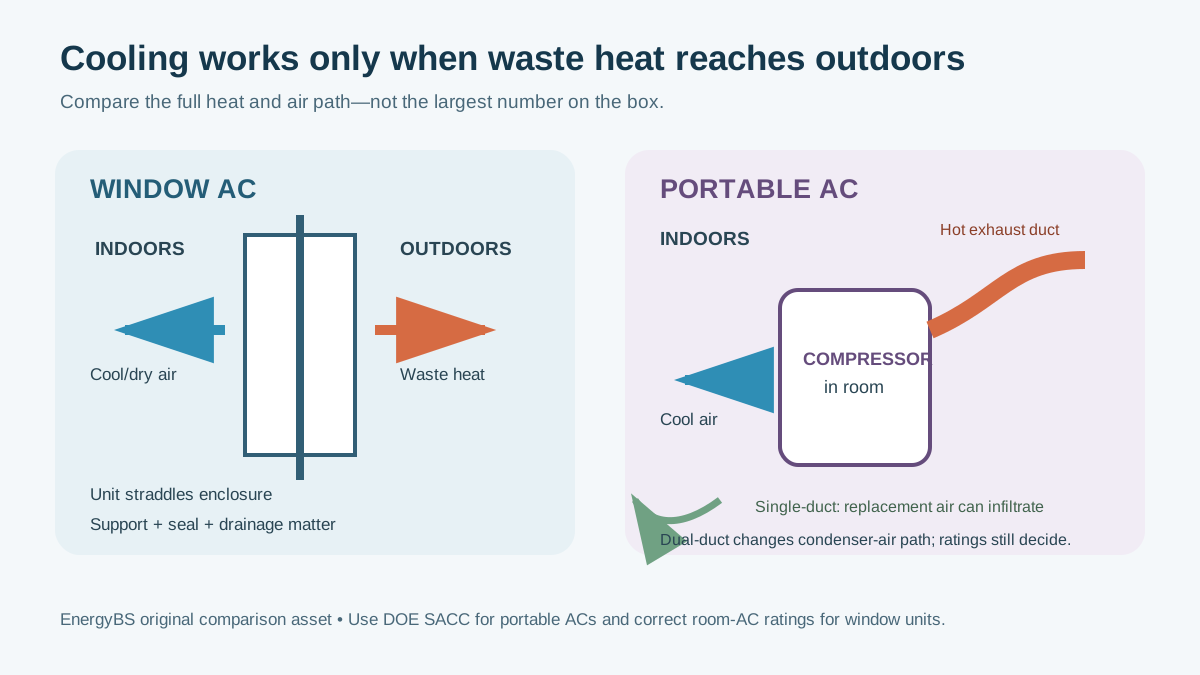
Short answer: Choose a window AC when the opening, structure, building rules, egress, support, and weather sealing allow a safe installation; most of the refrigeration hardware and waste heat then sit at the window boundary. Choose a portable AC when a floor unit and removable window panel solve a real access, seasonal, or building constraint—but compare the DOE-rated portable capacity (SACC), exhaust configuration, hose heat, infiltration, condensate, floor space, and indoor noise. Do not compare a portable's legacy/as-shipped “ASHRAE” number directly with a window unit's rated cooling capacity. Size both to the actual room and verify the exact electrical and installation instructions.
Both products are vapor-compression air conditioners: they absorb heat from indoor air and must reject that heat outside. The installation determines whether hot condenser air, duct heat, air leakage, and condensate are controlled or returned to the room.
Start With the Correct Rating
Window/room air conditioner
ENERGY STAR's room-air-conditioner program covers eligible room units and evaluates Combined Energy Efficiency Ratio (CEER) against product criteria. Its sizing guidance starts with room area and adjusts for sun, shade, people, and kitchen heat. Use the window AC sizing worksheet before comparing models.
Portable air conditioner
DOE defines portable air conditioners as a separate product category and requires a test procedure under 10 CFR Part 430 Appendix CC. The procedure produces a seasonally adjusted cooling capacity (SACC) and efficiency metric that account for specified operating conditions and effects such as duct and infiltration heat transfer. DOE's portable AC standards page is the current primary reference.
A package may show more than one Btu/h figure. Record the label exactly:
- DOE SACC Btu/h;
- any older or alternative capacity representation and its named standard;
- CEER or other applicable efficiency metric;
- input watts/amps;
- voltage and plug;
- tested configuration (single-duct/dual-duct where relevant).
Do not assume the largest printed number is usable room cooling. Compare portable models using SACC under the same test basis, then compare installed performance and room load.
Why a Single-Duct Portable Can Pull Outdoor Air In
A single-duct portable draws room air across its condenser and exhausts that heated air outdoors. Unless an equal amount of outdoor air enters through a dedicated path, the room/building becomes slightly negative relative to outdoors and replacement air comes through cracks, adjacent spaces, doors, or ventilation paths. That incoming air can carry heat and humidity.
DOE's portable-AC test-procedure materials explicitly discuss infiltration and duct heat transfer in adjusted cooling capacity (DOE test-procedure document). The exact impact in a home depends on enclosure leakage, weather, other exhaust appliances, and building pressure relationships.
Combustion safety warning
Any strong exhaust can interact with atmospherically vented combustion appliances, fireplaces, attached garages, or soil-gas pathways. Do not add a portable AC, range hood, dryer, or fan to a tight/complex building without considering pressure and makeup air. A qualified HVAC/building professional should evaluate combustion safety where relevant.
What a Dual-Duct Portable Changes
A dual-duct design typically draws condenser air from outdoors through one duct and rejects it through another, reducing use of conditioned room air for heat rejection. Duct leakage and heat transfer still matter, and not every “dual hose” architecture performs identically. Verify the tested configuration and exact SACC rather than assuming a fixed percentage advantage.
Check:
- intake and exhaust ducts cannot be swapped;
- both ports fit the panel without recirculating exhaust into intake;
- manufacturer maximum hose length and bends;
- ducts are not crushed, extended, insulated, or substituted contrary to instructions;
- outdoor termination has required clearance and pest/weather protection;
- panel is sealed without blocking egress or drainage.
For model selection inside the portable category, use the single- versus dual-hose SACC guide. It maps the two condenser-air paths, label fields, replacement-air evidence, hose heat, panel leakage, condensate, and pressure/combustion checks without reopening the window-versus-portable decision.
Window AC Heat Path
A window unit straddles the enclosure: the evaporator and supply air face the room, while the condenser rejects heat outdoors. This can avoid a long hot exhaust hose in the room, but only when:
- side/rear condenser openings are outdoors and unobstructed;
- a storm window or double-window cavity does not risk hot discharge;
- the unit has exact structural support;
- sash and anti-fall hardware are installed;
- gaps are air- and weather-sealed;
- condensate follows the designed path;
- the window remains secure and required egress is preserved.
ENERGY STAR notes that certified room units include clearer sealing/insulation provisions and that oversizing can waste energy and worsen comfort (ENERGY STAR room AC guidance). Certification does not approve a particular window structure.
Build the Room Load Before Shopping
Measure:
- conditioned floor area and ceiling height;
- exterior wall/roof exposure;
- window area, orientation, shade, and coverings;
- number and schedule of occupants;
- computers, cooking, lighting, and other heat sources;
- doors/open connections to other rooms;
- air leakage and ventilation/exhaust;
- desired temperature and humidity;
- typical and design outdoor conditions;
- whether the room must be cooled with the door closed.
One portable AC in a hallway rarely distributes evenly through closed bedrooms. A window unit at the far end of a long room may also create a cold zone near the sensor and hot zone elsewhere. Use fans only where they do not block intake/discharge or create cord/trip hazards.
Window and Building Constraints
Opening type
Double-hung, slider, casement, awning, tilt-turn, louvered, and fixed windows require different products/panels. Do not rotate a standard window AC on its side. A portable panel may fit a slider but still need secure, weather-tight fabrication approved by the manufacturer/building.
Structural support
Window units can fall. Use the listed bracket/support and anchoring method for the exact wall/window. Do not rely on expanding foam or side curtains. CPSC maintains current air-conditioner recalls and has documented falling room-unit concerns; check model/serial before installation.
Security and egress
Both products can prevent a window from locking normally. Add only approved security measures that do not violate emergency egress or damage the unit/window. Renters and condominium occupants need written permission where rules require it.
Rain and wind
The exterior assembly/panel must manage wind-driven rain, drainage, and seasonal storms. A portable hose panel is not automatically weatherproof. Never route condensate where it damages a facade, pedestrians, neighbors, or structure.
Electrical Scope
Read the nameplate and manual before buying:
- voltage, frequency, running current, and plug type;
- dedicated-circuit or receptacle requirement;
- LCDI/GFCI or other cord protection and test/reset procedure;
- maximum cord reach without extension;
- receptacle condition and grounding;
- other loads on the circuit;
- building/landlord rules.
Do not use an extension cord, power strip, travel adapter, plug converter, or defeated grounding/protection. Do not route a cord beneath carpet or through a closed sash. Stop for a hot plug/receptacle, discoloration, arcing, buzzing, or repeated trips and use qualified electrical help.
A portable's wheels do not make it an ordinary low-power appliance. Some larger room/window units require a different voltage or receptacle. Confirm before delivery.
Noise: Compare Location and Test Method
A portable keeps the compressor and both air paths in the room, so occupants hear cabinet, compressor, fan, airflow, water, and duct noise nearby. A window unit places part of the machine across the envelope, but vibration can transmit into sash, wall, bracket, and glass.
Record exact sound data and operating condition if published; do not compare one brand's “sleep mode” minimum with another's maximum at full output. Consider:
- distance to bed/desk;
- compressor modulation/on-off cycling;
- fan speed needed for distribution;
- panel/sash resonance;
- hose turbulence;
- condensate pump or slinger sound;
- neighbor/exterior noise;
- alert beeps and display light.
Test return policies and building quiet hours. A quieter low setting that cannot meet load is not equivalent performance.
Condensate and Humidity
Cooling creates condensate. Room AC designs may sling or evaporate some water, drain outdoors, collect it, or require a drain under high humidity. Portable units may have self-evaporation claims, an internal tank, gravity drain, or pump accessory. The behavior changes by mode and weather.
Before purchase, determine:
- tank capacity and full-water behavior;
- manual drain location and containment;
- continuous drain height and gravity requirement;
- hose route without trip/leak risk;
- pump approval and failure response;
- dehumidify mode drainage;
- floor protection and leak detection;
- winter storage/drying.
Do not drill a drain hole or remove a plug unless the exact manual directs it. Do not run a gravity hose uphill or into an unsanitary receptor. A recurring full-water code on dry days deserves inspection.
Installation Leakage Can Erase Comfort
For either product, inspect the complete boundary:
- panel/sash perimeter;
- unused window track openings;
- accordion side panels;
- portable duct-to-panel collars;
- gaps around cords/drains;
- storm window or exterior screen interference;
- hot-air recirculation from exhaust to intake;
- building exhaust pulling outdoor air through the opening.
Use compatible removable sealing materials that do not carry structural load, obstruct drainage, or risk water against wood. Check after sun/heat and storms. In cold seasons, remove/store or winterize per the manual; a thin panel can be a major winter leak.
Operating-Cost Worksheet
Use rated input and measured operation safely:
Annual electricity = input kW × compressor/fan equivalent hours
Annual cost = annual kWh × local marginal $/kWh
Example only:
- unit averages 0.9 kW over logged operation;
- 700 equivalent hours per season;
- electricity $0.18/kWh;
- 0.9 × 700 × $0.18 = $113.40 per season.
This does not compare two units unless they deliver comparable comfort under the same weather/room. A lower-watt portable running continuously may use more than a higher-capacity window unit that modulates or cycles appropriately. Track indoor/outdoor temperature and humidity with kWh.
Include purchase, panel/bracket, installer, electrical correction, condensate accessories, seasonal storage, replacement filters, floor/window repair, and expected service.
Renter and Condominium Decision
Get written answers:
- Are window units allowed?
- Are portable exhaust panels allowed?
- Which windows are fire egress?
- Can brackets penetrate facade/window?
- Who installs/removes and assumes falling/water damage risk?
- Is condensate discharge restricted?
- Are electrical circuits adequate?
- Are seasonal dates/noise limits specified?
- Must equipment be removed on vacancy?
A portable AC can be more reversible, but it still changes the window, drainage, power, and building pressure. Do not describe it as “no installation.”
Maintenance and Commissioning
For the exact model:
- clean/replace filters at manual triggers;
- keep intake, discharge, condenser, and ducts clear;
- inspect panel/seal/support after storms;
- drain and clean condensate systems safely;
- do not bend or crush fins;
- preserve remote, drain caps, bracket, hardware, and manual;
- dry before storage;
- check recalls annually and before resale.
Commission with a seven-day log:
| Time/weather | Room start/end temp/RH | Mode/setpoint | Runtime | kWh if safely measured | Water/noise/panel note |
|---|---|---|---|---|---|
| Day 1 | |||||
| Hot afternoon | |||||
| Humid night |
If the room does not improve, check load, rating, hose/panel, hot-air recirculation, filter, clearances, settings, condensate/error, and electrical conditions before declaring a refrigerant failure.
Test the Window Panel as Part of the Machine
For a portable unit, the panel is not packaging; it is the heat-rejection boundary. Before hot weather:
- assemble only the specified panel pieces and fasteners;
- confirm the duct collar locks without gaps;
- secure the sash/slider against opening and wind pressure without defeating egress;
- seal perimeter air gaps with compatible removable material;
- keep exterior intake and exhaust separated and unobstructed;
- provide rain, pest, and UV protection only as the instructions allow;
- route condensate independently from the exhaust panel where required;
- photograph the finished installation for seasonal reassembly;
- inspect after the first hot day and storm;
- remove and dry the panel/duct before cold-season storage.
An acrylic or plywood custom panel may improve fit, but it must not carry unsupported loads, violate facade/fire rules, block drainage, create sharp edges, or use combustible/heat-sensitive material where the manual prohibits it. Renters should obtain written permission before altering frames or screens.
Prevent exhaust recirculation
Hot exhaust that immediately returns through an adjacent intake, open sash gap, soffit, balcony enclosure, or another window adds load and raises equipment temperature. Use the manufacturer's minimum separation and clearance. In a recessed balcony, confirm hot air can leave the enclosure rather than collecting around the termination.
Portable Does Not Mean Every Room Is Ready
Moving a portable between rooms requires each destination to have:
- a compatible window/panel kit;
- a safe dedicated or adequate circuit as specified;
- enough floor and wall clearance;
- a hose route within length/bend limits;
- a condensate plan;
- a secure window and egress plan;
- a route that avoids stairs while carrying retained water;
- storage for panel/duct parts.
Do not move a running unit. Follow shutdown, drainage, transport orientation, and restart waiting instructions. Lock casters where provided. Protect floors and door thresholds. A 60–90 lb cabinet can injure someone on stairs; use appropriate lifting help.
If cooling is needed in several occupied closed rooms at once, repeated movement cannot solve simultaneous load. Compare multiple room units, ductless heat pumps, central equipment, or a targeted comfort/safety plan with the central-versus-room AC guide.
Dehumidify Mode Is Not a Standalone Dehumidifier Promise
Portable and window units may offer Dry/Dehumidify modes, but their sensible cooling, moisture removal, condensate routing, thermostat logic, and minimum room temperature are product-specific. A portable in Dry mode may require continuous drainage and may still reject heat through the hose. Some arrangements can cool the room while dehumidifying; a standalone dehumidifier typically releases its condenser heat into the same room and warms it.
Define the objective:
- hot and humid room: cooling plus moisture removal is useful;
- cool damp basement: a dehumidifier may fit better than overcooling with AC;
- water intrusion: stop the source and dry the building; an appliance is not remediation;
- whole-home humidity: one closed-room unit may not control remote zones.
Measure relative humidity trends with temperature. Relative humidity changes when temperature changes, so a falling percentage near cold supply air does not establish whole-room moisture removal. Condensate volume also varies with weather and infiltration.
Smoke, Wildfire, and Outdoor-Air Events
An air conditioner is not automatically an air cleaner. Typical room-AC filters protect equipment and capture larger dust, not all fine smoke particles. A single-duct portable may increase outdoor-air infiltration through building leaks. During smoke events, follow public-health/air-quality guidance and use an appropriately sized air cleaner if recommended; do not tape or add dense filters that restrict AC airflow contrary to the manual.
Window and portable panels should be sealed, but do not block required combustion air or mechanical ventilation without professional review. If the building has gas appliances or pressure-sensitive systems, coordinate the cooling/exhaust plan.
Heat-Wave Reliability Plan
For people at heightened heat risk, equipment selection should include failure response:
- identify a cooler backup location;
- know local heat alerts and cooling centers;
- keep model/support and landlord contacts;
- test the unit before extreme heat;
- clean the filter and verify window support/panel;
- ensure safe power without extensions;
- keep condensate containers/drains ready;
- monitor room temperature, not just setpoint;
- plan for outage—room ACs generally need substantial generator/battery capacity and startup compatibility.
Do not promise that a unit will protect health solely from square-foot sizing. Solar exposure, top-floor conditions, enclosure leakage, night cooling, power reliability, medication/health needs, and occupied-room access matter.
Repair, Replace, or Change Format
When an existing unit underperforms, compare:
- correct room load and rating;
- filter, hose, panel, support, seal, drainage, and electrical condition;
- measured room response under representative weather;
- error/recall/warranty status;
- diagnosed repair and parts availability;
- new exact model's SACC or room-AC capacity and efficiency;
- whether the original format caused the problem.
Replacing one single-duct portable with a larger single-duct unit may not solve panel leakage, hot-hose recirculation, poor distribution, or building pressure. Replacing a window unit without repairing a rotten sash or inadequate circuit is also incomplete. Sometimes the winning action is installation correction, shading/air sealing, or a different cooling format.
Decision Table
| Constraint | Window AC tends to fit | Portable AC tends to fit |
|---|---|---|
| Safe compatible window and support | Strong | Possible but uses panel/duct |
| Window unit prohibited | No | Maybe, with approval |
| Need seasonal room-to-room movement | Poor | Better, but each room needs panel/power/drain |
| Indoor floor space scarce | Strong | Poorer |
| Lowest indoor compressor noise desired | Often stronger | Often weaker; compare exact data |
| Need unobstructed view/egress | May conflict | Panel still may conflict, smaller opening |
| High infiltration concern | Sealed boundary can be stronger | Prefer evaluated dual-duct and tight panel |
| Frequent high-humidity condensate | Outdoor drainage can simplify | Tank/drain/pump scope matters |
This is not a product verdict. An unsafe window installation loses; an undersized single-duct portable in a leaky hot room also loses. The exact constraint decides.
Frequently Asked Questions
Why are two Btu ratings printed on a portable AC?
Portable models may show ratings from different test bases. Use DOE SACC for comparable adjusted cooling under the federal procedure and read the label definitions. DOE explains the current test framework on its portable AC page.
Is a dual-hose portable always better?
It can reduce reliance on conditioned room air for condenser cooling, but exact SACC, efficiency, duct leakage/heat, intake-exhaust separation, noise, and fit still decide. Compare certified ratings, not hose count alone.
Are portable ACs ENERGY STAR certified as room air conditioners?
Portable air conditioners are a separate DOE product category and are excluded from the ENERGY STAR room-air-conditioner specification. Compare DOE portable ratings; use the ENERGY STAR room AC page for eligible room/window models.
Can I extend a portable AC hose?
Only if the exact manufacturer instructions permit the exact component. Extra length, bends, leakage, and heat can reduce performance and create condensate issues.
Does a portable AC need a drain hose?
It depends on model, mode, and humidity. Read tank, self-evaporation, continuous-drain, and pump instructions. Never assume “self-evaporating” means no drainage in all weather.
Is a window AC always cheaper to run?
No universal bill result applies. Compare correct capacity/efficiency ratings and installed operation under the same room/weather. Window geometry often gives a favorable heat path, but sizing, sealing, technology, and use matter.
How do I dispose of either unit?
Do not cut refrigerant lines or discard informally. EPA explains retailer and responsible refrigerant recovery options in its homeowner appliance FAQ; verify the local program.
What to Read Next
Size and install a supported window unit with the window AC worksheet. Compare central and room strategies in the central AC versus window guide. Diagnose unexpected seasonal cost with the summer electric-bill guide, and trace wet glass/walls with the window condensation guide.
Sources and Verification
Portable definitions, SACC, and test-procedure claims use the DOE portable-air-conditioner page and DOE test-procedure record. Window/room capacity and CEER claims use ENERGY STAR room-air-conditioner guidance and key criteria. Recall and disposal claims use CPSC and the EPA homeowner FAQ. Exact manuals, ratings, building rules, electrical/plumbing conditions, and qualified installation control the decision.
Sources and Verification
Editorial Review
EnergyBS Editorial Team
EnergyBS publishes practical homeowner guides. Important program, product, and cost claims should be checked against the linked source and local project documents before you commit to work.
Related Guides
View All ArticlesWindow Air Conditioner Sizing and Installation: A RoombyRoom Worksheet
A roombyroom window AC worksheet that adjusts capacity for area, ceiling, sun, people, kitchen loads, enclosure leakage, airflow, electrical supply, window support, drainage, noise, and installed operating cost.
Central AC vs. Window Units: Compare the Cooling Boundary, Not Just Efficiency Ratings
A measurementfirst comparison of central air conditioning and window units using occupied rooms, SEER2, CEER, duct and enclosure losses, humidity, installation constraints, and a fiveyear cost ledger.
Why Is My Electric Bill So High in Summer? A 60Minute Diagnosis
A billfirst troubleshooting workflow that separates price changes, billingperiod effects, weatherdriven cooling, baseload growth, pool and waterheating loads, and HVAC faults before money is spent.