Whole House Humidifier Cost 2026: What Installation Really Costs
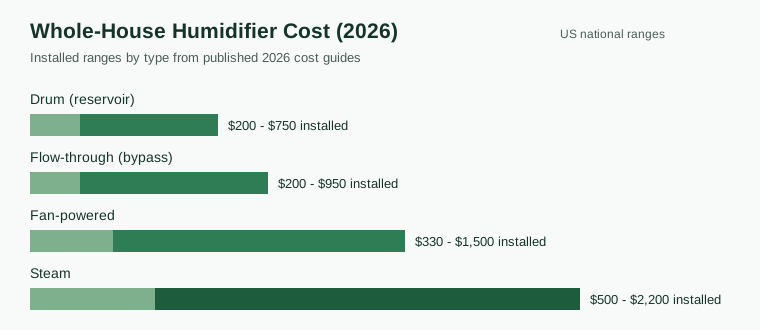
A whole house humidifier installed in 2026 typically costs $400 to $1,200 in the US, with steam models running $500 to $2,200 installed and costing far more to run. This guide breaks down price by type and home size, the extras that move a quote, a decade of ownership math, and the humidity ceiling you should not cross.
Quick Checks
- 1Budget $400 to $1,200 installed for a whole house humidifier in 2026. Angi's 2026 data puts the average job at $580, inside a $392 to $768 professional range.
- 2Type decides the bill twice. A bypass unit installs for $200 to $950 and costs $1 to $3 a year to run. A steam unit installs for $500 to $2,200 and costs $150 to $480 a year in electricity, plus a $60 to $200 canister every year.
- 3The EPA caps indoor humidity at 50 percent. Natural Resources Canada puts the winter target at 30 to 40 percent in cold climates. Condensation on windows is the signal to turn the humidistat down, not up.
- 4Size by output, not by the box. Published sizing runs 12 gallons per day for 1,000 to 2,000 sq ft homes and 18 or more gallons per day past 3,000 sq ft, and a leaky house needs more capacity than a tight one of the same size.
- 5Get the type, the capacity rating in gallons per day, the humidistat model, and the water and drain connections in writing. Steam also needs a dedicated electrical circuit at $250 to $900, and that line is often missing from the first quote.
Whole House Humidifier Cost 2026: What Installation Really Costs
By EnergyBS Editorial Team | October 6, 2026
The Short Answer: What a Whole-House Humidifier Costs
Short Answer: In 2026, a whole-house humidifier costs $400 to $1,200 installed in the US, according to HomeGuide's 2026 humidifier cost guide, with a national average near $750. Angi's 2026 cost data lands lower for the typical job: an average of $580, inside a professional range of $392 to $768, with budget models from $175 and high-end furnace-mounted models reaching $1,350. The gap between the two datasets is mostly the steam share. Steam units price at $500 to $2,200 installed and pull the top of every range up with them.
The type you pick matters more than the brand you pick. A drum or flow-through unit costs $100 to $500 before labor. A steam unit costs $300 to $1,300 before labor, needs its own electrical circuit, and then spends $150 to $480 a year on electricity where a bypass unit spends $1 to $3. Installation labor adds $100 to $900 across all types, at HVAC rates of $75 to $150 per hour. This guide prices each type from the same published 2026 data, shows the 10-year bill for each one, and covers the two mistakes that waste the money: sizing by the wrong number, and setting the humidity above what your windows can handle.
October is when this purchase gets made, because the first cold snap is when indoor humidity falls off the table. Forced-air heating takes outdoor air that already holds little moisture, heats it, and delivers it at a relative humidity that can sit in the teens. The humidifier is the fix that treats the whole house at once instead of one bedroom at a time.
1. Four Types, Four Different Bills
Whole-house humidifiers all mount at the furnace or air handler and push moisture into the duct system, but they make that moisture four different ways, and the running costs separate fast.
| Type | Unit price | Total installed | Yearly energy cost | Yearly consumable |
|---|---|---|---|---|
| Drum (reservoir) | $100 to $300 | $200 to $750 | $1 to $3 | Pad and cleaning, $10 to $30 |
| Flow-through (bypass) | $100 to $500 | $200 to $950 | $1 to $3 | Evaporator pad, $10 to $30 |
| Fan-powered | $200 to $600 | $330 to $1,500 | $9 to $28 | Evaporator pad, $10 to $50 |
| Steam | $300 to $1,300 | $500 to $2,200 | $150 to $480 | Canister, $60 to $200 |
Unit and installed ranges are HomeGuide's 2026 tables. Angi's 2026 ranges for the same types run drum $100 to $300, flow-through $200 to $600, and steam $300 to $1,100 for the unit, which is the same shape: evaporative units cluster low, steam sits alone at the top.
Drum humidifiers rotate a pad through a reservoir of standing water. They are the cheapest hardware in the category and the fussiest to own. The EPA's humidifier guidance is blunt about standing water: microorganisms grow in tanks that hold it, and the reservoir design is why drum units need the most frequent cleaning of the four. The float valve that keeps the reservoir full is also a known repair item at $90 to $180 professionally replaced.
Flow-through humidifiers trickle water over an evaporator pad while furnace air passes through, and the excess drains away. No standing water, one pad to change each year, and output that depends on hot supply air and furnace run time. HomeGuide calls flow-through the most common type and the best fit for most homes, and the installed band of $200 to $950 is why. Most are bypass models: a duct carries air from the supply side through the unit and back to the return, using the furnace's own blower instead of a separate fan.
Fan-powered humidifiers add an internal fan to the flow-through design. The fan lets the unit move more air per hour, work in larger homes, and run when the furnace is between heating calls. HomeGuide prices fan-powered models inside the brand tables rather than as a separate row, and Angi puts the running cost at $9 to $28 a year, still trivial next to steam. The trade is noise and one more motor: a fan motor replacement runs $100 to $450 professionally done.
Steam humidifiers boil water in a canister and inject the steam into the duct, or disperse it without ducts in ductless models. Output does not depend on furnace air temperature, control is the tightest of the four, and there is no pad. The bill arrives in three places instead: the highest unit price, a dedicated electrical circuit at $250 to $900 that HomeGuide lists as required for steam, and the highest running cost in the category by a factor of fifty.
One sizing note that applies to all four: capacity is rated in gallons per day (GPD), and published capacities run from 12 to 30 GPD across residential models. Section 6 covers how to pick the number.
2. Cost by Home Size
HomeGuide's 2026 sizing table prices the job by the house the unit has to serve:
| Home size | Unit price | Total installed | Output |
|---|---|---|---|
| 1,000 to 2,000 sq ft | $150 to $280 | $250 to $730 | 12 GPD |
| 2,500 to 3,000 sq ft | $200 to $500 | $300 to $1,400 | 17 GPD |
| 3,000 to 5,000+ sq ft | $250 to $1,100 | $450 to $2,000 | 18+ GPD |
Read the table as capacity pricing. Moving from a 12 GPD unit to an 18-plus GPD unit roughly doubles the unit price at the top of each band, and the installed range widens because the bigger jobs are where steam units and second units appear. Homes past the largest single-unit coverage get two units, which prices as two installations, not one installation plus a discount.
Angi's sizing note gives the other half of the picture: a well-sealed 1,500 sq ft home needs about 3.2 gallons of water per day actually delivered into the air, and larger homes may need twice that. The rated GPD on the box is output capacity under favorable conditions, not a promise. A 12 GPD bypass unit that only runs when the furnace runs, fed by warm rather than hot supply air, delivers a fraction of its rating across a cold day. That gap between rated and delivered output is where most undersizing complaints come from, and it is why the published tables map a modest 1,000 to 2,000 sq ft house to a 12 GPD unit rather than to a 4 GPD unit.
Tightness moves the requirement as much as floor area does. HomeGuide lists insulation and air sealing as a primary cost factor: a well-sealed home holds the moisture the unit makes, while a leaky home exhales it through every gap and needs a higher GPD rating to hold the same humidity. Section 8 covers when that ordering should change what you buy first.
3. What the Installed Price Actually Covers
A standard installation on an existing forced-air system runs 2 to 6 hours: bypass and fan-powered units take 2 to 3 hours, and steam takes 4 to 6 hours. The work itself is consistent across installers:
- Cut the mounting opening into the supply or return plenum and seal the unit to the duct
- Run the bypass duct on bypass models, from the unit to the opposite plenum
- Mount the humidistat, at least 6 inches from the humidifier so it reads room air rather than the discharge
- Wire the humidistat to the furnace control or transformer and to the humidifier's solenoid valve
- Connect the water supply, by saddle valve where local code allows or a T-fitting where it does not
- Run the drain line for flow-through and steam models
- Test for leaks, confirm the solenoid opens and closes, and set the starting humidity
The unit, that labor, and the basic water and drain connections are what the installed ranges in section 1 buy. Four lines sit outside those ranges often enough that each one deserves a direct question before you sign:
Dedicated electrical circuit: $250 to $900. Steam humidifiers require one. If the first quote does not show it, the quote is not finished.
Humidistat upgrade: $30 to $200. A manual humidistat costs $30 to $50 and an automatic digital model $90 to $200. The automatic version reads outdoor temperature and pulls the indoor target down as it gets colder outside, which is the behavior that keeps windows dry in a cold snap. On a quote that includes a basic manual control, the upgrade is the cheapest useful change you can make.
Service and diagnostic fees: $75 to $200. Angi puts the average HVAC service fee at $100 to $200 on top of labor where one is charged, and HomeGuide's repair data puts diagnostic fees at $75 to $200. Some firms roll the fee into the job and some do not. Ask which.
Hard-water protection: varies, up to a softener at $1,200 to $3,800. Flow-through and steam units scale up on hard water. HomeGuide notes that homes on well or hard water may need filtration ahead of the unit to prevent clogs and mineral buildup, and prices a water softener at $1,200 to $3,800 installed where the whole house needs one. Most homes need only an inline filter and a shorter pad-change interval, but a house on hard well water should hear this number before the installation, not after the first clogged canister.
Bundling changes the labor math. A humidifier added during a furnace replacement shares the trip, the duct opening work, and part of the wiring with the main job, so the marginal labor sits at the low end of the $100 to $900 band. Our furnace replacement cost guide prices that main job; if a furnace quote is already on your table, get the humidifier as its own written line inside it so the bundle can be compared against a standalone quote.
4. Brand and Model Anchors
Brand pricing in HomeGuide's 2026 table clusters tightly for evaporative units and spreads out only at steam:
| Brand | Unit price | Total installed | Warranty |
|---|---|---|---|
| Aprilaire | $130 to $1,000 | $230 to $1,900 | 5 years |
| Honeywell | $150 to $400 | $250 to $1,300 | 1 or 5 years |
| Carrier | $200 to $800 | $300 to $1,700 | 5 or 10 years |
| Bryant | $230 to $630 | $330 to $1,500 | 5 or 10 years |
| Trane | $200 to $900 | $300 to $1,800 | 5 or 10 years |
| American Standard | $300 to $1,100 | $400 to $2,000 | 10 years |
Most brands require professional installation and registration within 60 to 90 days for the full warranty term to apply. That condition is a real cost factor for the DIY question in the FAQ: a self-installed unit that loses its warranty registration has given up part of what the brand premium bought.
Aprilaire's model ladder is the clearest published example of how capacity prices:
| Aprilaire model | Type | Unit price | Max coverage | Output |
|---|---|---|---|---|
| 500 | Small bypass evaporative | $130 to $200 | 3,500 sq ft | 12 GPD |
| 400 | Water-saver bypass evaporative | $170 to $300 | 5,000 sq ft | 17 GPD |
| 600 | Large bypass evaporative | $150 to $250 | 5,000 sq ft | 17 GPD |
| 700 | Fan-powered evaporative | $250 to $350 | 5,300 sq ft | 18 GPD |
| 800 / 865 | Steam | $700 to $1,000 | 10,000 sq ft | 11.5 to 34.6 GPD |
Two things to take from that ladder. First, evaporative capacity is cheap: stepping from 12 to 18 GPD costs roughly $100 at unit level. The installed price moves more than the unit price does when the bigger job needs duct or electrical changes. Second, coverage ratings assume a reasonably tight house. The same 5,000 sq ft rating on a leaky 1970s house and a new sealed house describes two different real-world results, which is why a quote should state the assumed output in GPD and not just the model number.
Trane sits at the premium end of the dealer channel: HomeGuide prices Trane units at $320 to $1,800 installed, sold and installed only through Trane dealers, with a 10-year warranty when registered within 60 days. Bryant prices at $800 to $1,400 installed depending on type, with a 10-year warranty on registration within 90 days. The dealer-channel brands cost more at install and carry the longer warranties. Whether that trade is worth it depends on how long you plan to stay, and section 5 puts a time frame on the comparison.
5. The 10-Year Bill: A Worked Example
Installed price is the smallest difference between the cheapest and the most expensive way to humidify a house. The running costs run for a decade, and a whole-house humidifier lasts 10 to 15 years per HomeGuide, with Angi putting average life near 10 years. So the fair comparison is 10 years of ownership, all lines in.
Hypothetical example, with the math shown. The example assumes a 2,000 sq ft home, mid-band installed prices from the tables above, DIY pad and canister changes, and no repair calls. Your prices will land somewhere inside the same published bands.
| Cost line (10 years) | Bypass flow-through | Fan-powered | Steam |
|---|---|---|---|
| Installed (unit + labor) | $650 | $1,000 | $1,800 |
| Electricity | $2/yr x 10 = $20 | $18/yr x 10 = $180 | $300/yr x 10 = $3,000 |
| Pads or canister | $20/yr x 10 = $200 | $20/yr x 10 = $200 | $120/yr x 10 = $1,200 |
| 10-year total | $870 | $1,380 | $6,000 |
The inputs are the midpoints of fetched ranges, not best cases. Bypass energy at $1 to $3 a year is effectively zero. Steam energy at $150 to $480 a year is a utility bill. The steam canister at $60 to $200 a year, replaced annually per HomeGuide's repair data, costs more over the decade than the entire bypass unit cost to install.
Professional maintenance changes the evaporative numbers modestly and the conclusion not at all. Annual maintenance runs $70 to $150 per HomeGuide and $75 to $200 per Angi. Paying for a yearly visit instead of changing a $10 to $30 pad yourself adds roughly $700 to $1,500 over the decade to any column, and most manufacturers treat the pad change as an owner task.
What this math settles: steam is not a premium version of the same purchase. It is a different purchase, justified by the cases in section 8 where evaporative output cannot do the job, and priced at roughly seven times the 10-year cost of the bypass unit it replaces. Where an evaporative unit can hold the target humidity, paying steam money buys control precision most houses never use.
The reverse error also exists. A steam quote is sometimes the right answer presented to the wrong house, and a bypass quote is sometimes the wrong answer presented because it is cheap. The next two sections are the checks that tell you which situation you are in.
6. Picking the Capacity: Gallons per Day
Capacity selection has three inputs, and a good quote states all three: floor area, house tightness, and the heating system's air temperature.
Floor area sets the starting rating. The published mapping is 12 GPD for 1,000 to 2,000 sq ft, 17 GPD for 2,500 to 3,000 sq ft, and 18-plus GPD beyond that. Treat those as minimums for a tight house in a cold climate, not as generous ratings with headroom to spare.
Tightness moves the rating up or down. Delivered moisture leaves a leaky house at the air-change rate. HomeGuide lists insulation and seal quality as a direct sizing factor, and the mechanism is simple: the unit humidifies air that is continuously replaced by dry outdoor air. A leaky 2,000 sq ft house can need the 17 GPD unit that the table assigns to a tight 3,000 sq ft house. Our air sealing guide for older homes covers the work that reduces that requirement, and sealing first sometimes drops the right humidifier down a size.
Supply air temperature decides whether evaporative output is real. Evaporation from a pad depends on warm air moving across it. A high-efficiency gas furnace delivers hot supply air for long stretches and evaporative units perform near rating. Two systems fall short:
- Heat pumps deliver cooler supply air, and HomeGuide is direct that steam is the better fit for heat pump homes because the air is not hot enough to run a drum or flow-through unit effectively.
- Modulating furnaces spend much of the season at low fan speed, and HomeGuide advises against bypass models there for the same reason: low airflow across the pad means low output. A fan-powered unit, which brings its own airflow, is the evaporative answer for a modulating system.
Oversizing has its own failure mode. A unit with far more capacity than the house needs reaches the humidistat setting quickly and shuts off, which sounds like success until the first cold snap, when the setting that was safe at 30 degrees outdoors is too high at 5 degrees and the windows run with water. Capacity should match the house at a realistic winter setting, and the control should be the automatic type that adjusts the target with outdoor temperature.
7. The Humidity Ceiling: Where Comfort Stops
More humidity is not better humidity. The target is a band, and the top of the band is set by your windows and walls, not by the humidifier.
The EPA's ceiling is 50 percent relative humidity: above that level, moisture encourages dust mites and mold growth in the home. Natural Resources Canada's guidance for Canadian homes puts the general ideal at 30 to 50 percent, and the winter target in colder climates at 30 to 40 percent specifically to prevent condensation on windows.
The EPA gives the practical signal to watch: if water condenses on windows, walls, or pictures, turn the humidistat down or run the unit less. Condensation on the glass is the visible version. The invisible version is moisture condensing inside wall cavities and attic surfaces at the same conditions, which is why the ceiling matters even in rooms where the windows stay dry. Our winter window condensation guide works through the causes on the window side; the humidifier side of the same problem is a setpoint that did not come down when the weather turned cold.
An automatic humidistat with an outdoor temperature sensor handles this adjustment continuously. A manual humidistat handles it when someone remembers. In a climate with real cold snaps, that difference is the difference between a house that holds 35 percent safely all winter and a house that grows mold at the window frames in February. At $90 to $200 against a $30 to $50 manual control, the automatic control is the line item to protect when a quote gets negotiated down.
Below the band has its own symptoms, and they are the reason the unit exists: dry skin and sinuses, static shocks, gaps opening in hardwood and wood trim as the wood gives up moisture. The EPA also notes that added moisture relieves exactly those winter-heating nuisances, including cracks in paint and furniture. The purchase is justified inside the band. Outside it, in either direction, the house is telling you the setting is wrong.
8. When the Humidifier Is the Wrong Purchase, or the Wrong Type
Four situations change the recommendation, and each one shows up in quotes regularly.
The house is too leaky for the moisture to stay. Humidifying a house with heavy air leakage is running the unit against an open window. The moisture leaves, the unit runs longer, pads scale faster, and the humidity still will not hold on cold days. Seal first, then size the humidifier for the tighter house. The sealing work also cuts the heating bill in every month, humidified or not.
The heating system is a heat pump and the quote says bypass. Cooler supply air starves an evaporative pad. HomeGuide's guidance for heat pump homes is steam, because steam output does not depend on air temperature at all. A bypass quote on a heat pump home is a cheap quote for a unit that will underperform exactly when the weather is coldest and the need is highest.
The furnace modulates and the quote says bypass. Same failure, smaller degree. Low fan speeds starve the pad. Fan-powered evaporative or steam fits; plain bypass does not.
There are no ducts. A furnace-mounted unit needs a forced-air system to distribute moisture. Homes on boilers, baseboards, or stoves have no ductwork to mount to. The options are room units, or ductless steam dispersion: the Aprilaire 865 in the table above is a ductless steam model rated to 10,000 sq ft at $700 to $1,000 for the unit, which is the workable version of whole-house humidification for a ductless home, at steam prices and steam running costs. If a quote proposes a standard furnace humidifier for a house with no furnace, stop the conversation there.
A fifth situation deserves a sentence: indoor humidity that already sits above 40 percent in winter, or windows that already condense, points at a moisture source to fix (bathroom and kitchen exhaust, a wet crawl space, an oversized unit short-cycling) before any humidifier enters the discussion. Adding moisture to that house treats the wrong problem.
9. Running Costs and the Maintenance Calendar
The consumables are cheap and predictable. The failures are also predictable, and HomeGuide's repair data prices each one:
| Item | Cost | Interval |
|---|---|---|
| Evaporator pad replacement | $10 to $30 (DIY) | At least once per year, more often on hard water |
| Steam canister replacement | $60 to $200 (DIY) | Once per year |
| Solenoid valve replacement | $15 to $80 part, $90 to $230 installed | When the unit will not start or will not stop |
| Float valve repair (drum) | $15 to $30 part, $90 to $180 installed | As needed on reservoir models |
| Fan motor replacement | $25 to $150 part, $100 to $450 installed | As needed on fan-powered models |
| Humidistat replacement | $30 to $200 part, $100 to $400 installed | When control fails |
Angi's national average for a humidifier repair is about $230, with ducted whole-house repairs reaching $500. Most repairs take under an hour once the fault is found, at the same $75 to $150 per hour HVAC rate.
The calendar that keeps those costs at the cheap end:
Start of heating season. Fit a new evaporator pad, or a new steam canister. Open the water supply and the bypass damper. Confirm the solenoid clicks and water flows. A clogged pad from last season is the most common reason a flow-through unit produces no humidity, per HomeGuide's repair data, and it announces itself as a dry house in November that gets diagnosed as a failed unit.
Mid-season. Check the drain line is clear and running. On hard water, inspect the pad early; mineral crust cuts output long before the pad looks spent.
End of season. Clean the unit as the manufacturer directs, following the EPA's end-of-season guidance: clean it, make sure every part is dry before storage, and discard used cartridges and pads. A drum reservoir should not sit with standing water in it over the summer. That single habit is most of the difference between a drum unit that lasts a decade and one that grows a biology project by June.
Water quality runs through all of it. The EPA notes that low-mineral water reduces scale buildup, and scale is both an output killer and a surface where microorganisms establish. Hard-water homes should expect the short end of every pad interval above, and that expectation belongs in the purchase decision for steam, where the canister absorbs the minerals instead of the pad.
10. Canada Note
The pricing in this guide is US pricing, from US cost datasets. The two datasets fetched for this guide publish no Canadian installed band, and we are not going to convert one at an exchange rate and call it data. Canadian HVAC firms quote humidifiers per job, usually as an add-on line to furnace work.
What does transfer north is the humidity guidance, and the Canadian source is the stricter one. Natural Resources Canada's 30 to 40 percent winter band exists for exactly the housing stock that needs it: cold-climate homes where a 45 percent setpoint will condense on windows and inside walls for weeks at a time. A Canadian buyer should hold the quote to the same itemization as section 11, expect the automatic humidistat to earn its price in any province with real winter, and treat any US dollar figure quoted by a local firm as a number to question.
11. Quote Checklist: How to Compare Three Quotes Fairly
Get three written quotes for the same scope. Humidifier quotes diverge on type, capacity, and the electrical line, so each quote should state:
- Type (drum, bypass flow-through, fan-powered, or steam) and the exact model, with output in gallons per day
- The home size and tightness assumption behind the capacity chosen
- Humidistat included: manual or automatic with outdoor sensor, model stated
- Water supply connection method (saddle valve or T-fitting) and drain routing
- Electrical scope, including the dedicated circuit for steam, priced as its own line
- Pad or canister: first one included, replacement cost and interval stated
- Labor as a stated figure or hour estimate, plus any service or diagnostic fee
- Warranty terms for parts and labor, and the registration deadline (60 to 90 days on most brands)
- Start-of-season and end-of-season maintenance: what the firm charges ($70 to $200 a visit in published data) or what the owner does
- For bundled furnace quotes: the humidifier as its own priced line, separable from the equipment price
Red flags: a quote with no type or capacity stated, steam priced without the electrical line, a bypass unit quoted for a heat pump or modulating furnace with no discussion of output, an automatic-humidistat upsell with no mention of the outdoor sensor, and any promise that the unit will pay for itself in heating savings. That last one deserves a direct answer, given in the FAQ below.
The ductwork the moisture travels through matters too. A humidifier distributes through the same ducts that distribute heat, and leaking ducts send humidified air into the attic or crawl space. Our ductwork replacement cost guide prices that system, and a duct quote and a humidifier quote from the same visit should each survive on their own lines.
Frequently Asked Questions
How much does it cost to install a whole house humidifier in 2026?
HomeGuide's 2026 data puts a whole house humidifier at $400 to $1,200 installed, with a national average near $750 and a full range of $200 to $2,500. Angi's 2026 data puts the average professional job at $580, inside a $392 to $768 range. By type, HomeGuide prices drum units at $200 to $750 installed, flow through units at $200 to $950, and steam at $500 to $2,200, before add ons like a dedicated steam circuit at $250 to $900.
Which is better, a bypass or a steam humidifier?
For a gas furnace home that needs standard winter humidity, the bypass flow through unit is the value pick: $200 to $950 installed and $1 to $3 a year to run. Steam wins where evaporative output cannot work: heat pump homes with cooler supply air, very large or very dry homes, and cases needing tight control independent of furnace run time. Steam costs $500 to $2,200 installed, $150 to $480 a year in electricity, and a $60 to $200 canister annually. Over 10 years that is roughly $6,000 against roughly $870 for the bypass unit in the worked example above.
How long does installation take?
Two to 6 hours in HomeGuide's 2026 data. Bypass and fan powered units take 2 to 3 hours. Steam units take 4 to 6 hours, driven by the electrical work and the dedicated circuit. Adding the unit during a furnace replacement compresses the labor because the duct and wiring work overlaps.
How long does a whole house humidifier last?
HomeGuide puts service life at 10 to 15 years with proper installation and maintenance. Angi puts the average nearer 10 years. Annual pad or canister replacement and end of season cleaning are the maintenance that gets a unit to the top of that range; standing water left in a drum reservoir over the summer is the habit that cuts it short.
What humidity should I set in winter?
Inside the EPA's ceiling of 50 percent, and inside Natural Resources Canada's winter band of 30 to 40 percent for colder climates. Start near 35 percent. If water condenses on windows, turn the setting down: the EPA names window condensation as the signal to lower the humidistat or run the unit less. An automatic humidistat with an outdoor sensor makes that adjustment continuously as the weather changes.
Can I install a whole house humidifier myself?
The parts are sold retail and HomeGuide puts the labor saving at $100 to $900. The work, though, is cutting into ductwork, a pressurized water connection, a drain, and low voltage or line voltage wiring in one job, and a slow leak at the water line is the failure mode that costs real money. Most brands also condition the full warranty on professional installation and registration within 60 to 90 days. DIY makes the most sense on a straight replacement of an existing unit, where the duct opening, water line, and drain already exist.
Do whole house humidifiers cause mold?
Run inside the 30 to 50 percent band and cleaned on schedule, they should not. The EPA's guidance is that humidity above 50 percent encourages mold and dust mites, and that standing water in a tank grows microorganisms, which is the specific weakness of drum reservoir designs. Flow through units hold no standing water, and steam heats its water. The mold stories trace back to setpoints held too high through cold weather, reservoirs left wet over summer, or pads left in place for years. Each one is a maintenance failure, not a property of humidification.
Will a whole house humidifier lower my heating bill?
Treat it as a comfort purchase, not an energy measure. Humidified air feels warmer at the same temperature, and a household that responds by lowering the thermostat a degree or two will spend less on heat. No dataset fetched for this guide publishes a verified savings figure for that effect, and for steam the arithmetic runs the other way: $150 to $480 a year in electricity is a real bill chasing an unmeasured comfort saving. Buy the unit for dry skin, static, wood floors, and sleep. Let any thermostat effect be a bonus, and do not let a salesperson book it as payback.
What to Read Next
- Furnace Replacement Cost 2026 - the main job a humidifier most often bundles into, priced line by line
- Ductwork Replacement Cost 2026 - the distribution system your humidified air travels through
- Why Windows Get Condensation in Winter - the other side of the humidity ceiling, and how to tell a window problem from a setpoint problem
- Air Sealing a Guide for Older Homes - the fix that lets a smaller humidifier hold humidity in a leaky house
Sources and Verification
- HomeGuide How Much Does a Humidifier Cost to Install? (2026 installed ranges by type, brand and home size, Aprilaire model pricing, labor and running costs, based on project costs reported by HomeGuide members)
- HomeGuide 2026 Humidifier & Dehumidifier Repair Costs (evaporator pad, solenoid valve, fan motor, humidistat and steam canister replacement prices)
- Angi Whole House Humidifier Cost [2026 Data] (average installed cost $580, professional range $392 to $768, maintenance and repair averages, yearly energy cost by type)
- U.S. EPA Use and Care of Home Humidifiers (do not humidify above 50 percent relative humidity, condensation as the signal to turn the unit down, cleaning and end of season care for central humidifiers)
- Natural Resources Canada Choosing the right dehumidifier (ideal indoor relative humidity 30 to 50 percent, and 30 to 40 percent in winter in colder climates to prevent condensation on windows)
Editorial Review
EnergyBS Editorial Team
EnergyBS publishes practical homeowner guides. Important program, product, and cost claims should be checked against the linked source and local project documents before you commit to work.
Related Guides
View All ArticlesFurnace Replacement Cost 2026: What Installation Really Costs
Replacing a gas furnace in 2026 typically costs $3,800$12,000 installed in the US ($4,000$7,500 in Canada). This guide breaks down equipment vs. labor, efficiency tiers, sizing, the 80%to90% conversion risk, and repairvsreplace math.
Ductwork Replacement Cost 2026: What Installation Really Costs
Replacing home ductwork in 2026 typically costs $1,400 to $5,600 in the US, or $25 to $55 per linear foot, with a national average near $3,500. This guide breaks down cost by house size, duct location and material, the repair and sealing options that cost far less than replacement, and the addons that move a quote.
Winter Window Condensation 2026 Guide & Data
Use condensation location, outdoor temperature, indoor humidity, surface temperature, and room conditions to separate normal coldsnap fogging from failed glass, leaks, and mold risk.