Crawl Space Encapsulation Cost 2026: What Installation Really Costs
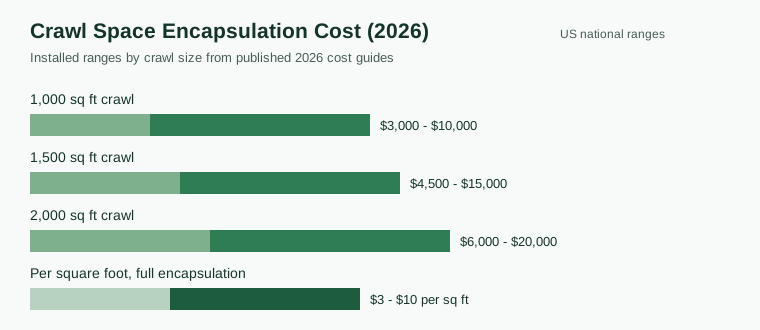
Encapsulating a crawl space in 2026 typically costs $3 to $10 per square foot, or $3,000 to $15,000 total for most homes. This guide breaks down cost by crawl size and barrier thickness, what the vapor barrier, insulation, and dehumidifier lines actually cover, the prep work that moves a quote, and how to compare bids without paying twice for the same scope.
Quick Checks
- 1Budget $3 to $10 per square foot installed for full encapsulation in 2026, or $3,000 to $15,000 total for most homes. Angi puts the average project near $5,500, inside a common $5,000 to $15,000 band.
- 2Size drives the total more than any single material choice: HomeGuide prices a 1,000 sq ft crawl at $3,000 to $10,000 and a 2,000 sq ft crawl at $6,000 to $20,000 on the same per-foot band.
- 3The vapor barrier alone is a small share of the job. Materials run about $0.30 to $0.70 per square foot by thickness, and barrier installation with labor is roughly $2 to $4 per square foot, before insulation, sealing, and drying.
- 4Prep is where quotes separate. Cleaning and repairs, mold work, drainage, and old insulation removal are all extra lines in the published data, and a wet or damaged crawl can add thousands before the liner goes in.
- 5Get the scope in writing by line: barrier thickness and coverage, wall insulation type and R-value, vent sealing, drainage and pump, dehumidifier size and drain, and what cleanup is included. A single total with no lines cannot be compared.
Crawl Space Encapsulation Cost 2026: What Installation Really Costs
By EnergyBS Editorial Team | October 5, 2026
The Short Answer: What Encapsulation Costs
Short Answer: In 2026, encapsulating a crawl space typically costs $3 to $10 per square foot installed, or $3,000 to $15,000 total for most homes, according to HomeGuide's 2026 encapsulation cost guide. Angi's 2026 cost data lands in the same place from the other direction: an average project near $5,500, with most homeowners paying $5,000 to $15,000, a low end near $1,500 for small, clean spaces, and a high end near $20,000 when the space is large or needs repair work first. Basic work at the low end of the per-foot band runs about $2 to $4 per square foot. More extensive work with heavier cleanup, repairs, and added features runs about $3 to $10 per square foot.
Those bands are wide because encapsulation is not one product. At minimum it means a heavy ground vapor barrier sealed at the seams and walls, with foundation vents closed. A complete job adds wall insulation, a drainage path or sump where water collects, and a dehumidifier or another intentional drying method to hold humidity down after the space is sealed. Two quotes can both say encapsulation and price jobs that differ by a dehumidifier, a drainage system, and a mold cleanup. This guide separates the lines, prices each one from the same published 2026 data, and shows where a quote moves from the base band into repair money.
One framing note before the tables. Encapsulation is moisture work first and energy work second. The energy benefit is real but it depends on the house: sealing and insulating the crawl changes heating and cooling load only when the crawl was a major leak and loss path to begin with. Section 9 covers what the published energy guidance does and does not promise, so the payback math does not overstate anything.
1. Three Jobs That All Get Called Encapsulation
Job one: barrier-only sealing. The crew cleans the space, lays a polyethylene vapor barrier over the ground and partway up the walls, seals the seams, and closes the vents. No wall insulation, no drainage work, no dehumidifier. This is the low end of the market and it is the right scope only for a dry crawl in a mild or dry climate with no standing water history and no ducts or plumbing that freeze. It controls ground moisture. It does not control humid air that enters through rim leaks, and it does not dry a space that starts wet.
Job two: full encapsulation. Barrier over the full floor and up the foundation walls, vents sealed, wall insulation installed, and a drying method in place, usually a crawl-space dehumidifier with a condensate drain or a small conditioned-air supply where the design calls for it. Most of the $3,000 to $15,000 band describes this job. This is the scope to assume when a quote does not itemize, and the scope to demand in writing when it does.
Job three: encapsulation plus repair and water management. The same full system, preceded by the work that makes it hold: debris and failed insulation removal, mold remediation, joist or sill repair, an interior perimeter drain or French drain with a sump pump, and grading or gutter fixes outside. Published repair and drainage lines put this job well above the base band, and section 6 prices each add-on so the jump is visible line by line instead of arriving as a surprise total.
Our crawl space encapsulation versus vented guide works through when sealing is the right call at all, including radon, combustion equipment, flood, and termite-inspection cases that can change the design. This guide assumes the decision is made and prices the work.
2. What the Installed Price Actually Covers
A complete encapsulation quote in the published data bundles cleaning, the barrier material and its installation, vent sealing, wall insulation, and the drying equipment, with inspection and permits priced separately or as small lines. HomeGuide puts a crawl space inspection at $100 to $250 when it is charged at all. Many contractors roll a basic inspection into the quote visit, so confirm whether that line is a fee or a sales call.
What a complete quote usually includes:
- Debris removal and a light cleaning of the crawl floor
- Vapor barrier over the ground, lapped and sealed at seams, run up the walls and sealed at the top edge
- Foundation vents closed and sealed, penetrations foamed or sealed
- Wall insulation where the scope calls for it, with the floor left uninsulated in a sealed design
- Dehumidifier sized for the space, hung or set, with a drain line to a pump or gravity drain
- A sealed access door or cover where the old access leaked air
What it usually does not include unless a line says so: mold remediation, structural repair, a perimeter drain and sump system, old insulation removal and disposal, radon mitigation, termite treatment, and the electrical circuit for the dehumidifier or pump if a new run is needed. Section 6 prices each of those from the same sources, because they are where a low quote becomes an average quote plus change orders.
The single most useful detail to demand is the barrier specification: thickness in mils, whether it is reinforced, how high it runs on the wall, and how seams and piers are sealed. Material cost by thickness is a small number, covered in section 4. The labor to lay, lap, and seal it is the larger number, and a quote that will not state thickness or coverage cannot be checked against any published band.
3. Cost by Crawl Size
Size is the cleanest pricing ladder because the barrier, cleaning, and sealing all scale with the floor the crew has to cover. HomeGuide's 2026 installed table is:
| Crawl size | Average installed cost |
|---|---|
| 1,000 sq ft | $3,000 to $10,000 |
| 1,500 sq ft | $4,500 to $15,000 |
| 2,000 sq ft | $6,000 to $20,000 |
| 2,500 sq ft | $7,500 to $25,000 |
| 3,000 sq ft | $9,000 to $30,000 |
Angi's size table uses rounder bands and lands in the same place: about $2,000 to $10,000 at 1,000 sq ft, $4,000 to $20,000 at 2,000 sq ft, and $6,000 to $30,000 at 3,000 sq ft. The two sources agree on the shape even where the endpoints differ by a few hundred dollars: each additional 500 sq ft of crawl adds roughly $1,500 to $5,000 at the full-encapsulation scope, and the per-foot rate, not the house value or the contractor's market, is what moves the total.
Read the low end of each row as a clean, dry, accessible crawl with good clearance and no repair list. Read the high end as the same floor area with low clearance, piers and ductwork to seal around, and at least one prep line from section 6. Height matters as much as area and neither table can show it: a 1,200 sq ft crawl with 4 feet of clearance prices lower per foot than a 900 sq ft crawl the crew crosses on their backs, because the labor hours per foot roughly double when no one can kneel.
Worked example, labeled hypothetical. Take a 1,400 sq ft crawl, dry, with 3 feet of clearance, no mold, and floor insulation that has already fallen and will be removed. At $3 to $10 per square foot, the full-encapsulation band is $4,200 to $14,000 before extras. Add old insulation removal at $1 to $2 per square foot, or $1,400 to $2,800, and a dehumidifier already inside the full scope on most bids. A careful planning number for that house is the middle of the band, about $7,000 to $9,000 installed, with the written scope deciding whether the real quote lands below or above it. This example uses only the published bands above. Your crawl's clearance, water history, and repair list move the result more than rounding does.
4. The Vapor Barrier: Thickness, Coverage, and Price
The barrier is the part of the system the name describes, and it is the cheapest material in the job. HomeGuide prices crawl space moisture barrier material at about $0.30 to $0.70 per square foot by thickness, or $360 to $840 per 1,200 sq ft roll, with installation bringing the barrier line to roughly $2 to $4 per square foot on its own. In the service breakdown, vapor barrier installation as a line runs $1,200 to $4,000 total for a typical crawl.
| Barrier thickness | Material cost per sq ft | Material per 1,200 sq ft roll |
|---|---|---|
| 6 mil | $0.30 to $0.35 | $360 to $420 |
| 8 mil | $0.35 to $0.40 | $420 to $480 |
| 10 mil | $0.40 to $0.50 | $480 to $600 |
| 12 mil | $0.50 to $0.60 | $600 to $720 |
| 20 mil | $0.60 to $0.70 | $720 to $840 |
Building guidance for closed crawl spaces calls for a durable ground cover, commonly at least 10 mil, extending up the foundation walls and sealed around piers and penetrations, with sheet joints lapped and taped. The ENERGY STAR and DOE guide to closing ventilated crawl spaces specifies that coverage pattern: full floor coverage, laps sealed, and the top edge sealed to the wall below the sill. A 6 mil builder-grade sheet meets none of the durability expectations for a permanent system. It tears under foot traffic, punctures on gravel, and is normally treated as a temporary cover. The price gap between 6 mil and 20 mil material on a 1,200 sq ft crawl is about $360 at the published rates. On a $7,000 job, choosing the thin sheet to save that amount trades the system's service life for about 5 percent of the ticket. Pay for thickness and reinforcement. Save elsewhere if you must save.
Coverage matters as much as thickness. Three questions separate a barrier quote from a plastic quote:
- Does the barrier cover 100 percent of the ground, including under ducts and around every pier, with piers wrapped and sealed?
- Are seams lapped at least 12 inches and taped or sealed, not just overlapped and left?
- Is the top edge sealed to the foundation wall with tape and mastic or a termination bar, a few inches below the sill, instead of ending loose on the floor?
A yes to all three is encapsulation. A no to any one is a vapor retarder laid on dirt, and it should be priced as one.
5. Insulation in a Sealed Crawl: Walls, Not the Floor
A sealed crawl is insulated at the perimeter walls, not between the floor joists. ENERGY STAR's basement and crawl space guidance makes the same distinction: in a sealed and conditioned design, insulate the walls and leave the floor open so the crawl stays inside the thermal boundary and plumbing and ducts sit in tempered air. Fiberglass batts stuffed between joists belong to the vented design, and in a sealed crawl they hold moisture against the subfloor and fall. If your crawl has sagging joist batts today, their removal is part of the job, priced below.
HomeGuide prices crawl space insulation at $1.00 to $4.50 per square foot, or $500 to $3,700 total, by type and placement:
| Insulation approach | Placement | Cost per sq ft | Installed total in the guide |
|---|---|---|---|
| Rigid foam board | Walls | $1.20 to $3.70 | $500 to $1,600 |
| Closed-cell spray foam | Walls | $2.00 to $5.00 | $850 to $2,100 |
| Rigid foam board | Subfloor | $1.20 to $3.70 | $1,200 to $3,700 |
| Blown-in | Subfloor | $1.00 to $2.80 | $1,000 to $2,800 |
| Roll and batt | Subfloor | $0.90 to $1.40 | $900 to $1,400 |
Totals in the guide assume about 1,000 sq ft with 3-foot walls, so wall totals run lower than floor totals for the same house because the wall area is smaller. For a sealed crawl, compare the two wall rows and ignore the subfloor rows except as the price of the old approach. Rigid foam board on the walls is the common value choice: it tolerates occasional moisture, leaves a termite inspection strip possible where local practice requires one, and does not hold water against the joists. Closed-cell spray foam prices higher per foot and seals as it insulates, which helps on irregular stone or block walls where board fits poorly. Price both on your wall area, not your floor area. Contractors who quote wall insulation by floor square feet are mixing the two ladders, and the quote needs a wall-area line before it can be compared.
Our attic insulation removal cost guide covers the parallel decision upstairs, and the blown-in insulation cost guide prices loose-fill work where it belongs. In the crawl, the insulation decision is simpler: walls in a sealed system, with the R-value your climate and code require, verified on the quote by type and thickness.
6. The Add-On Stack: Where the Quote Leaves the Base Band
Every line below comes from the same two 2026 cost sources. None is unusual. A wet, low, or damaged crawl can carry three or four of them at once, which is how a $6,000 encapsulation becomes a $14,000 project without any line being wrong.
Inspection. $100 to $250 when charged separately. Confirm whether it is credited against the job.
Cleaning and repairs. $500 to $8,000 as a combined line in HomeGuide's breakdown, covering debris removal, light cleaning, and minor repairs. Most contractors include light cleaning with encapsulation and charge extra for mold, pests, or standing water work. Ask which of those three your price assumes.
Mold remediation. HomeGuide puts crawl space mold remediation at $15 to $30 per square foot, or $1,500 to $4,000 on average for the space. Angi's repair table puts mold issues at $1,000 to $3,500. The band depends on coverage: spot growth on a few joists prices nothing like growth across the full floor system. Sealing over active mold without remediation traps the problem inside the system. Any quote that skips a mold line on a crawl with visible growth should be questioned before it is signed.
Drainage and sump. An interior perimeter drain or French drain in the crawl runs $800 to $3,000 in HomeGuide's data, including trenching, gravel, pipe, and a pump. Angi prices waterproofing more broadly at $1,500 to $7,000. If water enters from the ground or through the wall base, the drain comes before the barrier, and the barrier is laid over or integrated with the drainage path, not used as a substitute for it. A liner over standing water becomes a pond cover. The water still arrives, and it now sits against the foundation in the dark.
Dehumidifier. $300 to $2,000 for the unit alone, or $1,000 to $3,000 with professional installation, by size. A whole-house unit that also serves the first floor runs $1,500 to $3,500 installed. HomeGuide's service table puts dehumidifier installation at $1,000 to $3,500. In a humid climate, an encapsulated crawl without a drying method is an unfinished system: the barrier stops ground moisture, but humid air that enters during service visits and through small leaks has nowhere to go, and condensation forms on the coolest surfaces. Size the unit to the crawl volume and climate, confirm the drain path, and confirm whether a dedicated electrical circuit is included or extra.
Vent and penetration sealing. $150 to $450 as a line. Small money, large effect. Unsealed vents defeat the system they are part of.
Old insulation removal. $1 to $2 per square foot extra when failed joist insulation has to come out and be disposed of. On a 1,500 sq ft crawl that is $1,500 to $3,000 before any new material enters the space.
Repairs from the Angi table, for scale. Sealing cracks $200 to $1,000. Vent issues $100 to $500. Pest work $500 to $10,000 across a very wide range that reflects the difference between a treatment and a structural repair. Water damage $1,000 to $10,000. Sagging floor work $1,500 to $10,000. Structural repairs $1,500 to $16,000. Foundation crack repair runs $250 to $800 for minor cracks in HomeGuide's foundation data and far more for major work. None of these is encapsulation. All of them can be prerequisites for it, and a thorough inspection prices them before the barrier is sold, not after the crew is under the house.
Add every line of the stack when you budget. A dry 1,500 sq ft crawl with good clearance and no repair list sits near the middle of the $4,500 to $15,000 row. The same crawl with mold at $2,500, drainage at $2,000, and old insulation removal at $2,200 sits near $12,000 to $16,000 as a complete project. Both numbers come from the same tables. The difference is condition, not contractor padding, and the inspection is what tells you which house you have.
7. Encapsulation Versus a Vapor Barrier Only
Homeowners are often quoted both ways, and the cheaper quote wins on price while describing a different job. A vapor barrier installation on its own runs about $2 to $4 per square foot installed, or $1,200 to $4,000 total as a line, and it covers the ground only. It does not seal vents, insulate walls, manage bulk water, or dry the air. For a dry crawl in a dry climate with no ducts below the floor and no moisture history, that scope can be a reasonable maintenance step.
Full encapsulation adds the wall seal, the insulation, and the drying method, and it is the scope that changes how the crawl behaves in humid weather. The decision test is short:
- If the crawl has ever held standing water, needs a drain. Barrier-only does not fix water entry.
- If summer humidity condenses on ducts or pipes today, the space needs drying, not just a ground cover.
- If ducts or plumbing run through the crawl, sealing and wall insulation protect them. A ground sheet alone leaves them in outdoor air.
- If musty odor reaches the living space, the air path between the crawl and the house is open, and sealing that path is the point of the full system.
Price the two scopes against those four answers, not against each other. Our air sealing guide for older homes covers the house-side leaks that pair with this work, because sealing the crawl while leaving the floor above it open at every pipe and wire penetration keeps part of the stack effect the system was meant to stop.
8. Permits, Code, and the Details That Fail Inspections
Some municipalities require a permit and inspection for encapsulation. Fees vary by location and are rarely the large line, but an unpermitted sealed crawl can surface at sale time, and two design details cause most of the friction.
Termite inspection access. In termite country, many inspectors and some local rules require a visible inspection strip at the top of the foundation wall, or another approved way to inspect for termites after the walls are covered. Covering the full wall with foam and liner without that provision can void a termite warranty or block a treatment. Ask how the design preserves inspection access before the wall is covered, and get the answer in the contract, not at the kitchen table.
Radon. Sealing the ground changes soil-gas entry paths. It does not mitigate radon on its own. Test before the project where radon is a local concern, and retest after the pressure boundary changes. If levels are elevated, a sub-slab or crawl-space depressurization system is a separate scope with its own price. Any contractor who sells the liner as a radon fix is overselling the liner.
Combustion equipment. A natural-draft furnace or water heater in or near the crawl needs combustion air and a post-work safety check when the house pressure boundary changes. Sealing without that check is how a moisture project creates a carbon monoxide risk. The cost of the check is small. The cost of skipping it is not measured in dollars.
Flood vents. Homes in mapped flood zones may be required to keep flood openings. Closing them as part of a standard encapsulation can violate the floodplain rules the foundation was built under. If your home sits in a flood zone, the design changes, and the quote should say how.
9. What Encapsulation Does for Energy Bills, Stated Carefully
The energy claim that holds up is a range with conditions, not a percentage on a brochure. ENERGY STAR guidance for air sealing and insulation, including floors over crawl spaces and basement and crawl walls, associates a properly sealed and insulated envelope with average savings around 15 percent on heating and cooling costs, or about 11 percent on total energy costs, across the homes the estimate describes. DOE Building America work on sealed and conditioned crawl spaces reports heating and cooling savings in a similar mid-teens range, with crawl humidity reductions above 20 percent, in the monitored homes. Neither figure is a promise for your house. Both describe homes where the crawl and envelope were meaningful loss paths to begin with.
Three conditions decide whether your bills move:
- Ducts in the crawl. Leaky ducts in an unconditioned crawl lose conditioned air directly outdoors. Sealing the crawl and bringing those ducts inside the boundary is where the largest energy effect normally sits, and it pairs with duct sealing, which our duct guides price separately.
- Floor insulation condition. Wet, fallen joist insulation insulates poorly and stays wet. A sealed crawl with wall insulation keeps the floor system dry and tempered, which is worth more in comfort, warmer floors, steadier temperatures, than in any single bill line.
- The dehumidifier load. The drying equipment uses electricity. In a very humid crawl it runs often. Net savings are gross envelope savings minus that load, and an oversized or poorly drained unit can erase a thin margin. Right-size the unit and confirm its drain, or the energy section of the sales pitch is incomplete.
Worked example, labeled hypothetical. Take a home with $2,400 a year in heating and cooling cost where the crawl is a genuine loss path and ducts run below the floor. At the published 15 percent heating and cooling figure, gross savings would be about $360 a year before the dehumidifier load. On a $7,500 full-encapsulation job, energy alone would repay the ticket in about 21 years at that rate, which is why encapsulation rarely pays back on energy alone. The financial case normally rests on avoided moisture damage, protected framing, and the repair bills in section 6 that a dry crawl does not generate, with energy as a contributing line. A contractor who promises a 3-year energy payback on a dry, ductless crawl is describing a different house than yours. Ask which loss path in your home produces the number.
10. How to Compare Quotes Without Paying Twice
Get at least three quotes for the same written scope, and compare them line by line against this checklist. A quote that cannot fill in a line has not priced that part of the system.
- Crawl size in square feet and wall linear feet, with clearance noted. Both areas, not one.
- Barrier thickness in mils, reinforced or not, coverage percent, wall height, seam lap and seal method, pier wrap method.
- Insulation type, placement, thickness, and R-value, priced on wall area.
- Vent sealing method and access door treatment.
- Drainage scope: none, drain only, or drain plus sump and pump, with the discharge path stated.
- Dehumidifier make, capacity, drain method, and whether the electrical circuit is included.
- Prep scope by name: cleaning level, mold work, old insulation removal and disposal, each priced or explicitly excluded.
- Repair list from the inspection, priced separately from the encapsulation lines.
- Permit, inspection, termite-strip, radon, and combustion-check handling, stated per item.
- Warranty terms for materials and labor, transferability at sale, and the annual inspection requirement, if any, that keeps the warranty valid.
Two pricing habits deserve a direct question. The first is the single-total quote with no lines: it cannot be compared, and change orders fill the gaps the total hid. The second is the very low bid that assumes a clean crawl on a house that has not been inspected closely. HomeGuide's own guidance to homeowners makes the same point in plainer form: get multiple estimates for similar equipment and materials, be cautious with the lowest bid, and avoid paying the full amount up front. A deposit schedule tied to completed lines protects both sides better than a large payment before work begins.
Timing helps at the margin. Scheduling in early spring or late fall, when demand is lower, can improve pricing or scheduling in some markets, and clearing debris and stored items before the crew arrives reduces labor time you would otherwise buy. Neither replaces scope. A clear crawl and an off-season date save hours. A missing drainage line on a wet crawl costs thousands.
11. Canada Note
Published Canadian price bands for crawl encapsulation as a standalone line are thin compared with the US guides, and this guide does not invent one. Canadian homeowners should expect the same cost structure, inspection, barrier, wall insulation, drainage where needed, and a drying method, priced by local contractors, with two additions. Cold-climate designs place more weight on wall insulation value and on keeping plumbing inside the tempered boundary through the heating season, and provincial and municipal rules on permits, radon, and termite provisions differ from US practice. Get the quote itemized the same way, in Canadian dollars, and confirm which lines are included before comparing it to any US band in this guide. The US tables set the shape of the budget. They do not set your price.
Incentive rules also differ by country and by year, and several US federal home-energy credits changed after 2025. Do not subtract any credit from a 2026 quote until the program, the equipment, and the placed-in-service date are confirmed in writing for your address.
FAQ
How much does crawl space encapsulation cost per square foot in 2026?
Full encapsulation runs $3 to $10 per square foot installed in the 2026 published data, or $3,000 to $15,000 total for most homes. Basic work starts near $2 to $4 per square foot. More extensive work with repairs and added features reaches $3 to $10 per square foot. Angi puts the average project near $5,500. Your clearance, water history, and repair list decide where inside the band your crawl lands.
What is the difference between encapsulation and a vapor barrier?
A vapor barrier is the ground cover alone, about $2 to $4 per square foot installed or $1,200 to $4,000 as a line. Encapsulation adds vent sealing, wall insulation, and a drying method, and manages bulk water where drainage is needed. The barrier stops ground moisture. The full system also controls humid air, tempered ducts and plumbing, and condensation. On a wet or humid crawl, the barrier alone leaves the main problems running.
Does an encapsulated crawl space need a dehumidifier?
In a humid climate, yes, on most designs. The barrier stops ground moisture, but humidity still enters through small leaks and service access, and it condenses on cool surfaces with nowhere to go. A crawl-space dehumidifier runs $300 to $2,000 for the unit and $1,000 to $3,000 installed. Confirm the size, the drain path, and whether the electrical work is included. A sealed crawl with no drying method in a humid region is an unfinished system.
How long does encapsulation take, and how long does it last?
Most residential jobs take a few days of crew work once prep is complete, with repair and drainage work adding time before the liner goes in. Service life depends on barrier thickness and reinforcement, how well seams and piers were sealed, and whether water entry was fixed or covered. A 6 mil sheet is a temporary cover. A 12 to 20 mil reinforced barrier, sealed and protected, is the permanent scope. Ask what thickness the warranty assumes. The warranty and the material should describe the same system.
Will encapsulation lower my energy bills?
It can, when the crawl was a real loss path. ENERGY STAR associates sealing and insulation, including crawl and floor areas, with average savings near 15 percent on heating and cooling in the homes described. Homes with leaky ducts in the crawl normally see the largest effect. A dry crawl with no ducts below the floor may see little bill change, and the dehumidifier uses electricity that offsets part of the gain. Treat energy as one line in the case, alongside moisture protection and avoided repairs, not as the whole payback.
Should I remove old floor insulation when I encapsulate?
In a sealed design, yes, when it has fallen, holds moisture, or blocks inspection. Wall insulation replaces it. Removal adds $1 to $2 per square foot. Leaving wet batts between the joists inside a sealed crawl holds moisture against the subfloor and hides the joists from termite and rot inspection. If the batts are dry, intact, and local practice keeps floor insulation in your design, confirm that choice explicitly. Do not let it happen by default.
Does encapsulation stop radon or fix standing water?
No to both, as a standalone claim. Sealing changes radon entry paths but does not mitigate radon. Test before and after, and price a depressurization system separately if levels are elevated. A barrier over standing water covers a pond. Water entry needs a drainage path and pump, $800 to $3,000 for an interior drain in the published data, installed before or with the barrier. Any quote that promises either fix from the liner alone needs a second look.
Is encapsulation worth it before selling a home?
It can help where moisture, odor, or visible mold would otherwise surface in an inspection, because buyers and inspectors read a dry, sealed crawl as maintained. It does not return a fixed dollar figure at sale, and this guide does not invent one. Price the decision on the inspection you expect: fix the water and mold lines that fail inspections, encapsulate where the full system is warranted, and keep the itemized contract and warranty paperwork for the buyer file. Cosmetic sealing over active problems tends to be found, and it reads worse than the original condition.
What to Read Next
- Crawl Space Encapsulation Versus Vented Crawl Space - when sealing is the right call, and the radon, combustion, and flood cases that change the design
- Attic Insulation Removal Cost 2026 - the same removal and replacement math at the top of the house
- Blown-In Attic Insulation Cost 2026 - loose-fill pricing where loose-fill belongs
- Air Sealing Older Homes - the floor and penetration leaks that pair with crawl work
Sources and Verification
- HomeGuide How Much Does Crawl Space Encapsulation Cost? (2026 installed ranges by size, servicebyservice costs, vapor barrier thickness pricing, insulation and dehumidifier costs)
- Angi How Much Does Crawl Space Encapsulation Cost? [2026 Data] (average project cost, persquarefoot bands for basic and extensive work, size table, repair addon costs)
- ENERGY STAR Basement and Crawlspace Air Sealing and Insulating Project (sealed and insulated crawl space guidance, wall versus floor insulation placement)
- ENERGY STAR and U.S. DOE Guide to Closing and Conditioning Ventilated Crawlspaces (ground cover, sealing, and conditioning practice for closed crawl spaces)
Editorial Review
EnergyBS Editorial Team
EnergyBS publishes practical homeowner guides. Important program, product, and cost claims should be checked against the linked source and local project documents before you commit to work.
Related Guides
View All ArticlesCrawlspace Encapsulation vs Vented Crawlspace
Decide whether to seal and condition a crawlspace or retain a vented assembly after resolving bulk water, radon, pests, combustion, insulation, drainage, and flood constraints.
Attic Insulation Removal Cost 2026: What Removal and Replacement Really Cost
Removing old attic insulation in 2026 typically costs $1$2 per square foot, or $1,600$3,600 total on average, and removing plus replacing runs $2$6 per square foot. This guide breaks down cost by attic size and material, contamination and asbestos surcharges, why the empty attic is the cheapest airsealing window you will ever get, and how to compare quotes.
Air Sealing Guide for Old Homes 2026 Tool (Data & DIY)
Stop drafts and lower heating bills in centuryold homes. Learn the systematic topdown, bottomup approach to air sealing rim joists, attics, and chimneys without trapping moisture.