Solar Panel Cost in Arizona 2026: Installed Prices, State Credit, and Payback
Arizona solar costs about $2.27 per watt installed in October 2026 (EnergySage), or roughly $13,635 for 6 kW before incentives. The federal residential credit is gone for 2026 installs, but Arizona keeps a 25 percent state tax credit capped at $1,000, and export pay at APS and Tucson Electric Power sits below retail, which makes selfconsumption the key to payback.
Quick Checks
- 1Budget about $2.27 per watt installed in Arizona in late 2026: roughly $13,635 for 6 kW, $18,180 for 8 kW, and $22,725 for 10 kW before incentives (EnergySage, October 2026).
- 2Do not subtract a 30 percent federal credit from a 2026 quote. The IRS states the residential credit is not available for property placed in service after December 31, 2025.
- 3Arizona adds a real but small state credit: 25 percent of device cost up to $1,000 per residence, claimed on Form 310, with carryforward up to five years. On a typical system it is a $1,000 credit, not 25 percent of the whole price.
- 4Arizona has no retail net metering for new systems. APS and Tucson Electric Power pay a Resource Comparison Proxy export rate below retail, locked for ten years. Self-consumed solar is worth more than exported solar.
- 5APS and TEP solar customers must use a time-of-use plan. Model the actual plan, including any demand charge, not a flat average rate.
Solar Panel Cost in Arizona 2026: Installed Prices, State Credit, and Payback
By EnergyBS Editorial Team | October 2, 2026
The Short Answer: What Solar Costs in Arizona
Short Answer: In October 2026, a residential solar system in Arizona costs about $2.27 per watt installed, based on EnergySage marketplace quote data. That puts a typical 13.42 kW system at about $30,499 before incentives, with a typical market range of $25,924 to $35,074. At the same per-watt rate, 6 kW costs about $13,635, 8 kW about $18,180, and 10 kW about $22,725.
Arizona has some of the best solar production in the country, and systems here run large to feed heavy cooling loads. But production alone does not decide payback. Arizona ended retail net metering for new customers years ago, and both Arizona Public Service and Tucson Electric Power now pay an export rate well below the retail price of a kilowatt-hour. That single policy detail changes who solar works for: households that use power while the sun shines, charge an EV midday, or shift load into solar hours come out ahead of households that export most of their production.
Two financial facts frame everything below. First, the IRS states that the residential clean energy credit covers property installed from 2022 through December 31, 2025, and is not available for any property placed in service after December 31, 2025. A homeowner-owned Arizona system installed in 2026 gets no 30 percent federal credit. Second, Arizona keeps its own small credit, 25 percent of cost up to $1,000, which is real money but nowhere near the old federal credit. Anyone pricing a 2026 Arizona system as if either fact were different is working from expired rules.
1. The Installed Cost Stack: 6, 8, and 10 kW
EnergySage's October 2026 Arizona data reports an average of $2.27 per watt including installation and an average system size of 13.42 kW. The table applies that verified rate to the three sizes homeowners ask about most.
| System size (DC) | Gross installed cost at $2.27/W | What this size usually fits |
|---|---|---|
| 6 kW | $13,635 | Smaller or efficient homes, partial offset, budget-first projects |
| 8 kW | $18,180 | Mid-size homes offsetting a large share of annual use |
| 10 kW | $22,725 | Larger homes, high cooling loads, pool and EV charging headroom |
Source for all three prices: EnergySage Arizona Solar Panel Cost page, October 2026 data, opened for this guide. The same page lists 6 kW at $13,635, 8 kW at $18,180, and 10 kW at $22,725, matching the $2.27 per watt average after rounding.
That average is a starting point, not a quote. A tile or foam roof, a long trench or panel run, a service upgrade, and a ground mount all add cost. So does financing. Arizona solar is sold aggressively door to door and on monthly payment, and dealer fees built into loans can lift the financed price far above the cash price for identical hardware. Ask for the cash price, the financed price, and the total of payments. Then normalize every offer to dollars per watt with our solar quote comparison worksheet.
For national context, including how Arizona's pricing and incentives compare before you narrow to local installers, see the solar panel cost by state 2026 data guide.
2. The Federal Credit Is Gone for 2026 Installs
The IRS residential clean energy credit page states the current rule: the credit equals 30 percent of qualified costs for property installed anytime from 2022 through December 31, 2025, and the credit is not available for any property placed in service after December 31, 2025.
What that means for an Arizona 2026 purchase:
- Cash and loan purchases: no section 25D credit. Budget from the gross price minus the Arizona state credit in section 3. A quote that nets out 30 percent is using an expired rule.
- Leases and PPAs: a third-party owner may claim a commercial credit and reflect value in its pricing. You do not file for that credit. Judge the contract on payment, escalator, term, transfer, and buyout. Our buying vs. leasing solar and PPA guide compares the structures.
- Watch the loan structure. Many solar loans were built around paying down principal with the expected tax credit in year one, after which the payment steps up. In 2026 that payment has to come from savings or the monthly cost rises. Get both payment schedules printed.
Arizona's state credit softens this by $1,000. It does not replace it. Honest quotes show that plainly.
3. The Arizona State Credit and Tax Treatment
Arizona is one of the few states with its own solar income tax credit, and it is worth claiming, but its size is widely oversold. Arizona Revised Statutes 43-1083 gives a nonrefundable credit equal to 25 percent of the cost of a solar energy device installed during the taxable year in the taxpayer's Arizona residence, up to a maximum of $1,000. The aggregate credit per residence is capped at $1,000 across all years, only one residence credit may be claimed per year, and any unused excess may be carried forward for up to five consecutive taxable years.
Read that carefully, because installers quote the 25 percent and bury the cap:
- On an $18,180 system, 25 percent would be $4,545. The credit is $1,000. The cap binds on any system costing $4,000 or more, which is essentially every installed system.
- Nonrefundable means the credit can reduce your Arizona tax to zero but not below it. If your state tax liability is under $1,000 in the install year, the carryforward spreads the remainder across up to five more years. Plan for that instead of assuming a $1,000 check.
- The Arizona Department of Revenue administers the credit as the Credit for Solar Energy Devices, claimed on Form 310, filed with the related nonrefundable credits form. The statute also requires the seller to give you a cost accounting on request. Ask for it at signing and file with your own records.
- Battery and device eligibility details follow the statute's definitions and Title 44 standards. Confirm eligibility with the Department of Revenue pages current on your filing date rather than a sales slide.
Arizona property tax treatment is a separate, quieter benefit. State law treats a solar energy device used primarily for on-site consumption as adding no value to the property, so the system does not raise your property tax assessment the way a room addition would. There is no form to file for the benefit to be real, but confirm with your county assessor after installation and keep the invoice.
There is no standard statewide utility rebate to add on top. APS and Tucson Electric Power incentive offerings change with program budgets, and older rebate programs have closed. Check DSIRE and your utility for anything open on your install date, get terms in writing, and confirm whether funds are reserved before work begins.
4. Export Rates Below Retail: APS, Tucson Electric Power, and Salt River Project
Arizona's 2016 Value and Distributed Generation decision ended retail net metering for new solar customers at the regulated investor-owned utilities. In its place is net billing: solar you use on site avoids a full retail purchase, and solar you export is paid at an export rate called the Resource Comparison Proxy, or RCP, set by the Arizona Corporation Commission. The RCP is built from the five-year rolling weighted average cost of grid-scale solar and steps down slowly; APS's Plan of Administration caps annual reductions at 10 percent of the previous rate. The rate in effect when your system interconnects is locked for ten years. That lock is the single most valuable term in an Arizona interconnection agreement, because it freezes your export pay while later customers step down.
The documented history shows why the lock matters. APS's first RCP was $0.12900 per kWh for customers interconnecting in 2017-18, and installer tracking of APS's annual September 1 resets has put the level in the six cent range by the 2025-26 reset. Tucson Electric Power's Rider-14 sets its own RCP, reset each October 1, with the same ten-year lock from interconnection. We cite this history so you can see the direction and scale, not to hand you a number to budget by. The figure that matters is the RCP on your interconnection documents on your application date. Ask APS or TEP for it in writing before you sign, and treat any installer savings model that exports at full retail rate as fiction.
Utility specifics to confirm:
- Arizona Public Service (APS): solar customers must choose a time-of-use plan, either the Time-of-Use 4 pm to 7 pm Weekdays plan or Time-of-Use with Demand Charge. Export pay follows the RCP in effect at interconnection, locked ten years. Under a demand charge plan, one high-draw hour in the on-peak window can cost more than a month of careful behavior, so model the plan, not the average rate.
- Tucson Electric Power (TEP): Rider-14 requires service on a time-of-use rate, sets the RCP for new customers each October 1, applies the initial rate for ten years, rolls excess credits to the next period, and pays any remaining balance on the October bill when it exceeds $10. TEP also charges for the incremental cost of a bidirectional meter. Grandfathered older customers remain on prior net metering terms, which do not transfer to new systems.
- Salt River Project (SRP): SRP is a public power district and sets its own solar price plans outside the Corporation Commission process. Its customer generation plans carry their own export and demand terms, which change on SRP's schedule. If you are in SRP territory, get the current SRP plan document and model from it; APS and TEP numbers do not apply to you.
The household consequences are consistent across all three: self-consumed solar is worth the retail rate, exported solar is worth roughly half or less, and the gap between those two numbers is where Arizona solar is won or lost. Shift laundry, pool pumping, water heating, and EV charging into solar hours where you can. Our solar production estimate PVWatts guide gives you a free production check, and our pages on charging an EV with home solar and the EV charging cost per mile guide cover the biggest shiftable load in most homes.
5. A Worked Payback Example With Every Input Labeled
The example below uses the verified Arizona average price for hardware and clearly hypothetical inputs for production, rates, and behavior. It excludes financing costs, maintenance, degradation, and rate changes. Replace every hypothetical with your quote, your bills, and the RCP on your interconnection documents.
System (verified market input): 8 kW system at $2.27 per watt = $18,180 gross.
Incentives applied: Arizona state credit of $1,000 under ARS 43-1083 (25 percent of cost exceeds the cap, so the credit equals the cap; assumed fully usable through liability and carryforward). No federal credit in 2026. No utility rebate assumed. Net cost used here: $17,180.
Hypothetical inputs (illustration only, not a forecast):
- Annual production: 13,600 kWh (labeled hypothetical; equals 1,700 kWh per kW per year)
- Self-consumption share: 60 percent (labeled hypothetical; a household home during the day, with pool and EV loads partly in solar hours)
- Export share: 40 percent (labeled hypothetical)
- Retail rate avoided on self-consumed power: $0.15 per kWh (labeled hypothetical blended importing figure, before fixed charges and any demand effects)
- Export rate: $0.06 per kWh (labeled hypothetical, consistent with the recent RCP range described in section 4)
Year-one bill savings math:
- Self-consumption value: 13,600 x 0.60 = 8,160 kWh x $0.15 = $1,224
- Export value: 13,600 x 0.40 = 5,440 kWh x $0.06 = about $326
- Total year-one savings: about $1,550, before fixed charges, which apply with or without solar in this illustration
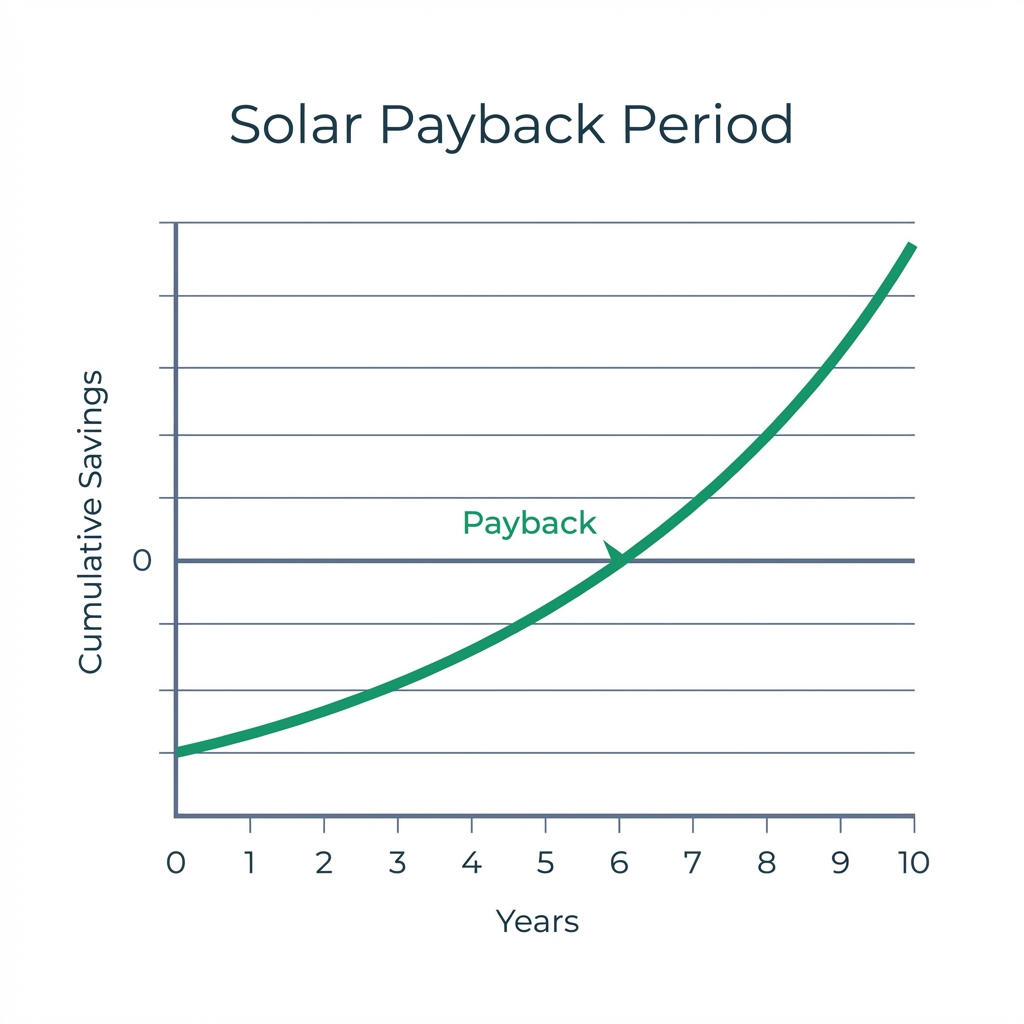
Simple payback: $17,180 / $1,550 = about 11.1 years, before rate escalation and any property tax value.
Now change one behavior. Let 80 percent of production be self-consumed because the EV charges at midday and the pool pump runs in solar hours (labeled hypothetical). Self-consumption value becomes 10,880 x $0.15 = $1,632, export value becomes 2,720 x $0.06 = about $163, total savings rise to about $1,795, and simple payback improves to roughly 9.6 years. Same panels, same price, same sun; about a year and a half of payback came from timing alone. That is the Arizona lesson, and it is the opposite of Florida's, where 1-to-1 net metering makes the annual total matter more than the clock. Compare the structures in our Solar Panel Cost in Florida 2026, Solar Panel Cost in California 2026, and Solar Panel Cost in Texas 2026 guides, and extend your own model with our solar panel ROI timeline for 2026.
6. The Battery Question in Arizona
In Arizona, a battery does two jobs that Florida's net metering does for free. It moves midday solar into the expensive late afternoon window, and it keeps essential loads alive in an outage. Under time-of-use rates with exports paid below retail, storing solar you would have exported cheaply and using it against the on-peak price is the strongest bill-only battery case in the country outside California. Under a demand charge plan, a battery that shaves your highest on-peak draw can pay for itself faster than energy arbitrage alone, but only if the controls actually manage demand, which is a settings and sizing question, not a brand question.
Be honest about scale. A typical residential battery runs lights, refrigeration, internet, medical devices, and selected circuits for hours. Whole-home air conditioning through a Phoenix evening is a large storage commitment. Size storage to the loads you want protected and the on-peak window you want covered, price it as a separate line, and budget it against the ten-year RCP lock, because the value of stored solar changes when your export rate steps down or floats after the lock ends.
Our home battery storage guide and home battery critical load sizing guide cover load selection and runtime math. Ask about warranty years, warranted capacity retention, whether the battery can charge from solar with the grid down, and how the inverter handles your air conditioner startup surge. Confirm that any battery savings claim in a quote names the rate plan and demand assumptions behind it.
7. Heat, Roofs, and Monsoon Season: Arizona Cost Movers
Arizona panels work in the harshest heat in American residential solar, and that shapes both cost and output:
- Extreme heat. Panel output falls as cell temperature rises, and summer cell temperatures here are severe. Your production estimate should use local weather data and realistic losses, not a brochure figure from a mild climate. Ask the installer what tool produced the estimate and check it with PVWatts.
- Roof material and age. Tile and flat foam roofs mount and seal differently than shingle. If the roof covering is near the end of its life, price roofing first using our replace roof before solar guide; removing and reinstalling an array later can erase a year of savings.
- Cooling-dominated loads. Annual use is driven by summer air conditioning, often peaking after solar output has fallen. A system sized to annual use can still leave hefty evening purchases on time-of-use plans. Model by hour where you can, and take the demand charge discussion seriously if your utility plan has one.
- Dust and monsoon season. Desert dust and summer storms cost production and argue for accessible monitoring so you see underperformance early, plus a workmanship warranty that covers roof penetrations through storm season.
- Service panel and interconnection. Panel upgrades, meter work, and utility application fees vary by city and utility. Separate them in the quote, and do not energize before permission to operate, because your RCP lock date ties to your interconnection.
Production here is genuinely excellent. The job of a good quote is to convert that production into on-peak and self-consumed value, not just into a large annual kilowatt-hour count.
8. Quote Checklist for Arizona Homeowners
Compare at least three installers against this list:
- Cash price, financed price, and total of all loan payments, shown separately, with system size in kW DC and dollars per watt.
- Panel, inverter, and monitoring equipment named by model, with product and workmanship warranty terms in writing.
- Annual production estimate checked against your last twelve months of usage, with the tool behind the estimate identified.
- Written confirmation that no section 25D federal credit is subtracted for a 2026 homeowner-owned install, or clear lease and PPA terms if a third party owns the system.
- Arizona credit handling: the $1,000 cap stated correctly, Form 310 and seller cost accounting promised, and no suggestion of a $1,000-plus credit on a large system.
- Your utility and rate plan named, the RCP and its ten-year lock date from your interconnection terms, and savings modeled with self-consumption and export priced differently.
- Any utility rebate claimed, with program name, amount, reservation status, and expiration.
- Roof, panel upgrade, and other house work as separate priced lines.
- Milestone-based payments, with the final payment tied to interconnection approval and permission to operate.
Red flags: exports valued at the full retail rate, a 25 percent state credit applied to the whole system price, a net price built on the expired federal credit, savings modeled on a flat rate when your plan has demand charges, or pressure to sign before you have seen your utility's RCP terms.
Frequently Asked Questions (FAQ)
How much do solar panels cost in Arizona in 2026?
EnergySage marketplace data for October 2026 puts the Arizona average at $2.27 per watt installed. That is about $13,635 for 6 kW, $18,180 for 8 kW, and $22,725 for 10 kW before incentives. The average Arizona system in the same data is 13.42 kW at about $30,499. Roof type, electrical work, batteries, and financing fees move real quotes off the average.
Is there a federal tax credit for an Arizona system installed in 2026?
No, not for a system you buy and own. The IRS states the residential clean energy credit is not available for property placed in service after December 31, 2025. A lease or PPA owned by a solar company is priced by that owner under commercial rules; the homeowner does not claim a credit.
How does the Arizona solar tax credit work?
Under ARS 43-1083, the credit equals 25 percent of the cost of a solar energy device installed in your Arizona residence, capped at $1,000 per residence. It is nonrefundable, claimed on Form 310, and any unused amount carries forward up to five consecutive taxable years. On any system over $4,000, the $1,000 cap is what you actually get.
Does Arizona have net metering?
Not retail net metering for new systems at APS or Tucson Electric Power. Under net billing, solar you use on site avoids a retail purchase, and exports are paid at the Resource Comparison Proxy rate, which is below retail and locked for ten years from interconnection. Salt River Project sets its own solar plans. Older grandfathered customers keep their legacy terms.
What is the APS export rate for solar?
APS pays the Resource Comparison Proxy rate in effect when your system interconnects, locked for ten years, reset each September 1 with annual reductions capped at 10 percent of the prior rate. The first RCP in 2017 was 12.9 cents per kWh, and installer tracking of the resets has put recent levels around six cents. Confirm the exact figure on your APS interconnection documents before signing.
Do I need a battery with solar in Arizona?
On bill math, batteries have a stronger case in Arizona than in net metering states, because stored solar displaces on-peak purchases instead of cheap exports. The case strengthens on demand charge plans and weakens if your home is empty through the on-peak window anyway. Size storage to your evening and outage loads and price it separately.
How long does solar take to pay back in Arizona?
This guide's worked example, using a $17,180 net cost for an 8 kW system and clearly labeled hypothetical rates and behavior, lands near eleven years at 60 percent self-consumption and near ten years at 80 percent. Your export lock, rate plan, and how much driving, pool, and cooling load you shift into solar hours decide where you land.
What to Read Next
- Solar Panel Cost by State 2026 Data Guide - how Arizona pricing compares nationally
- Solar Panel Cost in Florida 2026 - the 1-to-1 net metering contrast
- Solar Panel Cost in Texas 2026 - buyback plans next door in a deregulated market
- Solar Panel Cost in California 2026 - the low-export-rate template Arizona partly follows
- Solar Panel ROI Timeline 2026 - payback math with rate escalation over time
- Solar Quote Comparison Worksheet - compare installers on one scope
- Run your own system-size and savings scenarios with the solar calculators at CalculatorVillage.com once you have real quotes and a utility tariff in hand.
Sources and Verification
- IRS Residential Clean Energy Credit: 30% credit for property installed 2022 through December 31, 2025; credit is not available for any property placed in service after December 31, 2025
- EnergySage Arizona Solar Panel Cost (October 2026 marketplace data): average $2.27/W installed; 13.42 kW average system $30,499, range $25,924$35,074; 6 kW $13,635, 8 kW $18,180, 10 kW $22,725
- Arizona Revised Statutes 431083: nonrefundable credit equal to 25 percent of the cost of a solar energy device installed in the taxpayer's Arizona residence, maximum $1,000 per year and $1,000 per residence, excess carried forward up to five consecutive taxable years
- Arizona Department of Revenue Credit for Solar Energy Devices: nonrefundable individual tax credit for solar energy devices installed in an Arizona residence, claimed on Form 310
- Arizona Public Service Resource Comparison Proxy Plan of Administration: the RCP export method is based on the fiveyear rolling weighted average cost of gridscale solar, with reductions capped at 10 percent of the previous rate; first RCP $0.12900 per kWh effective September 1, 2017
- Tucson Electric Power Rider14, Resource Comparison Proxy for Partial Requirements Service (effective September 1, 2023, Decision No. 79065): RCP resets annually effective October 1, the rate at interconnection applies for ten years, a timeofuse rate is required, and remaining credit balances are paid on the October bill when over $10
- DSIRE Database of State Incentives for Renewables and Efficiency: crosscheck for current Arizona utility programs, exemptions, and export terms
Editorial Review
EnergyBS Editorial Team
EnergyBS publishes practical homeowner guides. Important program, product, and cost claims should be checked against the linked source and local project documents before you commit to work.
Related Guides
View All ArticlesSolar Quote Comparison Worksheet 2026 Tool (Guide & Data)
A sidebyside homeowner worksheet for normalizing solar cash prices, financed cost, equipment, production assumptions, roof scope, utility rules, warranties, and contract obligations.
Should You Replace the Roof Before Solar? A 2026 Analysis
A roofandsolar sequencing guide covering condition evidence, remaining life, removeandreinstall scope, warranties, structural and electrical coordination, and sidebyside lifecycle scenarios.
Solar Production Estimate Guide 2026 Tool (Guide & Data)
A homeowner method for independently checking quoted solar kWh using roof planes, tilt, azimuth, shading, DCtoAC ratio, system losses, weather variability, utility load data, and postinstallation verification.