Solar Panel Cost in Florida 2026: Installed Prices, Net Metering, and Payback
Florida solar costs about $2.12 per watt installed in October 2026 (EnergySage), or roughly $12,703 for 6 kW before incentives. There is no federal residential credit for 2026 installs, but Florida keeps 1to1 net metering at the big investorowned utilities, a sales tax exemption on solar equipment, and a full property tax exclusion for the value solar adds.
Quick Checks
- 1Budget about $2.12 per watt installed in Florida in late 2026: roughly $12,703 for 6 kW, $16,938 for 8 kW, and $21,172 for 10 kW before incentives (EnergySage, October 2026).
- 2Do not subtract a 30 percent federal credit from a 2026 quote. The IRS states the residential credit is not available for property placed in service after December 31, 2025.
- 3Florida still has 1-to-1 net metering at FPL, Duke Energy Florida, Tampa Electric, and Florida Public Utilities under PSC Rule 25-6.065. Size to your annual use, because leftover December credits settle at the low COG-1 generation cost, not retail.
- 4Solar equipment is exempt from Florida sales and use tax, and the value solar adds to a home is excluded from property tax assessment. If sales tax appears on a quote, ask for a corrected invoice.
- 5Municipal utilities and cooperatives set their own export rules. The 1-to-1 terms in this guide describe the investor-owned utilities; confirm your own utility before signing.
Solar Panel Cost in Florida 2026: Installed Prices, Net Metering, and Payback
By EnergyBS Editorial Team | October 2, 2026
The Short Answer: What Solar Costs in Florida
Short Answer: In October 2026, a residential solar system in Florida costs about $2.12 per watt installed, based on EnergySage marketplace quote data. That puts a typical 14.51 kW system at about $30,718 before incentives, with a typical market range of $26,110 to $35,326. At the same per-watt rate, 6 kW costs about $12,703, 8 kW about $16,938, and 10 kW about $21,172.
Florida systems run large. Heavy air conditioning loads push annual electricity use up, and installers size to that use. The Florida-specific factor that most changes the payback is not the panel price. It is the combination of 1-to-1 net metering, which Florida kept while California and Arizona moved to lower export rates, and two tax exemptions that quietly improve the math: no sales tax on solar equipment, and no property tax on the value the system adds to your home.
One federal fact applies in Florida exactly as it does everywhere else. The IRS states that the residential clean energy credit covers property installed from 2022 through December 31, 2025, and is not available for any property placed in service after December 31, 2025. A homeowner-owned Florida system installed in 2026 gets no 30 percent federal credit. If a quote nets that credit out of the price, the quote is using an expired rule.
1. The Installed Cost Stack: 6, 8, and 10 kW
Cost per watt is the cleanest way to compare Florida quotes because system sizes here run larger than the national pattern. EnergySage's October 2026 Florida data reports an average of $2.12 per watt including installation and an average system size of 14.51 kW. The table below applies that verified rate to the three sizes homeowners ask about most.
| System size (DC) | Gross installed cost at $2.12/W | What this size usually fits |
|---|---|---|
| 6 kW | $12,703 | Smaller or efficient homes, partial offset, budget-first projects |
| 8 kW | $16,938 | Mid-size homes offsetting a large share of annual use |
| 10 kW | $21,172 | Larger homes, high cooling loads, pool and EV charging headroom |
Source for all three prices: EnergySage Florida Solar Panel Cost page, October 2026 data, opened for this guide. The same page lists 6 kW at $12,703, 8 kW at $16,938, and 10 kW at $21,172, matching the $2.12 per watt average after rounding.
Averages hide the Florida-specific cost movers. A tile or metal roof, a long run to the panel, a service upgrade, hurricane-rated mounting and flashing, and a ground mount all add cost. So does financing. Florida solar is sold hard on monthly payment, and dealer fees built into loans can raise the financed price well above the cash price for identical hardware. Always ask for the cash price, the financed price, and the total of payments over the loan term. Those are three different numbers and you deserve all three.
Note also what the per-watt figure does not settle. Two quotes at the same dollars per watt can include different panels, different inverter warranties, different monitoring, and different workmanship coverage. Our solar quote comparison worksheet gives you a one-page structure for lining those differences up. For national context before you narrow to Florida installers, see the solar panel cost by state 2026 data guide.
2. The Federal Credit Is Gone for 2026 Installs
Florida homeowners heard about the 30 percent federal solar credit for a decade, and a lot of sales material still carries the old math. The current rule, from the IRS residential clean energy credit page, is short: the credit equals 30 percent of qualified costs for property installed anytime from 2022 through December 31, 2025, and the credit is not available for any property placed in service after December 31, 2025.
Practical consequences for a 2026 Florida purchase:
- Cash and loan purchases: no section 25D credit. Budget from the gross price. Any net-of-credit price on a 2026 proposal should be treated as an error until the installer corrects it in writing.
- Leases and power purchase agreements: a third-party owner may claim a commercial credit and reflect value in the contract price. You do not file for that credit. Judge the lease on payment, escalator, term, transfer, and buyout terms. Our buying vs. leasing solar and PPA guide compares the structures.
- Loan payment jumps: many solar loans assume a large principal payment in the first year or two, historically funded by the tax credit refund, after which the payment re-amortizes lower. Without a credit, that payment has to come from savings or the monthly payment rises. Get both payment paths printed before you sign.
Florida has no state income tax, so there is no Florida income tax credit waiting to replace the federal one. Anyone advertising a Florida state solar tax credit is describing a program that does not exist. What Florida offers instead is in section 3, and it is worth real money.
3. Florida Incentives That Genuinely Exist in 2026
Florida offers no statewide solar rebate and no state income tax credit. What exists is two exemptions plus net metering, and the exemptions apply automatically when the paperwork is right.
Sales tax exemption (sections 212.02(26) and 212.08(7)(hh), Florida Statutes). The Florida Department of Revenue states in Tax Information Publication 19A01-09 that Florida law exempts solar energy systems, and all components of such systems, from sales and use tax. The publication lists the equipment the Florida Solar Energy Center certifies as part of a solar energy system, including photovoltaic modules, inverters and other power conditioning equipment, storage, mounting, and system wiring unique to the solar system. In plain terms, the tax should not appear on the equipment portion of a Florida solar invoice. Sellers document the exempt sale with a purchaser certificate. If a quote shows sales tax on solar equipment, ask the seller to correct it before you sign, and keep the corrected invoice with your records.
Property tax exclusion (section 193.624, Florida Statutes). Florida Senate staff analysis of the statute describes the rule plainly: in determining the assessed value of residential real property, an increase in the just value attributable to the installation of a renewable energy source device may not be considered. The exclusion applies to devices installed on or after January 1, 2013, on new and existing residential property, and the device definition covers solar collectors, photovoltaic modules, inverters, storage, and interconnection equipment. In plain terms, the value solar adds to your home does not raise its assessed value. That matters every year you own the home, because most other improvements do raise the assessment. The device, if it is tangible personal property, is also exempt from tangible personal property tax under the companion provisions. There is no separate rebate check to chase. Confirm with your county property appraiser that the exclusion is reflected after installation, and keep your invoice and permit records.
What about utility rebates? The large investor-owned utilities, FPL, Duke Energy Florida, and Tampa Electric, do not pay a standard statewide rooftop rebate in the sources reviewed for this guide. Local and municipal programs open and close by budget year. The disciplined move is to check DSIRE and your utility for the program in effect on your install date, get any rebate terms in writing, and confirm whether funding is reserved before work starts. Do not copy a rebate amount from an article into your contract math.
HOA and local points. Florida law limits homeowner association bans on solar devices, with specific exceptions for placement and screening. If your HOA objects, ask the installer for the state rule reference and handle approval before the crew is scheduled. Permitting and interconnection timelines vary by city and county; get the schedule in the contract.
The pattern to notice: in Florida, the durable state benefits reduce the cost of buying and owning the system rather than writing you a check. The cash side comes from bill savings, and bill savings depend on section 4.
4. Net Metering: 1-to-1 Credits, With a December Catch
Florida is one of the remaining states where exported solar still earns close to its retail value, and that fact drives the economics in this guide. Florida Public Service Commission Rule 25-6.065 requires investor-owned utilities to offer standardized interconnection and net metering for customer-owned renewable generation up to 2 MW. The utilities covered by the rule include Florida Power and Light, Duke Energy Florida, Tampa Electric, and Florida Public Utilities. Municipal utilities and electric cooperatives set their own programs, and their export terms can differ, so the rest of this section describes the investor-owned utility structure. Confirm your utility before you rely on it.
FPL, the largest utility in the state, describes its program this way, and the structure is the standard one under the rule:
- Power your system makes is used by your home first. It never passes through the meter.
- When the system makes more than the home is using, the excess flows to the grid and is recorded by the bidirectional meter.
- That excess is subtracted from your monthly usage before you are billed. If you produced more than you received in a month, the extra kilowatt-hours are applied to the next month's bill. FPL shows the running balance on the bill as the kWh reserve.
- The bank works inside the calendar year. If you still have unused kilowatt-hours when the meter is read in December, FPL credits the account at the COG-1 rate, the annual average cost of generation. That is a generation cost figure, not your retail rate.
- Fixed charges stay. FPL applies a $30 minimum base bill even when the kWh reserve lowers the usage portion, and the PSC rule preserves the applicable customer charge and demand charge. Net metering zeroes the energy line, not the whole bill.
Three consequences follow:
- Size to annual use, not above it. Inside the year, a banked kilowatt-hour offsets a retail purchase, which is strong value. Past December, leftover credits settle at the low generation cost. A system that produces far more than the home uses across the year converts its best surplus into its cheapest payout. The free production check in our solar production estimate PVWatts guide helps you size against your last twelve months of bills.
- Self-consumption still helps, but less desperately than in California. Because banked exports keep retail value until December, a Florida home that is empty at noon is not punished the way a California net billing home is. What matters most is the annual balance, not the hour-by-hour match.
- Tiers decide paperwork, not value. FPL tiers run Tier 1 up to 10 kW, Tier 2 above 10 kW to 100 kW, and Tier 3 above 100 kW to 2 MW, with application fees and liability insurance requirements at the higher tiers. Nearly every home system is Tier 1. Confirm your tier and its requirements in the interconnection agreement, and do not energize before permission to operate.
Legislative attempts to phase Florida net metering down have been filed in recent sessions and have not become law as of this guide's sources. That history is a reason to confirm terms at signing, not a reason to rush a bad contract. The rule and your utility tariff on your install date are what count.
5. A Worked Payback Example With Every Input Labeled
The example below uses the verified Florida average price for hardware and clearly hypothetical inputs for rates and behavior. It excludes financing costs, maintenance, degradation, and rate changes. Replace every hypothetical with your quote, your usage history, and your utility tariff.
System (verified market input): 8 kW system at $2.12 per watt = $16,938 gross. No federal credit in 2026. No utility rebate assumed. Net cost used here: $16,938.
Hypothetical inputs (illustration only, not a forecast):
- Annual production: 12,000 kWh (labeled hypothetical; equals 1,500 kWh per kW per year)
- Share of production that offsets retail purchases inside the calendar year: 95 percent (labeled hypothetical; assumes the home uses nearly all production across the year, with a small December leftover)
- Share settled at the December generation cost: 5 percent (labeled hypothetical)
- Retail import price avoided: $0.16 per kWh (labeled hypothetical)
- December settlement value: $0.04 per kWh (labeled hypothetical, standing in for a low COG-1 style generation cost)
Year-one bill savings math:
- Retail offset: 12,000 x 0.95 = 11,400 kWh x $0.16 = $1,824
- December settlement: 12,000 x 0.05 = 600 kWh x $0.04 = $24
- Total year-one savings: about $1,848, before the fixed minimum base bill, which applies with or without solar in this illustration
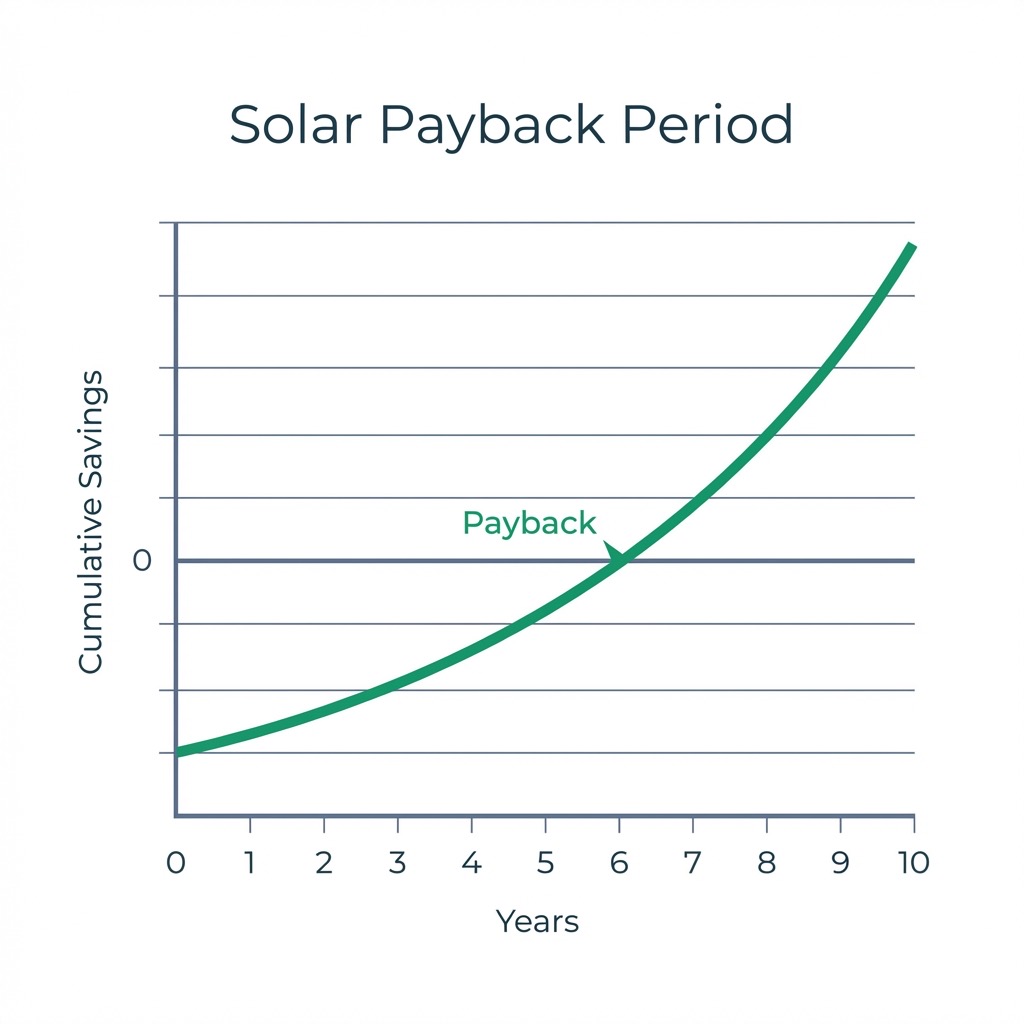
Simple payback: $16,938 / $1,848 = about 9.2 years, before rate escalation and any property tax value.
Now stress the assumption that hurts Florida oversizing. Keep production and rates the same, but let only 80 percent offset retail purchases because the system was sized well past annual use (labeled hypothetical). Retail offset becomes 9,600 x $0.16 = $1,536, December settlement becomes 2,400 x $0.04 = $96, and total savings fall to about $1,632, for a payback near 10.4 years. Same roof, same sun, longer payback, purely because the surplus was paid at generation cost instead of retail. That is the honest Florida lesson: 1-to-1 net metering rewards a right-sized system and quietly taxes an oversized one.
Compare the structure, not just the number, with our companion guides. California pays low avoided-cost rates for exports under net billing, Texas has no statewide net metering mandate and relies on retail buyback plans, and Arizona pays a Resource Comparison Proxy export rate below retail. The state pages are Solar Panel Cost in California 2026, Solar Panel Cost in Texas 2026, and Solar Panel Cost in Arizona 2026. Run your own version of this table before you judge a quote, and extend it with rate escalation using our solar panel ROI timeline for 2026.
6. The Battery Question in Florida
Florida adds a motive that pure bill math misses: storms. Hurricane season and summer thunderstorms cause the outages Florida homeowners actually plan around. A battery paired with solar can keep essential loads running, recharge from the roof during the day, and carry the home through the night. Whether that resilience is worth the price is a household decision, but it should be made with open eyes about what a typical residential battery can and cannot carry. It will run lights, refrigeration, internet, medical devices, and selected circuits for hours. It will not run a whole large home, including full air conditioning, indefinitely without careful sizing and a large battery bank.
On bills alone, the Florida battery case is narrower than in California. Because net metering already gives exported solar strong value inside the calendar year, storing solar to avoid a cheap export earns little. The battery earns more when your home is on a municipal or cooperative tariff with low export pay, when you want backup more than arbitrage, or when a utility program specifically rewards storage. Some Florida utilities have run battery programs at different times, which is another reason to check current DSIRE and utility listings rather than assuming a statewide rule.
Practical sizing advice: protect the loads you actually need in an outage on a dedicated backup panel, size storage to the evening and outage loads rather than to the solar array, and get the battery priced as a separate line. Our home battery storage guide and home battery critical load sizing guide cover the load decisions. Ask about warranty years, warranted capacity retention, and whether the system can charge from solar when the grid is down, a feature that must be designed in, not assumed. Confirm flood, wind, and mounting requirements for your county, because coastal installation rules can dictate where equipment may sit.
7. Heat, Humidity, Roofs, and Storms: Florida Cost Movers
Florida production is strong, but Florida roofs and weather shape the job:
- Roof life and material. Tile, shingle, and metal roofs each mount differently, and tile work costs more. If the roof covering is aging, price roofing first. Our replace roof before solar guide covers sequencing, because removing and reinstalling an array later can wipe out a year of savings.
- Wind and mounting. Coastal and inland wind requirements drive attachment spacing, rail, and flashing choices. Ask what wind rating the mounting system is engineered to, and confirm the permit set shows it. A cheap quote that omits required attachments is not cheap after inspection.
- Heat and humidity. Panels lose output as they get hotter, and Florida heat is the operating condition, not the exception. Ask about panel temperature ratings and inverter placement out of direct sun and flood risk. Salt air near the coast argues for corrosion-resistant hardware; ask what the workmanship warranty covers after a storm season.
- Service panel and meter work. Interconnection may require panel work or a meter change depending on the home and utility. Separate this cost in the quote.
- Insurance. Tell your homeowner insurer about the system before installation. Owned rooftop solar is usually added to the dwelling coverage, but Florida wind and hurricane terms deserve written confirmation, including how the array is treated in a named-storm claim.
A cheap per-watt quote that excludes storm-rated mounting or leaves roof penetrations under a weak warranty is not cheap in the way that matters over 25 Florida summers.
8. Quote Checklist for Florida Homeowners
Compare at least three installers against this list:
- Cash price, financed price, and total of all loan payments, shown separately, with system size in kW DC and dollars per watt.
- Panel, inverter, and monitoring equipment named by model, with product and workmanship warranty terms in writing.
- Annual production estimate checked against your last twelve months of usage, with the tool behind the estimate identified.
- Written confirmation that no section 25D federal credit is subtracted for a 2026 homeowner-owned install, or clear lease and PPA terms if a third party owns the system.
- Sales tax handling: solar equipment shown exempt under the Florida exemption, with any taxable items identified separately.
- Your utility named, your net metering tier confirmed, and the December COG-1 settlement and minimum base bill explained in the savings model.
- Any utility rebate claimed, with program name, amount, reservation status, and expiration.
- Roof, panel upgrade, and other house work as separate priced lines, plus the wind scope of the mounting system.
- Milestone-based payments, with the final payment tied to interconnection approval and permission to operate.
Red flags: savings modeled as if every exported kilowatt-hour earns retail forever with no December settlement, a net price built on the expired federal credit, sales tax charged on exempt solar equipment, a system sized far past your annual use with no explanation, or pressure to sign before you have read your utility's net metering terms.
Frequently Asked Questions (FAQ)
How much do solar panels cost in Florida in 2026?
EnergySage marketplace data for October 2026 puts the Florida average at $2.12 per watt installed. That is about $12,703 for 6 kW, $16,938 for 8 kW, and $21,172 for 10 kW before incentives. The average Florida system in the same data is 14.51 kW at about $30,718. Roof type, wind requirements, electrical work, batteries, and financing fees move real quotes off the average.
Does Florida have net metering?
Yes, at the investor-owned utilities. PSC Rule 25-6.065 requires interconnection and net metering for customer-owned renewable generation up to 2 MW at FPL, Duke Energy Florida, Tampa Electric, and Florida Public Utilities. Excess kilowatt-hours bank within the calendar year and offset later use. Municipal utilities and cooperatives set their own programs, so confirm your utility.
Is there a federal tax credit for a Florida system installed in 2026?
No, not for a system you buy and own. The IRS states the residential clean energy credit is not available for property placed in service after December 31, 2025. A lease or PPA owned by a solar company is priced by that owner under commercial rules; the homeowner does not claim a credit.
What Florida tax exemptions apply to solar?
Two. Florida law exempts solar energy systems and their components from sales and use tax, per the Department of Revenue. And under section 193.624, Florida Statutes, the increase in a home's assessed value attributable to a renewable energy device installed on or after January 1, 2013 is not considered for property tax. Florida has no state income tax, so there is no state solar income tax credit.
What happens to extra solar credits at the end of the year?
Under the FPL description of the standard structure, unused kilowatt-hours in your bank at the December meter reading are credited at the COG-1 rate, the annual average cost of generation, which is well below your retail rate. Fixed charges, including FPL's $30 minimum base bill, still apply. That is why sizing to your annual use matters more than maximizing roof coverage.
Do I need a battery with solar in Florida?
For bill savings alone, the case is limited while 1-to-1 net metering keeps export value high inside the year. For storm outage protection, many Florida households value a battery beyond the bill math. Size it to critical loads, price it separately, and confirm it can recharge from solar during an outage.
How long does solar take to pay back in Florida?
This guide's worked example, using a $16,938 8 kW system and clearly labeled hypothetical rates, lands near nine years when production offsets retail purchases across the year, and past ten years when an oversized system settles more surplus at December generation cost. Your annual use, utility, and quote decide where you land.
What to Read Next
- Solar Panel Cost by State 2026 Data Guide - how Florida pricing compares nationally
- Solar Panel Cost in Arizona 2026 - the low-export-rate contrast in the desert Southwest
- Solar Panel Cost in California 2026 - net billing economics on the West Coast
- Solar Panel Cost in Texas 2026 - buyback plans with no statewide mandate
- Solar Panel ROI Timeline 2026 - payback math with rate escalation over time
- Solar Quote Comparison Worksheet - compare installers on one scope
- Run your own system-size and savings scenarios with the solar calculators at CalculatorVillage.com once you have real quotes and a utility tariff in hand.
Sources and Verification
- IRS Residential Clean Energy Credit: 30% credit for property installed 2022 through December 31, 2025; credit is not available for any property placed in service after December 31, 2025
- EnergySage Florida Solar Panel Cost (October 2026 marketplace data): average $2.12/W installed; 14.51 kW average system $30,718, range $26,110$35,326; 6 kW $12,703, 8 kW $16,938, 10 kW $21,172
- Florida Department of Revenue, Tax Information Publication 19A0109 (August 9, 2019): Florida law exempts solar energy systems, and all components of such systems, from sales and use tax; references sections 212.02(26) and 212.08(7)(hh), Florida Statutes
- Florida Senate staff analysis (HB 193, 2016): section 193.624, Florida Statutes, provides that an increase in the just value of residential real property attributable to a renewable energy source device installed on or after January 1, 2013 may not be considered in assessing the property
- Florida Power and Light Net Metering FAQs: excess energy is subtracted from monthly usage, unused kWh bank carries within the calendar year, December bank balance is credited at the COG1 annual average cost of generation, and a $30 minimum base bill applies
- DSIRE Database of State Incentives for Renewables and Efficiency: crosscheck for current Florida utility programs, exemptions, and net metering terms
Editorial Review
EnergyBS Editorial Team
EnergyBS publishes practical homeowner guides. Important program, product, and cost claims should be checked against the linked source and local project documents before you commit to work.
Related Guides
View All ArticlesSolar Quote Comparison Worksheet 2026 Tool (Guide & Data)
A sidebyside homeowner worksheet for normalizing solar cash prices, financed cost, equipment, production assumptions, roof scope, utility rules, warranties, and contract obligations.
Should You Replace the Roof Before Solar? A 2026 Analysis
A roofandsolar sequencing guide covering condition evidence, remaining life, removeandreinstall scope, warranties, structural and electrical coordination, and sidebyside lifecycle scenarios.
Solar Production Estimate Guide 2026 Tool (Guide & Data)
A homeowner method for independently checking quoted solar kWh using roof planes, tilt, azimuth, shading, DCtoAC ratio, system losses, weather variability, utility load data, and postinstallation verification.