Subpanel Installation Cost 2026: By Amps, by Distance, and by Location
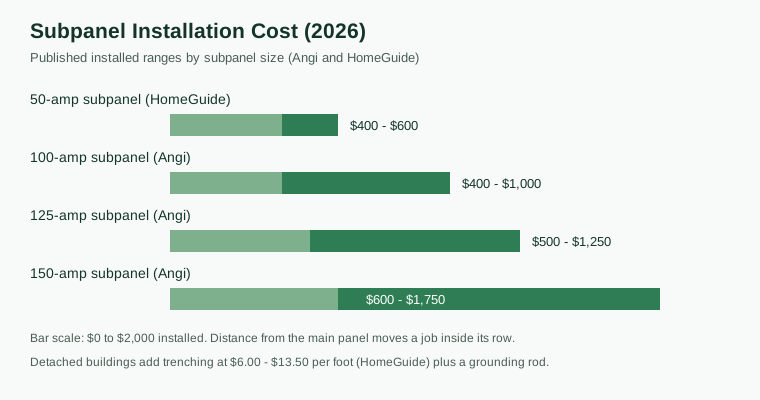
Installing a subpanel costs $1,200 on average in Angi's 2026 data, with most projects at $400 to $1,750, and $500 to $1,700 in HomeGuide's breakdown, where the panel itself is only $20 to $150 of the bill and labor is $430 to $1,000. Amperage sets the floor (100amp: $400 to $1,000, Angi; 150amp: $600 to $1,750), and distance from the main panel does the rest: feeder wiring runs $7 to $10 per linear foot (HomeGuide), new wiring averages about $1,400 (Angi), and a detached garage adds trenching at $6.00 to $13.50 per foot plus a grounding rod at $200 to $500. This guide separates the two decisions homeowners mix up: a subpanel adds breaker spaces and shorter circuit runs, but it adds no capacity, and when the main service is the real limit the money belongs in a main panel upgrade instead. Canada pricing from Ontario electricians (C$1,000 to C$2,500 allin, ESA permit and inspection included) closes the guide.
Quick Checks
- 1Budget $400 to $1,750 installed (Angi 2026, average $1,200) or $500 to $1,700 on HomeGuide's breakdown. The two sources agree closely because both are pricing the same job: a small panel, a feeder breaker, a cable run, and half a day of labor.
- 2The panel is the cheap part: $20 to $150 for a 50 to 125-amp subpanel (HomeGuide). Labor is $430 to $1,000 of the same bill, and the feeder run is priced by the foot ($7 to $10 per linear foot, HomeGuide). Where the subpanel goes matters more than which one you buy.
- 3A subpanel adds breaker spaces, not power. It is fed by one breaker in the main panel and cannot exceed what the main service delivers. Both sources repeat the sizing rule: keep the subpanel at or under 50 percent of the main panel's amps, and expect a 200-amp main upgrade conversation before a 100-amp subpanel on an older service.
- 4Detached buildings are a different price class: trenching at $6.00 to $13.50 per foot (HomeGuide), a grounding rod at $200 to $500 (Angi), and a disconnect at the building. Get the trench priced per foot in writing, because it is the line that grows.
- 5Ontario pricing is published by electricians, not cost databases: sub-panel installation at C$1,000 to C$2,500 including labour, breakers, the ESA permit and inspection (Ottawa Electric Service). Price the ESA paper as part of the job, not an extra.
Subpanel Installation Cost 2026: By Amps, by Distance, and by Location
By EnergyBS Editorial Team | October 17, 2026
The Short Answer
Short Answer: A subpanel installation costs $1,200 on average in Angi's 2026 data, with most projects between $400 and $1,750. HomeGuide's breakdown lands in the same place: $500 to $1,700 total, split into the panel itself at $20 to $150 (50 to 125 amps), breakers and supplies at $50 to $550, and labor at $430 to $1,000. Amperage moves the price in steps: a 100-amp subpanel runs $400 to $1,000 and a 150-amp $600 to $1,750 (Angi), while HomeGuide prices a 50-amp install at $400 to $600 and a 100-amp at $500 to $1,500. Distance moves it more. Feeder wiring costs $7 to $10 per linear foot (HomeGuide), new wiring for the project averages about $1,400 (Angi), and a detached garage adds trenching at $6.00 to $13.50 per foot plus a grounding rod at $200 to $500. Permits add $50 to $350 and an inspection $100 to $250 where they are billed separately.
One distinction decides whether this is the right project at all, and both sources state it plainly: a subpanel does not increase your home's total power. It is a smaller panel fed by a single breaker in the main panel, and it only redistributes the capacity the main service already has. Buy it when the main panel is full, or when the circuits you are adding sit far from the main panel and one feeder run beats six long home runs. If the service itself is undersized, the subpanel is a detour, and section 6 prices the fork in the road.
1. What a Subpanel Actually Buys You
A subpanel solves two specific problems. The first is space: the main panel has no open breaker slots, and the renovation, the workshop, or the hot tub needs circuits that have nowhere to land. The second is distance: the loads are concentrated in one place, a garage, an addition, a finished basement, a workshop, and running one feeder cable to a panel in that place is shorter, cleaner, and usually cheaper than running every circuit back to a main panel on the other side of the house. Local breaker access is the side benefit: when a garage circuit trips, you reset it in the garage.
What it does not buy is capacity. The subpanel draws through one two-pole breaker in the main panel, so everything downstream of it shares that breaker's rating. A 100-amp subpanel on a 100-amp main service has not made the house a 200-amp house. HomeGuide puts the sizing guardrail in one line: the subpanel's amps should not exceed 50 percent of the main panel's amps, and its experts recommend upgrading to a 200-amp main panel when installing a 100-amp subpanel on an older service. Angi repeats the same 50 percent advice and notes that most homes land on a 60 to 125-amp subpanel, with 200-amp and larger subpanels reserved for big workshops and properties with unusual demand.
There is a cheaper answer to the space problem alone, and a good electrician will raise it before quoting a subpanel: if the panel is listed for them, tandem breakers put two circuits in one slot. That solves a full panel with no feeder, no second panel, and no permit-sized project, but it adds no room for the large two-pole breakers that EV chargers, ranges, and heat pumps need, and it does nothing for distance. Ask which problem you have. Space, distance, or capacity. The three answers have three different prices, and only two of them are this guide's.
2. Cost by Amperage
Angi publishes the cleanest size ladder, and HomeGuide's two published sizes sit inside it:
| Subpanel size | Installed cost | Source |
|---|---|---|
| 50-amp | $400 to $600 | HomeGuide |
| 50-amp | starts around $400 | Angi |
| 100-amp | $400 to $1,000 | Angi |
| 100-amp | $500 to $1,500 | HomeGuide |
| 125-amp | $500 to $1,250 | Angi |
| 150-amp | $600 to $1,750 | Angi |
Read the ladder as a floor, not a quote. The steps between sizes are a few hundred dollars because the panel and its feeder breaker are the small part of the job; a 150-amp panel does not cost three times a 50-amp panel to hang on a wall. What grows with amperage is the feeder cable behind it: heavier cable costs more per foot and is slower to pull, which is why the top of each range belongs to long runs and the bottom to a panel mounted near the main.
Size to the loads, not to the ladder. A garage that will run lights, outlets, and a compressor is a 60-amp job for most houses. A garage that will also charge an EV and run a heater is the 100-amp conversation. Oversizing past the loads buys heavier cable and a bigger feeder breaker for capacity nothing will use, and Angi's own saving advice is the blunt version: keep the amperage manageable, because a higher rating raises cost without benefit when the loads are not there. Undersizing is the expensive error in the other direction, because the fix is a second project. List the planned circuits, including the ones two years out, before you pick the size (checklist item 2).
3. The Cost Stack: Where the Money Goes
HomeGuide's breakdown is the most useful way to read a quote, because it shows how little of this project is hardware:
| Cost line | Published range | Source |
|---|---|---|
| Subpanel, 50 to 125 amps (part only) | $20 to $150 | HomeGuide |
| Subpanel part, wider range | $20 to $350 | HomeGuide |
| Circuit breakers and supplies | $50 to $550 | HomeGuide |
| Installation labor | $430 to $1,000 | HomeGuide |
| Total to install | $500 to $1,700 | HomeGuide |
| Electrician labor rate | $50 to $130 per hour | Angi |
| Electrician labor rate | $40 to $100 per hour, plus $75 to $125 service call | HomeGuide |
| Electrical permit | $50 to $300 / $50 to $350 | Angi / HomeGuide |
| Electrical inspection | $100 to $250 | HomeGuide |
| New circuit breaker installed | $150 to $300 each | HomeGuide |
| Dedicated circuit added | $250 to $900 | HomeGuide |
| GFCI breaker premium (materials) | adds $10 to $100+ | HomeGuide |
Three things follow. First, labor is the project: at $430 to $1,000 of a $500 to $1,700 total, the electrician's hours are worth more than everything in the boxes combined, which is why the same subpanel costs $600 next to the main panel and $1,500 across the house. Both sources put the work at 4 to 8 hours for a standard install.
Second, breakers are where spec choices show. A panel filled with standard breakers sits at the low end of the $50 to $550 supplies band. Kitchens, bathrooms, garages, and unfinished basements typically require GFCI protection (HomeGuide), and a GFCI breaker adds $10 to $100 or more in material cost per circuit over a standard breaker. AFCI protection, where your code cycle requires it, prices the same way. Six protected circuits can add several hundred dollars that a bare-bones quote omitted, and the omission surfaces at inspection time, not quote time.
Third, the circuits beyond the panel are separate money. The subpanel price gets power to the new panel. Each circuit that then runs from it to a receptacle or appliance is its own line when it is new work: $150 to $300 per breaker installed, $250 to $900 for a dedicated circuit (HomeGuide). A quote for a garage subpanel that includes four new circuits and a quote that stops at the panel are not two prices for one job. Section 5 separates them by location.
4. Distance: The Feeder Run Is the Variable
Angi names distance from the main panel as the factor that drives the wiring requirement, and its numbers for the run are the widest on the page: new wiring for a subpanel project runs $600 to $2,200, about $1,400 on average, and permits, grounding rods, and new wiring together run $600 to $2,200 for most installations. HomeGuide prices the same run by the foot: $7 to $10 per linear foot for new subpanel wiring, with wiring through walls or underground costing more than surface runs because it takes longer.
The per-foot math explains the spread between two quotes for the same panel. A 15-foot run across an unfinished basement at $7 to $10 per foot is $105 to $150 of wiring. A 90-foot run is $630 to $900 before the trench, the conduit, or the drywall work, and at some distance the cable itself gets upsized to hold voltage, which raises the per-foot price again (HomeGuide: subpanels far from the main panel require thicker cable to account for voltage drop). There is no distance limit on a subpanel, only a price per foot and a cable-size step. That is also the way to compare quotes properly: ask for the feeder length and the cable size in writing, and a quote that is $400 lower on a 90-foot run has usually found its saving in one of those two lines.
Placement is the lever you control. Angi's advice is to position the subpanel close to the main panel where the use allows it, naming the wall nearest the main panel, such as the entrance of a finished basement or the closest wall of a garage, as the cheap seats. Every foot you accept there is a foot not paid for at $7 to $10, twice, once in cable and once in labor.
5. Cost by Location
Next to the main panel. The basement-wall install a few feet from the main is the bottom of every range in this guide: short feeder, no trench, no drywall to speak of, 4 hours more likely than 8. This is the $400 to $700 version of the project, and it is the right shape when the problem is breaker space for loads spread around the house.
Basement finish or addition. The panel goes where the new circuits are, the feeder crosses the house once, and the new circuits beyond it are short. Budget the install band ($500 to $1,700, HomeGuide) plus the new circuits at $250 to $900 per dedicated circuit. A combination panel, which blends main and subpanel features for a separate living space, runs several hundred dollars more than a standard subpanel (Angi) and comes up most often for basement suites and in-law units.
Attached garage or workshop. Same building, so no separate disconnect and no trench, but the circuit list is heavier: GFCI-protected outlets, a heater circuit, tool circuits, and often an EV charger circuit. The subpanel itself stays in the standard band; the garage's total is the subpanel plus its circuits. HomeGuide's garage wiring data prices an electric car charging station at $750 to $2,600 installed as part of wiring a garage, which is why garage quotes that include the charger circuit should be compared against garage quotes that do not.
Detached garage, barn, or shop. This is the second price class, and three lines create it. Trenching to bury the feeder runs $6.00 to $13.50 per foot (HomeGuide), so a 60-foot trench is $360 to $810 before cable and conduit. A grounding rod at the separate structure runs $200 to $500 (Angi), which Angi says an electrician will typically recommend whenever the subpanel sits in a separate structure. And the building needs its own disconnect: subpanels in the same building generally do not require a main breaker, but a main shutoff is often required in a separate structure (Angi), and HomeGuide states the same rule for a subpanel in a different structure. Add the three lines to the standard install and a detached job commonly budgets $1,200 to $2,800, assembled from the published lines above rather than quoted as a band by either source. Get the trench priced per foot in the contract, with the depth and the route named, because soil and driveways move that line more than any other.
Hot tub or spa panel. The 50-amp weatherproof panel sold for spas is the project Angi's cost page is built around, and it is why the 50-amp starting price (around $400) exists at all. The panel is small; the work is the GFCI protection the installation requires and the run to the tub. Our hot tub installation cost guide prices the tub side of that project.
6. Subpanel or Main Panel Upgrade: Price the Fork
This is the decision the guide exists for, because the two projects overlap in quotes and solve different problems.
Choose the subpanel when the main service has capacity to spare and the problem is slots or distance. The test is the load calculation, not the breaker count: an electrician works out what the house actually draws against the service size, using the National Electrical Code load calculation method (HomeGuide names the NEC load calculation as the way to confirm a subpanel is feasible). A 200-amp service with a full panel is the classic subpanel case.
Choose the main panel upgrade when the service itself is the limit: a 60-amp fuse box, a 100-amp service under a heat pump, an EV charger, and an electric range at once, or a panel on the replace-now lists. HomeGuide prices breaker box replacement at $1,400 to $2,800 when upgrading to 200 amps on this page's data, and our panel upgrade cost guide prices the full job, service entrance and all, line by line. Angi flags the same fork from the other side: if the home does not already have 200-amp service, expect the electrician to raise a main upgrade alongside the subpanel quote.
Doing both is common and legitimate, in that order: service and main panel first, subpanel second, ideally on one contract with the two priced as separate lines, the same discipline as our whole-house rewiring cost guide applies to panel work inside a rewire. What is not legitimate is a subpanel sold as a capacity fix. If a quote promises that a subpanel will stop a main breaker from tripping under load, the quote is describing the wrong project, because the subpanel's loads still pass through that same main breaker.
For the electrification sequence behind this decision, the panel capacity guide for electrification works through the load math load by load, and the home electrification blueprint totals the full order of operations.
7. The Code Points That Appear on Quotes
Four requirements explain most of the lines homeowners question, and each is stated in the sources used here:
- Four-wire feeder, neutral and ground separated. A modern subpanel is fed with two hots, a neutral, and a separate ground, and the neutral and ground are kept apart at the subpanel, bonded only at the main service. This is the detail that makes older three-wire subpanel installs a correction item when an electrician opens them, and it is priced in the feeder cable, not as a separate line.
- Disconnect at a separate structure. A subpanel in a different building requires a main breaker or disconnect so the building's power can be cut at the building (HomeGuide; Angi states the same rule). Same-building subpanels generally do not need one.
- Grounding electrode at a detached building. Angi prices the grounding rod at $200 to $500 and ties it to separate structures, a detached garage being its named example.
- GFCI and AFCI protection where the location requires it. Bathrooms, kitchens, garages, and unfinished basements typically require GFCI protection at the breaker or the outlet (HomeGuide), at $10 to $100 or more of added material cost per GFCI breaker. A GFCI outlet runs $100 to $175 replacing an existing outlet or $150 to $350 new, and grounding an outlet $100 to $300 (HomeGuide).
None of these is an upsell category. They are the lines that let the installation pass the inspection both sources price ($100 to $250, HomeGuide), and a quote missing all four on a detached garage job is missing the job.
8. Replacing or Moving an Existing Subpanel
Replacement is the cheaper sibling because the feeder and the circuit wiring already exist. HomeGuide notes that replacing a subpanel typically requires less labor for exactly that reason, so a like-for-like replacement usually lands in the lower half of the $500 to $1,700 band, with the price set by how much of the existing wiring can stay and how much protection upgrading the new breakers add.
Two replacement triggers are not optional. HomeGuide names Federal Pacific and Zinsco panels as known fire risks to replace as soon as possible, and adds older Challenger and Pushmatic/Bulldog panels to the upgrade list. Angi's threshold is age: a subpanel more than 25 years old is a replacement candidate on age alone. The warning signs both sources list are the same ones that apply to main panels: frequent trips, heat, buzzing or humming, burn marks, and a burning smell. Any one of them prices an electrician's visit ($75 to $125 service call, HomeGuide), not a debate.
Moving a subpanel is the expensive sibling: $1,000 to $3,000 in both sources (Angi adds $1,500 to $2,500 for an outdoor relocation), because a move is a new feeder plus re-terminating every circuit, and it can require junction boxes where the old runs no longer reach (HomeGuide). Move a panel when its location is non-compliant or genuinely in the way of a renovation, not for tidiness.
9. Timeline, Permits, and Living With the Work
Both sources put installation at 4 to 8 hours, a single visit for most houses. Angi notes the timeline grows with multiple subpanels or a spa panel wired to a hot tub, and HomeGuide ties the long end to circuit count, distance, and drywall repair. Power to the circuits being moved is off during the work; the rest of the house is usually live, which makes this one of the least disruptive electrical projects per dollar in the cluster.
The permit is required, and skipping it risks fines (Angi). Budget $50 to $300 (Angi) or $50 to $350 (HomeGuide) for the permit and $100 to $250 for the inspection where it is billed separately, and settle in the contract whether those fees are inside the quote or on top of it. The inspection record is part of what you are buying: it is the paper that answers an insurer's or a buyer's question about who installed the panel in the garage, and an unpermitted subpanel discovered at sale time costs more to document than the permit saved.
On doing it yourself, both sources land in the same place: it is legal for a homeowner in many jurisdictions with a permit, and both recommend a licensed electrician anyway, because the failure modes of a miswired subpanel (a bonded neutral, an undersized feeder, a missing disconnect at a detached building) are invisible until they are not. Angi adds the practical point that professionals carry the permits, the inspection, the warranty, and the insurance. This guide prices the professional job throughout.
10. Canada: Ontario Pricing and the ESA
Canadian pricing for this job comes from electricians rather than national cost databases, so read it as practitioner ranges in Canadian dollars. Ottawa Electric Service lists sub-panel installation at C$1,000 to C$2,500, at 3 to 5 hours, inside a price list that states its figures include labour, panel hardware, breakers, the ESA permit, and inspection. Its component table prices the ESA permit and inspection at C$100 to C$250 on its own, which is the line to check when an Ontario quote shows permits as an extra.
A second Ontario source, Newmarket Electrician, publishes by size: 50-amp subpanel $400 to $1,000, 100-amp $600 to $1,500, 150-amp $800 to $2,000. Set against the Ottawa all-in band, the two describe the same market from two directions: the by-size figures read as the panel job itself, and the Ottawa band as the job with the permit, inspection, and a longer feeder inside it. For the main-upgrade side of the section 6 fork, the same Ottawa list prices a 100-amp to 200-amp main upgrade at C$2,500 to C$4,500.
Ontario work runs through a Licensed Electrical Contractor with an ESA inspection, the same discipline our rewiring guide documents for larger jobs. In every province, the practical rule matches the US one: the permit and inspection paper is named in the contract, priced, and handed over at the end.
11. A Worked Example: 100-Amp Subpanel for a Basement Finish, 25 Feet From the Main
This is a hypothetical example built only from the published ranges above, to show how a budget assembles. Change every assumption to your own house before using it.
The job. A 200-amp main service with capacity to spare and no open slots. A 100-amp subpanel (inside the 50 percent rule) mounted in the basement 25 feet from the main panel, feeding a finished basement's lights, outlets, and one dedicated circuit.
The lines. Panel part at $85 (inside HomeGuide's $20 to $150). Breakers and supplies at $300 (inside HomeGuide's $50 to $550; this example assumes two GFCI breakers in the mix). Labor at $715 (inside HomeGuide's $430 to $1,000; roughly 6 hours at the sources' hourly bands). Feeder wiring, 25 feet at $8.50 per foot (inside HomeGuide's $7 to $10): $213. Permit at $150 (inside both sources' $50 to $350).
The total. $85 + $300 + $715 + $213 + $150 is $1,463. Cross-check it against the two published totals: inside Angi's $400 to $1,750 typical band and close to its $1,200 average, and inside HomeGuide's $500 to $1,700. Move the same panel to a detached garage 60 feet away and the example changes by published lines only: add trenching at 60 feet times $9.75 (inside $6.00 to $13.50) at $585, a grounding rod at $350 (inside Angi's $200 to $500), and a longer feeder. The planning total becomes roughly $2,400 to $2,600. Same panel, same electrician. The distance and the building did it.
12. The 10-Point Quote Checklist
Compare subpanel quotes line by line. A complete quote names:
- The problem being solved, in words: breaker space, distance, or capacity, and if capacity, why the answer is not a main panel upgrade instead (section 6).
- Subpanel size in amps, the feeder breaker size, and the load calculation or the reasoning that puts the subpanel at or under 50 percent of the main service.
- The planned circuit list, including loads two years out (EV charger, heater, hot tub, tools), so the size is chosen once.
- Feeder length in feet, cable size and type, and the route (through joists, surface, or trenched), with trenching priced per foot where it applies.
- Breaker schedule: how many standard, GFCI, and AFCI breakers, priced in the supplies line ($50 to $550, HomeGuide), not discovered at inspection.
- For a detached building: the disconnect, the grounding rod ($200 to $500, Angi), and the trench depth and route, each as a named line.
- The new circuits beyond the panel, priced each ($150 to $300 per breaker installed, $250 to $900 per dedicated circuit, HomeGuide), separated from the panel price.
- Permit and inspection: the fees ($50 to $350 and $100 to $250), who pulls the permit, and that the inspection record is handed to you.
- Drywall and finish work: who opens, who patches, and whether patching is in the price.
- Warranty and paper: workmanship warranty term, the itemized final invoice matching these lines, and the permit and inspection documents.
A quote that shows one number for the whole job is asking you to skip items 4, 5, and 6, which are the lines that vary by hundreds between two houses with the same panel.
Frequently Asked Questions (FAQ)
How much does it cost to install a subpanel in 2026?
Angi's 2026 average is $1,200, with most homeowners spending $400 to $1,750. HomeGuide's breakdown totals $500 to $1,700: the panel at $20 to $150, breakers and supplies at $50 to $550, and labor at $430 to $1,000. Permits ($50 to $350) and inspection ($100 to $250) may be billed on top. Distance from the main panel is the largest variable after size.
How much does a 100-amp subpanel cost?
Angi prices a 100-amp subpanel at $400 to $1,000 installed; HomeGuide prices it at $500 to $1,500 including labor and materials. The low end is a short feeder run near the main panel, the high end a long run or a location with several new circuits. In Ontario, Newmarket Electrician lists a 100-amp subpanel at $600 to $1,500.
Does a subpanel increase my home's electrical capacity?
No. A subpanel is fed by one breaker in the main panel and redistributes the capacity the main service already has; it adds breaker spaces and shorter circuit runs, not amps. Both Angi and HomeGuide repeat the sizing rule that a subpanel should not exceed 50 percent of the main panel's amps. If the service itself is undersized, the fix is a main panel and service upgrade, priced in our panel upgrade cost guide.
How far can a subpanel be from the main panel?
There is no fixed distance limit. The constraint is price and cable size: feeder wiring runs $7 to $10 per linear foot (HomeGuide), and long runs need thicker cable to limit voltage drop. A subpanel in a separate building also needs a disconnect at that building and, typically, a grounding rod at $200 to $500 (Angi). Distance is a budget line, not a code wall.
Can I add a subpanel to a 100-amp service?
Sometimes, and the load calculation decides. A 100-amp service feeding a 50-amp subpanel for a garage's lights and outlets can pass; the same service under a heat pump, an electric range, and an EV charger usually cannot take a 100-amp subpanel, which is why HomeGuide's experts recommend a 200-amp main panel alongside a 100-amp subpanel. Have the electrician show the calculation, not just the conclusion.
How long does subpanel installation take?
Four to 8 hours in both sources, usually one visit. Replacing an existing subpanel is faster because the feeder and circuit wiring are already in place. Long feeder runs, trenching to a detached building, and drywall repair push the job to the long end or into a second visit.
Do I need a permit to install a subpanel?
Yes. Angi states that electrical permits are required for subpanel installation and that skipping them can result in fines. Permits run $50 to $300 (Angi) or $50 to $350 (HomeGuide), with an inspection at $100 to $250. In Ontario the work runs through a Licensed Electrical Contractor with an ESA permit and inspection, priced at C$100 to C$250 as a component by Ottawa Electric Service.
What should I read next before deciding?
Start with the panel upgrade cost guide, because the subpanel-versus-upgrade fork in section 6 decides which project you are actually buying. Then the panel capacity guide for electrification for the load calculation, and the whole-house rewiring guide if the house's wiring, not just its panel, is the age problem. If a charger is the load driving this, the EV charger installation cost breakdown prices that circuit on its own.
Prices in this guide are planning ranges from the published 2026 sources cited above, not quotes for your house. Amperage, feeder distance, trench and drywall conditions, protection requirements, and local labor decide the final figure. Get the panel, feeder, breakers, and circuits priced as separate lines, get the load calculation shown, and keep the permit and inspection records with the house.
What to Read Next
Electrical Panel Upgrade Cost 2026: What a 100 to 200 Amp Upgrade RunsUse this next to compare the cost, incentive, installation, or operating-risk angle before you make a home energy decision.Sources and Verification
- Angi Cost To Install Subpanel [2026 Data], updated October 12, 2026 (national average $1,200; most homeowners spend $400 to $1,750; low end $125, high end $3,500; by amperage: 100amp $400 to $1,000, 125amp $500 to $1,250, 150amp $600 to $1,750; 50amp panel starts around $400 and 100amp around $500; most homes use a 60 to 125amp subpanel; electricians advise subpanels not exceed 50 percent of the main panel's amps; electricians charge $50 to $130 per hour; permits $50 to $300; new wiring $600 to $2,200, about $1,400 on average; permits, grounding rods and new wiring together run $600 to $2,200 for most installations; grounding rod $200 to $500, typically recommended for a separate structure such as a detached garage; subpanels in the same building generally do not require a main breaker, a main shutoff is often required in a separate structure; moving a subpanel $1,000 to $3,000, outdoor relocation $1,500 to $2,500; combination panel several hundred dollars more than a standard subpanel; installation takes roughly 4 to 8 hours; consider budgeting an additional amount for a main panel upgrade when the home lacks 200amp service)
- HomeGuide 2026 Cost To Install A Subpanel (total cost to install $500 to $1,700: electrical subpanel 50 to 125 amps $20 to $150 for the part, circuit breakers and supplies $50 to $550, installation labor $430 to $1,000; a 50amp subpanel costs $400 to $600 installed and a 100amp subpanel $500 to $1,500 including labor and materials, subpanel part alone $20 to $350; installing new circuit breakers $150 to $300 per breaker; dedicated circuit $250 to $900; electrical permits $50 to $350; electrical inspection $100 to $250; new subpanel wiring $7 to $10 per linear foot; trenching to bury electrical wiring $6.00 to $13.50 per foot; electricians $40 to $100 per hour plus a $75 to $125 service call fee; GFCI circuit breaker adds $10 to $100 or more to material cost; GFCI outlet $100 to $175 replacing, $150 to $350 new; grounding an outlet $100 to $300; moving a subpanel $1,000 to $3,000 or more; breaker box replacement $1,400 to $2,800 when upgrading to 200 amps; experts recommend upgrading to a 200amp main panel when installing a 100amp subpanel and the subpanel should not exceed 50 percent of the main panel amps; a subpanel does not increase the home's total power, only its distribution; a subpanel in a different structure requires a main breaker or disconnect; installation takes 4 to 8 hours; replace Federal Pacific and Zinsco panels due to known fire risk; upgrade a subpanel older than 25 years)
- Ottawa Electric Service Electrical Panel Upgrade Cost Ontario: 2026 Prices (subpanel installation $1,000 to $2,500, 3 to 5 hours, listed among panel services that include labour, panel hardware, breakers, ESA permit and inspection; the firm's component table prices ESA permit and inspection at $100 to $250 and a new panel with breakers at $300 to $800; 100amp to 200amp main upgrade $2,500 to $4,500 for comparison)
- Newmarket Electrician Cost to Upgrade Electrical Panel, Ontario (typical subpanel installation cost: 50amp subpanel $400 to $1,000, 100amp subpanel $600 to $1,500, 150amp subpanel $800 to $2,000; minor panel relocation $800 to $1,200, full relocation with rewiring $1,500 to $3,000)
Editorial Review
EnergyBS Editorial Team
EnergyBS publishes practical homeowner guides. Important program, product, and cost claims should be checked against the linked source and local project documents before you commit to work.
Related Guides
View All ArticlesElectrical Panel Upgrade Cost 2026: What a 100 to 200 Amp Upgrade Runs
Upgrading an electrical panel from 100 to 200 amps costs $1,300$4,200 installed in the US in 2026 depending on market and scope, and C$2,500$4,500 in Ontario. This guide breaks down cost by upgrade path, what a legitimate quote includes, when 200 amps is genuinely needed, and when load management avoids the upgrade entirely.
WholeHouse Rewiring Cost 2026: Per Square Foot, by Access and by Room
Rewiring a whole house costs $2 to $4 per square foot in Angi's 2026 calculator ($5,000 to $10,500 for 2,500 sq ft, before permits and wall repair) and $5 to $17 per square foot in HomeGuide's data (a $10,000 to $30,000 average project), and the gap is scope, not error: HomeGuide prices oldhouse work done through finished walls, with access method alone splitting the job into $10,000 to $20,000 fished through an attic or basement versus $20,000 to $30,000 or more with walls opened. This guide reconciles the two sources line by line, prices the panel, outlets, permits, and wall repair separately, covers knob and tube replacement ($12,000 to $35,000, HomeGuide), what Ontario's Electrical Safety Authority actually says about old wiring, and Canada pricing from BC electricians.
Electrical Panel Capacity for Home Electrification
A decision guide for homeowners adding heat pumps, EV charging, induction, water heating, solar, or batteries: service ratings, load calculations, demand data, panel space, load management, project sequencing, and quote review.