Boiler Replacement Cost 2026: What Installation Really Costs
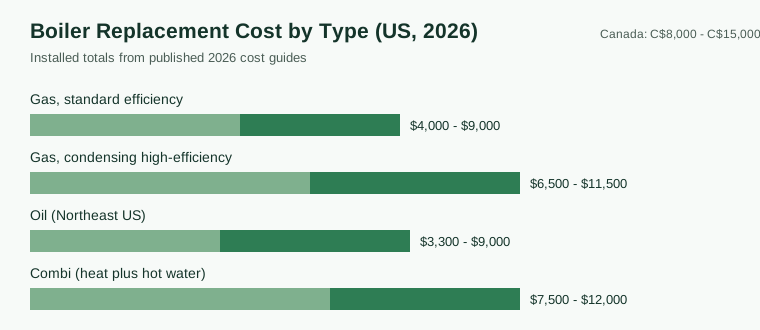
Replacing a home boiler in 2026 typically costs $4,000$9,000 installed for gas in the US (C$8,000$15,000+ in Calgary, Canada). This guide breaks down fuel, AFUE, steam vs. hotwater and combi pricing, repairvsreplace math, and the heat pump alternative.
Quick Checks
- 1Budget $4,000-$9,000 installed for a typical US gas boiler replacement in 2026; condensing, steam, and combi systems commonly price at $6,500-$12,500.
- 2The efficiency choice is also a lifespan choice: standard cast iron boilers commonly last 25-30 years, while condensing stainless steel models are typically warranted for 10-15 years.
- 3A condensing boiler only earns its 90%+ AFUE rating when return water is cool enough to condense flue gas; high-temperature baseboard systems can erase much of the gain.
- 4Do not size the new boiler from the old nameplate. Ask for a heat-loss calculation; most replaced boilers were oversized for the house as it exists today.
- 5Budget as if no federal tax credit is coming for a 2026 install, then verify utility, state, and provincial rebates (with pre-approval) before you sign.
Boiler Replacement Cost 2026: What Installation Really Costs
By EnergyBS Editorial Team | October 3, 2026
The Short Answer: What Boiler Replacement Costs
Short Answer: In 2026, replacing a residential boiler typically costs $4,000 to $9,000 installed for a natural gas unit in the United States, according to HomeGuide's 2026 cost guide, with the boiler itself at $1,400-$5,600 before labor. A broader national dataset puts the typical full replacement at $3,306-$8,464, with a national average of $5,883. High-efficiency condensing gas systems price higher: Modernize puts standard-to-condensing gas boilers at $6,500-$11,500 installed, combi boilers at $7,500-$12,000, and steam boilers at $7,000-$12,500. In Canada, a Calgary installer reports residential boiler replacement at C$8,000 to C$15,000 or more for a complete installation including removal, venting, permits, and commissioning.
Those ranges look far apart because "boiler replacement" describes at least four different jobs. A like-for-like swap of a standard-efficiency hot-water boiler with reusable piping, venting, and controls is the cheapest version. A condensing conversion with new sidewall venting, a condensate drain, rebuilt near-boiler piping, and new zone controls is a different project that happens to share a name. This guide separates the jobs so you can tell which one a quote is actually pricing.
One discipline note before the tables: a boiler is a 15- to 30-year decision, not a 15-year one. The efficiency-versus-lifespan tradeoff in section 4 is the single most underpriced variable in most quotes, and it is why the cheapest condensing quote and the cheapest cast iron quote should not be compared on installed price alone.
1. What the Installed Price Actually Covers
Homeowners often anchor on the boiler price they can find online. The installed invoice is roughly half equipment and half everything around it. Published 2026 cost items break down as follows:
| Cost component | Typical US range (2026) | What drives the variation |
|---|---|---|
| Boiler unit only | $1,400-$6,500 | Fuel, BTU size, AFUE tier, cast iron vs. condensing stainless steel |
| Labor and fitting | $1,200-$3,200 | Region, access, piping complexity, crew size |
| Old boiler removal | $820-$2,650 | Weight (cast iron sections), disposal, basement access |
| Permits | $50-$350 | Municipality and inspection count |
| Emergency replacement | $6,000-$15,000+ | After-hours work, expedited equipment, temporary heat |
A complete quote usually bundles the near-boiler piping, circulator pumps or zone valves, expansion tank, air separator, backflow preventer, venting, gas or oil connections, controls, system fill and purge, combustion testing, and commissioning. When one quote is $2,000 below the others, the gap is rarely the boiler. It is usually missing piping work, missing controls, or missing commissioning. Section 12 turns this into a line-by-line checklist.
Two scope items deserve early attention because they change the comparison set. First, if your boiler also makes domestic hot water through an indirect water heater, confirm whether the indirect tank is included, reused, or excluded. Second, if you have steam heat, confirm the quote is for a steam boiler and not a hot-water boiler with steam piping assumptions. The piping, traps, and commissioning are not interchangeable.
2. Cost by Fuel Type
Fuel is the first price fork. HomeGuide's 2026 published ranges by fuel, with Modernize's system-level ranges for context, are:
| Fuel type | Unit price only | Total cost installed (US) | Notes |
|---|---|---|---|
| Natural gas | $1,400-$5,600 | $4,000-$9,000 | Most common; needs gas line, venting, condensate drain on condensing models |
| Propane | $1,800-$4,000 | $2,800-$7,500 | Tank rental $50-$200/year or purchase $1,200-$4,500 if no tank exists |
| Oil | $1,700-$6,500 | $3,300-$9,000 | Standard efficiency $3,300-$7,200; high-efficiency $6,300-$9,000; concentrated in the Northeast US |
| Electric | $1,000-$6,000 | $1,800-$8,000 | No venting; highest running cost in most markets; panel upgrade can add $1,400-$2,800 |
| Wood | $5,000-$13,000 | $7,000-$16,000 | Specialist rural market; storage and handling drive total cost |
Modernize's installed ranges run higher for gas because they bundle standard-to-condensing systems: gas at $6,500-$11,500, oil at $6,000-$10,000, and electric hot-water boilers at $6,500-$12,500. Read the two sources as a floor and a fuller-scope band, not as a contradiction. Your quote should sit inside one of these bands once you name the efficiency tier and system type in the next two sections.
Fuel choice is rarely a free choice on a replacement. Most homeowners keep the fuel they have, because switching adds a gas-line extension, an oil-tank removal or install, or an electrical service upgrade on top of the boiler itself. The honest comparison is same-fuel replacement first, then a separate fuel-switch budget if you want one.
3. Hot-Water, Steam, and Combi: The System Type Premium
After fuel, system type sets the price band.
Hot-water (hydronic) boilers are the modern default. They heat water and circulate it through baseboards, radiators, radiant floors, or fan coils. This is the $4,000-$9,000 gas range for standard efficiency and the $6,500-$11,500 range for condensing models.
Steam boilers serve older radiator systems, mostly in pre-war housing in the Northeast and Midwest US. Modernize puts steam (gas or oil) at $7,000-$12,500 installed. Steam costs more because the near-boiler piping, header, traps, vents, and skim and commissioning work are specialized, and because a steam boiler installed with hot-water habits will bang, surge, and waste fuel. If your radiators have one pipe and air vents that hiss, you have steam, and the quote needs a steam contractor, not just a boiler contractor.
Combi boilers provide space heat and domestic hot water from one wall-hung unit, with no separate water heater tank. Modernize puts gas combis at $7,500-$12,000 installed. The premium over a heat-only boiler buys the second heat exchanger, larger gas and water connections, and DHW sizing work. A combi is sized by whichever load is bigger: the house heat loss on the coldest night, or the simultaneous shower and tap load on the busiest morning. In a home with two or more bathrooms used at once, a system boiler with an indirect tank often serves hot water better than a combi stretched to its flow limit.
Radiant floor homes sit at the favorable end of every comparison in this guide. Low water temperatures suit condensing boilers perfectly, which connects directly to the efficiency question next. For the heating-system side of that pairing, see our hydronic radiant floor heating cost guide.
4. Standard Cast Iron vs. Condensing: Efficiency Buys a Shorter Life
This is the decision that defines a boiler quote, and it is genuinely two-sided.
Standard-efficiency cast iron boilers run at about 80-85% AFUE. They vent through a metal flue or chimney, tolerate high return-water temperatures, and are built from heavy sectional cast iron. The durability record is the best in residential heating: cast iron models commonly last 25-30 years with proper maintenance, and 25-year or limited lifetime heat-exchanger warranties are common.
Condensing boilers extract extra heat from flue gas by condensing water vapor out of it, reaching 90% AFUE and above, with many current models rated at 95% AFUE. The acidic condensate requires stainless steel or aluminum heat exchangers, plastic or stainless venting, and a condensate drain with a neutralizer in many jurisdictions. The tradeoff is service life: most condensing warranties run 10-15 years, and expected lifespan is commonly 15-20 years with diligent maintenance, because the condensing process is inherently corrosive even in acid-resistant materials.
Neither answer is automatic. The right way to frame it:
- Choose standard cast iron when your emitters need hot water (most baseboard and older radiator systems run 160-180 F design temperatures), when you value a 25-30 year service life, and when your fuel bills are moderate enough that a 10-point AFUE gain pays back slowly against the condensing premium and shorter life.
- Choose condensing when your emitters can run cool (radiant floors, oversized radiators, or fan coils designed for low temperatures), when fuel prices are high, and when you accept a shorter replacement cycle in exchange for lower fuel use now.
The critical technical caveat: a condensing boiler only condenses when the return water coming back from the house is cool enough for flue gas to condense against it. Bolt a condensing boiler onto a high-temperature baseboard system with no control changes, and it can spend most of the season running as an expensive standard-efficiency boiler. Outdoor reset control, which lowers water temperature as the weather mildens, is what uses condensing operation in shoulder seasons. If a condensing quote has no reset or control line item, ask why.
The fuel savings math and a labeled payback example are in section 8. The lifespan point deserves emphasis here because it reverses the furnace comparison many homeowners know: with furnaces, higher efficiency usually does not shorten life this starkly. With boilers, it does, and total cost of ownership over 30 years can favor either technology depending on fuel price and emitter temperature. Buyers comparing a boiler against a forced-air replacement should also read the furnace replacement cost guide to keep the two 2026 price bands straight.
5. Sizing: The Expensive Mistake Is Oversizing
Boilers are sized in BTU per hour of input, with output lower by the AFUE. Published sizing guidance puts a small home under 1,000 sq ft at roughly 50,000-75,000 BTU, and a very large home over 3,000 sq ft at 175,000 BTU or more. Treat that as a sanity band, not a sizing method.
The correct method is a heat-loss calculation: a room-by-room accounting of conduction through walls, windows, and ceilings plus infiltration, at your local design temperature. Boilers suffer more from oversizing than almost any other heating equipment. An oversized cast iron boiler short-cycles, sooting and stressing the heat exchanger. An oversized condensing boiler short-cycles too, and because it rarely runs long steady burns, it rarely settles into efficient condensing operation. Either way you pay for capacity you do not use, in both purchase price and fuel.
Combi sizing adds the domestic hot water load on top of heat loss. Indirect-tank sizing adds recovery expectations. Both belong in writing on the quote: the calculated heat loss, the selected input BTU, the DOE heating capacity, and, for a combi, the DHW flow rate at your winter inlet-water temperature.
One practical pushback that costs nothing: ask the contractor to size from the calculation, not from the outgoing boiler's nameplate. The old boiler was commonly oversized when installed, and insulation, air sealing, or window work since then has usually shrunk the real load further.
6. The Scope Traps That Move a Quote by Thousands
Boiler quotes diverge in the basement details. These are the items that separate a complete job from a cheap one.
Near-boiler piping. The piping immediately around the boiler (primary loop, air separator, expansion tank, circulators, zone valves, low-water cutoff, pressure relief, backflow protection) is often at the end of its life when the boiler is. Reusing failing near-boiler piping to hit a price point defers a second labor bill into the near future.
Venting conversion. A standard-efficiency boiler vents through a chimney or metal flue. A condensing boiler vents through a side wall or roof with PVC, CPVC, polypropylene, or stainless venting, and needs a condensate drain. Converting means new penetrations, clearances from windows and doors, and a drain route with freeze protection where required. It also raises the orphaned-appliance question below.
The orphaned water heater. If a separate gas water heater shared the chimney with the old boiler, removing the boiler can leave the water heater venting into an oversized flue, which can cause condensation and corrosion. The fix is a chimney liner or a power-vented water heater. It belongs in the project budget, not as an install-day surprise. The same logic applies when an indirect water heater is part of the boiler system: include it, exclude it, but do not leave it ambiguous.
Controls and zones. Each zone needs a circulator or zone valve, and the control strategy (outdoor reset, priority domestic hot water, freeze protection) changes both comfort and condensing performance. Smart controls help, but the piping and wiring scope is the cost, not the thermostat badge.
Steam-specific work. Steam replacements can need header repiping to the manufacturer's diagram, risk and vent replacement, and a skim to clean oils from new piping. Our guide to steam radiator water hammer and efficiency explains why piping geometry matters more than boiler brand in a steam system.
None of this argues against any efficiency tier. It argues for itemized quotes, which section 12 enforces.
7. Repair vs. Replace: Different Math Than a Furnace
Boilers last longer than furnaces, so the repair threshold sits later. A furnace decision often turns at 15-20 years; a cast iron boiler decision commonly turns at 25-30, and a condensing boiler at 15-20. Published 2026 repair ranges from Modernize's gas boiler guide:
| Repair or part | Typical cost (US) |
|---|---|
| Circulator pump | $350-$900 |
| Expansion tank | $200-$600 |
| Pressure relief valve | $150-$400 |
| Igniter or flame sensor | $150-$400 |
| Zone valve (per zone) | $200-$500 |
| Aquastat or control board | $300-$900 |
| Minor leak diagnosis and repair | $250-$750 |
| System flush / water treatment | $200-$600 |
| Heat exchanger (if replaceable) | $1,200-$3,000+ |
A practical framework:
- Heat exchanger failure is a replacement conversation on any boiler past mid-life. The part alone, when it is replaceable at all, starts in replacement territory.
- The one-third rule, adjusted for material. If a single repair exceeds roughly a third of replacement cost, replacement usually wins on a condensing boiler past 10 years or a cast iron boiler past 20. The same repair on a 12-year-old cast iron boiler with decades of expected life left is often a sound repair.
- Frequency beats any single bill. One pump or control repair every few years is normal ownership at any age. Two major repairs in two heating seasons is the system announcing its trajectory.
- Efficiency and emitter fit. Replacing an 82% AFUE boiler that serves low-temperature radiant floors with a 95% condensing unit captures real fuel savings (section 8). Replacing the same boiler on a high-temperature baseboard system captures less. The emitter system, not just the boiler age, sets the efficiency prize.
Safety outranks the math, as it does with any combustion appliance: carbon monoxide alarm, sooting, yellow flickering flame, or a leaking pressure relief valve means a licensed technician the same day.
8. Running-Cost Math: What Higher AFUE Actually Saves
Savings claims need explicit assumptions, so here is the honest version with a labeled hypothetical.
AFUE is usable heat out divided by fuel energy in. Moving from an older 82% AFUE boiler to a 95% AFUE condensing boiler, delivering the same heat to the house:
- Fuel needed at 82%: proportional to 1 / 0.82
- Fuel needed at 95%: proportional to 1 / 0.95
- Savings fraction: 1 - (0.82 / 0.95) = 1 - 0.863 = 13.7% less fuel
Hypothetical example (labeled as such): if your current heating fuel bill is $2,000 per year for space heat, a true 82%-to-95% improvement saves about $274 per year. Over a 15-year condensing service life, that is roughly $4,100 in fuel, before maintenance differences. Against a condensing premium of, for example, $2,500 installed over a standard cast iron unit, simple payback on fuel alone is around 9 years in this example. In a colder climate with a $3,000 heating bill, the same math saves about $411 per year and pays back in roughly 6 years. In a mild climate at $1,200 per year, it saves about $164 per year and does not pay back inside the condensing unit's expected life, which is why section 4 pairs the efficiency choice with emitter temperature and climate, not with a universal recommendation.
Two honest discounts on that math. First, the 13.7% figure assumes the condensing boiler actually condenses; on high-temperature emitters without reset control, realized savings can be several points lower. Second, cast iron's longer life means the 30-year comparison can require two condensing boilers against one cast iron boiler, plus a second installation bill. Run both horizons, 15 years and 30 years, with your own fuel bill before letting an AFUE rating close the sale.
If you are also weighing whether to keep hydronic heat at all, the next section puts the boiler decision against the heat pump decision with the same discipline.
9. Canada Pricing: What Differs North of the Border
Canadian boiler pricing runs higher than US pricing for the same class of work, consistent with the pattern in furnaces and central air: labor rates, contractor density, and a shorter, more concentrated heating season. The clearest published 2026 Canadian data point is Calgary: residential boiler replacement typically ranges from about C$8,000 to C$15,000 or more for a complete installation, including removal of the old unit, new venting, permits, and commissioning, with radiant floor configurations and significant piping updates at the higher end.
For eastern Canada, published Ontario HVAC guidance is furnace-focused rather than boiler-focused, so treat any Ontario boiler number quoted without a site visit as provisional. The structure of a Canadian quote matches the US structure: boiler unit, removal and disposal, venting and gas fitting, electrical and controls, piping transitions, labor and commissioning, and permits. A straight swap in the same location is the low end; a condensing conversion with repiping is the high end.
Two Canada-specific cautions carry over from other HVAC work. First, confirm provincial and utility program rules before signing; heat pump incentives in Canada can be materially larger than boiler incentives in 2026, which changes the comparison in section 10. Second, be wary of rental or rent-to-own boiler offers presented as no-upfront-cost relief. Over a 10- to 15-year term, rentals commonly total well above the purchase price. A purchase quote you can compare line by line is the stronger negotiating position.
10. Boiler or Heat Pump: The Decision Framework
Every boiler replacement in 2026 deserves one honest alternative quote: keep hydronic heat with a new boiler, or move some or all of the load to a heat pump. Neither wins by default.
A new boiler is usually the disciplined choice when:
- Your emitters are high-temperature baseboards or older radiators and you are not planning to change them.
- The house is in a cold climate where the existing hydronic comfort is proven and the electrical service cannot support a full heat pump conversion without major work.
- You need domestic hot water from an indirect tank that already serves the house well.
- The existing piping, zones, and controls are sound, so the replacement is a true swap rather than a rebuild.
A heat pump deserves a full quote when:
- Emitters can run at low temperatures (radiant floors, fan coils, or oversized radiators), or you are replacing emitters anyway.
- You also need air conditioning, so one system replaces a boiler and an aging AC.
- Your electrical panel and service can carry the load, or the upgrade is already planned. Our electrical panel capacity guide explains what an installer actually checks.
- Current heat pump incentives in your state or province materially close the installed-price gap. The heat pump installation cost breakdown prices that side of the comparison.
A hybrid deserves consideration when the house needs heat pump efficiency for most of the season but hydronic backup for the coldest nights, or when you want to electrify in stages: boiler now sized and piped so a future heat pump can join it, rather than a forced either-or today.
The full 15-year operating comparison between a gas boiler's forced-air cousin and a heat pump is worked through in our heat pump vs gas furnace true cost comparison for 2026. The fuel and AFUE logic transfers; the distribution system is what changes.
11. Incentives in 2026: Budget Without the Federal Credit
Budget as if no federal cheque is coming, then treat verified incentives as a bonus. The federal Energy Efficient Home Improvement Credit (Section 25C) is not available for equipment placed in service after December 31, 2025, so a boiler installed in 2026 should not carry a federal credit in the quote math. Confirm any exception with a tax professional for your specific situation.
What can still apply, depending on address and program year:
- Utility rebates for high-efficiency boilers and controls, usually requiring approved equipment and often pre-approval before installation.
- State HOMES and HEAR programs, rolling out on state-specific schedules with income and contractor rules.
- Provincial and municipal programs in Canada, which in 2026 frequently favor heat pumps over boiler replacements; verify which side of section 10 the incentive landscape is subsidizing before you decide.
- Manufacturer promotions through dealers, typically seasonal.
Most programs require documentation before work starts: model numbers, AHRI or manufacturer certificates, invoices, photos, and permit sign-offs. Keep the full packet with your tax and warranty records.
12. Quote Checklist: How to Compare Three Quotes Fairly
Get three written, itemized quotes. Boilers reward scope discipline more than brand shopping. Each quote should state:
- Boiler make and exact model, input BTU, DOE heating capacity, and AFUE, fuel type, and whether a heat-loss calculation was performed (with the result, not just the old boiler's size)
- System type confirmed in writing: hot-water, steam, or combi; for a combi, the DHW flow rate at winter inlet temperature
- Near-boiler piping scope: pumps or zone valves, expansion tank, air separator, low-water cutoff, relief valve, backflow protection, included or explicitly excluded
- Venting scope: chimney reuse or new condensing venting, condensate drain and neutralizer, and the plan for any orphaned water heater
- Controls: outdoor reset (for condensing), zone controls, thermostat, priority domestic hot water where an indirect tank is used
- Indirect water heater, if any: included, reused, or excluded, with model and size
- Removal and disposal of the old boiler, permits, inspections, and who registers the warranty
- Parts and labor warranty terms stated separately, with registration deadlines
- Combustion test and commissioning included, with documented results at handover
- Total price with taxes and payment schedule; never pay the full amount before startup and commissioning
Red flags: a quote with no model number, no heat-loss calculation, no venting or condensate line on a condensing quote, a steam job quoted by a contractor who will not discuss the header piping, or pressure to sign the same day. Shoulder seasons (spring and fall) are usually the easiest time to get careful boiler quotes and prompt installs; mid-winter emergency pricing is the most expensive way to buy a 20-year appliance.
Frequently Asked Questions
How much does it cost to replace a boiler in 2026? Most US homeowners pay $4,000-$9,000 installed for a gas boiler replacement (HomeGuide, 2026), with a broader national typical range of $3,306-$8,464 and an average of $5,883. Condensing gas systems run $6,500-$11,500, combi boilers $7,500-$12,000, and steam boilers $7,000-$12,500. In Calgary, Canada, a complete residential replacement typically runs C$8,000-C$15,000 or more.
How long does a boiler last? Standard cast iron boilers commonly last 25-30 years with proper maintenance, and 25-year or limited lifetime heat-exchanger warranties are common. Condensing stainless steel boilers typically carry 10-15 year warranties and a 15-20 year expected service life with diligent maintenance, because condensing operation is corrosive even in acid-resistant materials.
Is a condensing boiler worth the extra cost? It depends on emitter temperature and fuel bill. A labeled hypothetical moving from 82% to 95% AFUE saves 13.7% of heating fuel, about $274 per year on a $2,000 annual heating bill. That pays back a $2,500 premium in roughly 9 years. But a condensing boiler only reaches its rating when return water is cool enough to condense flue gas; on high-temperature baseboard without outdoor reset control, realized savings can be several points lower.
Should I replace my boiler with a heat pump instead? Price both. A boiler usually wins when emitters need high temperatures, the hydronic system is sound, and electrical service is constrained. A heat pump deserves a full quote when emitters can run cool, you also need air conditioning, or current incentives close the price gap. A hybrid (heat pump plus boiler backup) suits cold climates electrifying in stages.
How long does boiler replacement take? A like-for-like hot-water swap is commonly one to two days, including removal, piping, fill and purge, and commissioning. Condensing conversions, steam header work, repiping, and permit inspections add time. Ask the contractor to separate install days from inspection scheduling in the quote.
What size boiler do I need? The correct size comes from a room-by-room heat-loss calculation, not the old nameplate or square footage alone. As a sanity band only, published guidance puts a home under 1,000 sq ft at roughly 50,000-75,000 BTU and a home over 3,000 sq ft at 175,000 BTU or more. A combi must also be sized for the domestic hot water load.
Are there tax credits for a new boiler in 2026? Do not budget on a federal credit: the Section 25C Energy Efficient Home Improvement Credit is not available for equipment placed in service after December 31, 2025. Utility rebates, state HOMES and HEAR programs, Canadian provincial programs, and manufacturer promotions may still apply, and most require pre-approval and approved equipment, so verify before signing.
Can I install a boiler myself? No. Gas or oil combustion, venting, hydronic piping under pressure, and electrical controls belong to licensed professionals. Improper installation risks carbon monoxide exposure, leaks, voided warranties, and code violations. Permits and inspections are required in most jurisdictions.
Related Reading
- Furnace Replacement Cost 2026 - the forced-air half of the heating replacement decision, with the same 2026 incentive rules
- Heat Pump vs Gas Furnace: The True Cost Comparison for 2026 - 15-year operating math for the main alternative to a new boiler
- Heat Pump Installation Cost Breakdown - equipment, labor, and rebate sequencing on the heat pump side
- Hydronic Radiant Floor Heating Cost 2026 - the low-temperature emitter that pairs best with a condensing boiler
- Steam Radiator Water Hammer and Efficiency - why piping geometry decides whether a steam replacement runs quietly
- Electrical Panel Capacity for Electrification - what to check before pricing an electric boiler or heat pump conversion
Common Questions
What should I check first before using this hvac advice?
Start with the numbers that apply to your home: climate, utility rate, equipment age, contractor quote, and local program rules. In 2026, replacing a residential boiler typically costs $4,000 to $9,000 installed for a natural gas unit in the United States, according to HomeGuide's 2026 cost guide, with the boiler itself at $1,400$5,600 before labor. A broader national dataset puts the typical full repla...
How should I verify rebates, tax credits, rates, or savings before spending money?
Treat program amounts, utility rates, and tax rules as date-sensitive. Check the named government, utility, or manufacturer source before you sign a contract, and keep screenshots or PDFs of eligibility rules for your records.
What is the next useful step after reading this?
Compare this with Heat Pump Sizing Guide so you can check the cost, rebate, installation, or operating-risk angle before making a decision.
What to Read Next
Heat Pump Sizing GuideUse this next to compare the cost, incentive, installation, or operating-risk angle before you make a home energy decision.Sources and Verification
- HomeGuide Boiler Replacement Cost 2026 (installed ranges by fuel type)
- Modernize Gas Boiler Cost in 2026 (installed ranges by system type and repair costs)
- PlumberArchive How Much Does a Boiler Replacement Cost? (2026 national average and cost items)
- Harpers Plumbing Boiler Installation Calgary (Calgary installed range C$8,000C$15,000+)
- Merts Heating & Air Conditioning Cast Iron Boiler vs. HighEfficiency Stainless Steel (lifespan and efficiency comparison)
Editorial Review
EnergyBS Editorial Team
EnergyBS publishes practical homeowner guides. Important program, product, and cost claims should be checked against the linked source and local project documents before you commit to work.
Related Guides
View All ArticlesHeat Pump Sizing Guide
A homeownerfocused guide to Manual J loads, Manual S equipment selection, coldweather capacity, balance points, duct constraints, and the documents a defensible heatpump quote should include.
Ductless MiniSplit Head Placement 2026 Tool
A homeowner planning method for locating ductless indoor units by room load, air throw, doors, sensors, noise, condensate, line routes, service access, and wholehome comfort not wall convenience alone.
Portable Dehumidifier Sizing and Placement 2026 Analysis
Size and place a portable dehumidifier using space area, uncontrolled moisture condition, temperature, air connection, drainage, electrical supply, sound, filtration, energy, heat release, commissioning, and sourcecontrol evidence.