EnergyBS
    Heat pumps

    Heat Pump Cost in Ontario 2026: Installed Prices, Rebates, and the Quote That Actually Matters

    A ducted air-source heat pump installed in Ontario in 2026 runs $4,500 to $12,000, a single-zone ductless mini-split $3,000 to $7,000, a multi-zone ductless system $8,000 to $20,000, and a ground-source system $20,000 to $40,000 (HomeStars, HVAC System Costs in Canada 2026). Ontario's Home Renovation Savings program pays $1,250 per ton, up to $7,500, for a cold-climate air-source heat pump in a home heated by electricity, oil, propane or wood, and $500 per ton, up to $2,000, in a home heated by Enbridge natural gas. A typical 3-ton system earns $3,750 in a non-gas home and $1,500 in an Enbridge gas home. The federal National Heat Pump Rebate, announced October 8, 2026, adds up to $10,000 below the median income and $2,000 for other households, opens in early 2027, and covers eligible installs from November 1, 2026. This guide prices each system type, works three net-cost examples with the arithmetic shown, prices running costs on the OEB rates in effect November 1, 2026, and lists what a quote must contain before it is signed.

    EnergyBS Editorial Team9 sources28 min read
    Heat Pump Cost in Ontario 2026: Installed Prices, Rebates, and the Quote That Actually Matters

    Quick Checks

    • 1A ducted air-source heat pump installed in Ontario runs $4,500 to $12,000 in 2026, a single-zone ductless mini-split $3,000 to $7,000, a multi-zone ductless system $8,000 to $20,000, and a ground-source system $20,000 to $40,000 (HomeStars). Those are installed prices before rebates.
    • 2Home Renovation Savings pays $1,250 per ton, up to $7,500, for a cold-climate air-source heat pump in a home heated by electricity, oil, propane or wood, and $500 per ton, up to $2,000, in a home heated by Enbridge natural gas. A typical 3-ton system earns $3,750 in a non-gas home and $1,500 in an Enbridge gas home.
    • 3Get the pre-approval before any work starts. Home Renovation Savings requires a participating contractor and written pre-approval before installation, and there is no retroactive claim.
    • 4The federal National Heat Pump Rebate, announced October 8, 2026, pays up to $10,000 below the median income and $2,000 for other households. It opens in early 2027 and covers eligible installs from November 1, 2026, so an install done now can be claimed once the portal opens.
    • 5Ontario electricity under the OEB Regulated Price Plan from November 1, 2026: time-of-use off-peak 9.1 cents, mid-peak 14.6 cents, on-peak 18.9 cents per kWh. Those are commodity prices only; delivery and regulatory charges are separate.
    • 6Get three quotes on the same scope. HomeStars notes quotes on identical work can differ by $2,000 or more, and Toronto runs 10% to 25% above mid-sized Ontario cities.
    On this page(12 sections)Show
    1. Heat Pump Cost in Ontario 2026: Installed Prices, Rebates, and the Quote That Actually Matters
    2. The Short Answer
    3. 1. What a Heat Pump Costs in Ontario, by System Type
    4. 2. What Moves a Quote Off the Middle of the Range
    5. 3. The Ontario Rebates: Home Renovation Savings and the Federal Rebate
    6. 4. Three Worked Net-Cost Examples
    7. 5. What It Costs to Run, on the November 1, 2026 Electricity Rates
    8. 6. Ground-Source: When $20,000 to $40,000 Makes Sense
    9. 7. Choosing the System and the Contractor
    10. 8. Checklist Before You Sign
    11. Frequently Asked Questions
    12. Related Reading

    Heat Pump Cost in Ontario 2026: Installed Prices, Rebates, and the Quote That Actually Matters

    By EnergyBS Editorial Team | November 7, 2026

    The Short Answer

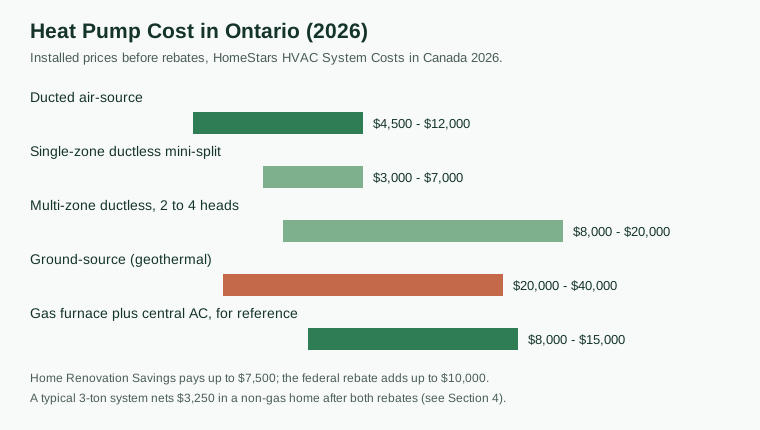
    Short Answer: A ducted air-source heat pump installed in Ontario in 2026 runs $4,500 to $12,000; a single-zone ductless mini-split runs $3,000 to $7,000; a multi-zone ductless system with two to four heads runs $8,000 to $20,000; and a ground-source system runs $20,000 to $40,000 (HomeStars, HVAC System Costs in Canada 2026). Those are installed prices, equipment and labour together, before rebates and before tax.

    Ontario's Home Renovation Savings program then pays $1,250 per ton, up to $7,500, for a cold-climate air-source heat pump in a home heated by electricity, oil, propane or wood, and $500 per ton, up to $2,000, in a home heated by Enbridge natural gas. A typical 3-ton system earns $3,750 in a non-gas home and $1,500 in an Enbridge gas home. A federal National Heat Pump Rebate worth up to $10,000 below the median income and $2,000 for other households was announced October 8, 2026. It opens in early 2027 and covers eligible installs from November 1, 2026, so a system installed now can still be claimed once the portal opens.

    The wide ranges are the honest part of the answer. A single-zone mini-split in a small electrically heated bungalow and a ducted cold-climate system in a 3,000-square-foot Toronto home with no usable ductwork are both heat pump installs, and they sit at opposite ends of the same table. This guide prices each system type, works three net-cost examples with the arithmetic shown, prices running costs on the OEB electricity rates in effect November 1, 2026, and lists what a quote must contain before it is signed. Our heat pump versus gas furnace comparison covers the 15-year total cost of ownership and the gas-versus-electric decision in full; this guide answers the cost question itself.

    How to use this guide in six steps:

    1. Find your system type in Section 1 and read its band, not the average. The band is the useful number; an average across system types describes no real install.
    2. Read Section 2 and mark which of the five quote-movers apply to your house: size, ductwork, electrical panel, location, and cold-climate tier. Each one pushes the price toward a different end of the band.
    3. Work your rebate in Section 3 before you compare quotes. The rebate depends on your current heating fuel and the rated tonnage, and the pre-approval must be in hand before work starts.
    4. Run the worked example in Section 4 that matches your house, then swap in your own quote. The arithmetic is shown so the substitution takes a minute.
    5. Check the running-cost math in Section 5 against your own electricity plan. The OEB rates changed November 1, 2026, and a quote built on last winter's rates is out of date.
    6. Use the checklist in Section 8 on every quote you receive. A quote that will not name the model number, the AHRI number, and the pre-approval status is not a quote to sign.

    1. What a Heat Pump Costs in Ontario, by System Type

    HomeStars publishes the clearest Canada-wide installed-cost table for 2026, built from contractor pricing, and it is the spine of this section. Every figure below is an installed price, equipment and labour together, before rebates and before tax. No published source gives a price specific to Ontario alone, a point the Ontario cost guides state plainly, so the Ontario adjustment lives in Section 2, where Toronto runs 10% to 25% above mid-sized cities.

    System Installed cost, 2026 (HomeStars) What it is
    Ducted air-source heat pump $4,500 - $12,000 One outdoor unit feeding the home through existing ductwork, heating and cooling the whole house
    Single-zone ductless mini-split $3,000 - $7,000 One outdoor unit and one indoor head, heating and cooling one room or zone, no ducts
    Multi-zone ductless, 2 to 4 heads $8,000 - $20,000 One outdoor unit feeding two to four indoor heads, each zone controlled separately
    Ground-source (geothermal) $20,000 - $40,000 A ground loop plus a heat pump unit, the most efficient residential option and the most expensive to install
    Gas furnace plus central AC, for reference $8,000 - $15,000 The conventional alternative: a furnace for heat and a separate air conditioner for cooling

    Read the table by what the system replaces. A ducted heat pump replaces a furnace and an air conditioner in one unit, which is why its band sits below the $8,000 to $15,000 furnace-plus-AC figure. A single-zone mini-split replaces nothing in the rest of the house: it heats and cools one space, and it is the cheapest way into a heat pump for a home without ducts, an addition, or a finished basement. A multi-zone system is the ductless answer to a whole house, and its price grows with the head count. Ground-source is a different project class, covered in Section 6.

    Two HomeStars details matter for how these bands behave in practice. First, labour is 30% to 50% of most quotes, and higher on retrofits, so the installer matters as much as the equipment. HVAC technicians in Canada typically charge $85 to $150 per hour, a standard replacement of an existing central system takes 8 to 16 hours of labour, and a full installation including ductwork runs $4,000 to $8,000 in labour alone. Second, a ductless install is fast: 4 to 6 hours for a single zone and 6 to 12 hours for a multi-zone system, against a full ducted install that can take one to three days where ductwork is involved.

    The band also has a floor set by the machine itself. A mid-range gas furnace costs $1,500 to $4,000 before installation and a central air conditioner $1,200 to $4,500, so the equipment alone in a ducted heat pump job is a substantial share of the low end of its band. A quote near the bottom of a band usually means a straightforward swap on a house that already has what the system needs: usable ducts, a panel with room, a short line set, and a ground-level outdoor unit. A quote near the top usually means one or more of the Section 2 items is missing.

    One more comparison before leaving this table. Replacing only a gas furnace runs $3,500 to $8,000, and replacing only a central air conditioner runs $3,000 to $7,500. A homeowner whose furnace dies in January and who prices a like-for-like furnace is comparing $3,500 to $8,000 against a ducted heat pump at $4,500 to $12,000 before rebates, and the rebate in Section 3 is what closes that gap in Ontario. That is the comparison that decides most Ontario installs, and it is the reason the rebate math comes before the brand discussion.


    Advertisement

    2. What Moves a Quote Off the Middle of the Range

    Five things decide where inside a band your quote lands. A contractor who will not name them is guessing, and a homeowner who does not know them cannot tell a good quote from a padded one.

    Size, and the tonnage it implies. Heat pumps are sized in tonnes of capacity, and HomeStars gives the working rule of thumb at about 20 BTU per square foot: a 1,500-square-foot home typically needs a 2- to 3-tonne system, while a 3,000-square-foot home generally requires 4 to 5 tonnes, with each additional tonne adding roughly $500 to $1,000 to equipment cost. Square footage is a starting point, not a sizing method. A qualified contractor performs a Manual J load calculation that accounts for insulation, ceiling height, windows, and air leakage, and the tonnage on the quote should come from that calculation. Oversizing is one of the most common installation mistakes HomeStars names: it accelerates wear, reduces efficiency, and raises indoor humidity. Undersizing leaves the house cold on the coldest nights and leans on backup heat, which is the most expensive heat a heat pump system can buy.

    Ductwork, or the lack of it. Whether a home already has ductwork is one of the largest single variables in total cost. A home with existing, well-maintained ductwork accepts a ducted system with minimal extra work and stays near the low end of its band. New sections or modifications where the existing layout does not suit the system add $2,000 to $8,000, covering materials and labour for new duct runs, plenums, and registers. A home without ductwork, or one where the ducts need heavy modification, is where a ductless system earns its keep: ductless mini-splits bypass the 20% to 30% energy loss common in poorly sealed duct systems, and they avoid the ductwork bill entirely. Where full new ductwork in a finished home is unavoidable, HomeStars puts a heat pump plus ductwork at $15,000 to $25,000 in total.

    The electrical panel. A heat pump is an electrical load, and a 100-amp panel in an older Ontario home often has no room for it. A panel upgrade is a separate line on the quote, and our electrical panel upgrade guide prices a 100- to 200-amp upgrade in full. Ask whether the quote includes the panel work, the disconnect, and the wiring, or whether those arrive as a second invoice from an electrician.

    Location. Labour rates vary across Canada, and HomeStars puts Toronto and Vancouver at 10% to 25% above mid-sized cities like Calgary or Ottawa for the same job. Equipment pricing is largely consistent nationally. In remote communities where contractor availability is limited, most HVAC pros charge a travel fee on top of the standard labour rate, either as a flat fee of $100 to $300 or by billing travel time at their hourly rate. A Toronto quote and a Thunder Bay quote for the same system are different quotes for a real reason, and comparing them without the location adjustment is a false comparison.

    Cold-climate tier and efficiency rating. The rebate in Section 3 only pays on a cold-climate air-source heat pump on Natural Resources Canada's qualified products list, and that tier costs more than a standard-efficiency unit. Modern cold-climate models operate efficiently at temperatures as low as -25C, which is what makes them a primary heating source across most of Canada, and high-efficiency ductless systems operate at SEER2 ratings of 18 or higher. The efficiency rating is measured in HSPF2 for heating: higher numbers mean lower operating costs, and the premium for a higher tier is paid back in the running costs of Section 5, not in the install price.

    Two costs sit outside the system bands and belong on the quote anyway. A mechanical permit runs $100 to $500 depending on the municipality, and some jurisdictions require an inspection before the system is commissioned, so ask whether the permit is included and who arranges the inspection. Materials outside the main unit, refrigerant lines, ductwork sections, electrical connections, and the thermostat, typically add $300 to $1,500. And timing matters: spring and fall installations often attract lower labour rates than emergency replacements during peak summer or winter, which is a real saving for a planned replacement and no saving at all for a furnace that died in January.

    The practical consequence is simple. HomeStars notes that quotes on the same scope can differ by $2,000 or more, and the remedy is three quotes on an identical written scope, not three quotes on three different scopes. Section 8 gives the scope list.


    3. The Ontario Rebates: Home Renovation Savings and the Federal Rebate

    Two rebates decide the net cost in Ontario, and they work differently. The provincial program pays per ton of capacity and needs pre-approval before work starts. The federal program pays a flat amount by income band and opens in early 2027, but it covers installs from November 1, 2026. Both require a cold-climate heat pump on the Natural Resources Canada qualified products list, and both require the system to be installed by a contractor.

    Home Renovation Savings (Ontario). The program is run by Save on Energy and Enbridge Gas, supported by the Government of Ontario. Save on Energy confirms the headline caps firsthand: a cold-climate air-source heat pump earns up to $7,500 and a ground-source heat pump up to $12,000, with the amount determined by the size of the heat pump installed. The per-ton rates, checked against the official site by RebateHub on October 25, 2026, are $1,250 per ton up to $7,500 for a cold-climate air-source heat pump in a home heated by electricity, oil, propane or wood, and $500 per ton up to $2,000 in a home heated by Enbridge natural gas. Ground-source pays $2,000 per ton up to $12,000 in a non-gas home and a flat $3,000 in an Enbridge gas home. The program maximum is $12,000. The tonnage is worked out on the heat pump's rated heating capacity at 8.3C (47F), unrounded, so a 3.2-ton unit earns 3.2 times the per-ton rate.

    Two conditions catch people out. First, the rebate needs a participating contractor and written pre-approval before installation, and there is no retroactive claim: work that starts before the pre-approval is in hand does not qualify. Second, homes heated by a gas utility other than Enbridge, and homes replacing an existing heat pump, do not qualify. The program also offers a $600 home energy assessment rebate and a bundle path, but the assessment is optional: single upgrades, including a heat pump on its own, can be done without it.

    The federal National Heat Pump Rebate. The Government of Canada announced the program on October 8, 2026: $2 billion over eight years to help up to 820,000 households install cold-climate heat pumps. Its program page on Canada.ca, read firsthand for this guide on November 8, 2026, sets out the rules. Households can be eligible for $2,000, or up to $10,000 for low- to median-income households. The program opens through an online portal in early 2027, needs no energy audit before or after installation, and closes in March 2034.

    The income line is drawn on after-tax household income against the median for the province and household size. For Ontario, the limits are $46,981 for one person, $92,884 for two, $119,850 for three, $146,217 for four, and $158,202 for five or more. The calculation uses the 2025 income tax return: line 23600 (net income) minus line 43500 (total taxes payable), added across spouses or common-law partners. When the portal opens, applicants for the higher amount provide their Social Insurance Number so the Canada Revenue Agency can verify household income.

    The retroactivity rule is the part that matters this winter. Installs from November 1, 2026 can be claimed once the program opens, and receipts must be submitted within six months. The contractor's receipt has to show the applicant's name and address, the installing company's name, the make, model and AHRI number of the equipment, the number of heat pumps installed, and the total project cost including directly related work such as ductwork and electrical upgrades. The heat pump must be on the eligible product list by its AHRI number, and it must be purchased from and installed by an HVAC contractor. Only one rebate is available per household, even across multiple properties, and no federal funding can previously have been provided for a heat pump at that address. The home does not need to be the primary residence. There is no requirement to remove the existing system or to show that it has broken down, and both emergency and planned installs qualify. All current heating fuels qualify, including electricity, natural gas, oil, propane, diesel, coal and wood, though Canada.ca notes plainly that a home currently heated by natural gas may not see lower heating bills after switching, depending on the region and the system selected. Rented or leased heat pumps may be eligible once the program launches, with details to follow. The program page states that parameters are still being finalized and remain subject to change, and that funding is not guaranteed until an application is approved.

    Stacking the two. The federal program is designed to work alongside provincial programs, so an Ontario homeowner can in principle claim both. Treat the combined total as provisional until both programs confirm it: the federal rules are still being finalized, and the Home Renovation Savings pre-approval is a separate gate that must be cleared before work starts. Section 4 works the combined arithmetic for three household types, with the stacking shown as an addition, not a promise.

    One more program for low-income households. The Energy Affordability Program installs a cold-climate heat pump at no cost for income-eligible households heated by electricity or oil, through the program's own contractors. It is a separate program from Home Renovation Savings with its own eligibility rules, and it is worth checking before paying for a system out of pocket.

    One warning from the federal program page is worth repeating in full. Environment and Climate Change Canada is aware of salespeople visiting and calling homes to sell heat pumps with misleading references to the National Heat Pump Rebate. The department never goes door-to-door to inspect, sell or rent heating equipment, and it does not make marketing calls. Initiate contact with HVAC companies yourself, and use the vetted installer lists that provinces, territories and utilities publish.


    4. Three Worked Net-Cost Examples

    Every example below uses the same inputs: installed prices from the HomeStars bands in Section 1, Home Renovation Savings at the per-ton rates in Section 3, and the federal rebate at $2,000 for above-median households and up to $10,000 for below-median households. The federal amount depends on household income and on the cost of the equipment installed, so the below-median example uses a system expensive enough for the full $10,000 to fit inside the installed price. Prices are before tax. Swap in your own quote and your own tonnage; the arithmetic is the same.

    Example A: electrically heated bungalow, ducted 3-ton system, above-median household. A 1,500-square-foot home with electric baseboards and existing ductwork from an old furnace gets a ducted cold-climate heat pump quoted at $9,000 installed, inside the $4,500 to $12,000 band. Home Renovation Savings pays 3 tons at $1,250, which is $3,750. The federal rebate pays $2,000. Net cost: $9,000 minus $3,750 minus $2,000 equals $3,250. That is the whole point of the Ontario stack: a system quoted near the middle of its band lands near the cost of a like-for-like furnace replacement once both rebates are counted.

    Example B: the same system in an Enbridge gas home. The quote is the same $9,000. Home Renovation Savings pays 3 tons at $500, which is $1,500. The federal rebate pays $2,000. Net cost: $9,000 minus $1,500 minus $2,000 equals $5,500. The $2,250 gap between Example A and Example B is entirely the fuel split in the provincial program, and it is the reason the first question on any Ontario rebate call is what heats the house today.

    Example C: below-median household, multi-zone ductless, electrically heated. A two-storey home without ducts gets a three-head multi-zone system quoted at $16,000 installed, inside the $8,000 to $20,000 band. Home Renovation Savings pays 3 tons at $1,250, which is $3,750. The federal rebate pays up to $10,000 for a below-median household, and the $16,000 installed price supports the full amount. Net cost: $16,000 minus $3,750 minus $10,000 equals $2,250. The same system in an above-median household would net $10,250, which shows how much of the Ontario story is income as well as fuel.

    Example D: ground-source, 4-ton, electrically heated, above-median household. A ground-source system is quoted at $32,000 installed, inside the $20,000 to $40,000 band. Home Renovation Savings pays 4 tons at $2,000, which is $8,000, under the $12,000 cap. The federal rebate pays $2,000. Net cost: $32,000 minus $8,000 minus $2,000 equals $22,000. Ground-source stays a different budget class even after both rebates, and Section 6 covers when it is worth it.

    Three cautions apply to every example. First, the federal rebate is claimed after installation, once the portal opens in early 2027, so the homeowner carries the gross cost until the claim is approved. Second, the Home Renovation Savings money depends on the pre-approval being in hand before work starts; without it, the provincial line in these examples is zero. Third, none of these examples includes a panel upgrade, ductwork additions, or a permit, which are separate lines on a real quote and are priced in Section 2.


    5. What It Costs to Run, on the November 1, 2026 Electricity Rates

    The install price is half the decision. The running cost is set by Ontario electricity prices, which changed on November 1, 2026, and any quote or payback sheet built on last winter's rates is out of date. Under the Ontario Energy Board Regulated Price Plan in effect November 1, 2026 through October 31, 2027, time-of-use prices are 9.1 cents per kWh off-peak, 14.6 cents mid-peak and 18.9 cents on-peak. Tiered prices are 11.2 and 13.2 cents. Prices fell about 7% on November 1, 2026, and the Ontario Electricity Rebate fell from 23.5% to 15.7% on the same date. The ultra-low overnight plan is built for overnight use, with on-peak electricity at 37.7 cents. All of these are commodity prices only; delivery and regulatory charges are billed separately.

    A heat pump's running cost is the electricity price divided by its coefficient of performance, the COP: the units of heat delivered per unit of electricity consumed. The COP figures in the table below are labelled assumptions, not measured performance. A real system's seasonal COP depends on the model, the sizing and the winter, so use the HSPF2 rating on the quote and ask the contractor for the expected seasonal COP at your design temperature, then re-run the table with that number. Our heat pump electricity use guide turns a COP into annual kWh for Ontario cities.

    Cost per kWh of heat delivered Off-peak 9.1c Mid-peak 14.6c On-peak 18.9c
    COP 2.0 (assumed) 4.55c 7.30c 9.45c
    COP 2.5 (assumed) 3.64c 5.84c 7.56c
    COP 3.0 (assumed) 3.03c 4.87c 6.30c

    Take a labelled example to make the table concrete. A house that needs 12,000 kWh of heat across the heating season, an assumption to replace with your own heating load, running at a seasonal COP of 2.5, uses 4,800 kWh of electricity. If half of that runs off-peak and half mid-peak, the commodity cost is 2,400 kWh at 9.1 cents, which is $218.40, plus 2,400 kWh at 14.6 cents, which is $350.40, for a total of $568.80. That is the commodity cost only, before the Ontario Electricity Rebate and before delivery and regulatory charges. The same house at a COP of 2.0 would use 6,000 kWh and cost about a quarter more, which is why the sizing and the cold-climate tier in Section 2 matter to the bill as much as to the install price.

    Two running-cost realities belong in the same section. First, a heat pump that heats with backup electric resistance on the coldest nights is buying heat at the full electricity price with a COP of 1.0, which is 9.1 to 18.9 cents per kWh of heat, and an undersized system leans on that backup exactly when the price is highest. Second, maintenance is a real annual line: HomeStars puts a visit at $95 to $180 and the 15-year maintenance total at $1,500 to $3,000. Neither figure belongs in a payback calculation that only counts the install price.

    Whether a heat pump beats a gas furnace on running cost depends on the gas price, the electricity plan and the COP, and it is not automatic. Canada.ca says so directly for gas-heated homes. Our heat pump versus gas furnace operating cost guide works the fuel-by-fuel comparison in full, and the 15-year total cost comparison carries the whole ownership picture.


    6. Ground-Source: When $20,000 to $40,000 Makes Sense

    A ground-source system, also called geothermal, is a heat pump plus a ground loop, and it is the most efficient residential option and the most expensive to install. HomeStars puts the installed price at $20,000 to $40,000 and its operating costs 40% to 70% below conventional systems. The Ontario rebate is the most generous of any system type at $2,000 per ton up to $12,000 in a non-gas home, or a flat $3,000 in an Enbridge gas home, and the federal rebate stacks on top the same way as for an air-source system, as Example D in Section 4 shows.

    The case for ground-source is a long horizon and a house that will stay a heat pump house. The efficiency advantage compounds every heating season, the equipment lasts longer than an air-source unit, and the rebate per ton is the highest in the program. The case against it is the upfront cost, the outdoor space a ground loop needs, and the fact that the payback depends on the same running-cost variables as Section 5, only stretched over more years. A homeowner who plans to move in five years is unlikely to recover the premium. A homeowner building new, or replacing a system in a house they expect to keep for decades, is the buyer the ground-source numbers are written for. Our air-source versus ground-source comparison works the two options side by side.


    Advertisement

    7. Choosing the System and the Contractor

    The equipment decision is smaller than the installer decision. A good contractor sizes the system with a Manual J load calculation, names the exact model and its AHRI number, confirms the model is on the Natural Resources Canada qualified products list for both rebate programs, and handles the Home Renovation Savings pre-approval before any work starts. A contractor who sizes by square footage alone, will not name the model, or wants to start before the pre-approval is in hand is cutting the corners that cost the rebate.

    Five checks before choosing:

    1. The model is on the list. Both rebate programs pay only on a cold-climate heat pump on the Natural Resources Canada qualified products list, identified by its AHRI number. The federal receipt has to show the AHRI number, so a quote without it is incomplete by definition.
    2. The sizing is calculated, not guessed. The tonnage on the quote should come from a Manual J calculation, and the rebate tonnage is the rated heating capacity at 8.3C, unrounded. Oversizing wastes money and wears the system out; undersizing buys backup heat at full price.
    3. The contractor is a participating contractor. Home Renovation Savings needs one, and the federal rebate needs the system purchased from and installed by an HVAC contractor. Ask which program the contractor has done before, and ask for the pre-approval paperwork by name.
    4. The quote is itemized. Equipment, labour, line set, ductwork, panel work, disconnect, permit, thermostat and disposal of the old system should each be a line. A single lump sum hides the panel upgrade and the permit, which are the two lines most likely to arrive later as a second invoice.
    5. The timing is honest. Spring and fall installs often cost less than emergency winter replacements. A furnace that died in January is not a planned replacement, and the premium for speed is real. The federal retroactivity window means a January install can still be claimed, so a rushed decision is not forced by the rebate calendar.

    The scam warning from Section 3 bears repeating at the point of choosing. Government departments do not go door-to-door selling heat pumps, and no one from the National Heat Pump Rebate will call to inspect a home. Start the conversation yourself, get three quotes on the identical written scope, and use the vetted installer lists that Ontario utilities and the province publish.


    8. Checklist Before You Sign

    • System type and tonnage named, from a Manual J load calculation, not a square-footage rule of thumb
    • Exact make and model named, with the AHRI number on the quote
    • Model confirmed on the Natural Resources Canada qualified products list
    • Home Renovation Savings pre-approval in hand, in writing, before work starts, with the per-ton amount stated
    • Federal rebate receipt requirements confirmed with the contractor: name and address, company name, make, model and AHRI number, number of heat pumps, total project cost
    • Panel upgrade, disconnect and wiring itemized, or confirmed unnecessary in writing
    • Permit included and the inspection arranged, at $100 to $500 depending on the municipality
    • Ductwork scope itemized, with the cost of new runs or modifications stated separately
    • Warranty terms in writing: equipment, labour and the installing company's own guarantee, with their lengths stated separately
    • Total price with tax shown, rebates shown as separate lines, and three quotes compared on the identical scope

    A quote that passes this list is a quote that can be signed. A quote that fails the first five items is not a quote yet, whatever its price.


    Frequently Asked Questions

    How much does a heat pump cost in Ontario in 2026? A ducted air-source heat pump runs $4,500 to $12,000 installed, a single-zone ductless mini-split $3,000 to $7,000, a multi-zone ductless system $8,000 to $20,000, and a ground-source system $20,000 to $40,000 (HomeStars). Those are installed prices before rebates and before tax. Toronto runs 10% to 25% above mid-sized Ontario cities.

    How much rebate can I get for a heat pump in Ontario? Home Renovation Savings pays $1,250 per ton up to $7,500 for a cold-climate air-source heat pump in a home heated by electricity, oil, propane or wood, and $500 per ton up to $2,000 in an Enbridge gas home. The federal National Heat Pump Rebate adds $2,000, or up to $10,000 for households at or below the Ontario median after-tax income. A typical 3-ton system in a non-gas home earns $3,750 provincially, and the two programs are designed to stack.

    Can I install a heat pump now and claim the federal rebate later? Yes. Installs from November 1, 2026 can be claimed once the program opens in early 2027, with receipts submitted within six months. The heat pump must be on the eligible product list by its AHRI number and installed by an HVAC contractor. Funding is not guaranteed until the application is approved, and the program rules are still being finalized.

    What income qualifies for the $10,000 federal rebate in Ontario? After-tax household income at or below $46,981 for one person, $92,884 for two, $119,850 for three, $146,217 for four, or $158,202 for five or more, calculated from the 2025 tax return as line 23600 minus line 43500. Households above the limit receive $2,000.

    Do I have to remove my furnace to get the federal rebate? No. Canada.ca states there is no requirement to remove the existing system or to show that it has broken down, and both emergency and planned installs qualify. A heat pump can sit alongside a furnace as a dual-fuel setup.

    Will a heat pump keep my house warm in an Ontario winter? Modern cold-climate models operate efficiently at temperatures as low as -25C (HomeStars), which covers most of Ontario most of the winter. The qualifier is sizing: an undersized system leans on backup electric heat on the coldest nights, which is the most expensive heat the system can buy. The Manual J calculation in Section 7 is what prevents that.

    Is a heat pump cheaper to run than a gas furnace? Not automatically. The running cost is the electricity price divided by the COP, and Section 5 works it at the November 1, 2026 rates. Canada.ca notes that a home currently heated by natural gas may not see lower heating bills after switching, depending on the region and the system selected. The fuel-by-fuel comparison is in our operating cost guide.

    How long does a heat pump installation take? A single-zone ductless install takes 4 to 6 hours and a multi-zone install 6 to 12 hours. A ducted install on a house with usable ductwork typically takes a day; a full install with ductwork can take one to three days (HomeStars).


    Common Questions

    What should I check first before using this hvac advice?

    Start with the numbers that apply to your home: climate, utility rate, equipment age, contractor quote, and local program rules. A ducted air-source heat pump installed in Ontario in 2026 runs $4,500 to $12,000; a single-zone ductless mini-split runs $3,000 to $7,000; a multi-zone ductless system with two to four heads runs $8,000 to $20,000; and a ground-source system runs $20,000 to $40,000 (HomeStars...

    How should I verify rebates, tax credits, rates, or savings before spending money?

    Treat program amounts, utility rates, and tax rules as date-sensitive. Check the named government, utility, or manufacturer source before you sign a contract, and keep screenshots or PDFs of eligibility rules for your records.

    When should I involve a licensed professional instead of doing this myself?

    Bring in a licensed electrician, HVAC technician, or other qualified professional for panel work, refrigerant handling, combustion equipment, structural changes, or anything that needs a permit or inspection. A guide can help you prepare questions and compare options, but it does not replace licensed work where codes or safety are involved.

    How should I compare contractor quotes for this kind of work?

    Ask each contractor to separate equipment, labor, electrical work, permits, and rebate assumptions on the quote, and to name the exact model numbers being priced. Comparing itemized quotes on the same scope is more useful than comparing headline prices, and it shows which savings claims depend on incentives you have not yet confirmed.

    What is the next useful step after reading this?

    Compare this with Heat Pump vs Gas Furnace: The True Cost Comparison for 2026 so you can check the cost, rebate, installation, or operating-risk angle before making a decision.

    What to Read Next

    Heat Pump vs Gas Furnace: The True Cost Comparison for 2026Use this next to compare the cost, incentive, installation, or operating-risk angle before you make a home energy decision.

    Sources and Verification

    Editorial Review

    EnergyBS Editorial Team

    EnergyBS publishes practical homeowner guides. Important program, product, and cost claims should be checked against the linked source and local project documents before you commit to work.

    Read our editorial policy and methodology, or report an error.

    Important: Educational Purposes OnlyThe guides, tools, cost estimates, and ROI calculators provided on EnergyBS.com are for informational and educational purposes only. They do not constitute certified financial, tax, or professional engineering advice. Energy costs, government rebates, and installation fees vary significantly by location and are subject to change. Always consult with certified local professionals before undertaking home energy projects or making financial commitments.