Garage Heater Installation Cost 2026: What Installation Really Costs
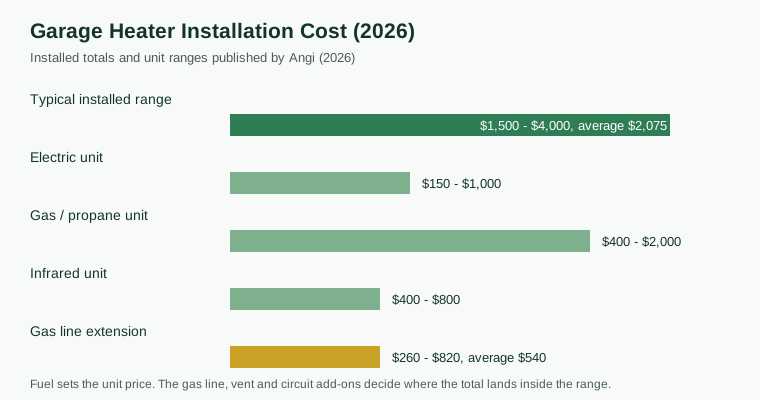
A professionally installed garage heater costs $2,075 on average in Angi's 2026 data, with a typical range of $1,500 to $4,000 and a full span from $150 for a small selfinstalled electric unit to $6,000 for a large gas or propane install. The heater itself runs $150 to $1,000 for electric models, $400 to $2,000 for natural gas or propane, and $400 to $800 for infrared. Labor sits near $100 an hour for electric work, while gas and propane installs add $500 to $800 for the line and venting work. This guide reconciles Angi's two sizing ladders, prices the gas line and circuit addons separately, works through running cost on an equaloutput basis, covers the insulation step that shrinks the heater you need, and closes with Canadian pricing from an Edmonton installer.
Quick Checks
- 1Budget $2,075 for a professionally installed garage heater in 2026. That is Angi's average, inside a typical range of $1,500 to $4,000. The full span runs from $150 for a small electric unit you hang yourself to $6,000 for a large gas or propane install.
- 2The unit is priced by fuel: electric $150 to $1,000, natural gas and propane $400 to $2,000, infrared $400 to $800 (Angi). Units at 60,000 BTU and up start past $1,000 for the heater alone.
- 3Labor is the small line on an electric job, about $100 an hour and about $200 for a typical two-hour install (Angi). Gas and propane add $500 to $800 for the line and venting work, and a new gas line extension averages $540 on its own.
- 4Sizing has two published ladders that disagree until insulation enters the picture: Angi's sizing guide works from 20 to 30 BTU per square foot (8,000 to 12,000 BTU for a one-car garage), while its cost guide puts a two-car garage at 45,000 BTU and a three-car at 60,000 BTU. The gap is insulation, ceiling height and climate, and it is why insulating first can shrink the heater you have to buy.
- 5In Canada, one Edmonton installer (Dyand Mechanical) publishes $400 to $2,000 installed depending on type and size, and Alberta gas installs need a permit and inspection, with a carbon monoxide alarm recommended on every install.
Garage Heater Installation Cost 2026: What Installation Really Costs
By EnergyBS Editorial Team | October 18, 2026
The Short Answer
Short Answer: A professionally installed garage heater costs $2,075 on average in Angi's 2026 data, with a typical range of $1,500 to $4,000. The full span is wider: a small electric heater you install yourself starts at $150, and a large natural gas or propane heater with professional installation can reach $6,000. The heater itself runs $150 to $1,000 for electric models, $400 to $2,000 for natural gas or propane, and $400 to $800 for infrared (Angi). Installation labor sits near $100 an hour, about $200 for a typical two-hour electric install, with gas and propane work adding $500 to $800 for the line and venting scope.
A garage heater is a heating purchase with an electrical or gas scope attached, which is why it belongs on an energy site and why the quotes spread so far apart. Two homeowners can both say they installed a garage heater and mean a $150 plug-in unit over a workbench or a 60,000 BTU gas unit heater with a new gas line, a vent through the roof and a permit. This guide separates those jobs. It prices the unit by fuel, reconciles the two sizing ladders Angi publishes, prices the gas line and the dedicated circuit as the separate lines they are, works through running cost on an equal-output basis, and covers the insulation step that decides whether the heater you buy is the right size at all.
1. What the Installed Price Covers
A standard professional installation, as Angi and Canadian installers describe the scope, covers mounting the heater (ceiling or wall brackets), connecting it to its fuel source, fitting the thermostat or control, and testing the unit through a heat cycle. On a gas or propane job, the Edmonton installer Dyand Mechanical lists the scope explicitly: the heater unit and materials including mounting brackets, venting, electrical wiring and gas connections where needed, labor for a licensed HVAC technician, and safety checks for ventilation and code compliance.
Six items sit outside the base scope often enough that each one needs a written answer before work starts:
- The gas line extension. A garage with no gas stub needs a line run to it. Section 4 prices this from Angi's gas line data: an average of $540 as its own project.
- The dedicated circuit. A hardwired electric heater needs a 240-volt circuit in most sizes. HouseDigest flags the version of this cost that surprises people: some units need a different outlet, and some need a new or larger circuit in the breaker box to support the load.
- Venting. Gas and propane unit heaters move exhaust outside through a wall or roof vent. The vent path, and any roof work it needs, belongs on the quote as its own line.
- The permit and inspection. Angi puts gas line permit fees at $100 to $300 in its gas line guide. In Alberta, a Calgary installer states the rule plainly: gas work needs a permit and an inspection, and its own gasfitters take out the permit as part of the install.
- The thermostat. A unit heater with a built-in dial and a heater wired to a wall thermostat are different comfort purchases. The quote should name which control you are getting.
- Insulation and door sealing. Not part of a heater quote, and the subject of section 6. A heater installed into an uninsulated garage is sized for the worst version of the space, and you pay for that size every hour it runs.
One bundling note. A gas line run for a garage heater can be sized, at the same visit, for a future gas appliance on the same wall, and a circuit run for an electric heater shares the electrician's trip with any other garage electrical work on your list. The shared-trip saving is real only if the second job is genuinely planned. Upsizing a gas line for an appliance you will never buy is a cost, not a saving.
2. Price by Fuel: Electric, Gas, Propane, and Infrared
Fuel is the first price decision, because it sets both the unit band and the installation scope that follows it.
| Heater type | Unit price (Angi) | What the install adds |
|---|---|---|
| Electric | $150 to $1,000 | Mounting plus a 240V circuit on hardwired models; plug-in models need no install |
| Natural gas | $400 to $2,000 | Gas line work and venting; add $500 to $800 over electric labor (Angi) |
| Propane | $400 to $2,000 | Same line and venting scope as natural gas, plus a propane supply arrangement |
| Infrared | $400 to $800 | Mounting and electrical; heats people and objects in its line of sight rather than the air |
HouseDigest publishes the installed version of the same comparison from the purchase side: buying and installing an electric garage heater runs $400 to $1,200, against $500 to $2,000 for a gas garage heater, with the electric advantage coming from the absence of gas supply lines and a ventilation system. Read against Angi's $1,500 to $4,000 typical installed range and $2,075 average, the two sources describe different slices of the market. HouseDigest's bands cover the common single-heater jobs. Angi's average is pulled upward by the large gas and propane installs at the top of its $6,000 span, where the unit alone passes $1,000 at 60,000 BTU and up and the line, vent and permit scope stacks on top.
Electric is the low-friction option. Small units plug in. Hardwired forced-air units mount on a wall or ceiling and need the circuit from section 4. There is no vent, no gas line and no combustion in the space, which removes the permit and safety scope in section 7 entirely. The cost arrives later, in running hours, and section 5 prices it.
Natural gas is the high-output option where a gas service already reaches the house. Angi describes gas heaters as the most efficient of the common types to run and prices the units from about $450, with the installation premium over electric set by the line and vent work rather than the heater. A garage that already has a gas stub, from a previous heater or a nearby appliance run, is the cheap version of this job. A garage on the far side of the house from the meter is the expensive version, priced by the foot in section 4.
Propane matches the gas unit bands ($400 to $2,000) and suits homes with propane service already on site. Angi flags the safety reading for this fuel directly: propane heaters carry risks that need the same venting and clearance discipline as natural gas, and a portable unvented propane heater is a camping appliance, not a permanent garage heating system. Section 7 covers that line.
Infrared heats what it can see. Angi prices the units at $400 to $800 and credits infrared models with using 30 to 40 percent less energy than other electric heaters in its comparison, because radiant heat warms the person at the bench instead of the full air volume of the garage. Our spot heating guide works through the physics of that trade: infrared is the right tool for a fixed work position in a drafty garage and the wrong tool for raising the whole space to a set temperature or keeping pipes from freezing, because the air itself stays cold.
A mini-split heat pump is the fifth option, and it prices in a different band entirely. Our mini-split installation cost guide puts a single-zone system at $2,500 to $6,000 installed in HomeGuide project data. That premium buys cooling in summer and heat at two to three times the efficiency of resistance electric in mild weather, and it only makes sense in a garage insulated well enough to hold the temperature, which is the subject of section 6. For a garage heated a few hours a week, it is the wrong purchase at any efficiency. For a garage used as a daily workshop, it belongs in the quote comparison.
3. Sizing: Two Published Ladders, and Why They Disagree
Angi publishes two sizing ladders for this job, and they appear to contradict each other until insulation and climate enter the picture.
The sizing guide works from floor area: 20 to 30 BTU per square foot for most spaces, which puts a one-car garage at about 8,000 to 12,000 BTU. Run that rule across a two-car garage of 400 to 600 square feet and it gives roughly 10,000 to 18,000 BTU. The cost guide works from garage count instead: most two-car garages need a 45,000 BTU heater, and three-car garages need 60,000 BTU.
Both figures are published by the same source, and the gap between them is the real sizing lesson. The per-square-foot rule describes a space that holds heat: insulated walls and ceiling, a sealed overhead door, and a target temperature modestly above freezing for working comfort. The garage-count figures describe the common North American garage as it actually stands: uninsulated or partly insulated, a thin overhead door as its largest wall, a concrete slab pulling heat down, and a door that opens to winter air several times a day. A heater sized by the first rule and installed in the second garage runs continuously and never catches up on a cold day. A heater sized by the second rule and installed in the first garage short-cycles and overshoots.
Angi's own sizing guide names the variables that move a garage from one ladder to the other: square footage, insulation quality, ceiling height, climate and heater type. Read in that order, the quote questions write themselves:
- Insulation quality first. Is the ceiling insulated, are the walls insulated, and is the overhead door an insulated model with intact seals? Each no moves you up the ladder.
- Ceiling height second. A 12-foot ceiling holds half again the air volume of an 8-foot ceiling over the same floor, and heat collects at the top of both.
- Climate third. Holding a garage at 10 degrees Celsius (50 degrees Fahrenheit) against a -5 degree day is a different load from holding it against -25, and the heater does not know which province or state it is in until the quote says so.
- Target temperature last. Freeze protection for pipes and stored paint asks for a space held just above freezing. A workshop asks for shirt-sleeve temperature at the bench. The second target can double the first one's load on the coldest days.
The practical sequence is to fix the cheap envelope items in section 6 first, then size the heater to the garage you now have, and to ask any installer quoting a 45,000 or 60,000 BTU unit to show the load reasoning behind the figure. A quote that names only the garage count has used the second ladder without checking which ladder your garage is on.
4. The Add-On Stack: Gas Line, Circuit, Vent, and Permit
Every item below is published pricing for a defined piece of work. An electric plug-in install needs none of them. A gas install on the far side of a house can need all of them.
| Add-on | Published range | Source |
|---|---|---|
| Gas line extension, typical project | $260 to $820, average $540 | Angi gas line guide |
| Underground gas line work | $15 to $25 per linear foot | Angi gas line guide |
| Gas line permit fees | $100 to $300 | Angi gas line guide |
| Gas line pressure test, standard | $75 to $150 | Angi gas line guide |
| Gas or propane install premium over electric labor | $500 to $800 | Angi garage heater guide |
| Electrician labor for circuit or outlet work | up to $130 per hour | HouseDigest |
| Base installation labor, electric or infrared | about $100 per hour, about $200 total | Angi |
The gas line. Angi's gas line guide puts the average cost of adding a line at $540, with most homeowners paying $260 to $820 across a full span of $120 to $1,350, and underground work at $15 to $25 per linear foot. One Calgary installer adds the planning detail that decides the quote: a new gas line is usually needed for a garage heater, the length of the run from the existing supply sets the work, and the line belongs in the written price after the site consult, not as an allowance to be settled later. A gas heater quote with no line item is either a garage that already has a stub or a quote that has not looked at the house yet. Our furnace and generator guides price this same line from the other side: a standby generator and a garage heater on one run share the trenching and the permit, which is the bundling case in section 1.
The circuit. A hardwired electric garage heater is a 240-volt load, commonly 20 to 30 amps for workshop sizes, and it needs a dedicated circuit. Where the panel is in or near the garage with spare capacity, this is a short electrician visit at the hourly framing above. Where the panel is full, the conversation grows: a subpanel installation at the garage is one standard answer, and a full panel upgrade is the larger one. The quote should state which situation your panel is in, in writing, before the heater is ordered. A heater that arrives before the panel question is answered is a heater in a box until the electrical scope is settled.
The vent. Gas and propane unit heaters exhaust through a wall or roof vent, and the vent path is priced inside the $500 to $800 gas premium in most quotes. Long vent runs, a roof exit on a steep pitch, and sealed-combustion (direct-vent) models that draw outside air through a second pipe all sit at the top of that band. The vent termination point also has clearance rules relative to windows, doors and the property line, and those rules can move the heater's mounting position, which is a site decision the installer should make with the tape measure out, not from the truck.
The permit and the test. Gas work closes with a pressure test of the new line, at $75 to $150 for a standard test in Angi's gas line data, plus the permit and inspection where the jurisdiction requires them. Alberta's rule, per the Calgary installer in our citations, is a permit and an inspection on gas work, with the installing gasfitters taking out the permit. Treat any quote that waves off the permit on gas work as a disqualifying quote. The inspection is the only independent check on the line you will ever get, and it costs less than the pressure test's high end in many places.
5. Running Cost: Priced on Equal Output
Angi puts the running cost of a garage heater at $0.08 to $0.80 per hour, or $2 to $19 per day, with a 30,000 BTU heater at $0.28 to $0.80 per hour. That band spans every fuel and size in the market at once, which makes it a poor tool for choosing between two heaters. The comparison only means something at equal delivered heat, so here is the same hour of heat priced three ways.
The worked example, with every assumption stated. Take a target of about 17,000 BTU per hour delivered to the space, roughly what a mid-size electric garage heater produces:
- Electric resistance. 17,000 BTU per hour is 5 kilowatts of heat, and a resistance heater turns 5 kilowatts of electricity into exactly that. At the US average residential electricity price of 18.31 cents per kilowatt-hour for July 2026, reported by HouseDigest from U.S. Energy Information Administration data, the hour costs 5 x $0.1831, which is about $0.92.
- Natural gas. A gas unit heater at an assumed 80 percent efficiency needs about 21,250 BTU of input to deliver the same 17,000, which is 0.2125 of a therm. At a labeled example price of $1.50 per therm, that hour costs about $0.32. Your gas price is printed on your own bill in therms or gigajoules; rerun the division with it before treating the gap as yours.
- Heat pump (mini-split). At an assumed coefficient of performance of 3.0 in mild cold, the same 17,000 BTU needs about 1.67 kilowatts of input, which is about $0.31 at the same electricity price. The COP falls as outdoor temperature drops, so this row is the mild-weather figure, not the coldest-night figure.
Priced over a workshop pattern of 3 hours a day on 20 days in a month, or 60 running hours, the three rows land at roughly $55, $19 and $18 for the month. At 200 running hours across a winter, they land at roughly $183, $64 and $61. These are illustration figures built from the stated assumptions, not measurements from your garage: change the electricity price, the gas price and the running hours to your own and the multiplications are the same.
Two readings follow. First, the electric heater's low installed price and the gas heater's low running price cross over on hours, not on calendar time. A garage heated 40 hours a winter never recovers the gas line's $540 average. A garage heated 600 hours a winter recovers it in the first season or two and keeps the difference. Second, Angi's wider runtime table is a warning about continuous heat: at its published $60 to $570 per month for round-the-clock running, a garage held at temperature all winter by resistance electric is a second heating bill, not an accessory. Freeze protection belongs on a thermostat set just above freezing, and workshop heat belongs on a timer or a habit of switching off, on any fuel.
6. Insulate First: The Step That Shrinks the Heater
Every sizing problem in section 3 gets cheaper if the envelope work comes first, and a garage has three envelope surfaces that matter in a specific order.
The ceiling, or the floor above it. Heat rises into the coldest surface in the space. In an attached garage with a room above, the U.S. Department of Energy's Energy Saver project for floors over unconditioned garages makes the case from the house side: installing continuous air and thermal barriers between the unconditioned garage and the conditioned spaces above saves energy and money, improves comfort in the room above, and safeguards indoor air quality. Our cold room above garage guide covers that floor assembly in full, including the air sealing that has to come before the insulation. For a garage with an attic above it instead, the blown-in attic insulation cost guide prices the ceiling from the attic side.
The overhead door. The door is the largest single surface in most garages and the leakiest. An insulated door model holds heat a single-layer steel door does not, and the perimeter seals decide how much of that rating survives contact with the real opening. Our garage door replacement cost guide prices the door itself. On an existing door, replacing crushed or missing weatherstripping and adjusting the bottom seal is the cheap version of the same fix, and it belongs ahead of any heater purchase.
The shared wall and the exterior walls. For an attached garage, the wall shared with the house is usually insulated to house standard already, because the house side of it is conditioned space. The exterior walls are the variable: many garages were framed and never insulated. Insulating them is a renovation-scope decision and it only pays inside a heated-garage plan, which is exactly the plan this guide is pricing. Do the arithmetic in the order this section lists: if the ceiling and door work move your garage from Angi's garage-count ladder toward its square-foot ladder, the heater you need drops a size class, and both the unit price and every running hour drop with it.
The Department of Energy source carries one more point that belongs in this section rather than the safety section, because it decides how the shared wall gets sealed. A garage is a source of pollutants for the house attached to it, including carbon monoxide from car exhaust. Careful air sealing between the garage and the living space is therefore part of the insulation job, not a separate nicety, and an engine should never be left running with the garage door closed. If you are paying to seal one plane of the garage, that plane is the shared wall and the floor above it.
7. Gas in a Garage: Venting, Clearances, and Carbon Monoxide
A garage concentrates the things combustion should stay away from: vehicles, fuel containers, solvents and stored paint. Gas and propane garage heaters are built and listed for this space, and the install rules are what make that true. Three of them decide whether a gas install is a sound purchase.
Sealed combustion where it is offered. A direct-vent (sealed-combustion) unit draws its combustion air from outside and sends its exhaust back outside through a sealed path, so the flame never shares air with the garage. In a garage that also stores fuel and runs vehicles, that separation is the strongest version of the install, and it is part of why two quotes for the same BTU figure can sit far apart.
Clearances are measurements, not judgment calls. The Calgary installer in our citations states the working rule: what matters is the install, meaning the manufacturer's clearances from anything that can burn, proper venting to outside, and a carbon monoxide alarm in the space, which it recommends with every install. A heater mounted where the installer found room, rather than where the clearance table puts it, fails that rule on the day it is installed.
Unvented portable heaters are not a heating system. A portable propane or kerosene heater with no vent burns into the room air, adding exhaust and water vapor to a space that usually has vehicles in it. Angi's propane guidance flags the risk directly. As emergency heat for a few supervised hours, that is one decision. As the permanent answer to a cold garage, it fails every test in this section, and no line in the cost tables in this guide prices it as an install, because it is not one.
Electric and infrared installs skip this entire section, which is a real part of their value in a garage used for fuel storage or vehicle work with solvents. The gas heater's running-cost advantage in section 5 is bought with this scope, and a fair comparison holds both halves at once.
8. Canada Pricing
Canadian pricing for this job is thinner in print than US pricing, so this section reports what named Canadian sources publish rather than assembling a national table the sources do not support.
Dyand Mechanical, an Edmonton HVAC installer, publishes a garage heater installation range of $400 to $2,000, with the total depending on the heater's type and size, and with garage size and insulation named as cost factors. Its described scope covers the unit and materials (mounting brackets, venting, electrical wiring and gas connections where needed), labor for a licensed HVAC technician, and safety checks for ventilation and code compliance. Read against Angi's US typical range of $1,500 to $4,000, the Edmonton band sits lower, and the two are not directly convertible: the Edmonton figure is one installer's published range for its own market and job mix, while Angi's is a national dataset average pulled up by large gas installs. Treat the Canadian band as evidence that straightforward electric and smaller gas jobs price in the hundreds to low thousands in a prairie market, and get the local written quote for anything larger.
The Alberta-specific rules travel well as a checklist even outside the province. A Calgary installer states that a gas garage heater usually needs a new gas line, priced into the written quote after the consult, that gas work in Alberta needs a permit and an inspection taken out by the installing gasfitters, and that a carbon monoxide alarm is recommended with every install. Provincial and municipal permit rules for gas and electrical work vary across Canada, and the quote should name the rule for your address the same way section 4 asks. In cold-climate terms, the Canadian sizing question is also sharper: the gap between Angi's two ladders in section 3 widens as design temperatures fall, and an uninsulated prairie garage heated to workshop temperature is the case the 45,000 and 60,000 BTU figures were built for.
9. A Worked Example: Two Garages, Priced From the Published Lines
These are hypothetical examples assembled only from the ranges above, to show how the budgets build. Change every line to your own quotes before using either total.
Garage A: the electric workshop. A hardwired 5-kilowatt electric unit heater goes into an insulated two-car garage with the panel on the garage wall. Unit at $400 (inside Angi's $150 to $1,000 electric band). Installation labor at $200 (Angi's typical two-hour figure at about $100 an hour). The circuit is short and the panel has capacity, so no add-on line beyond the labor hour framing applies. Total: $600. Cross-check: inside HouseDigest's $400 to $1,200 installed band for electric garage heaters. Running cost from section 5: about $0.92 an hour at the July 2026 US average electricity price, or roughly $55 across a 60-hour workshop month.
Garage B: the gas unit heater. A 45,000 BTU natural gas unit heater (Angi's two-car size) goes into a partly insulated garage with no gas stub. Unit at $900 (inside Angi's $400 to $2,000 gas band, below the $1,000-plus level Angi puts on 60,000 BTU-plus units alone). Base labor $200 plus a gas and vent premium of $650 (inside Angi's $500 to $800). Gas line extension at $540 (Angi's published average for adding a line). Total: $2,390, before a permit at $100 to $300 where the jurisdiction charges one. Cross-check: inside Angi's $1,500 to $4,000 typical installed range, a little above its $2,075 average, which is where a job carrying a full new gas line should land. Running cost from section 5: about $0.32 an hour at the labeled example gas price, or roughly $19 across the same 60-hour month.
The difference between the two totals, about $1,790, divided by the running-cost difference of about $36 a month at the stated pattern, is roughly 50 workshop months. Halve the usage and the payback doubles. Double it, and gas pays back in about two winters. That single division, run with your own hours, is the fuel decision in this guide.
10. The 12-Point Quote Checklist
Compare garage heater quotes line by line. A complete quote names:
- The heater by make, model and BTU output, priced separately from labor, with the sizing reasoning stated (square footage, insulation state, ceiling height, climate), not just the garage count.
- The fuel scope in one line: existing gas stub reused, new gas line (priced, with its length), propane supply arrangement, or a new 240V circuit (with the panel's capacity stated).
- The vent path for gas or propane: wall or roof exit, termination point, and whether the unit is sealed-combustion (direct-vent).
- Mounting: ceiling or wall position, checked against the manufacturer's clearance table for anything stored or parked below and beside it.
- Labor as its own line, checked against the published framing: about $100 an hour and about $200 for a standard electric install, plus $500 to $800 where gas line and vent work join the job.
- The gas line, where one is needed, as a priced line with its route and length, not an allowance. Angi's average for adding a line is $540.
- Electrical scope for hardwired units: circuit size, panel capacity confirmed in writing, and who does the work. If a subpanel or panel upgrade is quoted, it appears as its own line with its own price.
- The permit and inspection: required or not at your address for the gas and electrical scope, who pulls the permit, and the pressure test on a new gas line.
- The thermostat or control: built-in dial, wired wall thermostat, or smart control, named in the quote.
- A carbon monoxide alarm in the garage on any combustion install, and the clearance and venting checks recorded at completion.
- The envelope state the quote assumes: if the price was sized for an uninsulated garage and you plan to insulate, say so before the heater is ordered, because the right size may drop.
- Warranty split: heater, labor, and the gas or electrical work, each with its term, plus a full heat cycle run and, on gas work, a leak check at every new joint before final payment.
A quote missing lines 2, 6 and 8 is not yet comparable to one that has them. The cheapest complete quote, describing the same heater at the same size with the same fuel scope, is the one to buy.
Frequently Asked Questions (FAQ)
How much does it cost to install a garage heater in 2026?
Angi's 2026 average is $2,075 installed, with a typical range of $1,500 to $4,000. The full span runs from $150 for a small electric heater you install yourself to $6,000 for a large natural gas or propane install. HouseDigest puts common single-heater jobs lower, at $400 to $1,200 installed for electric and $500 to $2,000 for gas, because its bands exclude the large installs that pull Angi's average up.
How much is a garage heater unit by itself?
By fuel, in Angi's 2026 data: electric $150 to $1,000, natural gas $400 to $2,000, propane $400 to $2,000, and infrared $400 to $800. Natural gas units start around $450, and units at 60,000 BTU and up run $1,000 or more for the heater alone. Materials beyond the unit run inside Angi's $150 to $2,000 materials band.
What size garage heater do I need?
Angi publishes two ladders. Its sizing guide recommends 20 to 30 BTU per square foot, which puts a one-car garage at about 8,000 to 12,000 BTU. Its cost guide puts most two-car garages at 45,000 BTU and three-car garages at 60,000 BTU. The gap is insulation quality, ceiling height, climate and target temperature: the square-foot rule fits an insulated garage, the garage-count figures fit the uninsulated garages most homes have. Insulate and seal first, then size.
How much does a garage heater cost to run?
Angi puts running cost at $0.08 to $0.80 per hour across all types, with a 30,000 BTU heater at $0.28 to $0.80 per hour. On an equal-output basis at about 17,000 BTU per hour delivered, our worked example prices resistance electric at about $0.92 an hour at the July 2026 US average electricity price of 18.31 cents per kilowatt-hour, natural gas at about $0.32 an hour at a labeled example price of $1.50 per therm, and a heat pump at about $0.31 an hour at an assumed COP of 3.0. Your bill's prices decide your rows.
Is a gas or electric garage heater cheaper?
Electric is cheaper to buy and install: $400 to $1,200 installed in HouseDigest's bands against $500 to $2,000 for gas, with no gas line or vent work. Gas is cheaper per running hour at typical prices, per the section 5 example. The crossover is usage: divide the installed-price difference by the monthly running-cost difference at your hours. Low-hour garages stay electric. Daily workshops usually land on gas, or on a mini-split where cooling also matters.
Do I need a permit to install a garage heater?
For gas work, plan on yes. Angi puts gas line permit fees at $100 to $300, and an Alberta installer states that gas work in Alberta needs a permit and an inspection, taken out by the installing gasfitters. Electrical rules for a new 240V circuit vary by jurisdiction. A quote that waves off the permit on gas work is a reason to choose a different installer.
Can I install a garage heater myself?
The plug-in and small electric end of the market is sold for self-installation, and Angi's $150 low end is exactly that job. Hardwired electric work, and any gas or propane line and vent work, is licensed-trade scope in most jurisdictions: it involves a new circuit or a pressurized fuel line, a pressure test and an inspection. Replacing a heater on existing hookups sits between the two; the connections still have to be leak-checked and clearance-checked either way.
How much does garage heater installation cost in Canada?
One Edmonton installer, Dyand Mechanical, publishes $400 to $2,000 installed depending on the heater's type and size, with garage size and insulation as cost factors, covering the unit, materials, licensed-technician labor and safety checks. Alberta gas installs need a permit and an inspection, and a new gas line is usually part of the job. Canadian national datasets for this specific job are thin, so treat that band as one prairie market's published range and price your job from local written quotes.
What should I read next before deciding?
If the garage will be used daily or needs summer cooling as well as heat, price the mini-split option against this guide's gas figures before deciding. If the heater is electric and the quote mentions panel capacity, read the panel upgrade cost guide and the subpanel cost guide. If the cold problem is really the room over the garage, start with the cold room above garage guide, and if the overhead door is the leak, the garage door replacement cost guide prices that surface.
Prices in this guide are planning ranges from the published 2026 sources cited above, not quotes for your garage. The heater's fuel and size, the state of your insulation, the length of the gas line or circuit run, venting, permits and local labor decide the final figure. Get itemized written quotes on the same size and fuel scope, confirm the panel or gas capacity in writing, and have the installer run a full heat cycle, with a leak check on every new gas joint, before final payment.
What to Read Next
Ductless Mini Split Installation Cost 2026: What Installation Really CostsUse this next to compare the cost, incentive, installation, or operating-risk angle before you make a home energy decision.Sources and Verification
- Angi How Much Does Garage Heater Installation Cost? [2026 Data], updated August 3, 2026 (installation costs $1,500 to $4,000 typical, average $2,075, low end $150, high end $6,000; units by fuel: electric $150 to $1,000, propane $400 to $2,000, natural gas $400 to $2,000, infrared $400 to $800; natural gas units start around $450 and 60,000 BTUplus units run $1,000plus for the unit alone; labor about $100 per hour and about $200 total for a roughly twohour install, with propane and natural gas adding $500 to $800; materials $150 to $2,000; running cost $0.08 to $0.80 per hour and $2 to $19 per day, a 30,000 BTU heater at $0.28 to $0.80 per hour; most twocar garages need a 45,000 BTU heater and threecar garages 60,000 BTU)
- Angi What Size Heater Do You Need For Your Garage?, updated July 9, 2026 (20 to 30 BTU per square foot recommended for most spaces; onecar garage about 8,000 to 12,000 BTU; installed cost $1,500 to $4,000 with an average near $2,075; size depends on square footage, insulation quality, ceiling height, climate and heater type)
- HouseDigest Gas Or Electric: Which Is The Cheaper Option For Heating Your Garage? (electric garage heater bought and installed at $400 to $1,200 against $500 to $2,000 for a gas garage heater; hardwired electric units can need a 240volt outlet and a new or larger circuit; electrician labor up to $130 per hour; US average electricity price 18.31 cents per kilowatthour in July 2026, attributed to the U.S. Energy Information Administration; a 10,000 BTU electric heater draws about 2.931 kilowatts and costs about $0.54 per hour at that rate)
- Angi How Much Do Gas Line Installation or Repairs Cost? [2026 Data], updated August 3, 2026 (adding a gas line averages $540, with most homeowners paying $260 to $820 and a full span of $120 to $1,350; underground line work at $15 to $25 per linear foot; permit fees $100 to $300; pressure test $75 to $150 for a standard test)
- U.S. Department of Energy, Energy Saver DoItYourself Savings Project: Insulate and Air Seal Floors Over Unconditioned Garages (continuous air and thermal barriers between an unconditioned garage and the conditioned spaces above save energy and money, improve comfort and safeguard indoor air quality; the garage can be a source of pollutants including carbon monoxide from car exhaust, so careful air sealing and insulating matter, and an engine should never run with the garage door closed)
- Dyand Mechanical Garage Heater Installation Cost, Edmonton (published installed pricing range of $400 to $2,000 depending on heater type and size, with garage size and insulation named as cost factors; the installed scope covers the heater unit and materials including mounting brackets, venting, electrical wiring and gas connections where needed, labor for a licensed HVAC technician, and safety checks for ventilation and code compliance)
- Alberta Indoor Comfort Garage Heater Installation, Calgary (a new gas line is usually needed for a gas garage heater and is included in the written price after a consult; gas work in Alberta needs a permit and an inspection, taken out by the installing gasfitters; manufacturer clearances from anything that can burn, proper venting to outside, and a carbon monoxide alarm in the space recommended with every install)
Editorial Review
EnergyBS Editorial Team
EnergyBS publishes practical homeowner guides. Important program, product, and cost claims should be checked against the linked source and local project documents before you commit to work.
Related Guides
View All ArticlesDuctless Mini Split Installation Cost 2026: What Installation Really Costs
A ductless mini split installation in the US in 2026 typically costs $2,500 to $15,000 or more in HomeGuide project data: singlezone systems run $2,500 to $6,000, twozone $4,500 to $8,000, threezone $6,500 to $11,000, and fivezone wholehome systems $10,000 to $15,000. HVAC labor alone runs $700 to $3,000 on multizone work and permits $250 to $400 in Angi data. This guide prices by zone count, BTU capacity and indoor unit style, explains what moves a quote inside each band, runs labeled operatingcost math, and covers Canada pricing.
Garage Door Replacement Cost 2026: What Installation Really Costs
Replacing a garage door in 2026 typically costs $754 to $1,707 per door in the US, with a national average near $1,231. This guide prices single and double doors by material and insulation level, separates the door price from opener, removal and permit lines, works through Rvalue and the attachedgarage energy case, and covers Canada pricing, repairvsreplace math and a quote checklist.
Cold Room Above the Garage 2026 Guide & Data
Fix a cold or hot bonus room by mapping all six enclosure sides, isolating garage pollutants, aligning floor insulation with the subfloor, repairing kneewalls and ducts, and measuring the result.