Garage Door Replacement Cost 2026: What Installation Really Costs
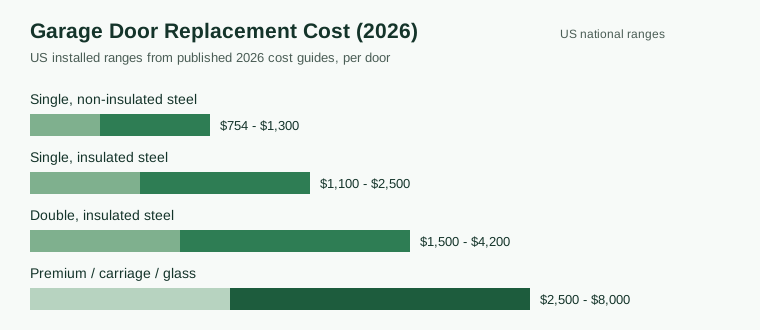
Replacing a garage door in 2026 typically costs $754 to $1,707 per door in the US, with a national average near $1,231. This guide prices single and double doors by material and insulation level, separates the door price from opener, removal and permit lines, works through Rvalue and the attachedgarage energy case, and covers Canada pricing, repairvsreplace math and a quote checklist.
Quick Checks
- 1Budget $754 to $1,707 per door installed in the US in 2026. Angi puts the national average at $1,231 from more than 15,000 verified projects, with specialty work pushing toward $8,000.
- 2Size and insulation move the price more than brand. A single non-insulated steel door sits at the bottom of the range. A double insulated door, or a carriage or glass design, sits at the top.
- 3Insulated doors run $1,100 to $4,200 installed in Angi data. Manufacturers rate garage doors from R-0 to about R-20. The jump matters most on an attached garage, and most of all where living space sits above the garage.
- 4The opener is a separate line. Budget $300 to $900 installed for a new opener in published guidance, $200 to $500 for labour alone on the door, $50 to $200 for old-door removal when it is not included, and $40 to $120 for a permit when one is required.
- 5In Canada, HomeStars puts a single door at $1,000 to $5,000 installed with $2,500 typical, and a double at $2,500 to $6,500. Insulated steel is the standard pick for freeze-thaw winters.
- 6Do not price a new door before the cheap test. A bottom seal, perimeter weatherstripping and, on a sound metal door, an R-8 insulation kit near $184 can fix a large share of draft and cold complaints for a fraction of replacement cost.
Garage Door Replacement Cost 2026: What Installation Really Costs
By EnergyBS Editorial Team | October 7, 2026
The Short Answer
Short Answer: A garage door replacement costs $754 to $1,707 per door installed in the US in 2026, and the national average sits near $1,231. Angi bases that figure on 15,434 verified projects. HomeGuide's installer guidance lands in the same neighbourhood from the other direction: $550 to $1,300 installed for a single door and $800 to $1,800 for a double, with the door itself at $400 to $1,100 and labour at $150 to $700. Premium materials, glass, carriage designs and custom sizes push the top of the market toward $8,000, and a three-car layout with three single doors can reach $7,200 before openers. The spread is not noise. It is size, material and insulation, priced in that order.
A garage door is the largest moving surface on most houses and, on an attached garage, one of the largest single pieces of the thermal boundary. Buyers tend to price it as a curb-appeal purchase. This guide prices it as both: what the installed figure covers, how material and insulation change the bill, where the opener and removal lines hide, how much energy an insulated door can and cannot save, and the repair work that often beats replacement. It starts where a good installer starts, with the checks that tell you whether you need a door at all.
1. Repair, Seal, or Replace: The Order That Saves Money
A garage door fails in four distinct ways, and only one of them needs a new door.
Air leakage comes first because it is the cheapest fault to fix. A hardened bottom seal, split perimeter weatherstripping and a threshold that no longer meets the slab will draft on a door that is otherwise sound. Those parts are consumables. A replacement bottom seal and a set of jamb seals are tens of dollars in parts and an hour of work, and they are the correct first move on any door that still runs true. Run a hand along the closed door on a windy day, or check for daylight at the corners. Light and moving air at the edges point to sealing. A cold panel face with sealed edges points to insulation, which is section 6.
Operation comes second. A door that binds, shudders or sits crooked in the opening is usually a hardware problem: worn rollers, a bent track section, frayed lift cables or a door that has come out of balance. Published repair guidance puts common fixes in the low hundreds: spring replacement in the $120 to $350 range, cables at $80 to $185, track work at $125 to $400 and opener repair at $75 to $300. Those are service calls, not replacement triggers, and section 8 works through the full repair ledger.
Panel damage is the judgement call. A single dented or cracked section on a current-production door can often be replaced on its own. A door whose sections are rusting through at the bottom rail, delaminating, or warping enough that the seals cannot meet is a different case, because the next section is usually in similar shape. Age matters here. Doors last 15 to 30 years in published guidance, openers 10 to 15 years, and springs 7 to 14 years or roughly 10,000 to 15,000 cycles. A 20-year-old door that needs a panel, a spring pair and an opener in the same year is telling you something about the next five years as well.
Safety decides immediately. Torsion springs and lift cables store enough energy to cause serious injury, and a door with a broken spring, a snapped cable or a failed safety sensor system is not a wait-and-see item. The door should stay closed and the work should go to a professional. That is not sales language. Angi and HomeGuide both flag spring work as the part of this trade that should not be a do-it-yourself project, and the installed prices in this guide assume professional fitting for the door itself.
Replace the door when the sections have failed across more than one panel, the frame or tracks are damaged beyond a section-level repair, security hardware can no longer anchor into sound material, or the repair ledger for the next few years approaches half the cost of a basic new door. Seal, service and insulate when the door runs true and the complaint is air, noise or temperature. That order, seal then service then replace, is the cheapest diagnostic path in this guide.
2. What the Installed Price Covers
A standard professional replacement, as US and Canadian installers describe the scope, normally includes measuring the opening, removing the old door and tracks, setting the new sections and hardware, fitting new springs sized to the door weight, balancing the door, reconnecting the existing opener, and fitting the bottom seal and perimeter weatherstripping. Disposal of the old door is included by many installers and billed separately by others at $50 to $200, so it belongs on the quote as an explicit line either way.
Five items sit outside the base scope often enough that each one needs a written answer before work starts:
- The opener. A replacement door reuses a working opener. A new opener is a separate purchase at $300 to $900 installed in HomeGuide guidance, with the unit at $150 to $500 and labour at $150 to $400. Section 5 prices the drive types.
- Structural repair. Rot, water damage or a damaged frame found when the old door comes out adds $155 to $380 in Angi data for the repair work itself, before the door price moves.
- Permits. A permit runs $40 to $120 where one is required. Most like-for-like replacements need none. Changing the opening size, adding an opening or removing a pedestrian door to fit a wider door is what triggers the requirement.
- Electrical work. A new opener outlet, relocated lighting or wiring for smart controls is electrician time, and a home adding an automatic opener where none existed may need a circuit run to the ceiling.
- Windows and decorative hardware. Glass lites, window inserts and carriage hardware are priced as options on most doors. Angi puts customization work from $800 for minor upgrades to well past $10,000 on elaborate projects, and security add-ons such as keypads and smart locks at $200 to $1,200.
One bundling note. Replacing two single doors on one visit, or pairing a door with opener and track work, spreads the setup and disposal trip across more hardware. It does not change the per-door price much, and a bundled quote should still price each opening as its own line so the numbers can be compared against a single-door quote from another installer.
3. Price by Size: Single, Double and Multi-Door Layouts
Size is the first multiplier. A single-car door is the standard 7 to 10 feet wide by 7 to 8 feet tall opening found on most one-car garages. A double door covers a two-car opening, usually 16 to 18 feet wide, in one wide unit with heavier springs and a stronger opener. Two singles in the same two-car garage are two complete doors, two spring sets and often two openers.
Angi's 2026 size table, per door installed, runs as follows:
| Layout | Installed range, US | What drives it |
|---|---|---|
| One-car, single door | $500 to $3,000 | Material and insulation pick most of the range |
| Two-car, one double door | $800 to $5,000 | One wide unit, heavier springs, stronger opener |
| Two-car, two single doors | $1,200 to $4,900 | Two doors, two hardware sets, often two openers |
| Three-car, double plus single | $1,400 to $7,000 | The double sets the spring and opener spec |
| Three-car, three single doors | $1,700 to $7,200 | Three installations in one project |
The width of each band is material and insulation, which sections 4 and 6 price separately. Read the table as the envelope and the next two sections as the dials inside it. A basic single steel door with no insulation sits near the bottom of the first row. The same opening in an insulated carriage design with glass sits near the top.
Two sizing traps show up in quotes. The first is the custom opening. Older garages, laneway garages and converted outbuildings often have openings that are not a current stock size, and a made-to-measure door costs more than a stock door in the same material regardless of configuration. The second is headroom. Low-headroom track hardware exists and works, but it is a specific hardware pick that should be named on the quote, not discovered on installation day. Measure the opening width, height, side room and headroom before the site visit and give those numbers to every installer quoting the job, so the quotes describe the same door in the same hole.
4. Price by Material: Steel, Wood, Aluminum, Fiberglass and Glass
Material sets the door price, the maintenance cycle and a large part of the weight the springs and opener have to move. Angi's 2026 per-door ranges by material, before size and insulation move them, run as follows:
| Material | Price per door, US | Notes |
|---|---|---|
| Steel | $650 to $3,200 | The default pick. Widest range of insulation and finish options |
| Aluminum | $600 to $2,900 | Light, rust resistant, dents more easily than steel |
| Vinyl | $800 to $2,500 | Low upkeep, limited colour and design range |
| Fiberglass | $800 to $2,700 | Resists dents and salt air, can fade over time |
| Wood composite / faux wood | $650 to $4,800 | Carriage looks without solid-wood upkeep |
| Wood | $900 to $4,500 | Real timber, highest maintenance, refinishing cycle applies |
| Glass | $2,500 to $8,000 | Full-view modern designs, lowest insulation per dollar |
Door style multiplies material. Sectional doors, the standard up-and-over design on tracks, run $500 to $1,800 in Angi data. Carriage house designs run $1,200 to $8,000, French doors $2,000 to $6,000, and roll-up doors $600 to $3,000. Style is largely a curb-appeal purchase, and it should be priced as one: the same budget moved from style to insulation buys measurable comfort on an attached garage, while the same budget moved from insulation to style buys a look. Neither is wrong. They are different purchases and a good quote keeps them on separate lines so the buyer can see the trade.
Weight is the material fact with operating consequences. A heavier door needs springs rated for that weight and cycle count, and an opener rated to lift it. Under-specified springs are the false economy in this trade: they cost less at purchase and fail early, and a spring failure on a heavy door is the dangerous kind. Where a quote is well below two competing quotes on the same door, the spring cycle rating and the steel gauge are the first two lines to compare.
5. The Opener: A Separate Purchase With Its Own Price Ladder
Many replacement doors reuse a sound opener, which is why the door prices above do not include one. When the opener is replaced as well, HomeGuide puts the installed total at $300 to $900, with the unit at $150 to $500 and labour at $150 to $400. The drive type sets most of the unit price:
| Drive type | Unit price guide | Character |
|---|---|---|
| Chain drive | $150 to $250 | Cheapest, proven, the noisy option |
| Belt drive | $200 to $450 | Steel-reinforced belt, quiet, the usual pick under a bedroom |
| Screw drive | $200 to $500 | Rotating rod, quiet, few moving parts |
| Direct / wall-mount drive | $300 to $500 | Motor at the shaft, frees the ceiling, top of the range |
Angi frames the automatic upgrade at $200 to $1,300 over a manual door once smart features and any new wiring are counted. The smart end of that range buys app control, battery backup and camera or keypad options, which Angi also prices inside the $200 to $1,200 security add-on band. None of that is required for the door to work. The functional floor is a correctly sized opener with working safety sensors and auto-reverse, and those safety items are the lines to confirm on any quote.
Two opener decisions interact with the door decision. The first is noise. A chain drive under a living space or bedroom transmits vibration that a belt drive largely avoids, and the price gap between the two is small against a door project. The second is sizing. An opener chosen for the old, lighter door may be undersized for a heavier insulated replacement, and a strained opener wears its gear set early. The door weight and the opener rating belong in the same conversation, which is another reason the door and opener lines should be quoted together even when they are priced separately.
Openers last 10 to 15 years in published guidance. A door project landing near the end of an opener's life is the natural moment to replace both on one visit, at one labour trip, rather than paying a second call-out the following winter.
6. Insulation and R-Value: What the Energy Case Actually Is
This is the section that puts a garage door on an energy site, and it needs to be stated plainly: a garage door is not a wall, and an insulated garage door does not pay for itself the way attic insulation does. What it does is narrow the temperature swing in the garage, and on an attached garage that protects the rooms that share a wall or a ceiling with it. The comfort effect is large and immediate. The bill effect is real, smaller, and hard to promise as a percentage, because it depends on how the garage is used and whether any part of it is heated.
Manufacturers rate garage doors by R-value from 0 to about 20. The construction behind the number matters more than the number itself:
- Single-skin steel or wood, no insulation: effectively R-0 to R-1. The panel is a weather surface, not a thermal one.
- Polystyrene core: roughly R-4 to R-9. Board insulation fitted between steel skins. Cheaper, lighter, and the usual entry point for an insulated door.
- Polyurethane core: roughly R-12 to R-18 and above. Foam injected between skins, denser, more rigid, and the construction behind the high-R residential doors.
Angi puts insulated doors at $1,100 to $4,200 installed, against the $754 to $1,707 typical band for a standard replacement. Read together, the insulation upgrade on a single door is a few hundred dollars at the modest end and over a thousand at the high-R end, before style options enter the quote.
The right target depends on the garage, not the brochure:
- Detached, unheated, parking and storage only: insulation is a comfort and noise purchase. A modest R, or none, is a defensible pick, and the money may do more work elsewhere in the house.
- Attached, unheated: the door is a large cold surface next to heated rooms. A mid-range insulated door, roughly R-9 to R-13, with sound seals, holds the garage measurably closer to house temperature and takes load off the shared wall.
- Living space above the garage, or a heated workshop: treat the door as part of the house envelope. High-R polyurethane construction, a thermal break and careful sealing are the correct spec, and our guide to the cold room above a garage covers the ceiling and air-sealing half of that problem, which matters as much as the door.
That last point deserves emphasis. Heat moves through the garage ceiling into the room above, and through the shared wall, by conduction and by air leakage. A high-R door fitted into a leaky opening, above an uninsulated ceiling, improves one term of the problem. The air-sealing work in our air sealing guide for old homes and the R-value comparisons in insulation types compared are the companion reads, because the door performs to the level of the opening it sits in.
One rating caution. The published R-value describes the door section as tested, usually at the centre of a panel. The installed assembly includes joints between sections, the window lites if any, and the perimeter seal, all of which conduct more heat than the panel centre. Compare doors by construction and whole-door ratings where a manufacturer publishes them, and treat a centre-panel number as a guide to the class of door, not a promise about the opening.
7. The Retrofit Alternative: Insulate and Seal the Door You Have
A sound, uninsulated metal door does not have to be replaced to be improved. Two retrofit moves cover most of the benefit at a small share of the replacement price.
The first is sealing, covered in section 1: a new bottom seal, perimeter weatherstripping and a threshold where the slab needs one. This is the highest-value work in this entire guide per dollar spent, because air leakage at a 100-plus square foot opening dwarfs the conduction through the panel at mild temperature differences.
The second is a panel insulation kit. The Owens Corning garage door kit at The Home Depot, eight vinyl-faced fiberglass panels sized 22 by 54 inches for a single metal door, is rated R-8 and listed at $184.30. Comparable foam-board kits sit lower in both price and R-value, in the $60 to $150 range for a single door in current retail listings, and a double door needs two kits. The limits are real: kits fit metal doors with open panel channels, they add weight that the springs were not balanced for, and they do not add the rigidity or the finished interior face of a factory insulated door. The weight point is the one to respect. Added panels change the balance, and a door that the opener strains to lift after a kit goes in needs a spring adjustment by a professional, not a stronger opener setting.
Worked comparison, with the assumptions stated. Take a single attached garage in a cold climate with a sound, uninsulated steel door. Option A is sealing alone, at parts cost in the tens of dollars. Option B is sealing plus an R-8 kit at roughly $184 in parts. Option C is replacement with a mid-range insulated steel door at roughly $1,500 to $2,500 installed inside the Angi band. Options A and B address air leakage and most of the panel conduction. Option C adds rigidity, a finished interior, new hardware, new springs and a warranty, and removes a 15-to-30-year-old door's remaining-life risk. The energy difference between B and C is the smallest part of that list, which is why replacement should be argued on condition, safety and function first, and energy second. A buyer told the opposite, that a new door pays for itself on the heating bill, is being sold a number the physics does not support on an unheated garage.
8. Repair vs Replace: The Ledger
Replacement is one way to spend money on a garage door. The repair ledger, from the published guidance used throughout this guide, prices the other way:
| Work | Published range, US |
|---|---|
| General repair call | $125 to $350 average |
| Spring replacement | $120 to $350 |
| Spring repair | $40 to $80 |
| Cable repair | $80 to $185 |
| Opener or chain repair | $75 to $300 |
| Track replacement | $125 to $300 |
| Track repair and alignment | $125 to $400 |
| Sensor alignment and repair | $85 to $200 |
| Roller and bracket repair | $80 to $200 |
| Opener replacement, installed | $300 to $900 |
| Old door removal, when billed | $50 to $200 |
| Structural repair found at install | $155 to $380 |
The working rule in the trade is the same one used for the entry doors in our entry door replacement cost guide: when the needed repairs approach half the cost of a basic replacement, and the door is in the back half of its 15-to-30-year life, replacement is usually the better spend, because the remaining repairs are already visible on the horizon. A 7-year-old door with a broken spring is a repair. A 22-year-old door needing springs, rollers, a panel and an opener in the same season is a replacement wearing a repair costume.
Two exceptions cut the other way. Cosmetic damage on a young, current-production door is a panel-level repair and should stay one. And a door with sound sections on a house being prepared for sale may still justify replacement on curb appeal, since the garage door is a large share of the front elevation. That is a resale argument, not an energy argument, and it should be made as one.
9. Canada Pricing
Canadian pricing runs higher in nominal dollars and puts more weight on insulation. HomeStars' 2026 Canada guide puts a single door at $1,000 to $5,000 installed, with $2,500 as the typical spend, and a double door at $2,500 to $6,500, with the larger panel, heavier springs and stronger opener scaling with the opening. By door type for a single door installed, HomeStars lists non-insulated steel at $1,000 to $1,800, insulated steel at $1,500 to $4,000, wood composite at $2,500 to $4,500, aluminum and glass at $2,500 to $7,000, and solid wood or custom designs at $3,500 to $10,000. Labour is priced per door at $350 to $700, often folded into the door price, and low-headroom, masonry or tight laneway work pushes toward the top of that band.
The Canadian buying pattern follows the climate. Steel is the standard pick for freeze-thaw winters because it handles the cycles with little upkeep. Fiberglass and vinyl earn their place near busy streets and in coastal areas by resisting dents and road salt. Insulation is close to a default on an attached garage at Canadian winter temperatures, for the same reason as in section 6 with the volume turned up: the shared wall and any room above the garage sit next to a very large, very cold surface for five months of the year.
As with the US figures, treat these as planning ranges for a standard opening in sound condition. Custom heights for tall vehicles add a premium over a stock door in the same material, and converting one double opening to two singles, or the reverse, adds framing and finishing work on top of the door prices.
10. Lifespan, Maintenance and Ownership Cost
A garage door is a 15-to-30-year purchase with a maintenance schedule:
- Springs are the wear item at 7 to 14 years, or roughly 10,000 to 15,000 cycles. At four cycles a day, the low end of that range arrives in about seven years. High-cycle springs cost more at fitting and last proportionally longer, and they are the upgrade that pays on a door that opens many times a day.
- Openers run 10 to 15 years. The safety sensors and auto-reverse should be tested whenever the door is serviced, and a failing sensor pair is a repair, not an inconvenience to work around.
- Seals are consumables on a shorter cycle than any of the above. The bottom seal and jamb seals harden, split and stop sealing years before the door itself is done, and replacing them is the maintenance item that protects the insulation investment.
- Finishes decide the steel and wood maintenance split. Factory-finished steel needs washing and a check for chips that expose the skin. Wood needs its finish maintained on the cycle the manufacturer states, and a wood door whose finish lapses degrades from the surface in.
Ownership cost over 20 years is therefore the installed price, one spring replacement in most cases, possibly one opener, and a few sets of seals. Priced against the repair table in section 8, a mid-range door's 20-year ledger commonly adds $600 to $1,200 of service to the purchase price. A quote comparison that ends at the installed figure misses that schedule, which is why the spring cycle rating belongs on the quote in writing.
Safety belongs in this section too. The door is the heaviest moving object in most houses. The professional installation premium, labour at $200 to $500 in Angi data when priced separately, buys correct spring sizing, balanced operation and tested safety systems. Preparation work a homeowner can usefully do is clearing the garage and driveway, confirming the opening measurements, and moving stored items away from the work area. The door fitting itself, and any spring work at any point in the door's life, should stay with a professional installer.
11. How to Compare Quotes: A Checklist
Quotes for the same opening can sit far apart while describing different doors. These lines force the comparison onto the same scope:
- Door size, in feet and inches, and whether the price assumes a stock size or a made-to-measure unit.
- Material, steel gauge where applicable, and construction: single-skin, polystyrene core or polyurethane core.
- The R-value as published for the door, and whether that figure is a centre-panel or whole-door rating.
- Window lites and decorative hardware, priced as options or included.
- Spring type and cycle rating, in writing. This line decides how soon the first major repair arrives.
- Tracks and rollers: new, or reused from the old door, and headroom hardware where the ceiling is low.
- Opener: reused, repaired, or new, with the drive type and rating named if new.
- Bottom seal, jamb seals and threshold: included, and which seal profile.
- Old door removal and disposal: included or billed, and at what figure.
- Structural repair allowance: what happens to the price if rot or frame damage appears when the old door comes out.
- Permit: required or not in your municipality, and who pulls it.
- Warranty split: door sections, finish, springs, opener and labour, each with its term.
- Balance and safety test at completion: door balanced by hand, auto-reverse and sensor test demonstrated before final payment.
A quote missing lines 2, 5 and 9 is not yet comparable to one that has them. The cheapest complete quote, on the same door with the same spring rating, is the one to buy.
Frequently Asked Questions (FAQ)
How much does it cost to replace a garage door in 2026?
Most US homeowners pay $754 to $1,707 per door installed, with a national average near $1,231 in Angi's 2026 data from 15,434 verified projects. A basic single steel door sits near the bottom. An insulated double, a carriage design or a glass door pushes toward $5,000 to $8,000. In Canada, HomeStars puts a single door at $1,000 to $5,000 installed with $2,500 typical, and a double at $2,500 to $6,500.
Is an insulated garage door worth the extra cost?
On an attached garage, usually yes, priced as comfort first and energy second. Insulated doors run $1,100 to $4,200 installed in Angi data. A polyurethane-core door at R-12 to R-18 holds an attached garage closer to house temperature, protects the shared wall and any room above, and runs quieter and more rigid than a single-skin door. On a detached, unheated garage used for parking only, the same upgrade is a comfort purchase and a modest R or no insulation is a defensible pick.
What R-value should I choose?
Match the garage, not the brochure. A detached unheated garage needs little. An attached unheated garage does well at roughly R-9 to R-13 with sound seals. A garage with living space above it, or a heated workshop, should be treated as house envelope, where R-12 to R-18 polyurethane construction and careful sealing are the correct spec. Compare whole-door ratings where published, since a centre-panel figure overstates the installed assembly.
Can I insulate my existing garage door instead of replacing it?
Yes, if the door is sound and runs true. Panel kits for a single metal door include an R-8 vinyl-faced fiberglass kit listed at $184.30 at The Home Depot, with foam-board kits lower in price and R-value, and a double door needs two kits. Seal the perimeter first, since air leakage is usually the larger loss. The kit adds weight, so a door the opener strains to lift afterwards needs a professional spring adjustment.
How long do a garage door, opener and springs last?
Published guidance puts doors at 15 to 30 years, openers at 10 to 15 years, and springs at 7 to 14 years or roughly 10,000 to 15,000 cycles. Seals wear faster than all three and should be replaced when they harden or split. A repair plan that ignores the spring clock is how a cheap year turns into an emergency call.
Should I replace the opener at the same time as the door?
If the opener is sound and correctly sized for the new door's weight, reuse it. If it is past 10 years old, noisy under a bedroom where a belt drive would run quiet, or undersized for a heavier insulated door, replacing both on one visit saves a second labour trip. A new opener runs $300 to $900 installed in HomeGuide guidance.
Do I need a permit to replace a garage door?
Most like-for-like replacements need no permit. Angi puts the permit at $40 to $120 where one is required, which is usually when the opening changes size, a new opening is cut, or a pedestrian door is removed to fit a wider door. Your installer will normally pull it. Confirm the requirement with your municipality before work starts.
What should I read next before deciding?
If the garage sits under a bedroom, read our guide to the cold room above a garage for the ceiling and sealing half of the job. For the other large openings in the envelope, compare this guide with entry door replacement costs and window replacement costs, and price the sealing work itself in our air sealing guide.
Prices in this guide are planning ranges from the published 2026 sources cited above, not quotes for your opening. Door size, material, insulation construction, spring rating, opener condition, structural repairs, permits and local labour decide the final figure. Get itemized written quotes on the same scope, confirm the spring cycle rating and warranty terms in writing, and have spring and door fitting work done by a professional installer.
What to Read Next
Entry Door Replacement Cost 2026: What It Really CostsUse this next to compare the cost, incentive, installation, or operating-risk angle before you make a home energy decision.Sources and Verification
- Angi How Much Does a Garage Door Replacement Cost? [2026 Data] (national average and installed ranges by material, size and insulation from 15,434 verified projects, updated September 21, 2026)
- HomeGuide Garage Door Installation cost guidance (single $550 to $1,300 and double $800 to $1,800 installed ranges, door prices $400 to $1,100 and labor $150 to $700, plus repair and lifespan figures in HomeGuide installer guides)
- HomeStars Garage Door Installation Cost in Canada: 2026 Guide (single $1,000 to $5,000 installed with $2,500 typical, double $2,500 to $6,500, labour $350 to $700 per door in Canada)
- The Home Depot Owens Corning Garage Door Fiberglass Insulation Kit GD01 (R8 vinylfaced kit for a single metal door, listed at $184.30, 8 panels 22 in. x 54 in.)
Editorial Review
EnergyBS Editorial Team
EnergyBS publishes practical homeowner guides. Important program, product, and cost claims should be checked against the linked source and local project documents before you commit to work.
Related Guides
View All ArticlesEntry Door Replacement Cost 2026: What It Really Costs
Replacing a single entry door in 2026 typically costs $500 to $2,500 installed in the US, with most projects landing near $1,218. This guide prices doors by material, separates slab work from a full prehung system, explains where frame damage changes the job, and works through the energy side: Ufactor, glass share, and the point where weatherstripping beats replacement.
Window Replacement Cost 2026: What Installation Really Costs
Replacing house windows in 2026 averages $517$800 per installed window in the US (C$600C$2,000 in Canada). This guide breaks down frame materials, insert vs. fullframe pricing, glass packages, overlooked costs, and a payback check with stated assumptions.
Cold Room Above the Garage 2026 Guide & Data
Fix a cold or hot bonus room by mapping all six enclosure sides, isolating garage pollutants, aligning floor insulation with the subfloor, repairing kneewalls and ducts, and measuring the result.