Propane Tank Installation Cost 2026: What Installation Really Costs
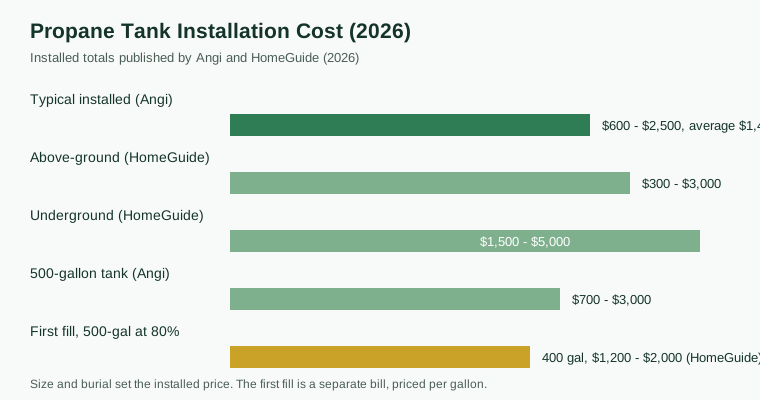
A propane tank installation averages about $1,400 in Angi's 2026 data, with most homeowners paying $600 to $2,500 for the tank and its installation. HomeGuide prices the same work by placement: $300 to $3,000 installed above ground, and $1,500 to $5,000 buried, because excavation and trenching replace the concrete pad. Tank size is the first price driver (a 250gallon tank runs $500 to $1,000 and a 500gallon tank $700 to $3,000 in Angi's size table), and placement rules are the second: most 125to500gallon tanks sit at least 10 feet from buildings and ignition sources under NFPA 58, which sets the length of the gas line you pay for at $15 to $25 per linear foot. This guide reconciles the two national datasets, prices the pad, line, permit and removal lines separately, works through sizing and the 80 percent fill rule, compares buying against leasing from a supplier, and closes with the Canadian supply model, where tanks are usually placed under a fuel agreement and the install is governed by CSA B149 codes.
Quick Checks
- 1Budget about $1,400 for a typical propane tank installation (Angi 2026 average, most jobs $600 to $2,500). HomeGuide splits the same market by placement: $300 to $3,000 above ground, $1,500 to $5,000 buried.
- 2Size sets the tank price: 250 gallons runs $500 to $1,000 and 500 gallons runs $700 to $3,000 in Angi's table. The 500-gallon size is the standard whole-home heating tank in both datasets.
- 3Placement is a cost line, not just a rule. Most tanks in the 125-to-500-gallon range sit at least 10 feet from buildings and ignition sources, and every foot of that distance is gas line at $15 to $25 per linear foot (Angi).
- 4The first fill is a separate bill. Tanks fill to 80 percent of stated size, so a 500-gallon tank takes about 400 gallons: $1,200 to $2,000 at HomeGuide's $3 to $5 per gallon fill range.
- 5Leasing from the supplier cuts the upfront cost (HomeGuide renting at $25 to $150 or more per year; Angi rental at $150 to $180 per year) but locks you to that supplier's per-gallon price. Buying at $1,000 to $2,000 (Angi) leaves you free to shop for fuel.
- 6In Canada the tank usually arrives under a supply agreement rather than as a purchase. Ontario installs follow CSA B149.1 and B149.2 under the TSSA, with the same 10-foot clearances and a 100-foot limit from tank to delivery truck.
Propane Tank Installation Cost 2026: What Installation Really Costs
By EnergyBS Editorial Team | October 19, 2026
The Short Answer
Short Answer: A propane tank installation averages about $1,400 in Angi's 2026 data, with most homeowners paying $600 to $2,500 for the tank and its installation. HomeGuide prices the same job by placement: $300 to $3,000 installed above ground and $1,500 to $5,000 installed underground. The tank itself runs $500 to $1,000 for 250 gallons and $700 to $3,000 for 500 gallons in Angi's size table. Permits add $25 to $150 (Angi) and the gas line from tank to house averages $540 on its own in Angi's gas line data. The first fill is not in any of those figures: a 500-gallon tank fills to about 400 gallons, which is $1,200 to $2,000 at HomeGuide's $3 to $5 per gallon fill range.
Propane is the heating fuel of homes the gas main does not reach, and the tank is the piece of infrastructure that makes it work like a utility. A furnace, boiler, water heater or generator draws from it, a truck refills it on a route, and the installation has to satisfy placement rules that were written around a fuel that is heavier than air and pools low when it leaks. That is why this guide spends as much time on distances and delivery access as on prices. On a propane job, the site decides the quote: the same 500-gallon tank is a pad, a short line and an afternoon of labor on one lot, and an excavation, a 60-foot trench and a permit file on another.
1. First Decision: Buy the Tank or Take the Supplier's Tank
Every other propane cost guide treats installation as a purchase. In practice there are two transactions, and they price differently.
You buy the tank. Angi puts the purchase budget at $1,000 to $2,000 for a homeowner buying a tank, inside its size table above. You own the asset, you pay for maintenance and the annual inspection ($50 to $75 a year in both datasets), and you can buy propane from any supplier who will fill a customer-owned tank. That freedom is the economic point of buying: the per-gallon price is the largest cost in a propane system over any five-year window, and owners can shop it.
The supplier places its tank. The propane company installs a tank it owns, often for a low install charge or as part of the supply agreement, and charges rent: $25 to $150 or more per year on HomeGuide's figures, $150 to $180 per year on Angi's. Maintenance and compliance sit with the supplier. The trade is lock-in. A leased tank can only be filled by the company that owns it, so your per-gallon price is that company's price, and leaving early can carry a termination fee of $100 to $250 (HomeGuide) plus a pump-out or removal charge.
Neither route is the right one in general. Section 8 runs the two routes side by side on published figures. What matters at quote stage is that the two quotes are not comparable until each one states the same four things: who owns the tank, what the install itself costs, what the rent (if any) is per year, and what the first-year per-gallon price is. A free install at a high per-gallon price is a financing arrangement, not a discount.
2. Cost by Tank Size
Angi publishes tank prices by capacity. Two readings of this table matter: the jump from appliance sizes to heating sizes, and how wide the 500-gallon band runs.
| Tank size | Average price (Angi) | What it usually runs |
|---|---|---|
| Under 100 gallons | $35 to $300 | Grill and small appliance cylinders |
| 100 gallons | $350 to $500 | One or two appliances |
| 120 gallons | $400 to $800 | Water heater or a cooktop (HomeGuide) |
| 250 gallons | $500 to $1,000 | Supplemental heat or two appliances |
| 500 gallons | $700 to $3,000 | Whole-home heating |
| 1,000 gallons | $1,500 to $5,500 | Large homes, all-propane homes |
The uses column blends Angi's sizing context with HomeGuide's refill table, which assigns the 120-gallon size to a water heater or small appliance, the 250-gallon size to supplemental heating or two appliances including a water heater, generator or pool heater, the 500-gallon size to home heating or two to three appliances, and the 1,000-gallon size to heating larger homes or homes with every appliance on propane. Section 5 works the sizing properly, from usage rather than from the tank catalog.
The 500-gallon band, $700 to $3,000, looks like an error until you split it. The low end is the tank as a purchased unit in a competitive market. The high end is where the size table absorbs placement: a 500-gallon tank bought for burial is built and coated for underground service and priced accordingly, and Angi's placement table (section 3) puts underground tanks at $1,500 to $5,500 against $400 to $3,500 above ground across the 100-to-1,000-gallon span.
One labeling risk both sources flag: small tanks are sold by the pound and large tanks by the gallon, and some mid-size tanks carry both labels. Angi's pound table prices a 420-lb tank at $400 to $800, the same band as its 120-gallon line, because a 420-lb cylinder and a 120-gallon tank are near-equivalent vessels (a gallon of propane weighs a little over four pounds). A quote that lists a 420-lb tank is not quoting a small grill cylinder. Check which unit the quote uses before comparing it to anything in this table.
3. Above Ground or Underground
This is the largest single fork in the installed price.
| Above ground | Underground | |
|---|---|---|
| Total installed (HomeGuide) | $300 to $3,000 | $1,500 to $5,000 |
| Tank range (Angi) | $400 to $3,500 | $1,500 to $5,500 or more |
| Site work | Concrete pad, $75 to $200 (HomeGuide) | Excavation and trenching, $500 to $1,000 (HomeGuide) |
| Gas line connection (HomeGuide) | $75 to $300 | $300 to $700 |
Angi states the premium directly: an underground installation costs $1,100 to $4,700 more than an aboveground one. Its underground line items explain where that premium sits: excavation at $500 to $2,400, trenching at $400 to $1,200 per 100 linear feet, plumbing labor at $45 to $200 per hour, and the gas line itself at $120 to $1,350. HomeGuide prices excavation by the machine instead, at $100 to $300 per hour for an excavator and operator, and excavation in Angi's prep section runs $50 to $200 per cubic yard. Different units, same story: burial is bought by the hour and by the yard, not by the tank.
What the premium buys is a yard with no visible tank, and a vessel that sits at steadier temperatures. What it costs beyond the install is access. An aboveground tank can be inspected, serviced and removed with hand tools and a truck. A buried tank needs its dome and fittings kept accessible, its corrosion protection maintained, and a machine on site again the day it comes out (section 7 prices removal and relocation for both placements). Angi also notes the siting case that overrides preference entirely: in flood-prone areas, aboveground is the recommended placement.
For most homes adding propane heat, aboveground on a pad is the default for a reason. The installed band tops out where the underground band is just getting started, and nothing about the fuel delivery, the appliance supply or the running cost improves with burial. Burial is a landscaping purchase. Price it as one, and it can still be worth making, but it should be made with the $1,100 to $4,700 premium visible as its own line.
4. The Cost Stack: Where the Money Goes
HomeGuide publishes the full breakdown for both placements. Read it with its labor text, because the two describe different scopes and the difference is a common source of quote confusion.
| Cost line | Above ground | Underground | Source |
|---|---|---|---|
| Tank | $50 to $2,000 | $500 to $2,500 | HomeGuide |
| Installation labor (breakdown table) | $100 to $500 | $200 to $800 | HomeGuide |
| Installation labor (full scope, text) | $250 to $1,000 | $1,000 to $2,500 | HomeGuide |
| Concrete pad | $75 to $200 | n/a | HomeGuide |
| Gas line connection | $75 to $300 | $300 to $700 | HomeGuide |
| Excavation / trenching | n/a | $500 to $1,000 | HomeGuide |
| Permits | $25 to $50 | $25 to $50 | HomeGuide |
| Permits (Angi range) | $25 to $150 | $25 to $150 | Angi |
| Total installed | $300 to $3,000 | $1,500 to $5,000 | HomeGuide |
The breakdown table's labor line is the set-and-connect work: place the tank, make the connections, test the system. The text's labor figures are the full job as contractors bill it. Aboveground, the $250 to $1,000 range includes pouring the pad, running the gas lines and setting the tank. Underground, the $1,000 to $2,500 range includes the excavation, the gas line trenching and the set. A quote whose labor line matches the small table figure while its total matches the large one has the excavation and line work billed somewhere else. Find out where before signing, because that somewhere is where change orders live.
The pad deserves its own sentence because it is the line most often quoted loosely. HomeGuide allows $75 to $200 for the pad in the breakdown and $5 to $10 per square foot for a new concrete slab as a separate rate. Angi prices pads by tank size: $50 to $75 for a 120-gallon tank, $75 to $125 for 250 gallons, $125 to $175 for 500 gallons, at $4 to $25 per square foot depending on thickness. All three describe the same small slab. If a quote shows $600 for a pad, it is pricing something else, usually the gravel bed, grading and access work around it, and it should say so.
The gas line is priced two ways in the sources, and both are useful. As a connection inside a tank job, HomeGuide allows $75 to $300 above ground and $300 to $700 below. As a standalone project, Angi's gas line guide puts the average at $540, most jobs at $260 to $820, with underground line work at $15 to $25 per linear foot, permit fees of $100 to $300 on that project type and a pressure test at $75 to $150. HomeGuide's per-foot rate for gas line in a propane job runs higher, at $15 to $50 or more per linear foot for materials and labor, with trenching at $5 to $12 per linear foot on top where the line is buried separately. The spread between the two per-foot figures is mostly route: a straight run through open soil prices at the low end, and a route with turns, wall penetrations and finished surfaces prices at the high end. Our garage heater cost guide prices the same line from the appliance side, where it appears as the $500 to $800 add-on on gas and propane installs.
5. Sizing the Tank: Usage First, Then the 80 Percent Rule
Tank size is a delivery-interval decision before it is a price decision. A tank that is too small does not fail dramatically. It just needs filling more often, in worse weather, sometimes at expedited prices: HomeGuide lists a standard minimum delivery at $25, an expedited delivery inside three days at $200 extra, and an emergency delivery inside one day at $300 extra, plus a hazmat handling fee of about $10. Undersizing is paid for in February, a few hundred dollars at a time.
Start from usage. HomeGuide's estimator gives a 2,000 sq ft home in a cold climate about 800 gallons a year when the heater and appliances run on propane, and breaks monthly use down by appliance:
| Appliance | Estimated monthly use | Monthly cost at $3 to $5/gal |
|---|---|---|
| Furnace | 80 gallons | $240 to $400 |
| Water heater | 20 gallons | $60 to $100 |
| Fireplace | 16 gallons | $50 to $80 |
| Cooktop | 5 gallons | $15 to $25 |
| Clothes dryer | 5 gallons | $15 to $25 |
Then apply the fill rule: propane tanks are filled to 80 percent of stated capacity, leaving room for the liquid to expand as temperatures change (HomeGuide). Usable capacity is therefore four-fifths of the nameplate, and HomeGuide's refill table is built on exactly that basis:
| Tank size | Usable gallons (80%) | Refill cost at $3 to $5/gal | Typical use |
|---|---|---|---|
| 120 gallons | 96 | $300 to $500 | Water heater or one small appliance |
| 250 gallons | 200 | $600 to $1,000 | Supplemental heat, or two appliances |
| 330 gallons | 264 | $800 to $1,300 | Water heater, stove and dryer together |
| 500 gallons | 400 | $1,200 to $2,000 | Home heating, or two to three appliances |
| 1,000 gallons | 800 | $2,400 to $4,000 | Larger homes, all appliances on propane |
Run the two tables against each other and the standard recommendation explains itself. A cold-climate home burning roughly 800 gallons a year, most of it in five heating months, goes through about 130 to 160 gallons a month at the winter peak. A 250-gallon tank holds 200 usable gallons, which is five to six weeks of peak-season fuel and a delivery schedule with no slack for a missed route or a cold snap. A 500-gallon tank holds 400 usable gallons, roughly a full quarter of winter, which is why it is the default whole-home size in both national datasets and why our furnace replacement guide treats propane furnace quotes and tank size as one conversation. A home adding propane for a generator and a range only, with no heating load, lives comfortably on 120 to 250 gallons, and our standby generator cost guide covers the generator side of that pairing.
6. Placement Rules Set the Route, and the Route Sets the Price
A propane tank cannot go where it looks best. It goes where the code distances allow, and the distance between that spot and the house is a line item at $15 to $25 per linear foot.
The distances most residential installs work under come from NFPA 58, the industry code for propane storage and handling, as summarized by propane suppliers who install to it. Tanks in the 125-to-500-gallon range, the standard residential heating sizes, sit at least 10 feet from any building and at least 10 feet from a source of ignition, and HomeGuide's placement guidance gives the same 10-foot minimum from buildings and ignition sources in most areas. Larger aboveground tanks need more: Foster Fuels, a propane supplier installing under NFPA rules, puts tanks of 1,000 to 2,000 gallons at least 25 feet from the home, while underground tanks up to 2,000 gallons can sit at 10 feet, measured at the access dome. Tanks do not go under overhangs or awnings, and not near mechanical ventilation intakes or direct-vent appliance intakes. Air conditioner compressors count as ignition sources, which surprises homeowners who planned the tank pad beside the condenser.
Three practical consequences follow.
The 10-foot rule is also a line-length rule. A tank placed the minimum distance away, on the same side as the furnace or boiler room, keeps the buried line short. A tank placed for looks at the far side of the lot can double or triple the line run, and at Angi's $15 to $25 per foot for underground line work, a 60-foot route carries $900 to $1,500 of line before the connection work at either end.
Delivery access is a hard constraint, not a courtesy. The tank has to sit within reach of the delivery truck's hose. The Canadian supplier guidance in section 9 puts the maximum at 100 feet from tank to truck, and the same limit appears in US supplier practice. A site that cannot meet it does not get a bigger tank in a worse spot. It gets a different spot, or a smaller tank the route can serve, or no economical install at all.
Local rules sit on top of the code. Permits run $25 to $50 on HomeGuide's figures and $25 to $150 on Angi's, and the permit is where the local fire marshal's or municipality's own setbacks, if any are stricter, get applied. The installer pulls the permit and the inspection verifies the placement. A quote with no permit line on a new tank install is not a saving. It is the inspection step missing, on the one fuel system in the house where the inspection exists for a stated reason.
This is licensed work throughout. Propane tank installation is done by the propane supplier's own crews, by licensed gas fitters, or by plumbers holding the right certification (HomeGuide), and the connection standard is the same one that governs the appliances at the other end of the line, from the boiler to the tankless water heater. There is no DIY version of this job in either dataset, and section 4's pressure test is the step that proves the finished system before fuel goes in.
7. Removal, Relocation and the End of a Tank's Life
Replacement jobs carry a second, smaller job inside them.
| Job | Above ground | Underground / buried |
|---|---|---|
| Old tank removal (Angi, all placements) | $100 to $1,500 across both | included in Angi span |
| Old tank removal (HomeGuide) | $50 to $200 | about $500 |
| Tank relocation (HomeGuide) | $100 to $200 | $1,000 to $1,500 |
| Replacement concrete pad (Angi) | about $200 | n/a |
Angi's wide $100 to $1,500 removal span and HomeGuide's split figures describe the same reality from two angles: unhooking an aboveground tank and hauling it away is a $50 to $200 job, and digging a buried tank out is a machine job that runs to about $500 for removal alone and $1,000 to $1,500 when the tank is moved and reset in a new hole. Two ownership points decide who pays. A supplier-owned tank is the supplier's to remove, and removal terms belong in the supply agreement. A customer-owned buried tank is the homeowner's cost at sale or decommissioning, which belongs in the buy-versus-lease arithmetic in section 8 as a real, if distant, line.
Portable cylinders have their own end-of-life cost, small but recurring: recertification at $40 to $60 every 5 to 12 years depending on the cylinder's manufacture date (HomeGuide). It applies to the under-100-lb world, not to ASME home tanks, but it is the reason an old grill or 100-lb cylinder sometimes cannot be refilled until it has been inspected and restamped.
8. Buy or Lease, Priced on Published Figures
With the install numbers assembled, the ownership comparison can be done without any invented figures. These are hypothetical examples built only from the ranges cited above, over a ten-year hold, for a 500-gallon tank. Change every line to your own quotes before using either total.
Route A: buy. Tank and install at Angi's $1,000 to $2,000 buying budget, call it $1,500 at the middle. Annual inspection at $50 to $75, call it $60, for ten years: $600. Ten-year ownership cost before fuel: about $2,100, plus the buried-tank removal liability later if the tank is underground. In exchange, every gallon for ten years is bought at whatever price you can negotiate among suppliers.
Route B: lease. Install often reduced or folded into the agreement; use $0 for the comparison and note that some agreements do charge an install fee. Rent at Angi's $150 to $180 a year, call it $165, for ten years: $1,650. Maintenance and inspections sit with the supplier. Ten-year cost before fuel: about $1,650, with an exit cost of $100 to $250 if you leave the agreement early (HomeGuide). In exchange, every gallon for ten years is bought at the owning supplier's price, at that supplier's minimum-usage and delivery terms.
The two routes land within a few hundred dollars of each other over a decade, which is the actual finding. The decision is not made on the tank lines at all. It is made on the fuel line: at roughly 800 gallons a year for a heating home (HomeGuide's estimator), a per-gallon difference of $0.25 is $200 a year and $2,000 over the same ten years, larger than every tank figure in this section combined. Owners can chase that difference. Leaseholders cannot, by construction. Buy if you expect to stay, expect to use real volume, and have more than one supplier in delivery range. Lease if the hold is short, the volume is small, or one supplier is the only realistic option anyway, in which case the lock-in costs nothing you could have used.
9. Canada: The Supply Model, CSA Codes, and What to Compare
Canadian propane heating runs on the same hardware and a different commercial shape, and no national Canadian dataset publishes installed purchase prices the way Angi and HomeGuide do for the US. The reason is the shape itself: in the main propane heating regions, the supplier typically places a tank it owns under a fuel supply agreement, so the transaction a Canadian homeowner compares is rent plus per-litre fuel price plus any install charge, not a tank purchase price. Treat any Canadian installed figure that does not name its source with suspicion. Compare quotes on the lines that exist.
The rules those installs follow are published, and Ontario supplier Budget Propane states them plainly. Installations fall under the Natural Gas and Propane Installation Code, CAN/CSA B149.1, and storage and handling under CAN/CSA B149.2. Oversight sits with the Technical Standards and Safety Authority (TSSA) in Ontario and the Regie du batiment du Quebec in Quebec, and municipalities can add rules of their own on top.
The placement numbers match the US pattern closely:
- Torpedo (horizontal) tanks, the main-heat style, from 325 to 1,000 USWG: at least 10 feet from property lines, buildings and ignition sources such as pool heaters and generators, and within 100 feet of where the delivery truck can park for filling.
- A 420-lb vertical cylinder: can be placed right up to a building or near a property line, which is why it is the standard pick for a generator or a small appliance load.
- Smaller tanks under 474 litres: 3 feet (1 m) from a building opening such as a door, window or dryer exhaust, and 10 feet (3 m) from a source of ignition such as an air conditioner or heat pump.
- The buried line and base: the gas line runs a minimum of 18 inches below grade, and the tank sits on a firm base such as gravel or concrete pads, the same pad line priced in section 4.
For a Canadian quote, the checklist translation is direct: get the tank size in USWG or litres, the annual rent, the install charge if any, the per-litre price and how it is set (fixed, capped or floating), the minimum annual volume if the agreement carries one, and the removal and termination terms in writing. Those six lines are the Canadian equivalent of the US cost stack, and two quotes can be compared on them completely.
10. The Running-Cost Context: Why Tank Size Gets Decided in October
The installation is a one-time bill. The reason to get the size and the ownership route right is the recurring one, and the current outlook frames it well. In its 2026-27 Winter Fuels Outlook, released October 6, 2026, the U.S. Energy Information Administration expects households heating mainly with propane to spend about 3 percent less this winter than last, with natural gas households at -9 percent, electricity at +4 percent and heating oil at +21 percent. Propane households are on the favorable side of this winter's split, which is precisely when a tank decision made in a hurry gets locked in for a decade of winters that may not split the same way.
Two older figures from Angi's guide, both attributed there to the EIA, show the spread a household can face inside the fuel line itself: an average residential price of $2.58 per gallon as of March 2024, with some states averaging roughly $1.60 per gallon and others over $5. At $2.58, one fill of a 250-gallon tank (200 usable gallons) runs about $516, and Angi's own worked figure of $645 for that fill reflects a fuller draw. The dated figures are shown as a range marker, not a current quote: your supplier's price this month is the only one that bills you. HomeGuide's $3 to $5 per gallon fill range, used throughout section 5, sits at the delivered, smaller-account end of that spread, and the gap between the two is itself the lesson. Delivered price varies by state, by supplier, by account size and by whether the tank is owned or leased, by more than the entire cost of the tank over a decade of fills. Our water heater fuel comparison works the same arithmetic from the appliance side, comparing electric, gas and heat pump running costs per unit of hot water.
11. A Worked Example: Two Properties, Priced From the Published Lines
These are hypothetical examples assembled only from the ranges above. Change every line to your own quotes before using either total.
Property A: aboveground 500-gallon tank for a propane furnace conversion. Tank at $1,200 (inside Angi's $700 to $3,000 for 500 gallons, at the aboveground end). Pad at $150 (inside Angi's $125 to $175 for 500 gallons and HomeGuide's $75 to $200). Installation labor at $600 (inside HomeGuide's $250 to $1,000 full-scope aboveground band). Gas line connection at $200 (inside HomeGuide's $75 to $300). Permit at $50 (inside both sources' ranges). Install total: $2,200. First fill, 400 usable gallons at an assumed $3.50 per gallon (inside HomeGuide's $3 to $5): $1,400, billed separately. Cross-check: the install total sits inside HomeGuide's $300 to $3,000 aboveground band and just above Angi's $600 to $2,500 typical span, pulled up by a mid-band tank and a full-scope labor line, which is where a heating conversion (not a like-for-like swap) should land.
Property B: underground 500-gallon tank on the same conversion. Tank at $1,800 (inside HomeGuide's $500 to $2,500 underground tank band). Excavation and trenching at $750 (inside HomeGuide's $500 to $1,000). Installation labor at $1,600 (inside HomeGuide's $1,000 to $2,500 full-scope underground band). Gas line connection at $500 (inside HomeGuide's $300 to $700). Permit at $50. Install total: $4,700, plus the same $1,400 first fill. Cross-check: inside HomeGuide's $1,500 to $5,000 underground band, and $2,500 above Property A, which sits inside Angi's $1,100 to $4,700 burial premium. The two properties heat identically for a decade. The $2,500 difference buys an invisible tank, and this example exists so that purchase is made as a landscaping decision with its price showing.
12. The 10-Point Quote Checklist
Compare propane tank quotes line by line. A complete quote names:
- Ownership in writing: customer-owned or supplier-owned, and if supplier-owned, the annual rent and the term.
- The tank by size and unit: gallons (or USWG in Canada), and whether a pound figure on the quote is a cylinder size in disguise (420 lb is about 120 gallons).
- Placement: above ground or underground, with the excavation, trenching and pad lines priced separately, not folded into labor.
- The setback check: the measured distance from the proposed spot to buildings, property lines and ignition sources, against the 10-foot standard for heating-size tanks (25 feet for 1,000-gallon-plus aboveground).
- Delivery access: the measured distance from the tank spot to where the truck parks, inside the 100-foot hose limit.
- The gas line as its own line: length in feet, the per-foot rate, the connection work at both ends, and the pressure test.
- Permits: who pulls them, the fee, and the inspection that follows.
- The first fill: usable gallons at 80 percent, the per-gallon price, and every delivery and handling fee attached to it (standard, expedited and hazmat lines included).
- The recurring lines: annual inspection cost and who performs it, rent if any, minimum-usage terms, and the early termination fee.
- The end of the agreement: who removes the tank, what removal and pump-out cost, and what happens to fuel left in the tank when the agreement ends.
A quote that is cheap on line 3 and silent on lines 8 to 10 has not lowered the cost of propane at the property. It has moved the cost into the years where it is hardest to leave.
Frequently Asked Questions (FAQ)
How much does propane tank installation cost in 2026?
About $1,400 on average in Angi's 2026 data, with most homeowners paying $600 to $2,500. HomeGuide prices an above-ground installation at $300 to $3,000 all-in and an underground installation at $1,500 to $5,000. The first fill is extra: a 500-gallon tank takes about 400 gallons, at $1,200 to $2,000 in HomeGuide's $3 to $5 per gallon range.
How much does a 500-gallon propane tank cost?
Angi prices the 500-gallon size at $700 to $3,000 as a tank, with the wide band covering aboveground and underground-rated vessels. Installed, it lands inside HomeGuide's placement totals: toward the middle of the $300 to $3,000 above-ground band or the $1,500 to $5,000 underground band, depending on labor, pad or excavation, and line length.
Is it cheaper to buy or lease a propane tank?
On the tank lines alone, close to even over ten years: buying runs about $1,000 to $2,000 upfront (Angi) plus $50 to $75 a year in inspections, while renting runs $25 to $150 or more per year (HomeGuide) or $150 to $180 per year (Angi) with maintenance on the supplier. The deciding figure is the per-gallon price. A leased tank can only be filled by its owner, so a leaseholder cannot shop for fuel, and at heating volumes a small per-gallon difference outweighs every tank line within a few years.
How far does a propane tank have to be from the house?
For the standard heating sizes (125 to 500 gallons), at least 10 feet from any building and 10 feet from a source of ignition under NFPA 58 as applied by installing suppliers, and at least 10 feet from property lines in the Canadian guidance as well. Larger aboveground tanks of 1,000 to 2,000 gallons need 25 feet. Underground tanks up to 2,000 gallons can sit at 10 feet, measured at the access dome. Local rules can be stricter, and the permit inspection is where they are applied.
Why is a propane tank only filled to 80 percent?
The remaining 20 percent is expansion space. Propane is stored as a liquid and expands as temperature rises, so the tank is filled to 80 percent of stated capacity to leave room for that expansion (HomeGuide). In practical terms, usable capacity is four-fifths of the nameplate: a 500-gallon tank delivers about 400 gallons per fill, which is the figure to use in any sizing or fill-cost calculation.
How long does a propane tank installation take, and who does the work?
The work is done by the propane supplier's crews, licensed gas fitters, or plumbers with the proper certification (HomeGuide), and there is no DIY route for a home tank in either national dataset. An aboveground set on a prepared pad with a short line run is the simplest version of the job. An underground install adds excavation and trenching by the hour ($100 to $300 per hour for an excavator and operator, HomeGuide), plus permit and inspection timing, and runs correspondingly longer. Get the schedule, including the inspection, in the written quote.
What does it cost to remove or move an old propane tank?
HomeGuide puts removal at $50 to $200 for an aboveground tank and about $500 for a buried one. Angi's removal span across all jobs runs $100 to $1,500. Relocating a tank costs $100 to $200 above ground and $1,000 to $1,500 buried, because the buried job is an excavation at both ends (HomeGuide). If the tank is supplier-owned, removal terms sit in the supply agreement rather than in a contractor quote.
Does a propane tank need a permit?
In most places, yes. HomeGuide puts the permit at $25 to $50 and Angi at $25 to $150, depending on location, tank size and zoning. The permit is also the mechanism that gets the placement inspected against the setback rules. In Canada, the install itself is governed by CSA B149.1 (installation) and B149.2 (storage and handling), under the TSSA in Ontario and the Regie du batiment in Quebec, with municipal rules possible on top.
What to Read Next
Furnace Replacement Cost 2026: What Installation Really CostsUse this next to compare the cost, incentive, installation, or operating-risk angle before you make a home energy decision.Sources and Verification
- Angi How Much Does Propane Tank Installation Cost? [2026 Data], updated July 10, 2026 (installation $600 to $2,500 typical, average about $1,400; by size: under 100 gallons $35 to $300, 100 gallons $350 to $500, 120 gallons $400 to $800, 250 gallons $500 to $1,000, 500 gallons $700 to $3,000, 1,000 gallons $1,500 to $5,500; by pounds: 420lb $400 to $800; labor $250 to $5,000 across job types, tank itself $30 to $3,500; underground installs cost $1,100 to $4,700 more than aboveground; excavation $50 to $200 per cubic yard; concrete slab $50 to $175; pads by size: 120 gal $50 to $75, 250 gal $75 to $125, 500 gal $125 to $175, pads $4 to $25 per square foot; permits $25 to $150; old tank removal $100 to $1,500, pad replacement about $200; gas line average $540, range $250 to $800, $15 to $25 per linear foot; aboveground tanks $400 to $3,500 and underground $1,500 to $5,500 or more, with underground extras of excavation $500 to $2,400, plumbing $45 to $200 per hour, trenching $400 to $1,200 per 100 linear feet and gas line $120 to $1,350; buying budget $1,000 to $2,000, tank rental $150 to $180 per year, annual inspections $50 to $75; EIA average propane price $2.58 per gallon as of March 2024, a 250gallon fill at $645, with some states averaging about $1.60 and others over $5 per gallon)
- HomeGuide How Much Does a Propane Tank Installation Cost? (2026) (aboveground installed $300 to $3,000, belowground $1,500 to $5,000; breakdown: tank $50 to $2,000 above ground and $500 to $2,500 below, installation labor $100 to $500 above and $200 to $800 below, concrete pad $75 to $200, gas line connection $75 to $300 above and $300 to $700 below, excavation and trenching $500 to $1,000 below ground; labor text: aboveground $250 to $1,000 including pad, lines and set, underground $1,000 to $2,500 including excavation, trenching and set; concrete slab $5 to $10 per square foot, gas line $15 to $50 or more per linear foot, trenching $5 to $12 per linear foot, excavation $100 to $300 per hour; permits $25 to $50, annual inspections $50 to $75; old tank removal $50 to $200 above ground and about $500 buried, relocation $100 to $200 above ground and $1,000 to $1,500 buried; delivery: standard minimum $25, expedited within 3 days $200 extra, emergency within 1 day $300 extra, hazmat fee about $10, early termination $100 to $250; renting $25 to $150 or more per year; filling at $3 to $5 per gallon, refill table at 80 percent fill: 120 gal $300 to $500, 250 gal $600 to $1,000, 330 gal $800 to $1,300, 500 gal $1,200 to $2,000, 1,000 gal $2,400 to $4,000; usage estimator: a 2,000 sq ft home in a cold climate uses about 800 gallons per year, monthly use furnace 80 gallons, water heater 20, fireplace 16, cooktop 5, dryer 5; placement at least 10 feet from buildings and ignition sources in most areas; portable cylinder recertification $40 to $60 every 5 to 12 years)
- Angi How Much Do Gas Line Installation or Repairs Cost? [2026 Data] (adding a gas line averages $540, most homeowners pay $260 to $820, full span $120 to $1,350; underground line work $15 to $25 per linear foot; permit fees $100 to $300; pressure test $75 to $150)
- Foster Fuels Propane Tank Placement: How Far Should It Be From Your Home (NFPA rules: most propane tanks at least 10 feet from the home; larger aboveground tanks of 1,000 to 2,000 gallons at least 25 feet; underground tanks up to 2,000 gallons at 10 feet; tanks not under overhangs or awnings and not near ignition sources, mechanical ventilation intakes or directvent appliances, with air conditioner compressors named as an ignition source; local, state and federal rules also apply)
- U.S. Energy Information Administration Press Release, October 6, 2026, and Today in Energy, October 7, 2026 (202627 Winter Fuels Outlook: households heating mainly with natural gas or propane, about half of U.S. households together, are expected to spend less this winter than last; expected change in winter expenditures: propane 3 percent, natural gas 9 percent, electricity +4 percent, heating oil +21 percent)
- Budget Propane Ontario Guide to Propane Tanks (torpedo or horizontal tanks serve as the main heat source and run 325 to 1,000 USWG; torpedo tanks must sit at least 10 feet from property lines, buildings and ignition sources such as pool heaters and generators, and within 100 feet of where the delivery truck can park; a 420lb vertical cylinder can be placed right up to a building or near a property line; Ontario installations fall under the Natural Gas and Propane Installation Code CAN/CSA B149.1, with storage and handling under CAN/CSA B149.2)
- Budget Propane About Propane, and Quick Facts About Propane Tank Installations (propane work in Ontario is overseen by the Technical Standards and Safety Authority (TSSA) and in Quebec by the Regie du batiment du Quebec; installations follow CSA B149.1 and storage and handling CSA B149.2, and municipalities can add their own rules; for a tank under 474 litres: 3 feet (1 m) from a building opening and 10 feet (3 m) from a source of ignition; maximum 100 feet (30 m) from tank to delivery truck; minimum 10 feet from any mechanical air intake and from sources of ignition; the gas line runs a minimum of 18 inches below grade and the tank sits on a firm base such as gravel or concrete pads)
Editorial Review
EnergyBS Editorial Team
EnergyBS publishes practical homeowner guides. Important program, product, and cost claims should be checked against the linked source and local project documents before you commit to work.
Related Guides
View All ArticlesFurnace Replacement Cost 2026: What Installation Really Costs
Replacing a gas furnace in 2026 typically costs $3,800$12,000 installed in the US ($4,000$7,500 in Canada). This guide breaks down equipment vs. labor, efficiency tiers, sizing, the 80%to90% conversion risk, and repairvsreplace math.
Standby Home Generator Cost 2026: What Installation Really Costs
A professionally installed standby generator typically costs $8,000$16,000 allin in 2026. This guide breaks down equipment, transfer switches, fuel choices, permits, and running costs plus Canadian pricing.
Boiler Replacement Cost 2026: What Installation Really Costs
Replacing a home boiler in 2026 typically costs $4,000$9,000 installed for gas in the US (C$8,000$15,000+ in Calgary, Canada). This guide breaks down fuel, AFUE, steam vs. hotwater and combi pricing, repairvsreplace math, and the heat pump alternative.