Radon Mitigation System Cost 2026: What Installation Really Costs
A radon mitigation system installed in 2026 typically costs $1,200 to $2,000 in the US, with active soil depressurization doing most of the work. This guide prices each system type, the testing that comes before it, the fan electricity that runs for decades, and the quote lines that separate a complete job from a cheap one.
Quick Checks
- 1Budget $1,200 to $2,000 installed for the standard fix in 2026: an active soil depressurization system, one pipe, one fan, vented above the roofline. Larger homes can pass $2,500.
- 2Test before you price anything. A do-it-yourself long-term test kit runs $10 to $30, professional testing $125 to $400, and the result decides whether you need a system at all.
- 3The US action level is 4 pCi/L, with fixing worth considering between 2 and 4 pCi/L. Canada sets its guideline at 200 Bq/m3 (about 5.4 pCi/L), with action inside two years at 200 to 600 Bq/m3 and inside one year above 600 Bq/m3.
- 4The fan never turns off. At roughly 60 watts continuous it uses about 526 kWh a year, near $79 at $0.15 per kWh, and published estimates put the yearly bill at $70 to $80. Over 20 years the electricity can cost as much as the installation.
- 5Piping lasts 20 to 50 years or more. The fan is the wear part at 5 to 10 years, and most manufacturers warranty professionally installed fans for 5 years. Get a post-installation retest in writing.
Radon Mitigation System Cost 2026: What Installation Really Costs
By EnergyBS Editorial Team | October 6, 2026
The Short Answer: What Radon Mitigation Costs
Short Answer: In 2026, a radon mitigation system costs $1,200 to $2,000 installed in the US, with a national average near $1,600 and a full range of roughly $500 to $8,000, according to HomeGuide's 2026 radon mitigation cost guide. The standard system, active soil depressurization, sits in that $1,200 to $2,000 band and can pass $2,500 on larger homes. Everything else in this category is a variation priced off the same parts: a suction point under the slab or membrane, PVC pipe, an inline fan that runs around the clock, and a vent stack that ends above the roof.
Radon earns a place on an energy site for two reasons. First, the system is an energy device whether you think of it that way or not: a fan drawing about 60 watts, 24 hours a day, for the life of the house works out to roughly 526 kWh a year, and published estimates put the running bill at $70 to $80 a year. Second, mitigation interacts with the work our readers already do. A tighter house holds conditioned air better and can hold radon better too. Crawl space encapsulation doubles as a radon entry barrier. The HRV some installers quote as a radon fix is a ventilation appliance with its own heating penalty. This guide prices the system types from the same published 2026 data, walks the testing that has to happen before any of it, and does the 20-year math on the fan.
The health stakes are the reason the purchase exists. The EPA attributes about 21,000 lung cancer deaths a year in the US to radon and ranks it the leading cause of lung cancer in people who have never smoked, and the second leading cause overall. The gas is colorless and odorless, it comes from the ground, and a test is the only way to know a home's level. Pricing the fix starts there.
1. Test First: The $10 to $400 Decision That Comes Before the $1,600 One
Nobody should buy a mitigation system on a suspicion. The measurement is cheap relative to the system, and it has to run long enough to mean something, because radon levels swing with weather, wind, season, and how often the furnace runs.
Three ways to get the number, at three prices:
| Method | Typical cost | What you get |
|---|---|---|
| DIY short-term or long-term test kit | $10 to $30 | A detector you place, seal, and mail to a lab; some states give short-term kits away free |
| Professional test | $125 to $400 | Device placement and pickup by a tester, lab fees included |
| Continuous digital radon monitor | $150 to $300 | A plugged-in detector that tracks levels ongoing, closer to a carbon monoxide alarm in spirit |
Costs are HomeGuide's 2026 figures. Health Canada steers Canadians to long-term tests of at least 91 days (three months), placed in the normal occupancy area of the lowest lived-in level, using devices approved under the Canadian National Radon Proficiency Program (C-NRPP). The logic transfers south: a two-day snapshot can read double or half the annual average, and a mitigation decision deserves the average. A home sale is the usual exception, where timelines force the short test and everyone prices in the uncertainty.
Placement details that change the reading: keep the detector out of closets, out of the sump pit, away from direct supply-vent airflow, and in a room people actually use. A finished basement rec room qualifies. A furnace room nobody sits in does not, even though it sits lower.
One more testing cost hides at the end of the job. A post-mitigation retest confirms the system works, and good contracts include it. If yours does not, budget for one more test after installation.
2. Action Levels: When the Number Says Fix It
Two countries, two units, one decision. The US works in picocuries per liter (pCi/L); Canada works in becquerels per cubic metre (Bq/m3). One pCi/L equals 37 Bq/m3.
United States (EPA). Fix the home at 4 pCi/L (150 Bq/m3) or above. Between 2 and 4 pCi/L, consider fixing. Below 2 pCi/L, reductions get hard to achieve and the EPA points out that the average indoor level is about 1.3 pCi/L and the average outdoor level about 0.4 pCi/L, so zero is not on the menu.
Canada (Health Canada). Take corrective action when the average annual level passes 200 Bq/m3 (about 5.4 pCi/L) in the normal occupancy area. Results from 200 to 600 Bq/m3 call for action within two years; above 600 Bq/m3, within one year. Health Canada also states the part people skip: below the guideline the risk is small, but no level is risk free, and where a system is installed it should bring the level as low as reasonably practicable rather than stopping at 199.
The EPA risk tables explain why the thresholds sit where they do. At a lifetime exposure of 4 pCi/L, the EPA estimates about 7 in 1,000 never-smokers could develop lung cancer from the exposure, roughly the risk of dying in a car crash, and about 62 in 1,000 for people who smoke, whose risk multiplies rather than adds. At 10 pCi/L those figures climb to about 18 and 150 in 1,000. Nobody can feel a 4 pCi/L house. That is the entire argument for testing instead of guessing.
3. System Types and What Each One Costs
Almost every home gets the first row of this table. The other rows exist for the foundations and water supplies the first row cannot serve.
| System type | Average installed cost | Where it fits |
|---|---|---|
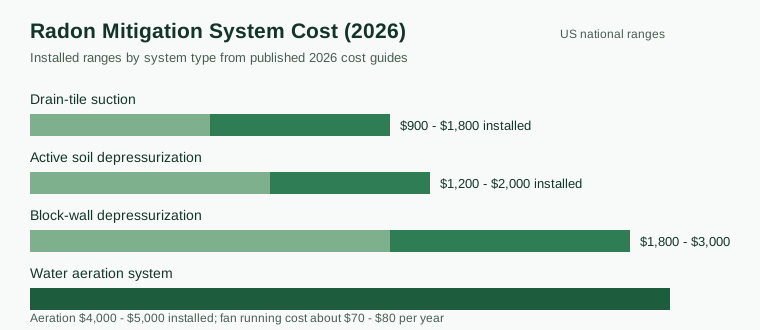
| Active soil depressurization (ASD) | $1,200 to $2,000 | Basement slab or crawl space; the default fix |
| Drain-tile suction | $900 to $1,800 | Homes with an existing perimeter drain or French drain to tap |
| Sump pit and crock sealing | $900 to $2,500 | Radon entering through the gravel bed around the sump |
| Block-wall depressurization | $1,800 to $3,000 | Hollow block foundation walls acting as the entry route |
| Above-slab air pressure differential barrier | $500 to $1,200 | Supplemental; draws from wall cavities and duct chases |
| Heat recovery ventilation (HRV) | $1,300 to $2,200 | Dilution where ASD is impractical; weaker radon reduction |
| Energy recovery ventilation (ERV) | $1,500 to $2,500 | Same dilution role with humidity transfer between airstreams |
| Water: carbon or charcoal filtration | $1,200 to $1,800 | Radon in well water, lower removal than aeration |
| Water: aeration | $4,000 to $5,000 | Radon in well water, the stronger water-side fix |
| Crawl space encapsulation | $3,000 to $15,000 | Sealed vapor barrier system; radon control plus moisture control |
Installed ranges are HomeGuide's 2026 tables. A few of these rows deserve a paragraph each, because the cheap option and the right option diverge.
Active soil depressurization drills or cuts one or more suction points through the slab (or into a crawl space membrane), connects them to PVC pipe, and mounts an inline fan, usually in the attic or outside, that pulls soil gas from under the foundation and vents it above the roofline. HomeGuide credits ASD with reductions of up to 99 percent, and it is the system nearly every certified installer leads with. The $2,500-plus pricing on larger homes buys additional suction points and longer pipe runs, not a different machine.
Drain-tile suction connects the fan to an existing perimeter drain instead of coring the slab. Where the drain tile is continuous and in decent shape, it depressurizes the whole footprint through one connection, which is why it prices at or below standard ASD. Where the tile is crushed, silted, or partial, the discount evaporates.
Ventilation systems (HRV/ERV) dilute indoor radon with outdoor air instead of capturing it under the slab. Contractors reach for them where an ASD pipe run has nowhere to go. They reduce radon less reliably than ASD, they move a lot of air (which is the point), and in cold climates the HRV version at least recovers heat from the exhaust stream before it leaves. Our HRV system cost guide prices these units as ventilation appliances in their own right; if an installer quotes one as your radon fix, ask what post-install level they will guarantee in writing, because dilution performance varies with how the house is run.
Crawl space encapsulation seals the ground under the house with a heavy vapor barrier, and a sub-membrane version of ASD can draw from beneath that barrier. At $3,000 to $15,000 it costs far more than a radon system alone, and quoting it as one is a category error. As our crawl space encapsulation cost guide lays out, encapsulation is a moisture and durability project that also blocks a radon entry route. Houses that need both conversations should have them together, because the membrane goes down before the suction pipe either way.
Water systems treat radon dissolved in well water, which off-gasses at showers and faucets. Carbon beds ($1,200 to $1,800) capture less and accumulate radioactivity in the media over time, which is a disposal conversation to have before installation. Aeration ($4,000 to $5,000) strips the gas and vents it outside, and is the stronger fix. Municipal-water homes can skip this row entirely.
4. What Moves the Price Inside the $1,200 to $2,000 Band
Two quotes on the same house can land $800 apart with both installers doing the job properly. The spread comes from identifiable scope, and a quote that itemizes these lines is easier to judge than one flat number.
- Suction points. One point serves a simple slab. Large footprints, split-levels, and additions on separate slabs can need two or three, each adding pipe, a core through concrete, and sealing.
- Foundation and finish access. An unfinished basement with an open ceiling prices lower than a finished basement where the pipe chase has to hide inside walls or run outside the house.
- Fan location. Attic-mounted fans keep the pipe inside the thermal envelope and the discharge high; exterior fans simplify the pipe run and complicate the look of the house. Either way the fan must sit outside the living space, never in the basement.
- Electrical. The fan needs a circuit and, in many jurisdictions, a switch and an exterior-rated connection. Homes already tight on panel capacity should read our electrical panel upgrade cost guide before assuming this line is trivial.
- Sealing scope. Caulking slab cracks, sealing the sump lid, and closing plumbing penetrations is part of a real ASD job, and it is the part that lets one fan do the work of two. Quotes that skip sealing shift cost into a bigger fan and a bigger electricity bill.
- Permit. $25 to $150 depending on jurisdiction, and most contractors fold it into the estimate. Ask, rather than assume.
- Aesthetics. Routing the stack through the roof near a ridge, matching exterior pipe to siding, or boxing a chase costs carpentry money that has nothing to do with radon and everything to do with how the house looks afterward.
5. The Fan Bill: Twenty Years of Electricity Nobody Quotes
A mitigation fan runs every hour of every day. Shutting it off for a weekend lets levels climb back, so pricing the system means pricing the electricity for as long as the house stands.
HomeGuide puts the fan draw at about the same as a 60-watt light bulb, with energy costs of $70 to $80 per year. The arithmetic checks: 60 watts running continuously uses 60 x 24 x 365 = 525,600 watt-hours, about 526 kWh a year. At $0.15 per kWh that is $79; at $0.10 it is $53; at $0.25 it is $131. Your rate decides which end of the published band you land on, and time-of-use pricing does not help because the load never moves.
Labeled hypothetical, worked in full: a $1,600 ASD installation at the national average, fan electricity at $79 a year, one fan replacement at year 8, and a post-install retest every 5 years done with a $30 DIY long-term kit.
| Year | Cost item | Amount |
|---|---|---|
| 0 | ASD installation | $1,600 |
| 1 to 20 | Fan electricity at $79/yr | $1,580 |
| 8 | Fan replacement (fan 5 to 10 yr service life) | priced within system quotes; get the figure in writing |
| 5, 10, 15, 20 | Long-term retest kits at $30 | $120 |
| 20-year total | Installation plus running, excluding the fan replacement line | about $3,300 |
Two lessons fall out of the table. First, the electricity roughly doubles the installed price over 20 years, so fan wattage belongs in the quote comparison next to the install price; a fan drawing 40 watts instead of 60 saves about 175 kWh a year at the same suction. Second, none of this argues against the system. It argues for buying the efficient fan and the well-sealed slab once, because the meter spins either way.
A monitoring note: systems should carry a U-tube manometer or an alarm that shows the fan is pulling. A failed fan with no indicator is a house that thinks it is mitigated and is not. Digital continuous monitors at $150 to $300 close that gap and double as the retest device.
6. Lifespan, Warranty, and the Maintenance That Actually Exists
The pipe is close to permanent: HomeGuide puts piping life at 20 to 50 years or more. The fan is the wear part at 5 to 10 years, shortened by sun exposure on exterior mounts, and most manufacturers warranty professionally installed fans for 5 years. DIY fan swaps sit outside that warranty in most product terms, which is worth knowing before pricing the job as a weekend project.
Maintenance beyond the fan is short: glance at the manometer when you pass it, keep the exhaust termination clear, and retest on the cycle Health Canada's guidance implies, after the first heating season and every few years after, plus after renovations that change the foundation or the air sealing. A tighter house after an insulation or air-sealing project can read differently than it did before the work; our humidity and ventilation coverage makes the same point from the comfort side, and the whole house humidifier cost guide covers what added moisture does in a tightened envelope.
Retesting matters more than any single component. Radon is not fixed forever by an installation date; it is fixed by a measured result, confirmed after the fan has run through real weather.
7. Canada: Different Number, Same Hardware
Canadian readers cross the border in search results constantly, so the conversion is worth stating plainly. Health Canada's guideline is 200 Bq/m3, which divides by 37 to about 5.4 pCi/L. The EPA's 4 pCi/L action level equals 150 Bq/m3. A Canadian home testing at 180 Bq/m3 sits below the Health Canada guideline and above the EPA action level, and both agencies would call the situation low risk and reducible. The hardware does not care which flag flies over the house: ASD is the standard fix in both countries, installed by C-NRPP certified professionals in Canada and by NRPP or NRSB certified specialists in the US.
This guide does not publish a Canadian dollar band for mitigation, because no published 2026 Canadian cost dataset was available to cite for one. Quoting a converted US range as if it were a surveyed Canadian price would invent exactly the kind of number our standards forbid. Get three quotes from C-NRPP certified mitigators and compare them against the scope lines in Section 4; the anatomy of the job transfers even where the price survey does not.
8. DIY: Where It Works and Where It Stops
The parts are ordinary: 3 or 4 inch PVC, fittings, a radon fan, a manometer, concrete sealant. Retired installers and confident tradespeople do install their own systems. Three limits apply.
First, design is the skill. Suction point placement, pressure field extension testing, and fan sizing against the sub-slab material decide whether the system reaches 1 pCi/L or stalls at 3.5. A professional's diagnostic visit exists because gravel, sand, and tight clay behave differently under the same fan.
Second, the warranty and certification paper trail matters at resale. A certified install with a documented post-mitigation test answers a buyer's home inspection cleanly. A DIY system with no test record starts an argument.
Third, the electrical connection and the roof or wall penetration are licensed-trade territory in many jurisdictions, and the permit line ($25 to $150) exists either way.
DIY testing, by contrast, is easy to endorse: the $10 to $30 kit is the same lab method professionals start from, and it is the cheapest decision tool in this entire guide.
9. Quote Checklist: How to Compare Three Quotes Fairly
Get three written quotes against the same scope. Radon quotes diverge on suction points, sealing, and testing, so each quote should state:
- System type (ASD, drain-tile, block-wall, or other) and why it fits your foundation
- Number and location of suction points, and the sub-slab material found or assumed
- Fan make, model, wattage, and mounting location (attic or exterior, never the living space)
- Pipe route and discharge point above the roofline, with any exterior visibility shown
- Sealing scope in writing: slab cracks, sump lid, penetrations, and what is excluded
- Electrical scope and permit handling, priced or explicitly included
- Vacuum indicator (manometer or alarm) included, and its location
- Post-mitigation retest included, its timing (after a closed-house period), and the level the installer will stand behind
- Fan warranty (expect 5 years on professional installs) and the replacement price after warranty
- Certification: NRPP or NRSB in the US, C-NRPP in Canada, plus license and insurance
Red flags: a quote written without any test result in hand, a fan specified by price alone with no wattage, ventilation offered as an equal substitute for ASD with no guaranteed result, a water system pitched to a municipal-water home, and any installer who discourages a post-mitigation retest. The retest is the product. Everything else is plumbing.
Frequently Asked Questions
How much does a radon mitigation system cost in 2026?
HomeGuide's 2026 data puts the average installed system at $1,200 to $2,000, with a national average near $1,600 and a full range of about $500 to $8,000 across system types. Active soil depressurization, the standard fix, runs $1,200 to $2,000 and can exceed $2,500 in larger homes. Drain-tile suction runs $900 to $1,800 where a perimeter drain already exists. Testing adds $10 to $30 for a DIY kit or $125 to $400 professionally.
At what radon level should I install a system?
In the US, the EPA says fix at 4 pCi/L or above and consider fixing between 2 and 4 pCi/L. In Canada, Health Canada recommends corrective action above an average annual 200 Bq/m3 (about 5.4 pCi/L), within two years for 200 to 600 Bq/m3 and within one year above 600 Bq/m3. Health Canada adds that no level is risk free and that an installed system should reduce radon as low as reasonably practicable.
How much electricity does a radon fan use?
About as much as a 60-watt light bulb running nonstop, per HomeGuide, which works out to roughly 526 kWh a year. At $0.15 per kWh that is about $79 a year; published estimates run $70 to $80 a year. The fan runs continuously by design, so the yearly figure, not the wattage, is the number to compare between quotes.
How long does a radon mitigation system last?
The piping lasts 20 to 50 years or more. The fan is the replacement item at 5 to 10 years, and most manufacturers give a 5-year warranty on professionally installed fans. A vacuum indicator or alarm shows the system is still pulling, and periodic retesting confirms it is still working.
Can I install a radon mitigation system myself?
The materials are standard plumbing and an inline fan, and experienced DIYers do it. The limits are design (suction point placement and fan sizing against your sub-slab material), the fan warranty that usually requires professional installation, and the resale value of a certified install with a documented post-mitigation test. DIY testing with a $10 to $30 long-term kit is the step to do yourself regardless.
Does a radon system work in a crawl space home?
Yes. The installer seals a heavy vapor barrier over the crawl space ground and draws suction from beneath it, a sub-membrane version of active soil depressurization. Full crawl space encapsulation at $3,000 to $15,000 is a broader moisture project that also blocks radon entry; the radon-specific version prices closer to standard ASD. Our encapsulation cost guide breaks down where the money goes in the full project.
Will an HRV or ERV fix a radon problem?
Ventilation dilutes indoor radon and can lower levels, but it reduces radon less reliably than active soil depressurization, and installers generally use it where an ASD pipe run is not practical. HRV systems run $1,300 to $2,200 installed and ERV systems $1,500 to $2,500. Ask any installer quoting ventilation for a guaranteed post-install level in writing, and confirm with a retest.
Who pays for radon mitigation when a house is sold?
The seller typically pays, according to HomeGuide, but it is negotiable and the seller is not legally obligated in most places. Some states require radon testing or disclosure around a sale. A certified system with a documented passing retest is a selling point; an untested DIY system is a negotiation item.
What to Read Next
- Crawl Space Encapsulation Cost 2026 - the moisture project that shares a membrane and a suction pipe with crawl space radon control
- HRV System Cost 2026 - what balanced ventilation costs when it is quoted as the radon answer, and what it does to heating load
- Whole House Humidifier Cost 2026 - the other fan-and-duct decision in the same mechanical room, priced by type
- Electrical Panel Upgrade Cost 2026 - panel capacity for the growing list of always-on home electrical loads
Sources and Verification
- HomeGuide How Much Does a Radon Mitigation System Cost? (2026 installed ranges by system type, testing and permit costs, fan energy use, system lifespan, based on project costs reported by HomeGuide members)
- U.S. EPA Health Risk of Radon (radon as the leading cause of lung cancer in nonsmokers, about 21,000 US lung cancer deaths per year, lifetime risk tables by radon level for smokers and neversmokers)
- Health Canada Canadian Radon Guideline (corrective action above an average annual level of 200 Bq/m3 in the normal occupancy area, faster action at higher levels, no level considered risk free)
- Health Canada Guide for Radon Measurements in Residential Dwellings (longterm testing of at least 91 days, testing in the lowest livedin level, CNRPP approved devices and professionals in Canada)
Editorial Review
EnergyBS Editorial Team
EnergyBS publishes practical homeowner guides. Important program, product, and cost claims should be checked against the linked source and local project documents before you commit to work.
Related Guides
View All ArticlesCrawl Space Encapsulation Cost 2026: What Installation Really Costs
Encapsulating a crawl space in 2026 typically costs $3 to $10 per square foot, or $3,000 to $15,000 total for most homes. This guide breaks down cost by crawl size and barrier thickness, what the vapor barrier, insulation, and dehumidifier lines actually cover, the prep work that moves a quote, and how to compare bids without paying twice for the same scope.
Whole House Humidifier Cost 2026: What Installation Really Costs
A whole house humidifier installed in 2026 typically costs $400 to $1,200 in the US, with steam models running $500 to $2,200 installed and costing far more to run. This guide breaks down price by type and home size, the extras that move a quote, a decade of ownership math, and the humidity ceiling you should not cross.
Electrical Panel Upgrade Cost 2026: What a 100 to 200 Amp Upgrade Runs
Upgrading an electrical panel from 100 to 200 amps costs $1,300$4,200 installed in the US in 2026 depending on market and scope, and C$2,500$4,500 in Ontario. This guide breaks down cost by upgrade path, what a legitimate quote includes, when 200 amps is genuinely needed, and when load management avoids the upgrade entirely.