WholeHouse Fan Installation Cost 2026: What Installation Really Costs
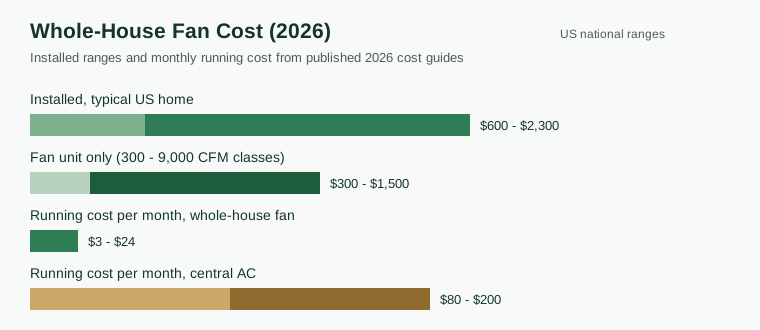
Installing a wholehouse fan in 2026 typically costs $600 to $2,300 in the US, with the fan itself at $300 to $1,500 and labor at $300 to $1,600 depending on wiring. This guide breaks down cost by home size and CFM, the attic venting rule that sizes the job, running costs against central AC, and the quote items installers most often leave out.
Quick Checks
- 1Budget $600 to $2,300 installed in 2026 for a typical US home. The fan unit runs $300 to $1,500 and labor runs $300 to $800 on existing wiring or $600 to $1,600 with a new dedicated circuit.
- 2Size the fan at 2 to 3 CFM per square foot of living space (2 coastal or mountain, 2.5 inland, 3 desert), then check the attic can exhaust it: US DOE guidance is 1 square foot of net free vent area per 750 CFM.
- 3Venting is the line item that breaks quotes. Added roof vents run $200 to $700 each, and an undersized vent area chokes the fan no matter what the nameplate CFM says.
- 4Running costs are small: published 2026 figures put a whole-house fan at $3 to $24 per month against $80 to $200 for central AC, because the fan draws roughly 120 to 600 watts instead of 3,000 to 5,000.
- 5A whole-house fan moves outdoor air. It does not dehumidify, and it stops helping when the night air is warm, humid, smoky, or heavy with pollen.
Whole-House Fan Installation Cost 2026: What Installation Really Costs
By EnergyBS Editorial Team | October 4, 2026
The Short Answer: What a Whole-House Fan Costs
Short Answer: In 2026, a whole-house fan costs $600 to $2,300 installed on average in the US, according to HomeGuide's 2026 installation cost guide, with a national average near $1,500 and a full published spread of $450 to $3,000. The fan itself is $300 to $1,500. Labor is $300 to $800 when existing attic wiring can serve the fan and $600 to $1,600 when the job needs a new dedicated circuit and switch. Most installs take 4 to 8 hours.
That band covers a standard job in a house with an accessible attic and enough venting. The rest of this guide is about the four things that move a real quote inside or outside the band: the CFM class your floor area calls for, whether the attic can exhaust that much air, how much electrical work the ceiling location needs, and which of the small parts (shutters, insulated cover, added vents) your quote remembered to include. A whole-house fan is one of the cheaper cooling installs in this site's cost library, and also one of the easiest to buy wrong, because the fan is the visible part while the vent area decides whether it works.
One distinction before any pricing. A whole-house fan cools the house. An attic fan cools only the attic. The two get quoted against each other constantly and they are not substitutes, so section 2 separates them before the cost tables start.
1. Whole-House Fan vs Attic Fan: Different Jobs, Different Prices
A whole-house fan mounts in the ceiling of the top floor, usually in a central hallway. You open windows on the lower or shaded side of the house, switch the fan on, and it pulls outdoor air through the living space, up through the ceiling opening, and out through the attic vents. The air you feel moving through the rooms is the cooling mechanism, and the hot air that built up in the attic during the day leaves with it.
An attic fan (roof-mounted or gable-mounted) vents only the attic air space. It never draws air through the rooms, so it cannot produce the breeze-through-the-house effect. It is also cheaper: HomeGuide's 2026 attic fan guide puts attic fan installation at $300 to $900, against the $600 to $2,300 whole-house band. Some installers quote an attic fan when a customer asks for whole-house cooling, and the lower number wins the job while delivering a different product. If the quote does not involve a ceiling opening in the living space and open windows as the intake, it is not a whole-house fan quote.
The operating rules differ too. A whole-house fan runs with the air conditioning off and the windows open, in the hours when outdoor air is cooler than indoor air: evening, overnight, and early morning. Run both systems at once and the fan exhausts the air the AC just paid to cool.
2. What the Installed Price Actually Covers
HomeGuide's 2026 cost stack for a whole-house fan install, with the lines a complete quote should show:
| Cost item | Published 2026 range |
|---|---|
| Whole-house fan unit | $300 - $1,500 |
| Installation labor and wiring | $300 - $1,600 |
| Fan shutters (if not included with the fan) | $40 - $200 |
| Insulated attic fan cover | $20 - $40 |
| Insulation (1 roll, for sealing around the opening) | $20 - $30 |
| Permits and inspection | $50 - $350 |
| Typical installed total | $600 - $2,300 |
The labor line splits cleanly in two. Work on existing wiring runs $300 to $800. A new dedicated circuit and wall switch runs $600 to $1,600 in labor, and the circuit itself, priced separately in the same guide, is $250 to $900. Electricians in that data charge $50 to $130 per hour, and the 4 to 8 hour install window is where the arithmetic comes from.
What pushes a quote above the band is carpentry and venting, not the fan. Cutting the ceiling opening can mean moving or reframing ceiling joists on direct-mount models, drywall repair runs $300 to $1,500 or more in HomeGuide's figures, and added roof vents run $200 to $700 per vent. A quote that lands at $550 for a mid-size fan in a house with no attic circuit and a ridge vent only has usually left one of those three lines out. Section 11 turns the full list into a checklist you can hold against each bid.
3. Cost by Home Size and CFM
Whole-house fans are sized by airflow, in cubic feet per minute (CFM), and airflow follows floor area. HomeGuide's 2026 unit-price table by home size:
| Home size | Recommended airflow | Average unit price |
|---|---|---|
| 1,500 sq ft | 3,000 - 4,500 CFM | $300 - $1,200 |
| 2,000 sq ft | 4,000 - 6,000 CFM | $350 - $1,300 |
| 2,500 sq ft | 5,000 - 7,500 CFM | $400 - $1,400 |
| 3,000 sq ft | 6,000 - 9,000 CFM | $450 - $1,500 |
Read those CFM bands against the sizing rule in section 5 and they reconcile: roughly 2 to 3 CFM per square foot of living space. The unit price climbs slowly with size because the fan motor and housing grow, but the installed price climbs faster, since the bigger classes are the ones that run into the venting ceiling in section 4. A 7,500 CFM fan in an attic with 5 square feet of net free vent area is a 5,000 CFM fan with a louder motor.
Two honest readings of the table. First, two smaller fans often beat one large one in two-story and split-level houses, because each zone gets its own ceiling opening and neither has to pull air around a staircase corner. Second, the top of each unit band is where the quiet ducted models live (section 6), and the noise difference is the main thing the extra money buys, not extra cooling.
4. The Venting Rule: The Line That Decides Whether the Fan Works
Every CFM the fan pulls into the attic has to leave through the attic vents. The US Department of Energy's Building America guidance for whole-house fans sets the sizing rule: 1 square foot of net free vent area for every 750 CFM of fan airflow. A 4,500 CFM fan needs at least 6 square feet of net free area. A 7,500 CFM fan needs 10.
Net free area is not the size of the vent on the roof. Screens, louvers, and grilles all subtract from it. The DOE guidance notes that vents with insect screens may deliver a net free area near half of their gross opening, depending on the screen. Ridge vents, gable vents, and soffit vents all count toward the total, but only at their net rating, and a roof that looks well vented on paper can be several square feet short once the screens are counted honestly.
Quotes go wrong here in a specific, predictable way. The installer prices the fan the floor area calls for, the attic cannot exhaust it, and the fan runs against backpressure: less air moved, more noise, more motor strain. The fix, added roof or gable venting at $200 to $700 per vent (HomeGuide, 2026), belongs in the first quote, not in a callback. Before signing anything, ask for two numbers in writing: the fan's rated CFM and the attic's measured net free vent area. If the second number times 750 is smaller than the first, the system is undersized at the exhaust side no matter what the box says.
The DOE guidance pairs the venting rule with a sealing rule. A running whole-house fan pressurizes the attic, so penetrations between the attic and the living space (light fixture boxes, plumbing cutouts, loose attic hatches, recessed light housings) should be caulked and sealed, so attic air is not pushed back down into the rooms. Our roof venting guide covers how ridge and soffit venting add up, and our air sealing guide for old homes covers the ceiling-plane work that pairs with it.
5. Sizing the Fan: CFM per Square Foot, Done Properly
The sizing rule used by manufacturers and cost guides is 2 to 3 CFM per square foot of living space, adjusted for climate. QuietCool, the largest US maker of ducted whole-house fans, publishes the adjustment directly: about 2 CFM per square foot in coastal and mountain climates, 2.5 inland, and 3 in desert climates, where the evening air has further to pull the house down. HomeGuide's sizing guidance matches: 2 to 3 CFM per square foot, sizing up for ceilings over 8 feet because the air volume grows.
Worked example, with every input named. This is a hypothetical sizing exercise built from the published rules above. A 1,800 square foot single-story house, 8-foot ceilings, inland climate:
| Step | Rule | Result |
|---|---|---|
| Target airflow | 1,800 sq ft x 2.5 CFM per sq ft | 4,500 CFM |
| Fan class | Next size at or above target, two-speed preferred | 4,500 to 5,500 CFM class |
| Attic exhaust needed | 4,500 CFM / 750 (DOE rule) | 6.0 sq ft net free vent area |
| If attic measures 4 sq ft net | Shortfall 2 sq ft | Add venting ($200-$700 per vent) or drop a fan class |
Two-speed and variable-speed models earn their premium in this math. The DOE guidance describes the pattern: run on high to flush the house quickly when you get home, then drop to the lower, quieter speed to hold the temperature. A single-speed fan sized for the evening flush is oversized and loud for the overnight hold, which is the shift it works most of the year.
Intake matters as much as exhaust. The fan can only pull in what open windows let through, and manufacturer operating guidance is to open several windows a few inches in the rooms you want cooled, closing windows in rooms you do not, so the airflow goes where people are. A house with small or painted-shut windows starves the fan from the intake side, and no CFM rating fixes that.
6. Fan Types: What the Extra Money Buys
Three designs share the 2026 market, all priced inside the $300 to $1,500 unit band:
Direct-mount fans sit in the attic floor over the ceiling opening, with louvers that open when the fan runs. They are the low end of the price band and the loud end of the noise range, and the large diameters can require moving ceiling joists. This is the classic design and the one most of the published cost data describes.
Ducted fans hang the motor in the attic, connected to the ceiling grille by a short insulated duct (about 6 feet in HomeGuide's description). The distance and the duct absorb the motor noise, which is why ducted models occupy the top of the unit band. HomeGuide puts the best-known ducted line, QuietCool, at $500 to $3,000 installed or $450 to $1,500 for the fan alone, depending on size and motor. The installed spread runs past the general $2,300 band top because the largest ducted systems are sized for 3,000-plus square foot houses and are sometimes installed in pairs.
Roof-mounted fans go through the roof itself, ducted or not, for houses with flat roofs or no usable attic. Professional installation matters most here, because the penetration is in the roof plane and flashing errors become leaks.
Motor type moves price inside each design: HomeGuide notes belt-driven motors cost about 20 percent more than direct-drive, and electronically commutated (ECM) motors are the efficiency end of the range in section 7. Timers, thermostats, multi-speed controls, and smart switches are the other price adders, and they are worth pricing separately because a timer is the control most owners actually use: set the fan to run the evening flush and stop before the coldest hour.
7. Running Costs and the Honest Payback Math
A whole-house fan is cheap to run because it moves air instead of refrigerating it. HomeGuide's 2026 figures:
| Cooling method | Energy draw | Cost per month (8 hours per day) |
|---|---|---|
| Whole-house fan | 120 - 600 watts | $3 - $24 |
| Central AC | 3,000 - 5,000 watts | $80 - $200 |
The same guide puts the saving from running the fan overnight instead of the AC at $70 to $170 per month, with the fan using 70 to 90 percent less energy than the central system depending on motor type. Treat those as ceiling numbers. They assume the fan actually displaces AC hours, which is a climate and habit question, not a fan question.
A labeled hypothetical, with the rate assumption stated. Electricity price is the input nobody can publish for your house, so pick your own from your bill. At a hypothetical $0.20 per kWh: a 350-watt fan running 6 evening hours uses 2.1 kWh, about $0.42 a night, or roughly $13 across 30 nights. A 3.5 kW central AC running the same 6 hours uses 21 kWh, about $4.20 a night, or roughly $126 across 30 nights. If the fan truly replaces those AC hours for a 4-month cooling season, the avoided cost is around $450 a year, and the $1,500 average install pays back in a little over 3 years. If your nights stay warm and the fan displaces AC only in the two shoulder months, the same arithmetic stretches past 6 years. HomeGuide's published estimate of a 1 to 3 year return fits homes in moderate climates with a strong day-to-night temperature swing, which is exactly the condition the next section prices.
Compare the installed side against the alternatives in the same 2026 data: central AC at $2,500 to $7,500 installed, ductless mini-split at $1,800 to $10,500. Our central AC replacement cost guide and ductless mini-split installation cost guide break those down line by line. The whole-house fan is not a cheaper version of either one. It is a different tool that wins in a specific weather pattern and does nothing outside it.
8. Where a Whole-House Fan Works, and Where It Does Not
The fan's fuel is a temperature difference. It needs outdoor air cooler than indoor air for enough hours to matter, which is why the design is standard practice in dry western US climates with hot days and cool nights and in mountain regions, and a marginal purchase where summer nights stay in the high 70s with humidity.
The limits, stated plainly:
- Humidity. The fan does not remove moisture. It imports whatever humidity the night air carries. In a humid climate it can leave the house cool-feeling and damp, and the cooling effect fades because moving humid air across skin does less than moving dry air. Our whole-house dehumidifier vs AC comparison covers the moisture side of cooling that a fan does not touch.
- Outdoor air quality. Wildfire smoke, high pollen counts, and traffic dust come in through the same open windows. On smoke days the fan stays off and the house stays shut, which in smoke-prone regions can mean the fan sits idle during the hottest weeks of the year.
- Noise and security. Open windows at night are the intake. Ground-floor windows in some settings are a security decision, and older direct-mount fans are loud enough that the DOE guidance covers two-speed operation partly as a noise measure.
- Winter heat loss. A ceiling opening with thin louvers leaks warm air all winter. The DOE guidance describes an insulated louver cover for the off-season (rigid insulation held tight against the louver section), and HomeGuide prices an insulated fan cover at $20 to $40. Ducted models with insulated dampers reduce the same leak. A fan with no winter cover plan is a heating penalty bought to save cooling money.
- Combustion appliances. A large exhaust fan changes house pressure. In a house with atmospherically vented gas water heaters, furnaces, or fireplaces, the installer should check that fan operation cannot interfere with safe venting of those appliances, and open windows sized to the fan's CFM are part of that check. This belongs on the quote walk, before the ceiling is cut.
9. Installation Day: What Actually Happens
HomeGuide puts a typical install at 4 to 8 hours, and the sequence explains the labor band. The crew confirms the ceiling location (central hallway on the top floor, clear of obstructions), cuts the ceiling opening, frames it if a joist has to move, sets the fan or the ducted unit in the attic, seals insulation around the opening (a $20 to $30 roll in the cost stack), wires the circuit and switch, fits the grille and shutters, and checks the attic venting against the fan's CFM.
The two judgment calls in that sequence are the joist and the vent. Moving a ceiling joist is ordinary carpentry on a direct-mount fan, and it is also the step that turns a $300 labor quote into drywall repair at $300 to $1,500. The vent check is the step most often skipped, because measuring net free area means counting and rating every ridge, gable, and soffit vent, and the day runs long. Get the vent area number in writing before the install date. Adding a vent during the same visit, at $200 to $700, is far cheaper than a second trip after the first hot week proves the fan is choking.
Permits run $50 to $350 in the published data and apply because the job is structural (the ceiling cut, on some models) and electrical (the new circuit). The permit is also your record that the circuit work was inspected, which matters for the dedicated-circuit installs at the top of the labor band.
10. DIY vs Professional Installation
The unit price ($300 to $1,500) makes DIY tempting, and the honest version of the comparison is narrow. The work a handy homeowner can do well: the ceiling cut and framing on a direct-mount model between joists, the grille and shutter fitting, and the winter cover. The work that prices as professional labor: the new dedicated circuit ($250 to $900 as a standalone line), any joist reframing, roof vent additions, and the permit.
Price the DIY version fully before comparing. Fan, shutters if not included ($40 to $200), cover ($20 to $40), insulation, wiring materials, permit ($50 to $350), and drywall repair if the cut needs it ($300 to $1,500) can stack a do-it-yourself job into the lower half of the professional band while carrying none of the warranty. The professional band also buys the vent-area measurement, which is the step that decides whether the system works at all. The sensible split for most houses: hire the electrical and the install, and handle the seasonal cover and window screens yourself.
One safety note that is not a pricing matter. Attic work in summer heat, over ceiling joists, around existing wiring, is the injury profile of this project, and the DOE installation guidance assumes sealed penetrations and intact attic insulation around the fan box. Blown-in insulation may need the fan box sides raised with baffles so insulation does not interfere with the fan, a detail our attic insulation removal cost guide touches from the other direction: anyone already planning attic insulation work should sequence the fan install first, while the ceiling plane is accessible.
11. Canada: Same Physics, Thinner Price Data
Canadian readers should know the published cost data above is US pricing in US dollars, and the usual Canadian move of converting it mechanically is not reliable here. Whole-house fans are a smaller market in Canada, installed pricing is not published in a national Canadian cost guide the way it is in the US data, and installer availability varies more by city. The sizing physics travels without conversion: 2 to 3 CFM per square foot, toward the low end in coastal and mountain regions, and 1 square foot of net free vent area per 750 CFM. Much of Canada gets the cool summer nights the fan needs, and the shorter cooling season stretches the payback in section 7, which makes the running-cost side of the ledger matter more than the install side. Get itemized Canadian-dollar quotes using the checklist in section 12, and be skeptical of any quote that is a US band with an exchange rate applied: labor, circuit work, and vent additions are local prices, not converted ones.
12. Incentives in 2026: Budget as if None Are Coming
Price the project on its own economics first. Whole-house fans sit in a gap in most incentive programs: they are too small and too climate-specific to headline utility rebate lists, and no federal credit should be assumed in the 2026 math. What can exist locally:
- Utility and municipal programs in some western US service territories have historically supported whole-house fans as a cooling-efficiency measure, with approved-model and installer conditions. Verify the current program before purchase, because these lists change year to year.
- Cooling-load programs tied to AC replacement occasionally credit ventilation cooling as part of a package. The fan rarely qualifies alone.
The documentation rule is the same as everywhere in this cost library: itemized invoice separating the fan, labor, circuit, and vent work, model and CFM records, and the permit record. If a program does apply, it will ask for exactly those lines.
13. Quote Checklist: How to Compare Three Quotes Fairly
Get three written, itemized quotes for the same fan class. Whole-house fan quotes diverge on scope, not on the fan, so each quote should state:
- Fan make, model, rated CFM, and speed control (single, two-speed, or variable), with the CFM per square foot it gives your floor area
- Attic net free vent area measured and stated in writing, and any added vents priced per vent at the quoted rate
- Electrical scope: existing circuit or new dedicated circuit and switch, priced as its own line
- Ceiling work: opening location, joist reframing if needed, grille, and shutters included or excluded
- Drywall and finish repair: included, excluded, or priced, stated explicitly
- Winter heat-loss plan: insulated damper model, or an insulated cover supplied and fitted
- Ceiling penetrations around the opening sealed, and insulation kept clear of the fan box with baffles if the attic is blown-in
- Combustion appliance check noted, for houses with atmospherically vented gas equipment or fireplaces
- Permit and inspection included, warranty on labor and fan stated separately
- Total with taxes and payment schedule; never pay in full before the fan is run on both speeds and the venting is verified
Red flags: a quote with no CFM figure, no vent-area measurement, a fan class well above what 3 CFM per square foot gives your floor area, the circuit work folded into a single unexplained total, or an attic fan quoted against a whole-house fan request. The cheapest quote that includes the vent measurement is usually the cheapest quote that works.
Frequently Asked Questions
How much does it cost to install a whole-house fan in 2026?
A whole-house fan costs $600 to $2,300 installed on average in the US, with a national average near $1,500 (HomeGuide, 2026). The fan itself is $300 to $1,500, labor is $300 to $800 on existing wiring or $600 to $1,600 with a new dedicated circuit, and added roof vents at $200 to $700 each are the most common item that pushes a quote above the band.
What size whole-house fan do I need?
Size at 2 to 3 CFM per square foot of living space: about 2 CFM per square foot in coastal and mountain climates, 2.5 inland, and 3 in desert climates, sizing up for ceilings over 8 feet. A 2,000 square foot inland home needs roughly 5,000 CFM, and the attic needs at least 1 square foot of net free vent area per 750 CFM to exhaust it.
Is a whole-house fan cheaper than air conditioning?
To install and to run, yes, and it is not a replacement. Published 2026 figures put a whole-house fan at $600 to $2,300 installed against $2,500 to $7,500 for central AC, and running costs at $3 to $24 per month against $80 to $200. The fan only cools when outdoor air is cooler than indoor air and does not remove humidity, so in hot, humid climates it supplements AC rather than replacing it.
How much attic venting does a whole-house fan need?
US DOE guidance is 1 square foot of net free vent area per 750 CFM of fan airflow, so a 4,500 CFM fan needs at least 6 square feet. Net free area is what remains after screens and louvers take their share, and screened vents may deliver near half their gross opening. Undersized venting is the most common reason a correctly sized fan underperforms.
Can a whole-house fan replace my AC?
In dry climates with cool nights, it can carry most of the cooling season, with AC kept for heat waves and smoke days. In humid climates, no: the fan moves air without drying it, and on nights when outdoor air is barely cooler than indoor air it adds little. Most owners in mixed climates run the fan for the evening and overnight hours and keep AC for the afternoon peak.
Are whole-house fans loud?
Direct-mount fans are the loud end of the market. Ducted models hang the motor in the attic on an insulated duct run specifically to cut the noise, and they occupy the top of the unit price band for that reason. Two-speed and variable-speed operation helps as well: the DOE guidance describes running high speed for the first flush of hot air, then dropping to the quieter low speed to hold temperature overnight.
Do whole-house fans waste heat in winter?
They can if the ceiling opening is left with thin louvers only. The fixes are an insulated damper built into ducted models, or an insulated cover fitted over the louvers for the off-season, priced at $20 to $40 in published 2026 data. The DOE installation guidance describes fitting a rigid insulation cover tight against the louver section. Price the winter cover in the original quote, not as an afterthought.
Should I install a whole-house fan myself?
The ceiling cut, framing, and grille work are within a capable homeowner's reach. The new dedicated circuit, joist reframing, roof vent additions, and permit are the parts that price as professional work, and the fan plus parts alone run $300 to $1,500 before any of it. The step DIY installs most often skip is measuring attic net free vent area, which is the step that decides whether the fan delivers its rated airflow.
What to Read Next
- Central AC Replacement Cost 2026 - what the full refrigeration option costs installed, line by line
- Ductless Mini-Split Installation Cost 2026 - zoned cooling prices when a whole-house fan cannot carry the climate
- Whole-House Dehumidifier vs AC - the humidity side of cooling that moving air does not solve
- Attic Insulation Removal Cost 2026 - attic work that is cheaper sequenced before the fan goes in
Sources and Verification
- HomeGuide How Much Does a WholeHouse Fan Cost to Install? (2026 installed ranges, unit prices by home size and CFM, labor, circuit, vent, permit and drywall costs, running costs, fan types, sizing at 23 CFM per square foot)
- HomeGuide Attic Fan Installation Cost (2026 attic fan installed range and wholehouse fan comparison)
- US Department of Energy, Building America Installing a Whole House Fan: Installation Tips and Concerns (1 square foot of net free vent area per 750 CFM, sealing ceiling penetrations, fan sizing and louver cover guidance)
- QuietCool (manufacturer) Whole House Fan sizing guidance (2 CFM per square foot coastal and mountain, 2.5 inland, 3 desert) and operating method
Editorial Review
EnergyBS Editorial Team
EnergyBS publishes practical homeowner guides. Important program, product, and cost claims should be checked against the linked source and local project documents before you commit to work.
Related Guides
View All ArticlesCentral AC Replacement Cost 2026: What Installation Really Costs
Replacing a central air conditioner in 2026 typically costs $3,900$8,100 installed in the US (C$4,000C$7,000 in Canada). This guide breaks down equipment vs. labor, tonnage and SEER2 pricing, the refrigerant change, and repairvsreplace math.
WholeHouse Dehumidifier vs. AC 2026 Tool (Guide & Data)
A measurementfirst wholehouse dehumidification guide covering moisturesource control, portableversusducted selection, pintload sizing, HVAC and ventilation coordination, drainage, energy, and commissioning.
Attic Insulation Removal Cost 2026: What Removal and Replacement Really Cost
Removing old attic insulation in 2026 typically costs $1$2 per square foot, or $1,600$3,600 total on average, and removing plus replacing runs $2$6 per square foot. This guide breaks down cost by attic size and material, contamination and asbestos surcharges, why the empty attic is the cheapest airsealing window you will ever get, and how to compare quotes.