Whole House Dehumidifier Cost 2026: What Installation Really Costs
A ducted whole house dehumidifier installed in 2026 typically costs $1,500 to $3,500 in the US, with most jobs landing near $2,200. This guide prices the work by capacity, separates unit cost from duct and drain labor, works through running cost and sizing, and covers when a portable unit or a crawl space unit is the better buy.
Direct Answer
A ducted whole house dehumidifier costs $1,500 to $3,500 installed in the US in 2026, with a national average near $2,200 in HomeGuide's 2026 cost guide and a full span of roughly $1,200 to $4,000. Angi's 2026 data lands lower for the typical job: $1,300 to $2,800 installed, a...
Quick Checks
- 1Budget $1,500 to $3,500 installed for a ducted whole house unit in 2026. HomeGuide puts the national average near $2,200, inside a $1,200 to $4,000 span. Angi puts the typical job lower, at $1,300 to $2,800 with an average near $1,500.
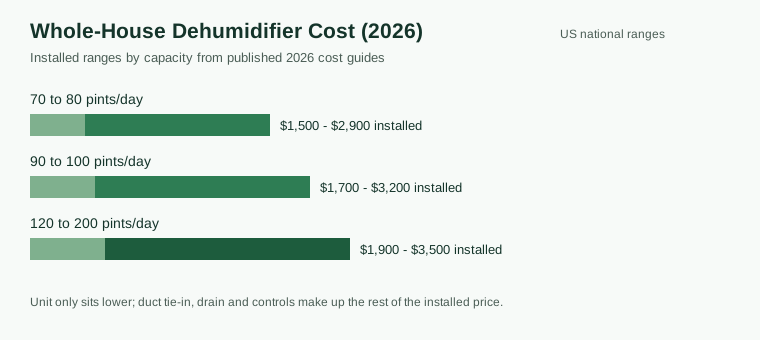
- 2Capacity drives the price more than the brand. Published 2026 tables put a 70 to 80 pint per day unit at $1,500 to $2,900 installed, a 90 to 100 pint unit at $1,700 to $3,200, and a 120 to 200 pint unit at $1,900 to $3,500.
- 3The EPA target is below 60 percent relative humidity, ideally 30 to 50 percent. Sustained readings above 60 percent are the condition a whole house unit exists to fix. Readings already inside 30 to 50 percent do not need one.
- 4Running cost is real but bounded. Published estimates put a whole house dehumidifier at $10 to $30 a month, or $120 to $360 a year, depending on capacity, run time, and your electricity rate. Filter replacement adds $10 to $30 a year.
- 5Fix the water source first. A leaking pipe, a wet crawl space with no vapor barrier, or gutters dumping at the foundation will outrun any dehumidifier. The machine manages humidity that remains after bulk water is stopped.
Whole House Dehumidifier Cost 2026: What Installation Really Costs
By EnergyBS Editorial Team | October 6, 2026
The Short Answer: What a Whole House Dehumidifier Costs
Short Answer: A ducted whole house dehumidifier costs $1,500 to $3,500 installed in the US in 2026, with a national average near $2,200 in HomeGuide's 2026 cost guide and a full span of roughly $1,200 to $4,000. Angi's 2026 data lands lower for the typical job: $1,300 to $2,800 installed, averaging near $1,500. The two datasets describe the same machine priced two ways. HomeGuide's band includes more of the large-capacity and dedicated-return jobs at the top. Angi's band centers on the standard tie-in to an existing return duct. Either way, this is not a $300 appliance purchase. The unit alone runs $1,000 to $2,300 depending on capacity, and duct work, a condensate drain, controls, and labor make up the rest.
The machine earns a place on an energy site because humidity is an energy problem before it is a comfort problem. Air that sits at 65 percent relative humidity feels warmer than the thermometer says, so the air conditioner runs longer to reach the same comfort. Wood, drywall, and insulation held damp lose performance and grow things they should not. A whole house dehumidifier removes moisture through the duct system, holds the house inside the band the EPA recommends, and drains itself, so the work happens without a bucket to empty. This guide prices the job from the published 2026 tables, separates the unit price from the installation price, works through what the machine costs to run, and covers the sizing decision that decides whether the purchase works at all.
1. Price by Capacity: Pints per Day Is the Number That Matters
Dehumidifiers are rated in pints of water removed per day under standard test conditions, and capacity is the cleanest predictor of price in both published datasets. Bigger house, wetter climate, and a basement or crawl space in the moisture path all push the required rating up.
| Capacity | Unit price | Total installed | Typical fit |
|---|---|---|---|
| 70 to 80 pints/day | $1,100 to $1,700 | $1,500 to $2,900 | Smaller homes, moderate humidity load |
| 90 to 100 pints/day | $1,300 to $2,000 | $1,700 to $3,200 | Mid-size homes, humid summers |
| 120 to 200 pints/day | $1,500 to $2,300 | $1,900 to $3,500 | Large homes, high load, Gulf and Southeast conditions |
Capacity and installed ranges are HomeGuide's 2026 tables. Angi describes the same ladder from the low end: whole house units start near 60 pints per day and run past 150 pints per day, with price rising with capacity and efficiency rating. The step from one row to the next costs a few hundred dollars at unit level. The installed gap is wider when the bigger job also needs a dedicated return duct, a longer drain run, or a condensate pump, which is why two quotes on the same house can sit $800 apart while both describe real work.
A related split matters for readers pricing a smaller job. A permanent basement system runs $1,100 to $2,800 installed, and a crawl space unit runs $1,000 to $3,000 installed in HomeGuide's data. Those are not cut-down whole house units. They dehumidify the space they sit in, and in some houses, particularly in milder climates, drying the crawl space or basement air is enough to bring the floors above into range. Section 5 covers when that smaller scope is the right scope.
Portable units sit in a different price world and a different performance world. A medium portable costs $130 to $300, a small-to-medium standalone $250 to $450 in the datasets, and either one treats the room it sits in. A house that needs moisture removed from every room, every day, for months will run several portables, empty buckets, and still leave the far bedrooms damp. The comparison that matters is in section 6.
2. What the Installed Price Actually Covers
The installed ranges above buy a specific scope of work. Reading a quote against this list is how you tell a complete job from a unit drop with the hard parts left as extras.
A standard ducted installation includes:
- Setting the unit at the air handler or in the basement or crawl space it will serve
- Cutting in and sealing the inlet and outlet connections, either tied into the existing return and supply or run as a dedicated return with its own grille
- Running the condensate drain by gravity to a floor drain, sump, or exterior termination, or fitting a pump where gravity cannot reach
- Mounting and wiring the controller or humidistat and setting the target humidity
- Electrical connection, most often a dedicated outlet near the unit, plus any permit the jurisdiction requires for that work
- Startup, drain test, and a check that the unit cycles on its control and not only on a manual switch
Labor for that scope runs $400 to $1,200 in HomeGuide's data, at HVAC rates of $75 to $150 per hour, with a two-person crew taking 3 to 6 hours on a typical job. Angi puts the labor portion at $500 to $700 for the standard tie-in, with mounting supplies at $20 to $25. The spread between the two figures is the difference between a clean return-duct tie-in in an open basement and a job that needs a new duct run, which HomeGuide prices separately at $270 to $500 for a short dehumidifier duct run and Angi prices more broadly at $1,000 to $2,700 where a full duct addition is required. Ask which one your quote assumes. It is the single largest swing item in most comparisons.
Four lines sit outside the base scope often enough that each one belongs in the written quote:
Condensate pump: $50 to $300 external, $150 to $500 where an internal pump is specified. Gravity drainage is free once the line is run. A unit sitting below the drain, which describes most basement and crawl space placements, needs a pump. Some models carry one internally. Confirm which version is quoted, because the external pump added later costs the pump plus a second trip.
Electrical: $150 to $350 for a GFCI outlet where one is needed, and $50 to $200 for a permit where a new circuit is pulled. Angi puts electrical labor at $50 to $100 per hour and permits at $50 to $200. Most whole house units need a dedicated outlet. If the panel is already full, that conversation connects to the electrical panel upgrade cost guide before the dehumidifier quote can be treated as final.
Old unit removal: $40 to $200. HomeGuide prices removal and disposal in that band. Angi puts it at $35 to $40 where a simple swap is involved. Small money, but it should be a line, not a surprise.
HVAC disconnect: $90 to $120 where the air handler has to come off line for the tie-in. Both datasets carry a version of this charge. On a straightforward return-duct cut-in it may not apply. On a tight mechanical closet it often does.
Bundling changes the labor math in your favor. A dehumidifier added during an air handler or furnace replacement shares the duct opening work and part of the electrical trip. Our furnace replacement cost guide and ductwork replacement cost guide price those main jobs, and a bundled quote should still show the dehumidifier as its own priced line so it can be compared against a standalone bid.
3. The Humidity Target: What the Machine Is Trying to Hold
A dehumidifier has one job, and the EPA states it as a range. Keep indoor relative humidity below 60 percent, ideally between 30 and 50 percent. Below 30 percent, the house trades one set of problems for another: wood shrinks and cracks, static builds, and skin and sinuses dry out. Above 60 percent sustained, mold can germinate on organic surfaces, dust mites thrive, and the house starts to smell like the basement it is trying not to become. The EPA also notes the time dimension: wet or damp materials dried within 24 to 48 hours after a leak usually will not grow mold, which is why a flood or a plumbing failure is a drying emergency first and a dehumidifier purchase second.
That range frames the purchase decision cleanly. Measure before you shop. A hygrometer costs $10 to $50 and, placed away from the kitchen and bathrooms, will tell you within a week whether the house lives at 45 percent, where no machine is needed, or at 62 to 68 percent through the summer, where one is. Readings taken only in the basement or only beside a shower will mislead the decision in opposite directions.
Where does the moisture come from in a house that has no leak? Cooking, showering, laundry, breathing, and outdoor air entering through every gap in the envelope. In a humid climate the outdoor load dominates in summer, and the air conditioner removes part of it as a byproduct of cooling. The gap a whole house dehumidifier fills is specific: the shoulder seasons and mild humid days when the house needs drying but does not need cooling, plus the overnight hours when the air conditioner cycles off and humidity climbs back. A correctly sized air conditioner in a dry climate may never leave that gap. An oversized air conditioner in a humid climate leaves it every day, because short cooling cycles end before the coil has removed much water. That is the house that feels cold and clammy at 72 degrees and is the strongest candidate for a dedicated unit.
One published claim deserves a careful read here. HomeGuide notes that homes using a heat pump typically do not need a separate dehumidifier because the heat pump itself dehumidifies as it cools. That is true while the heat pump is running a cooling cycle long enough to condense moisture. It is not true in dehumidification-only weather, and cold climate heat pump homes in humid summers report the same shoulder season gap as furnace homes. Treat the heat pump note as a prompt to measure across a full humid week, including the mild days, not as a blanket exemption.
4. Running Cost: The Monthly Bill After the Install Bill
Published running cost estimates put a whole house dehumidifier at $10 to $30 per month, or $120 to $360 per year. Angi's monthly figure is $15 to $25. The range is wide because run time is the variable: a unit holding a Gulf Coast house at 50 percent in August runs most hours, and a unit trimming a Mid-Atlantic house in June runs a fraction of them. Your electricity rate sets the rest. At 300 to 700 watts drawn while running, depending on capacity, the arithmetic is ordinary. A 500-watt unit running 12 hours a day for a 90-day humid season uses about 540 kWh. At $0.15 per kWh that is $81 for the season. The same unit in a longer, wetter season, or at a $0.25 rate, lands in the upper half of the published band quickly.
Efficiency is expressed in liters of water removed per kilowatt-hour, and the ENERGY STAR framework uses that figure, now carried as the Integrated Energy Factor, to separate models inside each capacity class. The practical use of the number is narrow and worth stating plainly: compare it only between units of the same pint rating. A higher value inside the same class removes the same water for less electricity. Across classes, capacity drives the bill far more than the efficiency figure does, so the correct sequence is size first, efficiency rating second. Buying a larger unit than the house needs in the name of efficiency buys more capacity to cycle on and off, which is the opposite of the goal.
Filters add $10 to $30 per year, replaced at least annually. Repairs, when they come, average $70 to $400 in HomeGuide's data. Service life runs 5 to 10 years for a whole house unit in both datasets, against 3 to 5 years for a portable, with muggy climates shortening life because the machine works more hours per year. None of those figures argues against the purchase. They price the decade in full: the installed price plus roughly one to three years of that price again in electricity, filters, and one repair across the life of the unit. A quote that presents the machine as a one-time cost with no running cost is leaving out the part of the bill you will actually notice.
A seasonal note applies to basement and crawl space placements. Units in cool spaces work against physics: capacity ratings assume warm test air, and a 55 degree basement delivers less water per day than the box promises. Published guidance is consistent here - choose a model rated to operate below 65 degrees for a cool basement, and expect a crawl space unit to need the encapsulation around it finished first, because dehumidifying an open, vented crawl space in a humid climate is drying the outdoors at indoor prices. Our crawl space encapsulation cost guide prices that enclosure at $3,000 to $15,000 including a dehumidifier, and sequencing the membrane before the machine is the difference between a system that holds and one that runs continuously.
5. Basement and Crawl Space Units: The Smaller Scope
Not every wet house needs the whole house treated. Two smaller scopes cover a large share of real moisture problems, and both price below the ducted job.
Basement systems at $1,100 to $2,800 installed treat the basement air directly, ducted through a wall or free-standing in the space with a drain to a sump or floor drain. Because the basement is where moisture concentrates in most houses - cool surfaces, foundation contact, and the stack effect pulling that air upward - drying the basement alone brings many houses into range on the floors above. The fit is best where the complaint is a musty basement, damp stored goods, and humidity readings that fall as you go upstairs. It is the wrong scope where bedrooms on the second floor also sit above 60 percent.
Crawl space systems at $1,000 to $3,000 installed, or $300 to $2,000 for the unit alone, serve the encapsulated crawl space. The pairing matters more than the machine. An encapsulated crawl space is a sealed, conditioned-adjacent volume; a modest unit holds it at target with short run times. A vented crawl space with bare earth is an open moisture source, and no reasonably sized unit wins that fight in a humid summer. In milder climates, published guidance notes that drying the crawl space can be enough to balance the house above. In hot humid climates, encapsulation is the project and the dehumidifier is its finishing component.
Both scopes share the drainage rule from section 2: an automatic drain to a sump, floor drain, or pumped termination is not an upgrade, it is the feature that makes the system work while nobody is watching. A basement unit draining to a bucket is a portable with a larger price tag.
6. Whole House vs Portable: The Comparison That Decides It
Portable dehumidifiers have a real job. A single damp room, a closet with a moisture problem, a garage, or a few weeks of drying while a leak repair is diagnosed are all portable work. The limits show up when the problem is the whole house, all summer.
| Factor | Portable | Ducted whole house |
|---|---|---|
| Coverage | One room, 300 to 1,500 sq ft | Whole house, 1,500 to 5,000+ sq ft |
| Capacity | 20 to 50 pints/day | 70 to 200+ pints/day |
| Upfront cost | $130 to $450 per unit | $1,500 to $3,500 installed |
| Drainage | Bucket, or hose where gravity allows | Hard drain or pump, automatic |
| Noise in living space | Audible at the unit, 45 to 55 dB typical | Low; unit sits at the air handler or below grade |
| Control | Per unit, manual or onboard | One humidistat for the house |
| Service life | 3 to 5 years | 5 to 10 years |
The table is a summary of the published datasets and manufacturer guidance, not a laboratory comparison. The economic point sits underneath it. Drying a 2,400 sq ft house with portables means two or three units at $250 to $450 each, each drawing power in the room it sits in, each needing a bucket emptied or a hose improvised, and each treating its room while the hallway between them stays damp. The whole house unit costs more once and then treats the air the house actually circulates. Where one room is the problem, buy the portable and keep the change. Where the hygrometer reads above 60 percent in room after room, the portable stack is the expensive way to get a partial result.
Two portable mistakes recur often enough to name. The first is sizing by the room the unit will sit in rather than by the moisture load of the space it must dry, which produces a machine that runs continuously and still loses. The second is drainage by bucket in a space nobody visits daily. A full bucket is an off switch. Every hour the unit sits full is an hour the space re-wets, and the purchase quietly becomes a decoration. If a portable is the right scope, a model with a built-in pump or a gravity hose to a real drain is the version to buy.
7. Sizing: How Many Pints Does the House Need
Sizing has two inputs: the size of the space and how wet it is. Published sizing guidance combines them in a way worth reproducing as a framework, with the caveat that the table describes the load, not a guarantee for any one house.
As a starting point, moderate dampness (50 to 60 percent, feels damp) in a 1,500 to 2,500 sq ft area points to roughly a 40 to 50 pint per day requirement. Very damp conditions (60 to 70 percent, musty) push the same area to 50 to 60 pints. Noticeable condensation at 70 to 80 percent pushes it to 60 to 70 pints, and very wet conditions toward mold risk at 80 to 100 percent push it past 70 to 100 pints. Smaller spaces scale down from there, and larger or wetter ones scale up. Whole house ducted units start at 70 pints per day because the whole house load, not any single room, is the denominator.
Three adjustments move the pick inside that framework:
Occupancy and internal load. More people, more showers, indoor laundry, and a lot of cooking add moisture the unit must remove. Published guidance flags all three as reasons to choose the higher end of a capacity band.
Envelope and climate. A leaky house in a humid climate imports moisture with every air change. A tight house in the same climate needs less capacity because the load is smaller and the dried air stays dried. This is the same relationship our whole house humidifier cost guide works through from the opposite direction: in winter the leaky house cannot hold moisture in, and in summer it cannot keep moisture out. Sealing helps both machines do less work.
Duct capacity. A whole house unit moves air, and the duct system has to carry it. An undersized return, a restrictive filter, or a long dedicated run with too many turns can starve the unit regardless of its pint rating. A competent installer checks static pressure and return sizing before quoting a capacity, and a quote written without anyone looking at the ductwork is a guess wearing a number.
Oversizing is a real failure mode, not a safety margin. A unit far larger than the load reaches its setpoint quickly and shuts off, which sounds efficient until you count what it missed: short cycles remove less moisture per hour of run time than steady operation, and the house oscillates around the target instead of holding it. The right unit is the smallest one that holds 50 percent on the worst humid week, running long cycles to do it.
8. Brands, Prices, and What the Nameplate Does Not Tell You
Published unit pricing by brand clusters in a band narrow enough that capacity and install scope separate quotes more than badges do. HomeGuide's 2026 brand table puts Aprilaire at $1,000 to $2,200 for the system, Carrier at $1,000 to $3,000, GeneralAire at $1,300 to $1,900, Honeywell at $1,300 to $2,400, Lennox Healthy Climate at $1,500 to $2,300, and Santa Fe and Sani-Dry each at $1,200 to $2,500, installation not included. Those are unit and system prices before the duct, drain, and labor lines from section 2, which is why a $1,200 unit so often becomes a $2,400 installed job.
What to compare between two units of the same capacity:
- Efficiency rating in liters per kilowatt-hour within the same capacity class, per section 4.
- Low temperature rating. A unit serving a basement or crawl space must be rated to run in cool air without frosting its coil into a block of ice. Models differ here by design, and a warm-space unit in a 55 degree basement will underperform its pint rating all winter.
- Drain configuration. Internal pump included, pump optional, or gravity only decides whether the section 2 pump line appears in your quote.
- Control. A built-in humidistat, a wall controller, or integration with the thermostat decides how precisely the house holds its target and whether the unit can dehumidify without a cooling call.
- Warranty and its installation condition. Both datasets note that most whole house warranties expect professional installation. A self-installed unit that loses warranty coverage has given back part of what its price bought, which belongs in the DIY math below.
Dealer channel brands price at the top of their bands and tend to carry the longer warranties when registered on time. Independent brands compete on capacity per dollar and low temperature performance, which is why crawl space work so often specifies them. Neither fact picks the unit. The house picks the capacity, the space picks the temperature rating and drain, and the quote picks between the two or three models that satisfy both.
9. DIY, Rental, and the Other Two Ways to Get Dry Air
DIY installation prices at $800 to $2,300 in HomeGuide's data, saving roughly the labor share, around 30 percent. The work is duct cutting and sealing, a pressurized drain or a pump, an electrical connection, and a control wire, performed around an air handler in a space that is rarely generous. Experienced homeowners with sheet metal and electrical skills complete it. The three limits that apply are the same ones our other HVAC cost guides record: the warranty condition that usually requires professional installation, the drain slope and termination that decide whether the unit floods its own closet in year two, and the duct sizing check in section 7 that a skipped measurement turns into a guess. DIY testing and measurement, by contrast, is easy to endorse. The hygrometer week from section 3 is the cheapest decision tool in this guide.
Rental runs $40 to $70 per day or $200 to $300 per week for the portable and restoration class machines that rental yards stock. Rental is the right tool after water damage, where the job is to dry wet materials inside the EPA's 24 to 48 hour window and then return the machine. It is the wrong tool for a humidity problem that returns every summer, where three rental weeks a year approach the portable purchase price and ten approach the installed one.
Ventilation substitution deserves a direct answer because it is quoted in this category. Exhaust style ventilation systems that pull house air down and out through the basement run $1,000 to $2,000, and published guidance is consistent that they are not a substitute for a dehumidifier where the problem is moisture in the air. Moving humid outdoor air through the house on a humid day imports the load the dehumidifier exists to remove. Ventilation has its own correct uses, priced in our HRV system cost guide. Humidity control in a humid climate is not one of them.
10. Canada Note
The pricing above is US pricing from US cost datasets. The two datasets fetched for this guide publish no Canadian installed band, and converting a US range at an exchange rate and presenting it as surveyed Canadian data would invent exactly the kind of number our standards exclude. Canadian HVAC firms quote ducted dehumidifiers per job, most often as part of a broader basement or HVAC scope.
The humidity guidance transfers without conversion. The EPA band of 30 to 50 percent, below 60 percent, is climate physics, not a US regulation, and Canadian building practice works to the same mold thresholds. The Canadian difference is seasonal emphasis: the humid summer problem this guide prices is concentrated in Ontario, Quebec, and the Atlantic provinces, while Prairie and northern readers meet the same machine more often in its crawl space form under a heated house. Hold a Canadian quote to the section 11 itemization, expect the capacity and drain lines to transfer directly, and treat any US dollar figure quoted locally as a number to question rather than adopt.
11. Quote Checklist: How to Compare Three Quotes Fairly
Get three written quotes against the same scope. Dehumidifier quotes diverge on capacity, duct scope, and drainage, so each quote should state:
- Capacity in pints per day, the home size and humidity assumption behind it, and the low temperature rating where the unit serves a basement or crawl space
- Duct scope in writing: existing return tie-in or dedicated return, any new duct run priced as its own line
- Drain method: gravity route and termination, or pump (internal or external) priced as its own line
- Control included: built-in humidistat, wall controller, or thermostat integration, model stated
- Electrical scope, including a dedicated outlet or new circuit and any permit, priced separately
- Old unit removal and disposal, stated or excluded
- Any HVAC disconnect charge, stated where it applies
- Filter type, replacement cost, and interval, plus the first year maintenance terms
- Warranty for parts and labor, and the registration deadline and professional installation condition
- For bundled HVAC quotes: the dehumidifier as its own priced line, separable from the equipment price
Red flags: a capacity quoted with no humidity measurement behind it, a ducted price with no duct scope stated, a basement or crawl space unit with bucket drainage, a ventilation system presented as an equal substitute for dehumidification, and any savings promise stated as a guaranteed bill reduction. Drier air can let a household raise the thermostat setting and spend less on cooling, and several sources describe that effect. No dataset fetched for this guide publishes a verified savings figure for it, so treat it as a possible bonus, not a payback calculation.
Frequently Asked Questions
How much does a whole house dehumidifier cost in 2026?
HomeGuide's 2026 data puts a whole house dehumidifier at $1,500 to $3,500 installed, with a national average near $2,200 and a full span of about $1,200 to $4,000. Angi's 2026 data puts the typical job at $1,300 to $2,800 installed, averaging near $1,500. By capacity, HomeGuide prices a 70 to 80 pint per day unit at $1,500 to $2,900 installed, a 90 to 100 pint unit at $1,700 to $3,200, and a 120 to 200 pint unit at $1,900 to $3,500. Labor runs $400 to $1,200 of the total.
Do I need a whole house dehumidifier if I have air conditioning?
Maybe. An air conditioner removes moisture while it cools, and a correctly sized system in a moderate climate can hold the EPA band of 30 to 50 percent relative humidity on its own. The gap appears on mild humid days when the house needs drying without cooling, overnight when the system cycles off, and in homes with oversized air conditioners that short cycle. Measure across a humid week with a hygrometer. Sustained readings above 60 percent at a comfortable temperature are the condition a dedicated unit fixes.
What size dehumidifier do I need for my house?
Published sizing starts from area and dampness together. Moderate dampness around 50 to 60 percent in a 1,500 to 2,500 sq ft area points to roughly 40 to 50 pints per day of required removal, wetter conditions push the same area to 50 to 70 pints, and very wet conditions toward 70 to 100 pints or more. Ducted whole house units start at 70 pints per day because they serve the whole house load. Occupancy, laundry and cooking load, envelope leakage, and humid climate all argue for the higher end of a band.
How much does it cost to run a whole house dehumidifier?
Published estimates put running cost at $10 to $30 per month, or $120 to $360 per year, depending on capacity, run time, and electricity rate. Angi puts the monthly figure at $15 to $25. Units draw roughly 300 to 700 watts while running. Filters add $10 to $30 per year, and repairs average $70 to $400 when they occur.
How long does a whole house dehumidifier last?
Five to ten years for a ducted whole house unit in the published datasets, against three to five years for a portable. Homes in muggy climates sit at the shorter end because the machine accumulates more run hours per year. Annual filter replacement and a clear drain line are the maintenance that gets a unit to the top of its range.
Is a basement or crawl space dehumidifier enough instead of a whole house unit?
Sometimes. A basement system at $1,100 to $2,800 installed or a crawl space system at $1,000 to $3,000 installed treats the space it sits in. Where the moisture problem concentrates below grade and readings upstairs sit inside the 30 to 50 percent band, drying the lower space can bring the house into range. A crawl space unit needs the encapsulation finished around it to work in a humid climate. Where bedrooms also read above 60 percent, the ducted whole house scope is the one that matches the problem.
Can I install a whole house dehumidifier myself?
The DIY price runs $800 to $2,300, saving roughly the labor share. The work combines duct cutting and sealing, a condensate drain or pump, an electrical connection, and control wiring around the air handler. Most manufacturers condition the full warranty on professional installation. DIY makes the most sense as a like for like replacement where the duct connections, drain, and outlet already exist. The measurement step, a week with a hygrometer, is worth doing yourself either way.
Will a whole house dehumidifier lower my energy bill?
It can, through one specific mechanism: air held at 50 percent feels cooler than air at 65 percent, so a household may set the thermostat a degree or two higher and run the air conditioner less. No dataset fetched for this guide publishes a verified savings figure for that effect, and the dehumidifier itself spends $10 to $30 a month to run. Buy the unit for humidity control, mold risk, and comfort. Treat any cooling offset as a bonus rather than a payback line.
What to Read Next
- Whole House Humidifier Cost 2026 - the winter half of the same humidity decision, priced by type with its own 10 year ownership math
- Crawl Space Encapsulation Cost 2026 - the enclosure project a crawl space dehumidifier finishes, priced layer by layer
- Ductwork Replacement Cost 2026 - the distribution system a ducted dehumidifier ties into, and what a new run adds to the job
- HRV System Cost 2026 - balanced ventilation priced on its own terms, and where it does and does not substitute for dehumidification
Sources and Verification
- HomeGuide How Much Does a WholeHouse Dehumidifier Cost? (2026) (installed ranges by type and capacity, labor, drainage and running cost figures drawn from project costs reported by HomeGuide members)
- Angi Whole House Dehumidifier Cost in 2026 (installed range, cost breakdown by capacity and location, pump, permit and labor figures, updated July 8, 2026)
- U.S. EPA Mold Course Chapter 2 and Brief Guide to Mold, Moisture and Your Home (keep indoor relative humidity below 60 percent, ideally 30 to 50 percent; dry wet materials within 24 to 48 hours after a leak)
- ENERGY STAR Dehumidifier specification background (capacity measured in pints per day and efficiency expressed as liters of water removed per kilowatthour; higher values remove more water per unit of electricity)
Editorial Review
EnergyBS Editorial Team
EnergyBS publishes practical homeowner guides. Important program, product, and cost claims should be checked against the linked source and local project documents before you commit to work.
Related Guides
View All ArticlesWhole House Humidifier Cost 2026: What Installation Really Costs
A whole house humidifier installed in 2026 typically costs $400 to $1,200 in the US, with steam models running $500 to $2,200 installed and costing far more to run. This guide breaks down price by type and home size, the extras that move a quote, a decade of ownership math, and the humidity ceiling you should not cross.
Crawl Space Encapsulation Cost 2026: What Installation Really Costs
Encapsulating a crawl space in 2026 typically costs $3 to $10 per square foot, or $3,000 to $15,000 total for most homes. This guide breaks down cost by crawl size and barrier thickness, what the vapor barrier, insulation, and dehumidifier lines actually cover, the prep work that moves a quote, and how to compare bids without paying twice for the same scope.
Ductwork Replacement Cost 2026: What Installation Really Costs
Replacing home ductwork in 2026 typically costs $1,400 to $5,600 in the US, or $25 to $55 per linear foot, with a national average near $3,500. This guide breaks down cost by house size, duct location and material, the repair and sealing options that cost far less than replacement, and the addons that move a quote.