Oven and Range Repair Cost 2026: What Repairs Really Cost, by Part
By EnergyBS Editorial Team | November 9, 2026
The Short Answer
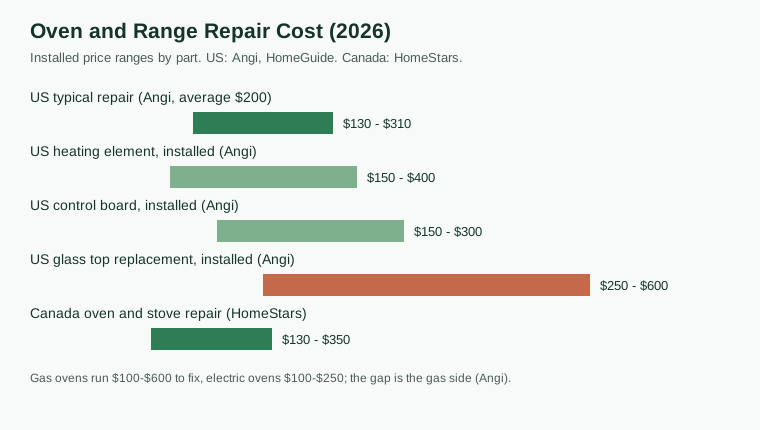
Short Answer: Most oven repairs cost $130 to $310 in the US in 2026, with a national average of $200 (Angi, updated September 11, 2026). HomeGuide puts oven repair at $150 to $350 on average, naming the igniter, heating elements and control board as the common repairs. Angi prices the work by part: a thermostat averages $150, an igniter $200, a control board $225, and a heating element $275. In Canada, oven and stove repair runs $130 to $350 in the HomeStars city cost pages.
A range is two appliances sharing one box, and that is the first thing to get straight before any price makes sense. The oven half heats a sealed cavity. The cooktop half heats open burners or a glass surface. They share a frame, a power or gas supply, and sometimes a control board, and almost nothing else. A quote that says "range repair, $400" without naming the half has not finished the diagnosis, because a burner job and a board job are different repairs at different prices with different safety rules. This guide prices the two halves separately and keeps them separate through every table that follows.
The oven half is also the appliance where the cheapest part and the most expensive part sit closest together. A thermal fuse costs $200 on Angi's by-part average and a control board $225, and both can be the answer to the same symptom: an oven that will not heat. The difference between them is a test, not a guess, and the test is what Section 9 is about. Get the test wrong and you pay board money for a fuse job, on a machine where the fuse was doing its job by failing.
This guide is the next piece in the site's repair-cost series, after the refrigerator, washing machine, dryer and dishwasher guides. It follows the same method: published prices from Angi, HomeGuide, HomeAdvisor and HomeStars, read firsthand for this article, with the disagreements printed rather than averaged away. Our companion guides cover the buying side of the same machine: gas, dual-fuel and induction ranges compared prices the three fuel choices against each other, and the induction range installation guide covers the electrical work a new induction cooktop needs.
The repair in six steps:
- Name the symptom in plain words before you call: will not heat at all, heats slowly or unevenly, will not turn on, clicks without lighting, door will not close, self-clean fails, a burner will not light, or the glass top is cracked. Each symptom maps to a short part list in Section 7, and Angi publishes a price band for the part itself, so you can place any quote against it.
- Do the free checks first: breaker on and not tripped, oven set to bake rather than a timer or delay mode, door closing and latching with a firm click, gas supply valve open on a gas range, and burners seated properly on the cooktop. A range set to a delayed start reads exactly like a dead range.
- Stop on the safety cases in Section 8 before pricing anything: a gas smell, sparking, a burning smell, repeated breaker trips, or a shattered glass top. Those are not quote-shopping situations.
- Call with the model number, the fuel type (gas, electric, induction or dual-fuel), the age, and the symptom ready. Ask the service call fee and whether it is credited toward the repair. HomeGuide puts an appliance service call at $70 to $130 including the first hour.
- Approve a diagnosis before you approve a part. On an appliance where a sensor costs $175 on Angi's average and a board $225, the sentence you are paying for is the one that names the failed part and the test that proved it.
- Run the age and percentage tests in Section 10 before approving any job over $300. Oven repairs are cheap enough that repair usually wins, and Section 10 marks the narrow band where it stops winning: board and gas-valve work on an old machine.
1. What a Repair Bill Is Made Of
An oven repair invoice has three layers, and the proportions are the useful part.
The first layer is the visit. HomeGuide puts an appliance service call at $70 to $130, including travel in the standard service area, diagnostics, and the first hour of labour. Angi does not publish a separate diagnostic fee for ovens, and this guide does not invent one by borrowing the dishwasher figure from the same series. Ask how the visit is priced before anyone is booked: flat rate, hourly, or minimum charge changes what a thermostat-sized job should cost, and whether the fee is credited if you approve the repair changes the comparison between two quotes by the full fee.
The second layer is labour, and the oven has three labour rates where most appliances have one. Angi puts oven repair specialists at $50 to $200 per hour, though some pros bill a flat trip fee rather than an hourly rate. An electrician, called in where the fault is in the wiring or the circuit, runs $50 to $100 per hour. A gas line specialist runs $45 to $150 per hour, reflecting the additional certifications and safety requirements. Angi's stove pages put general stove labour at $50 to $150 per hour, excluding diagnostic fees. Which rate applies depends on where the fault lives: a heating element is appliance labour, a tripping breaker is electrician labour, and a gas valve is gas labour. A quote should say which trade it is charging for, because the same two-hour job prices very differently across those three bands.
The third layer is the part, and the oven is unusual in how much of the bill the part can be. Angi publishes both a by-part average and a by-part range for fifteen oven components, and the ranges run from $100 to $400. A thermostat at $150 and a heating element at $275 are the same kind of job in labour terms, an hour or so with the machine pulled out, and the $125 gap between them is almost entirely the part. That is why the tables in Section 2 use Angi's installed figures and label them as installed: the part and the labour are already combined in the published number, and a quote should say which unit it is using. A $200 igniter line on a quote is a different claim from a $200 igniter part, and the difference is the visit and the labour you are also paying for.
Two more charges can appear on an oven invoice that rarely appear on other appliances. The first is the permit. Angi puts permits at $10 to $500 where major changes to the electrical setup or gas line require one, and notes that most minor oven and stove repairs do not require a permit at all. Requirements vary by municipality, so confirm with the local building department before work begins, and your repair professional should be able to advise whether the job needs one. The second is the cleaning fee. Angi notes that a heavily soiled oven can add a $25 cleaning fee where the technician has to work around baked-on grease and grime, because debris blocking the door or covering electrical elements can prevent accurate diagnosis. Cleaning the oven before the appointment is a simple way to avoid the extra charge, and it is also the cheapest diagnostic step in this guide: a clean oven shows its faults plainly.
HomeGuide adds the portfolio view, the same one it publishes across appliances: annual appliance maintenance plans run $200 to $500 depending on how many devices are covered, including cleaning, inspections and tune-ups, with repair discounts in some plans. Against an oven whose average repair is $200 (Angi), a plan's oven share only pencils out when the same plan covers several larger appliances. Price it as a portfolio, never for the oven alone.
2. US Prices by Part
Angi publishes oven pricing in two units at once: an average per part and a range per part, both installed, parts and labour together. Read the table in that unit. It answers the question "what should this job cost", and it does not answer "what does this part cost alone". The only parts-alone figures available are the small ones scattered through the repair guides: an igniter itself is usually under $100 for most brands, and a bake element $30 to $100, with the rest of the installed price being the visit and the labour. This guide does not build a parts-alone table from figures no source publishes.
| Oven part | What it does | Angi average, 2026 | Angi range, 2026 |
|---|---|---|---|
| Thermostat | Controls the oven temperature | $150 | $100 - $200 |
| Door switch | Detects whether the door is open or closed | $150 | $100 - $200 |
| Gas valve | Controls when gas flows to the igniter | $150 | $100 - $200 |
| Oven door | Hinges, latch and lock assembly | $175 | $100 - $250 |
| Sensor | Reads the cavity temperature for the board | $175 | $100 - $250 |
| Fan motor | Drives the convection fan | $175 | $100 - $250 |
| Gasket | Seals heat inside the oven | $175 | $100 - $250 |
| Oven paint | Refinish for scratches and wear | $175 | $100 - $250 |
| Fan | The convection fan itself | $190 | $100 - $275 |
| Igniter | Lights the gas that heats a gas oven | $200 | $150 - $250 |
| Oven door glass | Tempered glass panel in the door | $200 | $100 - $300 |
| Thermal fuse | Cuts power if the oven overheats | $200 | $100 - $300 |
| Control board | Governs every core function | $225 | $150 - $300 |
| Heating element | The coil that produces the heat | $275 | $150 - $400 |
| Insulation | Retains heat, protects cabinets and floors | $300 | $100 - $400 |
HomeGuide cross-checks the whole picture from its member project costs: oven repair at $150 to $350 on average, with the igniter, heating elements and control board named as the common repairs. HomeAdvisor puts the same picture at $100 to $600 with most homeowners spending around $200. Three sources, built from different data, land on the same centre: a typical oven repair is a $200-class job, and the expensive end of the table is the element, the insulation and the board.
Read the table from the bottom up and the diagnostic stakes become concrete. A heating element at $150 to $400 and a thermal fuse at $100 to $300 are the two answers to the same symptom, an oven that will not heat, and the gap between them is the price of a wrong guess. The fuse is a safety device that disconnects the heating element when it detects a malfunction, and when it fails the oven typically stops working entirely, which is by design. A fuse that has blown because the element shorted is a symptom, not the repair, and replacing the fuse without finding why it blew is how the same oven gets a second call-out in the same month. Section 9 works that pair in full.
The thermostat and sensor rows carry a quieter version of the same lesson. A thermostat at $150 average and a sensor at $175 average are both temperature parts, and both produce the same complaint: food burned on the outside but raw in the middle, or baked goods that never fully cook through. Before calling a pro, Angi notes you can attempt to calibrate the oven to see whether the temperature issue resolves. A calibration that fixes the fault costs nothing, and a sensor swap on an oven that only needed calibration is a $175 lesson in checking the free fix first.
One more comparison before leaving this table. The full range Angi publishes for oven repair is $100 to $600, and the typical band is $130 to $310, against an average of $200. A quote inside the typical band for a named part is ordinary. A quote above $400 for anything other than a heating element, insulation or a control board on a premium model needs the part named and the second visit explained. A quote under $100 for a named repair is not a bargain until the visit fee and the part are both on the same page.