EnergyBS
    Appliances

    Freezer Repair Cost 2026: What Repairs Really Cost, by Part

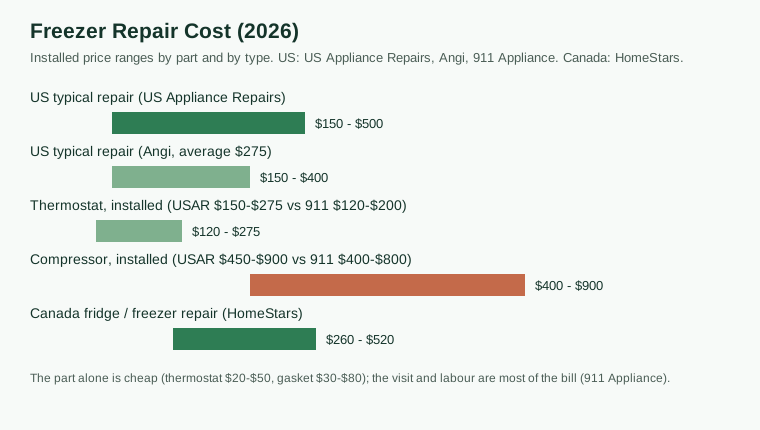
    Most freezer repairs cost $150 to $500 in the US in 2026 (US Appliance Repairs, updated August 5, 2026), with Angi putting a professional repair at $90 to $500 and a second source at $120 to $450. Angi prices the parts: a compressor $200 to $450, condenser coils $100 to $440, an evaporator fan motor $100 to $300, and a thermostat $100 to $440. The by-part tables disagree most on the thermostat and the compressor, and this guide prints both rows and explains why. Chest freezers run $150 to $375 to fix and uprights $175 to $450, and in Canada a fridge or freezer repair runs $260 to $520 (HomeStars). This guide prices repairs by symptom and by part, works the repair-or-replace decision on three labelled examples, and covers the food-safety clock that runs while the freezer is down.

    EnergyBS Editorial Team8 sources45 min read
    Freezer Repair Cost 2026: What Repairs Really Cost, by Part

    Quick Checks

    • 1Budget $150 to $500 for a typical US freezer repair in 2026 (US Appliance Repairs, updated August 5, 2026). Angi puts a professional repair at $90 to $500, a second source at $120 to $450, and HomeGuide at $100 to $400. The four published bands overlap at $150 to $400, which is the range a normal repair should land in.
    • 2The thermostat is the cheapest fix and the most argued-over price. Angi prices it at $100 to $440 as a part, US Appliance Repairs at $150 to $275 installed, and 911 Appliance at $120 to $200 installed on a $20 to $50 part. A thermostat quote above $275 sits outside two of the three rows and needs a second quote.
    • 3The compressor is the only repair that can cost more than the freezer. US Appliance Repairs prices it at $450 to $900 installed, 911 Appliance at $400 to $800, and Angi prices the part alone at $200 to $450. A compressor cannot be repaired, only replaced, and on a freezer over 10 years old it is usually the signal to replace the unit.
    • 4Chest freezers are cheaper to fix than uprights on every source in this guide: $150 to $375 against $175 to $450 (US Appliance Repairs), $120 to $350 against $120 to $450 (911 Appliance). The chest has no evaporator fan and no automatic defrost system, so two of the most common failure points do not exist.
    • 5The food clock runs while the repair clock runs. The FDA says a full freezer holds a safe temperature for about 48 hours with the door closed, 24 hours if half full. Keep the door shut, group food together, and buy dry ice if the repair will take more than a day: 50 pounds keeps an 18-cubic-foot fully stocked freezer cold for two days.
    • 6In Canada, a fridge or freezer repair runs $260 to $520 in the HomeStars national guide, with city pages pricing a visit at $120 to $400. HomeStars publishes no Canadian by-part freezer table, so a Canadian quote should be judged against that band and itemised the same way: part, labour and the visit fee stated separately.
    On this page(14 sections)Show
    1. Freezer Repair Cost 2026: What Repairs Really Cost, by Part
    2. The Short Answer
    3. 1. What a Repair Bill Is Made Of
    4. 2. US Prices by Part
    5. 3. Prices by Problem
    6. 4. Prices by Freezer Type
    7. 5. Prices by Brand
    8. 6. The Compressor Question
    9. 7. Food Safety While the Freezer Is Down
    10. 8. Repair or Replace
    11. 9. What to Check Before You Call
    12. 10. The Quote Checklist
    13. Frequently Asked Questions
    14. Related Reading

    Freezer Repair Cost 2026: What Repairs Really Cost, by Part

    By EnergyBS Editorial Team | November 11, 2026

    The Short Answer

    Short Answer: Most freezer repairs cost $150 to $500 in the US in 2026 (US Appliance Repairs, updated August 5, 2026). Angi puts a professional repair at $90 to $500, a second source at $120 to $450, and HomeGuide at $100 to $400. The four bands overlap at $150 to $400, and a normal repair should land inside that overlap. Angi puts the average repair at $275, with most repairs between $150 and $400. In Canada, a fridge or freezer repair runs $260 to $520 (HomeStars national guide).

    The freezer is the appliance where the repair bill is only half the problem. The other half is the food inside it, and the food has its own clock. The FDA says a full freezer holds a safe temperature for about 48 hours with the door closed, 24 hours if it is half full. A repair that takes three days to schedule is not a $200 problem any more. It is a $200 problem plus whatever was in the freezer, and Section 7 works through the food-safety numbers before the repair-or-replace math in Section 8, because the order matters: protect the food first, then price the part.

    The second thing that makes the freezer different from the other appliances in this series is how wide the published prices run for the same part. The thermostat is $100 to $440 on Angi, $150 to $275 on US Appliance Repairs, and $120 to $200 on 911 Appliance. The compressor is $450 to $900 on one source and $400 to $800 on another, while Angi prices the part alone at $200 to $450. Those are not errors. They are different baskets: part alone, installed job, and installed job on a premium unit. Section 2 prints the rows side by side and explains the gap instead of averaging it away, and Section 6 takes the compressor apart because it is the one repair that can cost more than the freezer it sits in.

    This guide is the next piece in the site's repair-cost series, after the refrigerator, washing machine, dryer, dishwasher, oven and microwave guides. It follows the same method: published prices from US Appliance Repairs, Angi, 911 Appliance, HomeGuide and HomeStars, read firsthand for this article, with the disagreements printed rather than averaged away. Our companion guides cover the rest of the kitchen: the refrigerator repair guide prices the appliance that shares the freezer's sealed system, and the oven and range repair guide covers the machine on the other side of the kitchen. The freezer frost buildup guide works through the frost problem in diagnostic detail when the symptom is ice rather than temperature.

    The repair in six steps:

    1. Name the symptom in plain words before you call: will not freeze at all, runs but will not hold 0 degrees, frost building up, leaking water, loud noises, runs constantly, will not turn on, door will not seal, or temperature swinging up and down. Each symptom maps to a short part list in Section 3, and the published prices in Section 2 cover every part on those lists.
    2. Do the free checks first: outlet live (plug in a lamp), breaker not tripped, thermostat dial set to the coldest test position and back, door closing with a firm click, condenser coils vacuumed, and the paper test on the gasket from Section 9. A freezer with a tripped breaker reads exactly like a dead freezer, and a dirty coil reads like a dying compressor.
    3. Check the food clock before pricing anything. If the freezer is warm and the door has been opened, read Section 7 first: keep the door shut from now on, group the food together, and line up dry ice or a borrowed freezer before the technician arrives. A repair scheduled for tomorrow is a different decision from a repair scheduled for next Tuesday.
    4. Call with the brand, the model number, the type (chest, upright, drawer, built-in, or the freezer compartment of a refrigerator-freezer), the age, and the symptom ready. Ask the diagnostic fee and whether it is credited toward the repair. US Appliance Repairs puts the service call at $75 to $125, HomeGuide at $70 to $130, and Angi at around $150, and all three sources say the fee is often credited if you approve the work.
    5. Approve a diagnosis before you approve a part. On an appliance where a thermostat costs $120 to $200 on one source and a compressor $400 to $800, the sentence you are paying for is the one that names the failed part and the test that proved it. Section 3 names the parts behind each symptom so you can ask which ones were cleared.
    6. Run the age and percentage tests in Section 8 before approving any job over $250. Freezer repairs are cheap enough that repair usually wins on units under 10 years old, and expensive enough to lose on a compressor job past that age, and Section 8 marks the line between the two with three labelled examples.

    1. What a Repair Bill Is Made Of

    A freezer repair invoice has three layers, and the proportions are the useful part.

    The first layer is the visit. US Appliance Repairs puts the service call at $75 to $125. HomeGuide puts an appliance service call at $70 to $130, including travel in the standard service area, diagnostics, and the first hour of labour. Angi puts the diagnostic or trip fee at around $150 and notes that many technicians credit it toward the final repair cost. 911 Appliance Repair charges a $49.95 house call in San Diego and waives it when the repair is approved. Ask how the visit is priced before anyone is booked: flat rate, hourly, or minimum charge changes what a thermostat-sized job should cost, and whether the fee is credited if you approve the repair changes the comparison between two quotes by the full fee.

    The second layer is labour, and the freezer sits in the middle of the series on labour. HomeGuide puts appliance repair labour at $50 to $125 per hour. Angi puts deep freezer installation labour at $50 to $150 per hour with a $50 to $150 minimum service fee, and the same band covers repair visits in most markets. A thermostat or gasket job is usually one visit, one part, and under two hours. A compressor job is longer: the sealed system has to be opened, the refrigerant recovered, the part brazed in, the system evacuated and recharged, and the unit tested. That is why the compressor row in Section 2 is mostly labour and handling, not the part. Emergency, after-hours or weekend work carries extra charges on top of standard rates on Angi, and HomeGuide puts an emergency call-out at $140 to $400. A freezer that still holds temperature is rarely an emergency. A freezer that has lost temperature is, because the food clock in Section 7 does not pause for a standard slot.

    The third layer is the part, and 911 Appliance publishes the only table in this guide that splits part cost from installed cost. Read it as the Rosetta stone for every other table here.

    Freezer part Part alone (911 Appliance) Installed, parts plus labour (911 Appliance)
    Thermostat $20 - $50 $120 - $200
    Defrost timer $30 - $80 $130 - $250
    Defrost heater $30 - $100 $130 - $280
    Evaporator fan motor $50 - $120 $150 - $300
    Door gasket $30 - $80 $120 - $200
    Start relay $20 - $50 $120 - $200
    Compressor $200 - $500 $400 - $800
    Control board $100 - $300 $250 - $500

    The split is the point. A thermostat that costs $20 to $50 as a part becomes a $120 to $200 installed job, because the visit and the diagnosis are most of the money. A door gasket that costs $30 to $80 as a part becomes a $120 to $200 installed job for the same reason. A compressor that costs $200 to $500 as a part becomes a $400 to $800 installed job, because the sealed-system work is most of that money. A quote should say whether it is charging for the part, the visit, or both, because a $150 thermostat line on a quote is a different claim from a $150 thermostat part, and the difference is the visit and the labour you are also paying for.

    Two more charges can appear on a freezer invoice that rarely appear on other appliances. The first is the food-loss charge, which is not on the invoice at all: the value of what thaws while the repair is scheduled. Section 7 prices that risk in hours, not dollars, because the contents vary too much to publish a number. The second is the removal and reinstallation charge on built-in and drawer units, and the delivery and haul-away charges on a replacement. Angi puts delivery at $50 to $150 and haul-away at $50 to $100 on a new deep freezer, and a built-in repair quote that does not mention removal is not finished, because the technician has to take the unit out of its cabinet to open it and put it back when the part is in.

    HomeGuide adds the portfolio view, the same one it publishes across appliances: annual appliance maintenance plans run $200 to $500 depending on how many devices are covered, including cleaning, inspections and tune-ups, with repair discounts in some plans. Against a freezer whose average repair is $275 on Angi data, a plan's freezer share only pencils out when the same plan covers several larger appliances. Price it as a portfolio, never for the freezer alone.


    Advertisement

    2. US Prices by Part

    US Appliance Repairs publishes the base table for this guide, and it prices every common freezer part as an installed job. Read the table in that unit. It answers the question "what should this job cost", and it does not answer "what does this part cost alone". The only parts-alone figures available are the eight 911 Appliance rows in Section 1, and this guide does not build a parts-alone table from figures no source publishes.

    Freezer part What it does US Appliance Repairs, 2026
    Thermostat Senses temperature, tells the compressor when to run $150 - $275
    Door gasket Rubber seal, keeps warm air out and cold air in $150 - $275
    Defrost heater Melts frost off the evaporator coils on a cycle $175 - $325
    Defrost timer Schedules the automatic defrost cycles $175 - $300
    Evaporator fan motor Circulates cold air through the compartment $200 - $375
    Condenser fan motor Cools the condenser and compressor $175 - $350
    Start relay Gives the compressor its starting push each cycle $150 - $250
    Temperature sensor Reads the compartment temperature for the control $175 - $300
    Electronic control board Runs temperature, defrost and compressor timing $300 - $500
    Compressor Pumps refrigerant through the sealed system $450 - $900

    Angi publishes a second parts table, and it prices parts rather than installed jobs. That is why its rows run lower on some parts and wider on others.

    Freezer part Angi, 2026
    Compressor $200 - $450
    Condenser coils $100 - $440
    Condenser fan $200 - $350
    Capillary tube $50 - $150
    Evaporator $150 - $250
    Evaporator fan motor $100 - $300
    Door gasket around $50
    Thermostat $100 - $440
    Start relay $50 - $200

    911 Appliance publishes a third table, with part cost and installed cost side by side, and it runs lower than US Appliance Repairs on nearly every row that overlaps.

    Freezer part US Appliance Repairs, 2026 911 Appliance, installed, 2026
    Thermostat $150 - $275 $120 - $200
    Door gasket $150 - $275 $120 - $200
    Defrost heater $175 - $325 $130 - $280
    Defrost timer $175 - $300 $130 - $250
    Evaporator fan motor $200 - $375 $150 - $300
    Start relay $150 - $250 $120 - $200
    Control board $300 - $500 $250 - $500
    Compressor $450 - $900 $400 - $800

    Three things explain the gaps, and none of them is a mistake. First, the three sources price different baskets. Angi's rows are part prices, US Appliance Repairs' rows are installed jobs, and 911 Appliance's rows are installed jobs from a single San Diego company, which prices its own market rather than a national average. Second, the thermostat row carries the widest spread because the part itself varies most: a mechanical thermostat on a chest freezer is a $20 to $50 part on 911 Appliance's table, while an electronic thermostat and sensor assembly on a frost-free upright is a different part at a different price, and Angi's $100 to $440 row covers both. A thermostat quote without the type of freezer and the type of thermostat cannot be judged against any row. Third, the compressor row carries the widest installed spread because the job varies most: a standard chest freezer compressor is a short sealed-system job, while a built-in upright compressor is a long one with cabinet work on top, and the refrigerant handling is priced into the labour either way.

    The practical rule follows from the table, not from any single source. A thermostat quote under $200 sits inside all three rows. A thermostat quote between $200 and $275 sits inside US Appliance Repairs' row and above 911 Appliance's, so it needs the parts-and-labour split stated before it can be judged. A thermostat quote above $275 sits outside two of the three rows and needs a second quote. The same test works down the table. A defrost heater at $280 is the top of 911 Appliance's row and the middle of the other source's row, so it is a normal price either way. A defrost heater at $400 is outside both rows and needs a second quote. An evaporator fan motor at $300 is the top of one row and the middle of the other, so it is high but not impossible where the visit fee is folded in. The rows are bands, not prices, and a quote that lands inside both bands is a quote that needs no further argument.

    Two rows deserve a note of their own. The door gasket row is the cheapest part in the freezer and the most misleading price in the guide. Angi prices the gasket itself at around $50, 911 Appliance at $30 to $80, and both sources price the installed job at $120 to $200 or $150 to $275. A $200 gasket job is a $50 part with a $150 visit and fitting attached, and that is a fair price for the visit, not a fair price for the gasket. The capillary tube and evaporator rows appear only on Angi, at $50 to $150 and $150 to $250 as parts. Both are sealed-system parts, which means the installed job costs far more than the part, and neither row should be quoted back to a technician as a job price.


    3. Prices by Problem

    Most people do not call a technician with a part name. They call with a symptom. US Appliance Repairs prices the work by symptom, and 911 Appliance prices the same symptoms from its own jobs. The two tables agree closely enough that the symptom is a reliable guide to the bill, and the gap between them is the range a quote should land in.

    Symptom US Appliance Repairs, 2026 911 Appliance, 2026
    Not freezing $200 - $500 $120 - $450
    Frost build-up $175 - $350 $120 - $280
    Leaking water $150 - $300 $120 - $200
    Loud noises $175 - $400 $150 - $800
    Runs constantly $175 - $350 $120 - $300
    Will not turn on $150 - $325 not published
    Door will not seal $150 - $275 $120 - $200
    Temperature fluctuations $175 - $350 not published
    Excessive ice build-up $175 - $350 $120 - $280

    Freezer Not Freezing

    A freezer that runs but will not hold temperature may have a failed thermostat, evaporator fan motor, start relay, compressor, or a sealed-system problem. 911 Appliance calls this the most common freezer problem, and its most common causes are a failed defrost system, a faulty evaporator fan motor, a bad thermostat, or a failed compressor. Minor repairs are relatively affordable, but compressor or refrigerant-system repairs push the cost up. Most homeowners spend between $200 and $500 on US Appliance Repairs' numbers, or $120 to $450 on 911 Appliance's. The spread is the diagnosis: a defrost-system repair costs $130 to $280 on 911 Appliance's table, an evaporator fan motor $150 to $300, and a compressor $400 to $800, and the symptom alone does not say which one it is.

    Frost Build-Up

    Excessive frost usually comes from a damaged door gasket, a failed defrost heater, a faulty defrost timer, or a malfunctioning defrost thermostat. These repairs generally range from $175 to $350 on US Appliance Repairs' numbers, or $120 to $280 on 911 Appliance's. A door gasket replacement costs $120 to $200 on 911 Appliance's table, and a defrost-system repair $130 to $280. Left alone, frost build-up blocks airflow and can stop the freezer from freezing entirely, which turns a $200 gasket job into a $400 compressor job when the compressor runs constantly against blocked coils. The freezer frost buildup guide works through the frost causes in diagnostic detail.

    Water Leaking From the Freezer

    Water leaks commonly occur when the defrost drain clogs or freezes. Less often, damaged water lines or drain components need replacement. Most leak repairs cost between $150 and $300 on US Appliance Repairs' numbers, or $120 to $200 on 911 Appliance's. The drain can often be cleared with warm water and a pipe cleaner, and a cracked drain pan needs replacement. A leak that appears under the freezer is usually the drain, not the sealed system, and it is one of the cheaper symptoms in this table.

    Loud or Unusual Noises

    Grinding, buzzing, rattling, or clicking sounds may indicate problems with the evaporator fan motor, condenser fan motor, compressor, or loose internal components. Repair costs generally range from $175 to $400 on US Appliance Repairs' numbers. 911 Appliance prices the same symptom at $150 to $800, and the top of that band is the compressor: an evaporator fan motor replacement costs $150 to $300, a condenser fan motor $150 to $250, and a compressor $400 to $800. A clicking sound with no compressor hum points at the start relay, which is a $120 to $200 job on 911 Appliance's table and the cheapest of the noise causes. A loud humming or rattling that tracks the compressor points at the expensive end.

    Freezer Runs Constantly

    A freezer that never seems to shut off may have dirty condenser coils, a faulty thermostat, poor door seals, or a sealed-system problem. Repairs usually cost between $175 and $350 on US Appliance Repairs' numbers, or $120 to $300 on 911 Appliance's. Cleaning the condenser coils is free if you do it yourself, and it is the first thing to try: dirty coils are the most common cause of a constantly running freezer, and a vacuum and a soft cloth can end the symptom before any part is priced. A thermostat replacement costs $120 to $200 on 911 Appliance's table, and a door gasket the same. A freezer that runs constantly uses more electricity and will eventually damage the compressor, so this symptom is worth fixing quickly even when the food is still frozen.

    Freezer Will Not Turn On

    If the freezer will not start, the problem may involve the thermostat, start relay, power supply, or electronic control board. Most repairs fall between $150 and $325 on US Appliance Repairs' numbers. Check the outlet and the breaker first: a freezer on a tripped GFCI outlet reads exactly like a dead freezer, and the fix is a reset, not a part. A start relay is the cheapest cause in this group at $120 to $200 installed on 911 Appliance's table. A control board is the most expensive at $250 to $500.

    Door Will Not Seal Properly

    A worn or damaged door gasket allows cold air to escape, forcing the freezer to work harder and increasing energy consumption. Replacing the gasket typically costs $150 to $275 on US Appliance Repairs' numbers, or $120 to $200 on 911 Appliance's. The paper test in Section 9 tells you whether the seal is the problem before you call, and a gasket that only needs cleaning or realignment costs nothing at all.

    Temperature Fluctuations

    If temperatures rise and fall unexpectedly, the thermostat, temperature sensor, evaporator fan, or control board may be at fault. Repairs usually range from $175 to $350 on US Appliance Repairs' numbers. A temperature sensor replacement costs $175 to $300 on the same source's by-part table, and the sensor is the part most often missed in this symptom: it is cheap, it fails quietly, and it reads like a thermostat failure until it is tested.

    Excessive Ice Build-Up

    Heavy ice accumulation often indicates a problem with the automatic defrost system or a leaking door gasket. Depending on the failed component, repairs generally cost between $175 and $350 on US Appliance Repairs' numbers, or $120 to $280 on 911 Appliance's. The defrost heater, defrost timer and defrost thermostat work as a set, and a quote that names one should say whether the other two were tested, because the three fail in the same way and the second failure follows the first.


    4. Prices by Freezer Type

    The type of freezer you own affects both labour time and replacement part costs, and the chest-versus-upright split is the largest type effect in this guide.

    Freezer type US Appliance Repairs, 2026 911 Appliance, 2026
    Chest freezer $150 - $375 $120 - $350
    Upright freezer $175 - $450 $120 - $450
    Refrigerator freezer compartment not published $150 - $450
    Commercial freezer not published $200 - $800
    Built-in / drawer not published not published

    Chest Freezers

    Chest freezers have a simpler design with fewer moving parts, making many repairs less expensive. Their insulation also allows them to stay cold longer during power outages. Average repair cost runs $150 to $375 on US Appliance Repairs' numbers, or $120 to $350 on 911 Appliance's. Common repairs are thermostat replacement, start relay replacement, compressor replacement, and door gasket replacement. A chest freezer has no evaporator fan and no defrost heater, so the two parts that fail most often on an upright do not exist on a chest. That is the whole reason the chest band runs lower: fewer parts, fewer failures, and easier access to the parts that remain.

    Upright Freezers

    Upright freezers are popular because they provide convenient shelving and easier organization. Most include automatic defrost systems and electronic controls, which can increase repair complexity. Average repair cost runs $175 to $450 on US Appliance Repairs' numbers, or $120 to $450 on 911 Appliance's. Common repairs are defrost heater replacement, evaporator fan replacement, thermostat replacement, door gasket replacement, and electronic control board replacement. The defrost system and the fan are the price of the shelving: they are the two parts a chest freezer does not have, and they are the two parts that generate most upright repair calls.

    Refrigerator Freezer Compartments

    The freezer half of a refrigerator-freezer costs $150 to $450 to repair on 911 Appliance's table, with not freezing, ice maker issues, and defrost-cycle faults as the common problems. The bill overlaps the upright band because the parts are the same, and the diagnosis is harder because the fault can sit in the refrigerator half: a refrigerator that is not cooling can read as a freezer problem, and the refrigerator warm, freezer cold guide works through that split. The refrigerator repair guide prices the shared sealed system in full.

    Commercial and Built-In Freezers

    A commercial freezer costs $200 to $800 to repair on 911 Appliance's table, with compressor, fan, control board, and door seals as the common faults. The band runs higher because the parts are larger, the labour is longer, and the unit cannot wait: a commercial freezer holds stock, not leftovers. Built-in and drawer freezers have no published repair band in any source in this guide, which is itself a useful fact: the quote is the price, and it should be compared against the upright band plus the removal and reinstallation line, because the cabinet work is what the band does not include.

    What a New Freezer Costs

    The replacement price is the other side of every repair decision, so it belongs in this section rather than buried in Section 8. Angi puts a new deep freezer at an average of $675, with most homeowners paying $450 to $1,340 and the range running $220 to $2,000. By type, a chest freezer costs $300 to $1,200, an upright $400 to $1,600, and a compact $200 to $500. By size, a 3-to-5-cubic-foot unit costs $150 to $500, a 7-to-9-cubic-foot unit $350 to $700, and a 16-plus-cubic-foot unit $1,000 and up. 911 Appliance prices a new chest freezer at $200 to $800 and a new upright at $400 to $1,200. HomeGuide puts a new chest or deep freezer at $350 to $1,100 for the unit alone. Delivery runs $50 to $150 and haul-away $50 to $100 on Angi's numbers, and those two lines belong in the replacement total when the 50 percent test in Section 8 is run.


    5. Prices by Brand

    Repair costs vary somewhat depending on the manufacturer, replacement part availability, and appliance design. US Appliance Repairs publishes the only by-brand table in this guide, and it is the narrowest table here: the brand moves the bill by about $50 to $100, while the part moves it by $300 to $600.

    Brand Typical repair cost (US Appliance Repairs, 2026)
    Whirlpool $175 - $400
    Frigidaire $175 - $400
    GE $175 - $400
    Kenmore $175 - $400
    Maytag $180 - $425
    LG $200 - $450
    Samsung $200 - $450
    Bosch $225 - $500

    Whirlpool, GE, Frigidaire, and Kenmore

    These brands generally have readily available replacement parts, helping keep repair costs moderate. Common repairs include thermostat replacement, fan motors, and defrost system components. Parts availability is the reason the band sits lowest: a thermostat for a Whirlpool chest freezer is a stocked part in most markets, and a stocked part is a same-day repair.

    LG and Samsung

    Many LG and Samsung freezers include advanced electronic controls and smart features. While these technologies improve convenience, replacement parts can be more expensive, resulting in repair costs ranging from $200 to $450. The control board is where the brand shows up: a board for a smart upright costs more than a board for a mechanical chest freezer, and the board is the part where the brand sets the price.

    Bosch

    Bosch freezers are known for premium construction and energy efficiency. However, specialized components and higher labour requirements can increase repair costs compared to standard models, with repairs ranging from $225 to $500. Premium and built-in brands carry pricier OEM parts on every source in this guide, and a Bosch quote should be compared against the Bosch row, not the Whirlpool row, because the parts are not interchangeable.

    Maytag

    Maytag sits between the two groups at $180 to $425. The difference from the Whirlpool group is small enough that a Maytag quote inside the Whirlpool band is a normal price, and a Maytag quote at the top of its own band needs the part named before it can be judged.


    6. The Compressor Question

    The compressor is the heart of the refrigeration system and also one of the most expensive components to replace. It is the only repair in this guide where the published rows disagree by enough to change the decision, so it gets its own section.

    Source Compressor price
    US Appliance Repairs, installed, 2026 $450 - $900
    911 Appliance, installed, 2026 $400 - $800
    Angi, deep freezer repair, parts and labour $200 - $700
    Angi, parts guide, part alone $200 - $450
    911 Appliance, part alone $200 - $500

    Five rows, one part, and a spread from $200 to $900. The spread is not a disagreement about the part. It is a disagreement about what the row counts. Angi's $200 to $450 row is the part alone. Angi's $200 to $700 row is parts and labour on a deep freezer. 911 Appliance's $400 to $800 row is the installed job from one San Diego company. US Appliance Repairs' $450 to $900 row is the installed job as a national figure, and it runs highest because it includes the sealed-system work at full labour. The part is $200 to $500. The job is $400 to $900. A quote that says "compressor, $600" without saying which of those two it is cannot be judged against any row.

    Two facts about compressors matter more than the price. The first is that a freezer compressor cannot be repaired, only replaced. 911 Appliance states it plainly, and every other source in this guide agrees by omission: there is no compressor repair row anywhere, only replacement rows. A quote that offers to repair a compressor is a quote that has not diagnosed the fault. The second is that compressor work is sealed-system work, which means the refrigerant has to be recovered, the part brazed in, the system evacuated and recharged, and the unit tested. That work needs EPA Section 608 certification in the US, which is why Angi's hiring guide tells readers to verify it before booking. A technician without the certification cannot legally do the job, and a quote from one is not a quote.

    The compressor is also the part where the age test bites hardest. A $600 compressor job on a 4-year-old upright with a $800 replacement price is 75 percent of a new unit, which fails the 50 percent test on its face, and yet it can still be the right repair: the unit has 10 years of life left, the cabinet and liner are sound, and the replacement would cost $800 plus $50 to $150 delivery and $50 to $100 haul-away. A $600 compressor job on a 12-year-old chest freezer with a $500 replacement price is 120 percent of a new unit, and it is the wrong repair on every reading. Section 8 works both cases with the arithmetic shown, because the compressor is the repair where the percentage test and the age test have to be run together, not separately.

    Three signs point at the compressor before any test is run: unusual noises such as thumping, the freezer running constantly without reaching temperature, or moisture on the outside of the unit. All three appear on Angi's parts guide, and all three are worth naming on the call, because a technician who hears "thumping and running constantly" arrives with a different diagnosis in mind than one who hears "not freezing". The diagnosis still has to be made on site, and a compressor quote that names no test is a guess with a $400 to $900 price tag.


    7. Food Safety While the Freezer Is Down

    A broken freezer is two problems at once: the repair, and the food. The food problem has its own numbers, published by the FDA, and they are the numbers that decide how fast the repair has to happen.

    The FDA's rule is short. Keep appliance thermometers in the refrigerator and the freezer, with the freezer at or below 0 degrees F and the refrigerator at or below 40 degrees F. Keep the refrigerator and freezer doors closed as much as possible to maintain the cold temperature. A refrigerator will keep food cold for about 4 hours if it is unopened. A full freezer will keep the temperature for approximately 48 hours, 24 hours if it is half full, if the door remains closed. Fifty pounds of dry ice should keep an 18-cubic-foot, fully stocked freezer cold for two days.

    Situation Safe hold time (FDA)
    Refrigerator, door unopened About 4 hours
    Full freezer, door closed About 48 hours
    Half-full freezer, door closed About 24 hours
    Full 18 cu ft freezer, 50 lb dry ice About 2 days

    The hold time is the reason the door stays shut. Every opening trades hours for a look inside, and a freezer that is opened to check whether the food is still frozen is a freezer that thaws faster. Group food together in the freezer, which helps the food stay cold longer, and freeze containers of water ahead of time for ice to help keep food cold. The FDA's preparation list is written for power outages, but it reads exactly the same for a broken freezer: thermometers in both boxes, frozen water containers ready, coolers on hand, and a local source for dry ice and block ice known before it is needed.

    When the power or the repair is done, the check is temperature, not smell. If an appliance thermometer was kept in the freezer, check the temperature when the power comes back on. If the freezer thermometer reads 40 degrees F or below, the food is safe and may be refrozen. If no thermometer was kept, check each package: food that still contains ice crystals or is 40 degrees F or below is safe to refreeze or cook. Discard any refrigerated perishable food, such as meat, poultry, seafood, milk, eggs, or leftovers, that has been at temperatures above 40 degrees F for 4 hours or more. Perishable food at 45 degrees F or below, measured with a food thermometer, should be safe, but should be cooked and eaten as soon as possible. Perishable food held at room temperature for 2 hours or more, or 1 hour if outdoor temperatures are above 90 degrees F, should be discarded.

    Three practical consequences follow. First, the repair schedule is a food decision, not a calendar decision: a technician who can come tomorrow is worth more than a cheaper technician who can come next week, because the food clock does not pause for a better quote. Second, a chest freezer buys more time than an upright in the same failure, because its insulation holds temperature longer and its cold air stays at the bottom instead of spilling out when the door opens. Third, the dry ice number is worth writing down before it is needed: 50 pounds for an 18-cubic-foot fully stocked freezer, for two days, from a local supplier whose address you already know. A freezer that fails on a Friday night is not the time to search for one.

    One more line from the FDA belongs here because it is the line most people get wrong. You cannot rely on appearance or odor to judge whether frozen food is safe. Ice crystals and a thermometer reading are the tests. Food that looks fine and smells fine after four hours above 40 degrees F is still food to discard, and food that looks soft but still holds ice crystals is still food to refreeze. When in doubt, the FDA's rule is the one to follow, and the rule is written in degrees, not in guesses.


    8. Repair or Replace

    In most situations, repairing a freezer is the more cost-effective choice. Freezers are built to last for many years, and common repairs, such as replacing a thermostat, door gasket, evaporator fan motor, or defrost timer, are often much less expensive than purchasing a new appliance. The decision still needs a test, not a feeling, and this guide uses the two tests every source in it agrees on.

    The first test is the 50 percent test. If the repair costs less than 50 percent of the price of a comparable replacement, repair it. If it costs more than 50 percent and the unit is over 10 years old, replace it. Angi, US Appliance Repairs, 911 Appliance and HomeGuide all publish the same rule in the same words, and the agreement is the reason it is the test to use. Run it on the full replacement total, not the sticker price: the new unit plus $50 to $150 delivery and $50 to $100 haul-away on Angi's numbers, against the repair quote including the visit fee.

    The second test is the age test. Repairing is usually worthwhile if the freezer is under 10 years old, the repair costs less than half the price of a comparable replacement, the appliance has required few previous repairs, the cabinet and interior liner remain in good condition, and replacement parts are readily available. Replacing is usually the better investment if the compressor has failed, the sealed refrigeration system requires major repairs, the repair estimate exceeds 50 percent of a comparable new freezer, the freezer is more than 15 years old, or the appliance has had multiple costly repairs in recent years. Both lists come from US Appliance Repairs, and they are worth reading as a pair: the percentage test answers the money question, and the age test answers the remaining-life question, and a repair that passes one and fails the other is the case Section 8's examples are for.

    Lifespan sets the age test's denominator. HomeGuide puts most freezers at 12 to 20 years. US Appliance Repairs puts the average freezer lifespan at 12 to 16 years. 911 Appliance splits it by type: a chest freezer lasts 12 to 20 years, an upright 10 to 15 years, and a refrigerator freezer compartment 10 to 15 years. Angi puts most deep freezers at 10 to 20 years with proper care. A 6-year-old chest freezer is early in its life on every source. A 12-year-old upright is past the middle on every source. The type matters as much as the years: a 12-year-old chest freezer has years left, and a 12-year-old upright with a failed compressor does not.

    Three Labelled Examples

    The examples below are hypothetical, worked with the published prices in this guide and the arithmetic shown, so the method can be checked against any real quote.

    Example 1: repair, clearly. A 4-year-old upright freezer stops holding temperature, and the diagnosis is a failed thermostat. The repair is $150 to $275 on US Appliance Repairs' table, or $120 to $200 on 911 Appliance's. Take the midpoint of the US Appliance Repairs row, $212, and a comparable new upright at $800, the midpoint of Angi's $400 to $1,600 band. The repair is 26 percent of the replacement price, and the unit is 4 years old with 6 to 11 years of life left on 911 Appliance's 10-to-15-year upright lifespan. Both tests pass. Repair it.

    Example 2: replace, clearly. A 12-year-old chest freezer needs a compressor. The repair is $450 to $900 on US Appliance Repairs' table, or $400 to $800 on 911 Appliance's. Take the midpoint of the 911 Appliance row, $600, and a comparable new chest freezer at $700, the midpoint of Angi's $300 to $1,200 band. The repair is 86 percent of the replacement price, and the unit is 12 years old with 0 to 8 years left on a 12-to-20-year chest lifespan. Both tests fail. Replace it, and the $50 to $150 delivery and $50 to $100 haul-away belong in the replacement total, which still leaves the repair at more than half the all-in cost of a new unit.

    Example 3: on the line. A 7-year-old upright freezer needs a defrost heater. The repair is $175 to $325 on US Appliance Repairs' table, or $130 to $280 on 911 Appliance's. Take the midpoint of the US Appliance Repairs row, $250, and a comparable new upright at $800. The repair is 31 percent of the replacement price, so the percentage test passes, and the unit is 7 years old with 3 to 8 years left, so the age test passes too. Repair it, but the tiebreak is the fault count: if this is the second costly repair in two years, the remaining-life arithmetic changes, because a unit that needs a $250 repair every two years costs $125 a year in repairs against a new unit that costs $800 once and runs for 10 to 15 years. One repair is a repair. Two in two years is a pattern, and the pattern is the tiebreak.

    The Running-Cost Question

    A new freezer also costs less to run, and Angi publishes the numbers: most models use between 200 and 600 kilowatt-hours per year, costing $30 to $90 annually depending on the local electricity rate, and ENERGY STAR-rated freezers can cut usage by 10 to 25 percent. On a $60-a-year running cost, a 20 percent saving is $12 a year, which is $120 over 10 years. That saving does not decide a repair on its own, but it belongs in the replacement column of the comparison, next to the delivery and haul-away lines. A freezer that runs constantly because of a failing part costs more than the published band to run, and the extra running cost is a second reason to fix the fault quickly rather than live with it.


    Advertisement

    9. What to Check Before You Call

    A technician visit starts at $70 to $150 on the published bands, so the free checks are worth ten minutes. They do not replace a diagnosis. They stop you paying for one when the fault is not a part at all.

    Outlet and breaker. Plug a lamp into the freezer's outlet. If the lamp does not light, the outlet is dead. Check the breaker, and check whether the outlet is a GFCI that has tripped: a freezer on a tripped GFCI reads exactly like a dead freezer, and the fix is a reset. If the lamp lights, the power is fine and the fault is inside the unit.

    Thermostat setting. Turn the thermostat dial to the coldest position, wait an hour, and check whether the compressor starts. Then set it back to the normal position. A dial that was knocked to its warmest setting during cleaning reads like a failed thermostat, and the fix is a turn of the dial.

    Door seal, paper test. Shut a piece of paper in the freezer door and try to pull it out. If the paper comes out easily, the seal is weak. Angi's parts guide describes the same test, and it works on chest lids as well as upright doors. Clean the gasket edge if there is mould, realign the gasket if it seems out of place, and replace it only if it is damaged. A gasket that only needs cleaning costs nothing.

    Condenser coils. Dirty condenser coils are the most common cause of a freezer running constantly, and cleaning them is free. Turn off the freezer at the power source, vacuum the coils with an attachment, and wipe them with a soft cloth. Angi's parts guide gives the same instruction, and 911 Appliance lists coil cleaning as the first money-saving step in its guide. If the freezer stops running constantly after the coils are cleaned, the symptom is fixed and the call is cancelled.

    Listen for the click. A start relay that has failed makes a clicking sound from the back of the freezer, with no compressor hum following it. That click is the cheapest diagnosis in this guide: the start relay is a $120 to $200 installed job on 911 Appliance's table, and naming the click on the call tells the technician which part to bring.

    Frost pattern. Frost on one part of the evaporator coils and not the rest points at the sealed system, not the defrost system. Frost everywhere, thick and even, points at the door gasket or the defrost system. The pattern is worth describing on the call, because it separates a $150 gasket job from a $600 sealed-system job before anyone is booked.

    The Owner Layer and the Pro Layer

    The owner layer is short: cleaning, checking the outlet and breaker, checking the thermostat setting, cleaning the condenser coils, testing the door gasket with paper, and clearing a clogged defrost drain with warm water. Angi draws the line in the same place: condenser coils and door gaskets can be cleaned by the owner, and replacing electrical components like the evaporator fan motor and thermostat needs a pro. Sealed-system work needs an EPA-certified technician, and no part of it is owner work. The line is not about skill. It is about the refrigerant, which is a regulated substance in a sealed system, and about the diagnosis, which is the part you are paying for. A thermostat replaced on a guess is a $200 guess. A thermostat replaced after a test is a repair.


    10. The Quote Checklist

    A freezer quote is a short document, and twelve lines cover it. Use this list on the call, before the technician is booked, and keep it beside the quote when it arrives.

    • The symptom written down in your words, and the part the technician believes has failed
    • The test that cleared the other parts behind the same symptom, named on the quote
    • The diagnostic or service call fee, and whether it is credited if you approve the repair
    • The part price and the labour price stated separately, not as one number
    • Whether the sealed system is involved, on any compressor, evaporator or capillary tube quote
    • The EPA Section 608 certification, on any sealed-system job
    • Whether the part is OEM or aftermarket, and what the warranty on each is
    • The warranty remaining on the freezer, checked before the repair is booked
    • The total against the 50 percent test, with the replacement price of a comparable unit written beside it, including delivery and haul-away
    • The age of the unit and the fault count, for the tiebreak in Section 8
    • The food plan while the repair is scheduled, with dry ice or a borrowed freezer lined up if the wait runs past a day
    • The old part returned or shown to you, on any repair over $250

    Red flags: a compressor quoted for a will-not-freeze symptom with no thermostat, defrost system or fan test recorded; a thermostat quoted above $275 with no parts-and-labour split; a control board quoted with no sensor or thermostat test; a defrost heater quoted a second time on the same unit with no timer or thermostat test named; a built-in quote with no removal line; emergency pricing on a freezer that still holds temperature, when the food is safe for 48 hours with the door closed; and a compressor quote on a freezer over 10 years old with no percentage test shown.


    Frequently Asked Questions

    How much does it cost to repair a freezer in 2026? Most US repairs cost $150 to $500 (US Appliance Repairs, updated August 5, 2026). Angi puts a professional repair at $90 to $500 with an average of $275, a second source puts most repairs at $120 to $450, and HomeGuide puts freezer repair at $100 to $400 on average. The four bands overlap at $150 to $400, and a normal repair should land inside that overlap. In Canada, a fridge or freezer repair runs $260 to $520 in the HomeStars national guide.

    How much does freezer compressor replacement cost? US Appliance Repairs prices it at $450 to $900 installed, and 911 Appliance at $400 to $800. The part alone is $200 to $450 on Angi and $200 to $500 on 911 Appliance, so the gap between the part rows and the installed rows is the sealed-system labour. A compressor cannot be repaired, only replaced, and on a freezer over 10 years old the replacement of the unit is usually the better investment.

    How much does a freezer thermostat replacement cost? US Appliance Repairs prices it at $150 to $275 installed, 911 Appliance at $120 to $200 installed on a $20 to $50 part, and Angi prices the part at $100 to $440. The Angi row is the widest because it covers both mechanical thermostats on chest freezers and electronic thermostat assemblies on frost-free uprights. A thermostat quote above $275 sits outside two of the three rows and needs a second quote.

    How much does it cost to fix a freezer that is not freezing? $200 to $500 on US Appliance Repairs' numbers, or $120 to $450 on 911 Appliance's. The cost depends on the cause: a defrost-system repair costs $130 to $280, an evaporator fan motor replacement $150 to $300, a thermostat $120 to $200, and a compressor $400 to $800, all on 911 Appliance's table. A technician can diagnose the exact cause during the service call, and the quote should name the part and the test that proved it.

    Is it worth repairing a freezer? Run the 50 percent test and the age test together. Repair when the freezer is under 10 years old and the estimate is under half the cost of a comparable replacement. Replace a unit over 10 years old with a failed compressor, replace any unit where the repair costs more than half of a new one, and replace a unit that has needed two costly repairs in two years. A chest freezer at $200 to $800 new and an upright at $400 to $1,200 new set the replacement side of the test on 911 Appliance's numbers.

    How long does food stay safe in a broken freezer? The FDA says a full freezer holds a safe temperature for about 48 hours with the door closed, 24 hours if it is half full. Keep the door shut, group food together, and buy dry ice if the repair will take more than a day: 50 pounds keeps an 18-cubic-foot fully stocked freezer cold for two days. Food that still has ice crystals or reads 40 degrees F or below on a thermometer can be refrozen.

    How much does freezer repair cost in Canada? $260 to $520 for a fridge or freezer repair in the HomeStars national guide, inside an appliance repair average of $220 with most homeowners spending $135 to $300. The city cost pages price a fridge or freezer visit at $120 to $400, minor repairs at $120 to $200, and compressor, motor or major part replacement at $200 to $350. HomeStars publishes no Canadian by-part freezer table, so a Canadian quote should be judged against the $260 to $520 band and itemised the same way: part, labour and the visit fee stated separately.

    How long do freezers last? A chest freezer lasts 12 to 20 years and an upright 10 to 15 years on 911 Appliance's table. HomeGuide puts most freezers at 12 to 20 years, US Appliance Repairs at 12 to 16 years on average, and Angi at 10 to 20 years with proper care. Chest freezers last longer because they have fewer components and the cold air stays at the bottom naturally. Regular maintenance, including cleaning the condenser coils and checking the door gasket, extends the life on every source in this guide.

    Common Questions

    What should I check first before using this appliances advice?

    Start with the numbers that apply to your home: climate, utility rate, equipment age, contractor quote, and local program rules. Most freezer repairs cost $150 to $500 in the US in 2026 (US Appliance Repairs, updated August 5, 2026). Angi puts a professional repair at $90 to $500, a second source at $120 to $450, and HomeGuide at $100 to $400. The four bands overlap at $150 to $400, and a normal repair...

    How should I verify rebates, tax credits, rates, or savings before spending money?

    Treat program amounts, utility rates, and tax rules as date-sensitive. Check the named government, utility, or manufacturer source before you sign a contract, and keep screenshots or PDFs of eligibility rules for your records.

    When should I involve a licensed professional instead of doing this myself?

    Bring in a licensed electrician, HVAC technician, or other qualified professional for panel work, refrigerant handling, combustion equipment, structural changes, or anything that needs a permit or inspection. A guide can help you prepare questions and compare options, but it does not replace licensed work where codes or safety are involved.

    How should I compare contractor quotes for this kind of work?

    Ask each contractor to separate equipment, labor, electrical work, permits, and rebate assumptions on the quote, and to name the exact model numbers being priced. Comparing itemized quotes on the same scope is more useful than comparing headline prices, and it shows which savings claims depend on incentives you have not yet confirmed.

    What is the next useful step after reading this?

    Compare this with Refrigerator Repair Cost 2026: What Repairs Really Cost, by Part so you can check the cost, rebate, installation, or operating-risk angle before making a decision.

    What to Read Next

    Refrigerator Repair Cost 2026: What Repairs Really Cost, by PartUse this next to compare the cost, incentive, installation, or operating-risk angle before you make a home energy decision.

    Sources and Verification

    Editorial Review

    EnergyBS Editorial Team

    EnergyBS publishes practical homeowner guides. Important program, product, and cost claims should be checked against the linked source and local project documents before you commit to work.

    Read our editorial policy and methodology, or report an error.

    Important: Educational Purposes OnlyThe guides, tools, cost estimates, and ROI calculators provided on EnergyBS.com are for informational and educational purposes only. They do not constitute certified financial, tax, or professional engineering advice. Energy costs, government rebates, and installation fees vary significantly by location and are subject to change. Always consult with certified local professionals before undertaking home energy projects or making financial commitments.